Rainy afternoon? Hand over a garden that still needs its color.
These 30 garden coloring pages cover the whole yard: a bee at a sunflower, a snail crossing a wet leaf, kids planting seeds, a wheelbarrow piled with pumpkins, and one owl keeping watch after dark. Every sheet is free to print.
The set runs from thick, chunky outlines a toddler can manage to fine-lined scenes that will keep a grown-up busy for an hour. Under each picture you will find what is actually drawn on it, a color idea, and who it suits, so you can choose before you print.
Cat in the Flower Garden
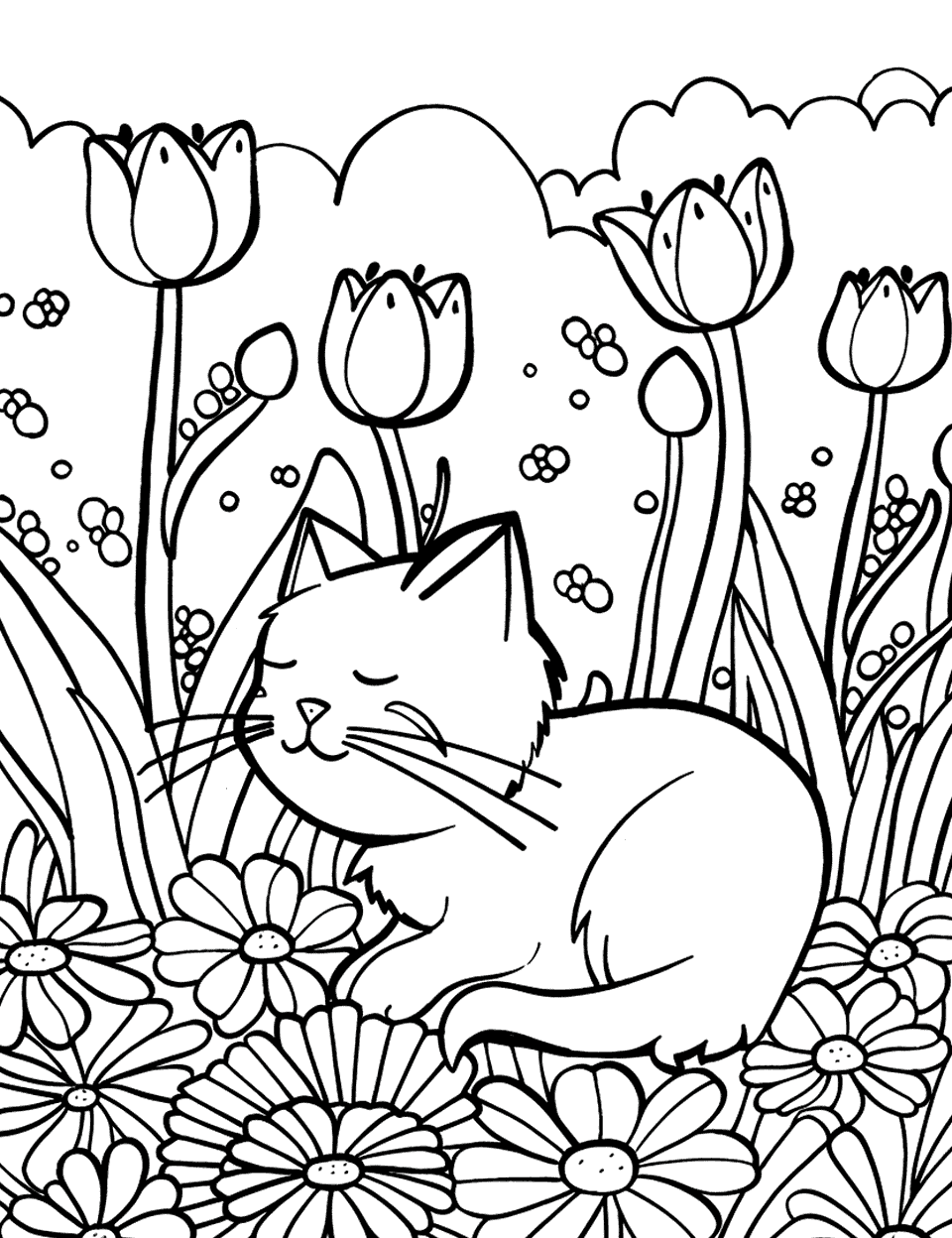
A round-faced cat naps with its eyes shut in front of a row of tall tulips, with wide daisies filling the front of the sheet. The fluffy cat is drawn with big open shapes, so it forgives a heavy hand. Try a warm ginger coat against cool purple tulips so the cat stands out from the flower bed. Simple clouds sit along the top for anyone who still has energy after the petals.
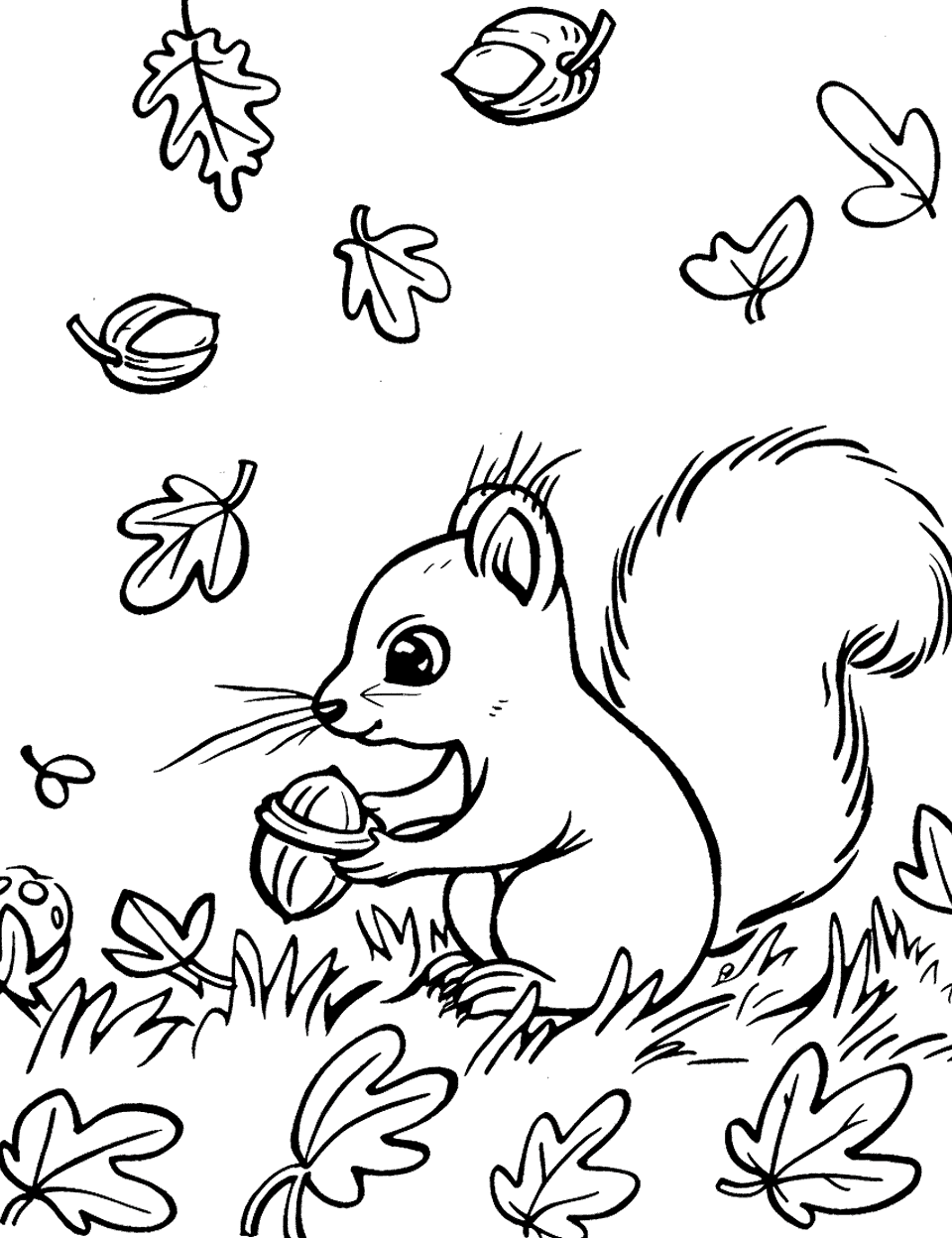
A bushy-tailed squirrel sits in the grass gripping an acorn in both front paws while leaves drift down around it. The falling leaves make this a natural pick for a fall-themed garden display. Browns and rusty oranges carry most of the page, so let kids blend two or three shades into that tail alone. A small mushroom hides near the bottom left for anyone who likes spotting extras.
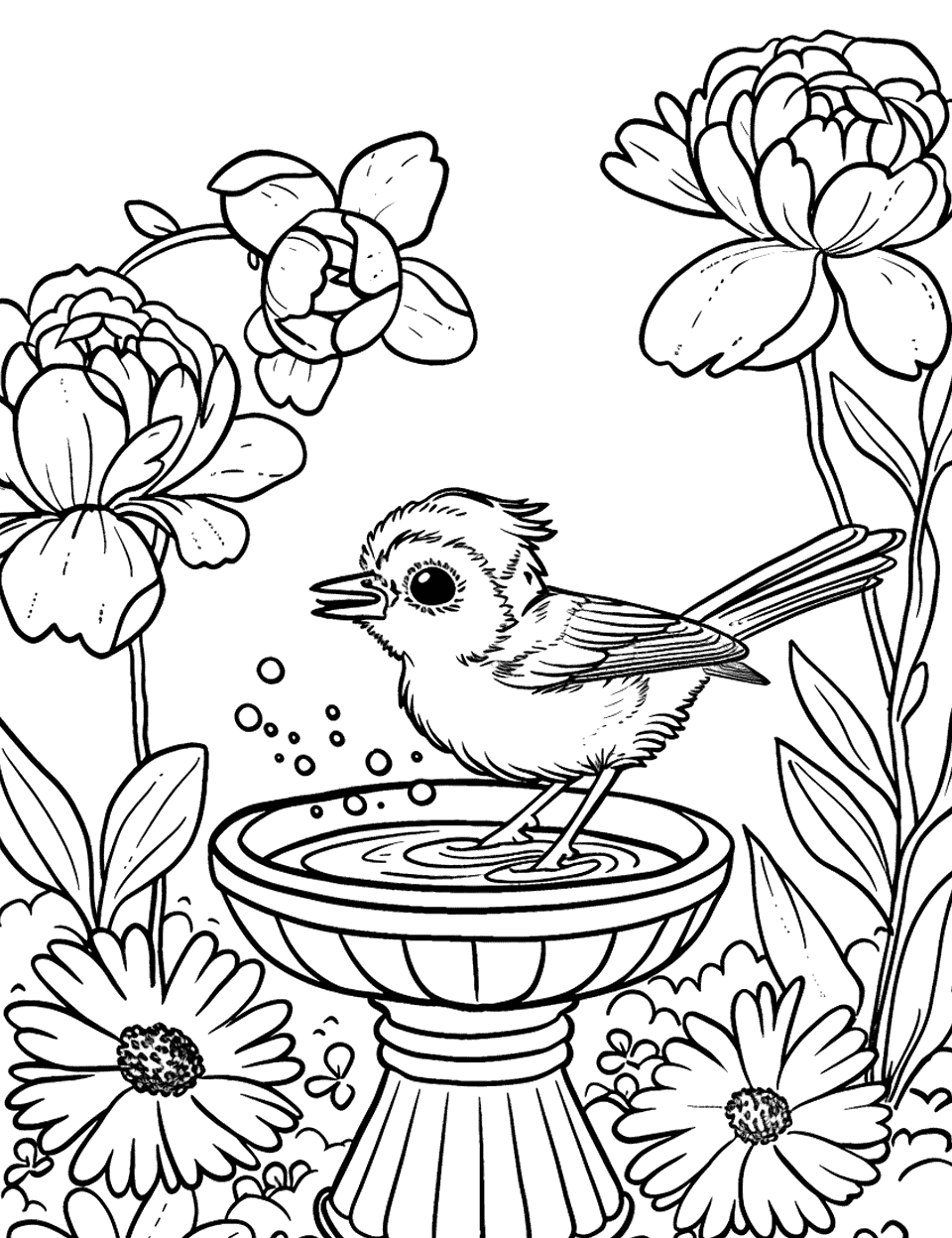
One small songbird stands in the bowl of a stone bird bath with its beak open and bubbles rising in the water. Peonies and daisies crowd in from both sides, so there is plenty left to color once the bird is finished. Gray or sandy stone tones on the bath make the flowers around it look brighter. The lines here are medium weight, a comfortable middle ground for early grade schoolers.
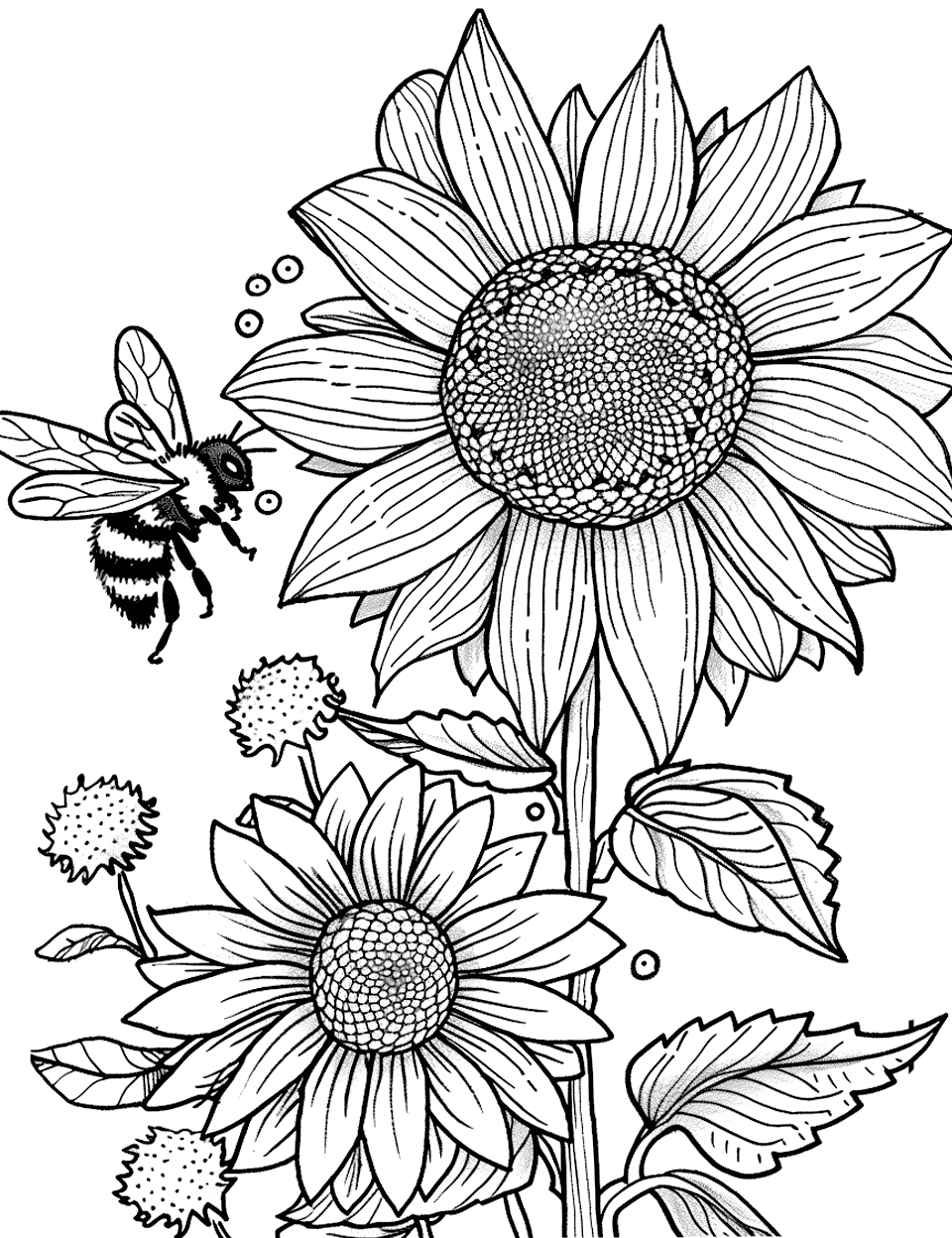
A striped bee hovers with its wings spread beside a sunflower in full bloom, its center drawn as hundreds of tiny circles. Watch the bee collecting pollen as it works the flower center. That dotted center takes patience, so hand it to an older child or keep it yourself and use a fine-tip pen. Yellow petals are the obvious call, though red and rust sunflowers exist too, so nobody is wrong here.
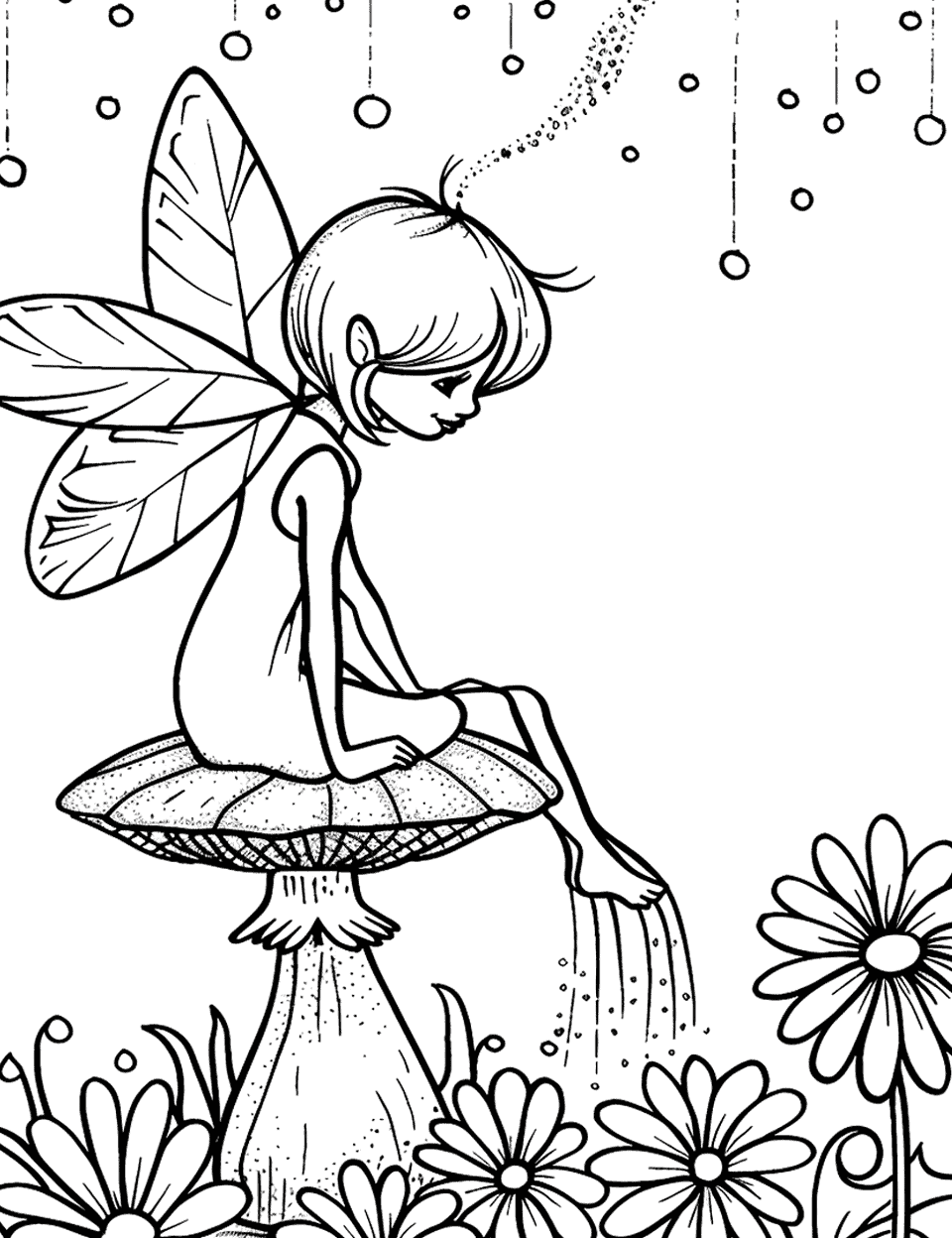
A winged fairy sits on a mushroom cap with her legs crossed and one hand trailing sparkles down toward the daisies below. Dots and short dashes fall from the top of the sheet like light rain. The thin wing lines reward colored pencils more than fat crayons. Pastels on the wings with a deeper shade on the mushroom keep her from disappearing into the background.
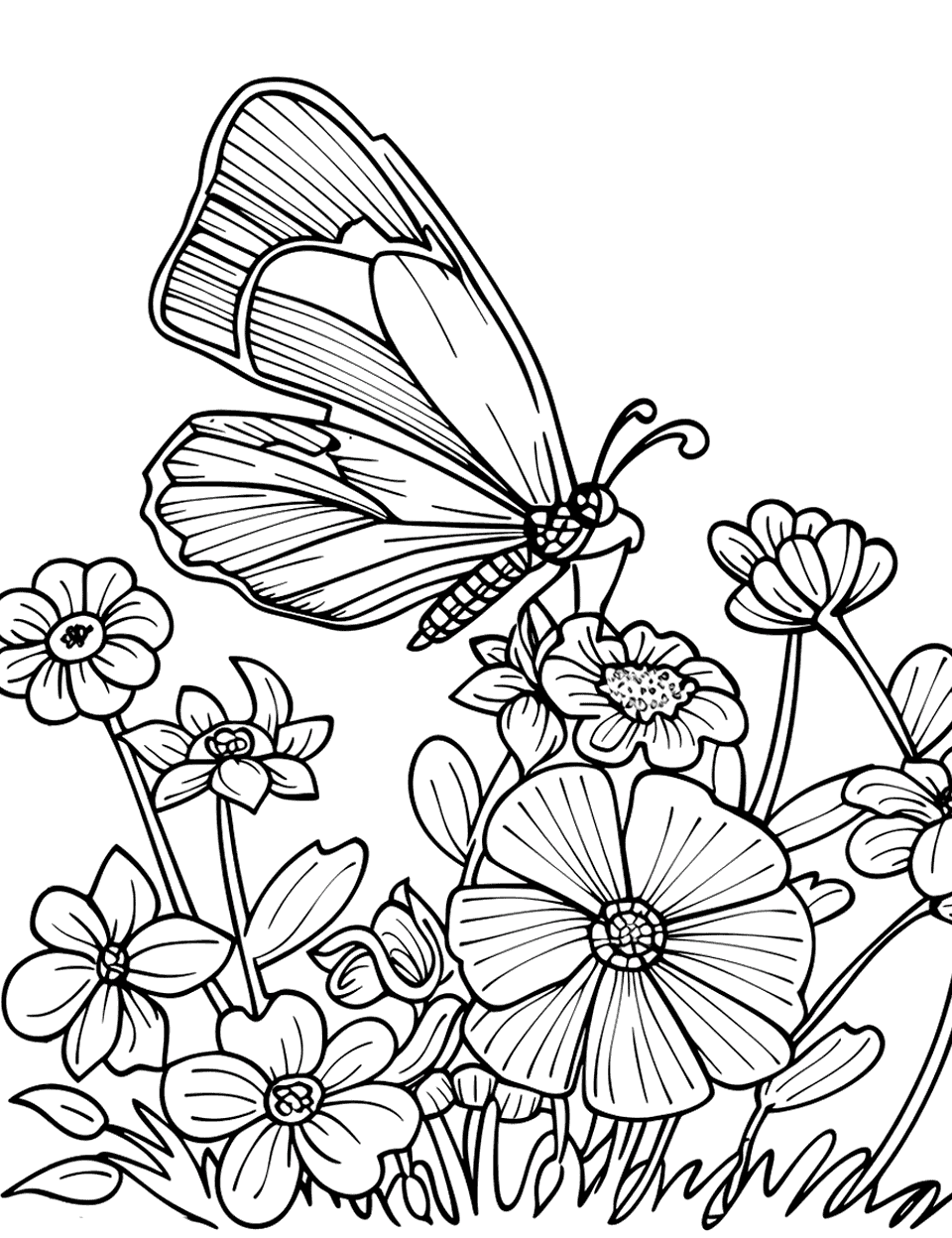
A butterfly with large wings rests on an open bloom, its wings ruled with long thin stripes. Flowers of several shapes fill the rest of the sheet, from round poppy-like heads to small five-petal blossoms. Every wing stripe can take a different color, which turns one insect into a long, calm project. Grass lines run along the bottom edge for anyone who finishes the wings early.
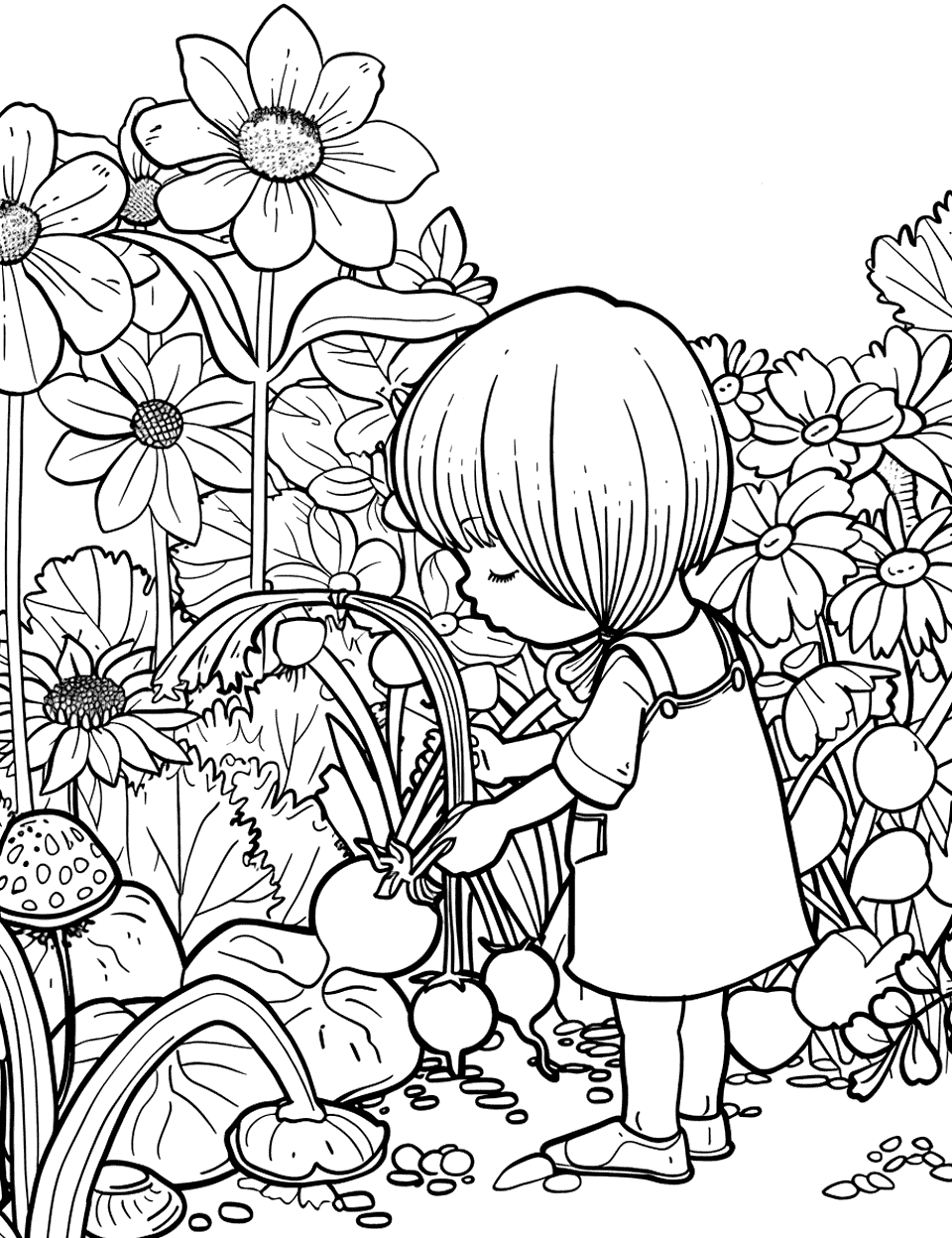
A girl in a pinafore leans down to pull fresh vegetables from the soil, with round roots and loose leaves scattered at her feet. Tall daisies and sunflowers lean in over her from both sides. There is a lot of small leafwork here, so it holds attention longer than a single-subject sheet. Reds and purples on the roots against green tops give the page an easy center.
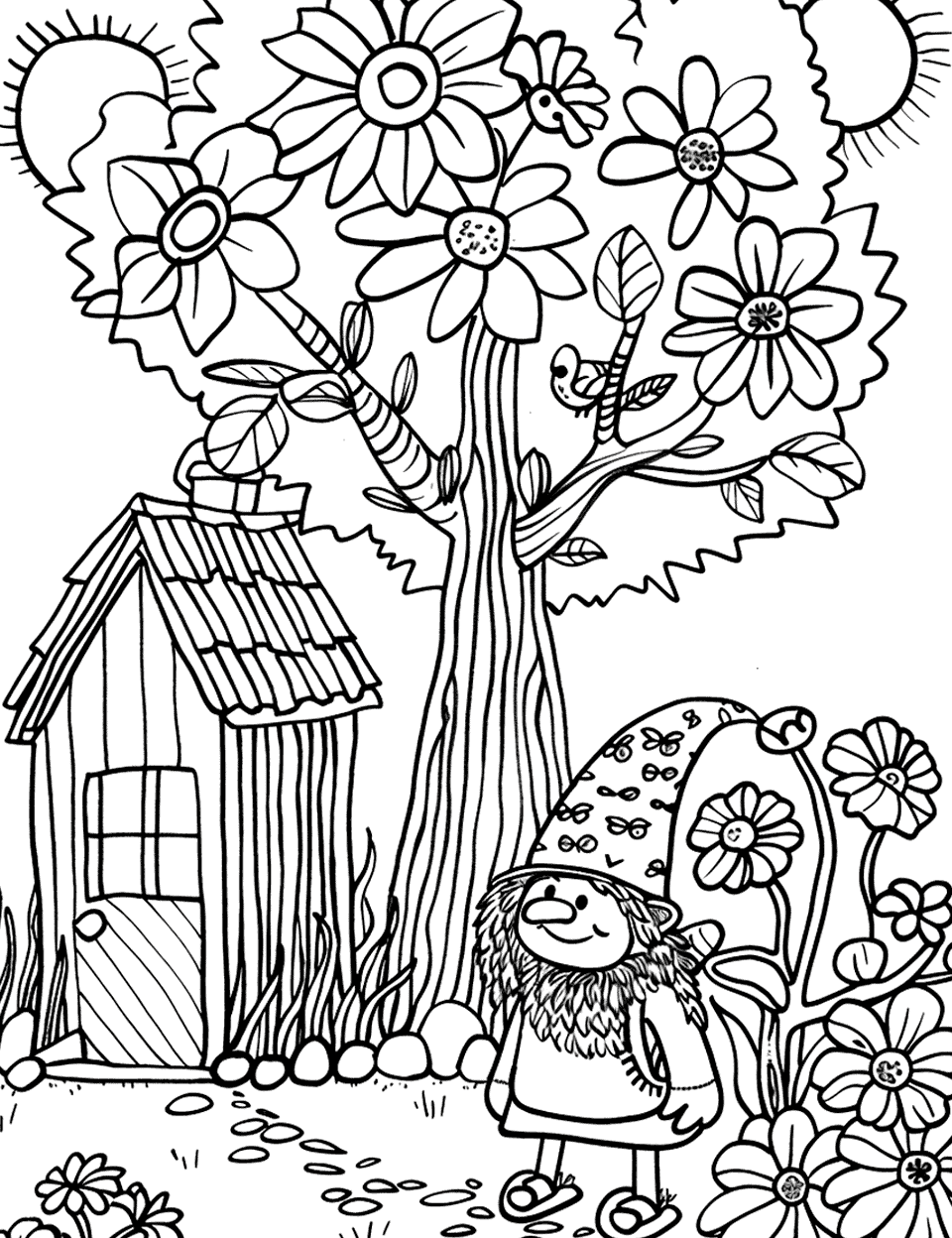
A bearded gnome in a pointed hat stands beside a small wooden house with a shingled roof and a square window. Behind him a tree spreads out with flowers on its branches, and a spotted mushroom grows near the door. A short path of stepping stones runs along the bottom. Bold outlines and large shapes make this one of the friendlier sheets in the set for younger kids.
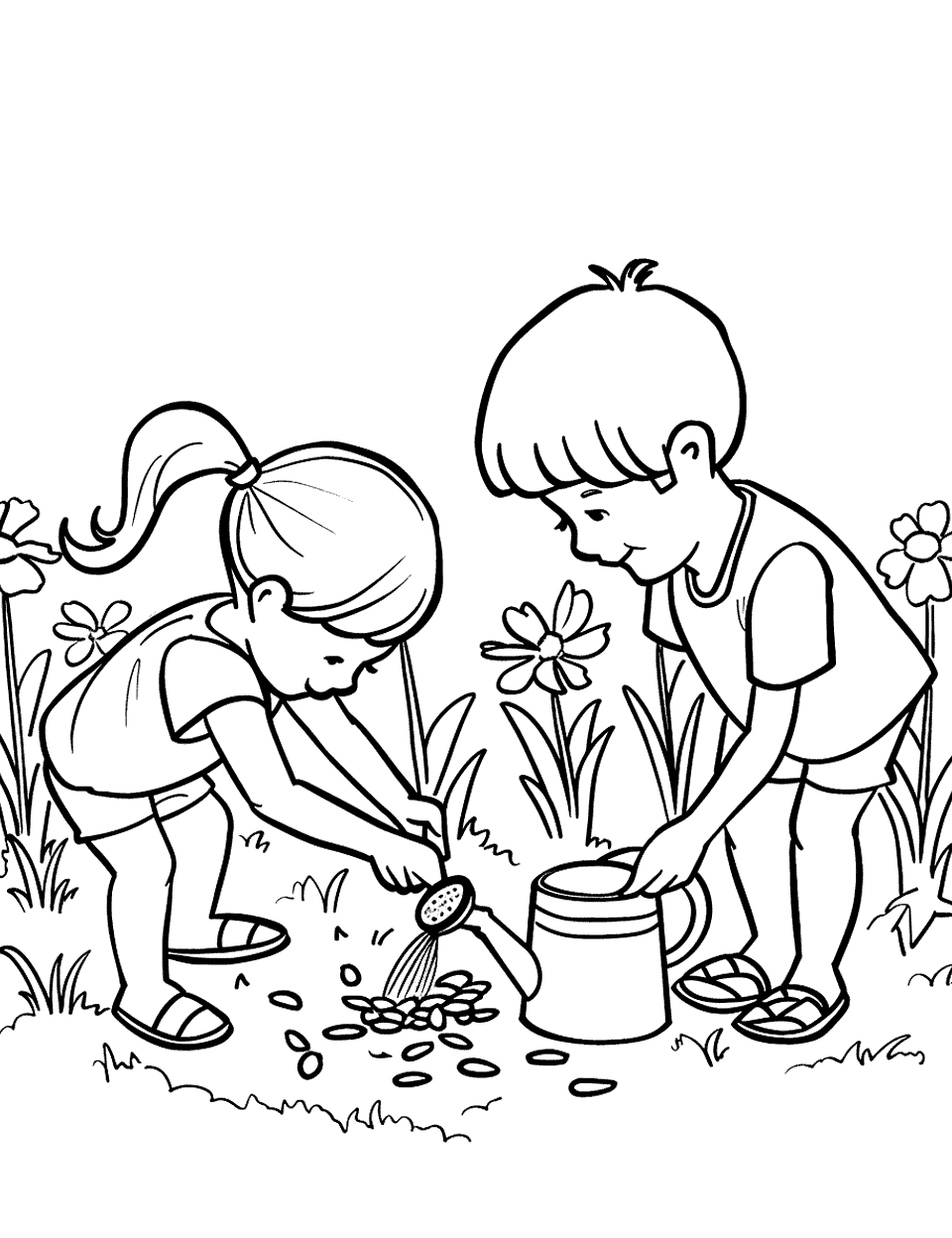
Two kids crouch over the same patch of ground with a watering can between them, seeds scattered across the soil in front of their shoes. Their clothes, shoes and the can are all separate shapes, so the page colors up quickly with crayons. Grass and a couple of flowers fill the edges without crowding the scene. Print it the morning you actually plant something and the two activities feed each other.
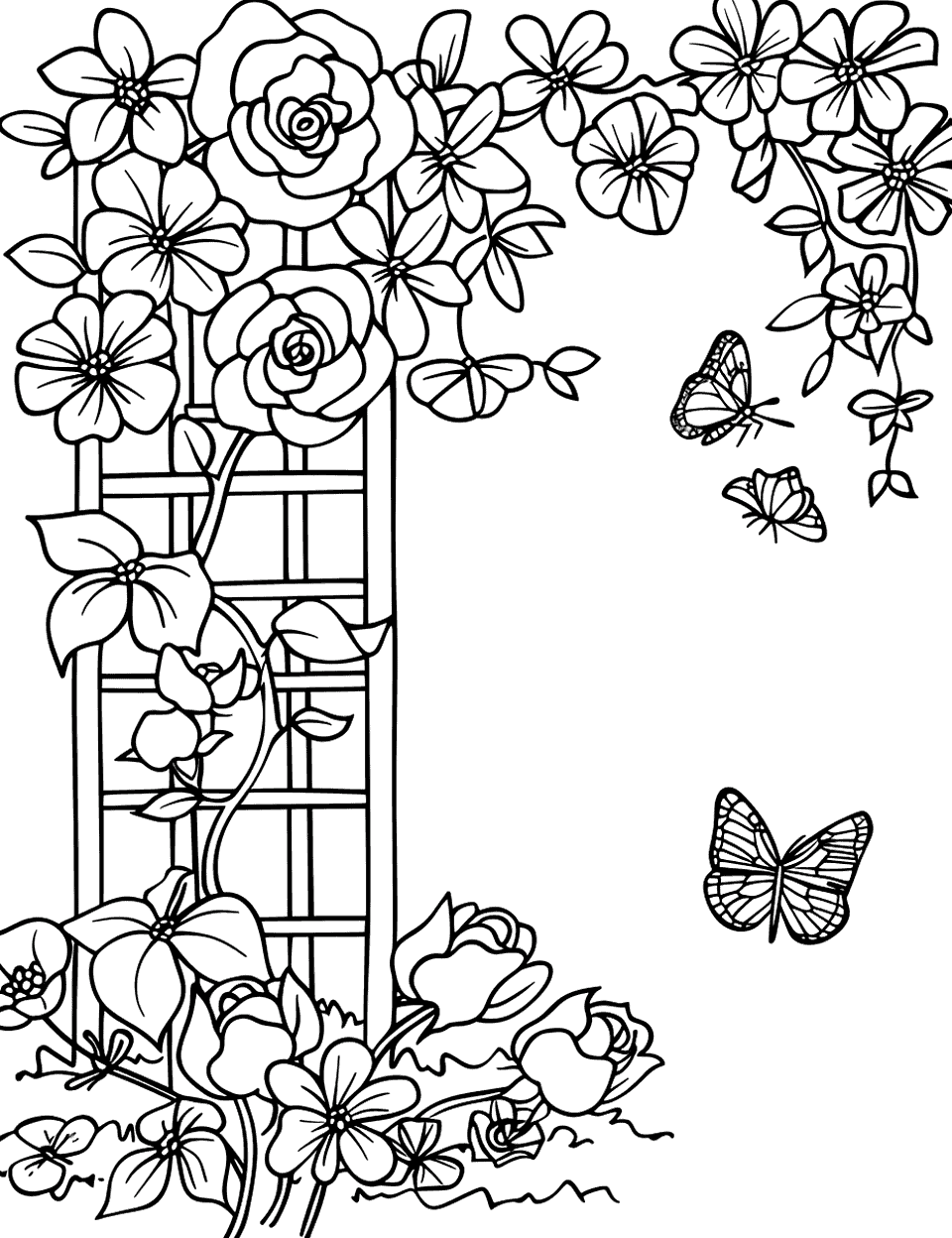
Blooming roses and flat five-petal flowers climb a wooden lattice that arches across the top of the page. Butterflies drift off to the right with their wings fully open. More flowers pile up at the base, so the empty space sits in the middle rather than at the edges. Two shades of pink on the roses and one steady green for every leaf keeps a busy sheet from turning noisy.
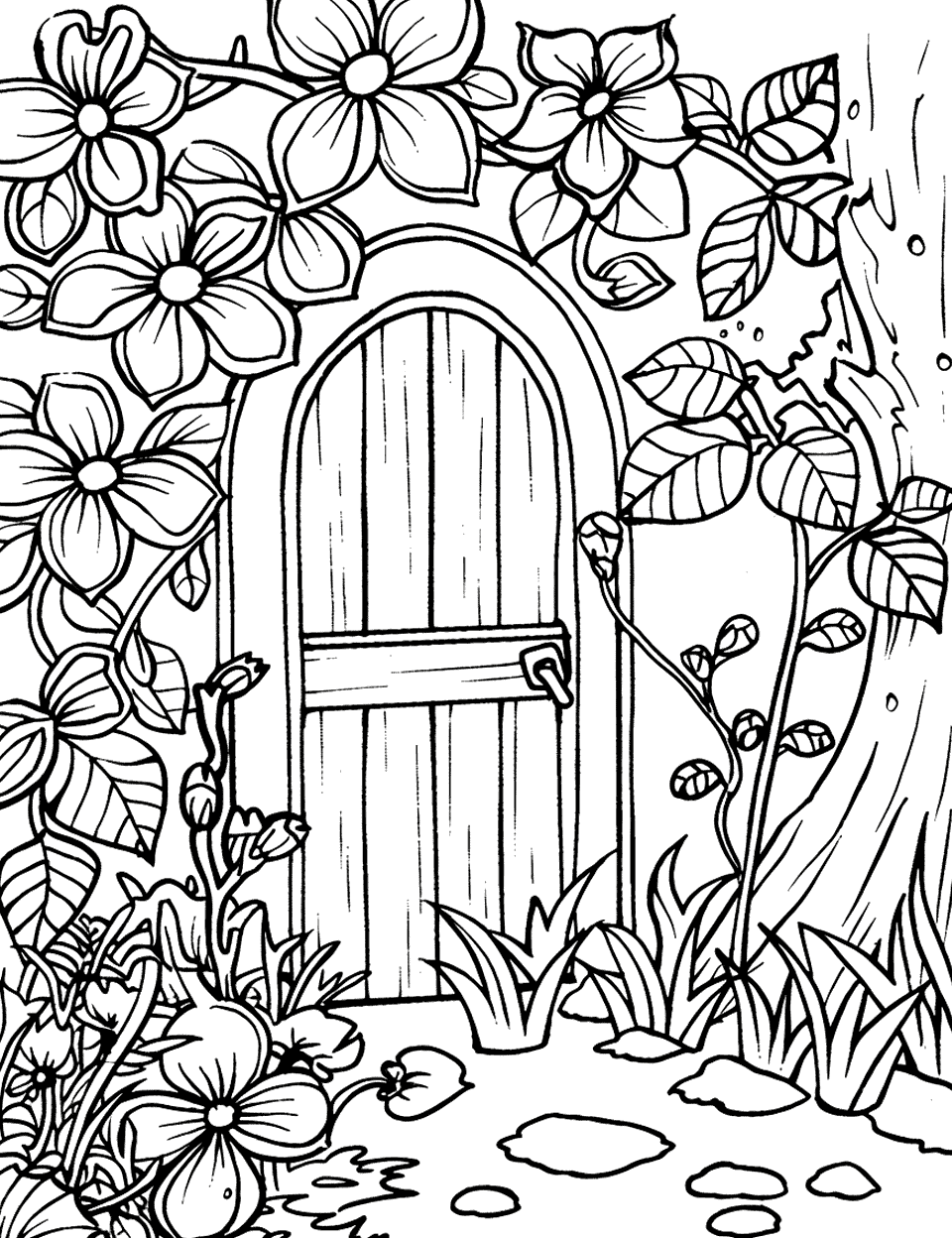
An arched wooden door with plank lines and a small handle sits half covered by climbing vines and wide-open flowers. Leaves and stems spill across the frame from both sides. Flat stones lie on the ground in front of the step. Warm brown on the door with cool greens around it makes the entrance look like the way into somewhere hidden.
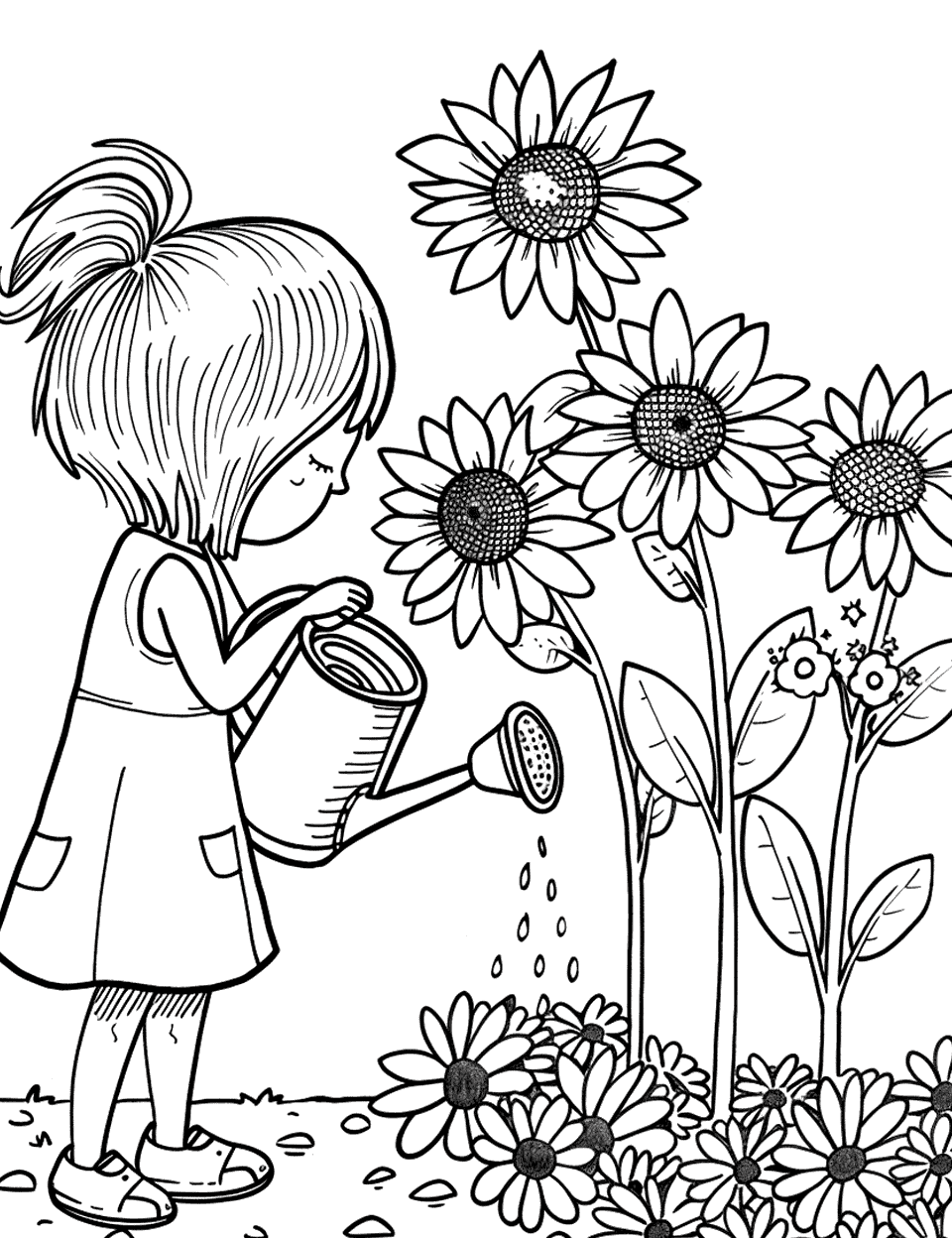
A girl tips a watering can toward a row of sunflowers that stand taller than she is, and the water falls in a line of drops to the ground. Daisies fill the space around her shoes. The shapes are large and cleanly separated, which suits preschoolers. Older kids can still find work in the sunflower centers, which are drawn as fine speckled disks.
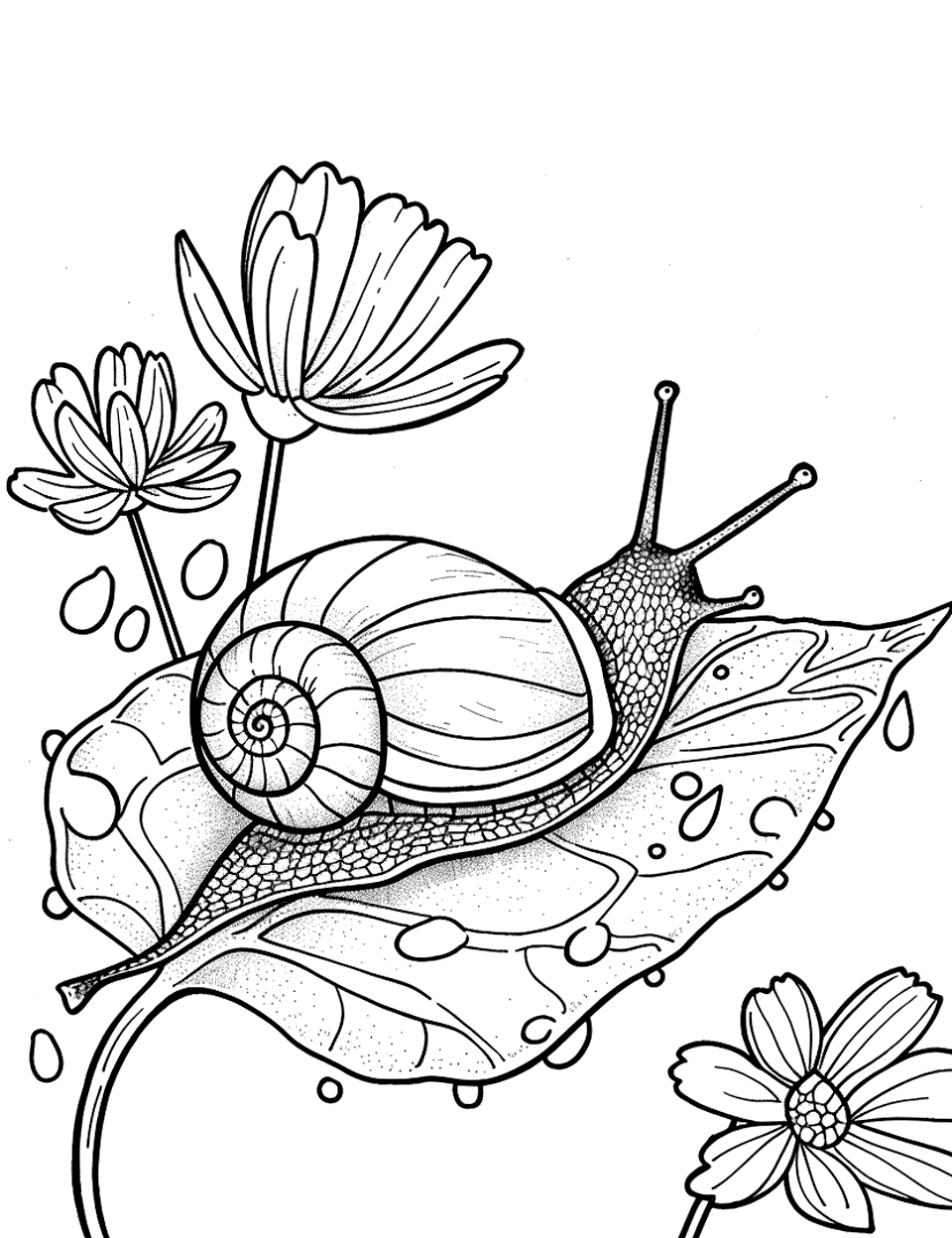
A snail with a spiral shell crosses a broad leaf, eye stalks up and its body textured in fine scale-like marks. Water droplets sit on the leaf and fall past its edges, and flowers frame the top left and bottom right corners. This is one of the most detailed sheets in the collection, so save it for someone who enjoys slow work with pencils. Shading the shell from dark at the center to light at the rim gives it real depth.
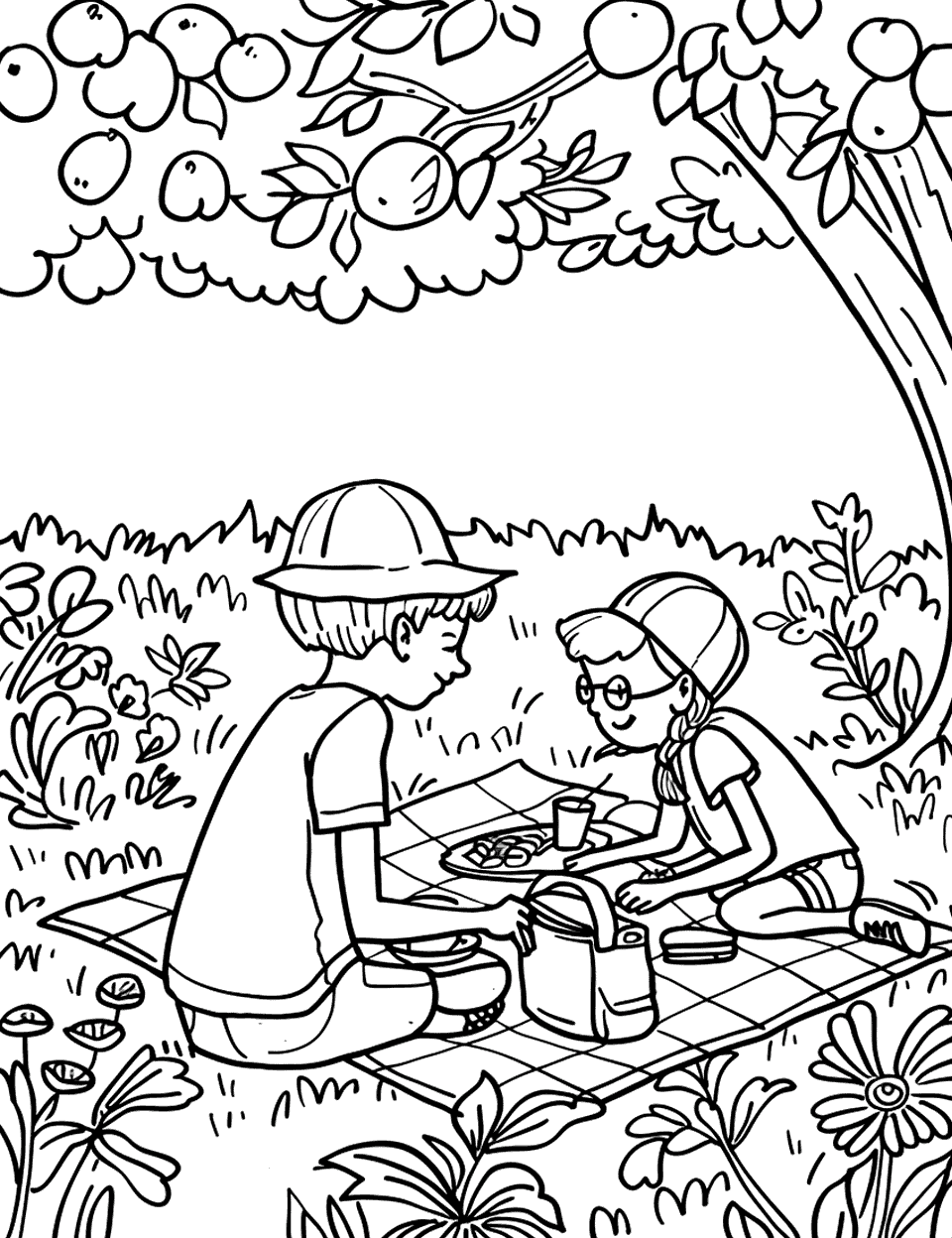
Two kids in caps kneel on a checked picnic blanket with a plate between them and a jug beside it. A tree hangs overhead with round fruit tucked among the leaves, and tall grass and flowers close in on every side. The blanket grid is the fun part, since kids can turn it into a pattern with two or three colors. It is a good sheet to bring along on an actual picnic, clipboard and all.
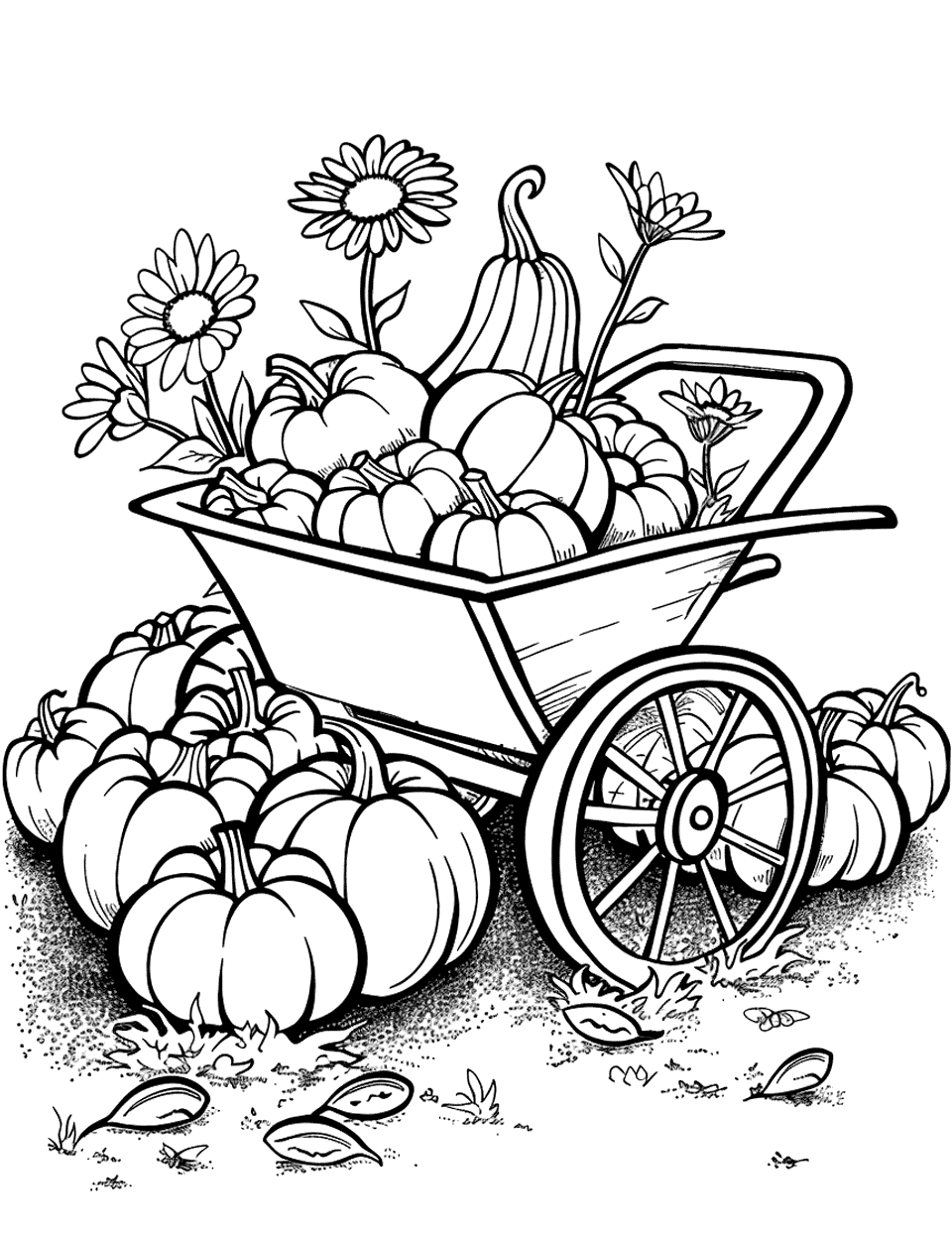
A wheelbarrow sits full of pumpkins, with a curved gourd and a few daisies poking out of the pile. More pumpkins rest on the grass around the wheel. Orange is the obvious choice, but white and pale green pumpkins are real, so a mixed load is still true to life. Bring this one out in October next to the leaf-jumping sheet.
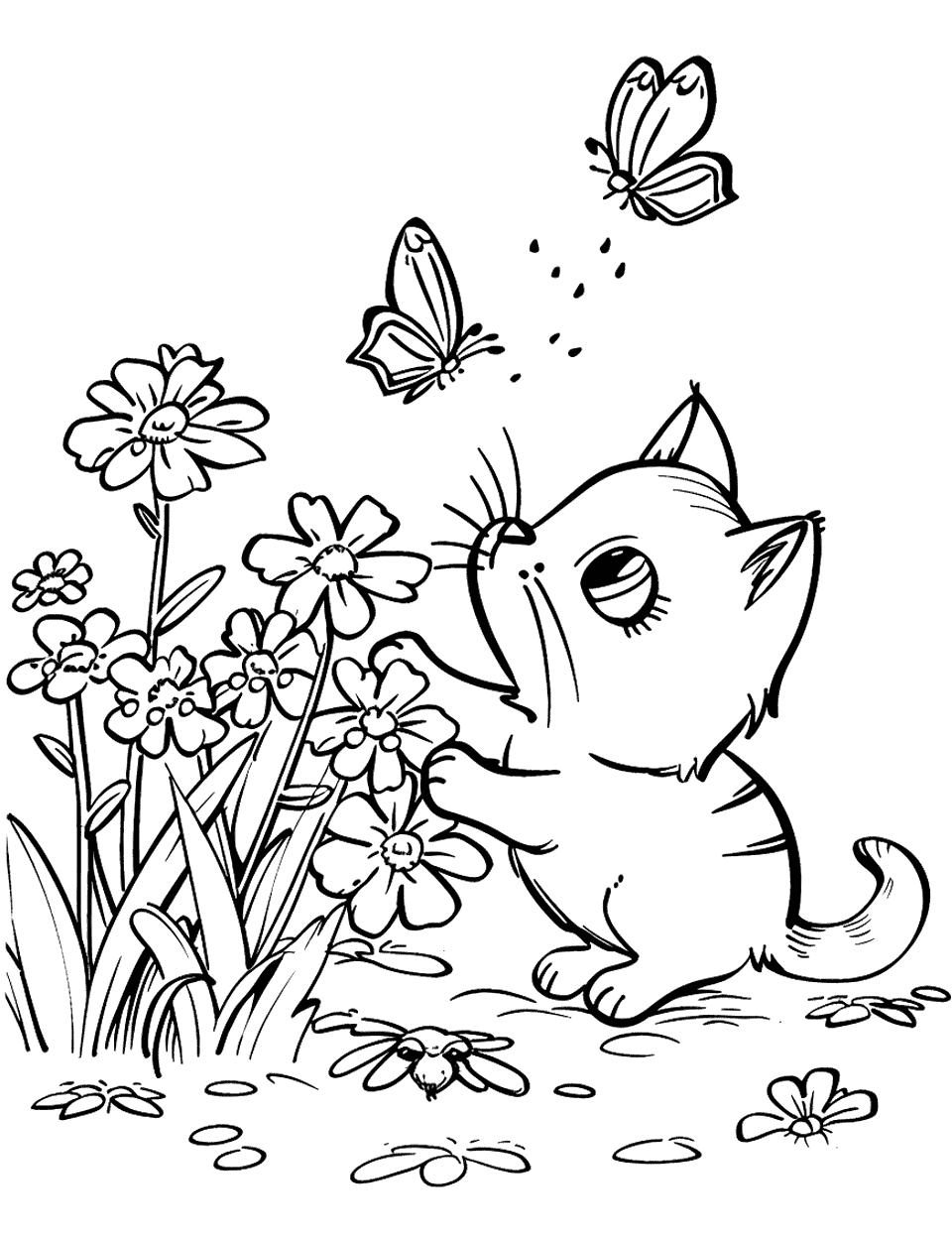
A playful kitten sits back on its haunches and reaches a paw toward butterflies fluttering above a clump of flowers. Its face is drawn large and simple, with a few long whiskers and one big eye in view. Thick outlines make this a solid first sheet for a toddler. Let the butterflies take the boldest colors so the paler kitten still reads clearly.
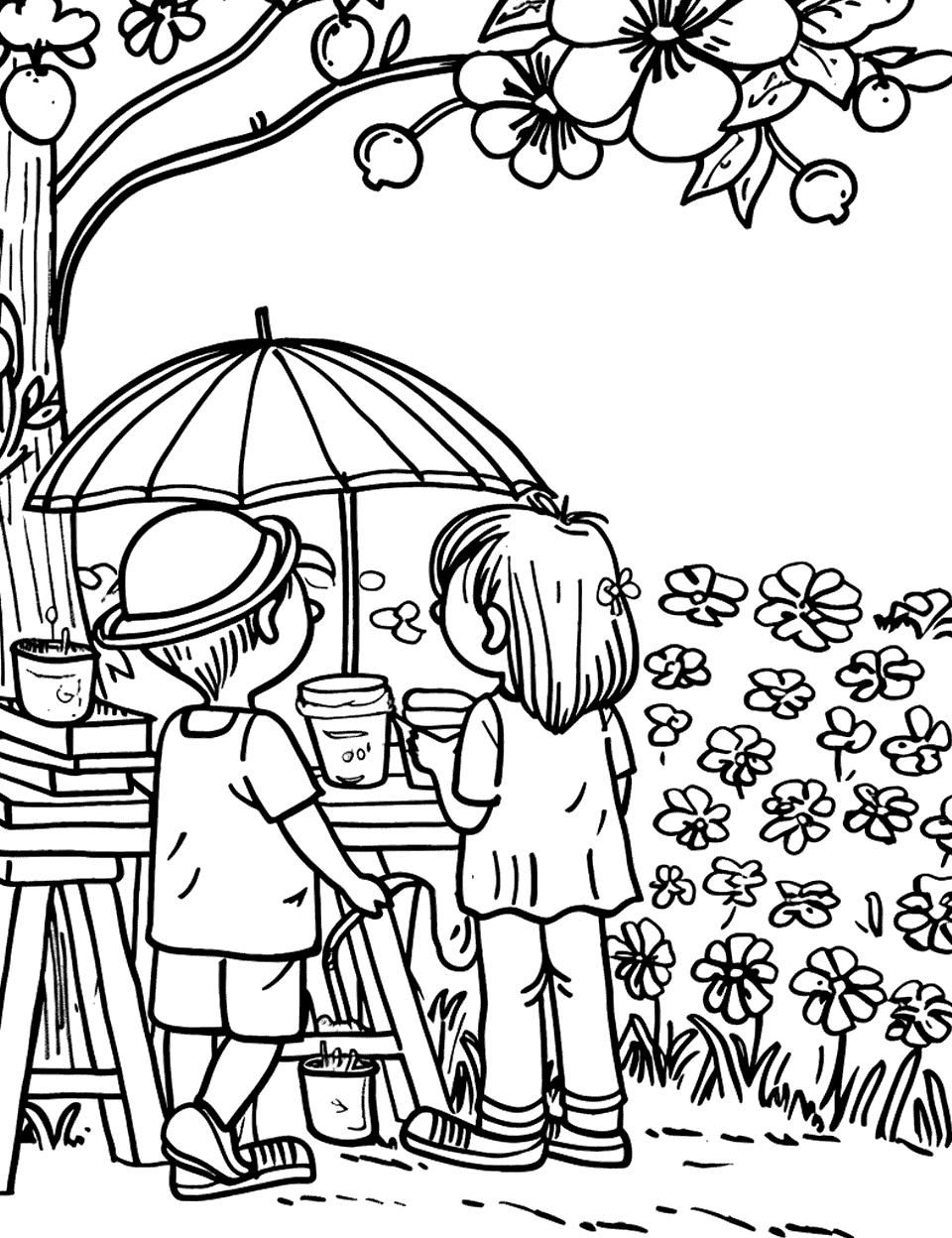
Two kids stand behind a wooden counter under a wide umbrella, with cups lined up along the top. A tree leans over the stand and a thick bed of flowers runs off to the right. That flower bed alone can eat twenty minutes, so the sheet stretches further than it first looks. Give the umbrella panels alternating colors and the whole page picks up.
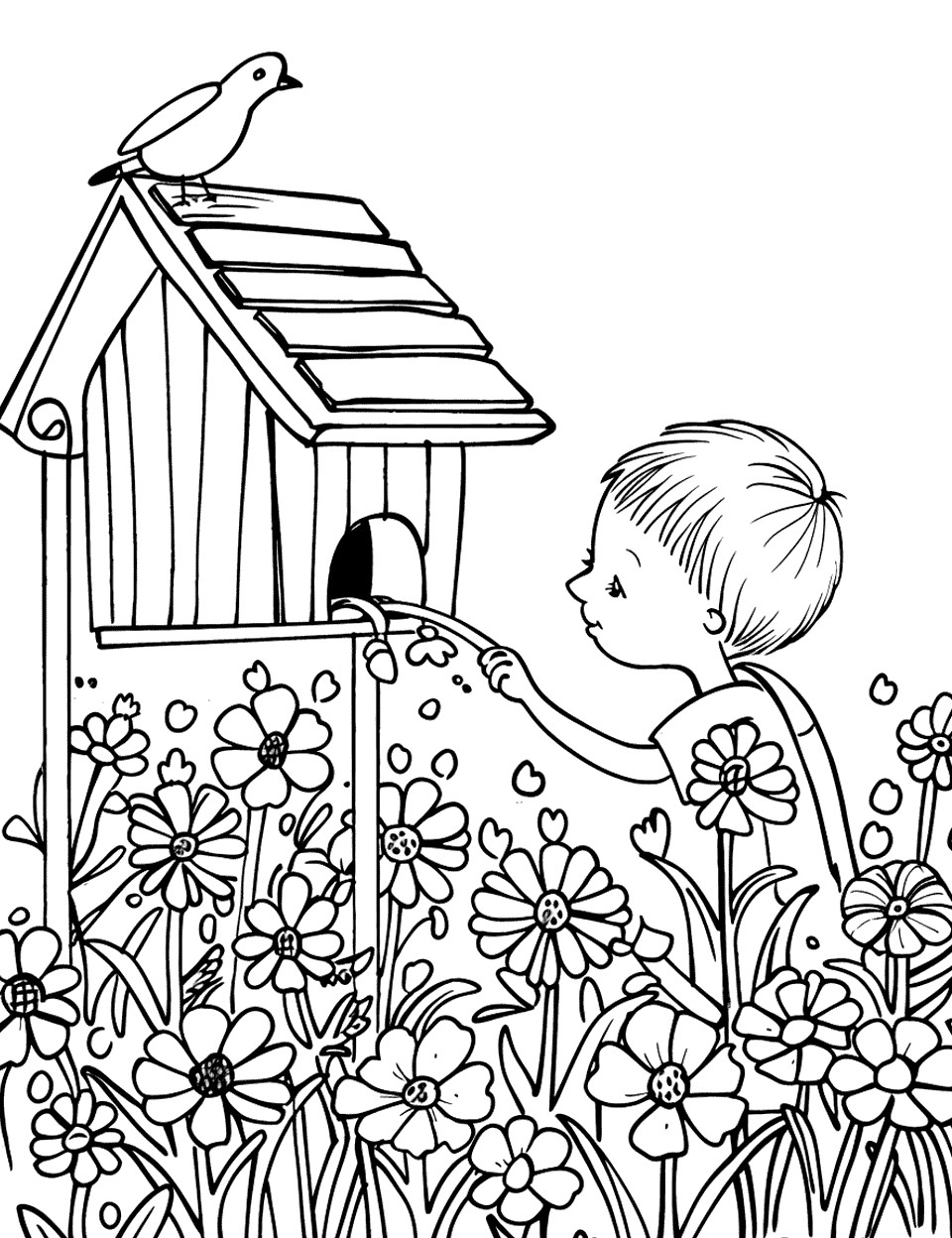
A small bird perches on the peaked roof of a tall birdhouse while a boy reaches toward the opening from the right. Below them, the lower half of the sheet is packed edge to edge with wide-open flowers. This is a spring garden scene, good for a window display once the weather turns. The dense flower bed suits kids who like filling every gap, while younger ones can color the birdhouse and stop there.
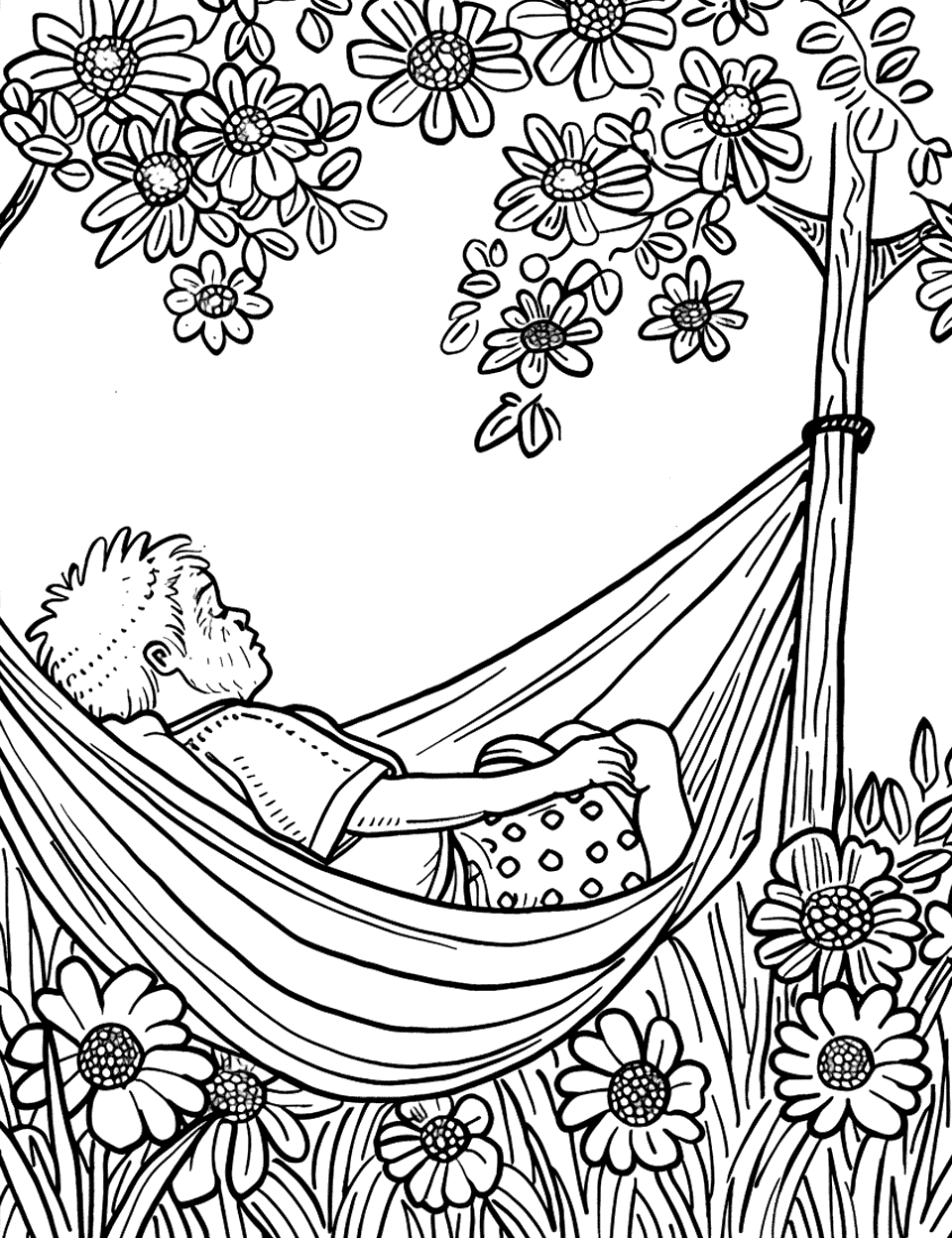
A grown-up lies back in a hammock strung between a tree and a post, hands resting, one knee bent up. Flowers hang from the branches overhead and daisies push up through the grass below. The hammock is drawn as long parallel lines that are oddly satisfying to fill with a single color. Pair it with our trees in a lush garden pages for a quiet afternoon set.
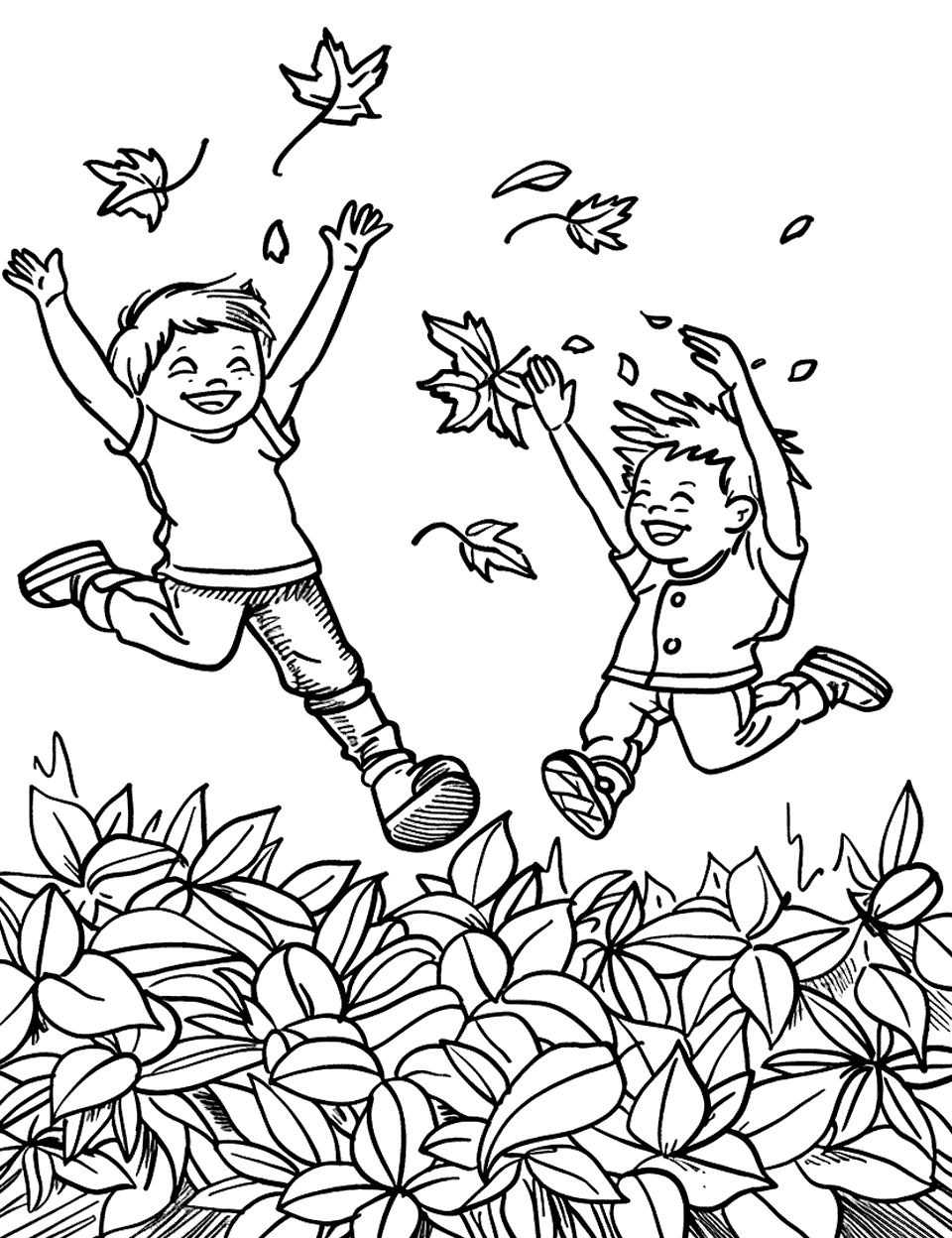
Two kids leap with their arms thrown up while leaves spin through the air around them. A thick bank of leaves fills the bottom third of the sheet. Their faces are simple and grinning, so young kids can color them without fuss. The scattered leaves are an excuse to use every warm color in the box, one leaf at a time.
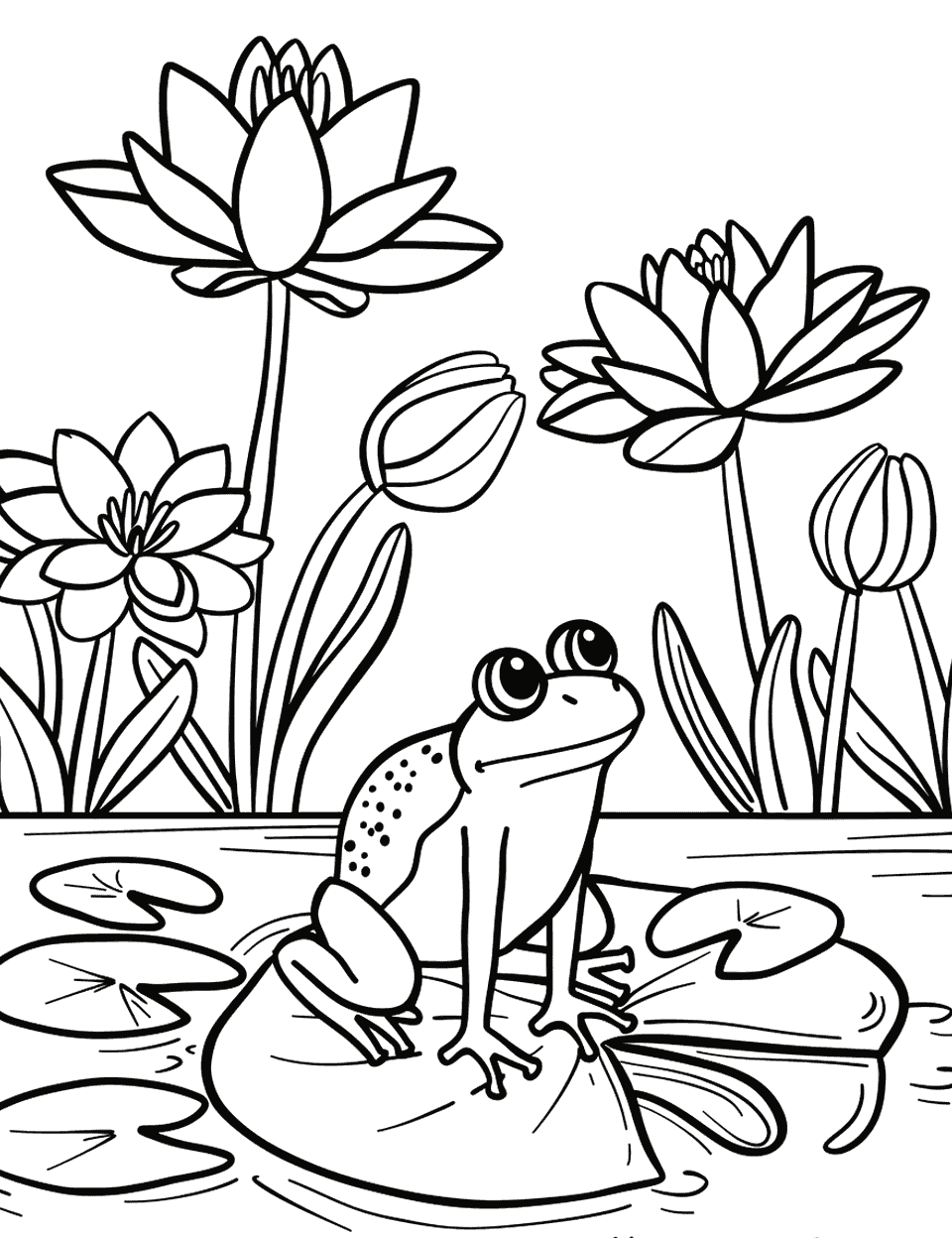
Find a frog sitting on a lily pad with big round eyes and spots running down its back. Water lilies and closed buds stand behind it, and flat pads float across the pond. Greens and pond blues do most of the work here. The shapes are large and well separated, so it works for a first-time colorer.
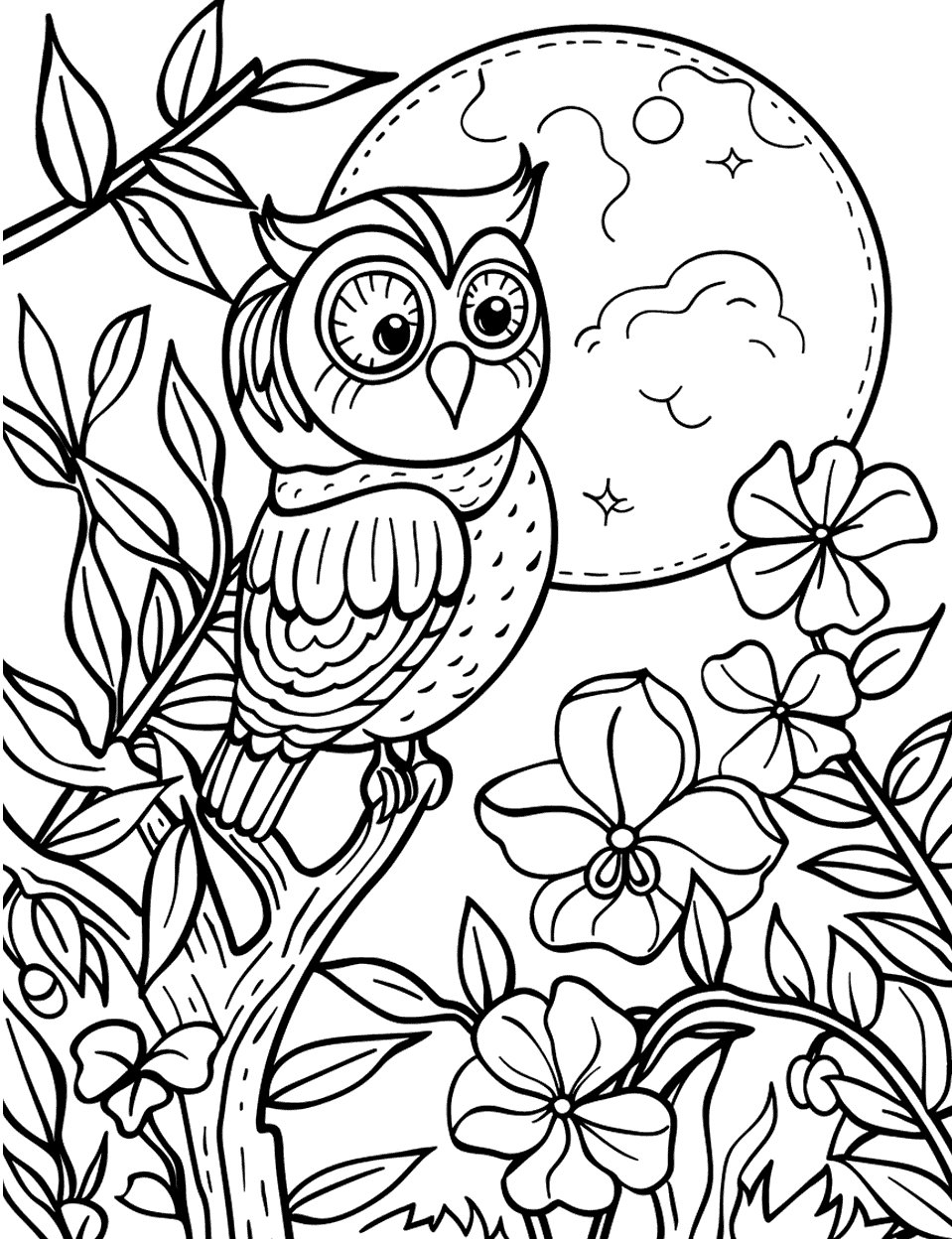
An owl perched on a tree stares straight out from the page, with a full moon rising behind its head. Leafy branches fill the left side and wide flowers fill the right. Its chest is covered in small feather marks that reward a sharp pencil. A deep blue sky behind that moon makes this the one night scene in the set.
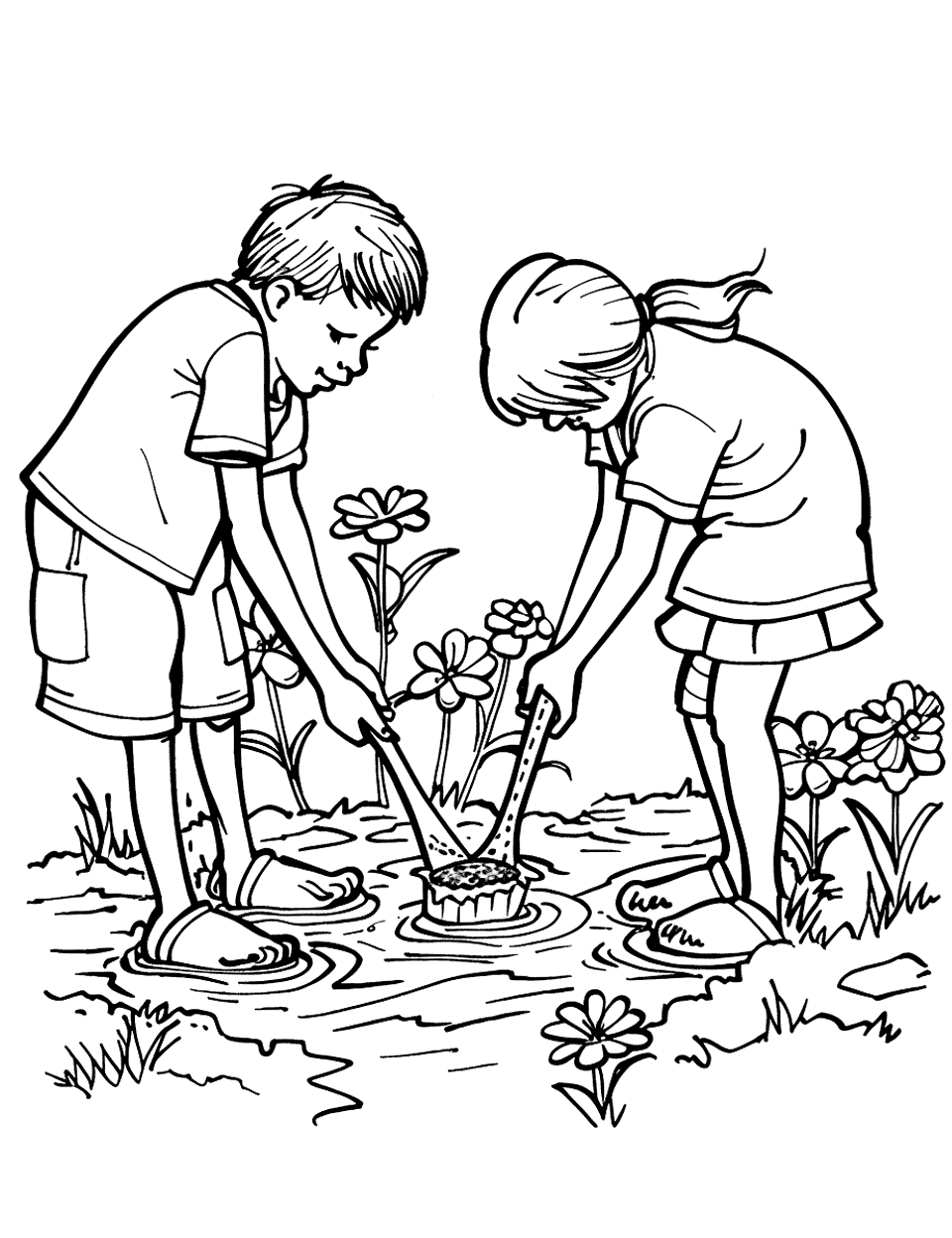
A boy and a girl bend over a shallow stream with their hands down in the water and flowers growing along the bank. Ripples spread out from the spot where they are working. Both faces are turned down, so there is less fiddly detail than in the picnic scene. Blues for the water, any color for the clothes, and the page is done in one sitting.
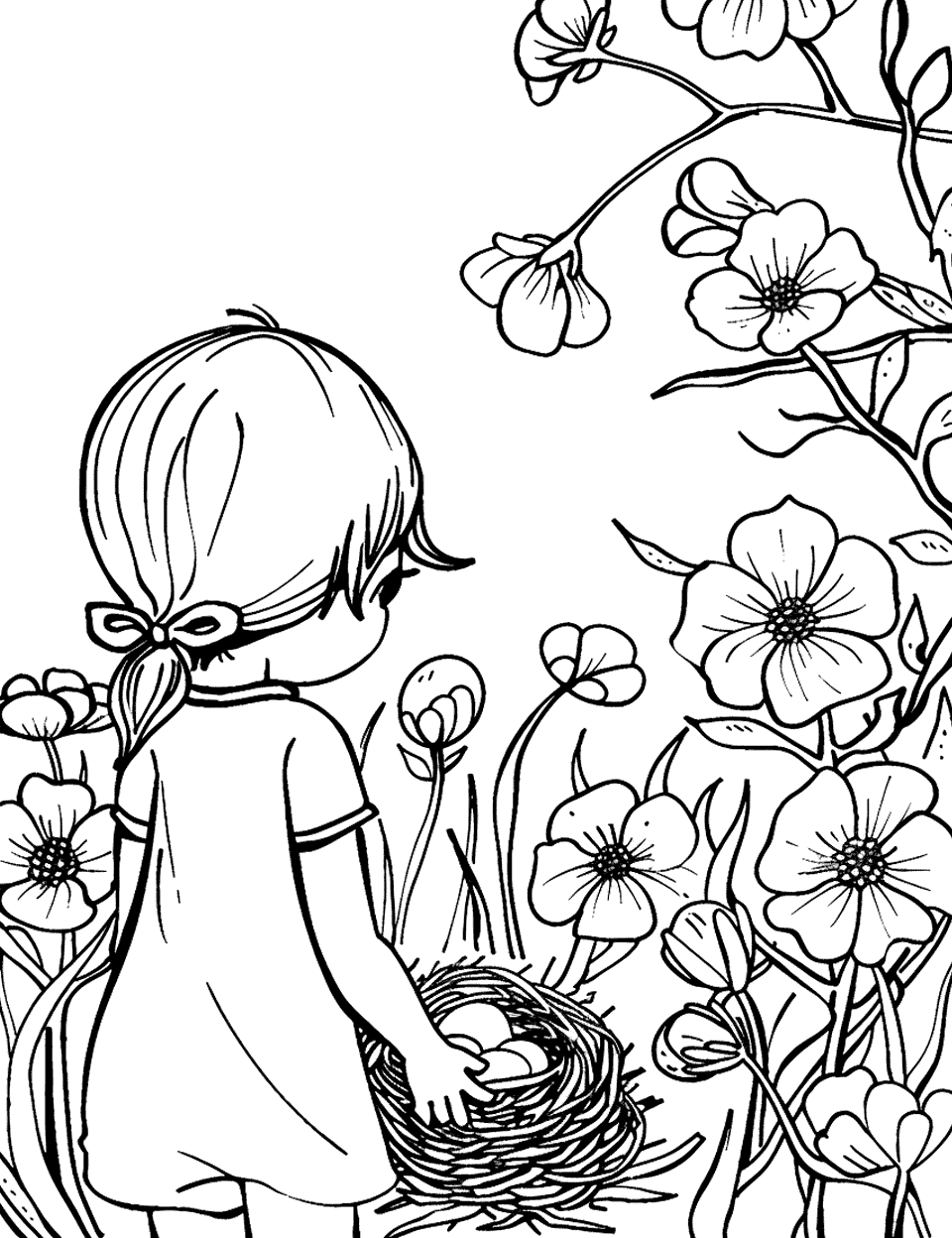
A girl with a ribbon in her hair reaches down toward a woven nest holding eggs. Large open flowers surround her and a blossoming branch leans in from the top corner. The nest is drawn with fine woven strokes worth doing in two browns. It pairs well with a spring walk spent spotting real nests, looking without touching.
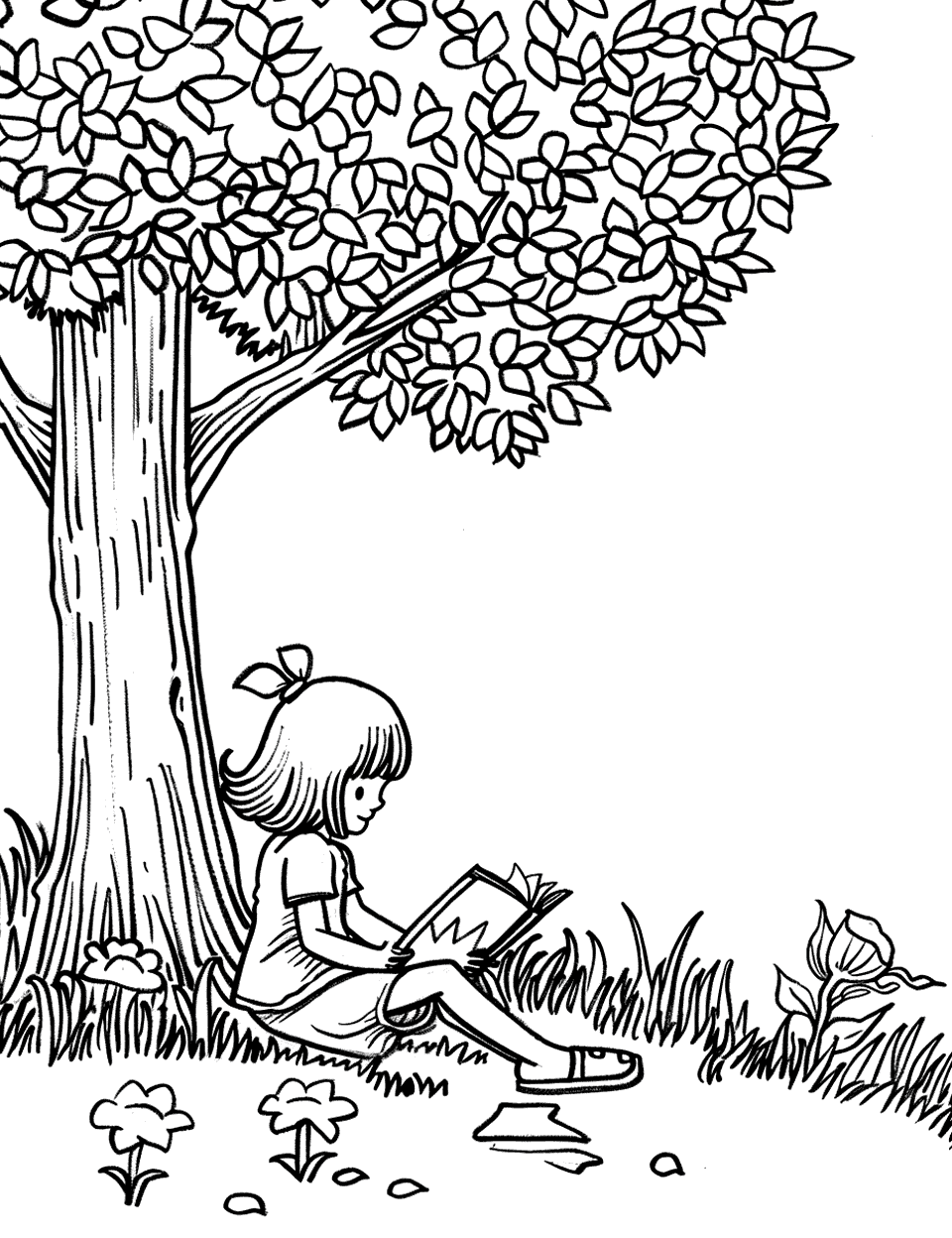
A girl sits in the grass with her back against a thick trunk and an open book in her hands. The tree’s leaves fill the top half of the sheet as hundreds of small shapes. Little flowers dot the grass around her. Leave that canopy to an older child, or let a younger one sweep through it in one green and call it finished.
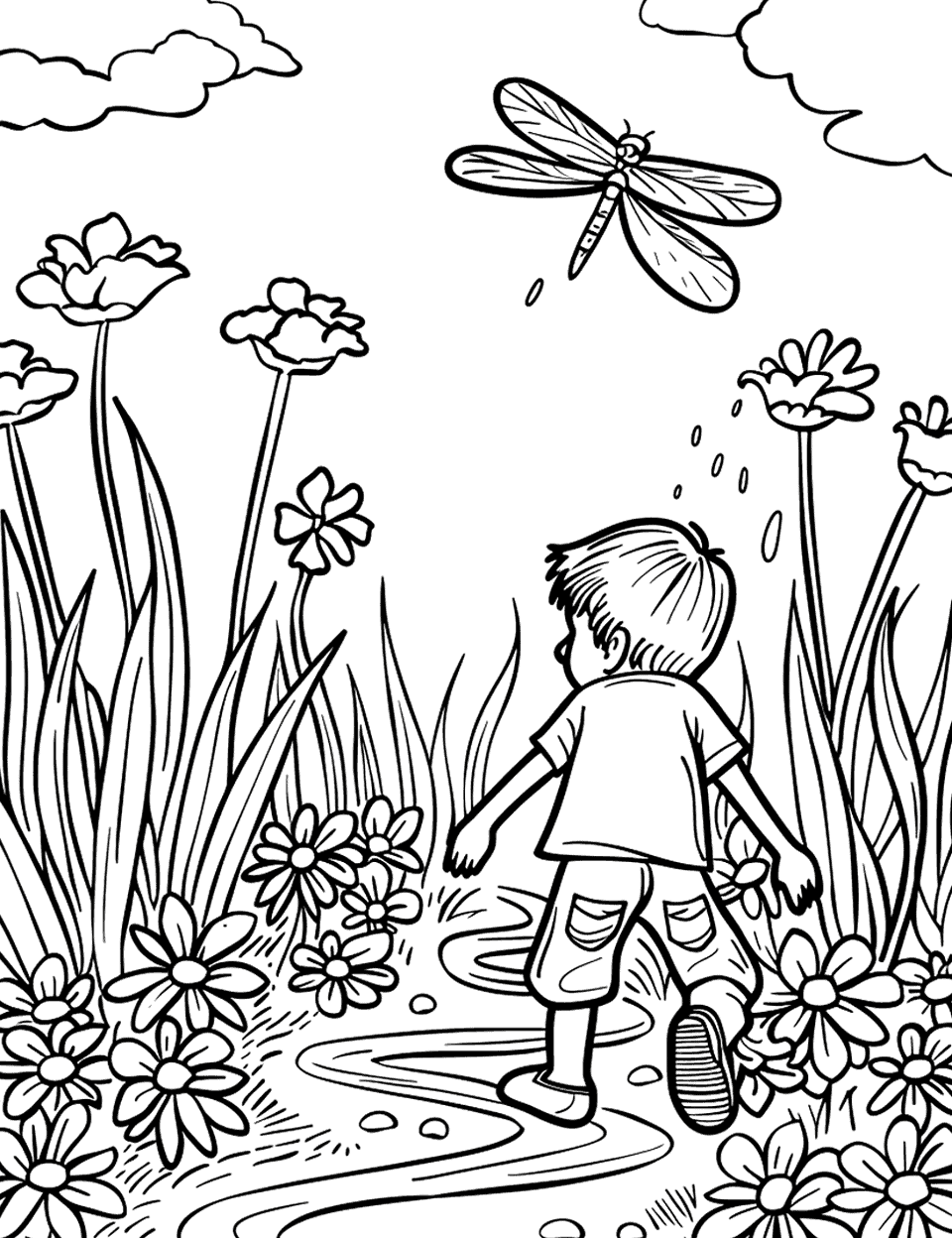
A boy walks along a narrow stream that winds through tall grass, with a dragonfly gliding above him. Daisies crowd both banks and clouds drift across the top of the page. The dragonfly’s wings are drawn with fine veins, a small challenge on an otherwise easy sheet. Cool blues in the water and warm yellows in the grass keep the two halves apart.
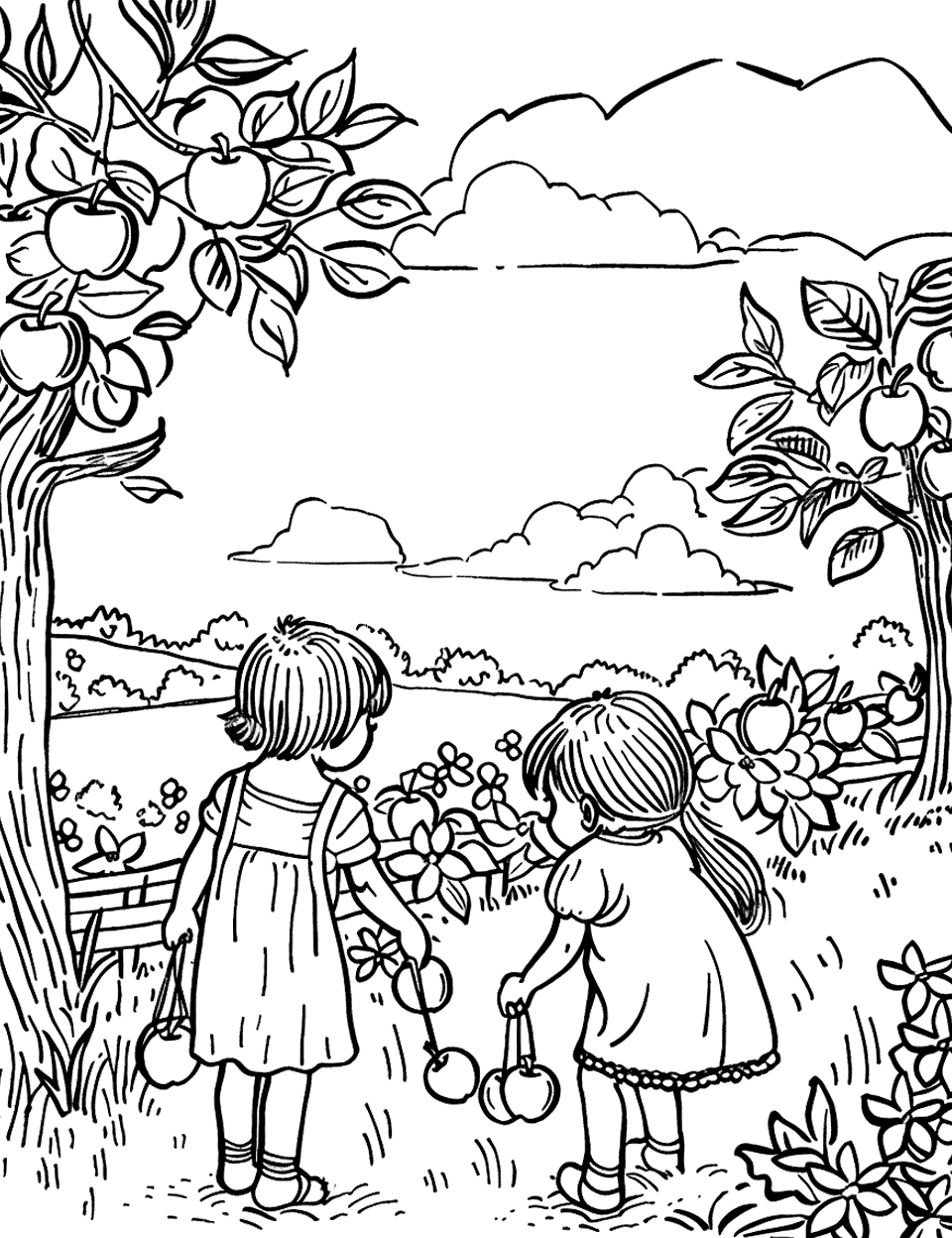
Two girls stand with their backs to us, each holding apples in an orchard with fruit trees on either side. Hills and long clouds stretch across the middle of the page and a fence runs off into the distance. All that open sky is a good place to practice light, even shading with the side of a crayon. Red, green and yellow apples on the same tree keep it from looking flat.
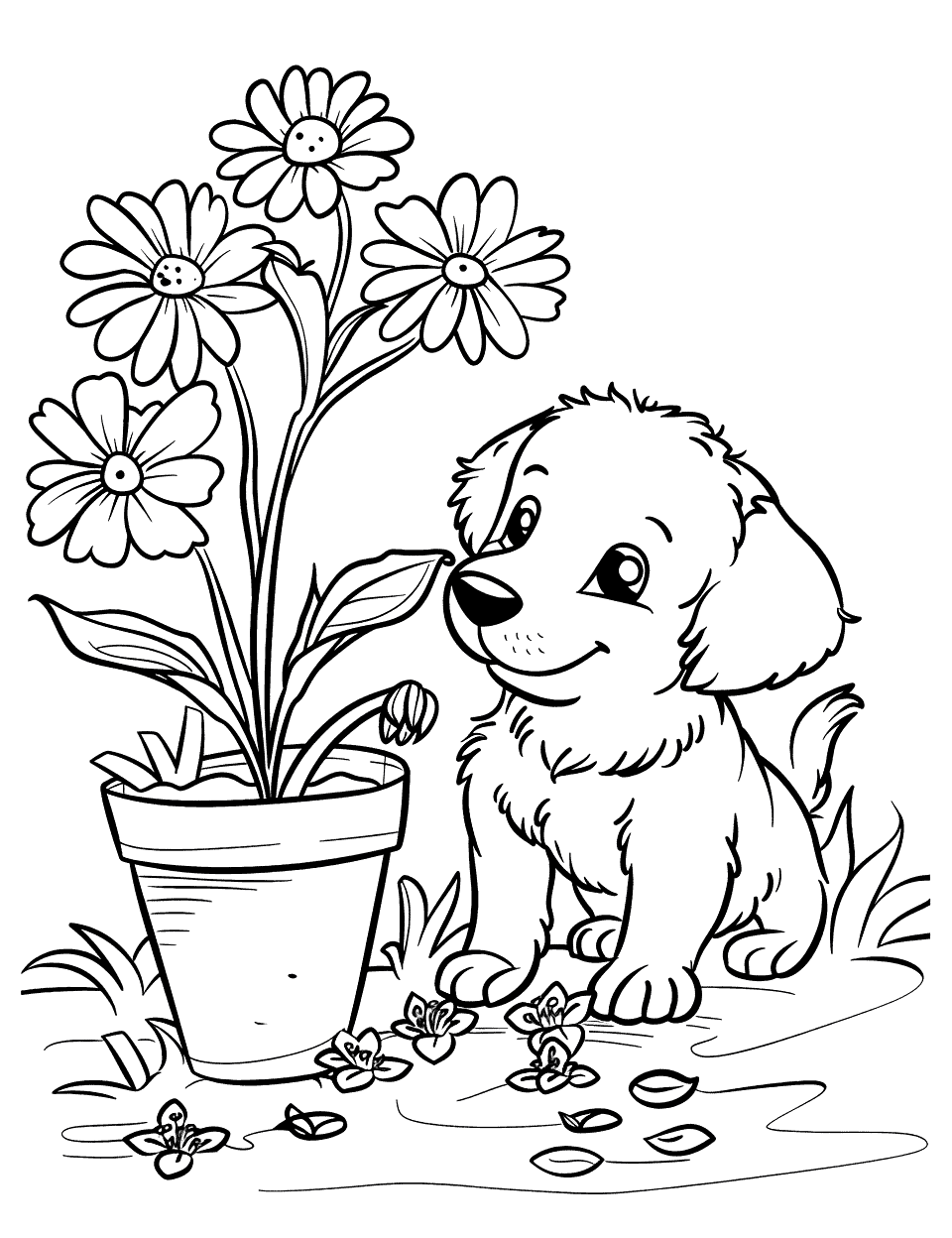
A puppy sits beside a potted plant with its nose almost touching a leaf and its ears hanging long and soft. Daisies rise out of the pot and loose petals lie scattered on the ground. The lines are thick and rounded, which is exactly what small hands need. A golden coat against a bright pot keeps the two subjects easy to tell apart.
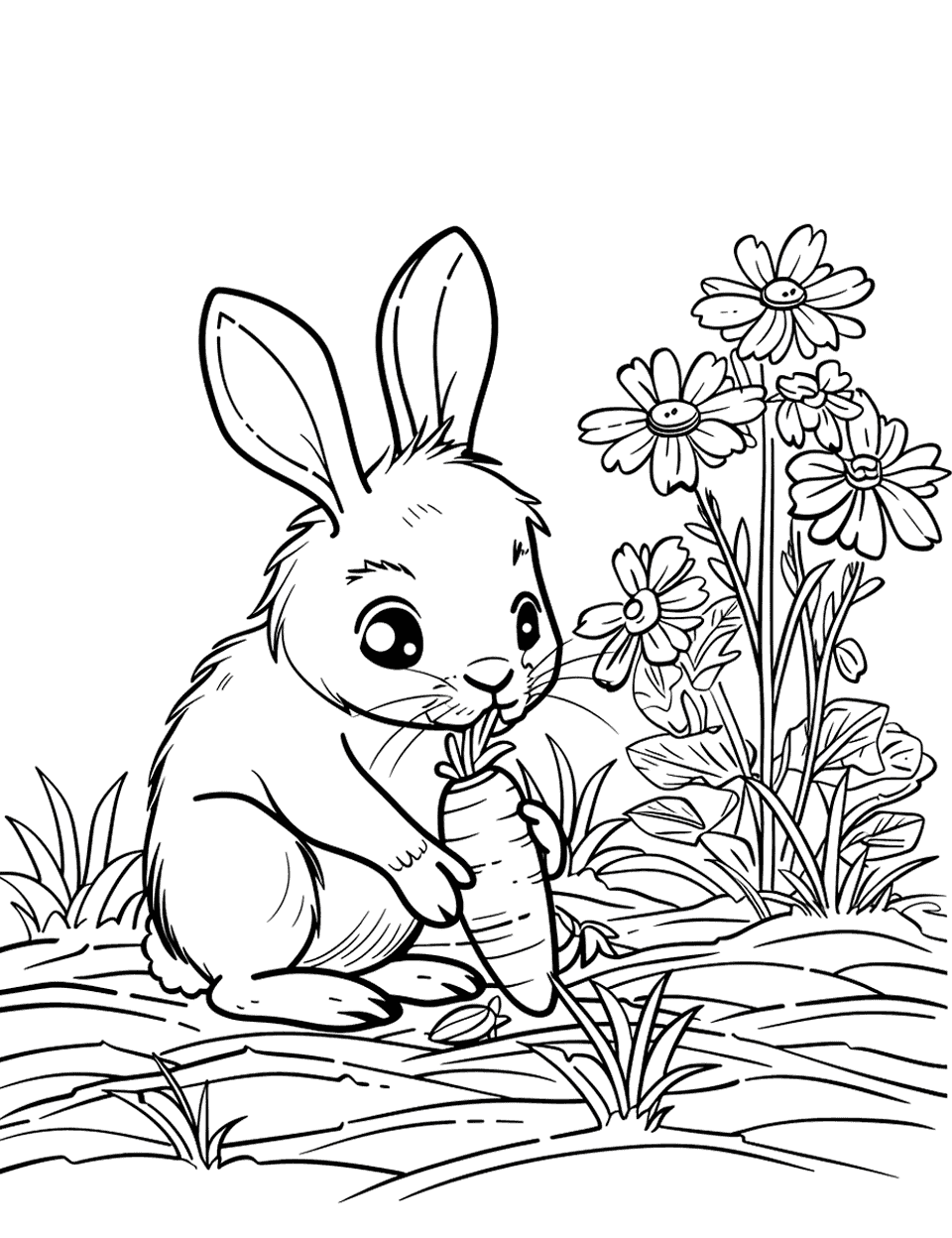
A young rabbit sits up holding a single carrot in both paws, ears tall and eyes wide. Daisies grow to its right and long grass runs beneath its feet. Real rabbits eat carrots as an occasional treat rather than a staple, which is a fun thing to mention while somebody colors one. Soft grays or browns on the fur let the orange carrot carry the page.
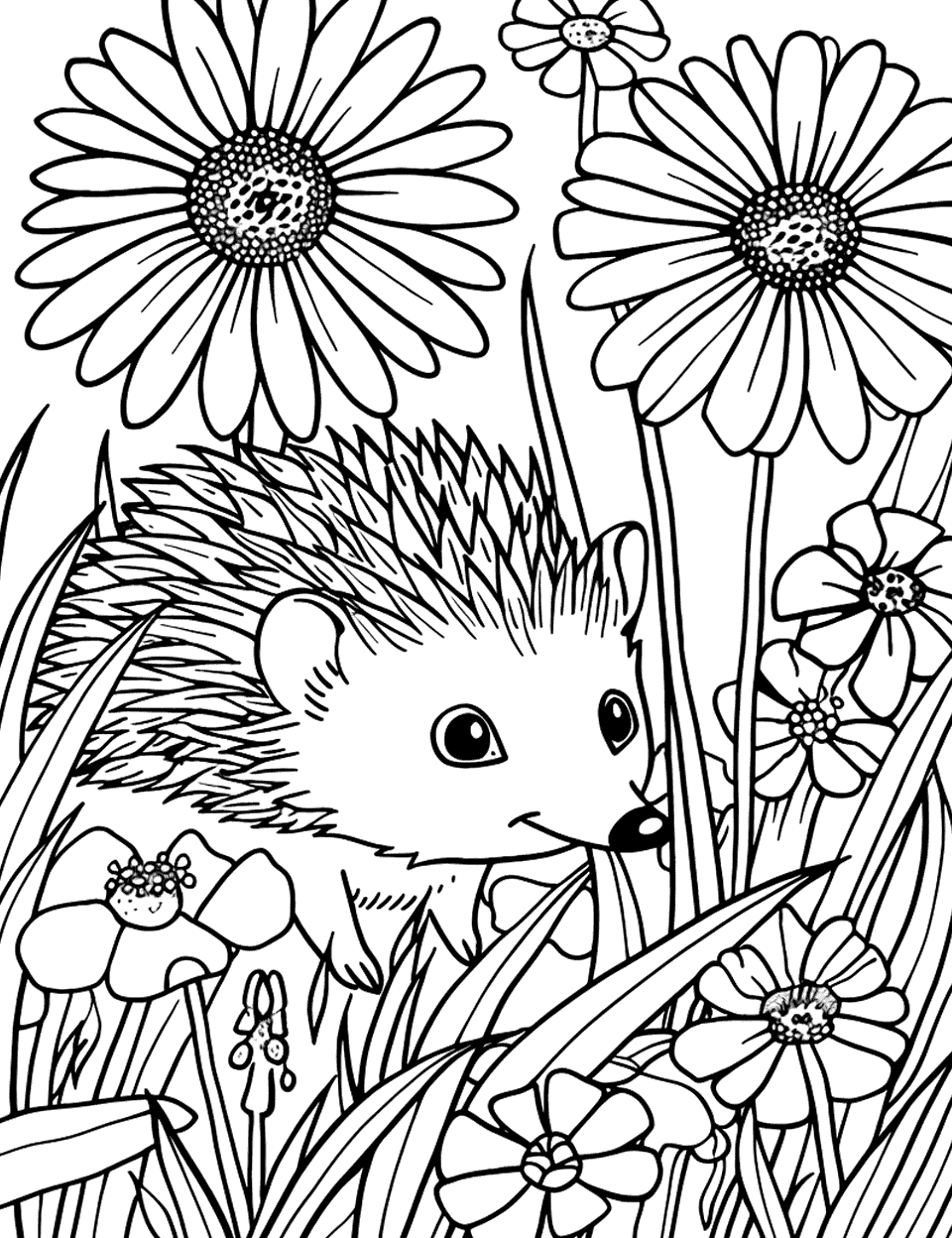
A hedgehog noses through long grass, its spines drawn as short sharp strokes across its back. Big daisies lean over it from above while smaller flowers sit up front. He is out looking for food among the stems. The animal is small on the page, so most of the work is greenery, making this a calm sheet to finish on.
By using our free coloring pages, you acknowledge and agree to our full disclaimer. All materials are for personal, non-commercial use only and all rights belong to their respective license holders.
What Do Kids Get Out of Coloring a Garden Scene?
Coloring a garden scene buys quiet focus, fine-motor practice, and a reason to look closely at plants and insects kids usually run straight past. In one study, 84 participants colored a mandala, a plaid pattern, or a blank sheet after a short anxiety induction, and both structured-coloring groups calmed down more than the free-drawing group (1). The authors, Curry and Kasser, concluded that “structured coloring of a reasonably complex geometric pattern may induce a meditative state that benefits individuals suffering from anxiety.” A page like the snail or the rose trellis is exactly that kind of structure.
There is a nature angle too. The EPA reports that people in the United States spend about 90 percent of their time indoors (2). A survey of 19,806 adults in England found that those who spent at least 120 minutes in nature during the previous week reported better health and well-being than those who spent none (3). A printed sheet is no substitute for going outside. It is a decent bridge, though: name what is on the page, then go find the real bee, nest or snail in the yard.
Which Garden Sheets Suit Which Age?
Toddlers and preschoolers want the thick, widely spaced outlines: the kitten, the puppy, the rabbit, the frog and the gnome house. By age 4 most children can hold a crayon between their fingers and thumb instead of in a fist, and can draw a person with three or more body parts (4), which is roughly the point where staying inside the lines stops being a fight.
Early grade schoolers are ready for the mid-weight scenes, where several figures share the page but the lines stay open: the picnic, the drink stand, the leaf pile, the bird bath and the seed planting.
Older kids, teens and adults should go straight to the fine-line sheets. The snail’s shell, the butterfly’s striped wings, the owl’s feathered chest, the lattice of roses and the sunflower’s speckled center all hold up to colored pencils, blending and shading.
Activities to Do With Garden Coloring Pages
A finished page does not have to go in a drawer. Here are ways to put these garden sheets back to work.
Create DIY Garden Markers
Turn the vegetable and sunflower sheets into labels for the real garden. Color them, cut the images out, laminate them or cover them with clear tape, and glue each one to a craft stick. Push them into the soil next to the matching row so a preschooler can see which patch is which.
Nature Scavenger Hunt
Use the sheets as a checklist for a walk. Color the bee, the snail, the bird’s nest and the dragonfly first, then head to the yard or a park and try to find the real versions. Bring a clipboard so anything spotted can be ticked off on the spot.
Texture Rubbing Backgrounds
Before coloring, slide a leaf, a piece of bark or a paving stone under the paper and rub over the blank areas with the side of a crayon. The texture prints straight through and gives the sky or grass a surface no crayon can fake. It works best on thinner printer paper.
Make a Pop-Up Garden
Print several sheets with separate elements, such as the sunflowers, the gnome and the trellis. Color and cut them out, then glue them onto folded cardstock or inside a shoebox lid so they stand up. Rearranging the pieces into a dream garden usually outlasts the coloring itself.
Storytelling Collages
Cut the characters and animals from different sheets, the fairy, the cat, the squirrel and the hedgehog, and paste them onto one large sheet of paper. Ask your child how they all met. Writing two lines under each character turns a craft into handwriting practice without announcing it.
Run a Pollinator Count
Color the bee, butterfly and sunflower pages, then take five minutes outside to count how many real pollinators visit a single flowering plant. The USDA puts it at about 35 percent of the world’s food crops depending on animal pollinators, or one in every three bites of food. Kids remember that number better after they have watched a bee earn it.
Label the Plant Parts
Use the sunflower, vegetable or trellis pages for a science lesson. After coloring, have your child write labels for the roots, stem, leaves, petals and seeds, drawing an arrow from each word to the right spot. It fits neatly with a school unit on plants and costs nothing but a pencil.
FAQs
What Is the Best Paper for These Coloring Pages?
Regular printer paper is fine for crayons and colored pencils. Switch to cardstock or heavyweight paper if markers or watercolors are coming out, because thin paper lets marker ink bleed through to whatever is underneath and buckles once it gets wet. Print the busiest sheets, such as the snail or the rose trellis, at full page size so the fine lines do not close up.
Are These Coloring Pages Suitable for Toddlers?
Several of them are. The kitten, puppy, rabbit, frog and gnome sheets use thick outlines and large open shapes that forgive a wobbly grip, while the snail, butterfly and trellis pages are drawn with fine lines meant for older kids and adults. If a toddler picks a detailed one anyway, print it and let them color it their way. Nothing says the tulips have to be red.
How Can I Download These Pages?
Right-click the image you want and save it, or press and hold it on a phone or tablet until the save option appears. Print it at full page size rather than fit-to-margins so the outlines stay crisp, and choose the black-and-white or grayscale setting to save color ink you do not need. Printing two or three at once means nobody has to wait their turn.
Can I Use These Pages for a Classroom Project?
Yes, teachers are welcome to print them for classroom use. The set lines up with units on plant parts, seasons, life cycles and pollination: more than 75 percent of the world’s flowering plants depend on bees, butterflies, birds, bats and other pollinators (5), so the bee, butterfly and sunflower sheets slot straight into that lesson. The seed-planting and harvest pages work as before-and-after bookends for a growing project.
What Are the Benefits of Coloring for Kids?
Coloring builds hand strength, fine-motor control and the kind of sustained attention that a screen never asks for. It also gives a wound-up child something to do with their hands while they settle, which is why coloring shows up in waiting rooms and classrooms alike. Garden sheets add a second layer, since naming a snail, a hedgehog or a bumblebee while coloring it is free vocabulary practice.
Do You Have Seasonal Garden Pages?
Yes, three seasons are covered here. Spring shows up in the seed planting, the birdhouse and the nest discovery; summer in the sunflower watering, the picnic and the drink stand; fall in the squirrel with its acorn, the wheelbarrow of pumpkins and the leaf jumping. There is no snow scene in this set, so a winter display needs a different collection.
Which Garden Coloring Pages Work Best for Adults?
Start with the snail on the leaf, the striped butterfly, the rose trellis and the owl under the moon. Each one carries dense, repeating detail, which is what makes coloring absorbing rather than quick, and each has enough separate areas to reward a full pencil set. The fairy on the mushroom is the gentlest of the detailed group if you want something shorter.