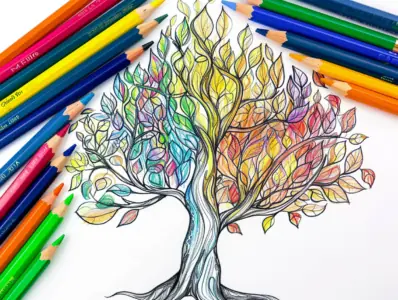
Which tree gets the first crayon, the corner oak or the giant sequoia?
Forty tree coloring pages, ready to print: oaks and pines, a palm on a small island, a cherry tree in full bloom, and a sequoia that fills the whole page.
The sheets run from chunky, thick-lined outlines for preschoolers to dense scenes that will hold an older child or an adult for an afternoon. Each description below says what is actually drawn on the sheet, so you can choose before you print.
Grab the crayons. Ideas for what to do with the finished pages are further down.
Simple Oak Tree
Thick, confident outlines make this oak a good first sheet. The trunk carries a few grain lines and a knothole, and the canopy is drawn as big rounded clumps that fill in fast. Try two shades of green so the front clumps sit forward of the ones behind them. Chunky crayons work fine here, which makes it a solid pick for preschoolers.
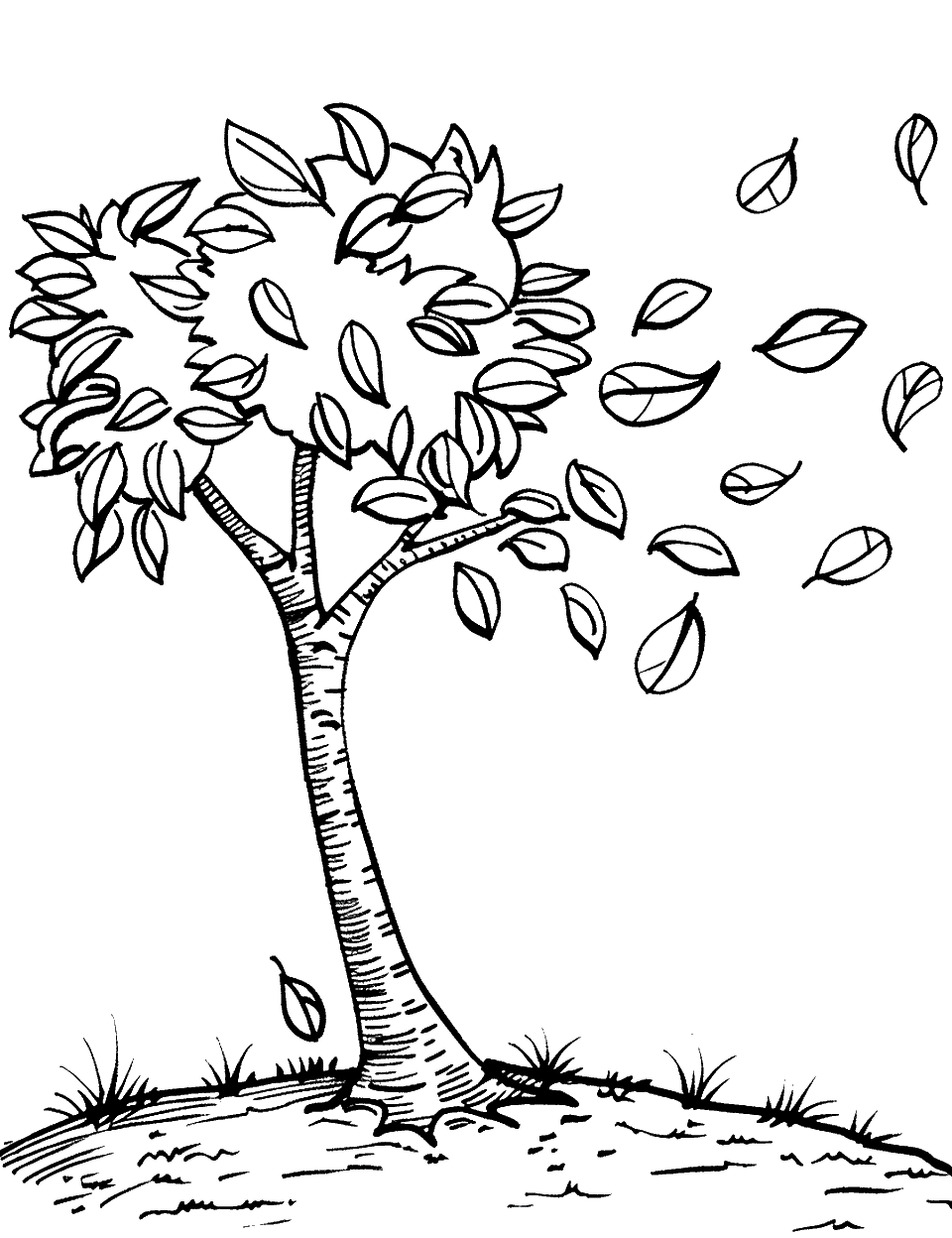
Loose leaves drift off to one side of this leaning tree, each drawn as its own small shape. The bark is ruled with short horizontal marks that look good in pale grey or silver. Give the drifting leaves warm reds and golds and keep the ones still on the branches greener, so the page reads as a season in progress. It is a nice one to color while talking about why leaves fall.
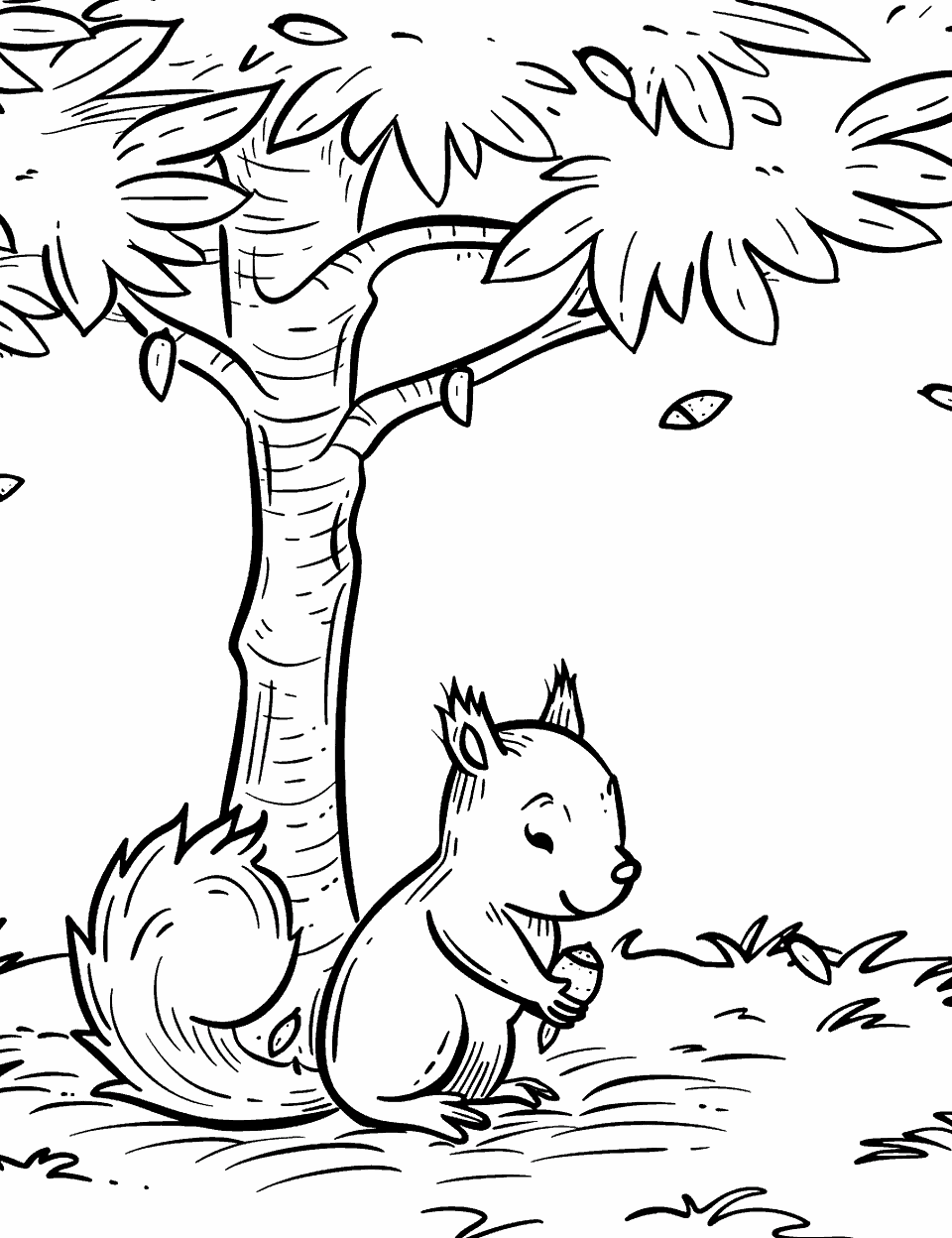
A squirrel sits at the foot of the tree holding an acorn, its bushy tail curled up behind it. That tail is full of small strokes, so this one suits colored pencils better than fat crayons. Warm browns on the fur and a russet acorn keep it realistic, though a purple squirrel is nobody’s business but your child’s. Pair it with our winter coloring pages if you are building a seasons folder.
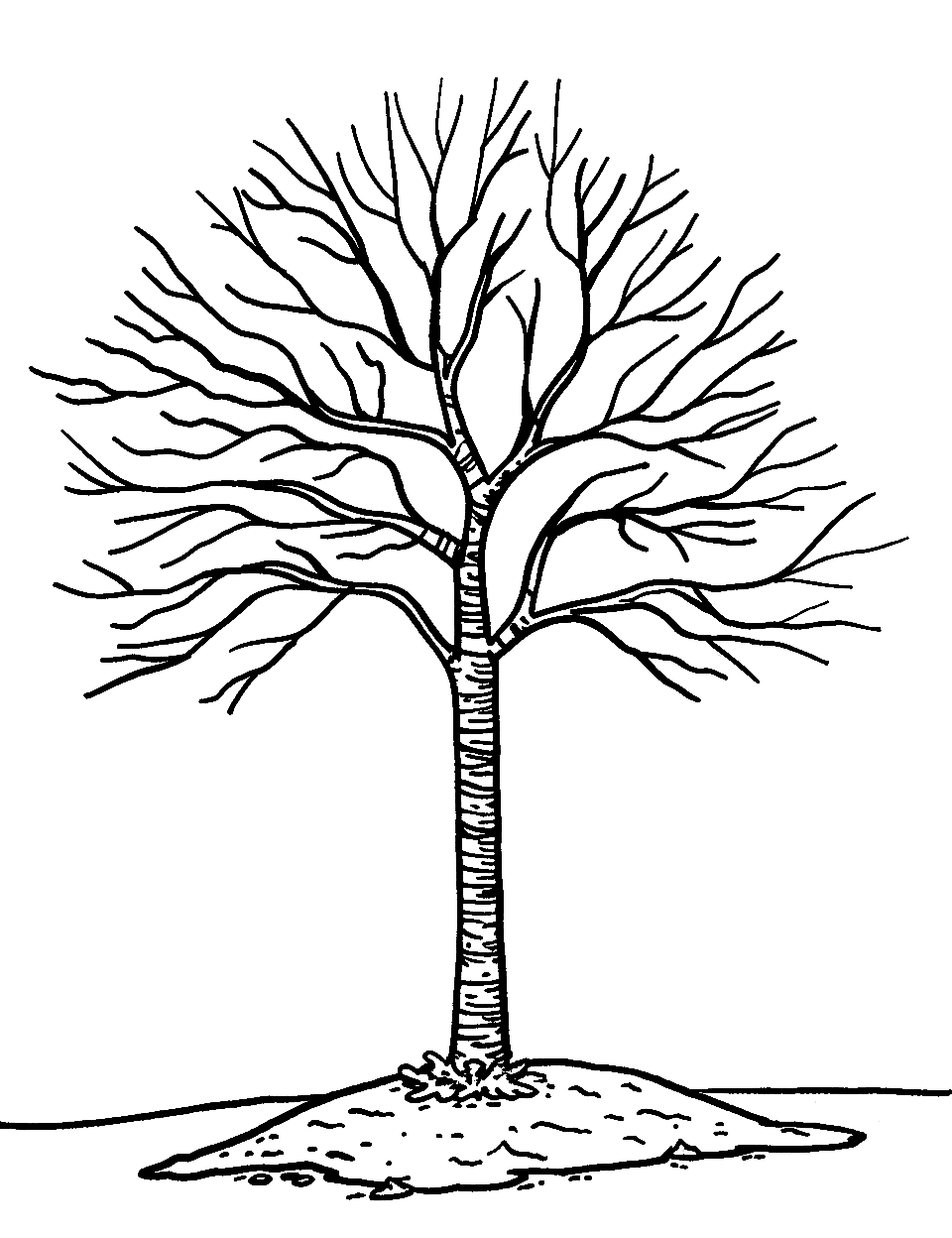
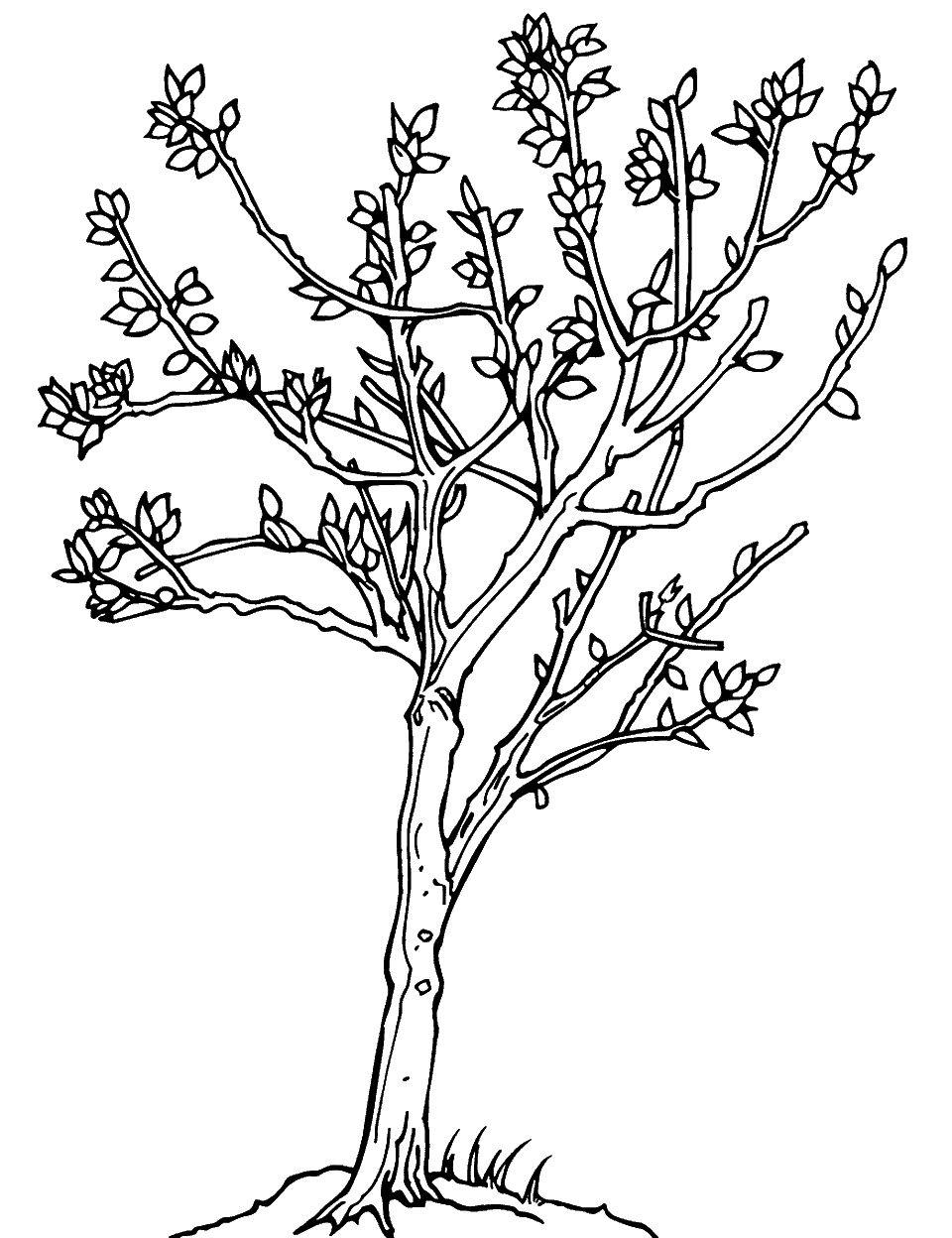
Every branch on this leafless tree splits into finer and finer twigs, right down to hairline tips. There is no foliage to fill, so the interest sits in the bark and the low mound of earth at the base. Older kids can shade the trunk dark at one edge and light at the other and leave the sky blank for contrast. Print a few extra copies if you want to try the four seasons project further down the page.
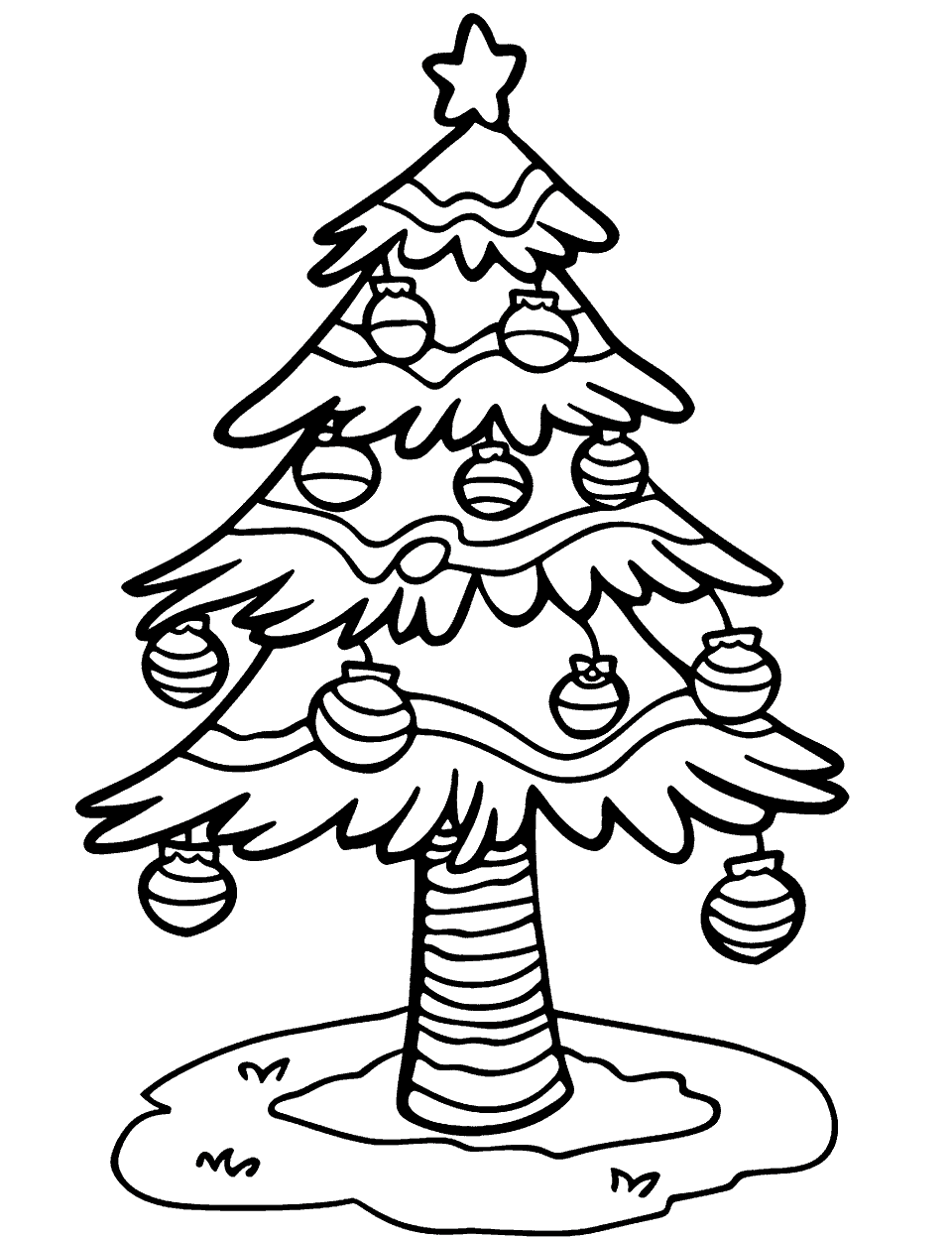
A star sits at the very top of this tiered tree, with round ornaments hanging along the branches and a swag of garland looped across each layer. The trunk is a striped cylinder standing on a plain oval base. Ornaments are the fun part, so let every one be a different color instead of matching them up. See our Christmas tree collection if this is the sheet your child keeps asking to print again.
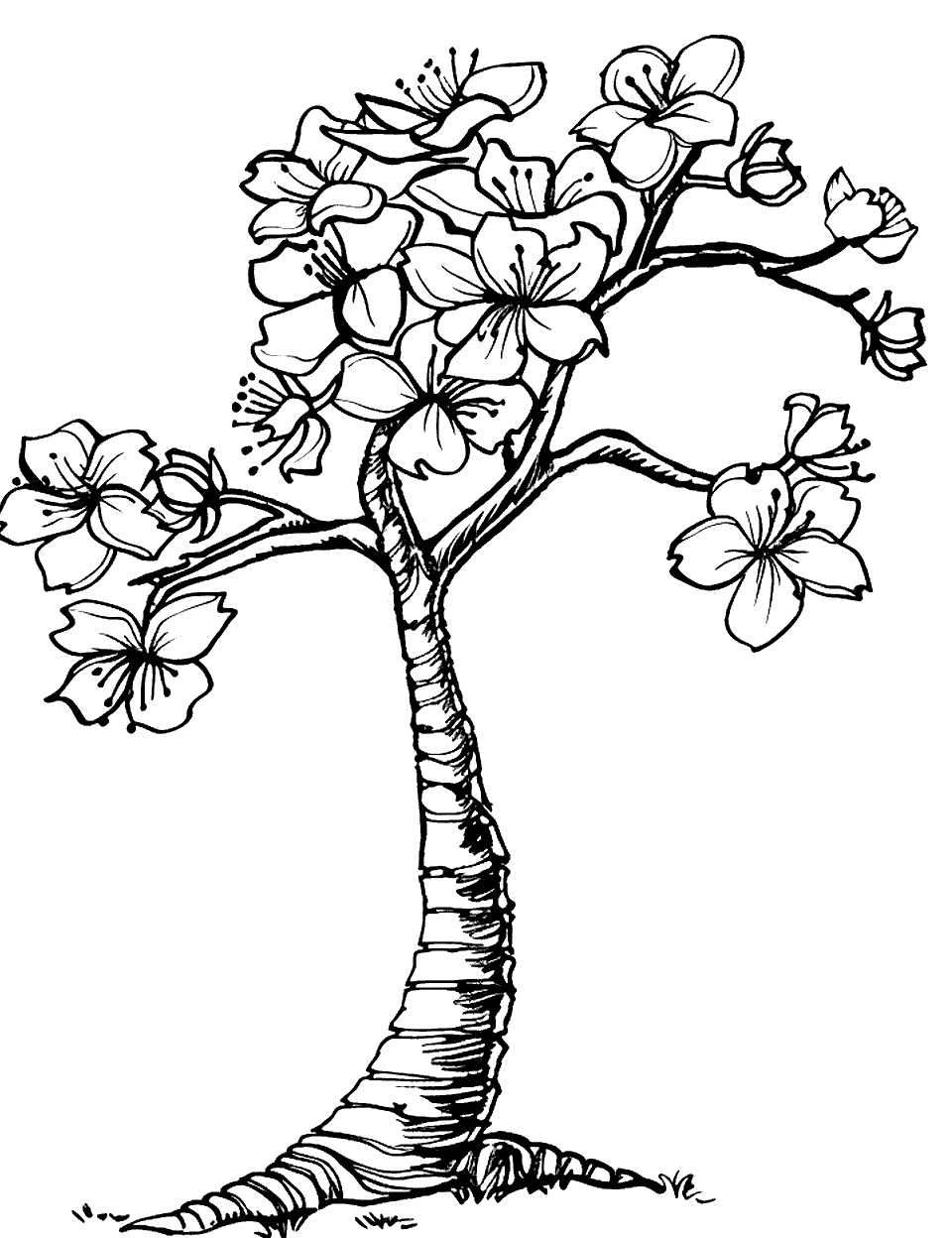
Wide open blossoms sit along the branches of this cherry tree, each flower big enough to color petal by petal. The trunk is drawn with tight horizontal banding that suits a soft grey or a warm brown. Pale pink on the outer petals with a deeper pink at the centers gives real depth without much effort. Our flower coloring pages pick up where this one leaves off.
Small buds and new leaves dot the thin branches of this young tree, with plenty of white space between them. That openness makes it a calm page for a child who gets overwhelmed by busy scenes. Fresh yellow-greens on the new growth read as early spring far better than a deep forest green does. It pairs neatly with our spring coloring pages.
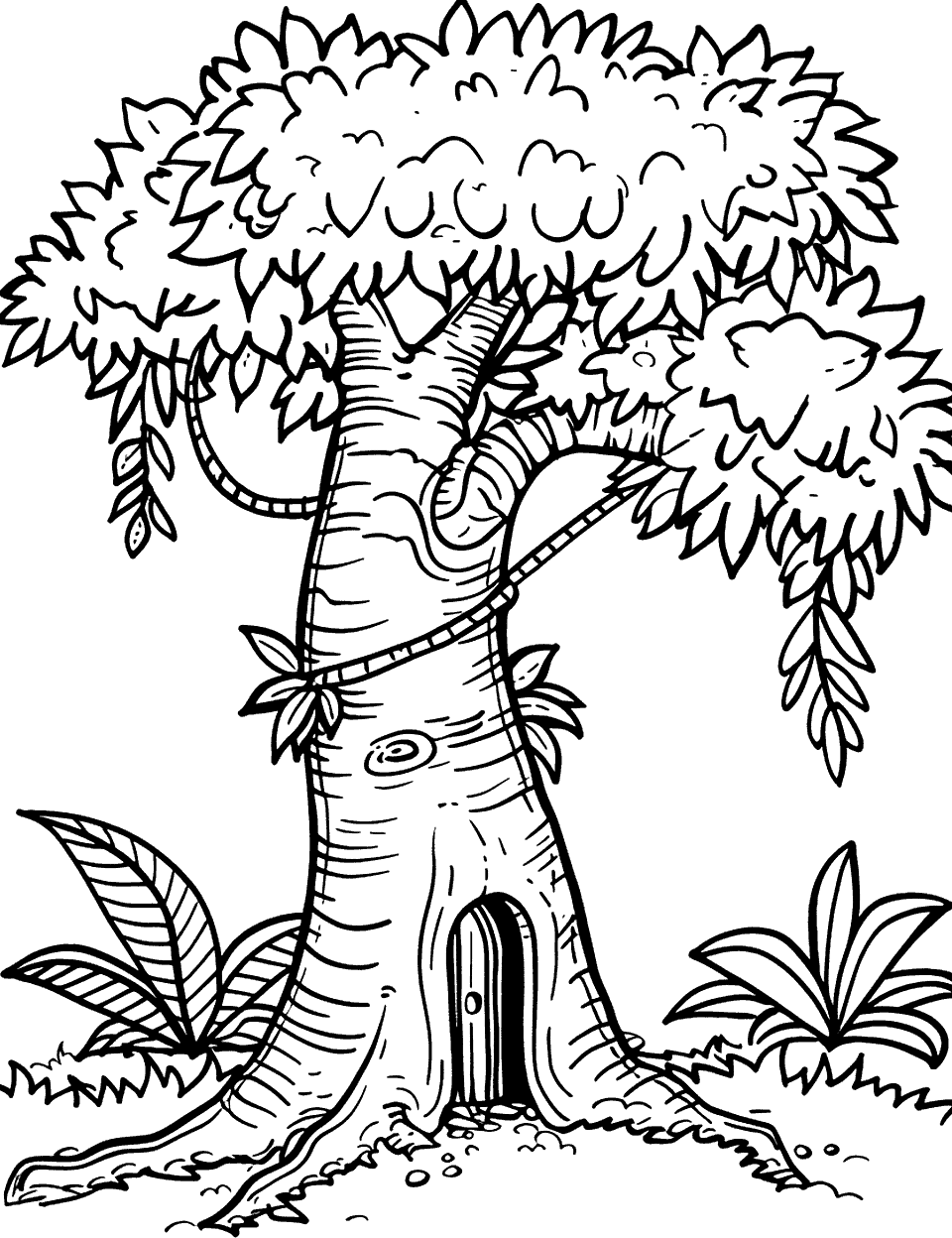
A small arched door is set into the base of this trunk, complete with a round handle. Broad leaves and ferns crowd around the roots, and a thin vine winds up the bark. There is a lot happening in a small space, so save it for a child with patience. Metallic or gel pens on the door make it look genuinely magical against a plain brown trunk.
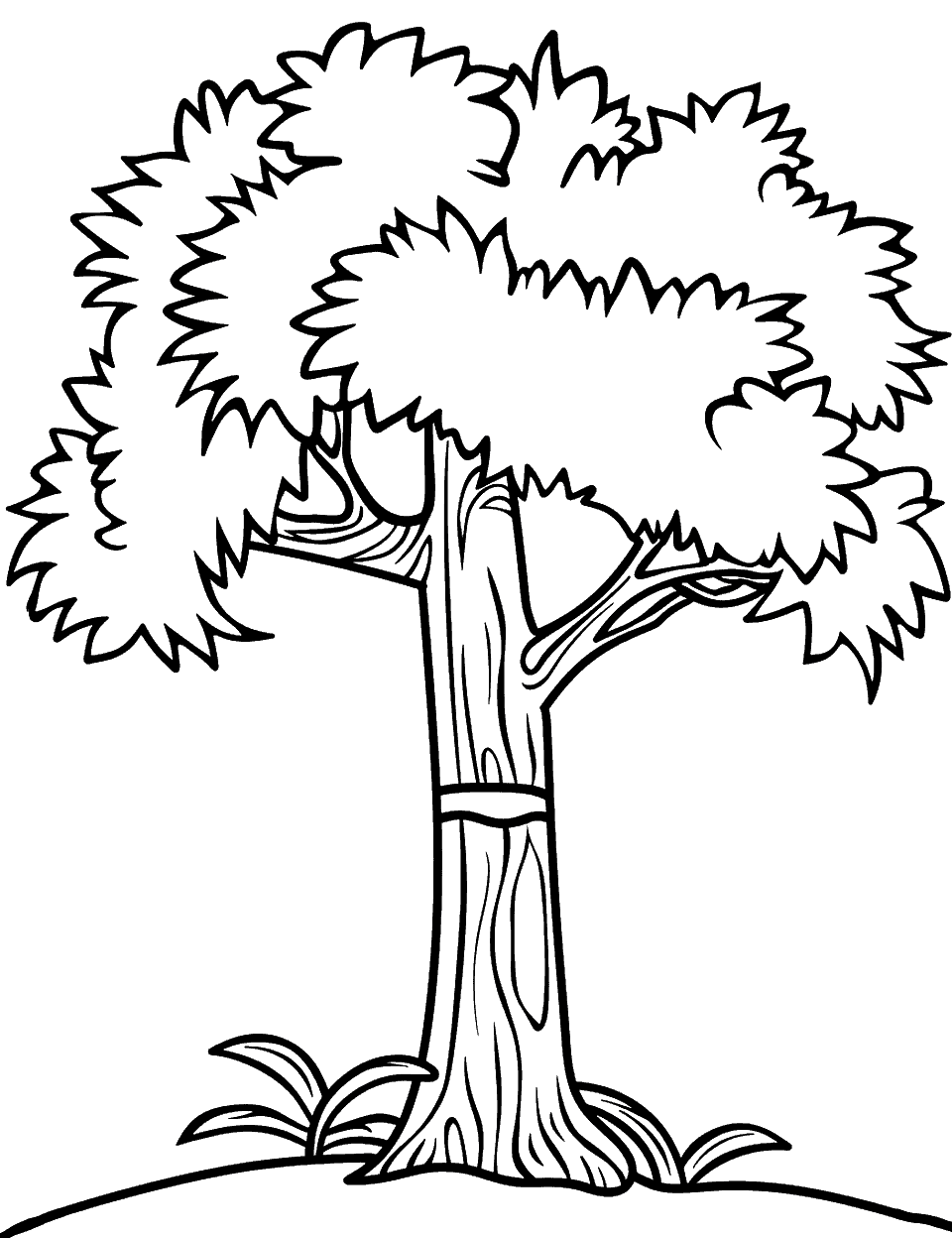
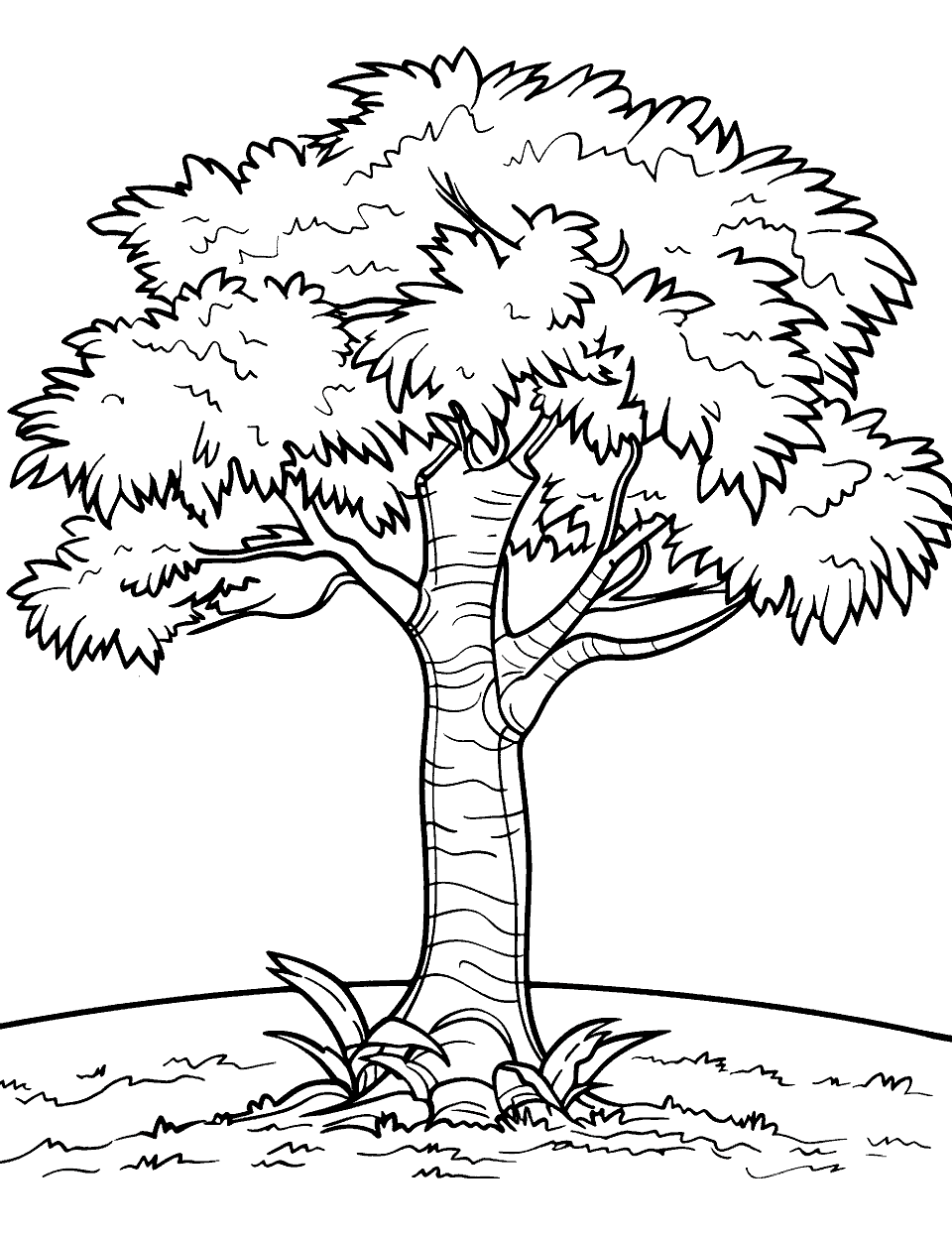
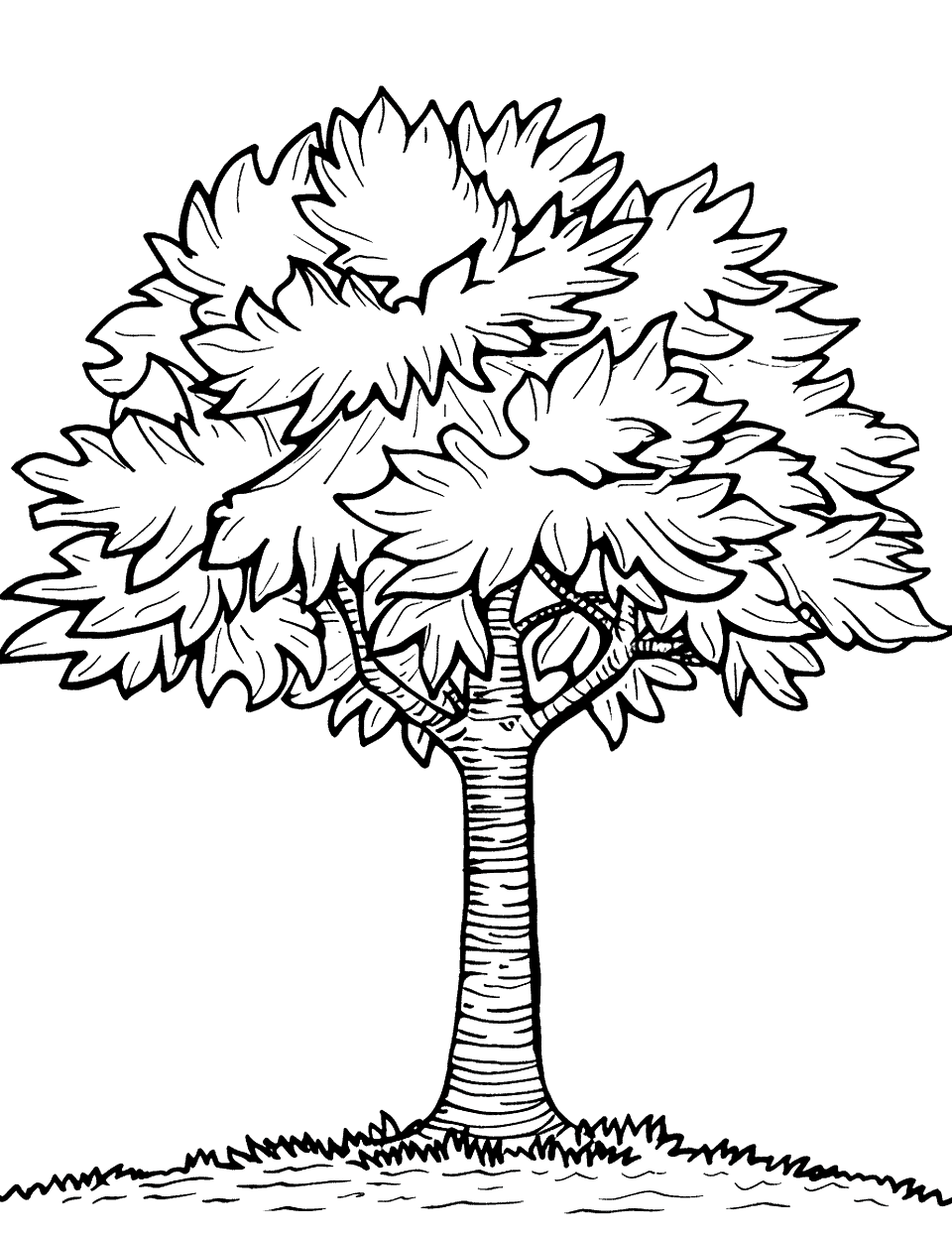
This oak rises on a single trunk that forks into heavy limbs partway up, and the canopy above them is drawn as ragged, feathery clumps. Grass sprouts around the base and the horizon curves gently behind it. Leaving a few clumps lighter than the rest suggests sunlight hitting the top of the tree. A good middle-difficulty sheet for kids who have outgrown chunky outlines.
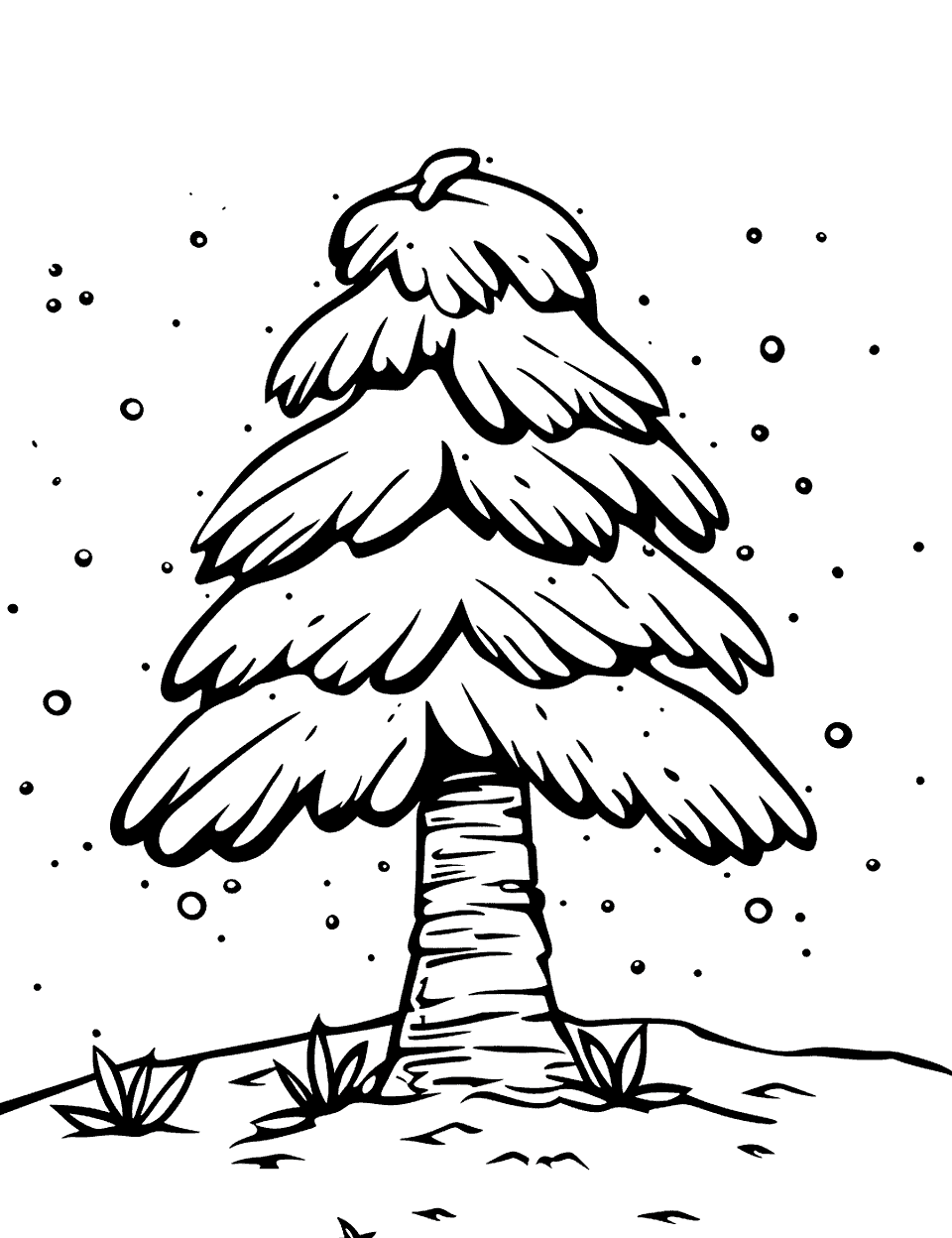
Snow-laden boughs stack up in wide tiers on this fir, and dots of falling snow fill the air around it. The trunk is short and banded, with small plants poking through at ground level. Leave the tops of the boughs white and color only the undersides for an easy snow effect. This one prints well on heavier paper if you plan to add glitter glue.
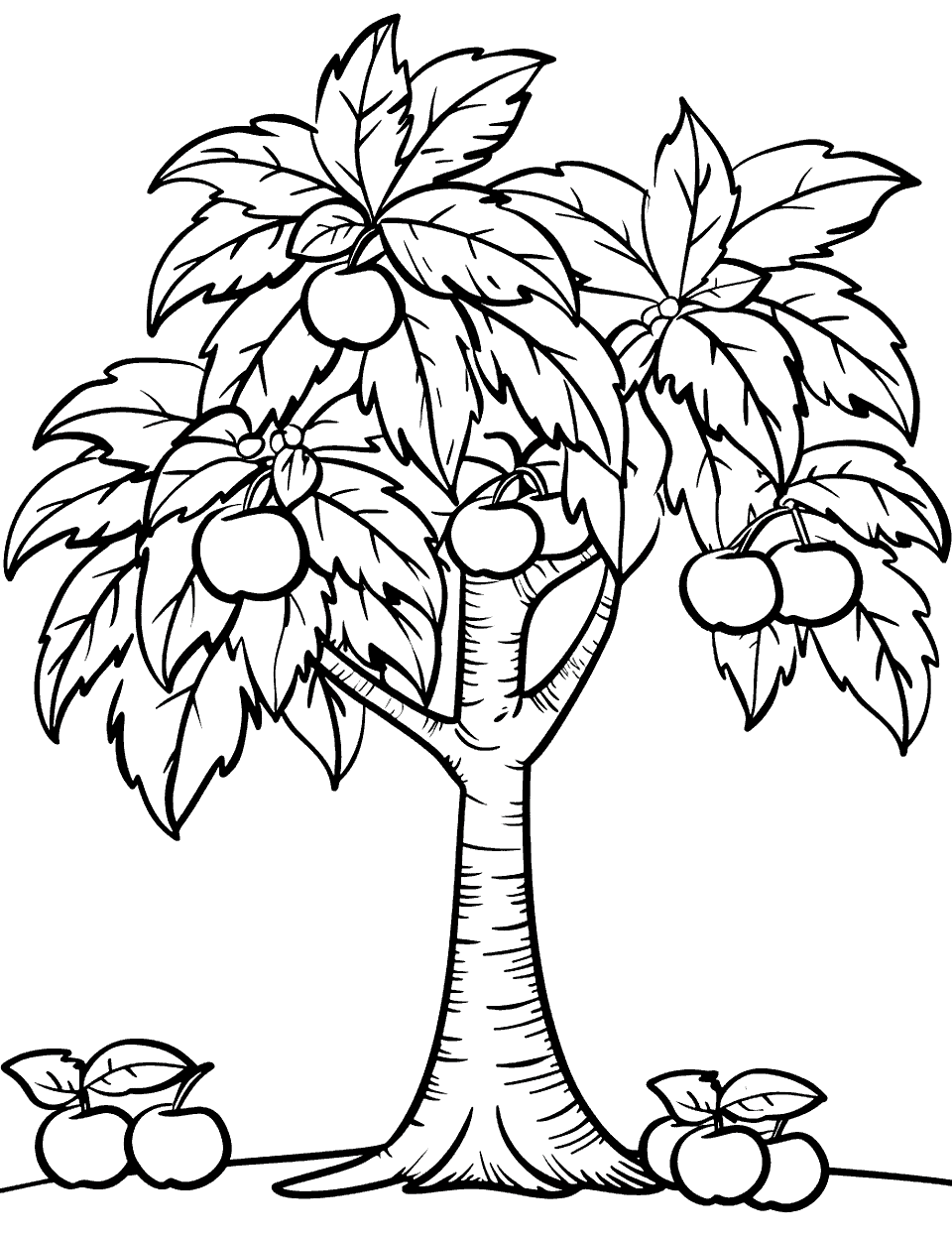
Round fruits hang in small clusters among big veined leaves, with more resting on the ground on either side of the trunk. The leaves have their center veins drawn in, which gives older kids something to shade around. Reds and yellows mixed across the same tree look more natural than making every apple identical. Our apple coloring pages make an easy follow-up.
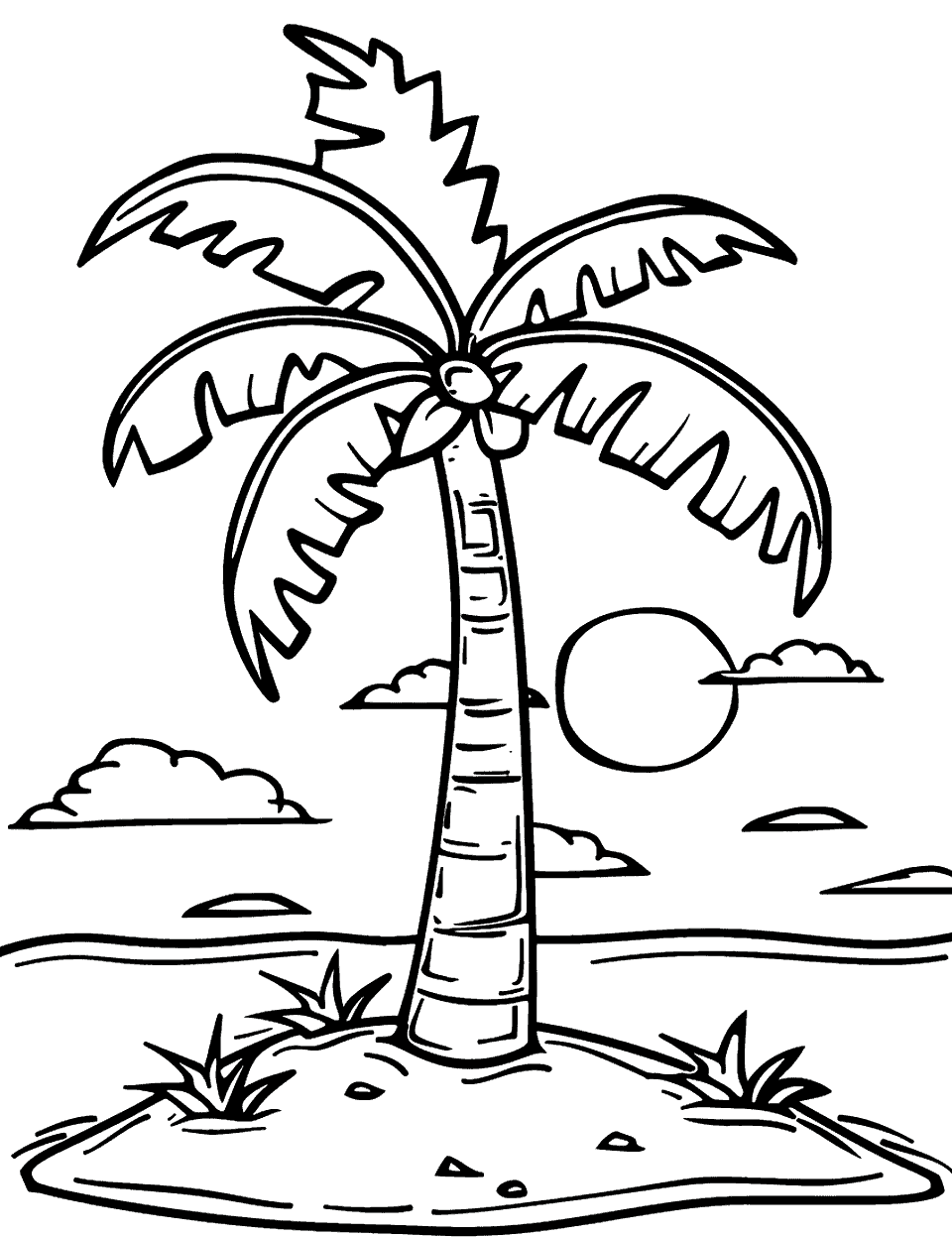
A single palm leans over a small sandy island with the sun sitting low behind its fronds. Simple wave lines mark the water, and a few clouds float off to the side. The fronds are long jagged blades, so a green pencil worked in strokes along each blade beats coloring them flat. Orange and pink in the sky turn the whole thing into a sunset.
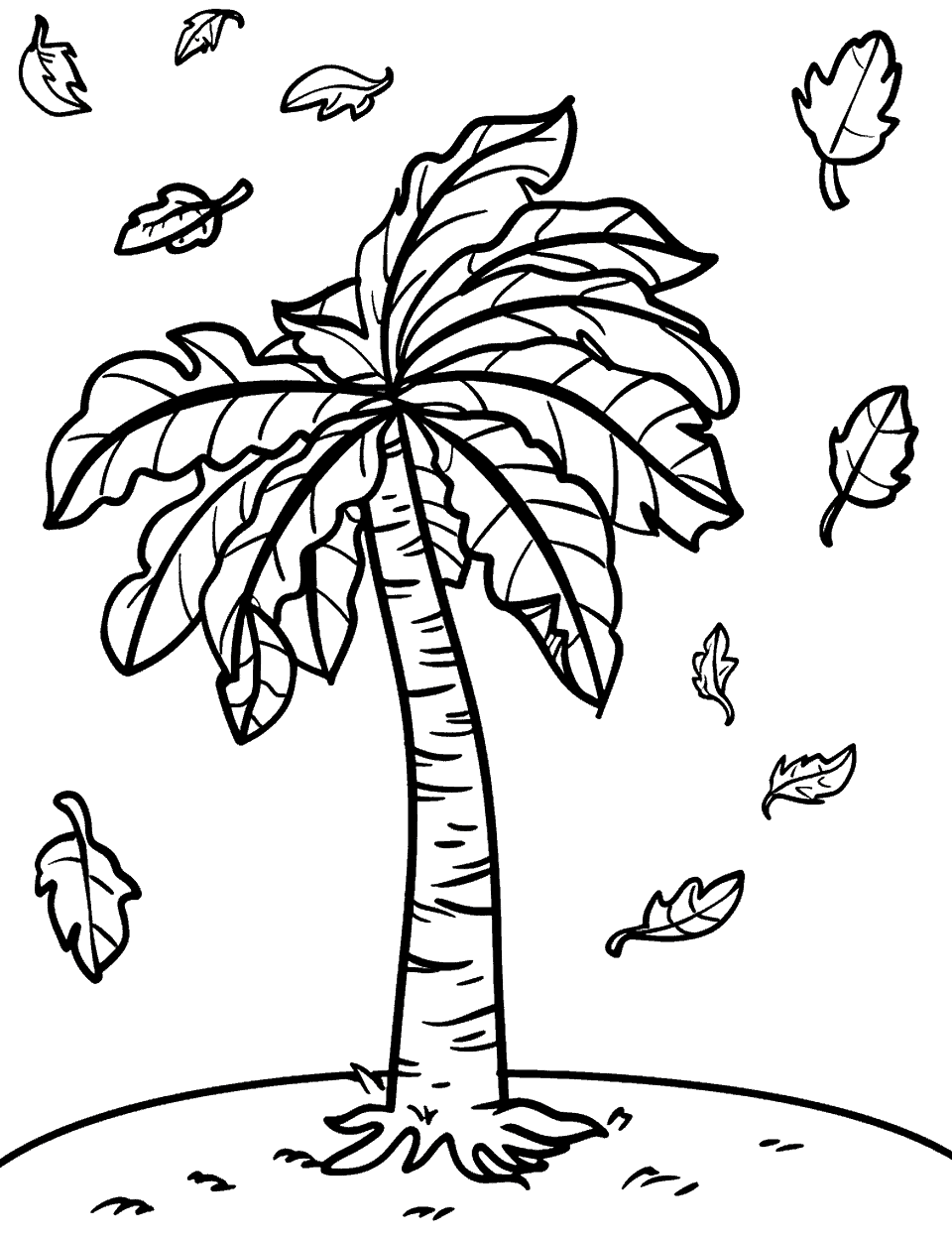
Broad fan-shaped leaves spread out from the top of this slim trunk, and loose leaves of several different shapes float in the air around it. No two of the falling leaves match, which makes a nice sorting game before anyone picks up a crayon. Ask your child to color matching shapes the same color. The trunk’s banding takes a light grey beautifully.
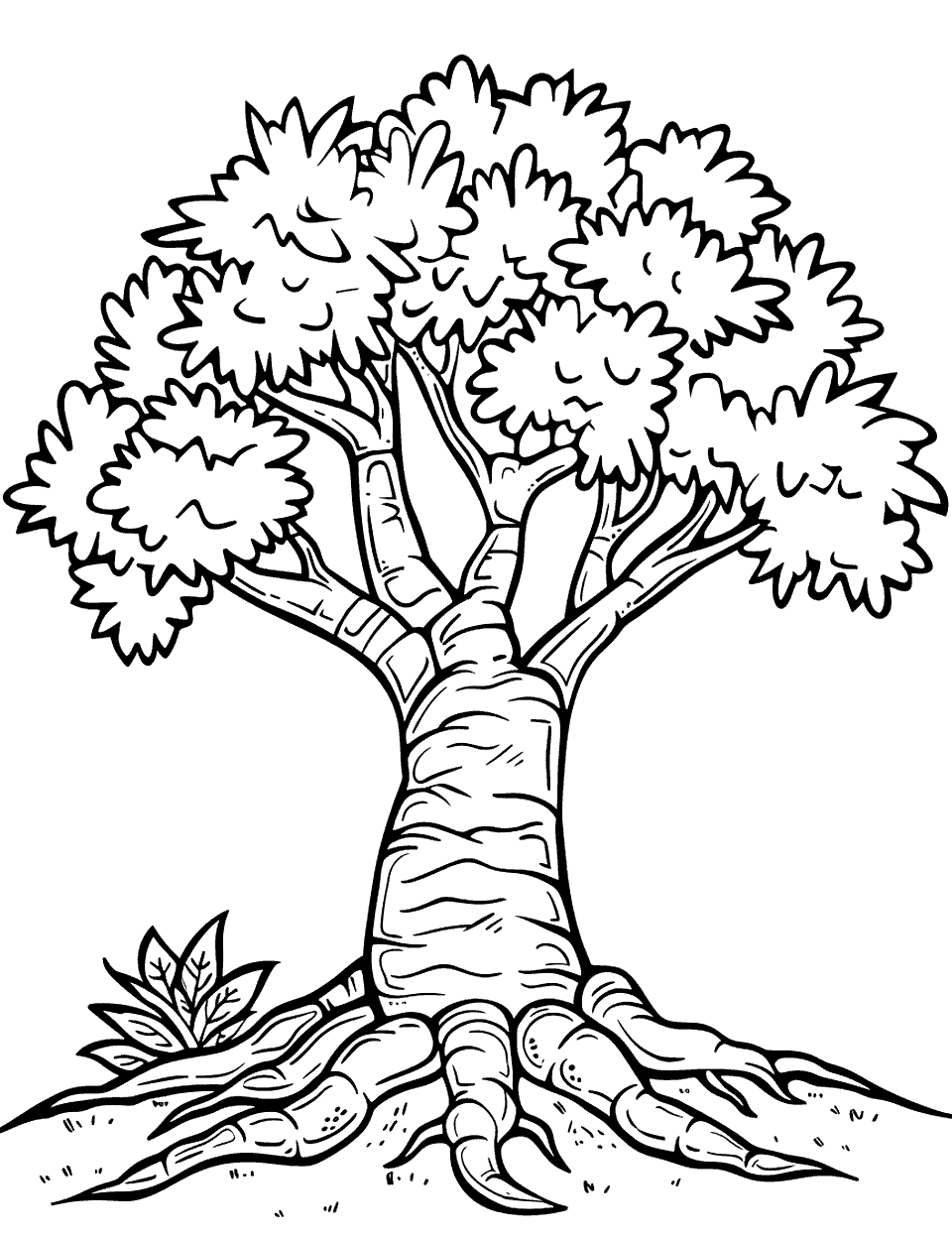
Thick roots break out of the ground and spread across the bottom of this page like fingers. Above them the trunk is broad and heavily textured, and the canopy is drawn as rounded clumps. A small leafy plant tucks in beside the roots on one side. Roots this size are a good excuse to talk about what a tree does underground while you color.
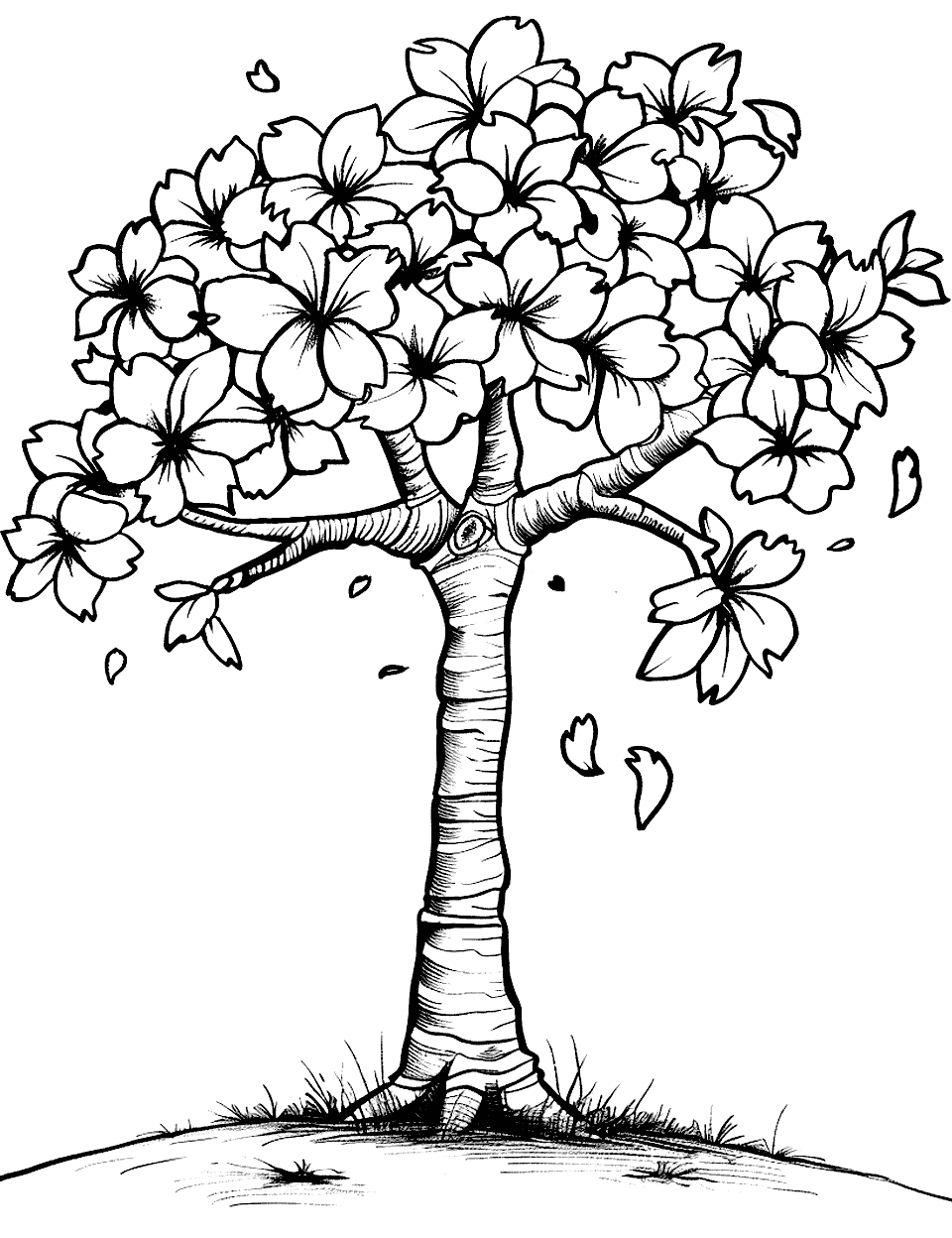
Blossoms pack the whole canopy here, with loose petals drifting down past the trunk. It is the busier of the two cherry sheets in this set, so hand it to an older child or to an adult who wants something absorbing. Varying the pink from almost white at the edges to deep pink at the centers keeps it from going flat. Fine-tip markers reach into the smaller flowers better than crayons do.
Pointed maple leaves fill the entire canopy of this tree, each outlined clearly enough to color on its own. The trunk is banded and the ground is a low strip of grass. Mixing red, orange, and yellow across the leaves rather than blocking them by color gives the best autumn effect. See how many leaves your child finishes before the crayon gives out.
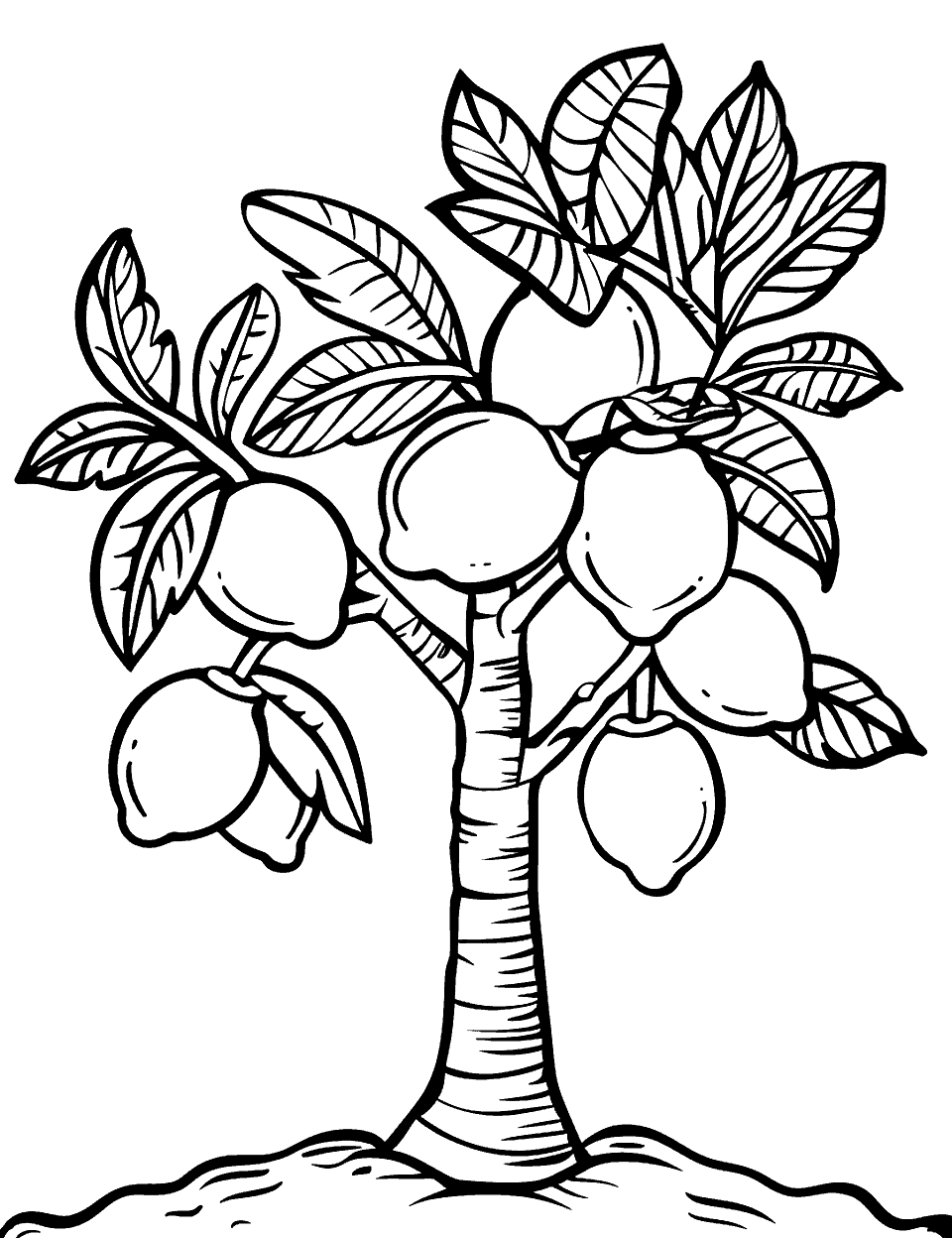
Lemons hang singly and in pairs among long veined leaves on this compact tree. The fruit shapes are simple and there is room around each leaf, so it suits a child still learning to stay inside the lines. Yellow on the fruit and two greens on the leaves is all it needs. It makes a cheerful placemat if you laminate the finished page.
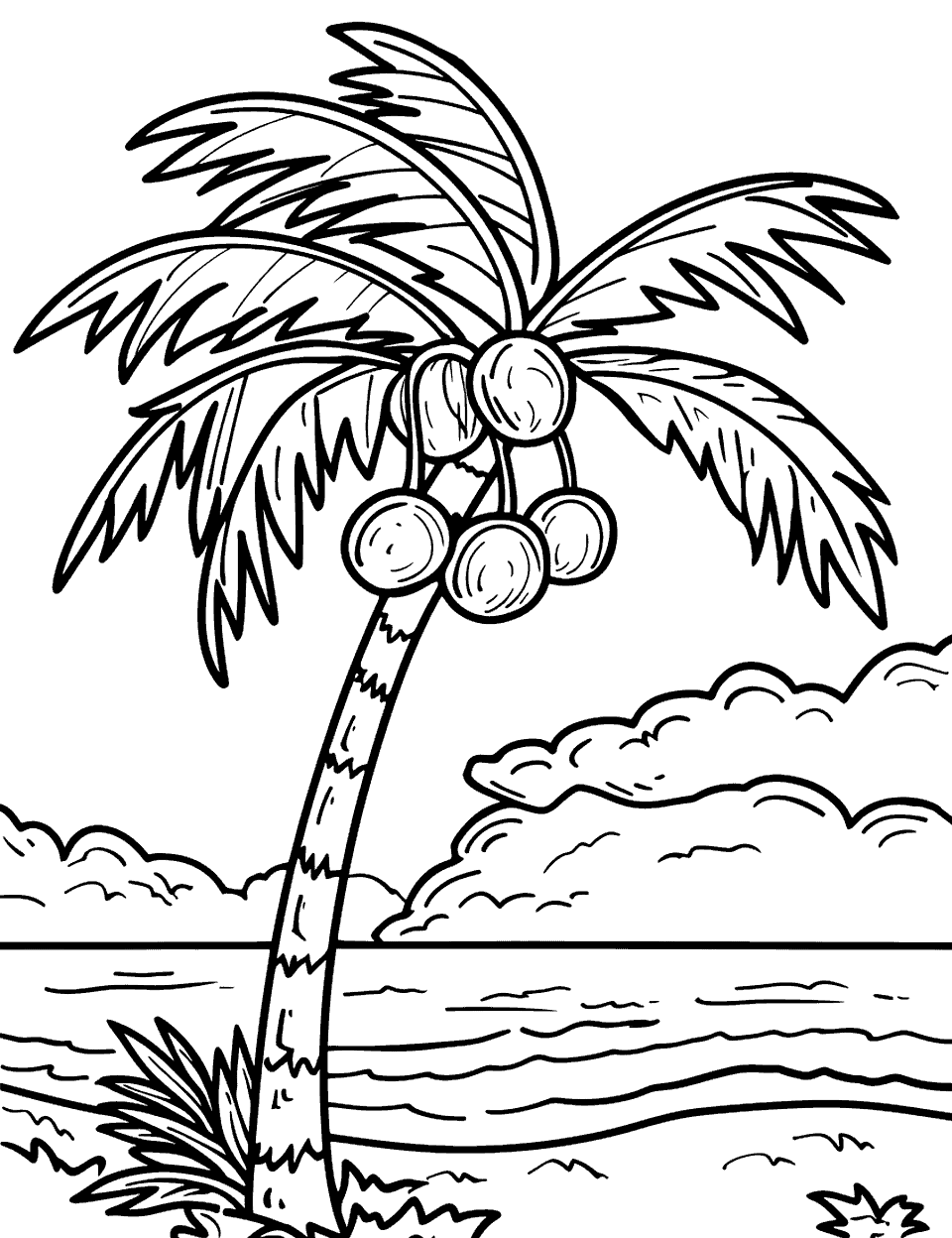
Coconuts cluster tightly under the crown of this leaning palm, with the sea and a bank of clouds behind it. The fronds have sharp saw-tooth edges that catch the eye. Blue for the water, brown for the nuts, and a paler blue for the sky sets the scene quickly. Older kids can add their own boat or bird to the empty sky.
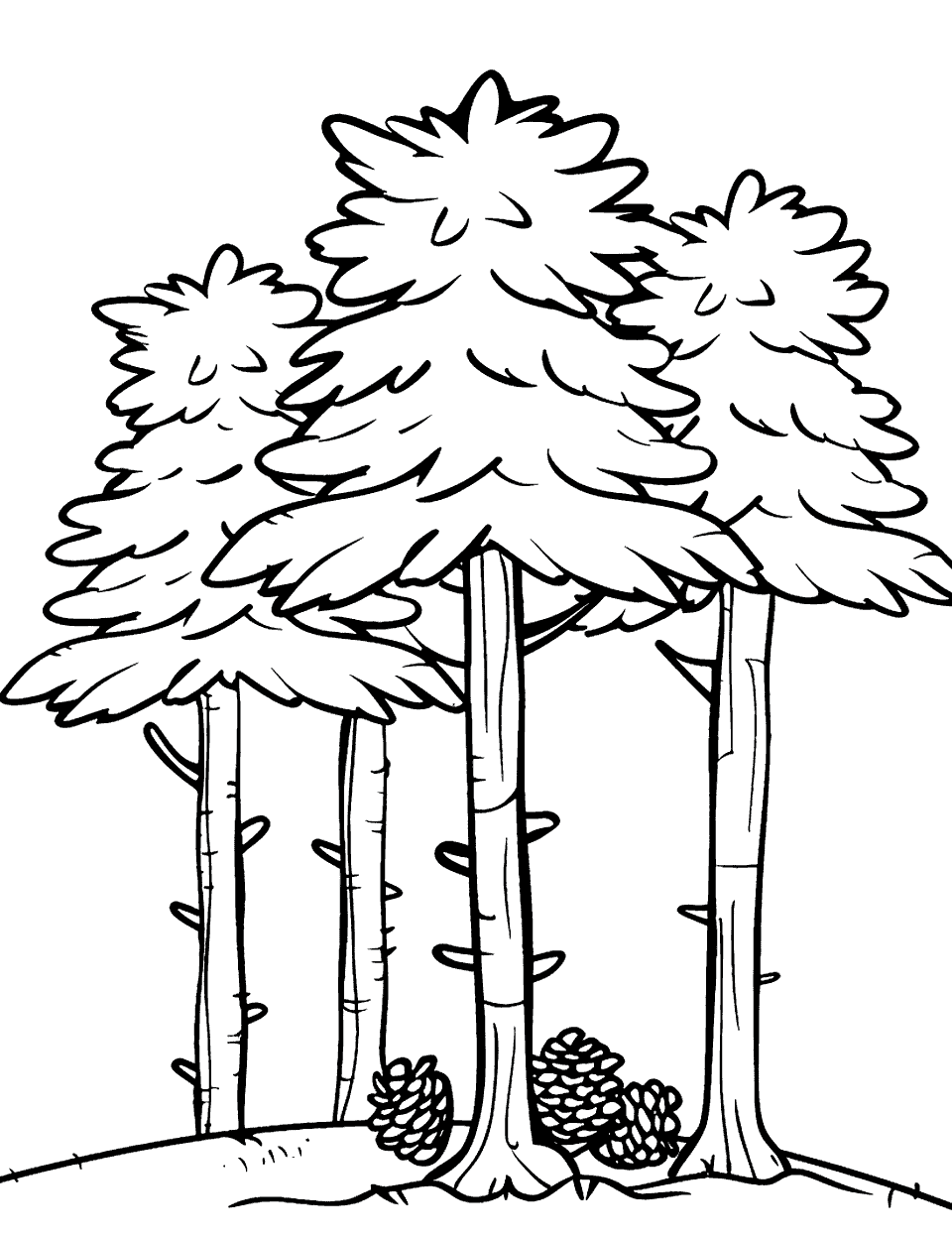
Several conifers stand close together here, their trunks bare until the branches start. Pine cones sit on the ground at the foot of the middle trunk. Using two or three different greens across the trees keeps them from blending into one mass. It is a forgiving sheet, since the shapes are large and the edges are soft.
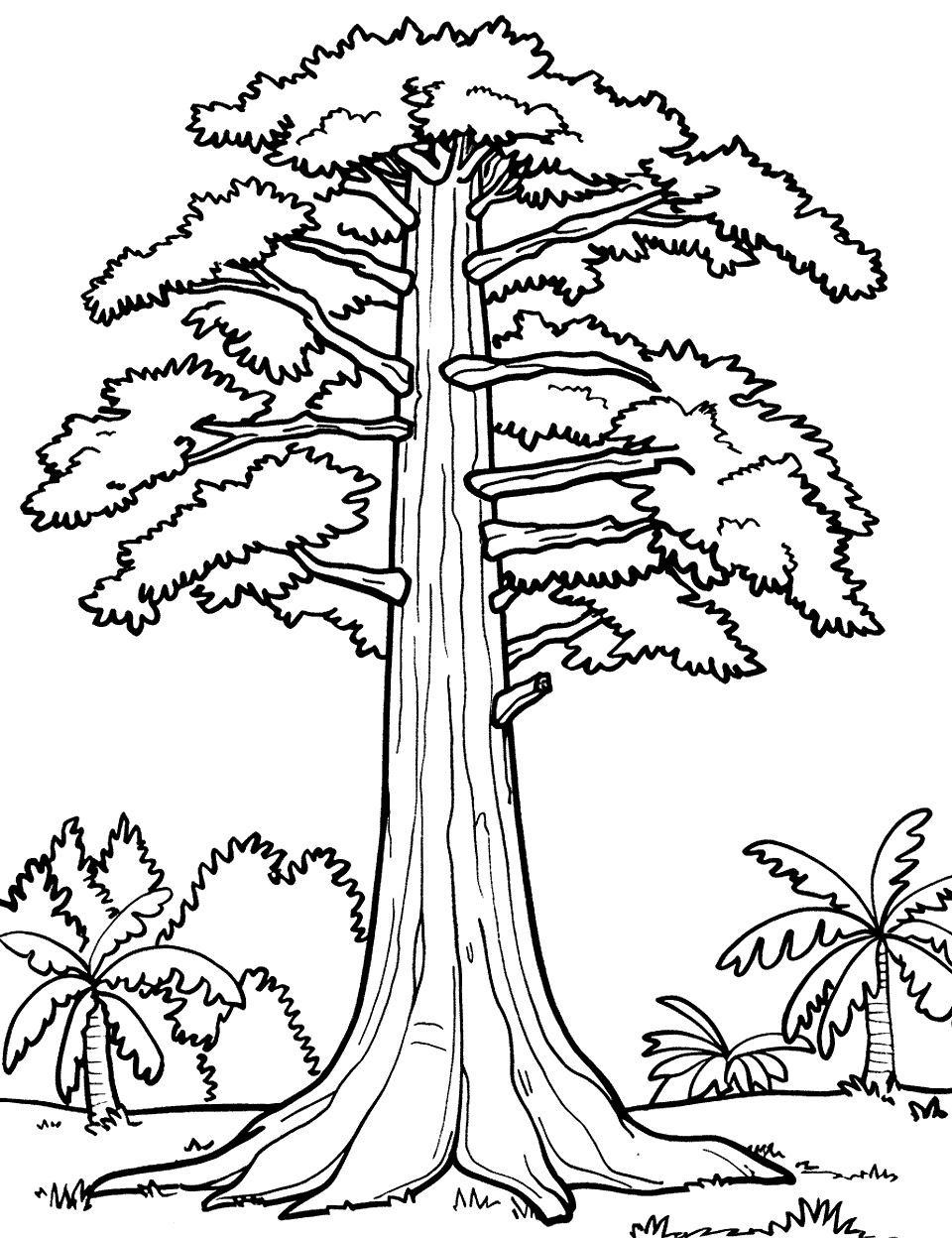
The trunk on this sequoia takes up the middle of the page and carries deep vertical fluting all the way down. Smaller trees and shrubs at its feet are there to show the scale. Reddish brown is the honest choice for sequoia bark, though nothing stops a purple one. If your child asks how big these really get, the facts section below has the numbers.
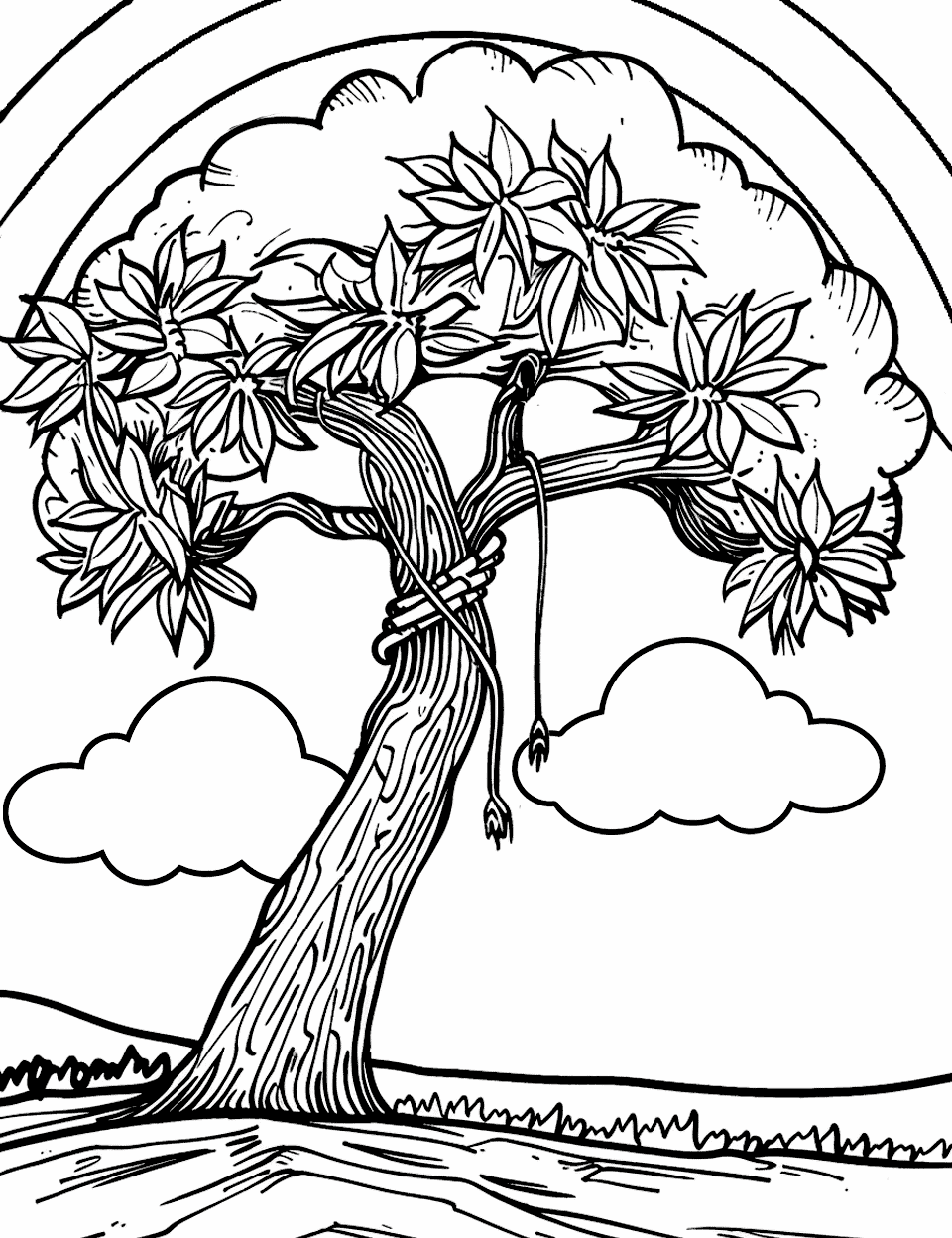
A rainbow arcs behind this leaning tree, and a rope swing hangs from one of its lower branches. Clouds sit on either side and the ground runs in long horizontal lines. The rainbow bands are the obvious draw, so keep the tree muted and let the sky do the work. Our rainbow coloring pages have more if that is the part your child likes best.
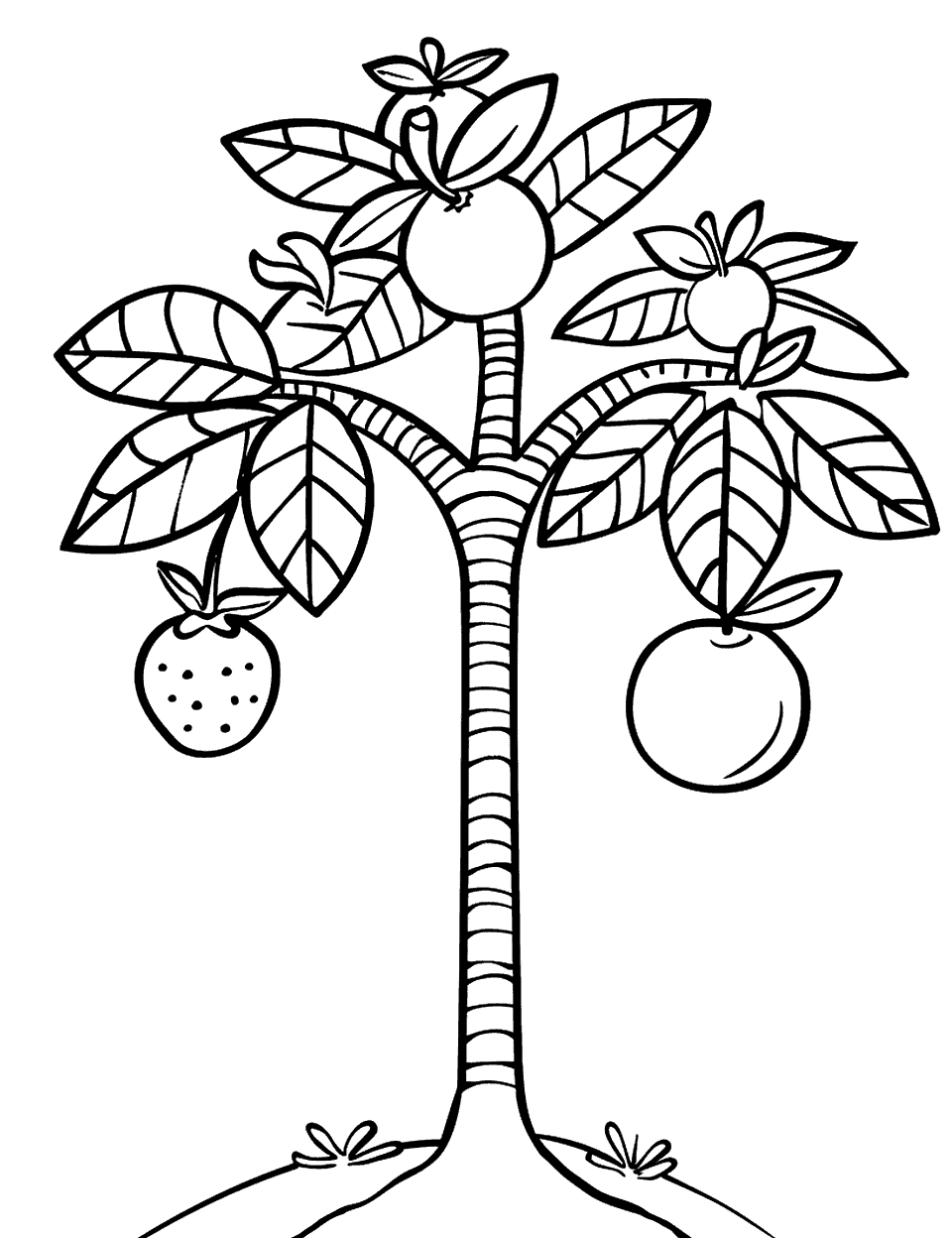
Several different fruits grow on this one slender tree, including a dotted berry and a large round citrus hanging from the lower branches. The trunk is a plain banded column with almost nothing to fill, so the fruit gets all the attention. Coloring each one correctly turns the sheet into a quick naming game. There is more of the same in our fruit coloring pages.
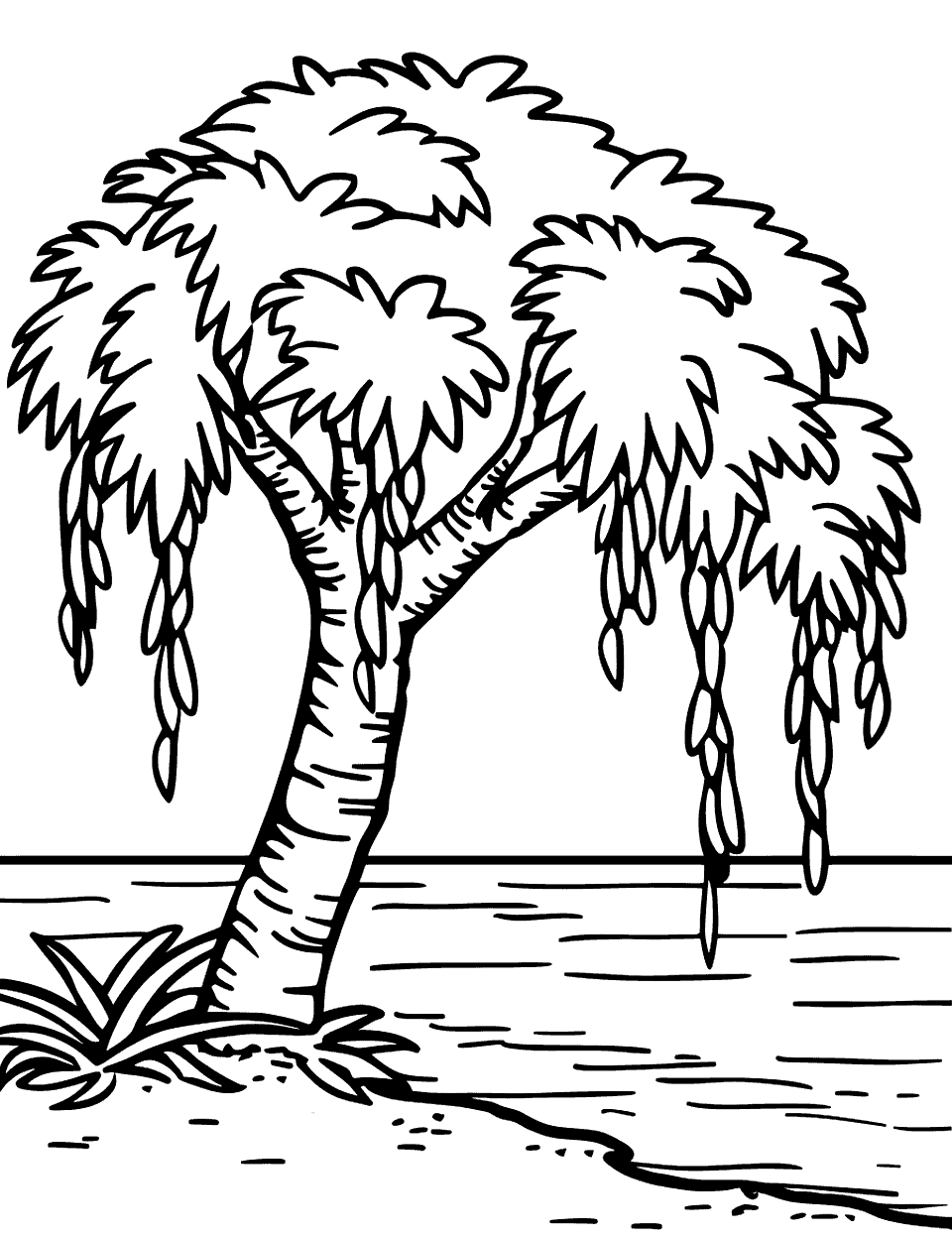
Long strands hang from every branch of this willow and trail down toward the water behind it. Each strand is a chain of small leaf shapes, which takes patience and rewards a fine-tip pen. Sweeping the green from dark at the top to pale at the tips comes closest to the real thing. Horizontal blue lines behind the tree finish the lake in about a minute.
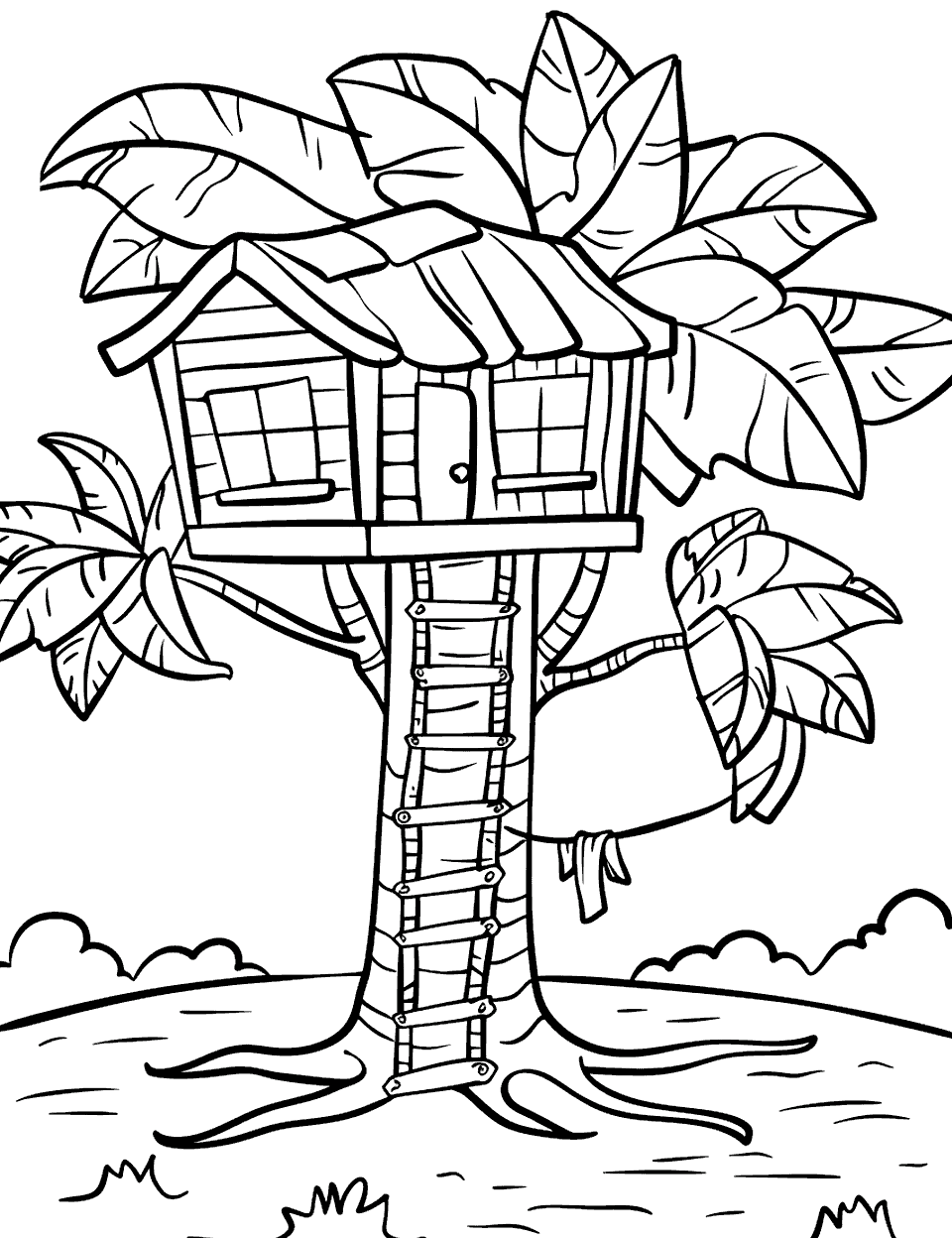
A wooden tree house with a shingled roof and two windows sits partway up this trunk, reached by a ladder fixed straight to the bark. Broad leaves frame it on both sides and the roots spread out below. The plank lines on the roof and ladder are the fiddly part, so it suits steadier hands. Ask your child what they would keep inside, then have them draw it in the window.
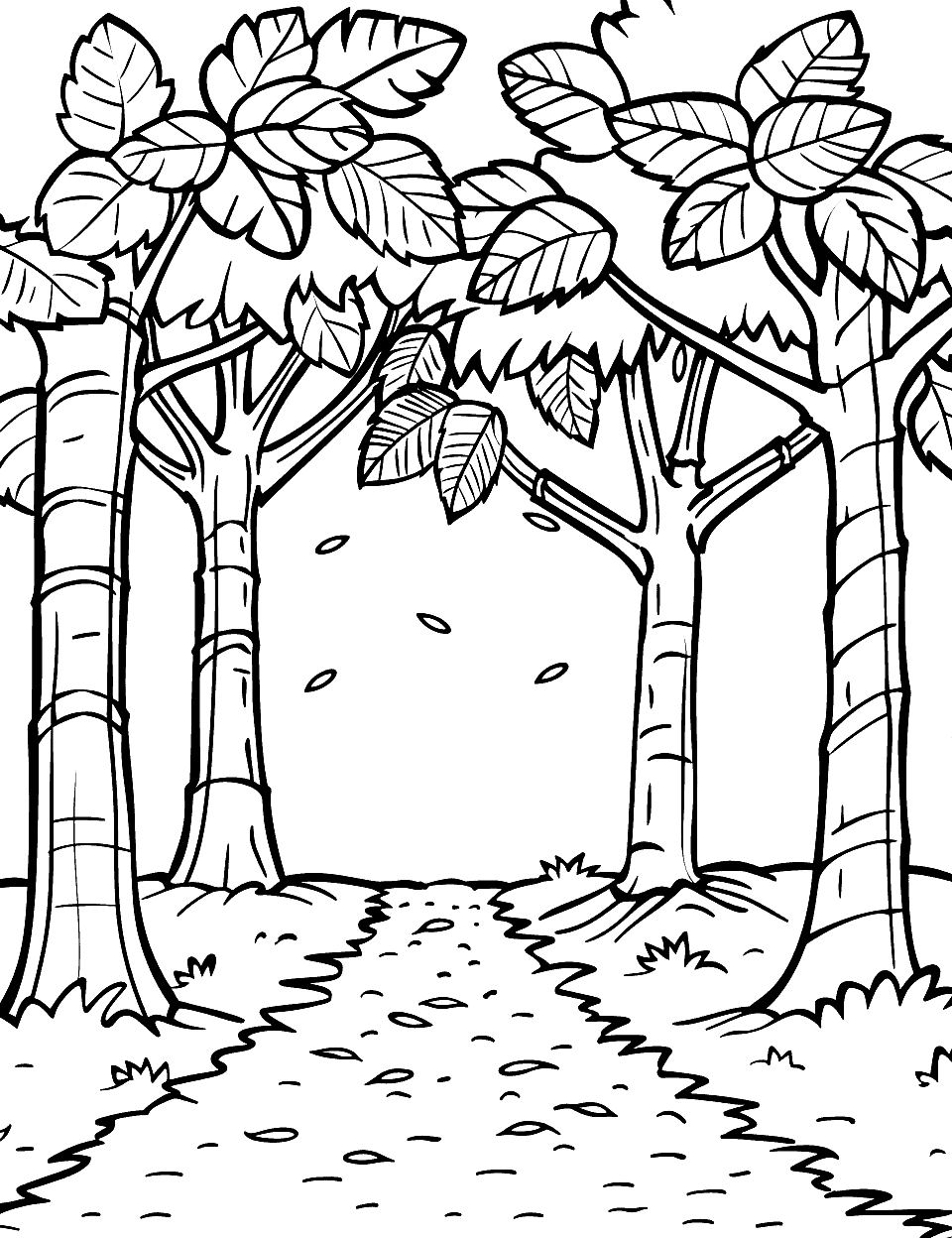
Tall trunks line both sides of a dirt path that runs from the bottom of the page into the distance. Leaves scatter across the path and a few drift down between the trunks. Making the far trees lighter than the near ones is an easy way to teach depth. It is a calm, open sheet that does not take long to finish.
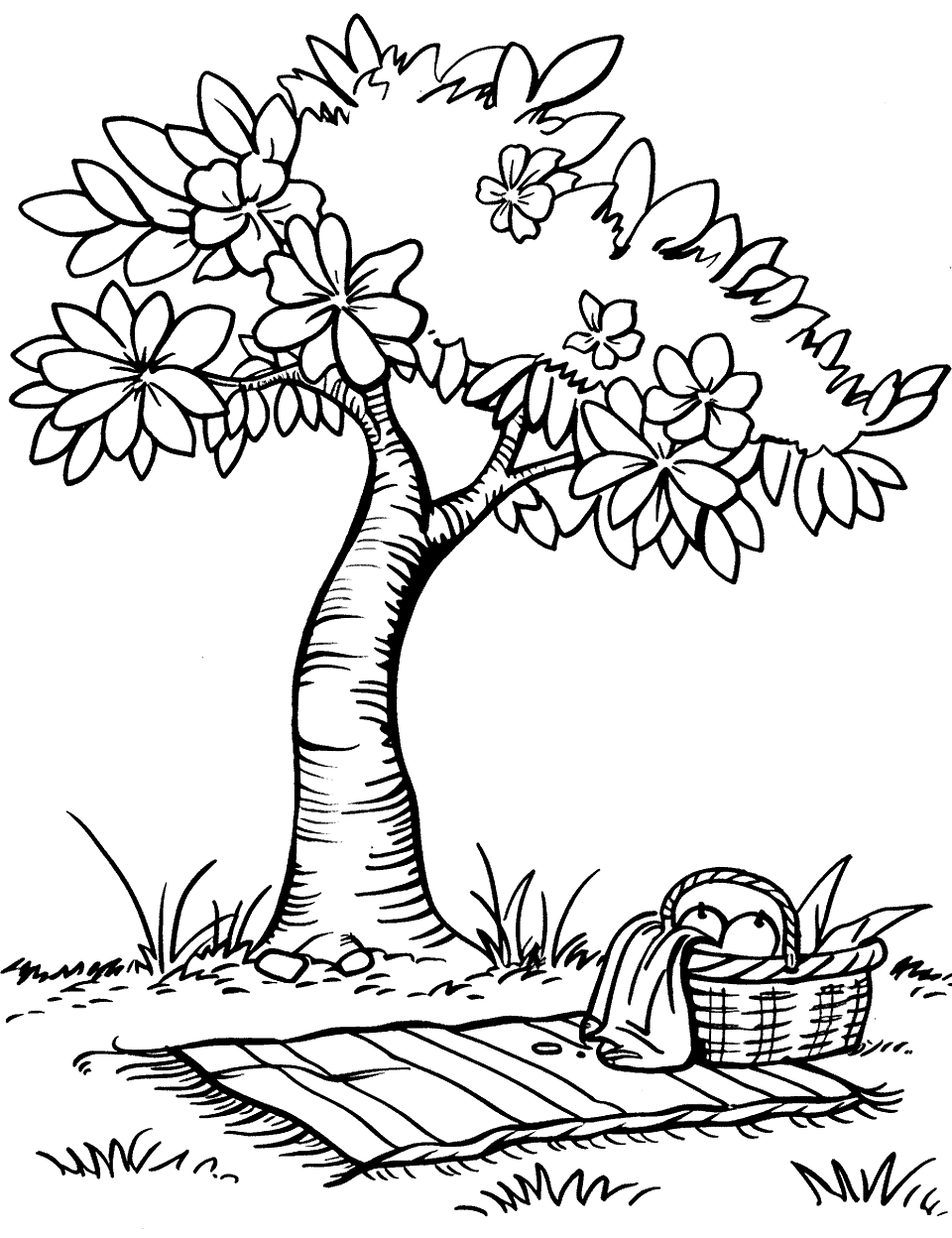
A striped picnic blanket is spread under a blossoming tree, with a wicker basket and a folded cloth on one corner. Grass tufts run along the bottom and the trunk leans over the scene. The blanket stripes are a good place to let a child pick a repeating pattern. Pair it with our spring coloring pages for a picnic-themed printing session.
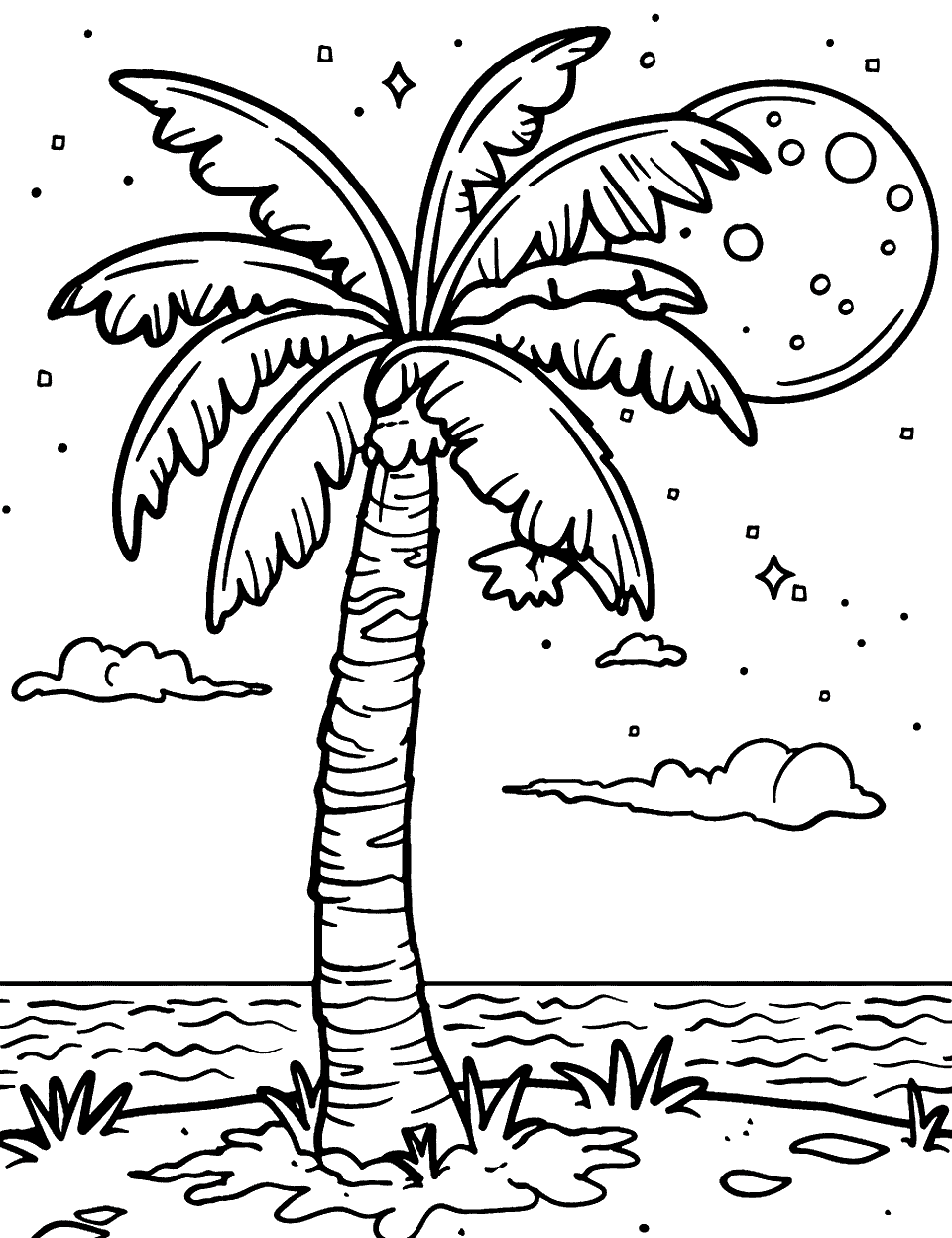
A large moon with visible craters sits just behind the fronds of this palm, with small stars scattered across the sky. Wave lines run along the bottom and clouds break up the space on either side. Leave the moon almost white and press harder on the sky around it for the strongest night effect. Grey and deep blue beat black here, since black swallows the line work.
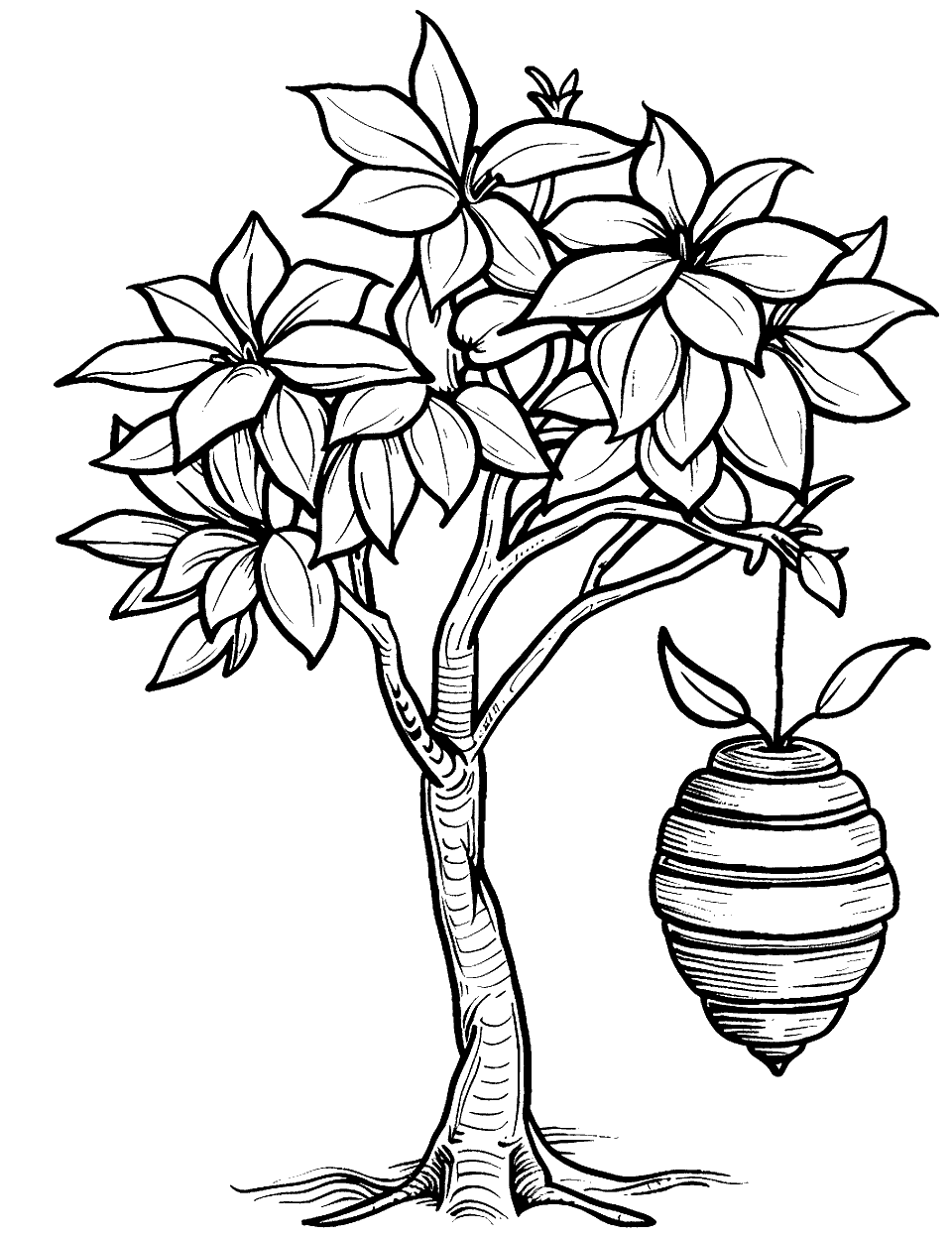
A striped beehive hangs from a branch on one side of this tree, with big pointed leaves and open flowers filling the crown. The hive’s bands are wide and easy to alternate in two shades of yellow. No bees are drawn in, so your child can add their own around it. It is a good page for talking about why bees matter to fruit trees.
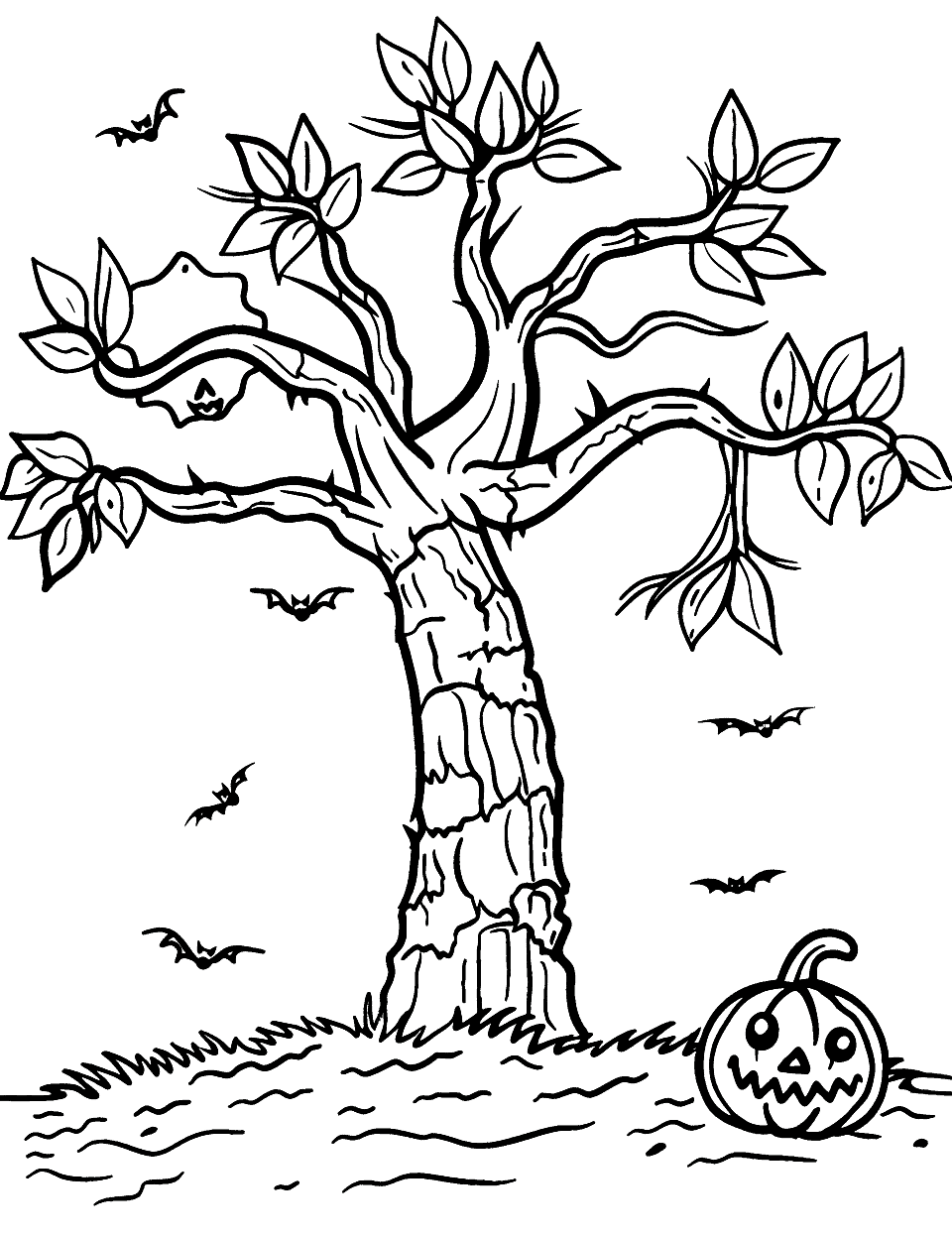
A face peers out from the upper trunk of this twisted tree, and a jack-o’-lantern grins on the ground beside it. Bats cross the sky above and thin vines wrap around the branches. Orange for the pumpkin against a grey trunk and a dark sky is the classic combination. See our Halloween coloring pages if you are putting together a party pack.
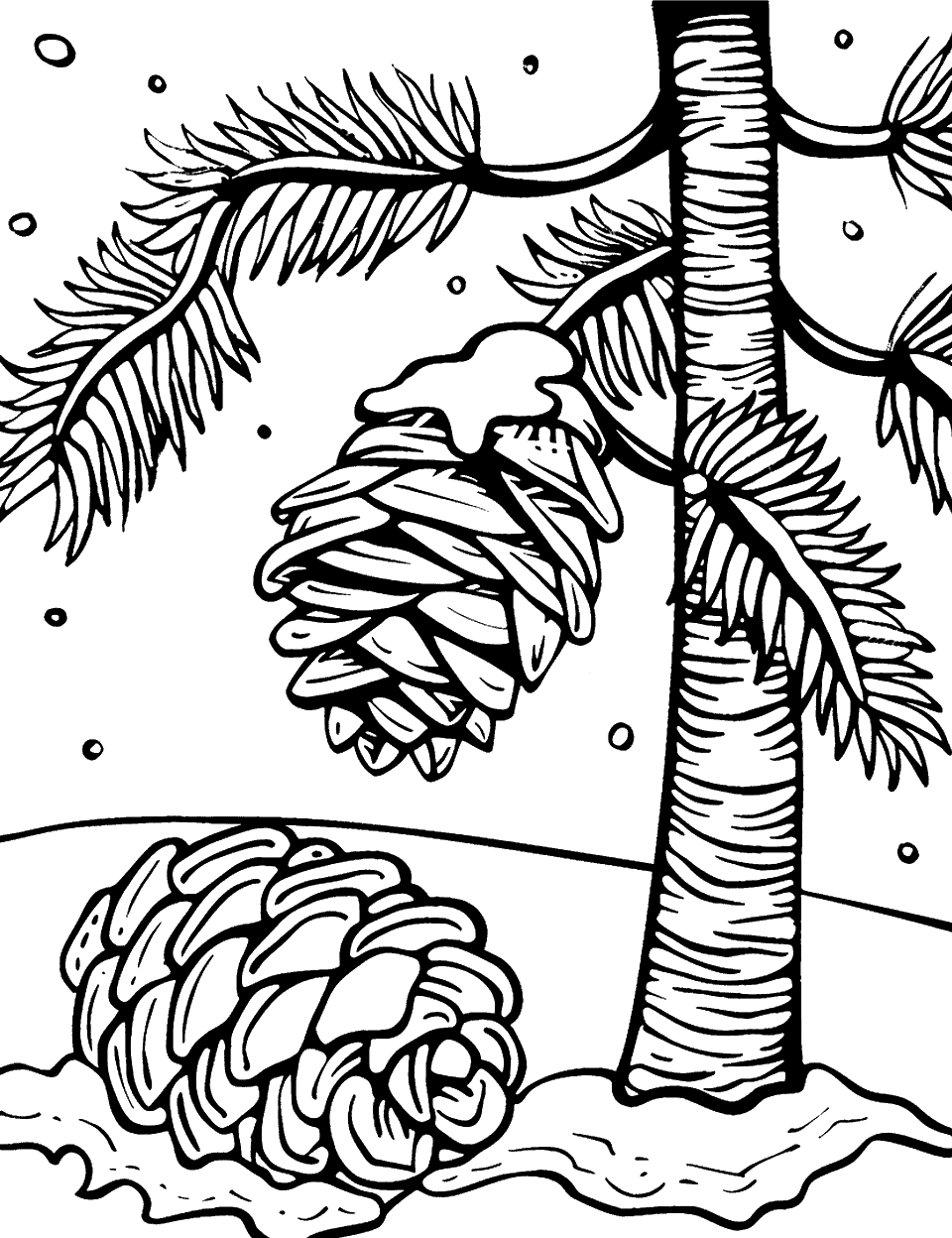
This one zooms in close: a large cone hangs from a pine branch while another rests on the snowy ground below. The scales overlap in neat rows, which makes them satisfying to shade one by one. Browns layered from light to dark give the cones real dimension. Because the shapes are big, it also works nicely as a watercolor page.
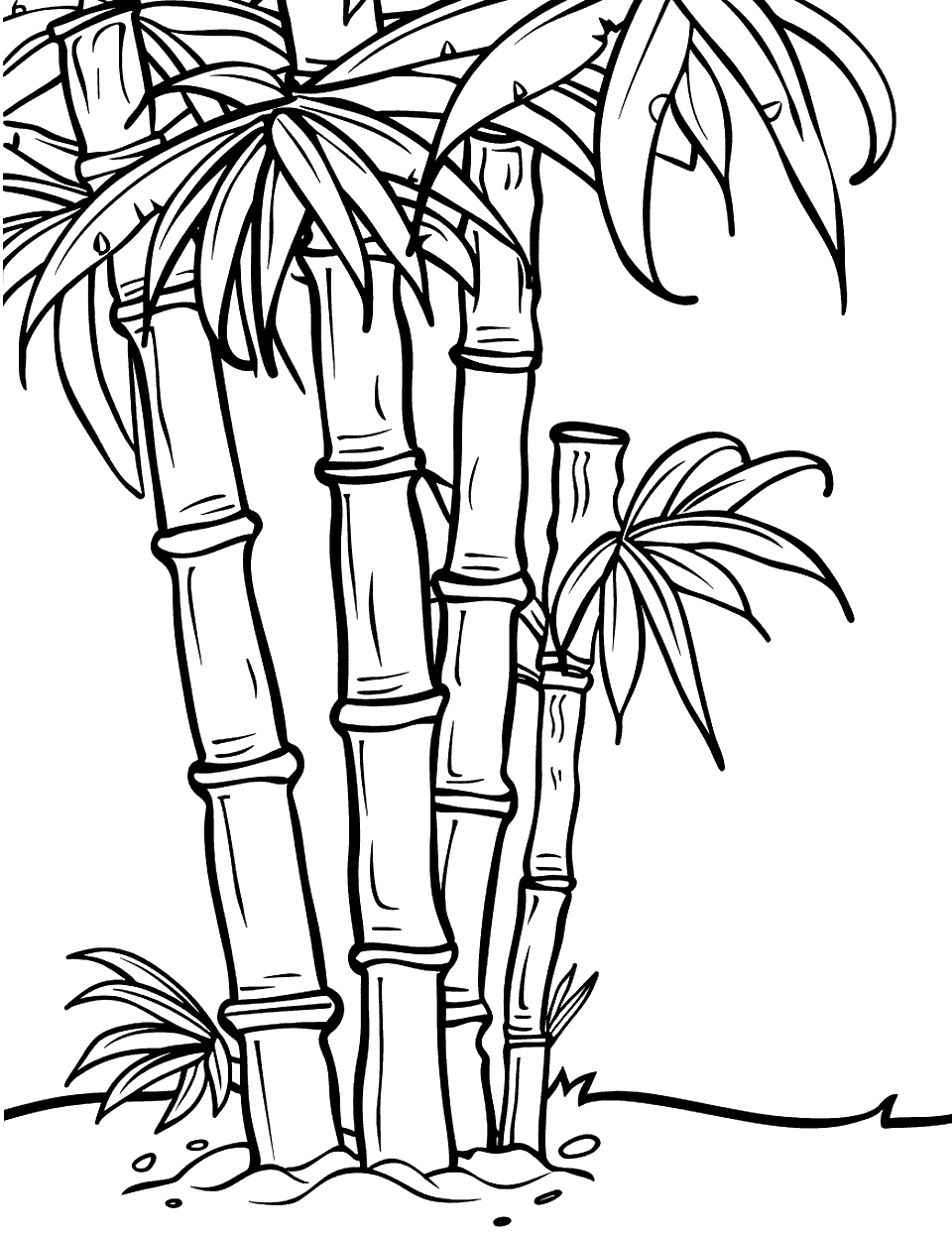
Segmented bamboo stalks rise straight up the page with narrow leaves fanning out at the top. The joints between segments give the stalks their rhythm and are worth outlining in a darker shade. Yellow-green on the stalks and a deeper green on the leaves reads as real bamboo. The tall, narrow layout makes this a good bookmark once it is cut into strips.
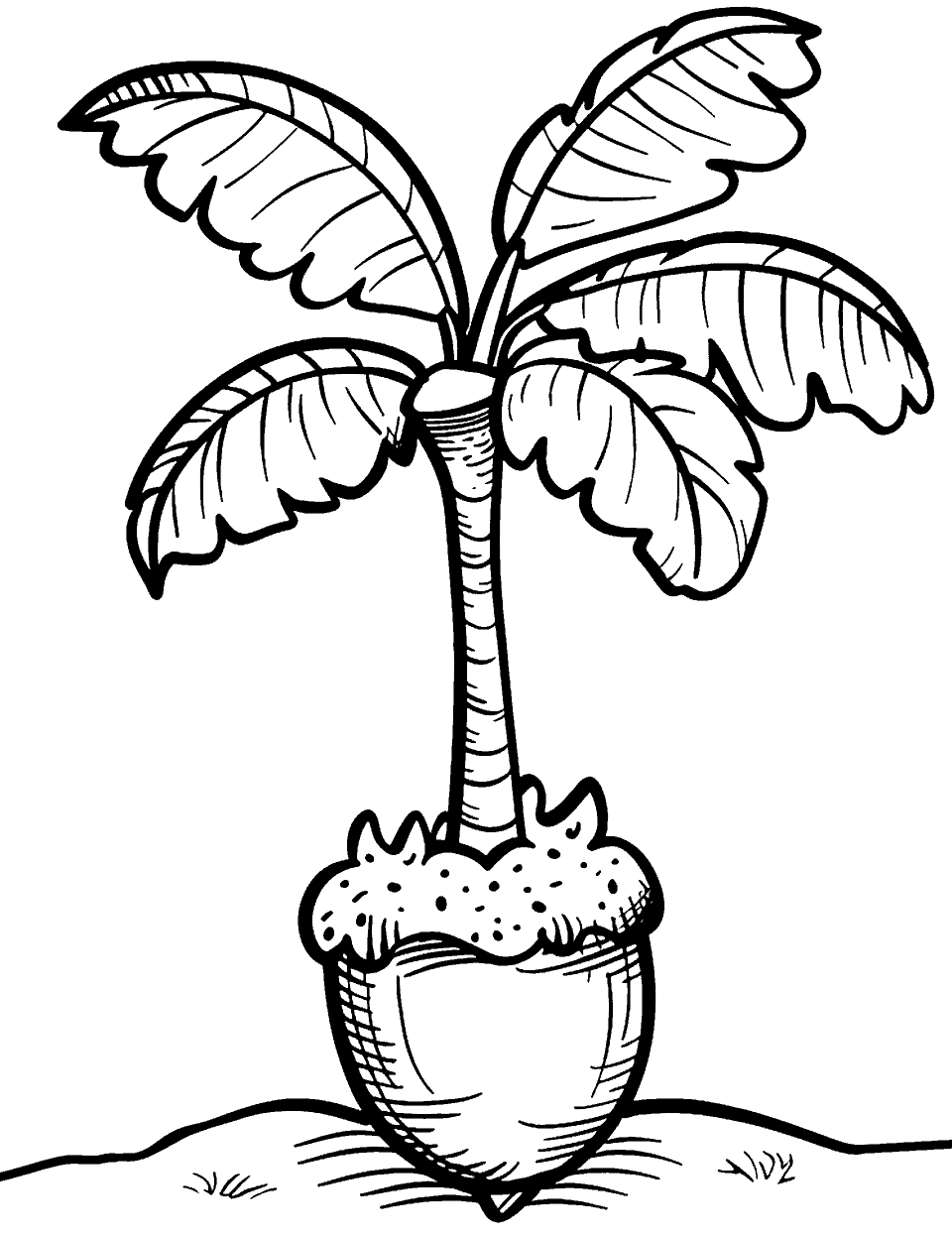
An oversized acorn sits on the ground with a young tree growing straight out of the top of it. The cap has a rough dotted texture and the new leaves are broad and simple. Brown on the shell with bright green above makes the point of the picture obvious. It is a nice sheet to color before planting something in a cup on the windowsill.
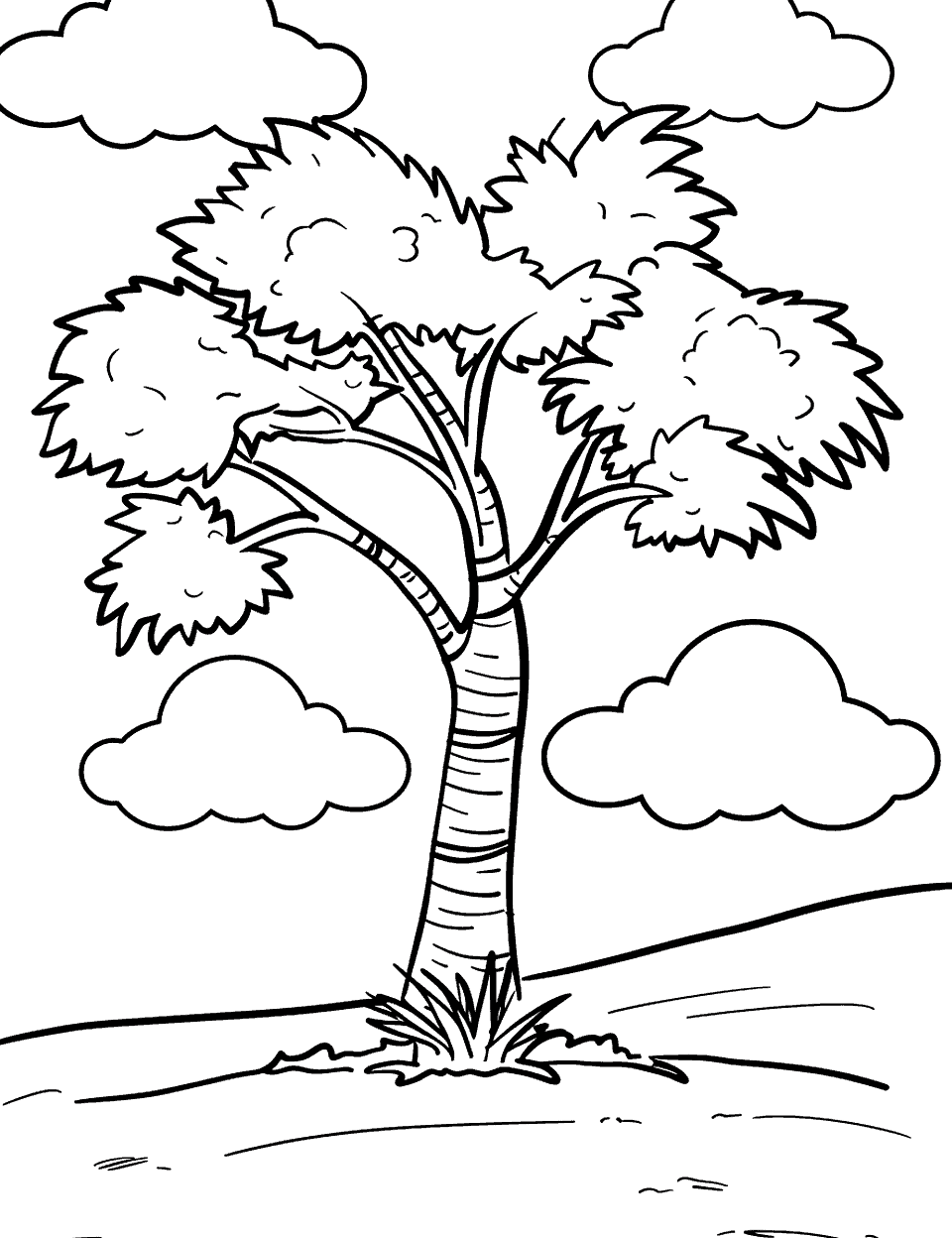
Rounded clouds float around a tree whose canopy is drawn in the same puffy clumps, so the two almost rhyme. The ground is nothing more than a few long lines, which leaves room to add your own scene. Keep the clouds pale and push the canopy darker so the tree stands forward. This is one of the simplest sheets here, good for a quick five minutes before dinner.
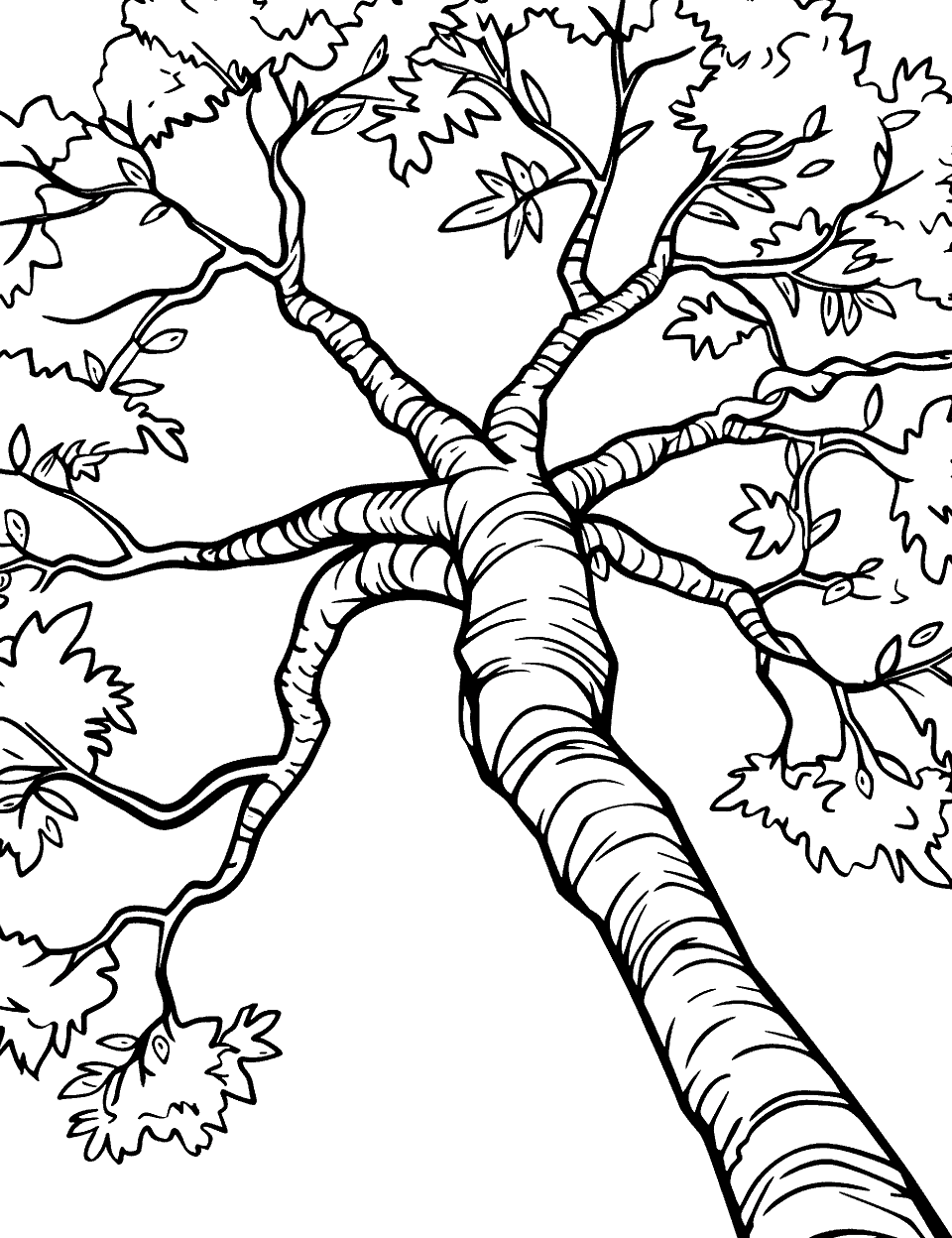
The view here is straight up the trunk, with branches spreading overhead and leaves filling the gaps between them. The perspective is unusual enough that some kids need a moment to work out what they are looking at. Colored pencils suit the many small leaf shapes better than crayons. Ask your child to try the same view for real outside, then compare.
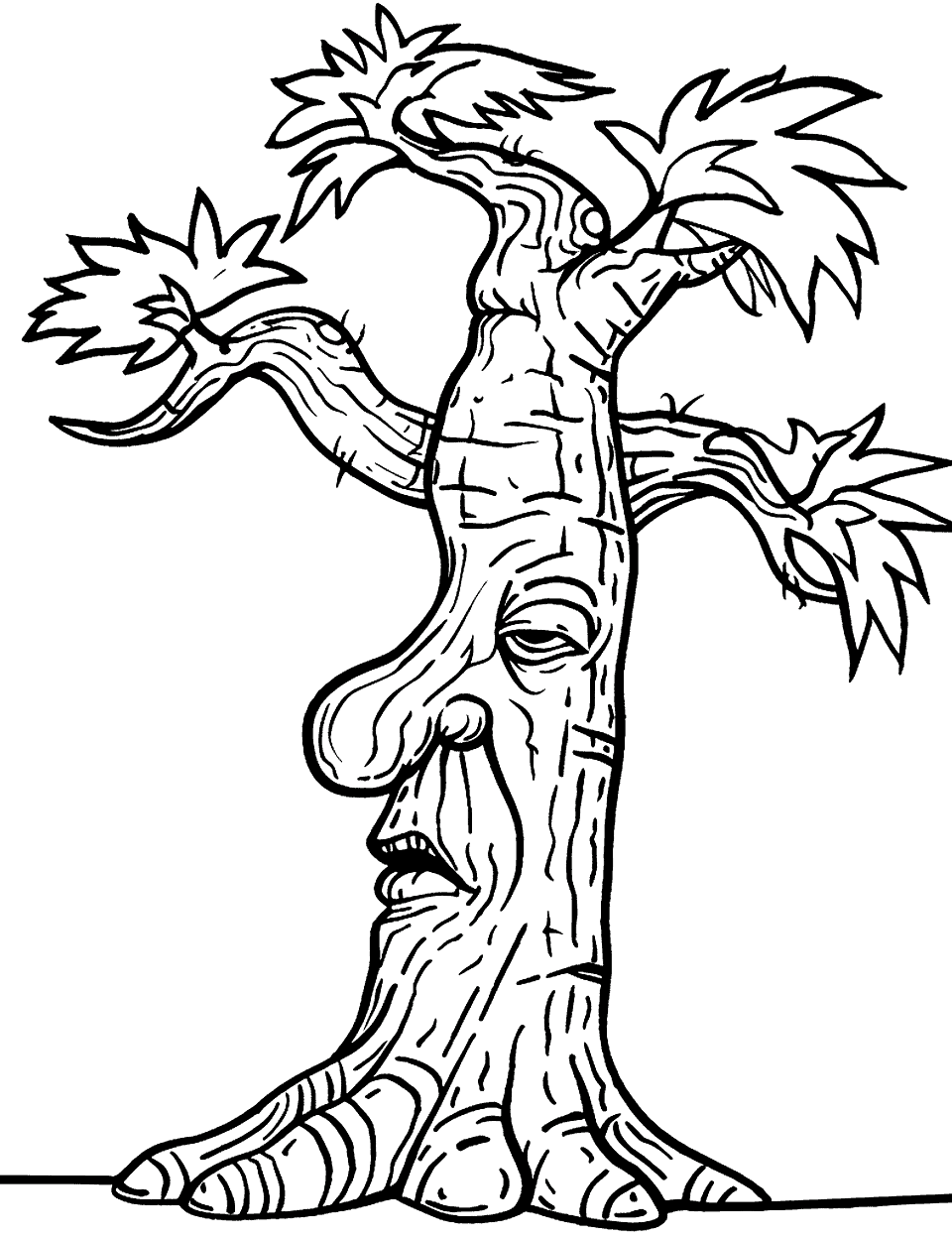
A face is carved into the front of this trunk, with heavy brows, a long nose, and a downturned mouth. The roots below splay out like toes, and spiky tufts of leaves sit at the ends of the branches. Shading the deep bark lines darker makes the face read from across the room. Give it a name and a backstory while you color; that part usually writes itself.
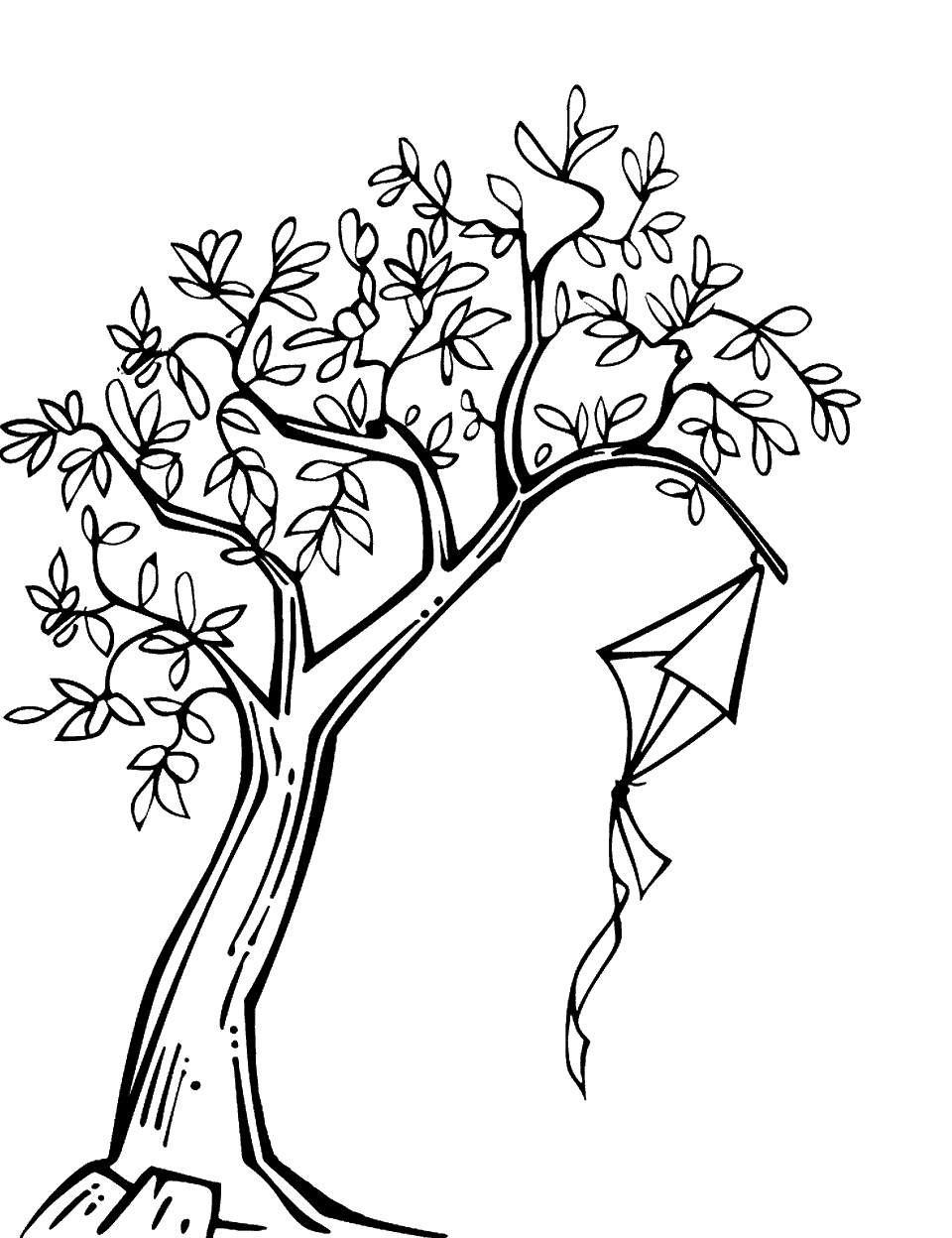
A kite with a long ribbon tail is caught in the upper branches of this leafy tree. The leaves are small and drawn in outline, which gives the page a light, airy feel. A bright kite against muted greens makes the story obvious at a glance. Younger kids can take the kite and leave the leaves to an older sibling.
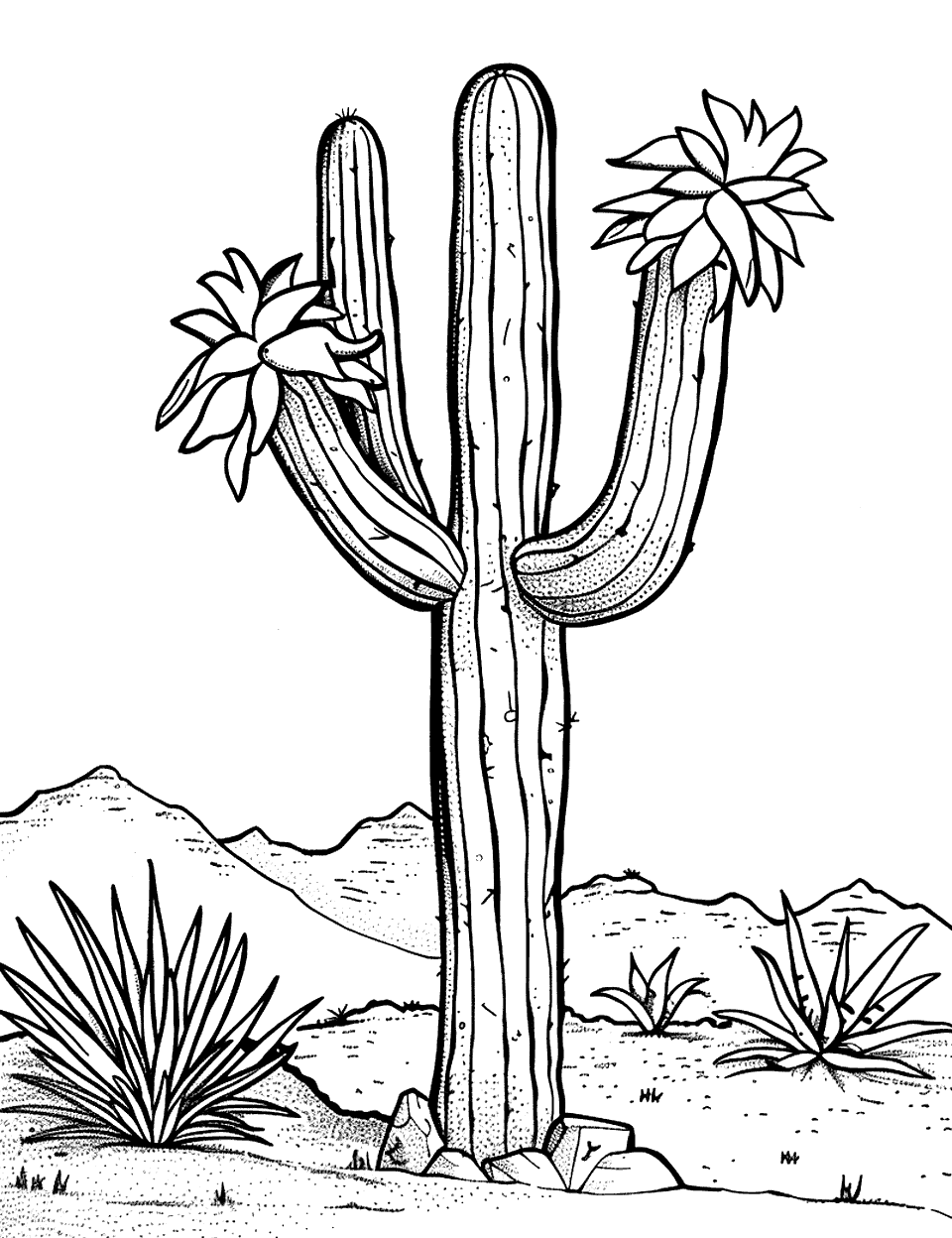
A tall cactus with two raised arms stands in the middle of this desert scene, topped with open flowers. Spiky shrubs, scattered rocks, and a low mountain ridge fill in behind it. The cactus body is finely stippled, so press a light green gently to keep the dots visible. It is the only desert sheet in the set, which makes it a good change of pace.
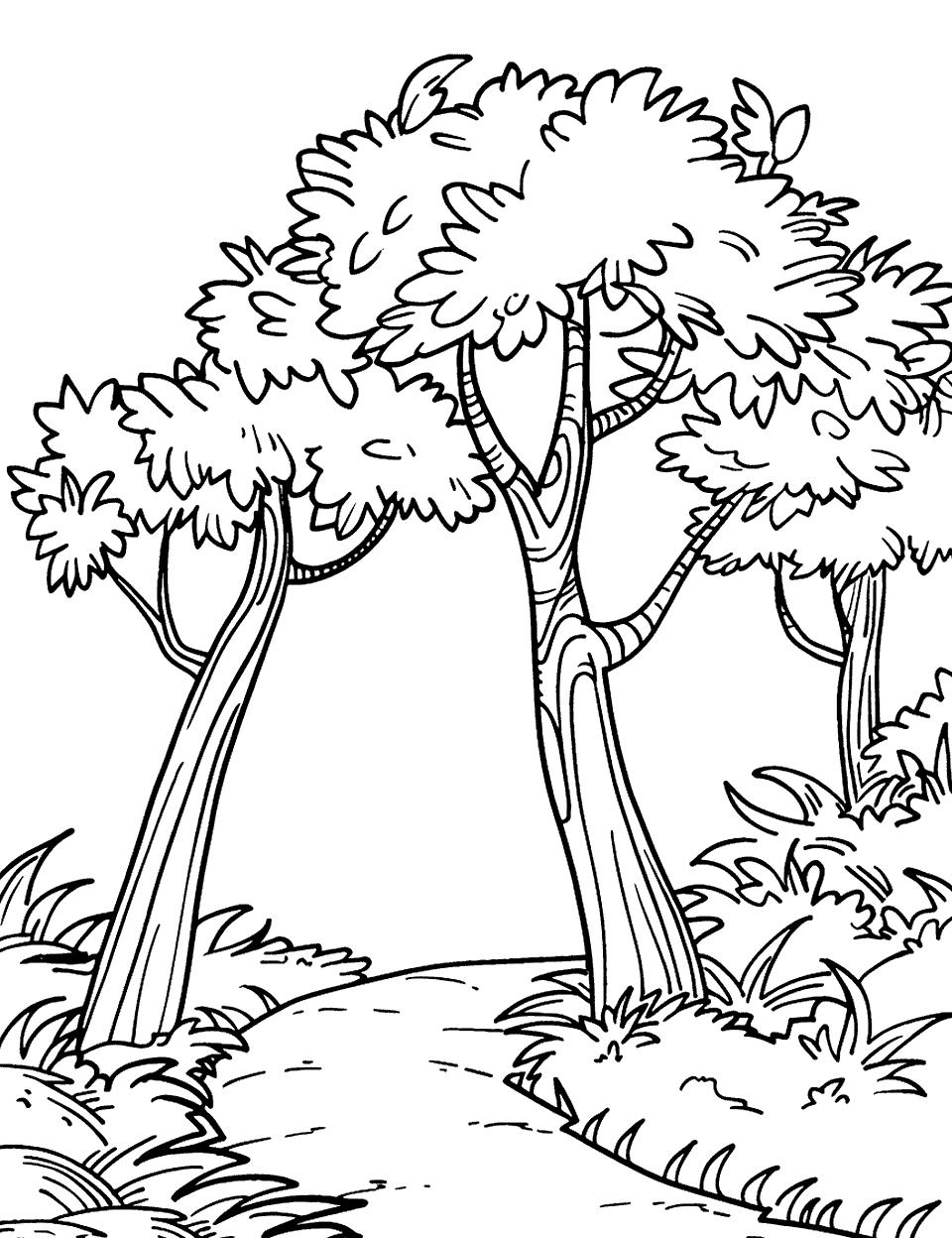
A path curves between clumps of grass and disappears behind the trees on this page. The trunks lean at slightly different angles, which keeps the scene from looking staged. Warm browns on the path against cool greens on either side is the quickest way to make it pop. There is a lot of open ground, so it is a good candidate for adding your own animals.
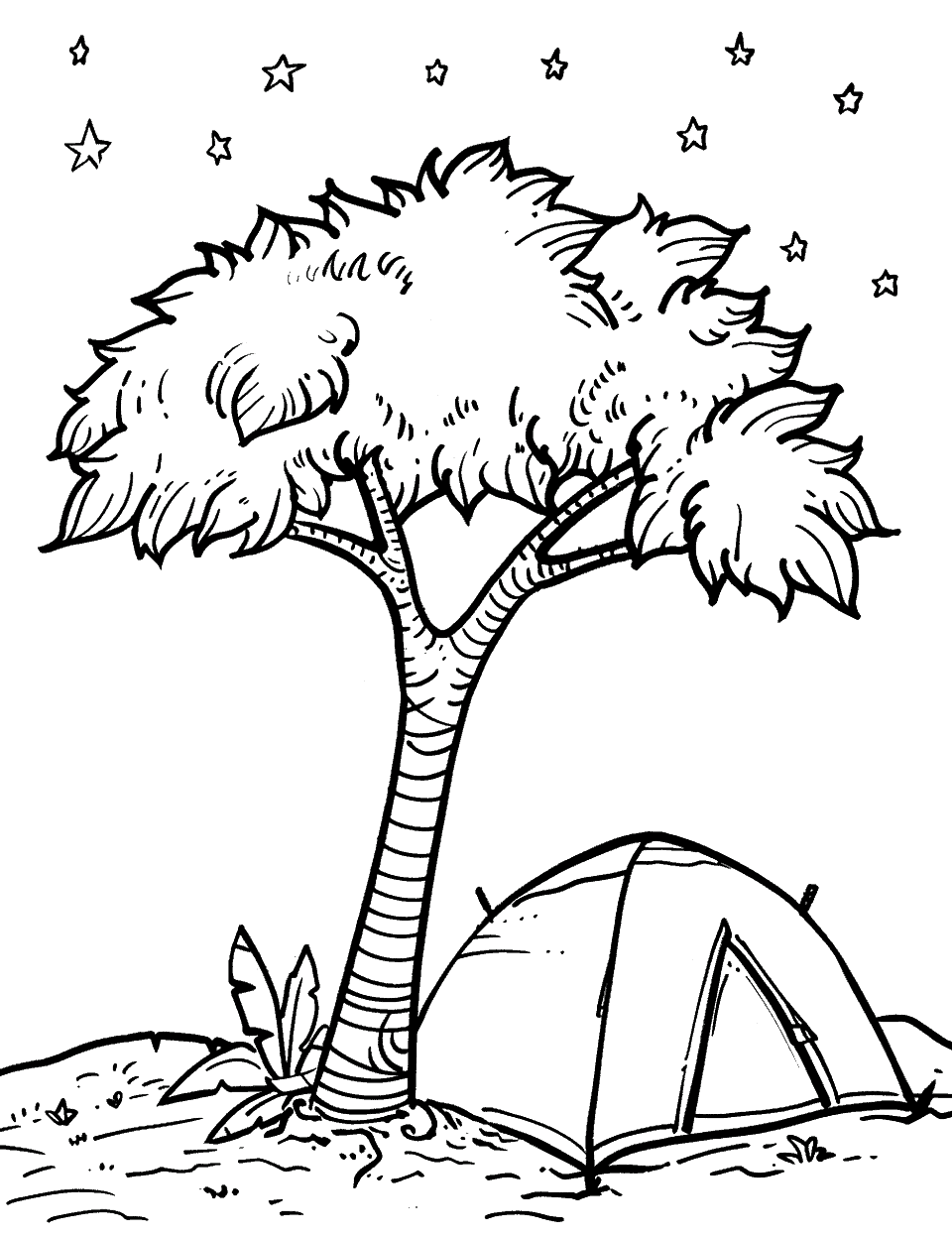
A dome tent is pitched under a spreading tree, with stars scattered across the sky above. The tent panels are large and clean, which makes them an easy first target. A dark blue sky with the stars left white is worth the extra minute it takes. Color it the night before a camping trip and it doubles as a countdown.
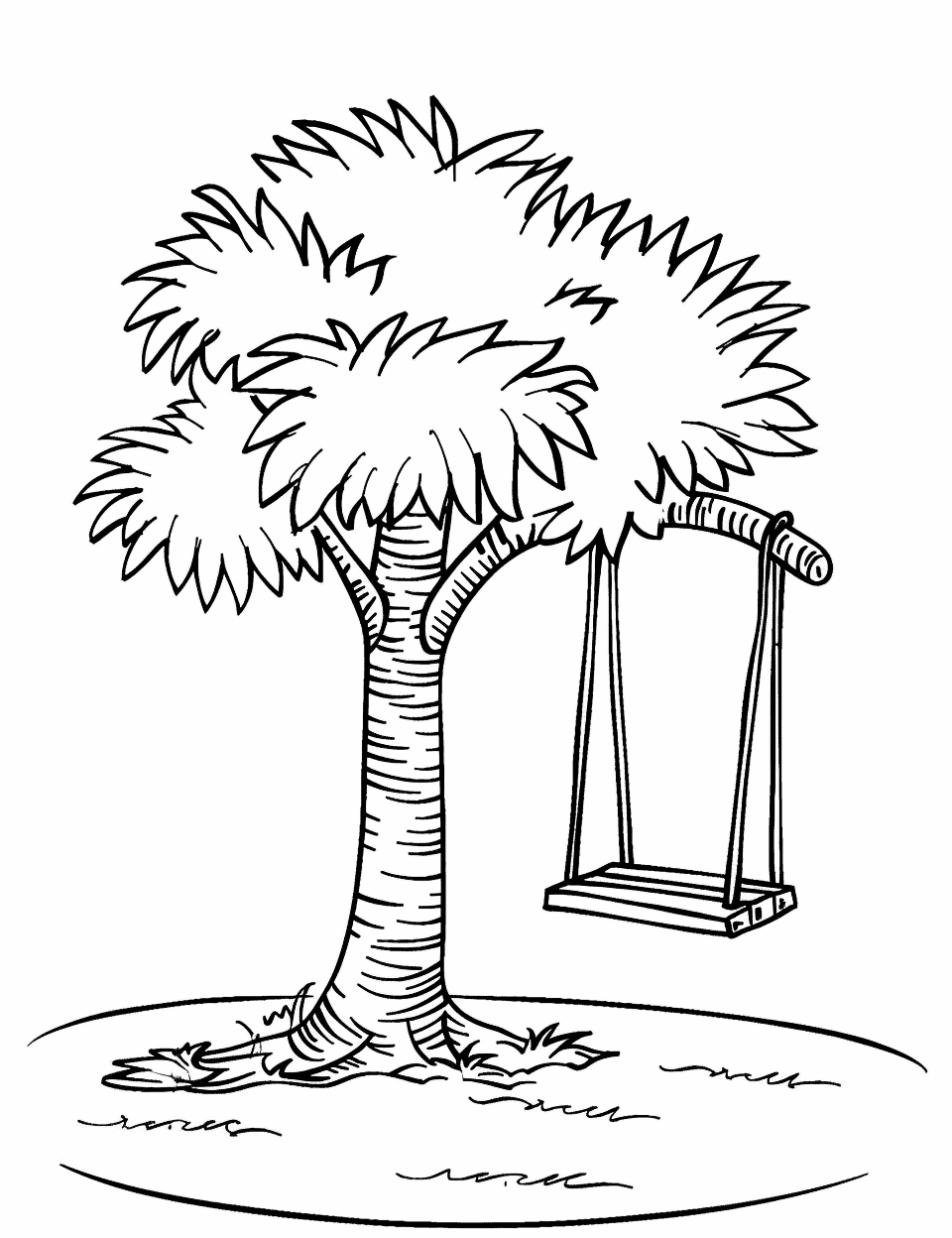
A wooden plank swing hangs on two ropes from a branch of this round-crowned tree. The ground is drawn as a simple oval with grass tufts around the base. The canopy is one big spiky shape, so it fills in fast with a fat crayon. Finish it, then go and find a real swing.
By using our free coloring pages, you acknowledge and agree to our full disclaimer. All materials are for personal, non-commercial use only and all rights belong to their respective license holders.
Which Tree Coloring Pages Suit Your Child’s Age?
Match the sheet to the hand: thick-lined pages like Simple Oak Tree and Tree Under Puffy Clouds suit ages 3 to 5, while dense ones like Cherry Blossom Serenity and Enchanted Forest Entry are better from about 8 up.
Preschoolers do best with large closed shapes and heavy outlines, which is what the oak, the fir in Winter Wonderland, and the swing sheet give them. Around 6 to 8, most kids handle the middle of this set comfortably: Apple Tree Harvest, Summer Lemon Tree, Spring Picnic Under a Tree, Pine Tree Forest. After that the detailed sheets open up, and Willow by the Water, both cherry blossom pages, and Giant Sequoia will hold an older child or an adult for a while.
Difficulty here is about line density, not subject. If a page looks too busy, print it larger or ask your child to color one section and stop. Nobody has to finish a sheet for it to have been worth printing.
Activities to Do With Tree Coloring Pages
Coloring is the starting point. These tree templates also work as the base for craft projects and outdoor lessons, and most of them need nothing you do not already have in a kitchen drawer.
Create a 3D Tissue Paper Tree
Give the page some texture with tissue paper. Have your child color the trunk with markers or crayons, then scrunch small squares of green tissue (or red, orange, and yellow for autumn) and glue them onto the branches. The Simple Oak Tree sheet works best because its canopy is drawn as big clumps you can fill one at a time. A glue stick holds well enough and dries far faster than school glue.
The Four Seasons Art Project
Print four copies of Bare Tree in Winter and turn each one into a different season. Green buds and pink blossoms for spring, full green leaves for summer, oranges and browns for autumn, and cotton balls glued along the branches for winter. Tape the four together in a square and the cycle is easy to see at a glance. Ask which season the tree is in right now outside your window.
Family Tree Project
Turn Simple Oak Tree or Apple Tree Harvest into a family history lesson. Your child colors the tree, then writes family names along the branches or inside the apples, one name per shape. Small printed photos glued on top make it a keepsake worth keeping. Start with the people your child sees most often and work outward, or the branches run out before the names do.
Nature Walk Scavenger Hunt
Use the pages as a checklist. Print the sheets that show a specific kind of tree, such as Pine Tree Forest, Majestic Oak Tree, or Sunny Palm Tree, then take them along to a park or around the block. When your child spots the real version, they color that page in when you get home. Bark texture and leaf shape are the two clues worth pointing out.
Leaf Rubbing Collage
Collect fallen leaves outside, then place one under the coloring page near the branches and rub over the paper with the side of a crayon until the veins come through. Thinner paper picks up more detail, so this is the one time standard printer paper beats cardstock. Bare Tree in Winter gives you the most empty branch space to fill. It is also the fastest way to show a child that every leaf has its own pattern.
What Can Kids Learn From These Tree Coloring Pages?
A giant sequoia can stand over 270 feet tall and live up to 3,400 years, and in 1912 Japan gave Washington, DC, 3,020 cherry trees whose blossoms still fill the capital every spring. This set of oaks, pines, palms, cherry blossoms, bamboo, a sequoia, and a desert cactus turns facts like those into conversation while your child colors.
Start with size. The General Sherman giant sequoia in California stands 274.9 feet tall with a base circumference of 102.6 feet (1). Giant sequoias can live up to 3,400 years, and they grow from seeds so small that 91,000 of them weigh a single pound (2). Put the Giant Sequoia sheet next to Acorn Sprout and the contrast does the teaching for you.
The cherry blossom sheets carry a story too. Japan sent 3,020 cherry trees to Washington, DC, and they arrived on March 26, 1912 (3). First Lady Helen Herron Taft wrote back in April 1909: “Thank you very much for your suggestion about the cherry trees.” She accepted the gift three years before it landed. Those trees are the reason the capital turns pink every spring.
FAQs
How Do I Print These Coloring Pages?
Click the image or the download button to open the full-size file, then print it from your browser or save it and print later. Choose “fit to page” in the print dialog so nothing is cropped at the edges. Black and white or grayscale printing keeps ink use down, since these are line drawings with no color in them.
What Paper Is Best for Coloring?
Standard printer paper is fine for crayons and colored pencils, and cardstock is better for markers or paint. Heavier stock, roughly 65 lb or more, cuts down marker bleed-through to the next sheet. The one exception is leaf rubbing, where thinner paper picks up the veins far more clearly.
Are These Coloring Pages Free to Use?
Yes, every page here is free for personal and classroom use, and you can print as many copies as you need. That includes running off four copies of the same bare tree for the seasons project above. Selling the printed sheets or reposting the files is the only thing that is off the table.
Can I Use These Pages for Crafts?
Yes, and several of them are drawn with cutting in mind. Trim around a colored canopy and you have a card front, a window decoration, or a piece for a diorama. The tissue paper and leaf rubbing projects above both start from a printed sheet, and the bamboo page cuts neatly into bookmarks.
What Are the Benefits of Coloring Trees?
Coloring builds the pencil grip and hand control a child needs later for writing, and staying inside an outline is early practice at both. Tree sheets add a second layer, since each one shows a real species or season your child can then go looking for outdoors. The busier pages also stretch attention span in a way that feels like play rather than work.