
Let’s be honest: a baby carrier is a total game-changer. It frees up your hands for coffee (or laundry) while keeping your little one happy and close. But with the market flooded with wraps, slings, and buckles, finding “The One” can feel impossible.
We’ve spent hundreds of hours testing and reviewing carriers to cut through the noise. We’ll break down the different styles and help you match them to your lifestyle.
Here is the ultimate guide to the best baby carriers, so you can skip the research spiral and find the perfect fit for you and your baby.
- Fully machine washable
- Comes with a storage bag
- Ergonomic seat
- Worn at different heights
- Supports ergonomic carry position
- Can support up to 45 pounds
- Extremely versatile
- Comes with lumbar support
- Includes a detachable pouch
- Padded, adjustable neck pillow
- 100% cotton
- Allows for multiple carry positions
- Great breathability
- Kind on sensitive skin
- Includes storage bag
- Easy-to-adjust straps
- Grows with your baby
- Lightweight, simple design
Why You Need A Baby Carrier
Baby carriers are the ultimate multitasking tool for parents. They allow you to keep your baby soothed and secure while giving you the freedom to move. If you worry about arm fatigue or shoulder strain from carrying your little one the old-fashioned way, a carrier is a must-have.
A good carrier distributes your baby’s weight evenly across your body. This means you can hold them longer without feeling like you just did a heavy gym session.
They are also a lifesaver for places where strollers just don’t work. If you want to hike a trail, walk on a sandy beach, or navigate a crowded farmers market, wearing your baby is much easier than pushing a bulky pram.
Beyond convenience, there are significant benefits to babywearing. Evidence suggests that carried babies cry less, which means a happier household for everyone.
Types of Baby Carriers
There are five main styles you will encounter, and each serves a different purpose:
A wrap is essentially a long piece of fabric that you tie around your body to hold your baby. They are incredibly soft and mimic the feeling of the womb, making them perfect for newborns.
They are very comfortable for the wearer, but they have a learning curve. Mastering the “origami” of tying a wrap takes practice, but once you get it, it offers a custom fit every time.
Ring Slings
Ring slings are made of a single piece of fabric threaded through two strong rings. They are fantastic for quick ups and downs, making them a favorite for toddlers who want to be held one minute and run around the next. They are easily adjustable and great for breastfeeding.
Pouch Slings
Pouch slings are a continuous loop of fabric. They are similar to ring slings but lack the adjustability. You simply drape it over one shoulder and pop the baby in. They are inexpensive and fold down tiny for a diaper bag, but sizing is critical since you can’t tighten them.
Mei Tais (or Meh Dais) combine the flexibility of a wrap with the structure of a carrier. They feature a body panel with four straps that you tie around your waist and shoulders. They offer excellent weight distribution and airflow without the complexity of buckles.
Soft Structured Carriers (SSC)
These are the “backpacks” of the baby carrier world. They use buckles, padded straps, and structured waistbands to support the baby. They are generally the easiest to use and offer the most support for heavier babies and toddlers. If you want a “click and go” option, this is it.
How to Choose
It’s not just about picking a cute pattern. The best carrier needs to be safe for the baby and comfortable for you.
Here is what you need to look for before making a purchase:

Safety Checklist (TICKS)
Your baby’s safety is non-negotiable. Improper positioning can lead to falls or airway restriction (1).
To keep your baby safe, always follow the T.I.C.K.S. rules developed by the UK Sling Consortium (2):
- Tight: The carrier should be tight enough to hug your baby close to you. Any slack allows the baby to slump, which can hinder breathing or strain your back.
- In view at all times: You should always be able to see your baby’s face by simply glancing down. The fabric should not close around them so you have to open it to check on them.
- Close enough to kiss: Your baby’s head should be close to your chin. By tipping your head forward, you should be able to kiss their forehead.
- Keep chin off the chest: Ensure there is always a space of at least a finger width under your baby’s chin. If they are curled so their chin is forced onto their chest, it can restrict their airway.
- Supported back: In an upright carrier, the baby should be held comfortably close to you so their back is supported in its natural position. Their tummy and chest should be against you.
Beyond T.I.C.K.S., you need to consider hip health. Improper support can contribute to hip dysplasia (3). Look for a carrier that supports the baby’s thighs and keeps their knees higher than their bum, forming an “M” shape.

Versatility and Growth
Babies grow fast. Ideally, you want a carrier that adapts. Look for adjustable seats that widen as your baby’s legs get longer.
Some carriers offer multiple positions:
- Front inward: Best for newborns and connection.
- Front outward: For curious older babies (usually 6+ months).
- Hip carry: Good for quick ups and downs.
- Back carry: Essential for heavier toddlers to save your back.

Durability and Material
You get what you pay for. A cheap carrier might save money now, but it may have flimsy buckles or zippers that snag. Look for reputable brands that use reinforced stitching (often called bartack stitching) at stress points.
For ring slings, ensure the rings are a solid piece of metal (usually aluminum) without a weld point, as weld points can break under pressure.

Comfort for You
If the carrier hurts you, you won’t use it.
Key comfort features to look for include:
- Wide waistbands: These transfer the weight from your shoulders to your hips, which is crucial as your baby gets heavier.
- Padded shoulder straps: Look for thick, high-density foam that won’t dig in.
- Lumbar support: Some carriers have a specific pad for your lower back, which is a game-changer for long walks.
- Breathability: If you live in a hot climate, look for “Cool Air” mesh panels to prevent you and the baby from becoming a sweaty mess.

Ease of Use
Be realistic about your patience level. A soft structured carrier (SSC) with buckles is usually the easiest to learn; click, tighten, and go.
Wraps and ring slings have a steeper learning curve. They are wonderful once mastered, but they might frustrate you if you are trying to tie a complex knot in a rainy parking lot while your baby screams. Watch a few YouTube tutorials for the specific model you are eyeing to see if it looks manageable for you.

Budget
You can find decent carriers for $30 and luxury ones for $200+. Generally, the higher price tag gets you better fabrics (like linen or organic cotton), more magnetic buckles, and better lumbar support.
However, you do not need to break the bank. Many mid-range carriers pass the same safety standards and work perfectly well for daily use.
Product Reviews
We’ve tested the top contenders to see which ones actually live up to the hype. Here are our favorites.
MiaMily Hipster Plus Baby Carrier
Best Baby Carrier for Hiking
If you suffer from back pain or plan on long hikes, the MiaMily Hipster Plus is a standout choice. The secret sauce here is the 3D hip seat. Unlike standard carriers where the baby hangs, this one allows the baby to sit on a firm shelf.
This design absorbs much of the baby’s weight, taking the pressure off your shoulders and spine. It keeps the baby’s hips in the proper ergonomic position naturally.
The carrier offers six carry positions and is incredibly modular. You can use just the hip seat for a quick up-and-down with a toddler, or zip on the full panel for hands-free carrying.
It also features a massive storage pocket under the seat, big enough for diapers, wipes, and a bottle, essentially replacing your diaper bag for short trips.
Pros
- Large storage pocket eliminates the need for a bag.
- Hip seat takes significant weight off shoulders.
- Approoved by the International Hip Dysplasia Institute.
Cons
- The hip seat creates a bulky silhouette.
Our Ratings
Hip Baby Wrap Ring Sling
Best Ring Sling

The Hip Baby Wrap offers the perfect blend of style and function. If you want a carrier that feels more like clothing and less like hiking gear, this is it. The patterns are vibrant, fun, and distinct.
This sling uses a simple aluminum ring system to secure the fabric. It allows for a custom fit every single time, whether you are wearing a newborn tummy-to-tummy or a toddler on your hip.
The fabric is 100 percent cotton, making it breathable and soft right out of the box. It is lightweight, so it won’t overheat you or the baby during summer months.
Because it lacks bulky padding, it folds down small enough to fit in a purse. It is also Fair Trade certified, so you can feel good about where your money is going.
Pros
- Fair Trade, handwoven fabric with non-toxic dyes.
- Cool and breathable for hot weather.
- No buckles or snaps to fiddle with.
Cons
- Learning to thread and tighten the rings takes practice.
Our Ratings
BabyBjorn Mini Baby Carrier
Best Baby Bjorn Carrier

The BabyBjorn Mini is famous for being one of the easiest carriers to put on by yourself. The entire front section unbuckles, allowing you to lift a sleeping baby out without waking them, a feature every exhausted parent will appreciate.
It is small, soft, and flexible. It feels more like a hug than a piece of equipment. You don’t need any infant inserts; it is ready for your newborn from day one (7 lbs).
The head support is adjustable and firm, crucial for those early months when neck muscles are weak.
However, keep in mind this is a “Mini” carrier. It lacks a waist belt, which means all the baby’s weight is on your shoulders. It is fantastic for the first 6-9 months, but as your baby gets heavier, your back will likely crave something with more lumbar support.
Pros
- Incredibly easy to put on and take off alone.
- Perfectly sized for newborns without extra inserts.
- Front section detaches completely to lay a sleeping baby down.
Cons
- No waist belt means back strain with heavier babies.
- Short lifespan of use compared to other carriers.
Our Ratings
LilleBaby Baby & Child Carrier
Best Baby Carrier for All Seasons
The LILLEbaby Complete All Seasons is the Swiss Army Knife of carriers. It offers six carrying positions, including fetal, infant, outward-facing, toddler, hip, and back.
The standout feature here is the temperature control panel. In winter, zip it up to block the wind and keep the baby warm. In summer, zip it down to reveal 3D mesh that lets air flow right through to the baby’s back.
It is designed for serious comfort. The lumbar support pad is widely considered one of the best on the market, preventing lower back pain during long walks. The shoulder straps can also be crossed in an “X” on your back, which many parents find more supportive than the standard backpack style.
Pros
- Zip-down panel adjusts for hot or cold weather.
- Excellent lumbar support pad included.
- Wide weight range (7 to 45 lbs) requires no infant insert.
Cons
- Can feel bulky on petite frames.
Our Ratings
Ergobaby Omni 360 Ergonomic Baby Carrier
Best Baby Carrier for C-Sections
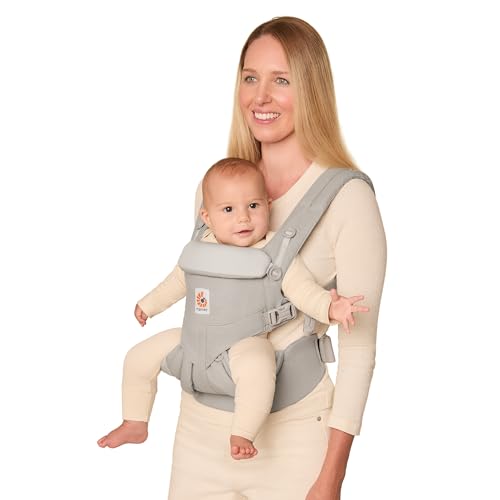
The Ergobaby Omni 360 is a gold standard in the babywearing world. It does everything the original Ergo did but adds the ability to face the baby outward comfortably and ergonomically.
We love it for C-section moms because the structured waistband is wide and supportive but can be worn higher up on the waist, keeping it clear of a tender incision site.
Adjusting the seat from “newborn” to “toddler” or “facing out” is done with simple sliders, no complex velcro or snapping required. It ensures your baby is always in the hip-healthy “M” position.
It also comes with a detachable pouch for your keys and phone, which is a small but mighty convenience.
Pros
- No infant insert needed; adjustable from newborn to toddler.
- Sliders make switching baby’s position fast and easy.
- High resale value due to durability and popularity.
Cons
- Some parents find the buckles behind the neck hard to reach.
Our Ratings
Bebamour Adjustable Mesh Baby Carrier
Best Forward Facing Baby Carrier
The Bebamour offers a budget-friendly alternative to high-end hip seat carriers. It gives you the versatility of a structured carrier with the back-saving benefits of a solid seat base.
The seat is foldable, which makes this slightly less bulky than competitors when storing it away. The mesh fabric is generous, ensuring your baby doesn’t turn into a radiator against your chest.
It includes two bibs that snap onto the straps (because forward-facing babies tend to drool on everything) and a zipper pocket for essentials.
While the materials might not feel as premium as a $180 carrier, it offers incredible value and functionality for the price point.
Pros
- Foldable aluminum seat saves space.
- Great airflow thanks to extensive mesh panels.
- Comes with drool bibs and a storage pocket.
Cons
- Waistband is very wide, which may be uncomfortable for short torsos.
- You cannot breastfeed in this carrier.
Our Ratings
Baby Tula Sleepy Mesh Carrier
Best Baby Carrier for Sleeping

Tula carriers are cult favorites for a reason: they are stylish, comfortable, and simple. The Tula Explore (often called the Sleepy Mesh in specific prints) is designed to let you face baby out, but it excels at the inward snuggle.
The large mesh panel keeps the air moving, which prevents your baby from getting sweaty and waking up. The material is soft cotton, avoiding the “stiff backpack” feel of some tactical carriers.
It features a padded neck support pillow that flips up. This is key for naps; it gives your sleeping baby a place to rest their head so it doesn’t flop backward.
The waistband pocket is perfect for your phone, and the patterns are arguably the cutest on the market.
Pros
- Stylish prints and soft, high-quality fabric.
- Adjustable neck pillow is perfect for napping babies.
- Intuitive adjustments for switching between facing in and out.
Cons
- Shoulder straps can feel bulky to some.
Our Ratings
Infantino Cuddle Up Ergonomic Carrier
Best Ergonomic Baby Carrier

You don’t have to spend a fortune to get a safe, ergonomic carrier. The Infantino Cuddle Up proves that. It features a unique “hoodie” style pocket for your hands, which makes you feel like you are just hugging your baby.
It supports the knee-to-knee “M” position that doctors recommend. You can use it for front carrying (facing in) or back carrying.
The adorable teddy bear hood isn’t just for looks; it detaches easily but provides great coverage for naps or sunny days.
While it lacks the fancy magnetic buckles or lumbar pads of expensive brands, it is sturdy, machine washable, and gets the job done comfortably for a fraction of the price.
Pros
- Extremely affordable compared to competitors.
- Pocket for parent’s hands mimics a hoodie.
- Cute, detachable hood.
Cons
- Cannot be used for outward-facing front carry.
- Adjustment straps can be a bit stiff initially.
Our Ratings
Acrabros Baby Wrap Carrier
Best Breathable Carrier
The Acrabros wrap is a lightweight, jersey-mesh hybrid fabric. It offers the snugness of a traditional wrap but with significantly more breathability. If you love the idea of wrapping but worry about overheating, this is the solution.
It is great for “kangaroo care” (skin-to-skin contact) while keeping your hands free to work or manage the house. The fabric has a bit of give, making it easy to pop a newborn in, but it’s supportive enough for babies up to 35 lbs (though we find wraps are best for babies under 20 lbs).
Because it is just fabric, there are no buckles to dig into you when you sit down, making it arguably the most comfortable option for the wearer during sedentary activities like working at a desk.
Pros
- Soft, stretchy fabric is ideal for newborns.
- Highly breathable mesh design prevents sweating.
- One size fits most body types.
Cons
- Wrapping takes practice to master.
- Long fabric tails can drag on the ground while tying.
Our Ratings
Infantino Flip 4-in-1 Convertible Carrier
Best Baby Carrier for Dads

The Infantino Flip is a best-seller for a reason: it’s simple, rugged, and affordable. We call it the best for dads because the tactical, no-nonsense design often appeals to fathers who don’t want complex wraps or floral patterns.
It features a clever seat adjustment system that narrows for small babies and widens for older ones, ensuring proper hip support at every stage. You can face baby in, out, or put them on your back.
It includes a “Wonder Cover” bib to protect your clothes from spit-up. The carrier is lightweight and packs down fairly small, making it a great “leave in the car” option.
While the padding isn’t as plush as an Ergobaby or Tula, it is perfectly adequate for grocery runs or short walks.
Pros
- Very budget-friendly.
- Simple, intuitive adjustments.
- Includes a handy bib to protect clothing.
Cons
- Shoulder straps are thinner than premium models.
Our Ratings
Sleepy Wrap Newborn Baby Carrier
Best Newborn Baby Carrier

The Sleepy Wrap is a classic stretchy wrap. It is made of a cotton-spandex blend that feels like your favorite yoga pants. You tie it around your body first, and then pop the baby in.
This “pre-tying” ability is a huge advantage. You can wear the wrap all day like a shirt and put the baby in and out as needed without having to re-tie it every time.
It provides excellent weight distribution across your entire back and shoulders. For breastfeeding moms, the fabric offers easy, discreet coverage.
While rated up to 35 lbs, the stretchy nature of the fabric means it works best for babies under 20 lbs. As the baby gets heavier, the fabric tends to sag and bounce more.
Pros
- You can tie it once in the morning and wear it all day.
- Extremely soft and cozy for the newborn phase.
- Machine washable and durable.
Cons
- Can get warm in the summer due to multiple layers of fabric.
- Not supportive enough for toddlers.
Our Ratings
Tula Baby Free-To-Grow Baby Carrier
Best Carrier for Toddlers

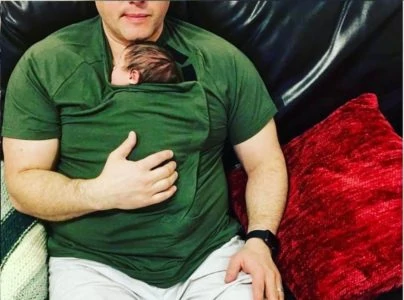
The “Free-To-Grow” name says it all. This carrier adjusts seamlessly from newborn (7 lbs) to toddler (45 lbs) without any infant inserts or extra accessories.
The panel adjusts in both width and height. This means as your toddler gets taller, you can raise the back panel to ensure they still have proper back support and aren’t leaning dangerously backward.
It focuses on the two most ergonomic positions: front facing-in and back carry. It does not offer a forward-facing option, but many parents of toddlers prefer back carrying anyway as it is easier on the spine.
The waistband pocket is functional, and the leg padding is extra plush to prevent red marks on chubby toddler thighs.
Pros
- Adjustable height panel is excellent for tall toddlers.
- No infant insert required.
- Wide, supportive waistband.
Cons
- Does not offer a forward-facing (facing out) option.
Our Ratings
Mebien Ring Sling Baby Wrap Carrier
Best Plus Size Baby Carrier

Size inclusivity is a problem in the baby carrier world, but ring slings like the Mebien are a great equalizer. With no waistbands to measure or clips to reach, it fits nearly every body type comfortably.
The Mebien features an extra-long tail (over 87 inches), ensuring that plus-size moms and dads have plenty of fabric to work with and secure safely.
It is made of super-soft Turkish cotton that requires no “breaking in.” It is soft from day one. The fabric is grippy enough to stay tight in the rings but smooth enough to adjust easily.
It can hold up to 35 lbs, and because you carry the baby high on your chest or hip, it feels very secure.
Pros
- Extra-long length fits plus-size parents easily.
- Soft Turkish cotton needs no breaking in.
- Elegant look suitable for dressy occasions.
Cons
- Asymmetrical weight distribution can strain one shoulder over long periods.
Our Ratings
Boba Wrap Air Baby Carrier
Best Travel Baby Carrier
The Boba Air is the ultimate “just in case” carrier. It is an unstructured carrier made of nylon that folds up into its own pocket, ending up about the size of a makeup bag.
It weighs practically nothing (0.7 lbs), making it perfect for tossing in a carry-on or keeping in the stroller basket for when your toddler refuses to walk.
It is surprisingly supportive for being so light, accommodating children from 15 to 45 lbs. Note the minimum weight; this is NOT for newborns. It is for babies who have head control and can sit well.
The nylon material wipes clean instantly, a huge plus for travel spills, but it isn’t as cozy or soft as cotton carriers.
Pros
- Folds incredibly small for travel.
- Wipeable nylon fabric.
- Great for older babies and toddlers (15+ lbs).
Cons
- Not suitable for newborns.
- Zero padding means it can dig in during long-term wear.
Our Ratings
TwinGo Original Baby Carrier
Best Carrier for Twins
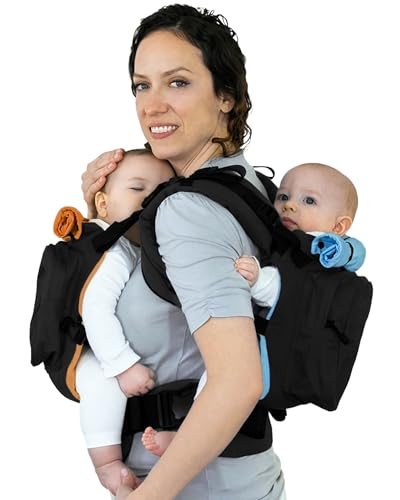
The TwinGo is an engineering marvel for parents of multiples. It allows a single parent to tandem carry two babies, balancing the weight between front and back.
But the real genius is its versatility. The system can separate into two independent carriers. So if you and your partner are out together, you can each take one baby. If you are alone, you link them up.
It features large pockets on each carrier, meaning when you are in “tandem mode,” you have two huge storage compartments.
The waistband is reinforced to handle the weight of two children (up to 70 lbs total). While it looks intimidating, color-coded clips make it easier to figure out than you’d expect.
Pros
- Can be used as one double carrier or two single carriers.
- Large pockets on both units.
- Sturdy waistband handles heavy loads well.
Cons
- Expensive upfront cost (though cheaper than buying two separate premium carriers).
- Back-carry baby cannot be seen easily without a mirror.
Our Ratings
What Position Should My Baby Be In?
Positioning is key for development. For the first few months (0-4 months), your baby should always face you (inward). This protects their neck and prevents overstimulation.
Once they have strong head control (usually around 4-6 months), you can try hip carrying or forward-facing (if your carrier supports it). Back carrying is generally recommended for babies 6 months and older who can sit up independently.
When Can I Start Using a Carrier?
You can wear your baby from day one, provided they meet the minimum weight requirement of your specific carrier (usually 7 or 8 lbs). For preemies or low-birth-weight babies, consult your pediatrician first. Stretchy wraps and ring slings are often the favorites for the newborn “squishy” stage.
Baby Carrier FAQs

Can Baby Carriers Cause Back Pain?
If worn correctly, no. A good carrier should actually prevent back pain by distributing weight evenly. However, if the carrier is too loose, sits too low on your hips, or if you have a bad posture, it can strain your muscles. Ensure the waistband is tight and sits on your waist (or hips for toddlers), not your bum.

Can Baby Carriers Cause Hip Dysplasia?
They can if the baby’s legs are allowed to dangle straight down. This puts pressure on the hip joint socket. To prevent this, always ensure your carrier supports the baby’s thighs from knee to knee, creating an “M” shape (knees higher than bum). This is the natural, healthy position for hip development (4).

Can Baby Carriers Be Used from Birth?
Yes, most can, but check the weight limits. Some structured carriers require a bulky “infant insert” to boost the baby up high enough. Wraps and ring slings are naturally newborn-ready without extra accessories. Just ensure the baby’s airway is always visible and clear.

Can You Wear a Baby Carrier at the Airport?
Absolutely. It is a travel hack! You can wear your baby through the terminal, which frees up your hands for luggage and tickets. However, TSA will likely ask you to take the baby out of the carrier to walk through the metal detector. You also cannot wear the baby during takeoff and landing on the plane (5).

Can My Baby Sleep in the Carrier?
Yes, carrier naps are the best! The movement and heartbeat sound often lull babies to sleep quickly. Just monitor them to ensure their chin doesn’t drop to their chest, which can restrict breathing. If they fall asleep, check their position frequently.

How Long Can I Wear My Baby Per Day?
There is no strict time limit, as long as both you and the baby are happy and comfortable. However, it is good practice to take breaks every hour or two to let the baby stretch, have a diaper change, and feed. Listen to your body; if your back hurts, take a break.