Let’s be honest: sometimes you just need a safe place to put the baby down so you can drink your coffee while it’s still hot. If your little one has strong neck control and is craving more stimulation than a playmat offers, an activity center is the ultimate upgrade.
We skipped the boring, single-use toys and hunted down the most engaging activity centers, exersaucers, and entertainment hubs on the market. These aren’t just “baby containers.” We selected products that spark curiosity, encourage motor skills, and actually grow with your child from infant to toddler.
Whether you need a bouncing jumper to burn off energy or a convertible table for cruising, we’ve found the best options to keep your baby happy, safe, and entertained.
- 3 adjustable positions
- Machine-washable seat pad
- Lightweight
- Multiple stages for different ages
- For visual and audio stimulation
- Weighs less than 5 pounds
- No weight or height restrictions
- Grows with your child
- Great for tummy time
- Both a jumper and exersaucer
- Features sound, light, and touch toys
- Unique language introduction feature
- Adjustable to 3 different heights
- Machine-washable seat pad
- Secure learn-and-play environment
What are Activity Centers?
Think of an activity center as a “Station of Fun.” It is a centralized play area designed to keep your baby safe while offering 360 degrees of entertainment. Unlike a walker, these stationary centers don’t have wheels for mobility, making them a safer choice for containing an active baby.
They typically feature a rotating seat surrounded by toys, lights, and textures. The goal is simple: encourage independent play, boost curiosity, and give parents a few minutes of hands-free time.
How to Choose an Activity Center for Your Baby
Before you click “add to cart,” consider your living space and your baby’s personality. Here are the main factors to look for.

Grow-With-Me Features
Baby gear is expensive, so longevity is key. Some basic centers are strictly for the “sitting but not walking” phase, which might only last a few months.
However, many modern activity centers convert into toddler play tables, art stations, or cruising tracks. If you want more bang for your buck, look for a 3-in-1 design that evolves from a containment seat to a freestanding table as your child grows.

Jumping vs. Stationary
Know your baby’s energy level. “Exersaucers” typically have a saucer-shaped bottom that allows for rocking and spinning, while “Jumpers” use bungee cords to let babies bounce vigorously.
If you have a high-energy baby who loves to kick, a jumper is a lifesaver. If your baby is more observant and prefers fine motor tasks, a stable activity center with a spinning seat is a better fit.

Footprint and Portability
These toys can be bulky. If you live in a smaller apartment or want to move the toy between rooms, check the dimensions.
Some models are designed to fold flat for storage under a couch, while others are large, rigid structures that take up significant floor space. If you plan to travel to grandma’s house, look for “pop-off” legs or collapsible frames.

Sensory Overload
More isn’t always better. Some babies get overstimulated by flashing strobe lights and loud, repetitive music.
Check if the unit has volume control or an “off” switch for the electronics. Sometimes, the best toys are the ones that encourage manual manipulation, spinners, shakers, and bead chasers, rather than just pushing a button for noise.
The Stages of Play
Play isn’t just a distraction; it is how babies decode the world. Providing the right type of stimulation at the right time helps prevent frustration and builds confidence.
Here is how play needs change as your baby grows:
- Newborn to 3 Months: Vision is blurry and muscles are developing. High-contrast cards, soft play mats for tummy time, and gentle rattles are best. They don’t need a seated center yet.
- 4 to 6 Months: Once they have strong head control, they crave a better view. This is the sweet spot for introducing activity centers. They love reaching for dangling toys, chewing on teethers, and discovering cause-and-effect sounds.
- 6 to 12 Months: Mobility kicks in. They are learning to bear weight on their legs (supported). Activity centers allow them to spin 360 degrees to track you across the room, which helps with object permanence and separation anxiety.
- 12+ Months: They are ready to cruise and walk. The confinement of a seat becomes frustrating. This is when you convert the center into a standing activity table for coloring, block building, or imaginary play.
Product Reviews
We’ve tested and reviewed the top-rated options to help you find the perfect match for your baby’s developmental stage.
Fisher-Price Activity Center
Best for Newborns

The Fisher-Price 3-in-1 Spin & Sort is a masterclass in versatility. It manages to bridge the gap between a newborn playmat and a toddler table seamlessly, giving you years of use rather than just months.
It starts as a clean, cushioned playmat for tummy time, featuring a musical alligator that keeps infants engaged. Once your baby has neck control, you pop the seat into the center of the frame. The seat spins 360 degrees so they can access different activity pods, which helps develop gross motor skills and core strength.
We love that the toys are movable. You can rearrange the shape-sorters and spinners to keep the experience fresh. When your little one graduates to walking, the seat is replaced by a shape-sorter plate, turning the entire unit into a sturdy toddler play table.
Pros
- Converts from mat to entertainer to table.
- Machine-washable seat pad handles blowouts easily.
- Customizable toy placement keeps babies interested.
- Lightweight frame (12 lbs) is easy to move.
Cons
- Leg height is not adjustable for the seat mode.
- Some gaps between pods can pinch tiny fingers.
Our Ratings
LeapFrog Learn and Groove Musical Table
Best for Travel
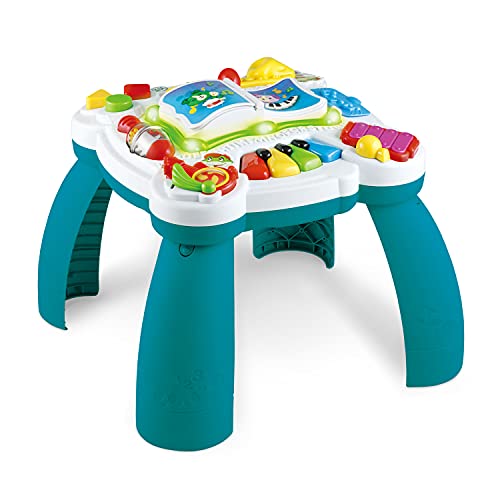
If you need an option that focuses on education without the bulk of a large frame, the LeapFrog Learn and Groove is a fantastic choice. It isn’t a “container” style seat; instead, it encourages babies to pull up, stand, and cruise around the perimeter.
For younger babies who aren’t standing yet, the legs detach completely. You can place the activity top directly on the floor for tummy time or seated play. It features a bilingual mode, allowing you to toggle between English and Spanish, which is a great way to introduce language concepts early.
The table is packed with interactive elements, including a piano, turning book pages, and sliding beads. We found the music to be catchy rather than annoying, and the volume control is a blessing for parents. Because it’s lightweight and breaks down easily, it is the best option for taking on road trips or storing in a closet.
Pros
- Supports bilingual learning (English/Spanish).
- Legs detach for floor play or easy travel.
- Encourages standing and cruising skills.
- Compact design fits in small apartments.
- Volume control saves parent sanity.
Cons
- Very lightweight; can slide on hardwood floors if leaned on heavily.
Our Ratings
Baby Einstein Around We Grow Activity Center
Best for Small Spaces

The Baby Einstein “Around We Grow” offers a completely unique approach to activity centers. Instead of placing the baby inside the table, the seat rotates around the outside. This design mimics natural walking motions and encourages cruising better than almost any other product.
The seat runs on a 360-degree track, allowing your baby to run circles around the central activity station. This gives them freedom of movement while keeping them safely tethered to the play zone. The table itself is loaded with 15 different activities, including a piano and flip-book visuals.
Once your toddler is walking independently, the seat detaches completely. You are left with a high-quality standing activity table that siblings or playdates can use simultaneously. It is an excellent choice for families with multiple children of different ages.
Pros
- Unique design encourages actual walking mechanics.
- Detachable seat extends the product’s lifespan.
- Great for multi-child households.
- Smooth surfaces are easy to wipe down.
Cons
- Large footprint requires significant floor space.
- Not suitable for babies without strong sitting skills.
Our Ratings
Lupante 7-in-1 Activity Gym Mat
Best Activity Center Mat
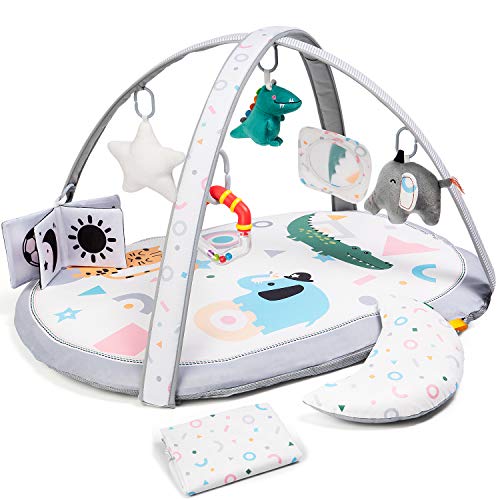
Not every baby loves being strapped into a seat. For parents who practice “floor freedom” or want to avoid hip-positioning concerns, the Lupante Activity Gym is the top contender. It provides a huge, soft space for rolling, scooting, and playing.
This isn’t your average small square mat. It is extra-large (36.5 inches), making it spacious enough for twins or very active rollers. The overhead arches feature high-contrast toys and a baby-safe mirror to stimulate visual development.
The sides can be folded up to create a “ball pit” environment, which keeps crawling babies contained safely. It comes with a variety of sensory textures, including crinkle fabrics and soft rattles. Since it is entirely fabric and foam, you can toss the mat in the wash, making hygiene a breeze.
Pros
- No weight or height restrictions.
- Promotes unrestricted movement and floor skills.
- Converts into a ball pit for toddlers.
- Machine washable and easy to fold away.
Cons
- Does not offer the vertical containment of a seated center.
Our Ratings
Baby Einstein Activity Jumper
Best Jumper Activity Center

If your baby has endless energy and loves to kick, a standard stationary center won’t cut it. You need the Baby Einstein Neighborhood Symphony Jumper. It combines the safety of an activity center with the bouncing action of a doorway jumper, without the risk of hitting a doorframe.
The seat is suspended by fabric-covered springs, allowing your baby to jump safely while rotating 360 degrees to reach the toys. The music station is particularly impressive; it features drums, a piano, and a guitar that introduce instrument sounds in three languages (English, French, Spanish).
The drums actually detach, so your toddler can play with them long after they’ve outgrown the seat. With four height adjustments, it accommodates growing legs better than most competitors. Just remember, this is a large item that doesn’t fold flat easily, so measure your space first.
Pros
- Provides a safe outlet for high-energy babies.
- Bongo drums detach for separate play.
- Introduces music and languages (English, Spanish, French).
- Seat pad is machine washable.
Cons
- Large footprint; difficult to disassemble for storage.
- Short use window (until walking or 25 lbs).
Our Ratings
Evenflo Exersaucer Bounce & Learn
Best on a Budget
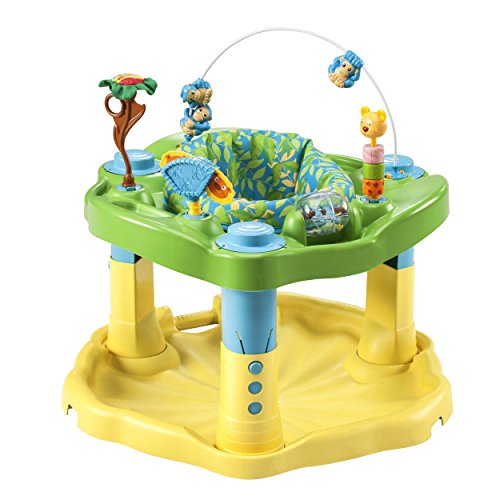
You don’t need to spend a fortune to get a safe, engaging activity center. The Evenflo Exersaucer is a classic for a reason. It focuses on physical development without relying on batteries, flashing lights, or annoying soundtracks.
The base has a unique convex shape that allows the baby to rock and bounce manually, building core and leg strength naturally. The toys are simple but effective, featuring “spin and grab” animals like monkeys and parrots. Because it lacks complex electronics, it is incredibly durable and easy to wipe clean.
It is also one of the lighter options on the list, making it easy to drag out to the backyard or move to the kitchen while you cook. While it doesn’t convert into a table, its low price point makes it an excellent value for the 6-12 month window.
Pros
- Excellent value for the price.
- Encourages physical rocking and bouncing.
- No batteries required for the main unit.
- 3-position height adjustment.
Cons
- Lacks music and light features.
- Harder to assemble than some premium models.
Our Ratings
FAQs

What is the Difference Between an Exersaucer and an Activity Center?
An Exersaucer is a brand name (by Evenflo) that has become a generic term for saucer-shaped entertainers. They typically have a rounded base that allows for rocking and bouncing.
Activity centers are the broader category. They can include stationary tables, jumpers, or convertible 3-in-1 units. Generally, exersaucers focus on physical movement (rocking), while standard activity centers focus on fine motor skills and toys.

Are Activity Centers Bad for Baby’s Hips?
They can be if used excessively. Placing a baby in a seat that forces their legs to dangle straight down can put stress on the hip joints (hip dysplasia).
Look for centers where the seat supports the baby’s thighs and keeps the hips in a natural “M” position. To be safe, limit time in the device to 15 or 20 minutes per session.

Do Exersaucers Help With Walking?
No, they do not teach walking. In fact, they can sometimes delay it if used too much because babies tend to walk on their toes or lean forward in the seat, which uses different muscles than independent walking.
They are great for entertainment, but floor time and cruising along furniture are the best ways to teach walking skills.

How Long Can You Leave a Baby In an Activity Center?
Pediatricians generally recommend limiting time in any “container” device to 15 to 20 minutes at a time, twice a day.
Think of it as a sprint, not a marathon. It is a safe spot for a quick break, but your baby needs plenty of unrestricted floor time to develop crawling and rolling skills.

When Should I Stop Using an Exersaucer?
You should stop using the seat component when your baby can walk independently or when they try to climb out of it. Most babies outgrow the seated portion by 9 to 12 months.
If you have a convertible model, you can switch it to the table mode and continue using it well into toddlerhood.

Should My Baby’s Feet Touch the Floor in an Activity Center?
Yes. Your baby’s feet should touch the base or floor flatly. They should not be dangling in the air, nor should their legs be bent sharply.
If they are on their tiptoes, lower the seat. If their knees are up by their chest, raise the seat. Proper foot placement protects their hips and allows them to push up safely.