If your baby has finally decided to sleep through the night, you are probably desperate to do the same. However, you know that skipping a session can impact your milk supply or lead to painful issues like clogged ducts and mastitis. This leaves many parents asking the big question: do I really need to pump at night?
We want your baby to have the best nutrition possible, but we also know you need rest to function. We have analyzed the science of milk production to help you find the right balance.
In this guide, we will break down pumping schedules for exclusive pumpers and nursing moms. We will also explain the “magic window” for milk hormones and how to safely drop night sessions without tanking your supply.
Key Takeaways
- Supply regulation: Newborns nurse frequently, so exclusive pumpers need to pump every 2 to 3 hours at night to establish a robust milk supply.
- The hormone factor: Prolactin levels peak in the early morning hours, meaning a 2 a.m. or 3 a.m. pump often yields the most milk.
- Nursing moms: If your baby is healthy and sleeping through the night, you generally do not need to wake up to pump unless you are in pain.
- Dropping sessions: As your baby starts solids and sleeps longer, you can gradually space out night pumps to get more rest.
If You Are Exclusively Pumping
When you are pumping and bottle feeding, your machine has to do the work of a nursing infant. This means you generally need to match the frequency of a baby’s natural feeding rhythm to maintain volume.
1. Pumping for a Newborn
Newborn tummies are tiny, requiring them to eat 8 to 12 times in a 24-hour period. To establish your supply, you should pump at least every two hours during the day and never go longer than three hours at night (1).
Pumping whenever your newborn baby eats is the easiest way to stay on track. However, if you have a sleepy baby who doesn’t wake often, you still need to set an alarm. Your body relies on frequent milk removal to establish a long-term supply.
Aim to double pump for 15 to 20 minutes per session. Most experts recommend pumping for two to five minutes *after* the last drops of milk flow; this signals your body to produce more for the next round (2).
Volume Goals
If you are pumping right from the start, begin with eight to ten sessions every 24 hours. You can treat this as a baseline; if you have a low milk supply, add a session. If you have a massive oversupply, you might be able to drop one.

2. The “Magic Hour” for Older Babies
It is crucial to pump at least once during the night for the first few months. Lactation consultants often refer to the time between 1 a.m. and 4 a.m. as the “magic window.” Your levels of prolactin, the milk-making hormone, are highest during this time, meaning you will likely get your highest output of the day.
In addition, your prolactin levels are highest at night, so you’re taking advantage of the milk-making hormone by pumping at night.

Editor's Note:
Michelle Roth, BA, IBCLCKeep In Mind
As your baby ages, they will consume more milk per sitting (usually 3.5 to 5 ounces) but will eat less frequently. Once they start incorporating solids, your demand will naturally decrease.
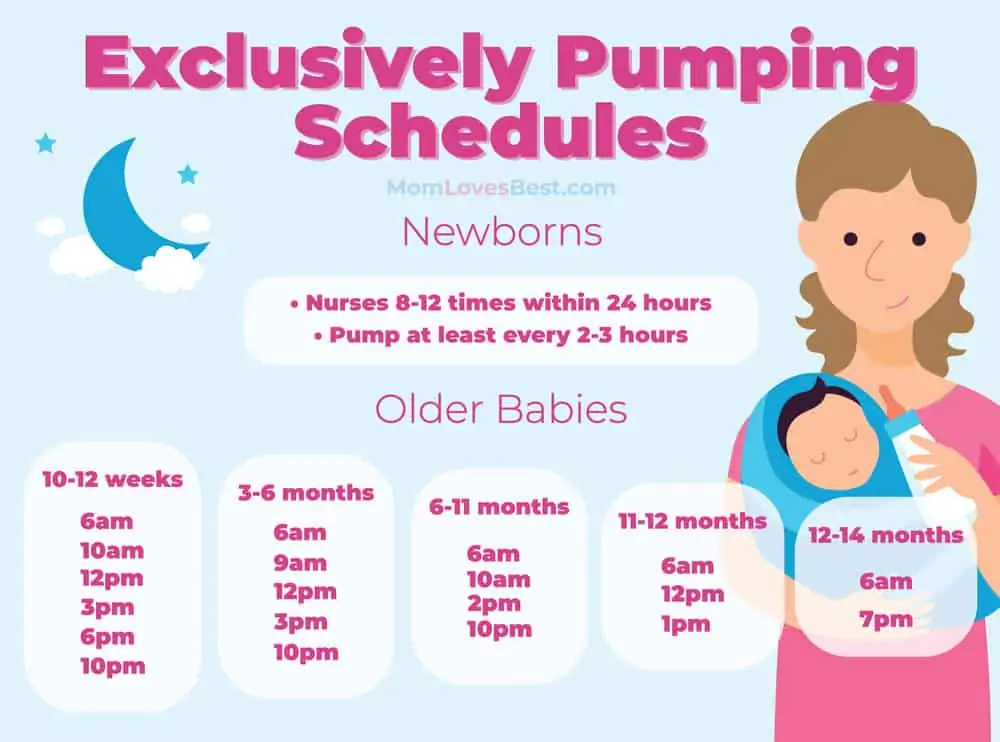
You have to find a rhythm that fits your life, but here are some common schedules based on age:
- 10 to 12 weeks: 6 a.m., 10 a.m., 12 p.m., 3 p.m., 6 p.m., 10 p.m.
- 3 to 6 months: 6 a.m., 9 a.m., 12 p.m., 3 p.m., 10 p.m.
- 6 to 11 months: 6 a.m., 10 a.m., 2 p.m., 10 p.m.
- 11 to 12 months: 6 a.m., 12 p.m., 1 p.m.
- 12 to 14 months: 6 a.m., 7 p.m.
What If You Miss a Session?
Life happens, and sometimes you sleep through your alarm. If you accidentally miss a pumping session, do not panic. Missing a single session will not ruin your supply permanently, especially if you can squeeze in a “makeup session” later in the day to keep your total minutes consistent.
Don't Stress
If You Are Nursing (Not Exclusively Pumping)
Breastfeeding at night is excellent for maintaining supply, but do you need to wake a sleeping baby just to empty your breasts?
Should You Wake the Baby?
If your baby has regained their birth weight, is following their growth curve, has no medical issues, and produces plenty of wet diapers, you typically do not need to wake them. Enjoy the sleep while you can.
To Pump or Not To Pump?
If your baby sleeps through the night, you generally do not need to wake up to pump. Breastfeeding works on supply and demand; if you pump while the baby sleeps, you are telling your body to create extra milk that the baby isn’t eating. This can lead to a problematic oversupply.
However, if you wake up in pain or feel rock-hard engorgement, use a manual pump or hand express just enough milk to relieve the pressure. Avoid emptying the breast completely, or your body will think it needs to keep producing that volume at 3 a.m. forever.
FAQs

Is Pumping in the Middle of the Night Important?
Yes, especially in the first few months. Prolactin (the milk-making hormone) levels are highest between 1 a.m. and 5 a.m., making this the most productive time for milk removal. Skipping this window early on can signal your body to down-regulate supply, leading to a permanent drop in production.

Will Pumping Overnight Increase Supply?
Absolutely. Because your hormone levels are naturally higher at night, removing milk during these hours is one of the most effective ways to boost overall supply. If you are struggling with low production, adding a session between 2 a.m. and 4 a.m. is often the first recommendation from lactation experts.

Will Not Pumping at Night Hurt My Supply?
It depends on your “magic number” (storage capacity) and how old your baby is. For the first 12 weeks, skipping night pumps creates a high risk of supply drops and clogged ducts. Once your supply regulates (usually after 3 to 4 months), many mothers can sleep longer stretches without seeing a decrease in total daily volume.

How Long Can I Go Without Pumping at Night?
Newborn mothers should not go longer than 3 to 4 hours without pumping. Once your supply is established (around 12 weeks), you can experiment with stretching this to 5 or 6 hours. If you wake up leaking or in pain, your body is telling you that you waited too long.

When Can I Drop the Middle of the Night Feeding?
Physiologically, many babies can sleep for longer stretches without feeding once they reach a healthy weight, typically around 6 months. However, every baby is different. You can begin night weaning or dropping pump sessions when your pediatrician gives the all-clear regarding your baby’s weight gain and growth patterns.
Pump or Sleep?
Deciding whether to set that 3 a.m. alarm is a balancing act between your mental health and your milk production goals. If you are exclusively pumping, try to mimic a newborn’s natural schedule by pumping every time they would normally eat. This protects your supply during those critical early weeks.
For newborns, stick to the 120-minute rule during the day and never go longer than a few hours at night. As they grow and begin eating solid foods, you can celebrate by slowly dropping those exhausting middle-of-the-night sessions.
If you are nursing and your baby is naturally sleeping through the night, take the win! There is no need to pump unless you are uncomfortable. Get some rest, mama; you earned it.