Obsessing over a baby’s weight is practically a rite of passage for new parents. We all want to know if our little one is “normal,” healthy, and eating enough. Pounds and ounces are concrete numbers we can hold onto when everything else feels overwhelming.
But that number on the scale can also trigger a lot of anxiety. I’ve been there, and I don’t know many parents who haven’t worried about their baby being too small or too chunky at some point. Let’s break down what counts as an average birth weight, how those numbers change over the first year, and how to make sense of those confusing percentile charts without losing your mind.
Key Takeaways
- The average U.S. newborn weighs about 7.5 pounds, though the “normal” range spans from 5.5 to 10 pounds.
- Genetics, maternal health, birth order, and gestational age are the biggest factors influencing size at birth.
- Most newborns lose up to 10 percent of their body weight in the first week but regain it within two weeks.
- Percentiles are about consistency; staying on a specific growth curve is more important than hitting a specific number.
What Is the Average Baby Weight at Birth?
In the United States, the average newborn clocks in at roughly 7.5 pounds. However, averages don’t tell the whole story. Anything between 5.5 pounds and 10 pounds is generally considered a healthy, normal birth weight (1).
This “healthy zone” applies specifically to full-term babies born between 37 weeks and 40 weeks plus 6 days. If you go past your due date or deliver early, those numbers will naturally shift.
How Big of a Baby Can You Deliver?
A baby weighing more than 8 pounds, 13 ounces is medically considered “large for gestational age.” Roughly 9 percent of babies fall into this category (2). When a baby tips the scales over 9 pounds, 15 ounces, the risks for delivery complications do increase for both mom and baby.
However, the weight on the scale isn’t the only factor determining if you can deliver vaginally. Your ability to deliver a larger baby depends on:
- Positioning: Whether the baby is facing the right way and tucking their chin.
- Uterine strength: How effective your contractions are at moving the baby down.
- Pelvic shape: How the baby’s size relates to the specific shape and width of your pelvis (3).
Some women with wider pelvises can deliver 10-pound babies with ease, while others may struggle with a 7-pounder due to positioning issues. Your healthcare provider is the best person to gauge whether your baby’s size might require a C-section or induction.
Factors Affecting Average Baby Weight at Birth
Birth weight is a complex cocktail of genetics, health, and timing (4). While we can predict some trends, babies have a way of surprising us.
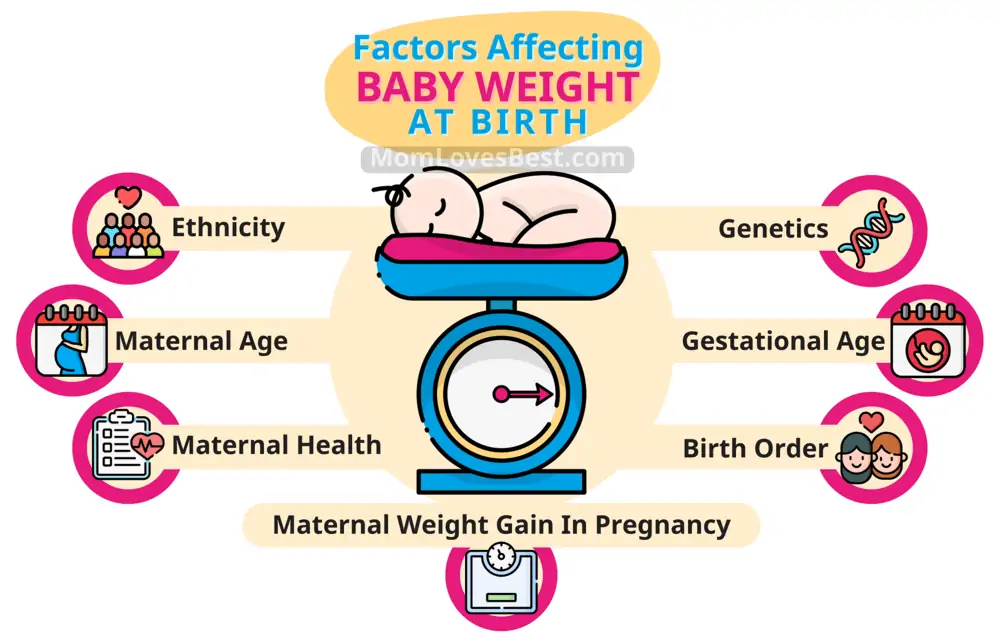
Ethnicity
Statistical data shows disparities in birth weight across different demographics. In the U.S., babies born to Black parents are statistically more likely to have a lower birth weight compared to other ethnicities (5).
Research is ongoing to determine how much of this is genetic versus environmental. Many experts point to systemic health disparities and higher stress levels affecting maternal health as major contributors, rather than biology alone.
Maternal Age
Age plays a surprisingly large role. Moms under 20 are more likely to have smaller babies. Meanwhile, women between 20 and 35 typically have average-sized newborns.
Once you hit 35 and older, the variance widens. Older moms are more likely to have larger babies. In fact, about 10 percent of moms over 40 deliver “large” babies, compared to just 3 percent of teen moms (6).
Maternal Health
Your health before and during pregnancy acts as a blueprint for baby’s growth.
- Diabetes: Moms with pre-existing or gestational diabetes often have larger babies because the extra blood sugar acts like fertilizer for growth.
- Blood Pressure: Chronic hypertension or preeclampsia can restrict blood flow to the placenta, often leading to smaller babies.
- Substance Use: Smoking tobacco or marijuana is strongly linked to low birth weight (7). Excessive alcohol has a similar negative effect.
Pregnancy Weight Gain
Weight gain guidelines exist for a reason. Generally speaking, if you gain more than the recommended amount for your body type, you are more likely to have a heavy baby. Conversely, gaining too little can lead to a smaller infant. It is about finding that sweet spot recommended by your OB-GYN.
Genetics
If you and your partner are tall and broad, don’t expect a tiny bird of a baby. The birth weights of the biological parents are strong predictors (8). It is nature’s way of trying to match the baby to the family gene pool.
Gestational Age
This one is simple logic: the longer the baby stays in the “oven,” the bigger they get. Premature babies (born before 37 weeks) are almost always smaller, while post-term babies (41+ weeks) have had extra time to pack on the ounces.
Birth Order
The “first pancake” rule sort of applies here. Typically, your first baby is your smallest. Subsequent children with the same biological father often weigh a bit more.
However, this isn’t a hard law of physics. My second child was a whopping 11 pounds, 9.5 ounces (my heaviest), while my fourth was a petite 4 pounds, 4 ounces (my lightest). Every pregnancy is unique.
Are Boy Babies Bigger Than Girls?
Generally, yes. If all other factors are equal, boys tend to weigh a few ounces more than girls at birth. It isn’t a massive difference, but on average, the blue team comes in slightly heavier than the pink team.
Average Baby Weight By Month
Curious what the trajectory looks like? This table shows the average weight of healthy, full-term babies during the first year.
| Age | Boys | Girls |
| 1 Month | 9 lbs 14 oz (4.5 kg) | 9 lbs 4 oz (4.2 kg) |
| 2 Months | 12 lbs 5 oz (5.6 kg) | 11 lbs 4 oz (5.1 kg) |
| 3 Months | 14 lbs (6.4 kg) | 12 lbs 14 oz (5.8 kg) |
| 4 Months | 15 lbs 7 oz (7.0 kg) | 14 lbs 2 oz (6.4 kg) |
| 5 Months | 16 lbs 9 oz (7.5 kg) | 15 lbs 3 oz (6.9 kg) |
| 6 Months | 17 lbs 8 oz (7.9 kg) | 16 lbs 2 oz (7.3 kg) |
| 7 Months | 18 lbs 5 oz (8.3 kg) | 16 lbs 14 oz (7.6 kg) |
| 8 Months | 19 lbs (8.6 kg) | 17 lbs 7 oz (7.9 kg) |
| 9 Months | 19 lbs 10 oz (8.9 kg) | 18 lbs 2 oz (8.2 kg) |
| 10 Months | 20 lbs 3 oz (9.2 kg) | 18 lbs 11 oz (8.5 kg) |
| 11 Months | 20 lbs 12 oz (9.4 kg) | 19 lbs 4 oz (8.7 kg) |
| 12 Months | 21 lbs 3 oz (9.6 kg) | 19 lbs 10 oz (8.9 kg) |
Newborn Weight Loss
Don’t panic when your baby weighs less at their first pediatrician appointment than they did at birth. This is totally normal. Babies are born with extra fluids, and they eliminate that excess (and pass meconium) in the first few days.
Losing between 7 and 10 percent of birth weight is standard (9). Most babies regain this weight within 10 to 14 days. As long as your little one is eating well and producing plenty of wet diapers, that initial drop is nothing to lose sleep over.
Baby Growth Spurts
Your baby won’t grow in a perfectly straight line. They grow in jumps. During a growth spurt, your baby might act hungrier, fussier, or sleep differently than usual (10). These periods usually last a few days.
Common times for growth spurts include:
- 1 to 3 weeks old.
- 6 to 8 weeks old.
- 3 months.
- 6 months.
- 9 months.
How to Track Average Baby Weight
You don’t need to weigh your baby every day. In fact, doing so will probably just drive you crazy. Here is how to keep tabs on their growth sensibly.
- Stick to the doctor’s visits: The most accurate way to track growth is during well-child visits. They use the same calibrated scales every time, ensuring consistency.
- Use a baby scale: If you are anxious or need to track weight for medical reasons, a dedicated baby scale is your best bet at home.
- The bathroom scale trick: For a rough estimate, weigh yourself holding the baby, then weigh yourself alone. Subtract your weight from the combined weight. It isn’t precise to the ounce, but it gives you a ballpark.
- Watch the baby, not the number: Is your baby alert? Are they meeting milestones? Are they wetting diapers? Often, these signs tell you more about health than a scale can.
Understanding Weight Percentiles
If you have ever looked at a baby weight chart and felt confused, you are not alone. Here is the secret: it is about the curve, not the competition.
Think of percentiles as lanes on a highway. A baby in the 5th percentile is in the “slow lane” for size (lighter than 95% of babies), while a baby in the 90th percentile is in the “fast lane” (heavier than 90% of babies).
Neither lane is “better.” The goal is for your baby to stay in their lane.
- If a baby is born at the 25th percentile, we generally expect them to stay near the 25th percentile at 6 months and one year.
- A problem only arises if a baby “swaps lanes” dramatically, dropping from the 50th percentile down to the 10th, or shooting from the 20th up to the 90th suddenly.
Doctors look for that consistent curve. As long as your baby is following their own personal growth line, they are likely doing just fine.
Why Is My Baby Not Gaining Weight?
When a baby’s growth stalls significantly, doctors call it “failure to thrive.” This sounds scary, but it’s really just a medical term meaning “not getting enough calories to grow.”
This calorie deficit usually happens for one of three reasons:
1. Not Getting Enough Calories
This is an input issue.
- Feeding struggles: Breastfeeding difficulties like a poor latch or low supply.
- Formula errors: Mixing formula with too much water (diluting the calories).
- Hunger cues: Missing early signs that baby is hungry.
2. Not Eating Enough
Sometimes the food is there, but the baby can’t take it in.
- Physical barriers: A tongue-tie or cleft palate making sucking difficult.
- Reflux: Severe spit-up where the baby loses a lot of what they eat.
- Sensory issues: Trouble transitioning to solids or extreme pickiness.
3. Not Absorbing Calories
Rarely, a baby eats enough but the body doesn’t use it.
- Food intolerances: Allergies to milk protein, wheat, or dairy.
- Medical conditions: Issues like Cystic Fibrosis or metabolic disorders.
What To Do If Your Baby Is Not Gaining Weight
If you notice the numbers stalling, don’t panic, but do take action.
- Call the doctor: This is step one. They need to rule out underlying issues.
- Check your mix: If using formula, double-check you are following the instructions exactly.
- Feed on demand: Forget the schedule. If the baby is awake and willing, offer the breast or bottle.
- Prioritize milk over solids: For babies under one, breastmilk or formula is the main source of nutrition. Don’t let low-calorie veggies fill them up before they get their milk.
- Add healthy fats: If your baby is on solids, add avocado, olive oil, or nut butters (if not allergic) to boost calorie counts.
What If My Baby Weighs More Than Average?
A big baby is usually a healthy baby. Often, a higher weight corresponds with a longer length. My oldest was off the charts for weight (11+ pounds), but he was also 24 inches long. He was proportional, just huge.
However, sudden, rapid weight gain crossing multiple percentiles can sometimes signal an issue.
- Overfeeding: This is harder to do with breastfeeding, but with bottle feeding, it’s easy to encourage a baby to finish the bottle when they are already full.
- Solids choices: Starting solids with too many sugary fruits or processed snacks can spike weight.
- Medical conditions: Rarely, hormonal issues like hypothyroidism can cause excess gain, usually accompanied by lethargy and constipation (11).
What To Do If Your Baby Is Gaining Too Much
Word Of Caution
- Consult your pediatrician: Verify if the weight gain is actually a problem or just a growth spurt.
- Check formula prep: Adding too much powder to the water concentrates calories (and can cause dehydration).
- Respond to cues, not cries: Not every cry is hunger. Try soothing, rocking, or changing a diaper before offering food if they just ate.
- Healthy solids: Focus on veggies and lean proteins rather than just sweet fruits or rice cereal.
FAQs

When Should A Baby Double Their Birth Weight?
Most babies double their birth weight by the time they are 4 to 6 months old. By their first birthday, they typically triple it. Remember, this is a guideline, not a strict rule.
Do Breastfed Babies Weigh Less Than Formula-Fed Babies?
Often, yes. Breastfed babies tend to gain weight faster in the first 3 months but then slow down compared to formula-fed babies. Formula-fed babies typically gain weight at a steadier, more constant rate throughout the first year.
Does A Low Birth Weight Affect Intelligence?
In most cases, no. While very low birth weight (often associated with premature birth) can be linked to developmental delays, babies born at a slightly lower weight who receive proper nutrition and care usually develop typical cognitive abilities.
What Is The Average Length Of A Newborn?
The average length for a full-term newborn is around 19 to 20 inches (about 50 cm). Like weight, this varies significantly based on genetics and gestational age.
Weighing Up Your Baby’s Pounds
Healthy babies come in all shapes and sizes, from petite peanuts to adorable chunk-monsters. Your child’s weight is just one small piece of a much larger puzzle.
I won’t tell you to stop worrying, I’m a parent, I know that’s impossible. But try to look at the whole picture. If your baby is meeting milestones, dirtying diapers, and generally seems happy, they are likely doing just fine, regardless of what the scale says.
When in doubt, trust your gut and call your doctor. They are there to help you navigate these numbers so you can get back to enjoying those baby snuggles.