
When you’re a new parent, sleep is the ultimate luxury. Most experts agree that the safest way to keep your baby close is with a dedicated co-sleeper. But with so many styles available, from attached bedside cribs to portable nests, it’s easy to get overwhelmed.
We are co-sleeping parents, too. We know the exhaustion and the desire to keep your little one within arm’s reach. To help you find the best fit, we analyzed safety ratings, comfort, and convenience across the top brands. We also dug into recommendations from pediatric sleep experts to ensure you’re making a safe choice.
In this guide, we break down the best baby co-sleepers on the market. We’ll clarify the difference between co-sleeping and bed-sharing, share safety tips, and highlight the pros and cons of each pick so you can all get a better night’s rest.
- With mattress & mattress sheet
- Has a carrying case
- Endorsed by influential pediatricians
- Rotates and swivels 360 degrees
- Side can be lowered
- Fitted sheet included
- Great for breastfeeding moms
- Can be used as standalone bassinet
- Five adjustable heights
- Comfy sleeping area
- Lightweight and portable
- Hypoallergenic premium cotton
- Comes with airflow design
- Easy to store
- No assembly required
- Cotton fabric
- Can be used for other activities
- Grows with your child
What Is a Co-Sleeper?
Choosing between a standard crib and a co-sleeper is a big decision. First, let’s clear up the terminology.
Many people assume “co-sleeping” only means the baby sleeps in the adult bed with the parents. However, the term actually covers two main setups: room-sharing and bed-sharing.
Here is the difference:
- Room sharing: Your baby sleeps in the same room as you but on a separate surface. This could be a bassinet, a crib, or a dedicated bedside sleeper attached to your bed.
- Bed sharing: Your baby sleeps in the same bed as you. Medical experts generally warn against this due to risks like SIDS and suffocation (1).
If you want to co-sleep safely, a dedicated co-sleeper is the way to go.
Bedside sleepers are a popular choice. They look like regular bassinets but have a drop-down side that attaches to your bed. This keeps your baby within arm’s reach for breastfeeding or comforting without the risks associated with sharing a mattress.
How to Choose the Right Co-Sleeper
Finding the perfect co-sleeper involves balancing safety, convenience, and your bedroom layout. You want your baby close enough to hear their breathing, but you also need a setup that protects them.
Here are the essential features to look for.

Size and Versatility
Babies grow faster than you think. A tiny newborn bassinet is great for the first few months, but you need a plan for when they get bigger.
Some parents prefer a co-sleeping crib that converts into a standard crib or playard. These versatile options save space and money in the long run. Look for models with adjustable heights to match your mattress level perfectly. This ensures a seamless (and safe) bridge between your bed and theirs.

Breathability and Visibility
Since your baby will spend a lot of time here, the environment needs to be safe and airy.
We highly recommend co-sleepers with mesh walls. Mesh provides better airflow, which reduces the risk of overheating and suffocation. As a bonus, it allows you to see your baby through the side of the bassinet without having to sit up in bed every time they make a sound.

Safety and Mattress Firmness
Comfort for a baby is different than comfort for an adult. The American Academy of Pediatrics (AAP) requires that all infant sleep surfaces be firm and flat.
While a plush, soft mattress feels nice to us, it poses a suffocation risk for infants (2). A firm mattress prevents the baby from sinking or rolling into a position where they can’t breathe. Always check that there are no gaps between the mattress and the mesh sides.

Ease of Cleaning
Between diaper blowouts and spit-up, baby gear gets messy fast.
Look for a co-sleeper with machine-washable fabrics or a removable cover. A waterproof mattress pad is also a lifesaver for protecting the foam insert. If you can’t easily strip the bedding to wash it, you might regret it at 3 a.m.
Product Reviews
We’ve rounded up the safest, most convenient co-sleepers to help you (and your baby) rest easy.
Arm’s Reach Concepts Co-Sleeper Bassinet
Best Co-Sleeper for Most Parents

This versatile unit from Arm’s Reach works as both a bedside co-sleeper and a standalone bassinet. The mesh sides offer excellent breathability, allowing you to check on your little one without lifting your head from the pillow.
It features built-in wheels, making it easy to move around the house if you want to keep an eye on your napping baby while you get things done. For breastfeeding moms, the drop-side access is a game-changer, minimizing sleep disruption during those middle-of-the-night feeds.
The included leg extensions allow you to adjust the height to match your bed perfectly, ensuring a safe gap-free fit.
Pros
- Includes a mattress and fitted sheet.
- Convenient storage basket for diapers and wipes.
- Comes with a carrying case for travel.
- Leg extensions accommodate taller bed frames.
Cons
- Screws may need retightening periodically if moved often.
Our Ratings
Snuggle Me Organic Co-Sleeper
Best Organic Co-Sleeper
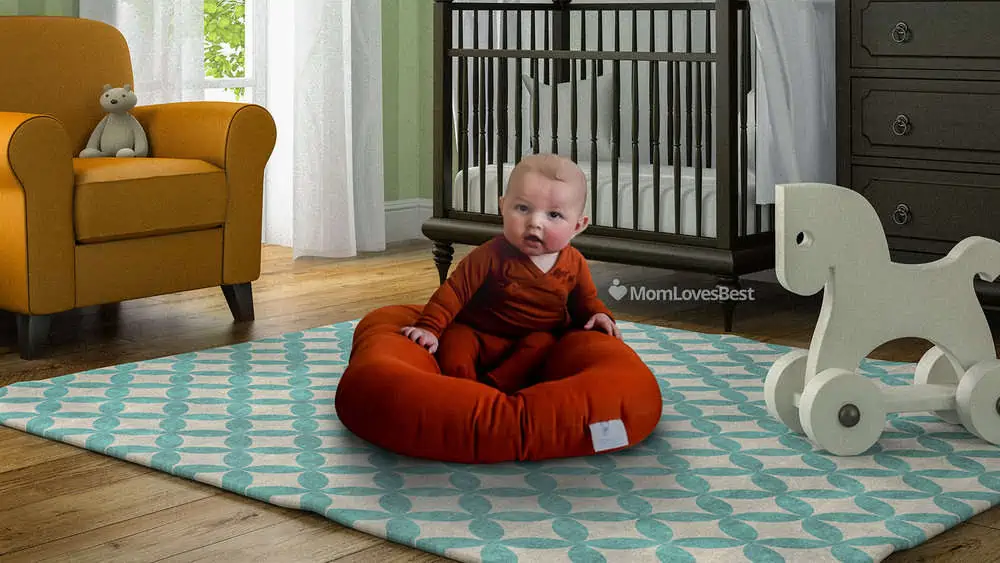
Those sleepless newborn nights are tough, especially if your baby hates being put down. The Snuggle Me Organic is designed to hug your baby’s torso, mimicking the feeling of being held. This can be a lifesaver for parents who need a hands-free moment while their baby lounges nearby.
It uses GOTS-certified organic fabrics and virgin polyester filling, making it hypoallergenic and cozy. It’s great for babies up to 9 months old who aren’t yet crawling.
Important Safety Note: While this product is often called a “co-sleeper” in marketing, pediatric experts recommend firm, flat surfaces for unattended sleep. This product is best used for supervised lounging, tummy time, or active bonding rather than overnight sleep.
Pros
- Unique “hugging” sensation soothes fussy babies.
- Made with organic, non-toxic materials.
- Perfect for supervised lounging and tummy time.
- Machine washable cover (sold separately).
Cons
- Not recommended for unattended overnight sleep.
- Cover fit can be tricky to put back on.
Our Ratings
Halo Bassinest Swivel Sleeper
Best Co-Sleeper for Newborns

The Halo Bassinest is unique because it rotates 360 degrees. You can swivel it over your lap for nursing or comforting, then swivel it away when you need to get out of bed.
The base tucks neatly under your bed frame, saving floor space. It also features a lowering bedside wall, which is helpful for moms recovering from C-sections who find it painful to lift their baby over a high rail.
The mattress pad is chemical-free and waterproof. While it’s heavy and not meant to be moved from room to room, it’s one of the most sturdy and functional options for the primary bedroom.
Pros
- Swivels 360 degrees for easy access.
- Side wall lowers for easy lifting.
- Mesh walls allow full visibility.
- Includes a storage pocket for essentials.
Cons
- Heavy base makes it difficult to move to other rooms.
Our Ratings
KoolaBaby Bedside Sleeper Crib
Best Bedside Co-Sleeper
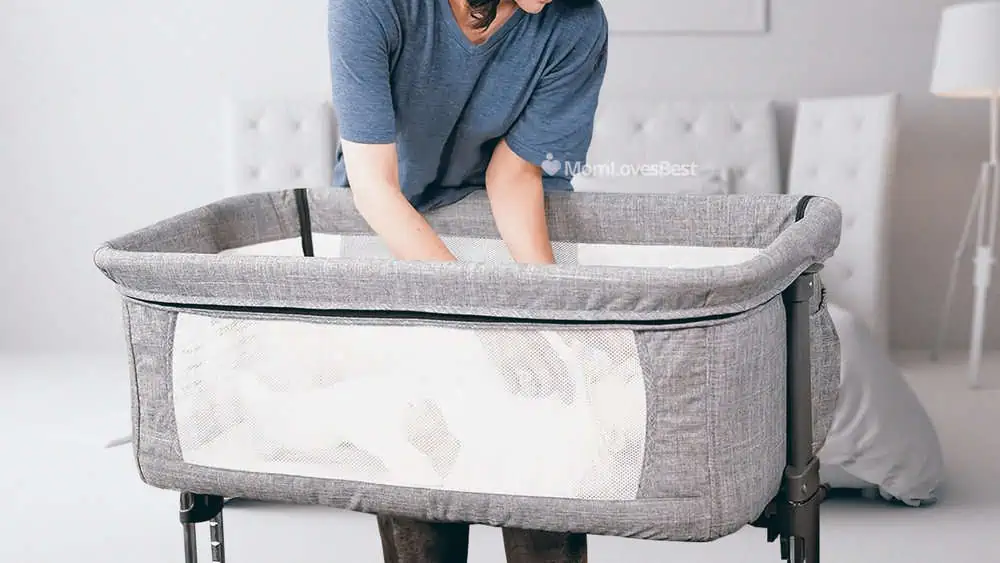
This dedicated bedside sleeper attaches securely to your adult bed, giving you the closeness of co-sleeping with the safety of a separate surface. You can unzip and lower the side wall, making it easy to slide your baby over for a feed and back again without standing up.
It features five adjustable height positions to align with most adult mattresses. The construction is sturdy, and the mattress offers the firmness babies need for safe sleep.
It’s suitable from birth until your baby reaches 20 pounds or can pull themselves upright. Once they become mobile, you’ll need to transition to a standard crib to prevent climbing accidents.
Pros
- Easy access for middle-of-the-night feeds.
- Functions as a standalone bassinet or attached sleeper.
- Simple assembly.
- Five height adjustments for a custom fit.
Cons
- Does not include bottom storage.
Our Ratings
Junoon Baby Lounger
Best Co-Sleeper for Toddlers
If you have a toddler who isn’t ready for a solo room, the Junoon Baby Lounger is a spacious option. It accommodates children as long as their shoulders and hips fit comfortably within the center.
The raised edges provide a gentle barrier, helping to prevent your toddler from rolling around too much. It creates a “nest” feel that can help active sleepers feel secure. While it is lightweight, its larger size makes it a bit bulky for air travel, though it’s fine for road trips.
Use this on the floor or a large safe surface to give your toddler their own designated sleep zone.
Pros
- Sized to fit older babies and toddlers.
- Lightweight and easy to move around the house.
- Padded bottom works well on various surfaces.
- Helps define sleep space for bed-sharing toddlers.
Cons
- Too bulky to fit easily in standard luggage.
Our Ratings
Munchkin Brica Fold N' Go
Best Co-Sleeper for Breastfeeding

If you are looking for an affordable, portable solution, the Munchkin Brica Fold N’ Go is a solid choice. It’s designed to be placed in the center of a large bed (if practicing safe bed-sharing) or used as a travel pod.
For breastfeeding moms, having the baby safely contained right next to you can make nights easier. The mesh panels allow for clear visibility and airflow.
The entire unit folds flat for storage, making it perfect for grandparents’ houses or hotels. It includes a fitted sheet and mattress pad that are machine washable. Note that this is best for smaller babies; once your child can roll over or sit up, the shallow sides won’t contain them safely.
Pros
- Machine-washable sheet and cover.
- Folds compactly for travel.
- Clear mesh panels for breathability.
- Budget-friendly.
Cons
- Babies outgrow it quickly.
- Sides are not rigid enough for active rollers.
Our Ratings
Soobaby Baby Nest Co-Sleeper
Best Travel Co-Sleeper
The Soobaby Nest is designed for families on the go. It folds up neatly and comes with a travel bag, so you can bring your baby’s bed to the park, the beach, or grandma’s house.
The cover is made from 100% cotton, which is soft and gentle on sensitive skin. The rounded bumpers are also great for propping your baby up during tummy time or lounging.
It functions well as a changing station or a safe spot to set the baby down while you have your hands full. Like other nests, use this primarily for supervised rest and lounging.
Pros
- Soft, breathable cotton fabric.
- Versatile design for lounging or tummy time.
- Includes a travel bag.
- Lightweight and foldable.
Cons
- Lesser-known brand compared to major competitors.
- May still require a hard-sided bassinet for unattended sleep.
Our Ratings
Daoluan Baby Lounger Pillow
Best Budget Co-Sleeper

You don’t have to spend a fortune to get a decent sleeper. The Daoluan Baby Lounger offers a sturdy, breathable frame at a wallet-friendly price point.
We appreciate the hidden zipper design, which allows you to easily remove the pillowcase for washing, a must-have feature for messy infants. It comes in three colors (green, blue, pink) to match your nursery decor.
At over 27 inches long, it offers plenty of room for growth. However, because it is quite large, make sure you have enough space on your bed or floor to place it safely.
Pros
- Affordable price point.
- Removable, washable pillowcase.
- Sturdy bumpers.
- Good size for growing infants.
Cons
- Limited customer reviews available.
- Large footprint takes up significant space on a bed.
Our Ratings
Co-Sleeping Safety Tips
We know you want to keep your baby close, but safety must come first. The safest place for a baby is in a crib or bassinet within your room, rather than in your actual bed (3).
If you use a co-sleeper, follow these critical guidelines:
- Keep the sleep space bare: No loose blankets, pillows, stuffed animals, or bumper pads. These are suffocation hazards.
- Check the temperature: Avoid overdressing your baby. Overheating is a SIDS risk factor.
- Fit matters: Ensure sheets fit tightly. There should be no gaps between the mattress and the sleeper walls.
- Back is best: Always place your baby to sleep on their back, never on their stomach or side (4).
FAQs

Is a Co-Sleeper Worth It?
Yes, for most parents, a co-sleeper is worth the investment. It allows you to keep your baby close for feeding and comforting without the safety risks of bed-sharing. It is especially helpful for recovering moms who need to minimize movement during the night.

What Are the Downsides to Co-Sleeping?
The main downsides are potential sleep disruptions for parents (babies are noisy sleepers!) and the eventual challenge of transitioning the baby to their own room. If bed-sharing is practiced incorrectly, it also carries significant safety risks.

What Are the Best Co-Sleeping Tips?
Use a dedicated bedside sleeper rather than sharing your mattress. Keep the baby’s sleep surface flat and bare (no pillows or blankets). Always place the baby on their back. If you are extremely overtired or have consumed alcohol, do not co-sleep.

Are Co-Sleepers Safe for Newborns?
Yes, co-sleepers that meet current safety standards (like ASTM or CPSC) are safe for newborns. Look for a firm, flat mattress and breathable mesh sides. Avoid soft “loungers” for unsupervised overnight sleep.

Can Newborns Sleep on an Incline?
No. Newborns should not sleep on an incline. Inclined sleepers were recalled due to safety risks. Babies should always sleep on a flat, firm surface to keep their airways open and prevent positional asphyxiation.

Is Co-Sleeping a Risk Factor for SIDS?
Bed-sharing (sleeping in the same bed) increases the risk of SIDS, especially if soft bedding is present or parents smoke. However, room-sharing (sleeping in the same room but on a separate surface) actually reduces the risk of SIDS by up to 50%.

What Is the Weight Limit for Most Co-Sleepers?
Most bedside bassinets have a weight limit between 15 and 30 pounds. However, the developmental limit is more important: stop using the co-sleeper once your baby can push up on hands and knees or pull themselves up, as they could fall out.

When Should I Move My Baby to a Crib?
You should move your baby to a standard crib when they outgrow the weight or height limits of their co-sleeper, or when they become mobile enough to pull themselves up (usually around 4 to 6 months).