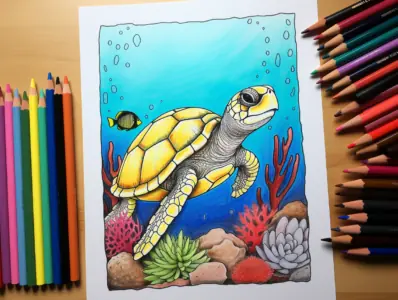
How many of these 50 turtles can your crew color before dinner?
Fifty free turtle coloring pages are lined up below, and they run the whole range from chunky toddler outlines to shells packed with fine linework.
You will find a turtle in a plaid scarf, one floating under three balloons, a tortoise crossing the desert past a prickly pear, and plenty of sea turtles cruising over open sand.
Every sheet prints on plain letter paper. Grab one for a rainy afternoon or run off a stack for a classroom ocean unit.
Turtle's Kawaii Smile
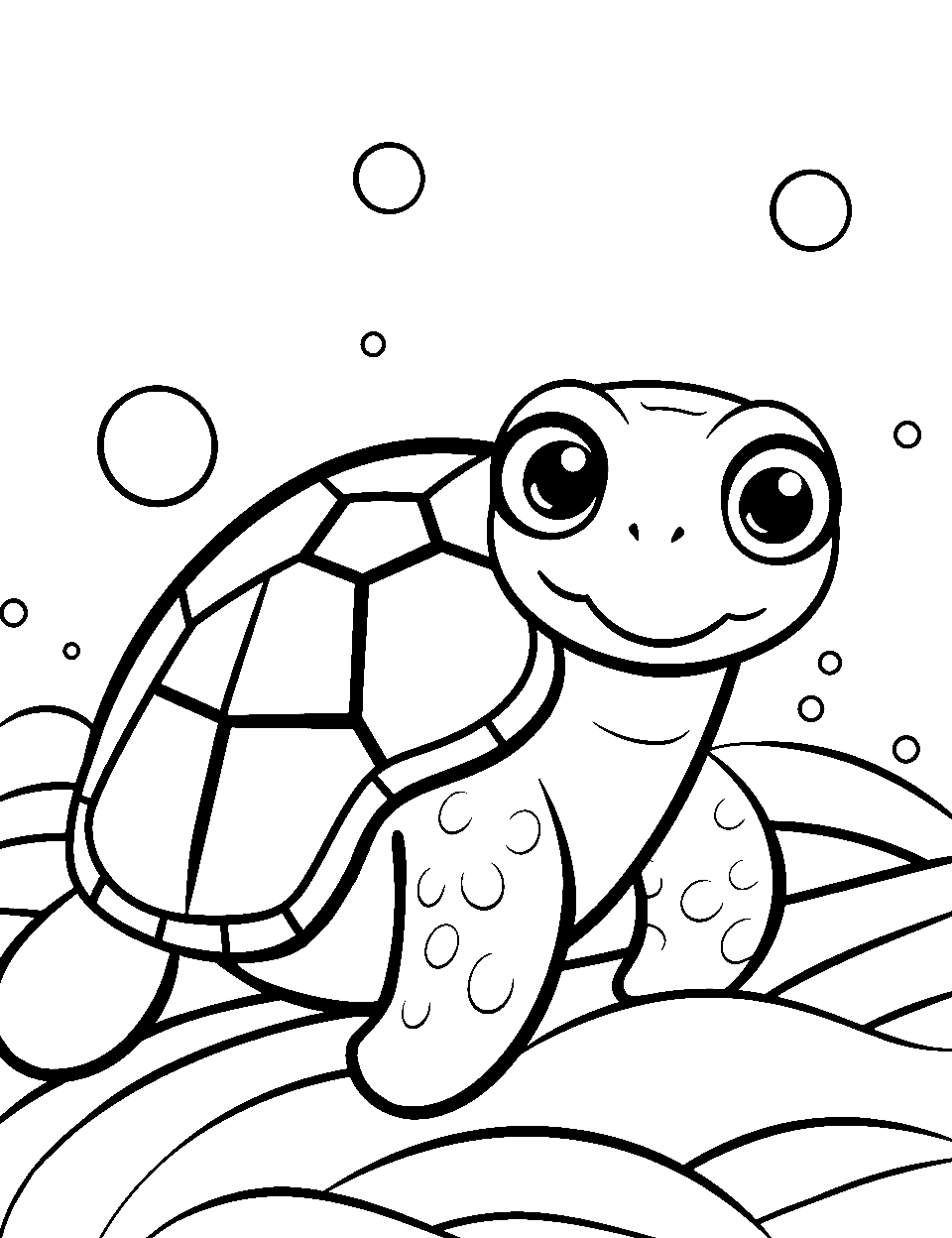
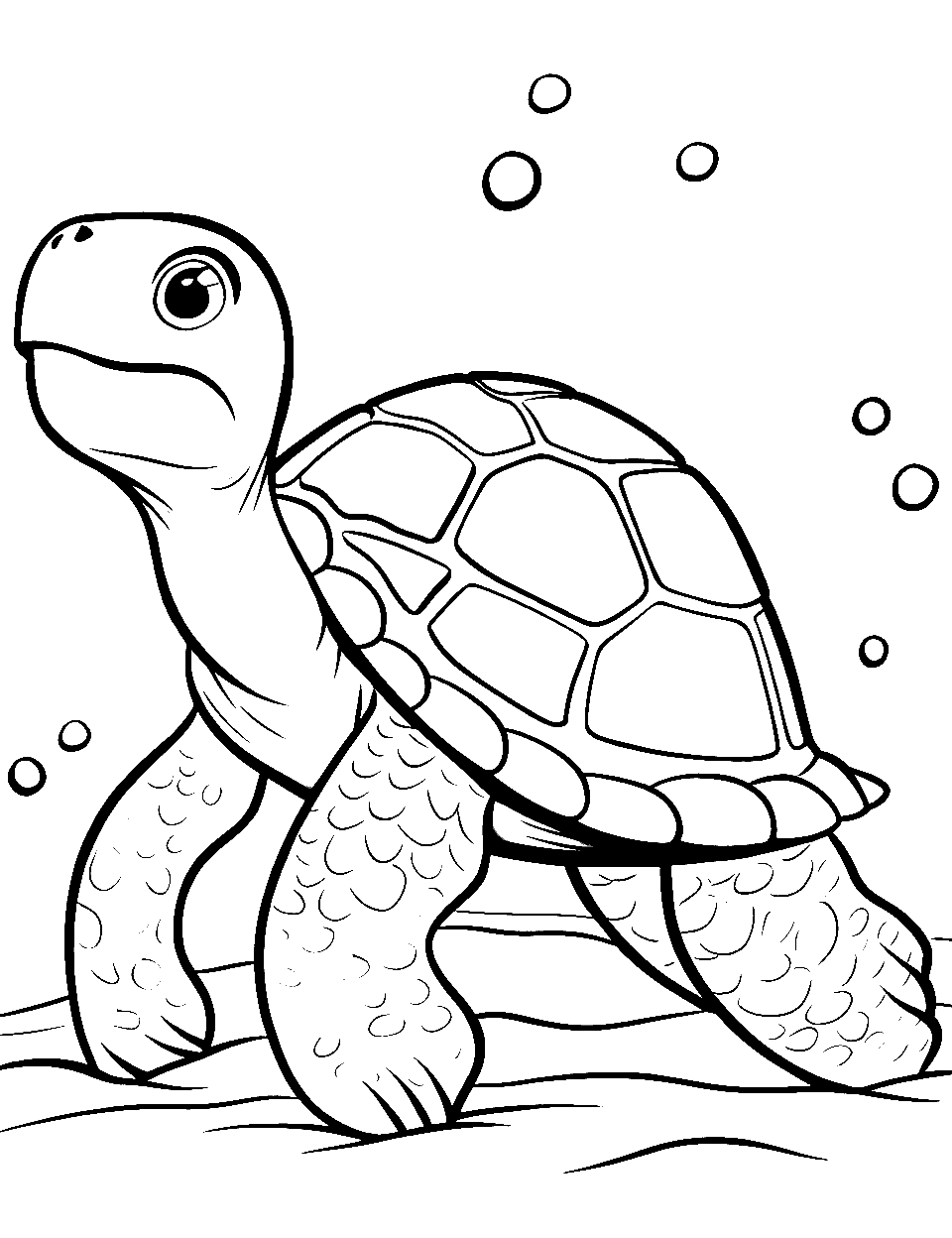
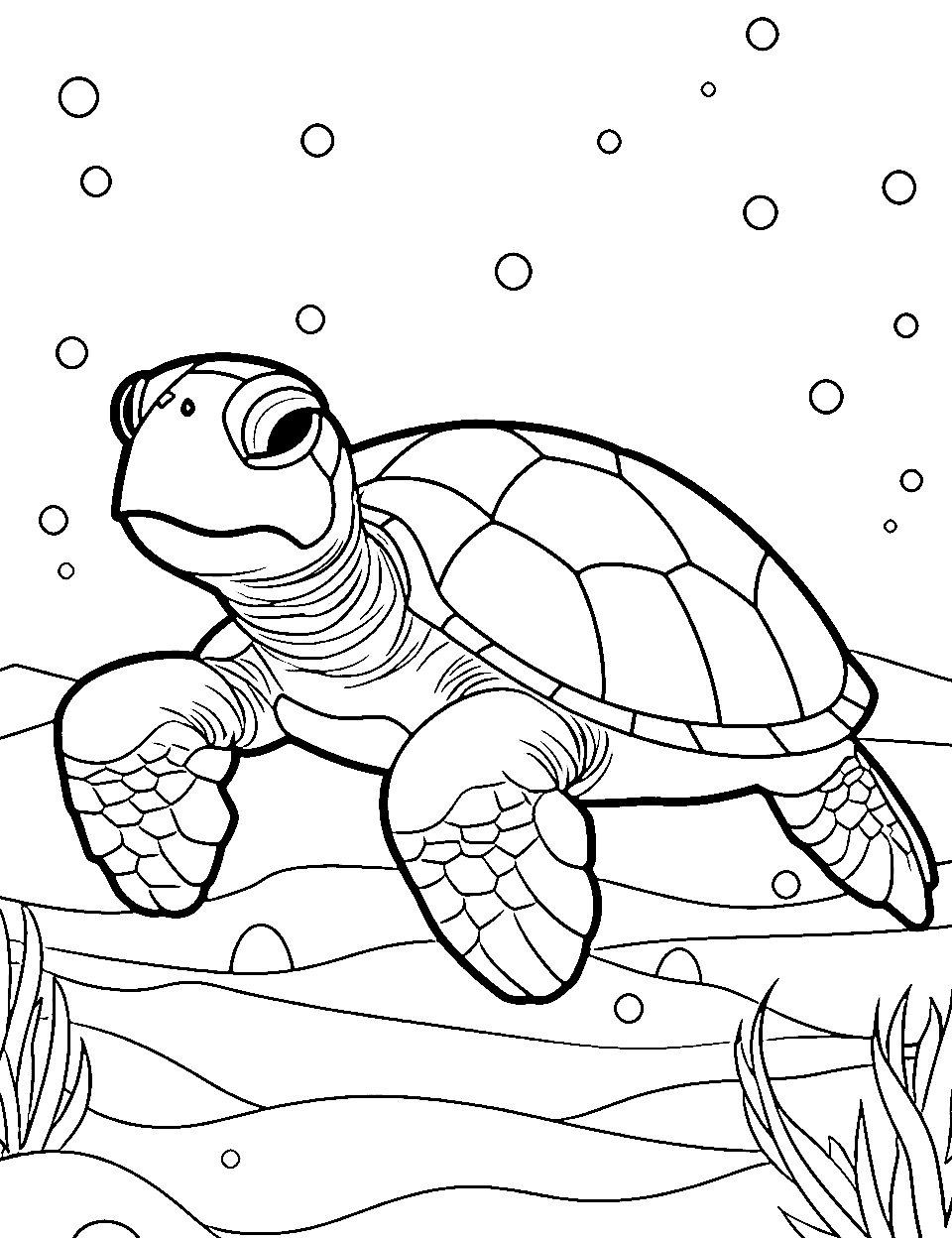
Huge sparkling eyes and a closed-mouth smile make this the friendliest turtle in the set. The shell breaks into big open panels, so even a two-year-old can fill it without straying far. Try a kawaii-style palette of mint and pale pink instead of realistic browns. The bubbles floating around it are easy targets for a light blue.
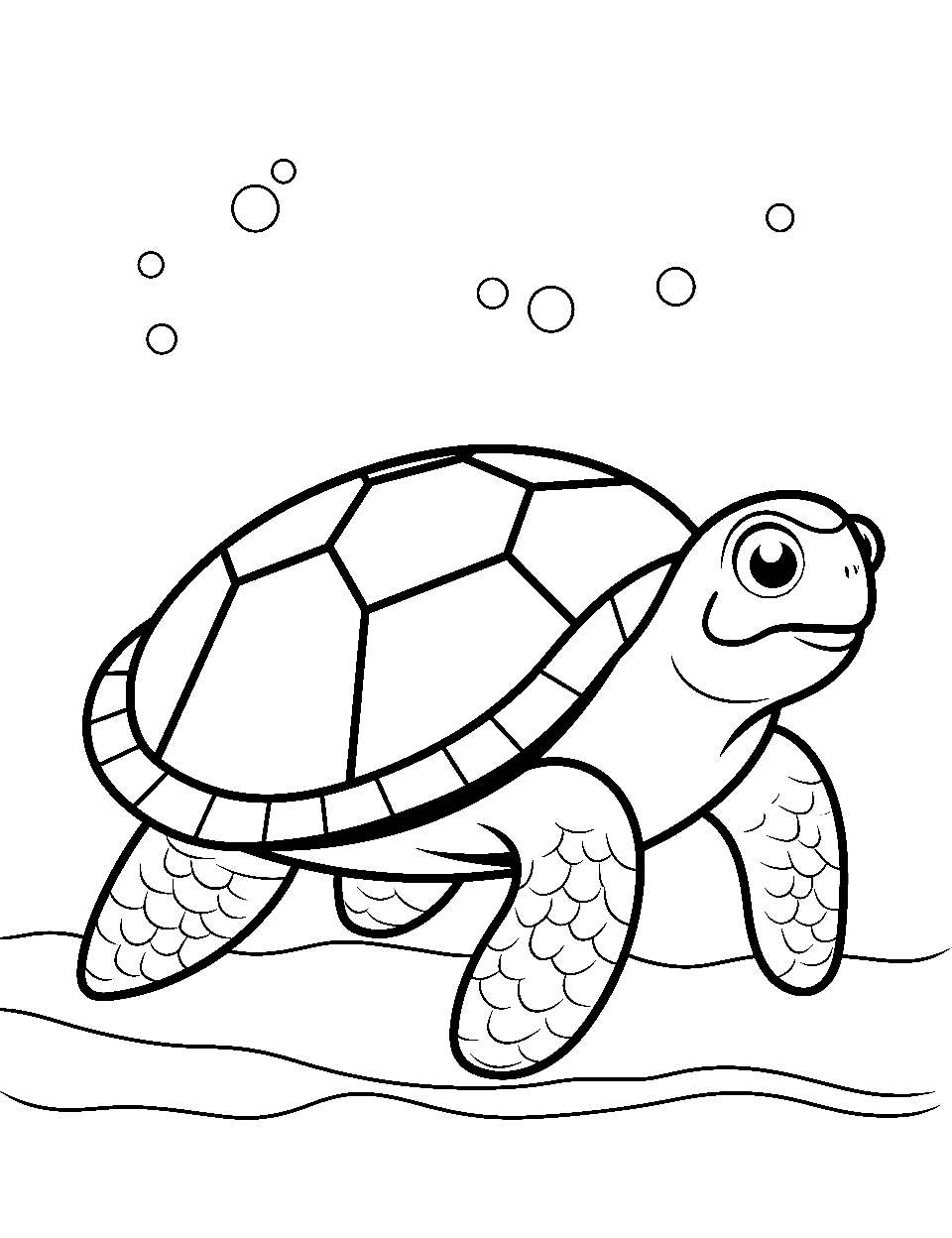
Everything here is one clean, heavy line: the shell, the four legs, one big eye. There is no shading and no background clutter, which makes it a fast win for a child who gives up when a page looks busy. A handful of bubbles float overhead if they want somewhere extra to color.
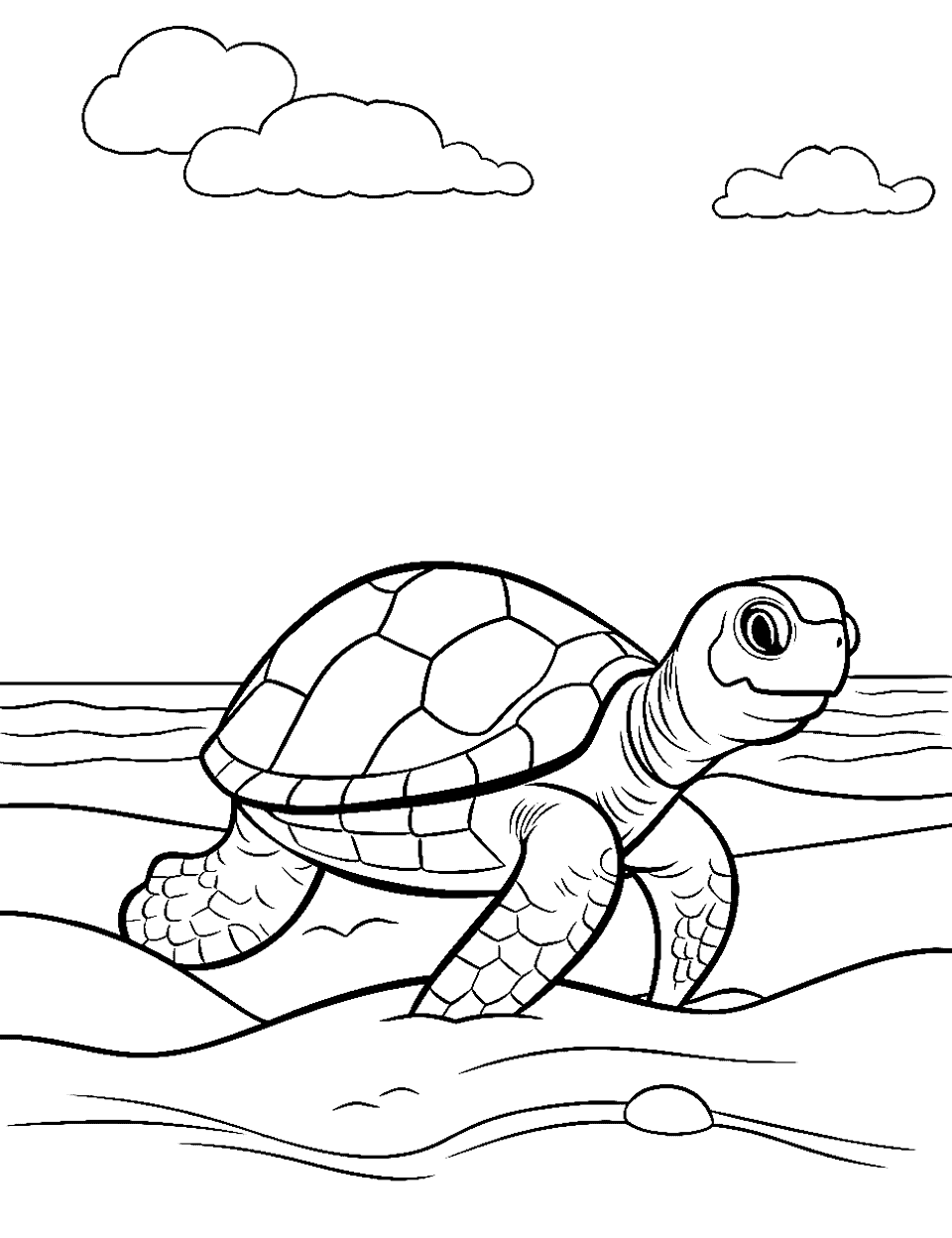
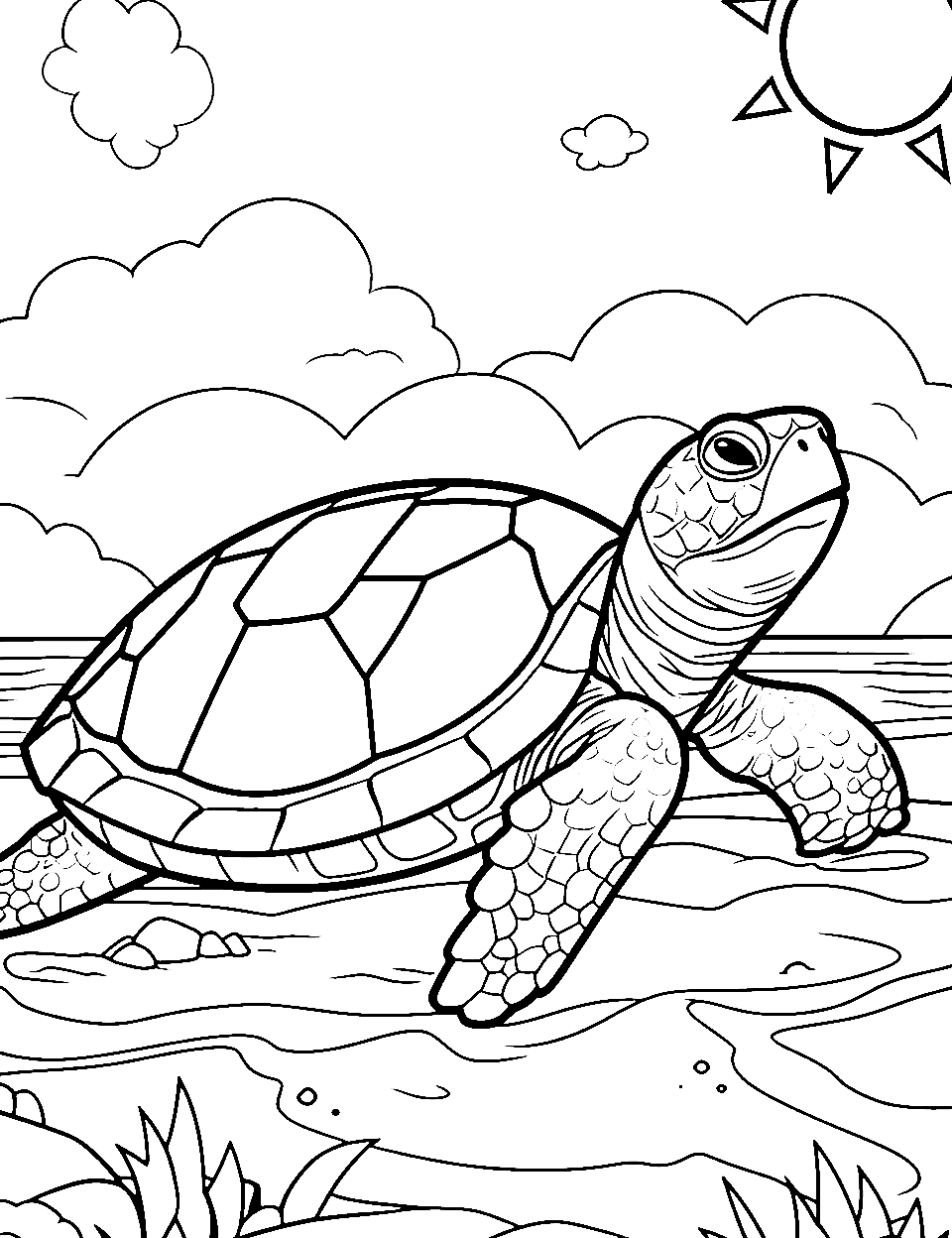
A young turtle plants one foot forward on the sand while low clouds sit in the sky behind it. The ground is drawn as long open bands that fill fast with the side of a crayon. Keep the shell in warm browns and let the sky carry the bright work.
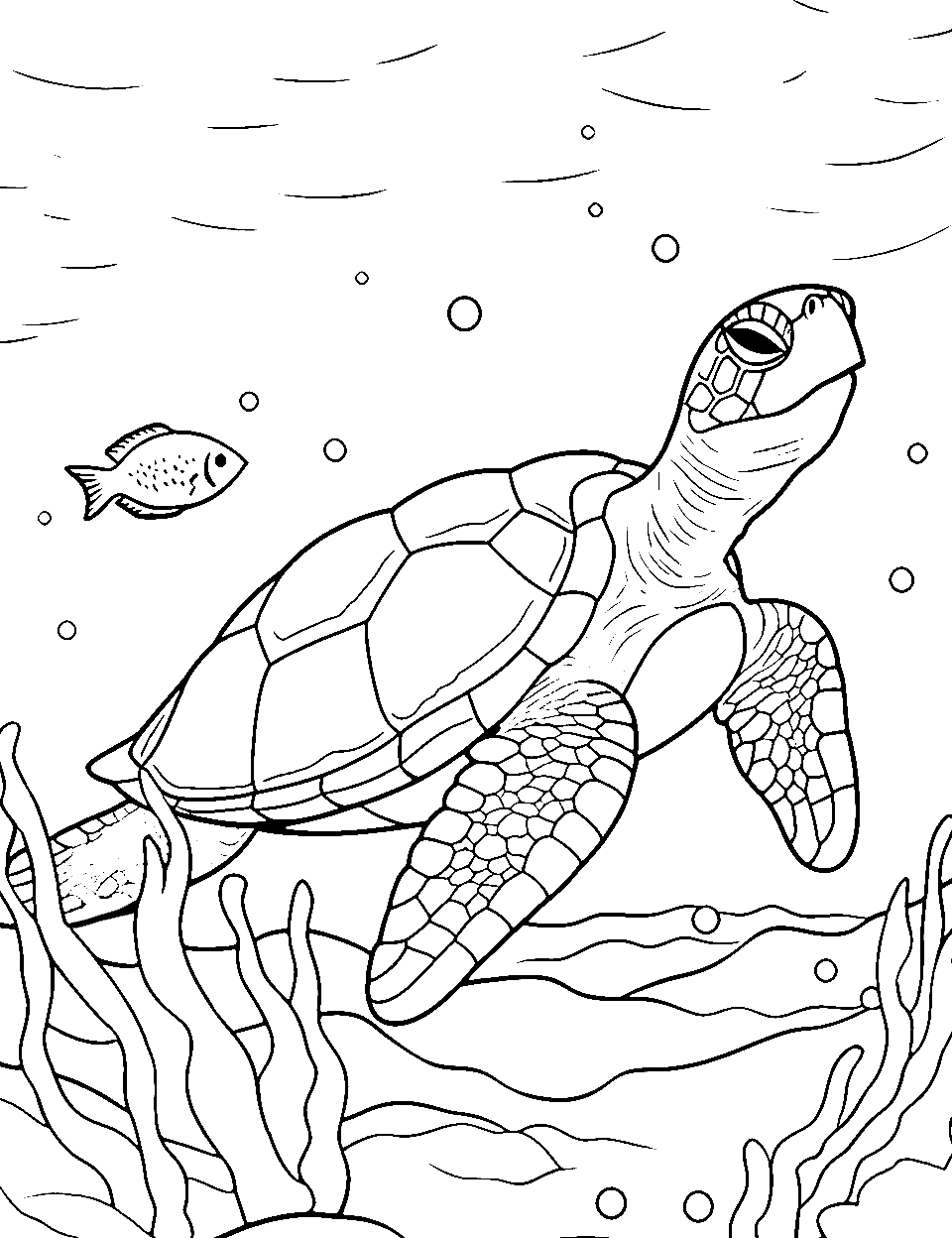
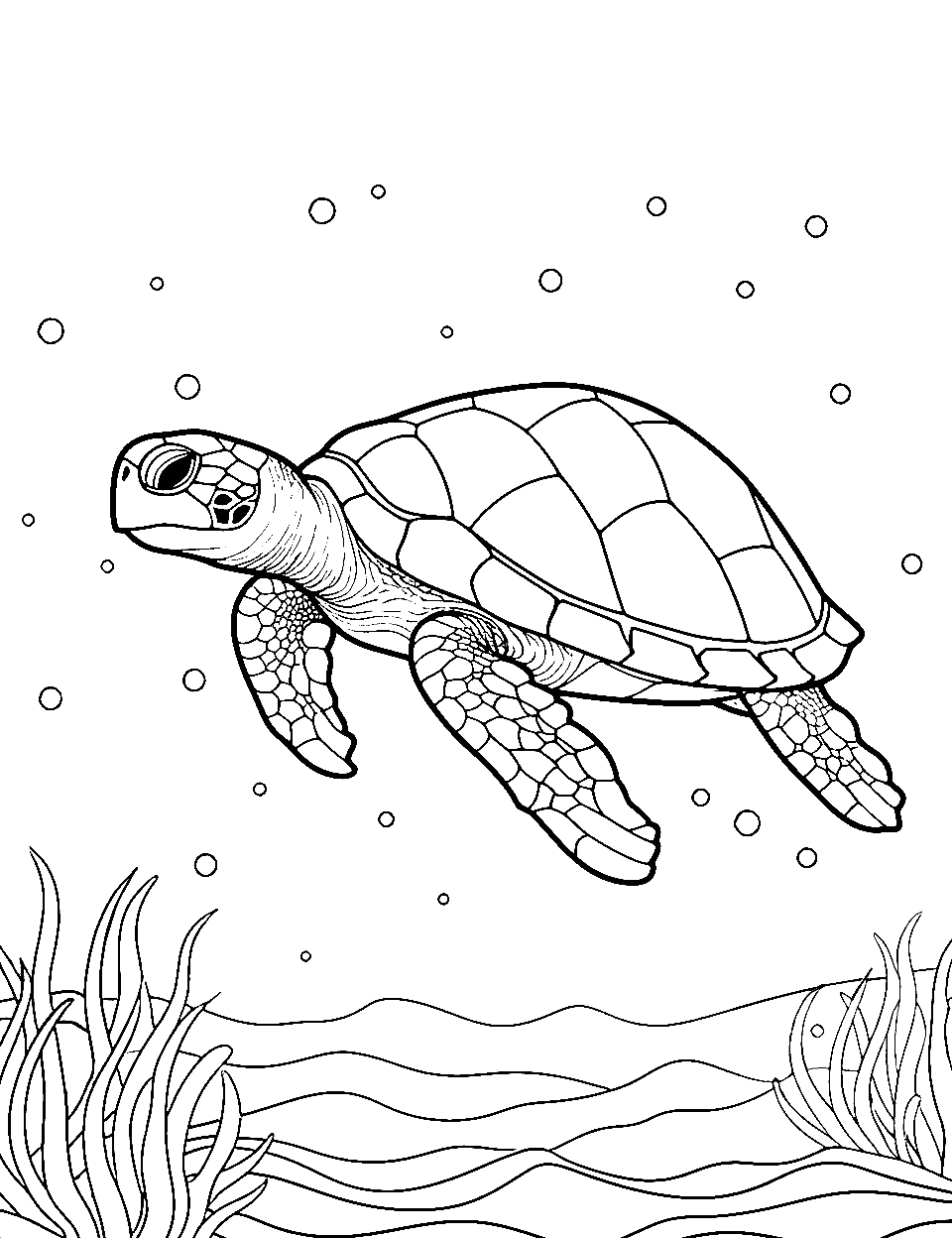
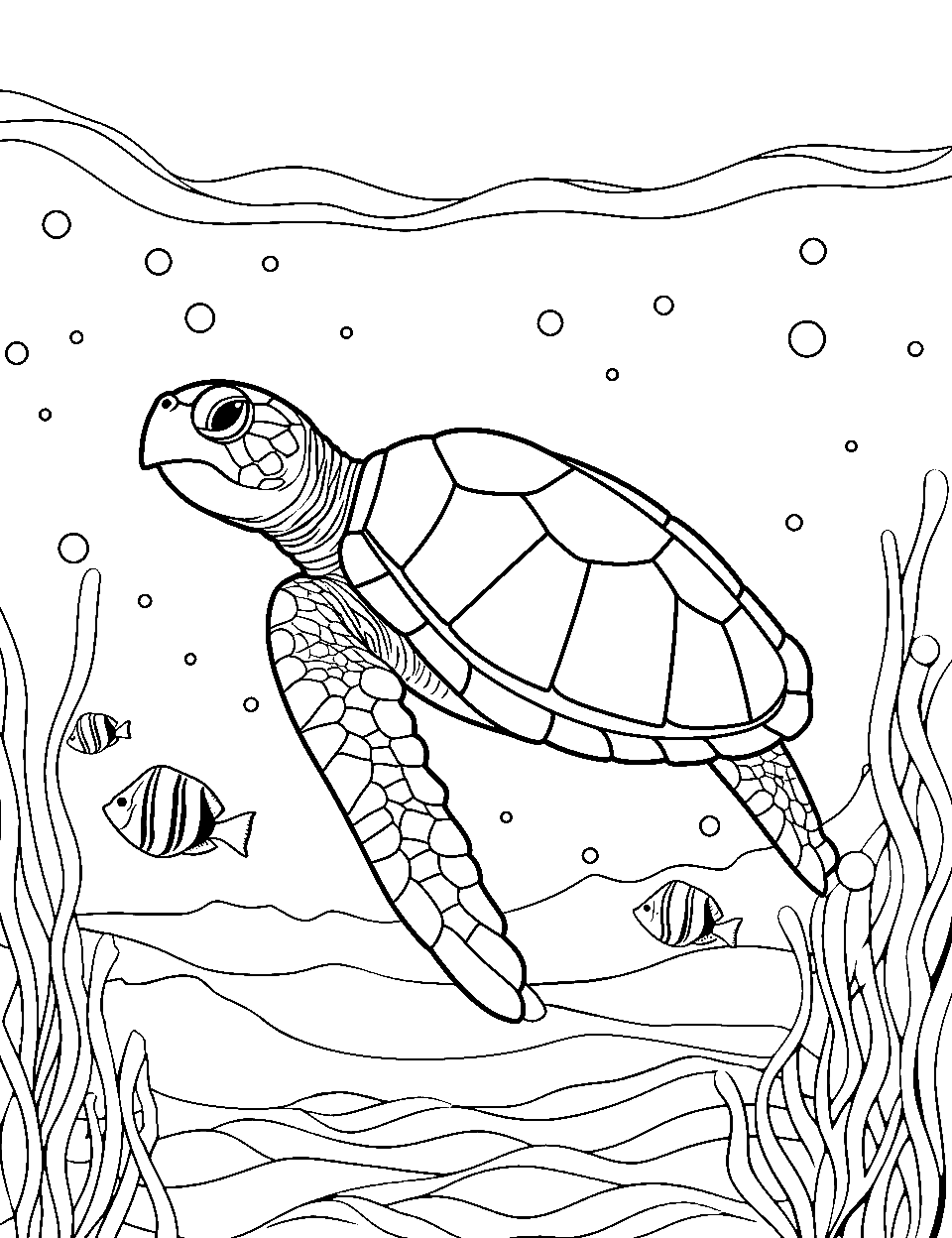
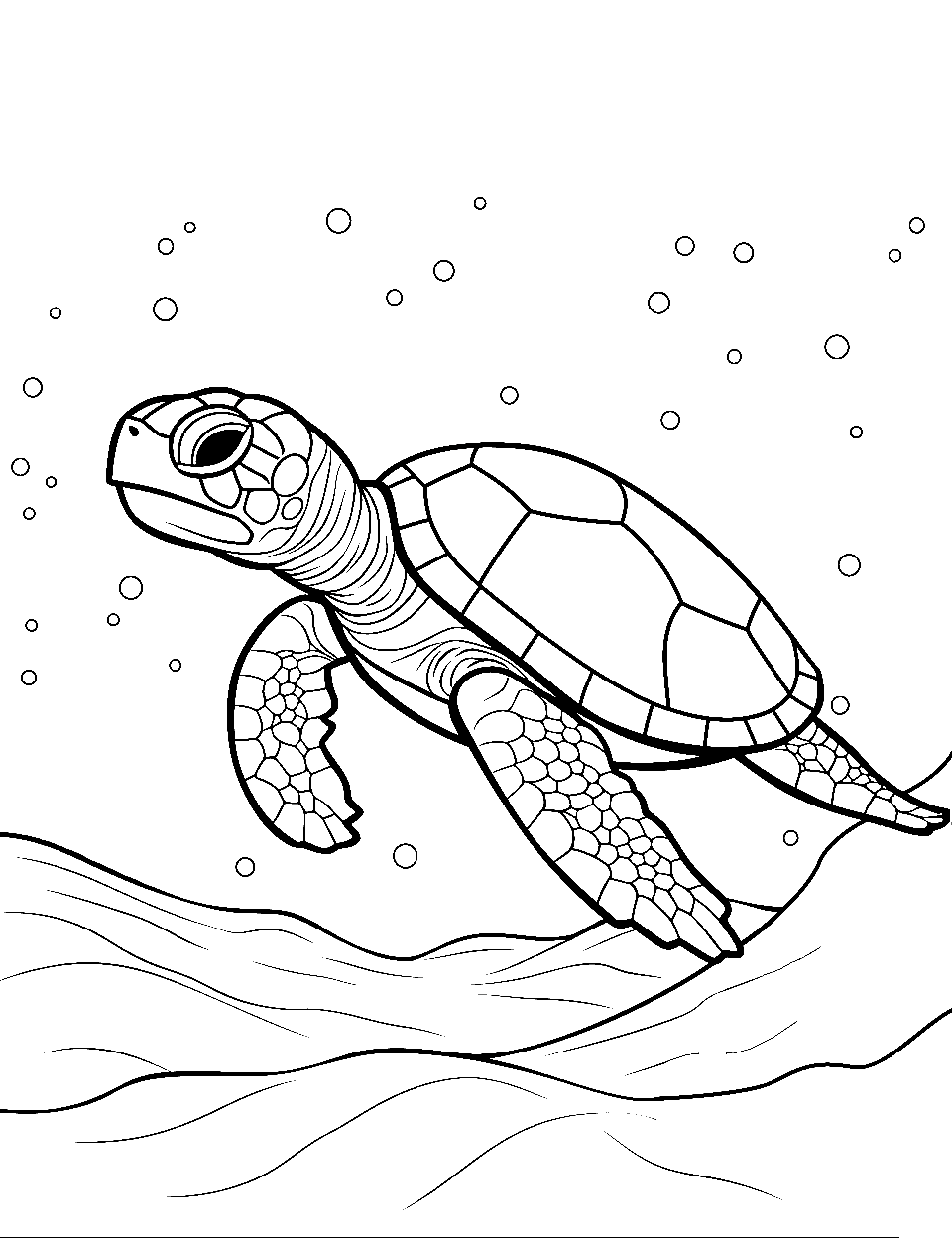
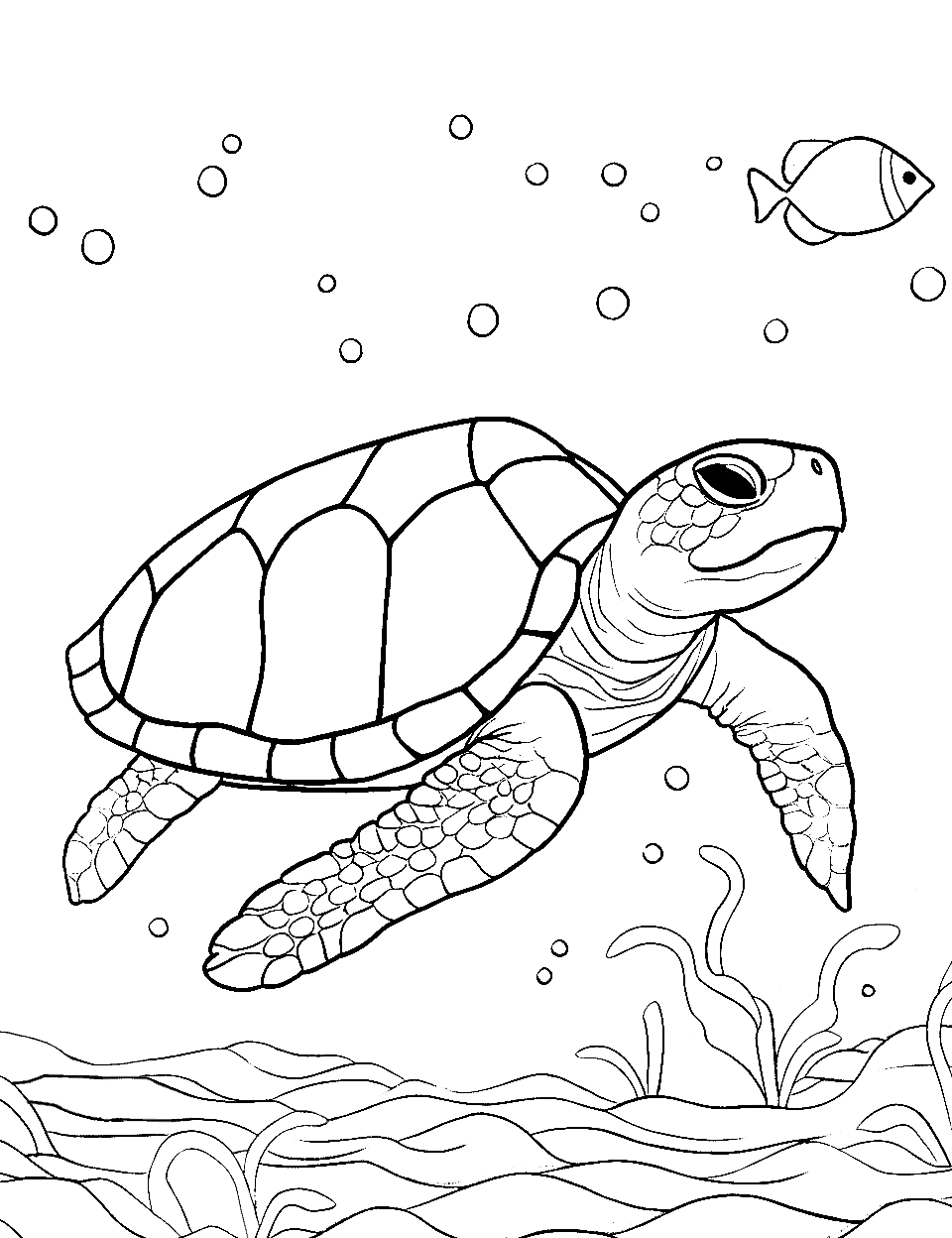
This sea turtle is angled upward with its head stretched toward the surface and bubbles trailing past its flippers. One small fish hangs in the water off to its left, and tall ribbons of seaweed lean in along the bottom edge. The flippers are broken into many small scales, so it suits a child who likes slow, careful work. Pair it with more sea creature sheets for a full underwater set.
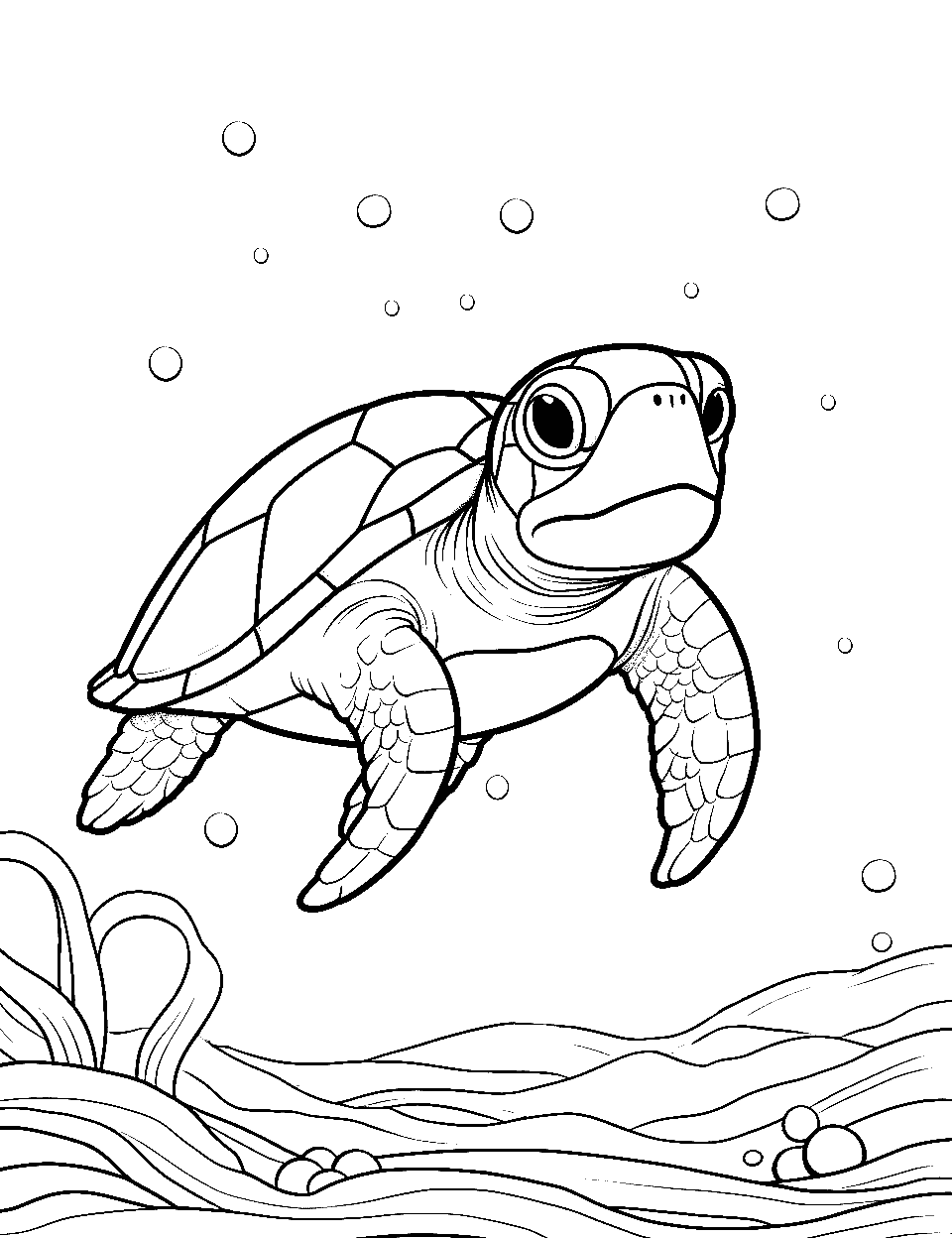
A broad, plain-paneled shell and two long front flippers make this turtle look like it is coasting rather than swimming. Bubbles rise all around it and two clumps of grass sit on the seabed below. The empty water through the middle of the page is a good place for graded blues, light at the top and deeper toward the bottom.
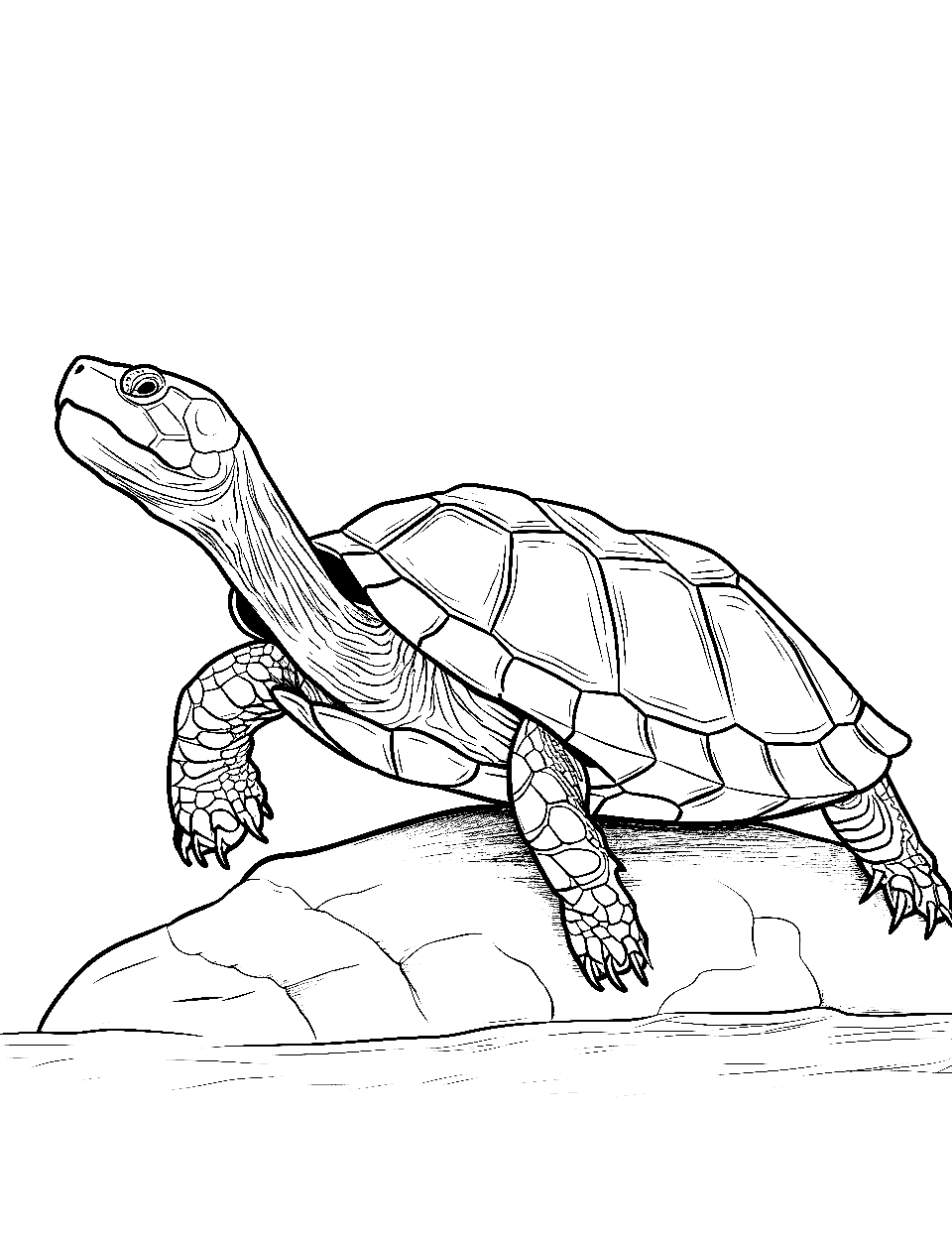
Fine hatching covers the neck and legs of this one, and the shell is divided into narrow plates. The turtle stands on a rounded rock with its neck stretched right out and its head lifted. This is one of the more detailed sheets here, so hand it to an older child or keep it for yourself. Colored pencils hold the small shapes far better than fat markers.
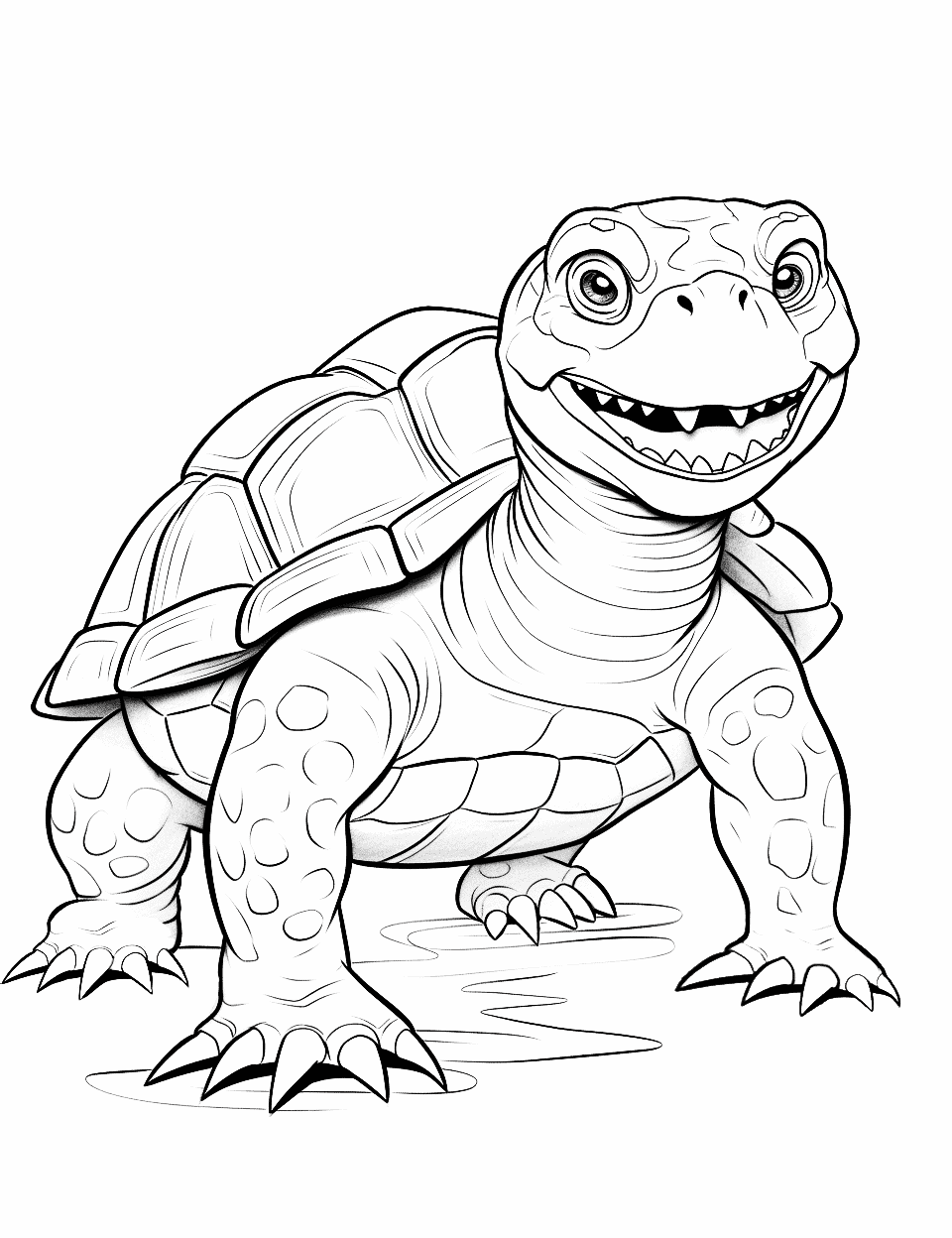
This one grins with its mouth open and a row of pointed teeth showing. The legs are thick and end in long claws, and the shell sits low and rough across its back. Turtles generally have no teeth, just sharp jaw edges, which is a fun thing to point out to a curious kid. Greys and mossy greens suit it better than bright colors.
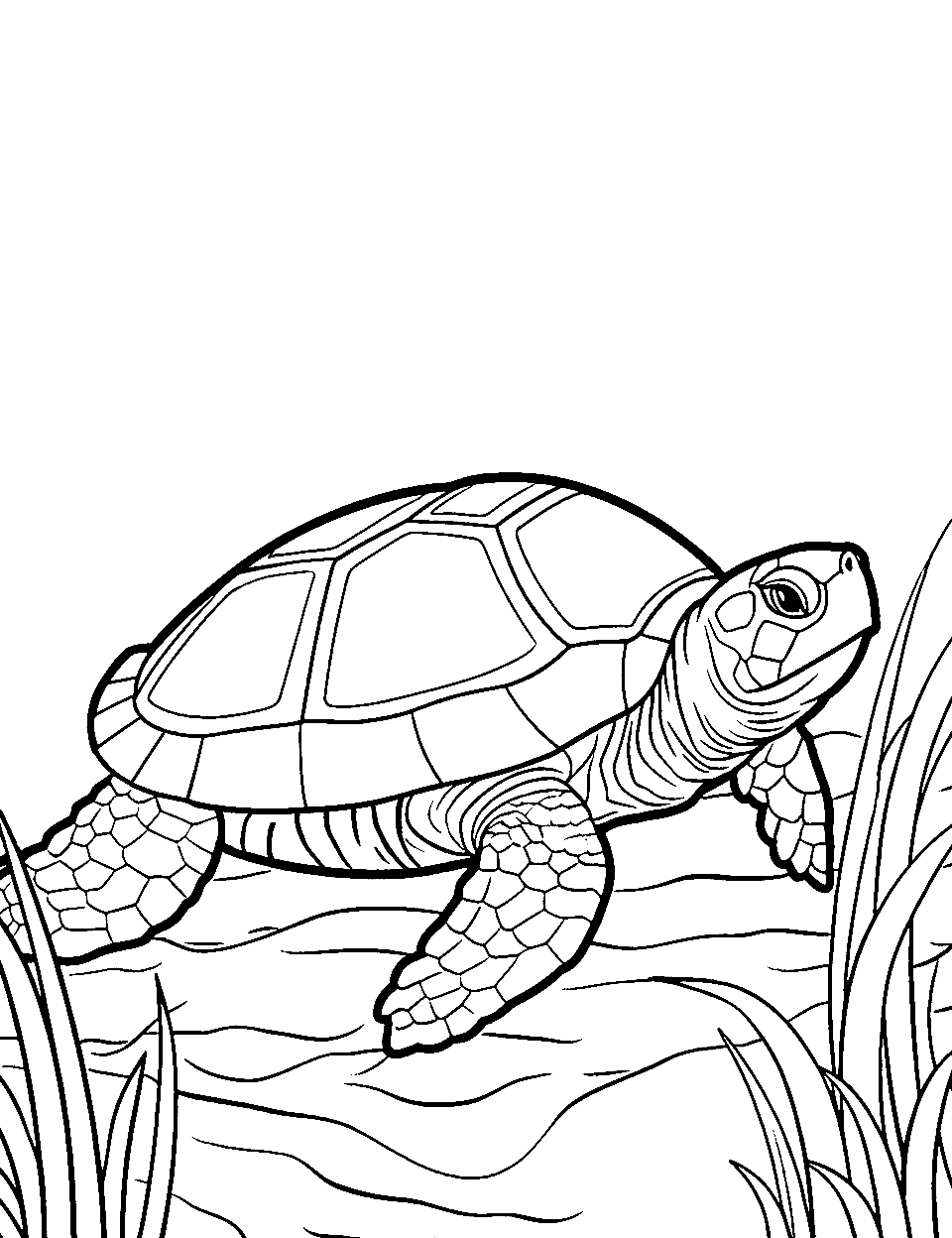
Blades of grass rise on both sides of this turtle and frame it like a curtain. The shell panels are large and evenly spaced while the legs are covered in small round scales. Let the grass take two shades of green, one for the front blades and a lighter one behind, and the page gains depth without a single extra line.
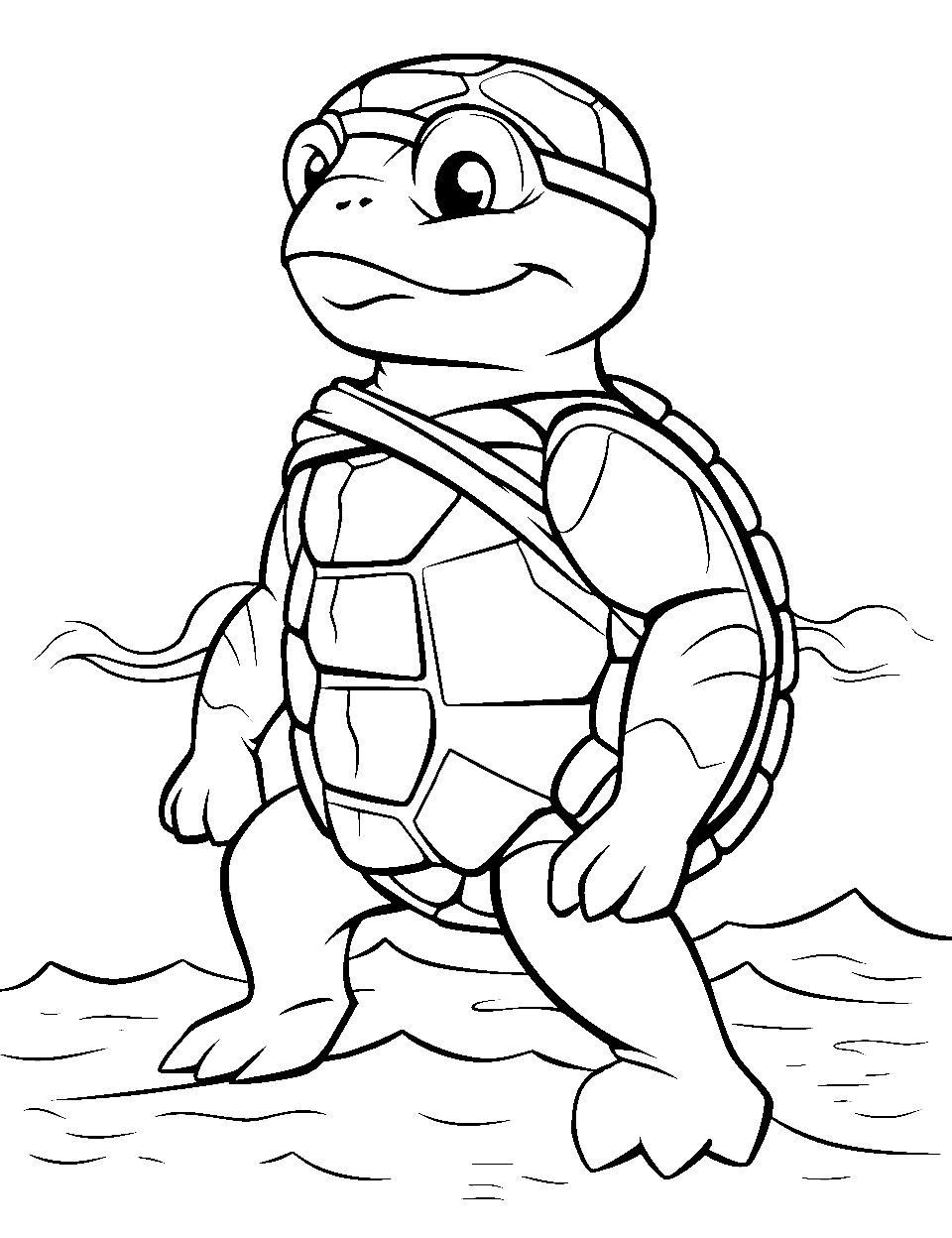
Here is a turtle standing up on two legs with a mask tied across its eyes and the ends trailing behind its head. The shell is drawn comic-book style, as a chest plate and a back plate. Kids who love ninja turtles reach for this one first, and the mask is the obvious spot for a bold color. Everything else is simple enough for a five-year-old.
Three striped fish share the water with this sea turtle, two out in front of its head and one trailing behind its back flipper. Seaweed grows up both edges of the page and bubbles fill the gaps. Give each fish a different pattern and the sheet turns into a small reef. It goes well beside more colorful fish pages.
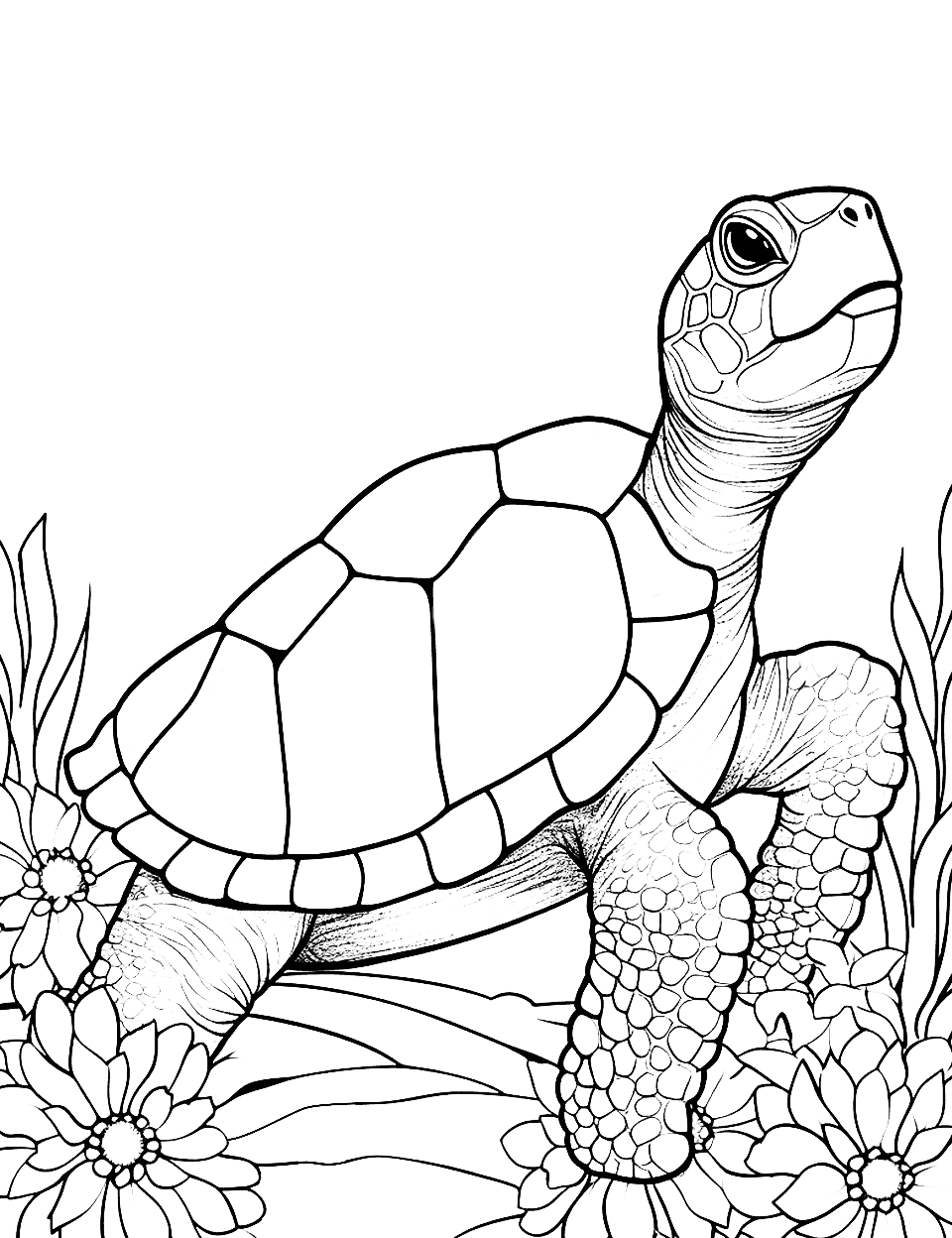
Wide open daisies crowd the bottom of this page with blades of grass pushing up between them. The turtle holds its head high on a fully extended neck, and its shell is drawn in clean panels over a heavily shaded body. Warm yellows in the flowers against a green shell make it pop, which is why it works so well as a spring project.
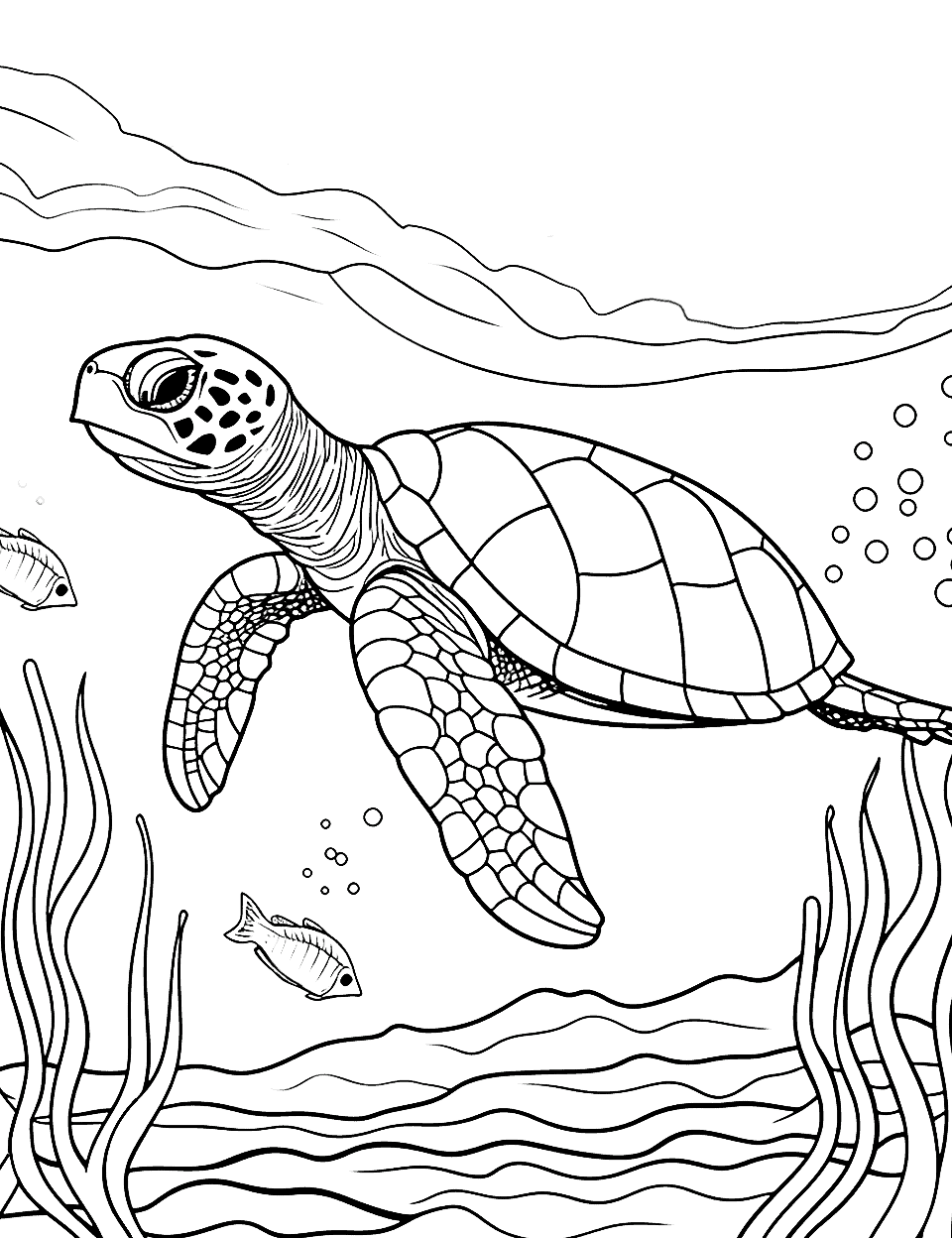
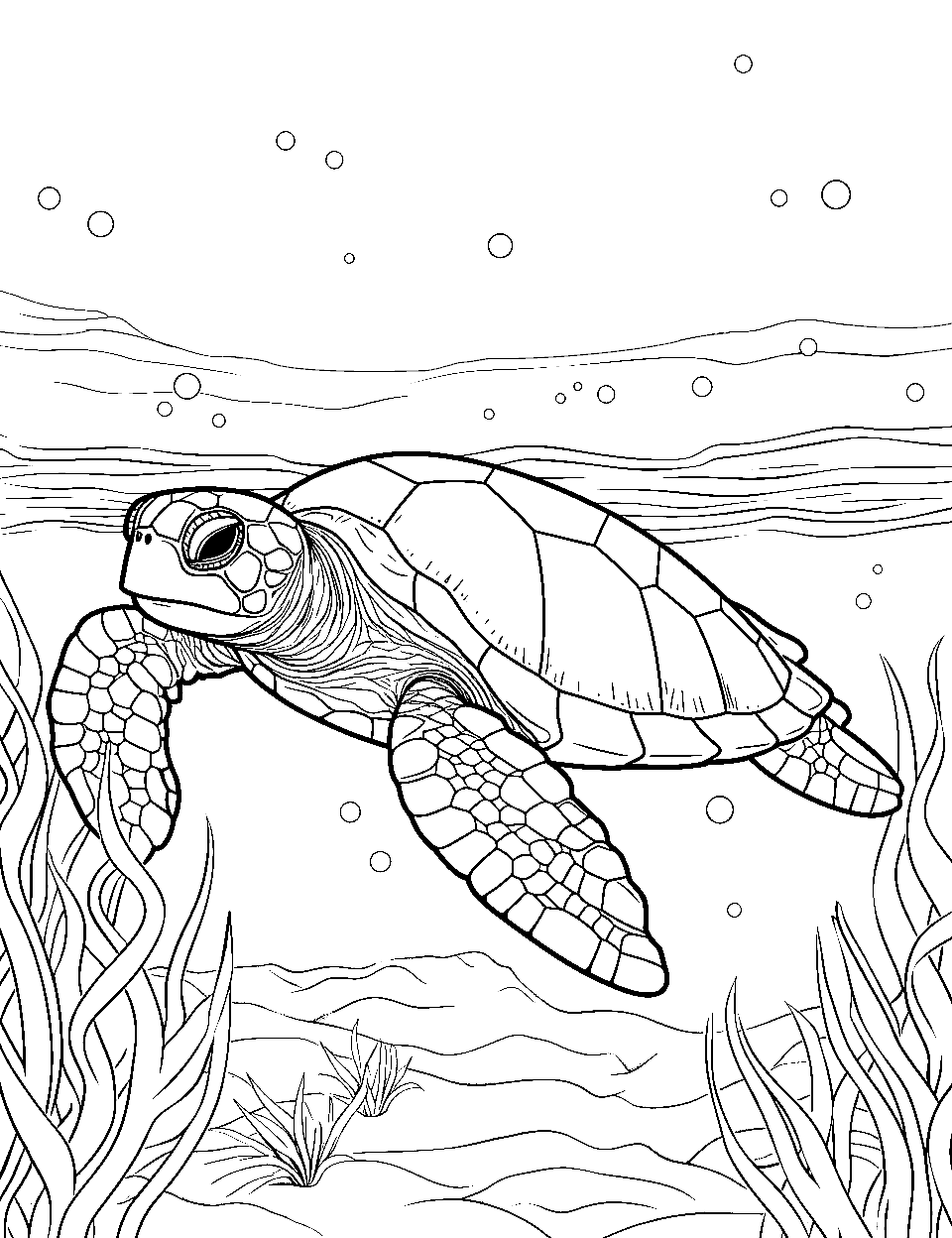
Ripples run across the top of this sheet to mark the surface far above the turtle. Its head is speckled with small dark spots, one little fish swims below its front flipper, and long seaweed strands lean in from both sides. Layer two or three blues, pale at the top and deep at the bottom, and the whole ocean scene gains real depth.
Thick, rounded lines and very few of them: that is the whole design. The shell splits into a few wide panels and the legs are chunky enough to survive a fist grip on a crayon. Print this one when a toddler wants to color alongside an older sibling.
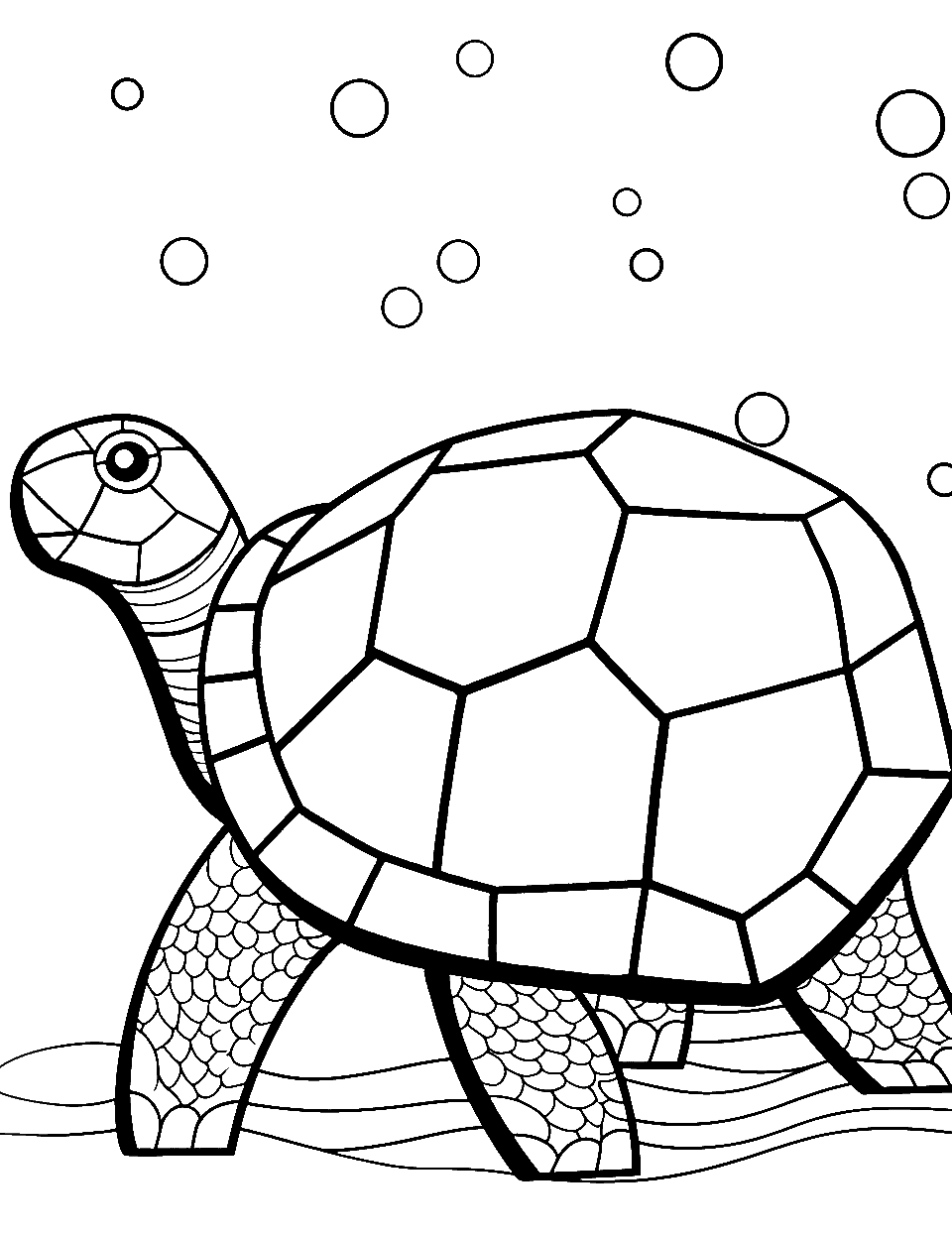
The shell here is built from flat panels that meet at hard angles, closer to a stained glass window than a real carapace. The legs keep a fine scale texture, so the page mixes big easy shapes with small fussy ones. Work one color family across the shell, light to dark, panel by panel. If that style lands well, other geometric shapes pages use the same trick.
Wavy bands run under this turtle’s feet and bubbles drift up past its shell. The eyes are large and cartoonish while the legs carry a fine pebbled texture, an easy mix for a mid-elementary kid. Leave the water pale and the turtle dark so it does not sink into the background.
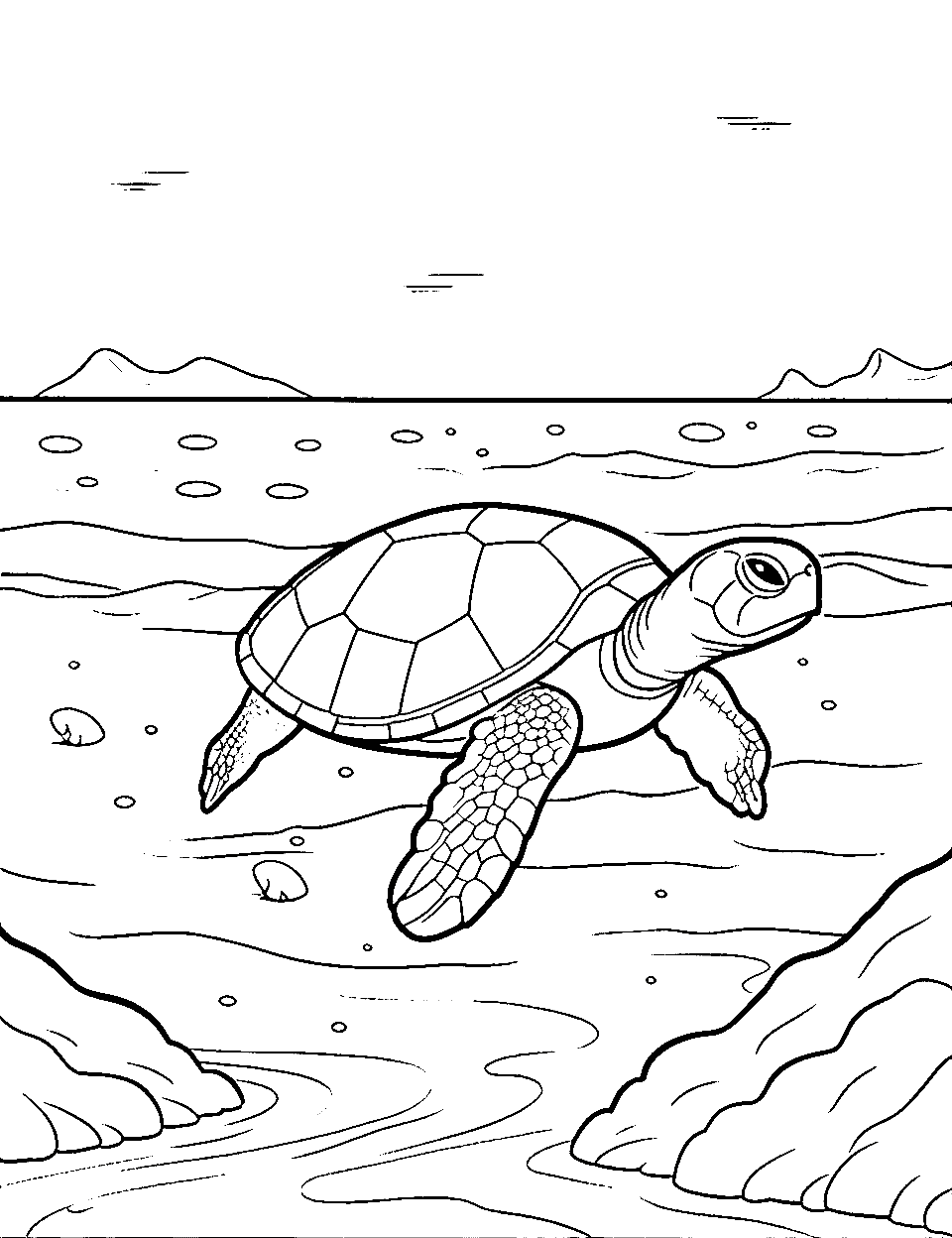
A flat horizon line splits this page, with faint hills in the distance and open beach in front. The turtle sits low on the wet sand with pebbles scattered around it and rocks in the bottom corners. Most of the sheet is empty sand, which reads as restful rather than boring if you keep a light hand. Save it for a beach vacation week.
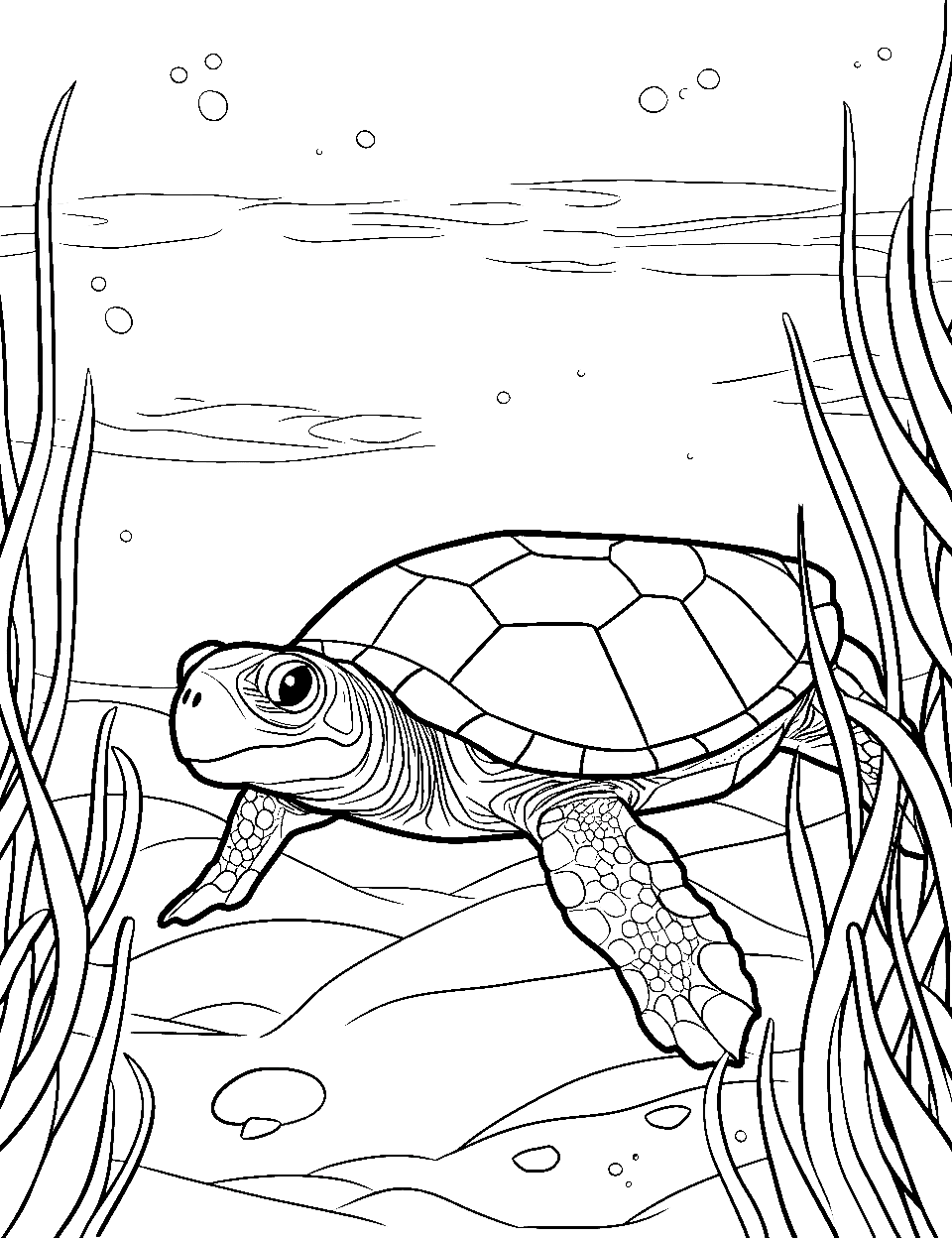
Tall seagrass leans across both sides of this underwater scene while the turtle walks the sandy bottom between the stems. The surface is drawn as soft ripples near the top and a few bubbles rise toward it. Shell panels stay clean and open, but the neck and legs carry dense shading.
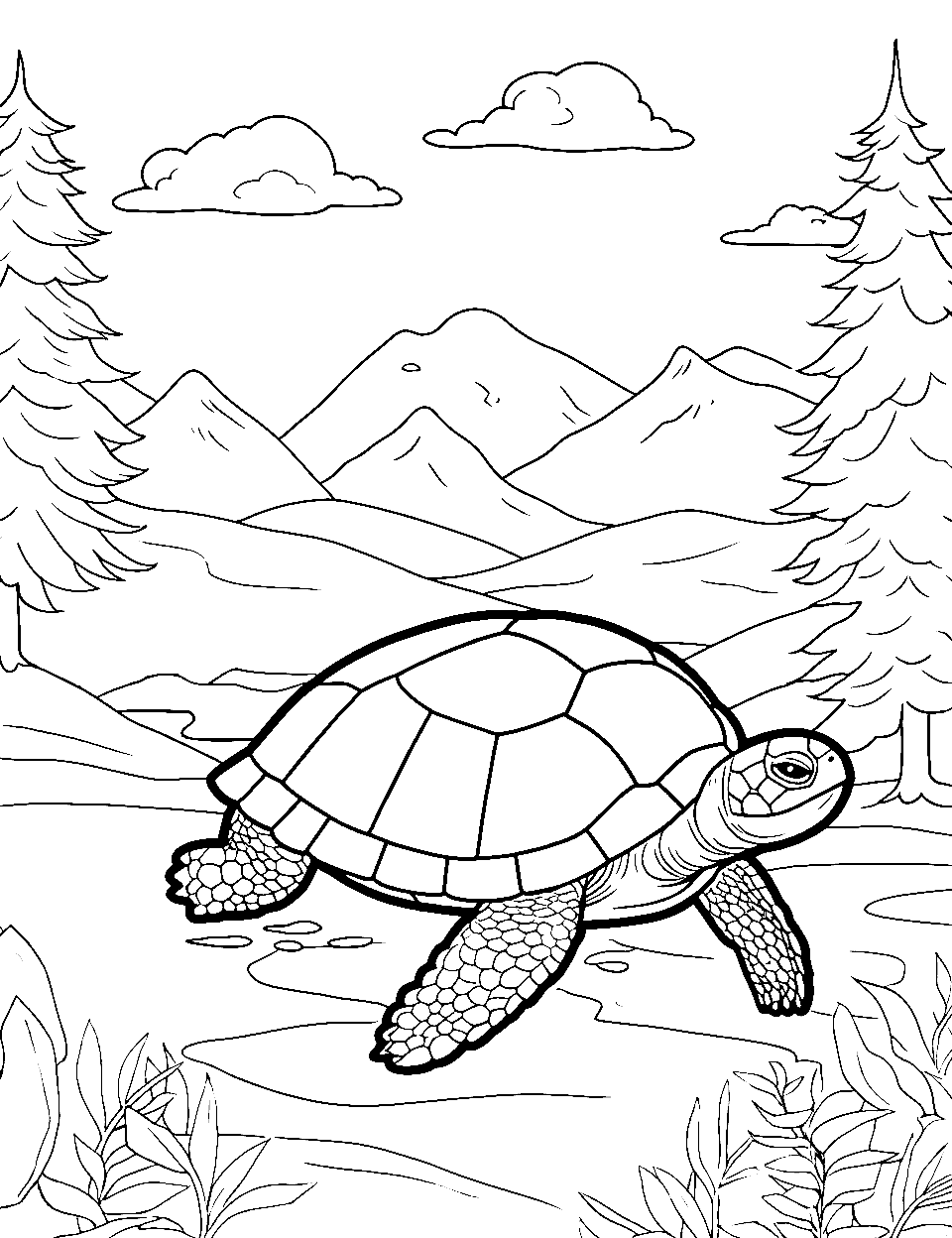
Pine trees stand at both edges of this page with mountain ridges and clouds stacked behind them. The turtle crosses open ground in the middle with its head turned toward you, and leafy plants fill the bottom corners. It is one of the busier landscapes in the set, so plan the greens before you start or the whole page ends up a single shade.
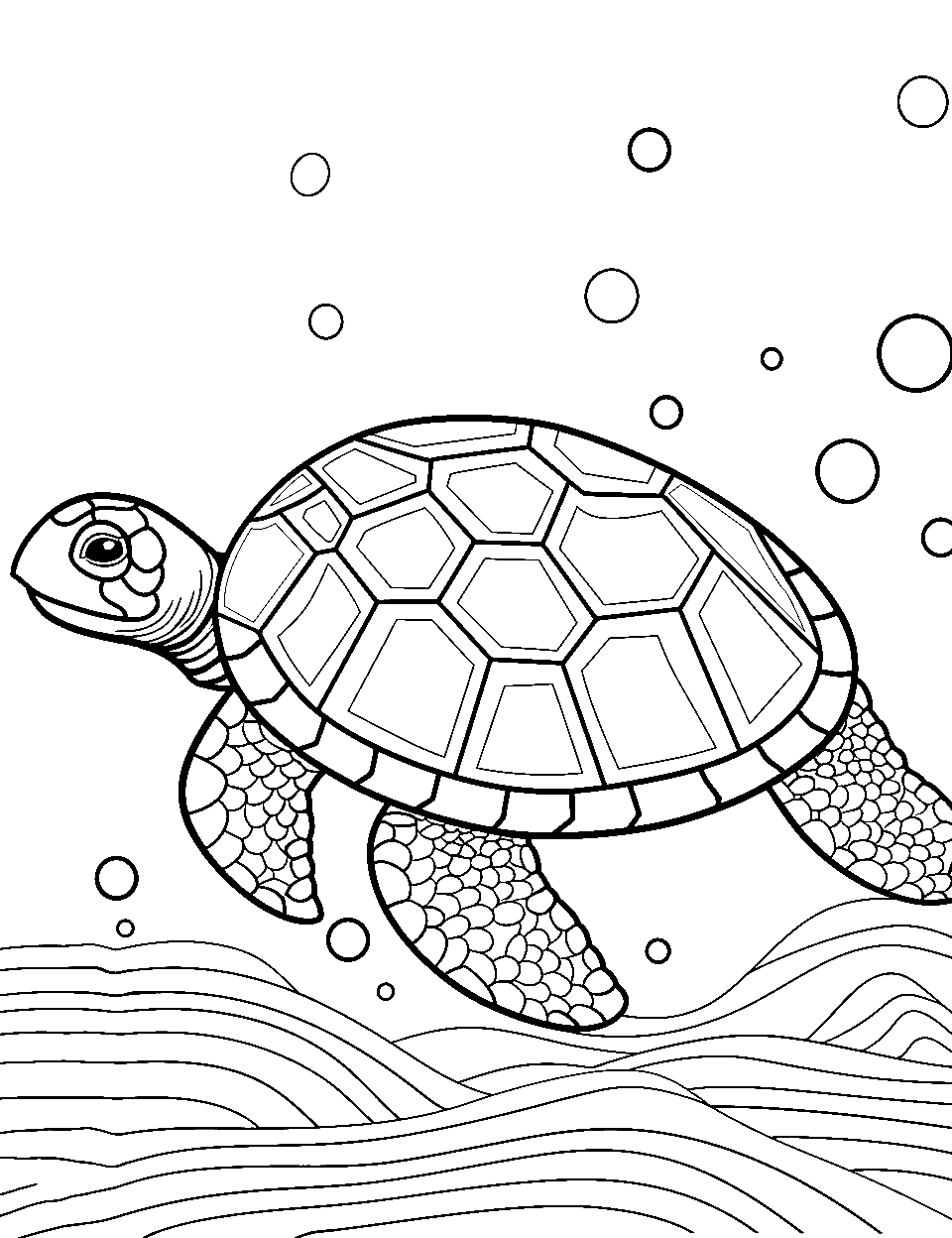
The shell is the whole point of this one: bold hexagons ringed by a border of smaller plates. Bubbles float in the space above and long wavy lines fill the water below. Color each hexagon a different shade of the same green and the shell reads like real scutes.
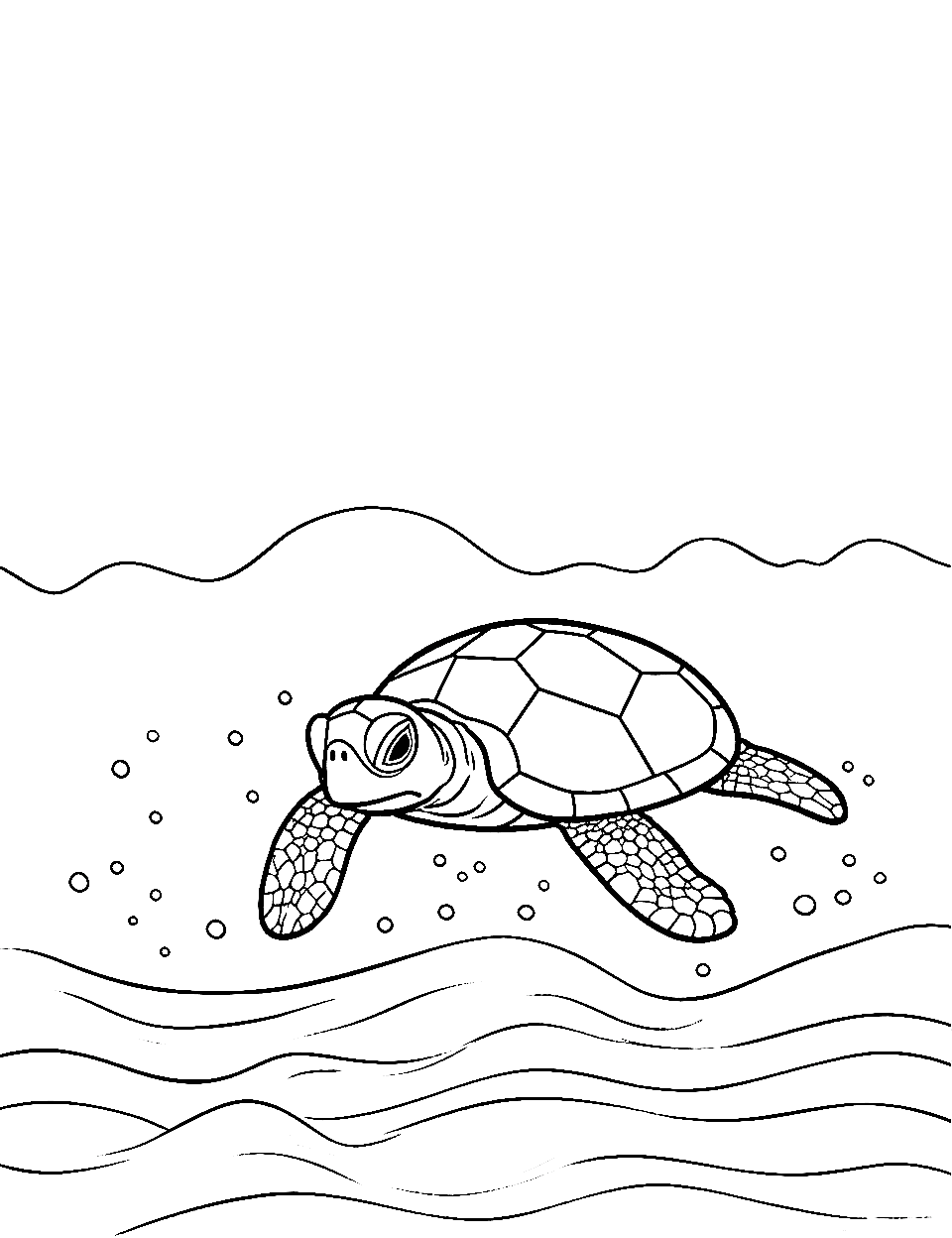
Most of this page is open water, with one small turtle swimming low and long ripple lines beneath it. Tiny bubbles trail behind its flippers. All that blank space is a gift for a child who wants to add their own fish, weeds, or sunken treasure.
A sun with straight rays sits in the top corner above a bank of clouds. The turtle rests on the shore with its neck stretched up toward the light and tufts of grass at its feet. Yellows and oranges in the sky with a warm brown shell keep the whole page in one mood.
This sea turtle swims straight at you with both front flippers spread wide and enormous round eyes. Bubbles scatter across the top half while small stones and seaweed sit along the bottom. The face is cartoon soft, yet the flippers keep a realistic scale pattern, so the sheet suits a wide age range.
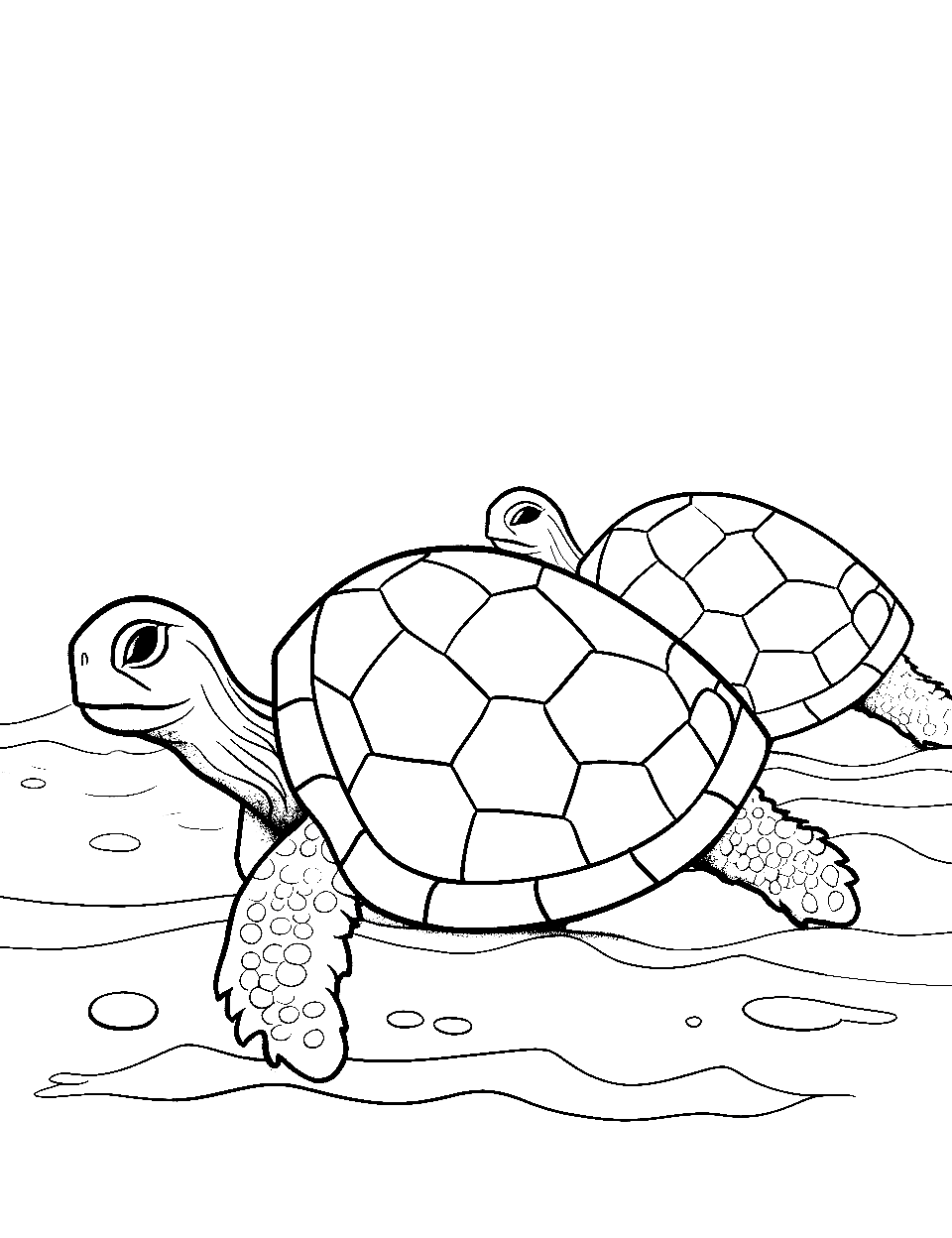
Two turtles walk one behind the other across a stretch of sand, the second one just visible over the leader’s shell. Small pebbles dot the ground around them. Color the two shells in different families, one warm and one cool, so they read as separate turtles rather than a shadow.
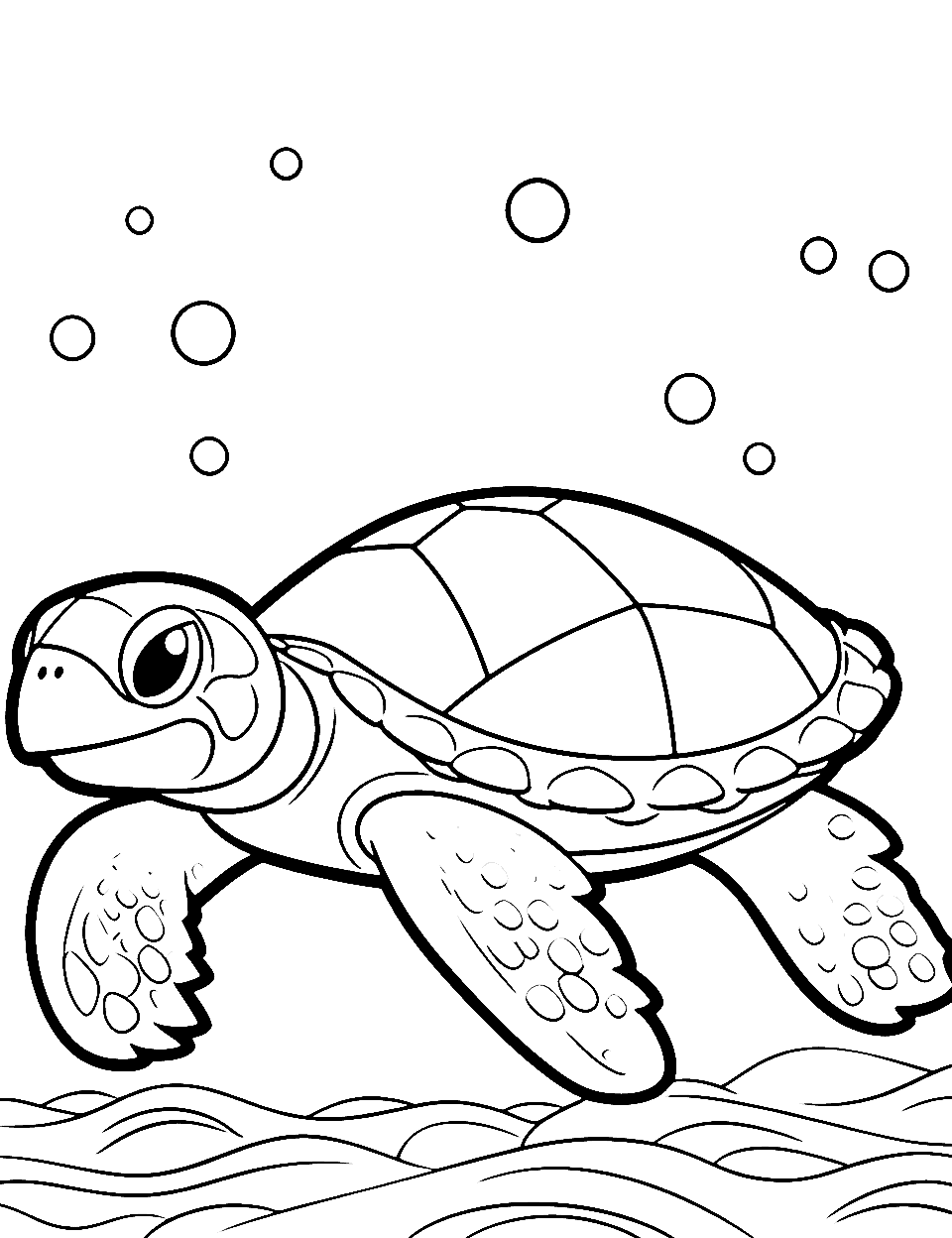
Heavy outlines, spotted flippers, and a shell split into a few wide bands: nothing here needs a steady hand. A scatter of bubbles rises overhead and one long wave line runs beneath. Markers work fine on this sheet because there are no thin gaps to bleed into.
A single small turtle swims across a wide, mostly empty page with a soft dune sloping underneath it. Small bubbles fill the water all around. The sense of scale is the whole idea here, so keep the background pale and let the turtle carry the color.
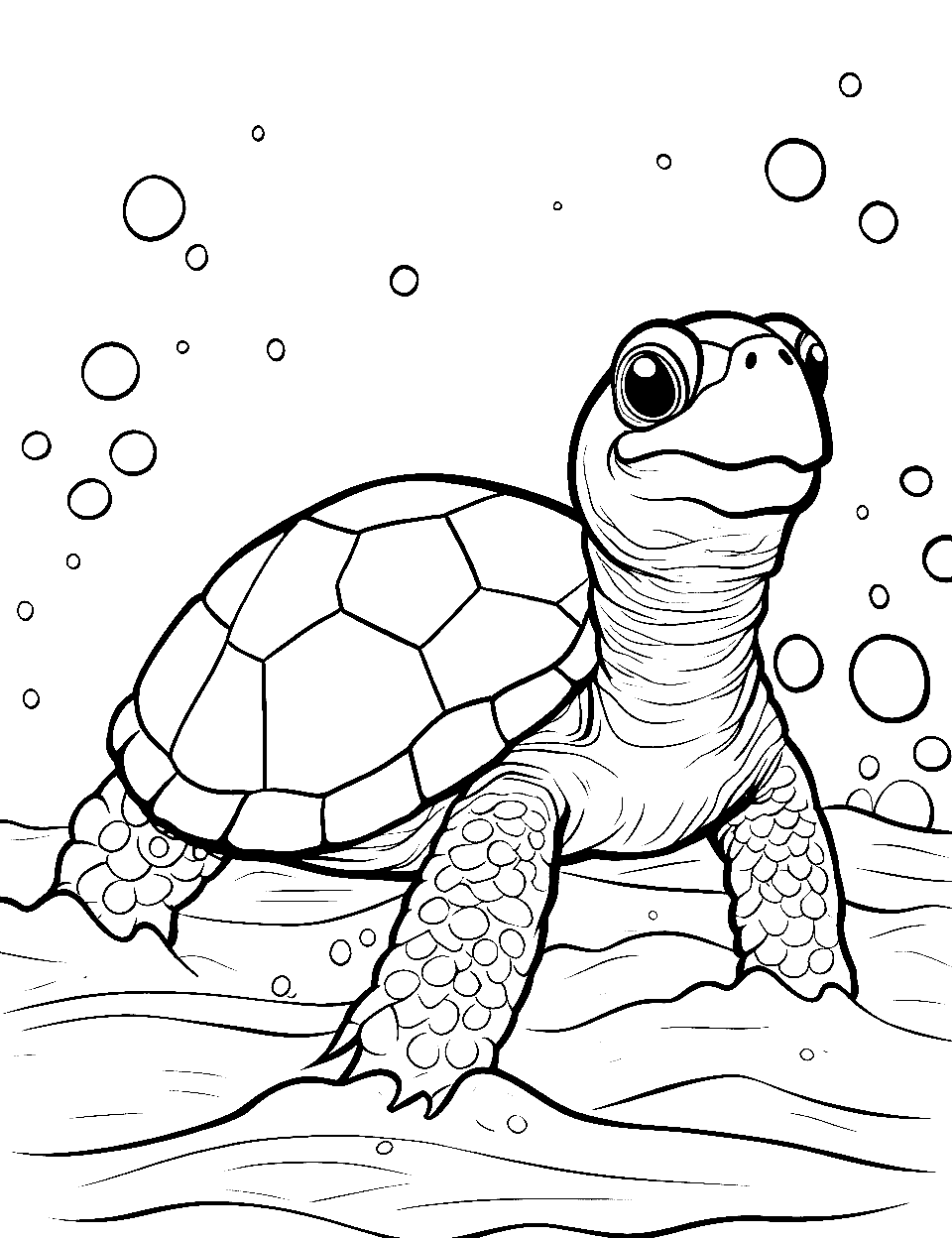
Round bubbles of every size float above this turtle while it hovers just off the seabed. Clumps of seaweed grow at the bottom corners and the sand is drawn in long soft waves. The eyes are big and glossy, so leave a white dot uncolored inside each dark pupil and the face comes alive.
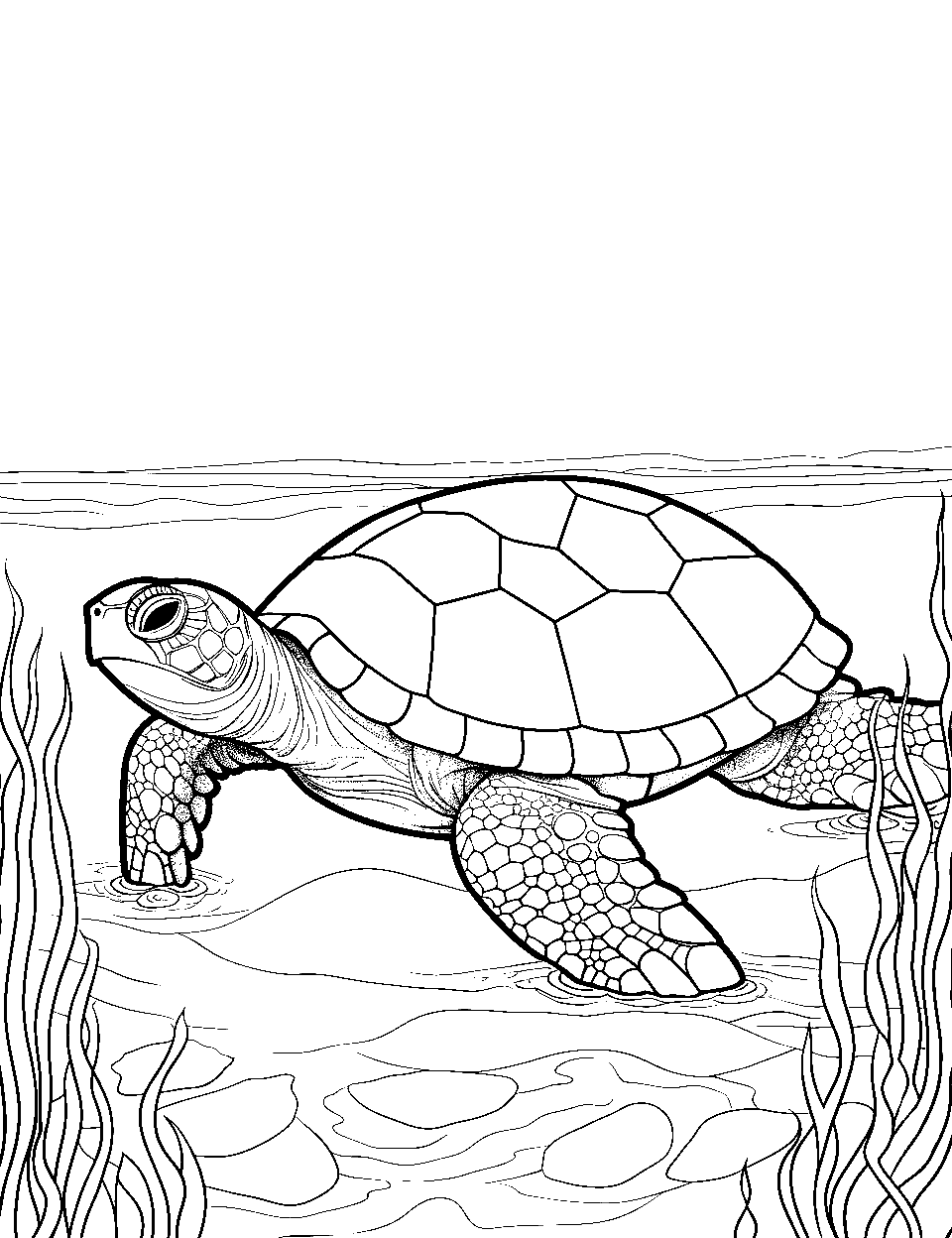
Thin reeds rise on both sides and the turtle walks between them over a bed of smooth stones. Fine hatching shades the neck and legs while the shell stays clean and open. The water line runs straight across the top of the page. This one rewards colored pencils and patience.
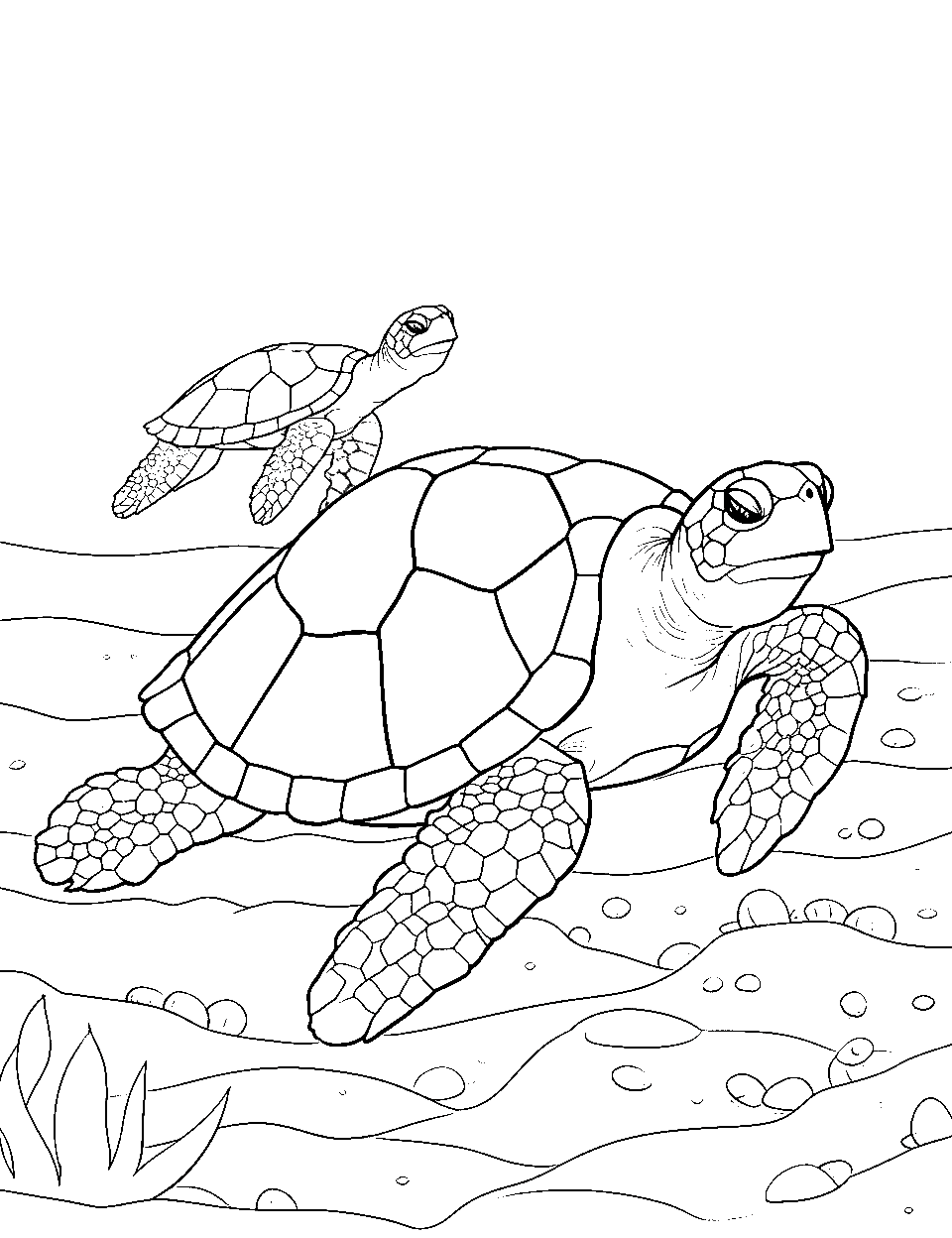
A small turtle swims above and behind a much larger one, both heading the same direction. The seabed below is dotted with pebbles and a tuft of grass. Matching the two shells in the same colors, one a shade lighter, makes the family idea obvious at a glance.
One little fish swims in the top corner and the turtle is angled as though it has just noticed. Bubbles fill the water between them and a few seaweed shoots curl up from the bottom. It is a simple scene, so it works for a child who wants to finish something in one sitting.
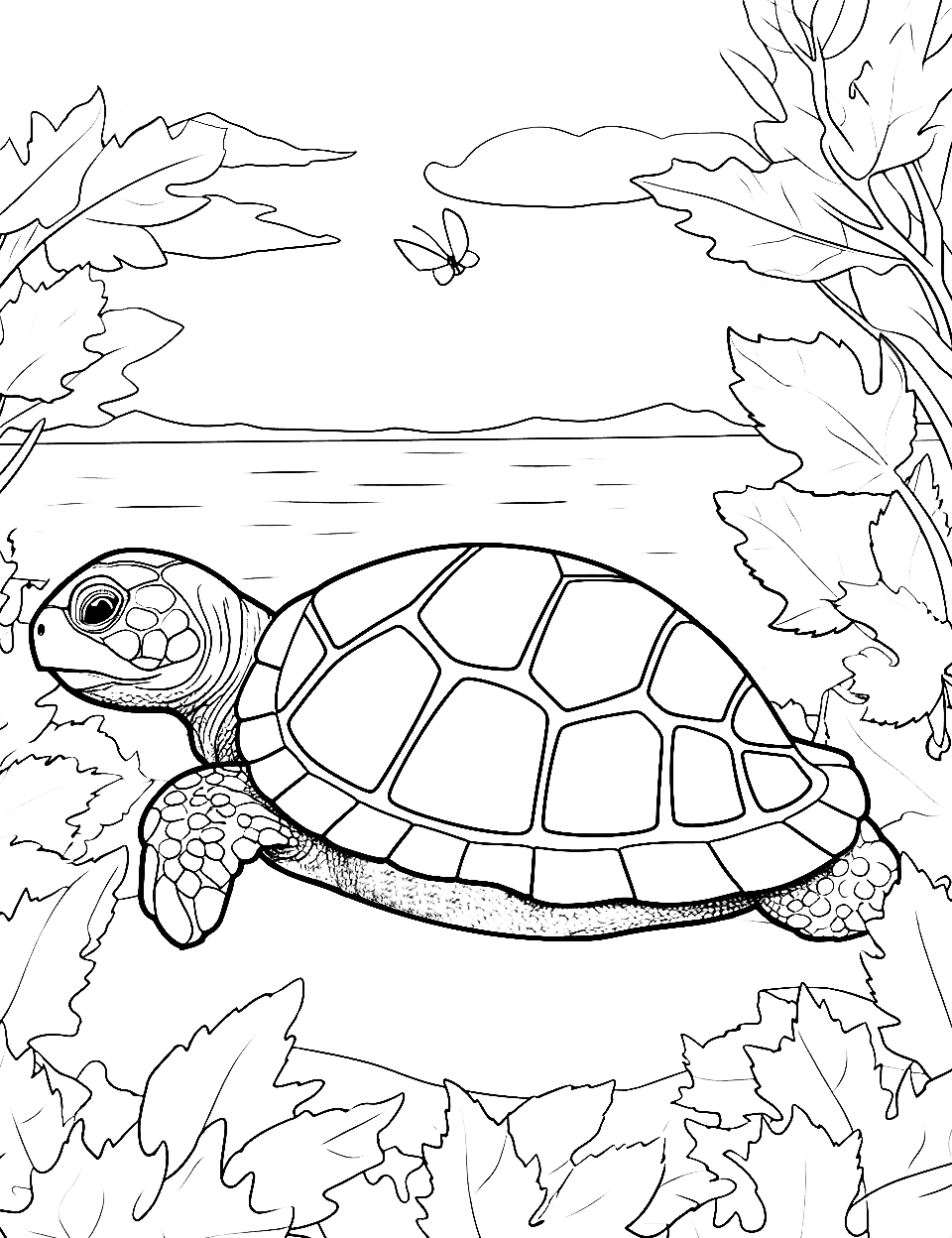
Big maple leaves frame this turtle on every side and a stretch of open water sits behind it. A tiny insect flies near the top edge. Reds, oranges, and golds in the leaves of fall against a dark shell make this one of the best sheets here for a hallway display.
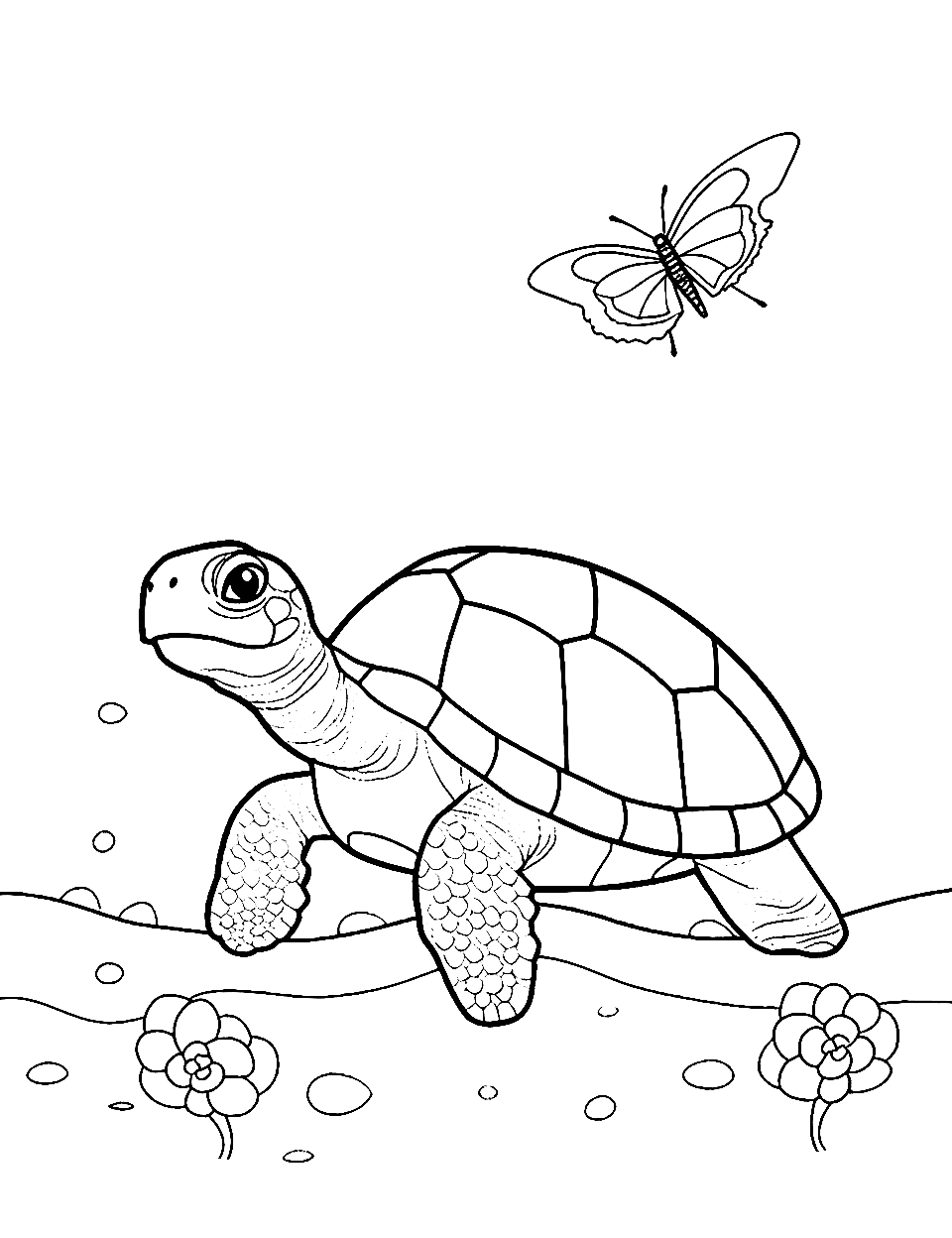
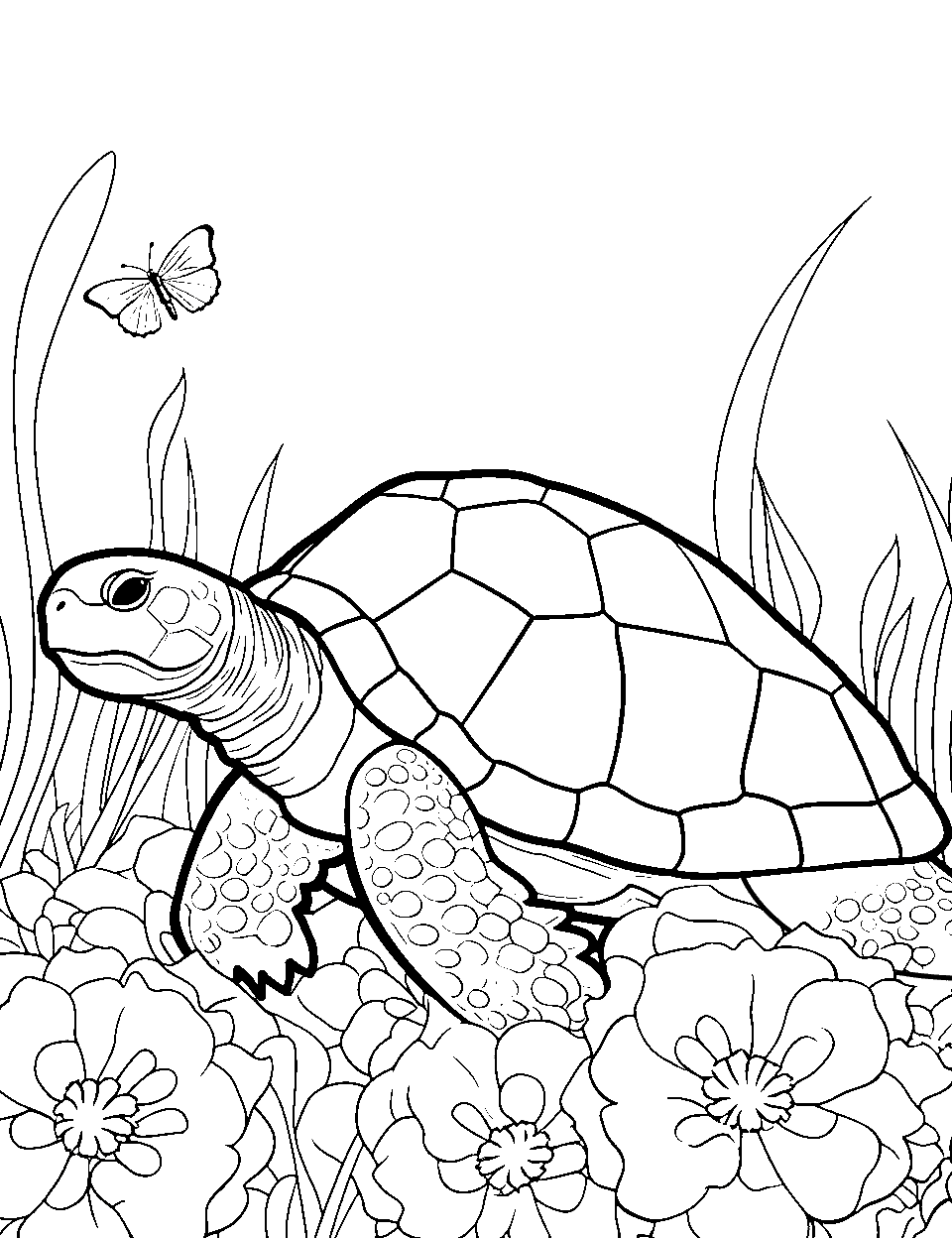
A butterfly hovers above this turtle with its wings fully open. Two round flowers sit on the ground below, one at each side. The shell is drawn in large plain panels while the legs are pebbled, and there is plenty of white space left over for a child to fill in their own way.
Long ribbons of seaweed sway on both sides while the turtle glides through the middle of the page. The surface ripples above it and small grass tufts sit down on the seabed. Shading on the neck and flippers is fine and dense, which puts this one in the older kid or grown-up pile.
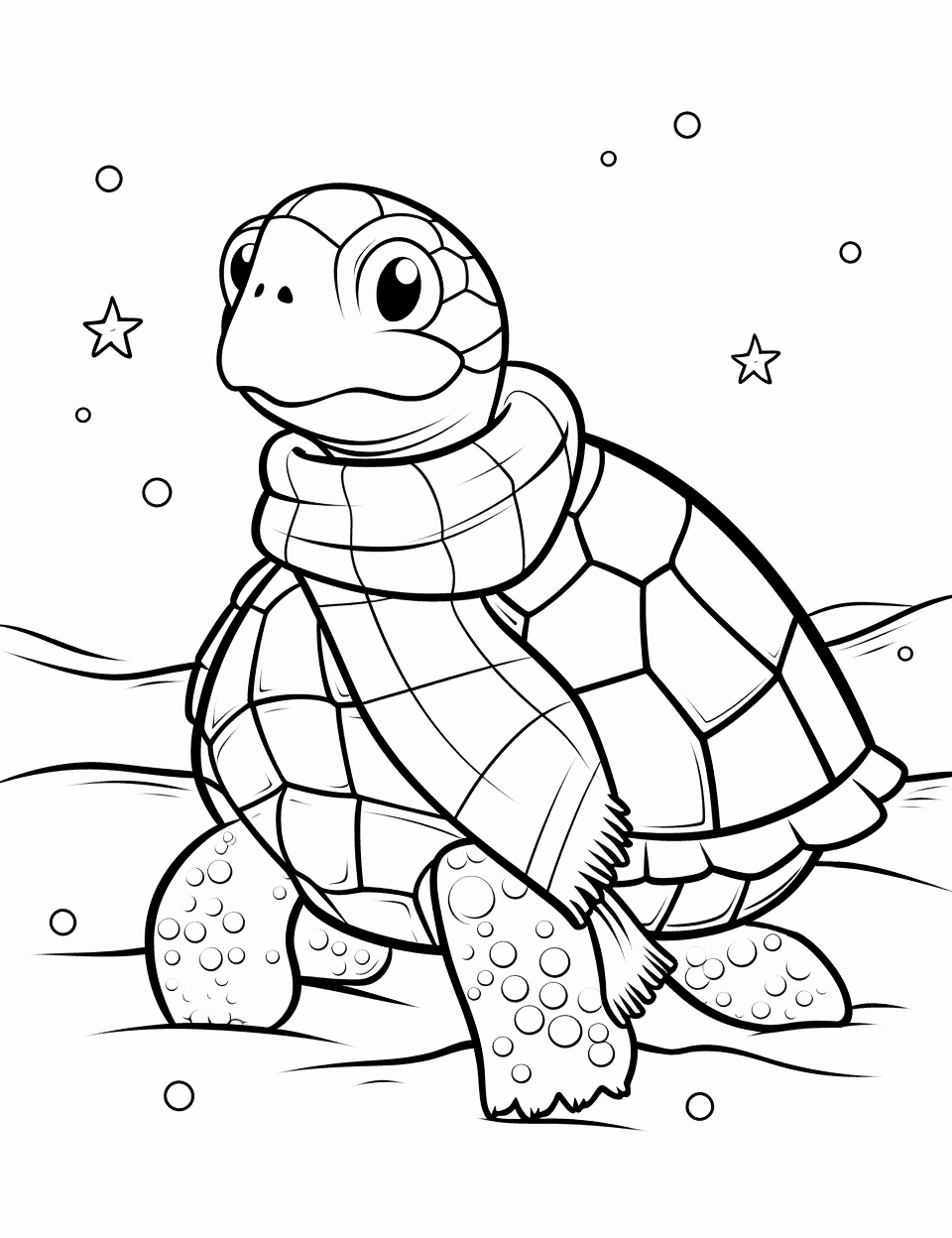
A plaid scarf is wound around this turtle’s neck with the fringed end hanging down past its shell. The scarf squares are the fun part, so pick two colors and alternate them. A couple of stars and a few dots float in the background. Print it in December and it doubles as a winter card front.
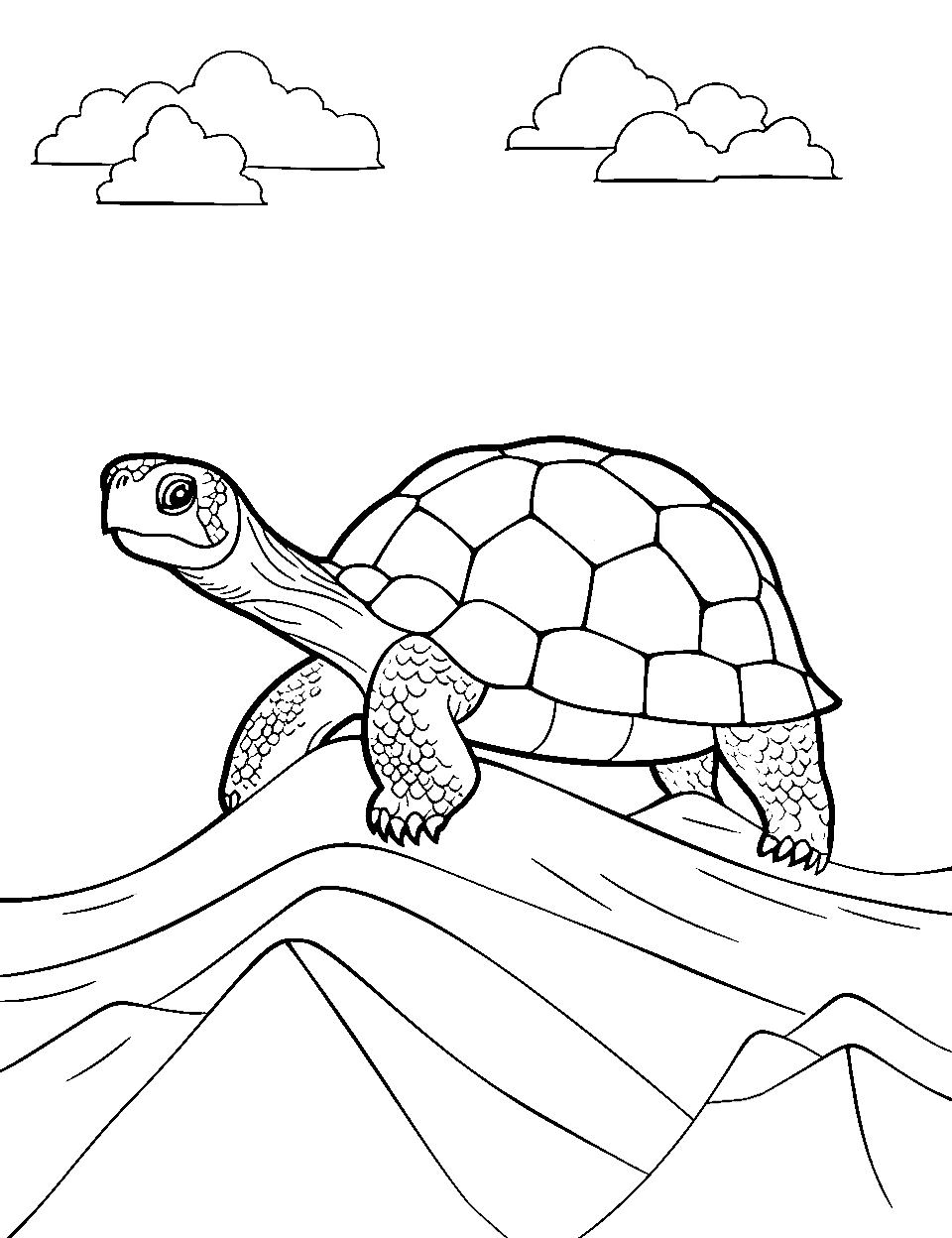
This turtle stands on a high ridge with mountain peaks stacked below it and clouds strung across the sky. The shell is drawn as large clean panels while the legs are scaled and shaded. Cool greys and purples in the peaks behind will push the turtle forward.
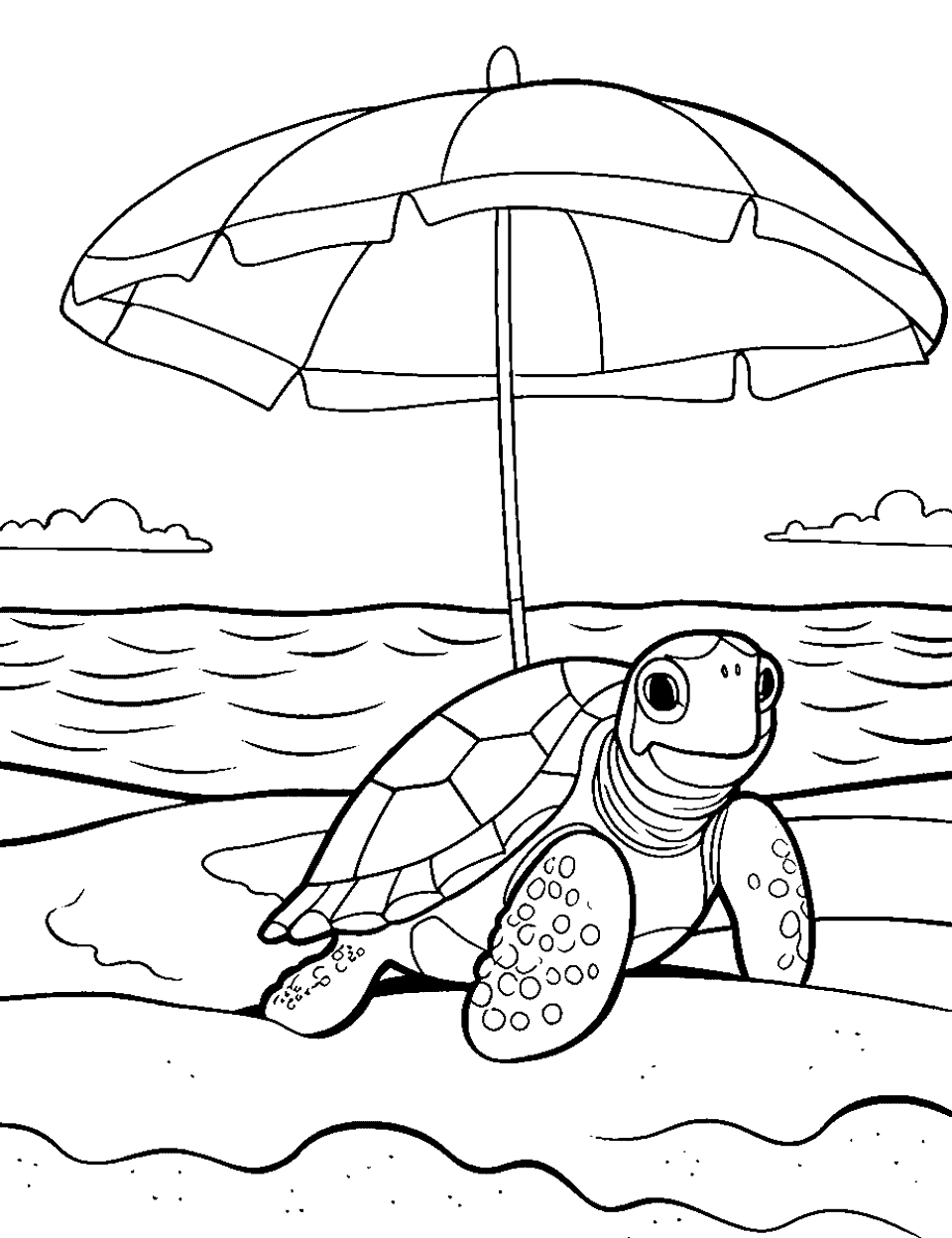
A wide beach umbrella takes up the entire top half of this sheet and the turtle sits in its shade on the sand. The sea runs flat behind them with two small clouds on the horizon. Umbrella panels are made for alternating stripes, so let a child pick two colors and work around it.
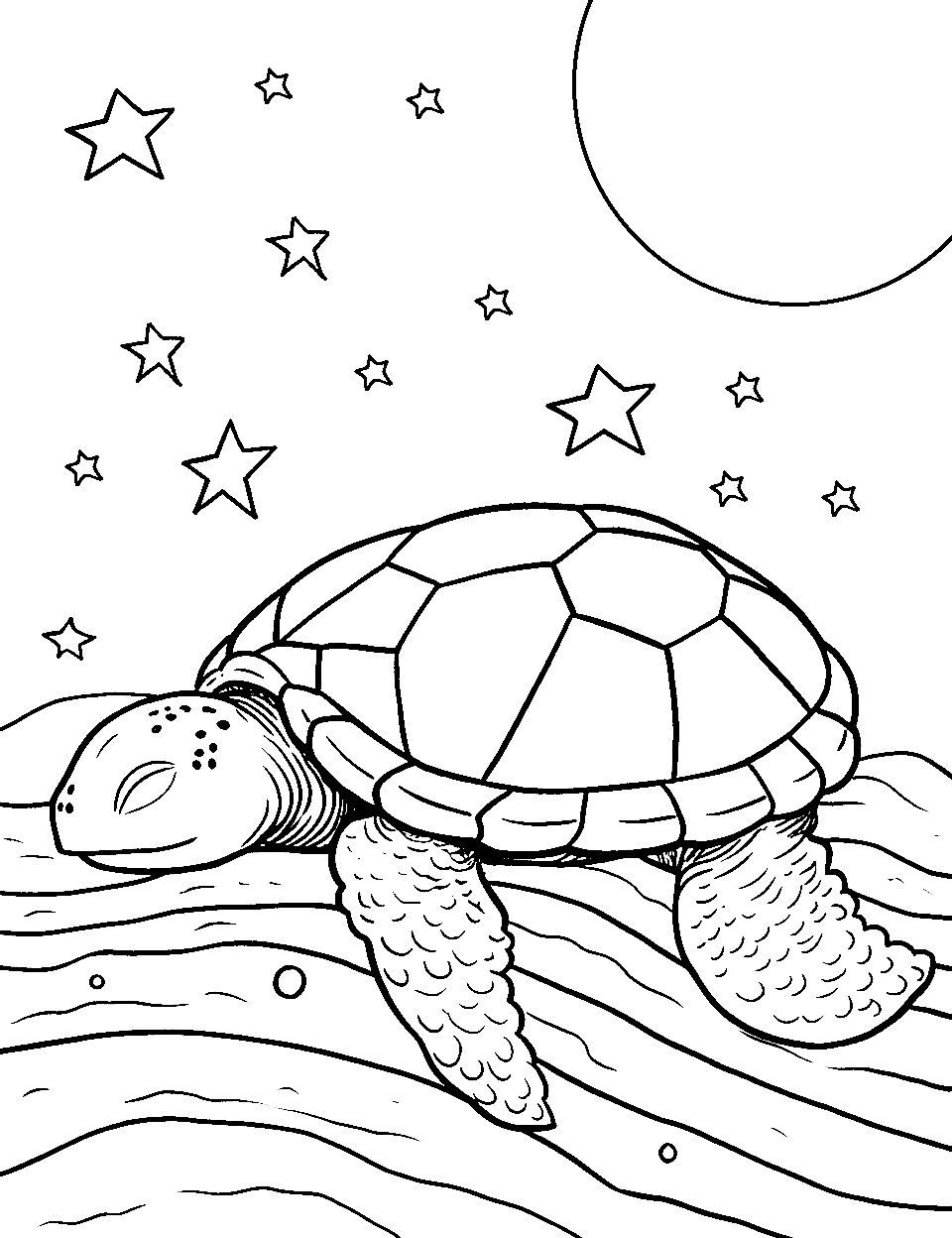
Eyes closed and head resting flat, this turtle is asleep under a big round moon and a sky full of stars. The dunes beneath it are drawn as long soft waves. A dark navy sky with the stars and moon left white makes the strongest version of this page. Save it for a bedtime coloring session.
Flowers cover the entire bottom third of this page, packed shoulder to shoulder with grass pushing up between them. The turtle stands among them with its neck stretched out and a small butterfly floats above the leaves. There is a lot of small detail down in that flower bed, so this one takes a while. It is worth it in full color.
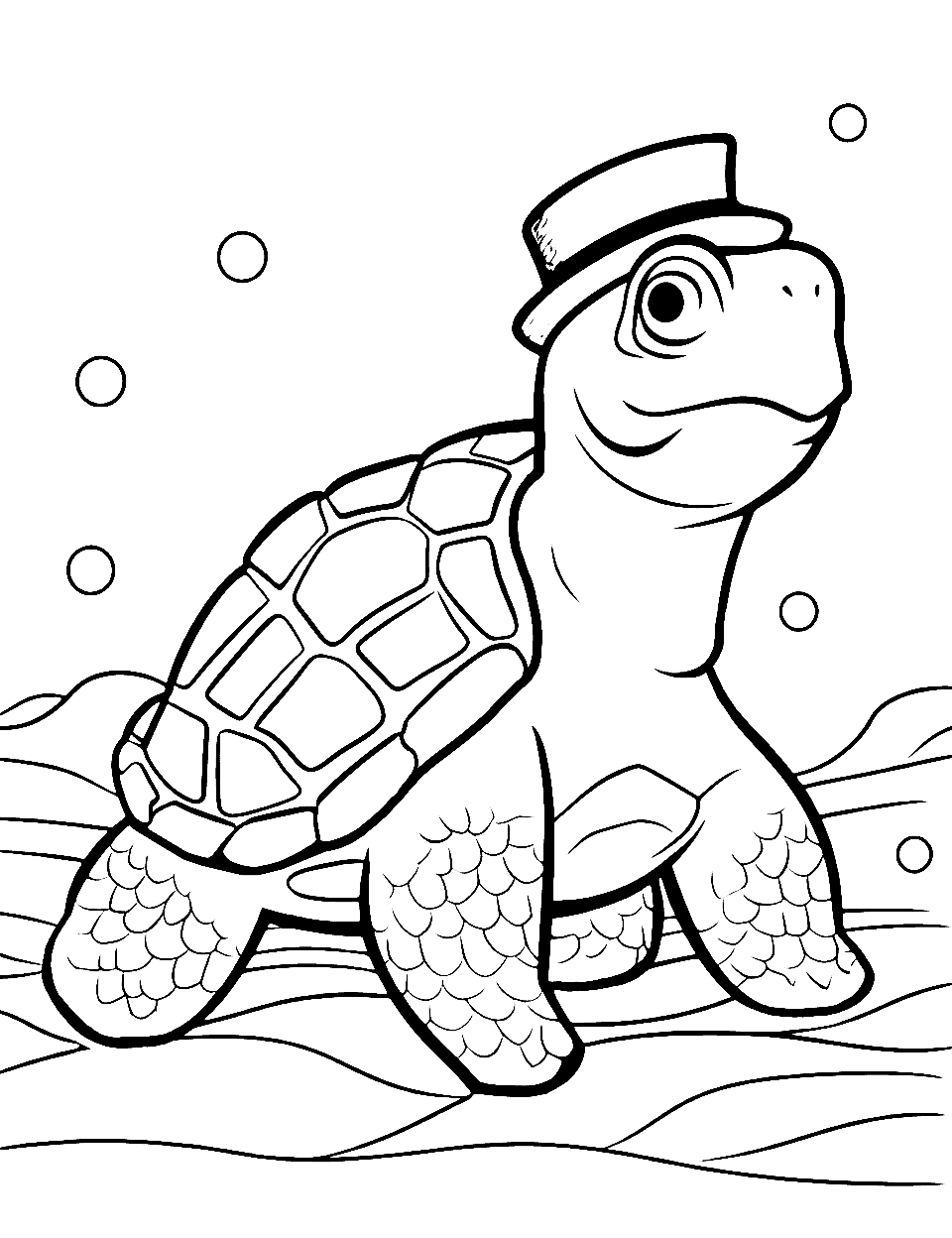
This turtle wears a small top hat tipped forward over one eye. The body is drawn with heavy outlines and a lightly paneled shell, and a few bubbles float alongside. A black hat, a green shell, and one bright band around the brim is all it needs.
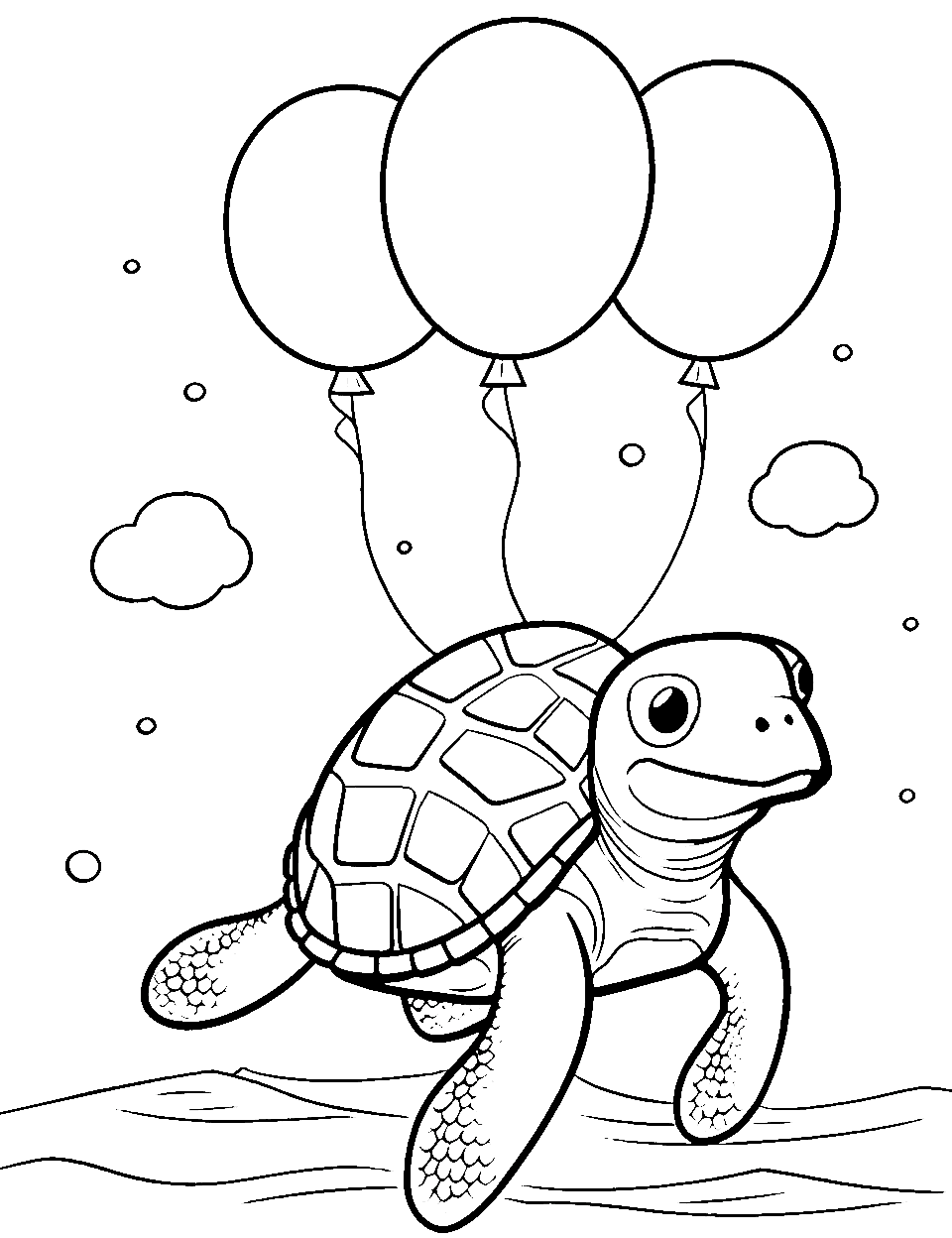
Three balloons on long strings lift this turtle off the ground while two small clouds drift nearby. The turtle looks perfectly calm about the whole situation. Give each balloon its own color and leave the turtle a natural green so the balloons carry the page.
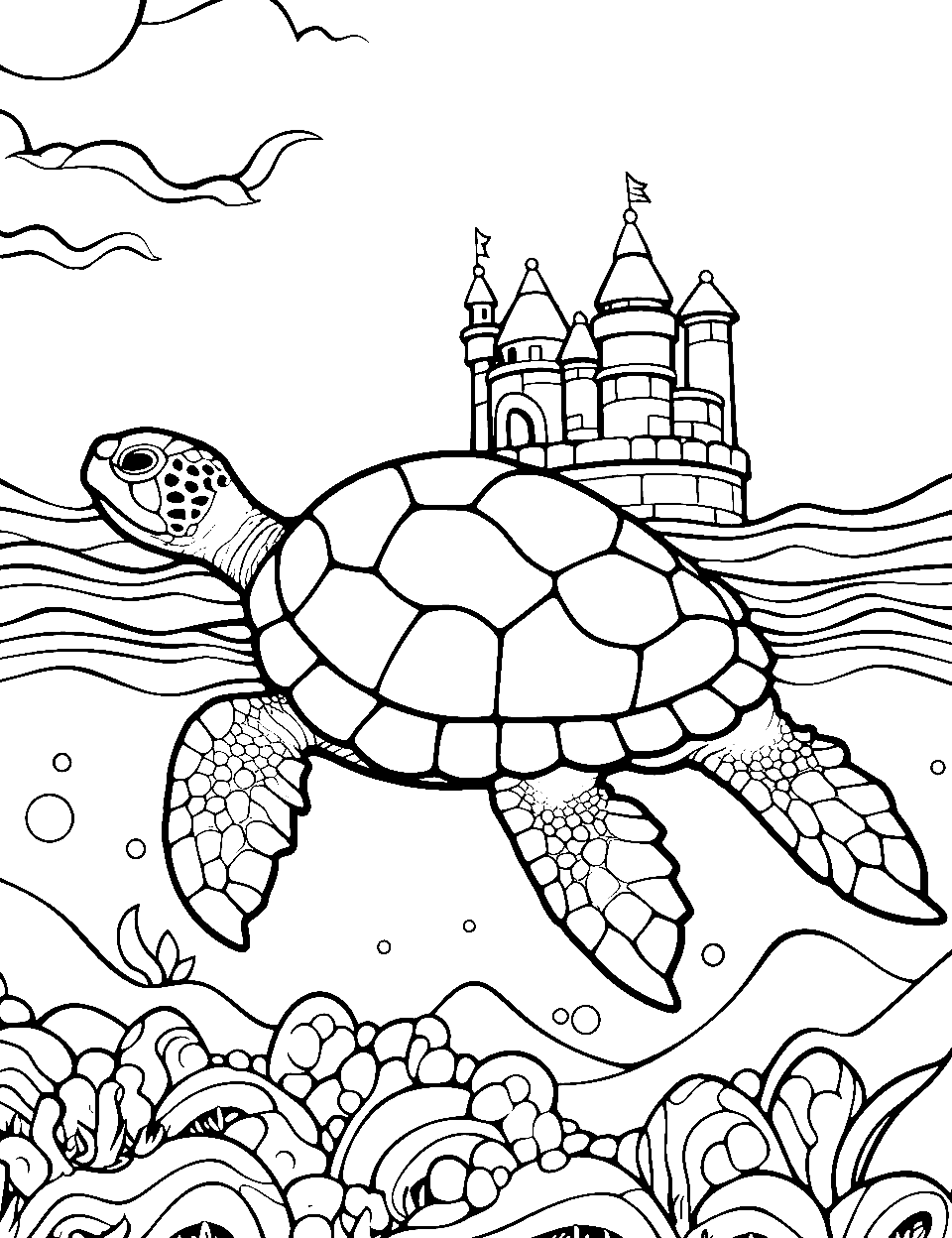
A castle with pointed towers and small flags sits on the shore behind this swimming turtle. Rounded coral and rocks fill the bottom edge and the water is drawn as long flowing lines. The mix of stonework and shell detail gives an older child plenty to work with.
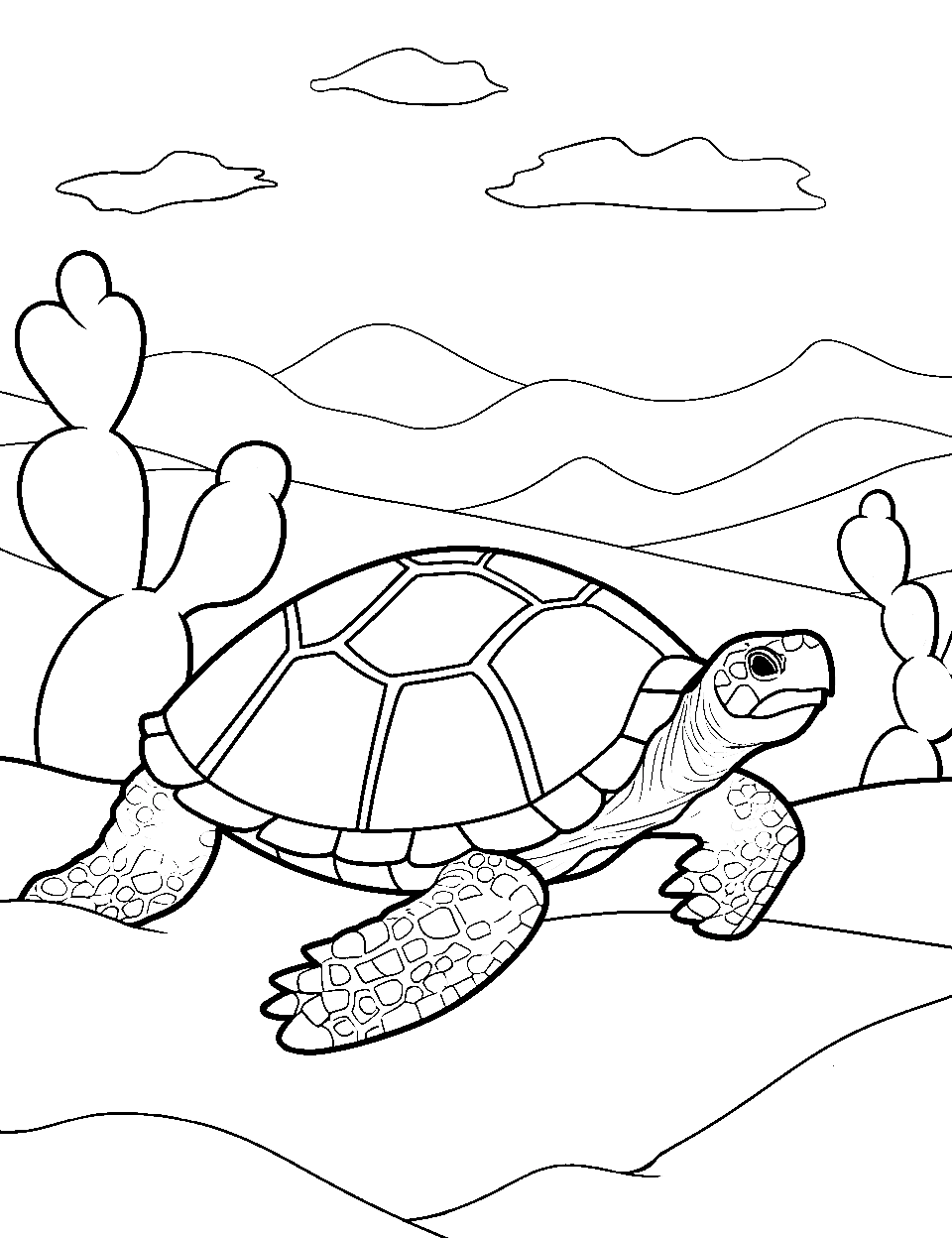
A prickly pear cactus stands at the left edge and a smaller one at the right, with low hills rolling behind them. The tortoise crosses the open sand between them with a front leg lifted mid-step. Sandy tans, a dull green cactus, and a pale washed sky keep it true to the desert.
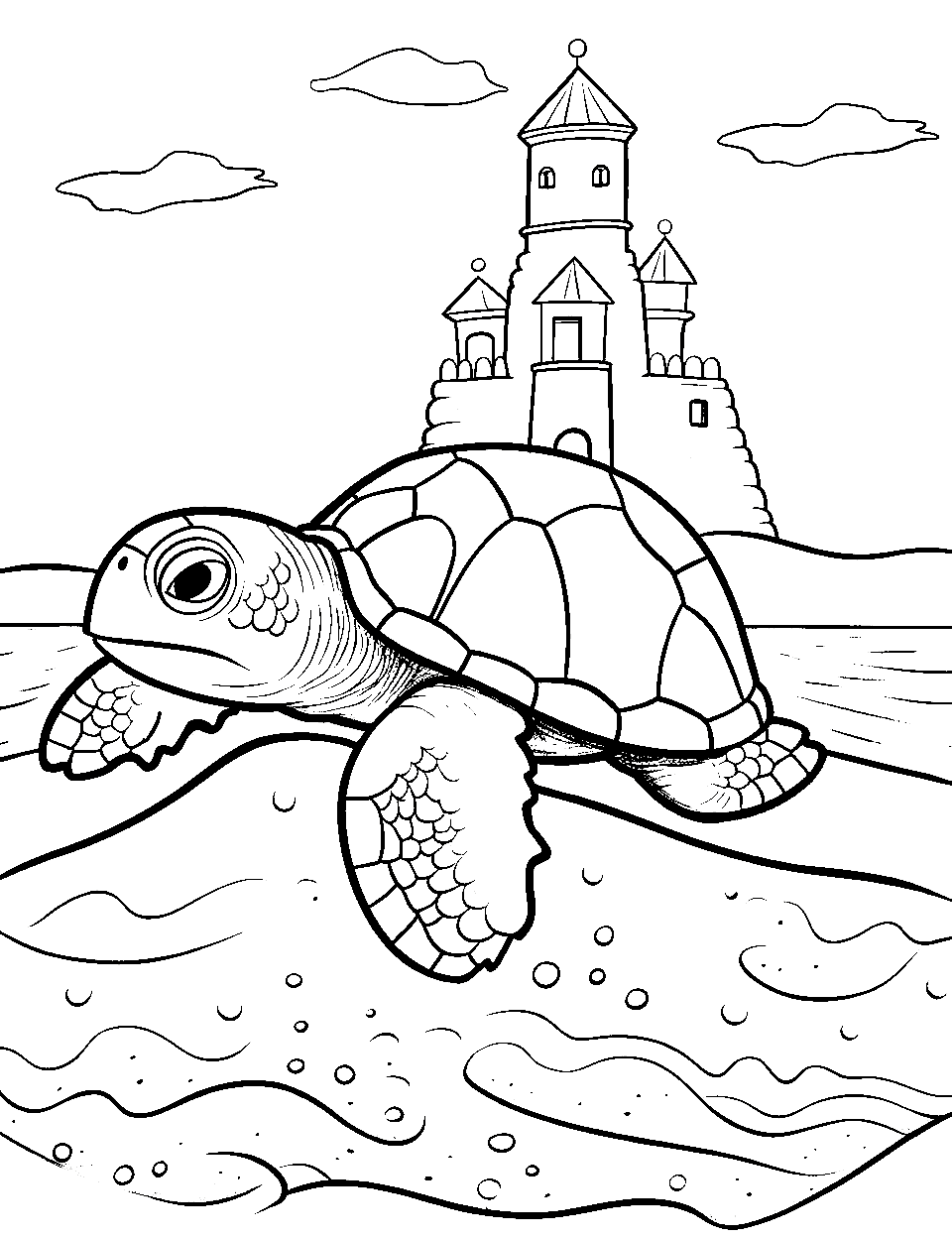
A tall sandcastle with turrets rises on the mound behind this turtle. Foam and small bubbles speckle the wet sand under its flippers. Leave the castle almost uncolored, just a wash of tan, and the turtle in front will stand out.
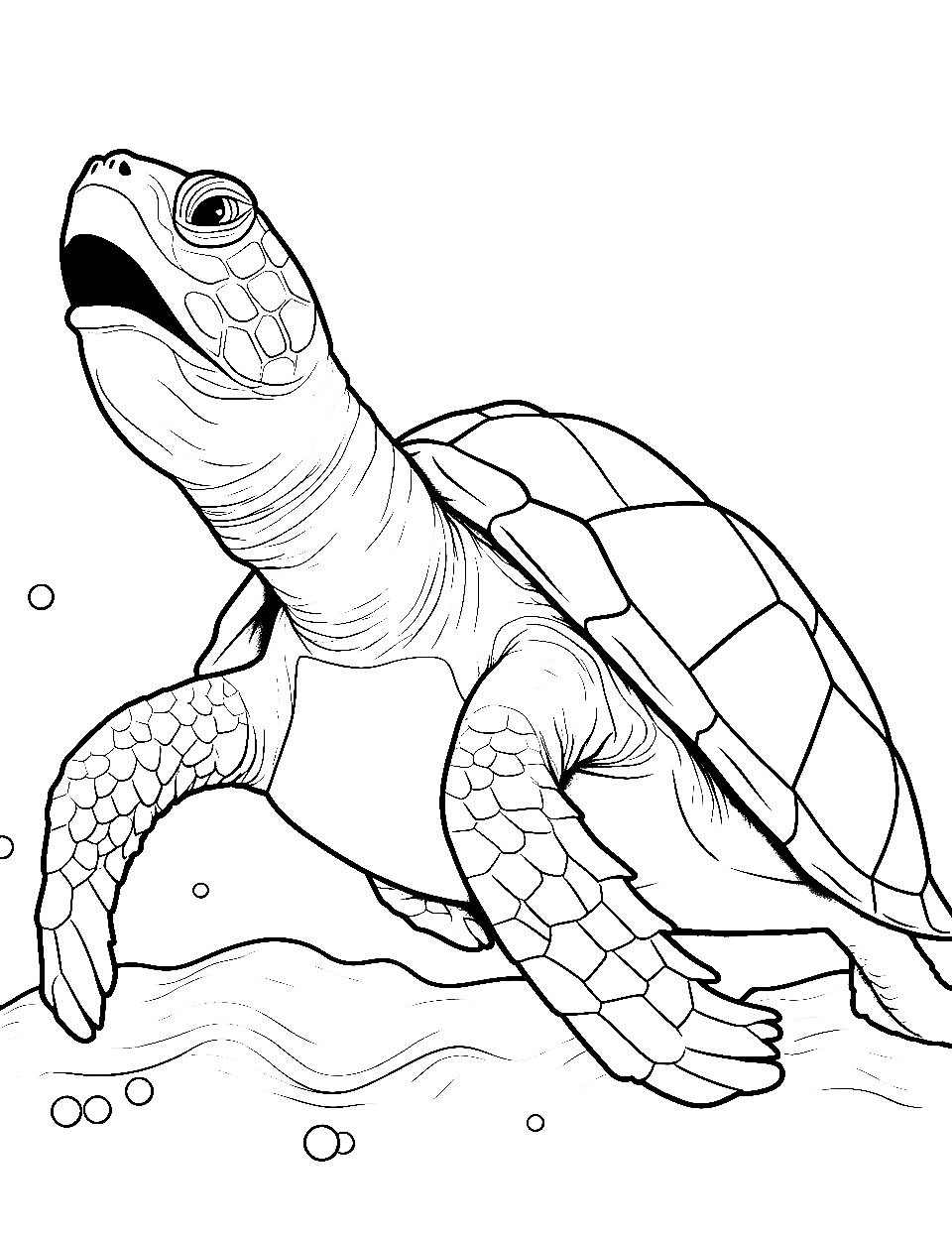
Head thrown back and mouth wide open, this turtle is either yawning or about to complain. The neck is heavily lined and the shell plates are long and narrow. It is one of the most detailed drawings here and reads as almost photographic once it is shaded. Layered grey pencils do more for it than flat color.
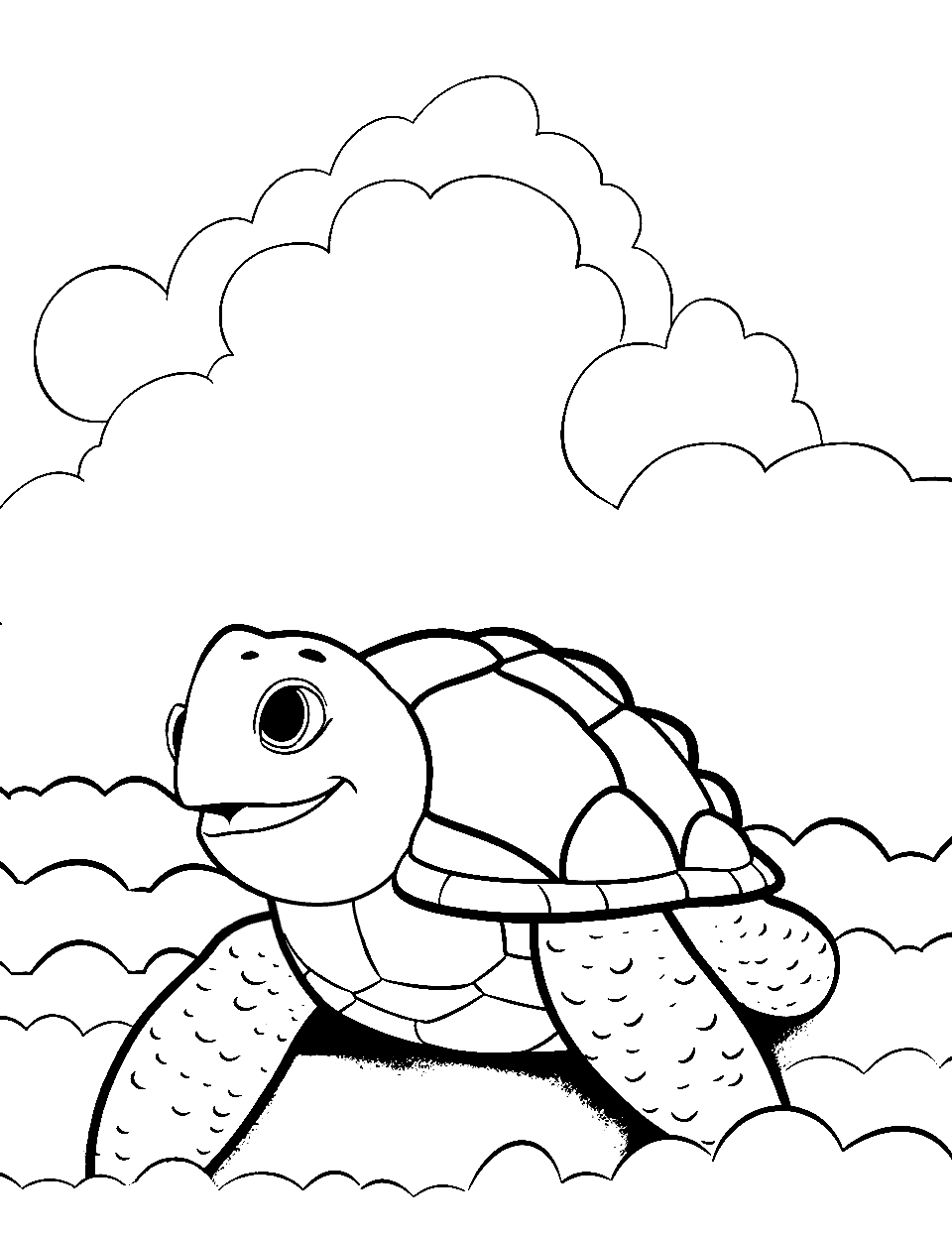
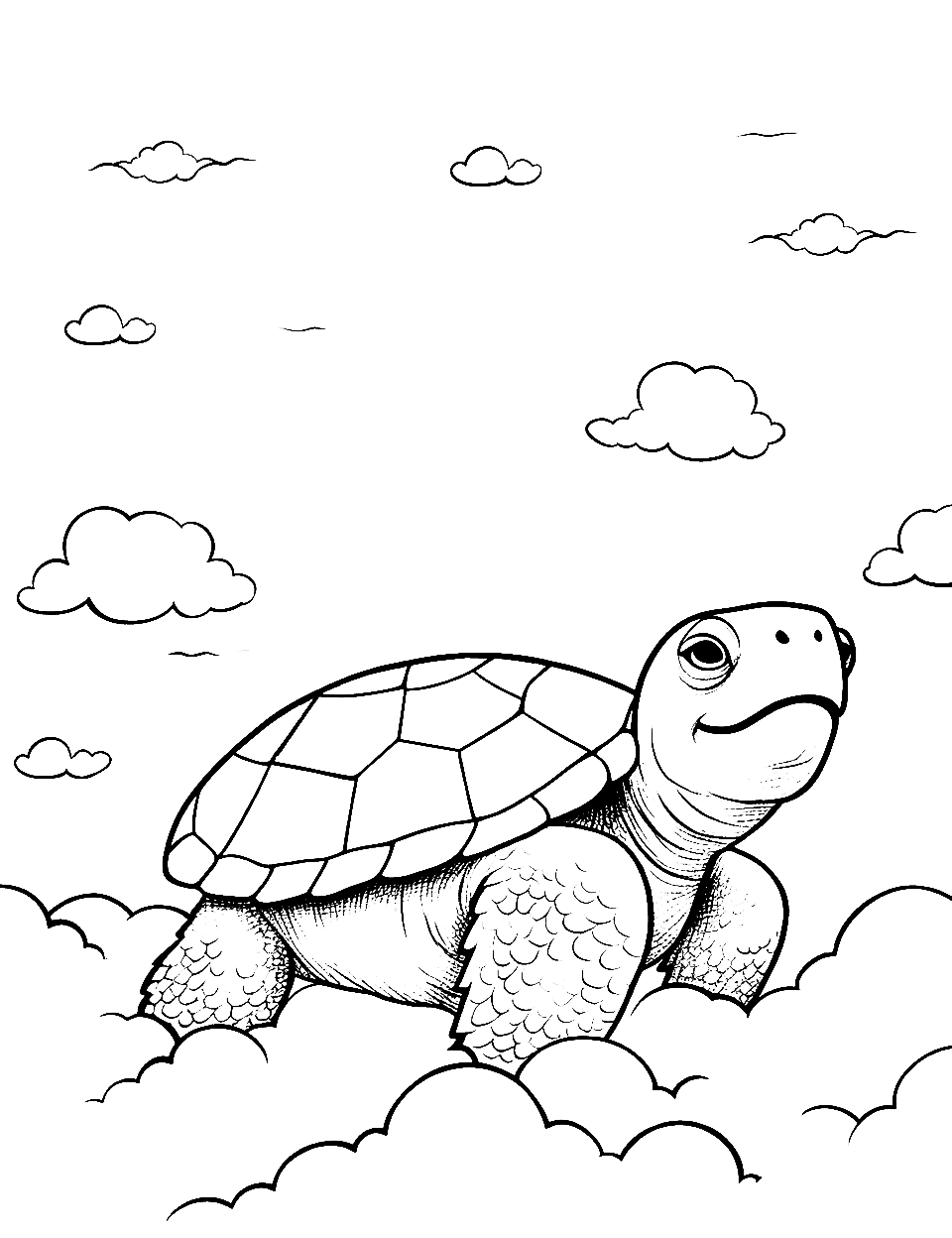
This turtle walks across a bank of clouds with a big puffy one rising behind, and it is clearly pleased about the arrangement. The outlines are thick and the shell splits into wide bands. Pale blues and greys around a bright shell sell the floating idea.
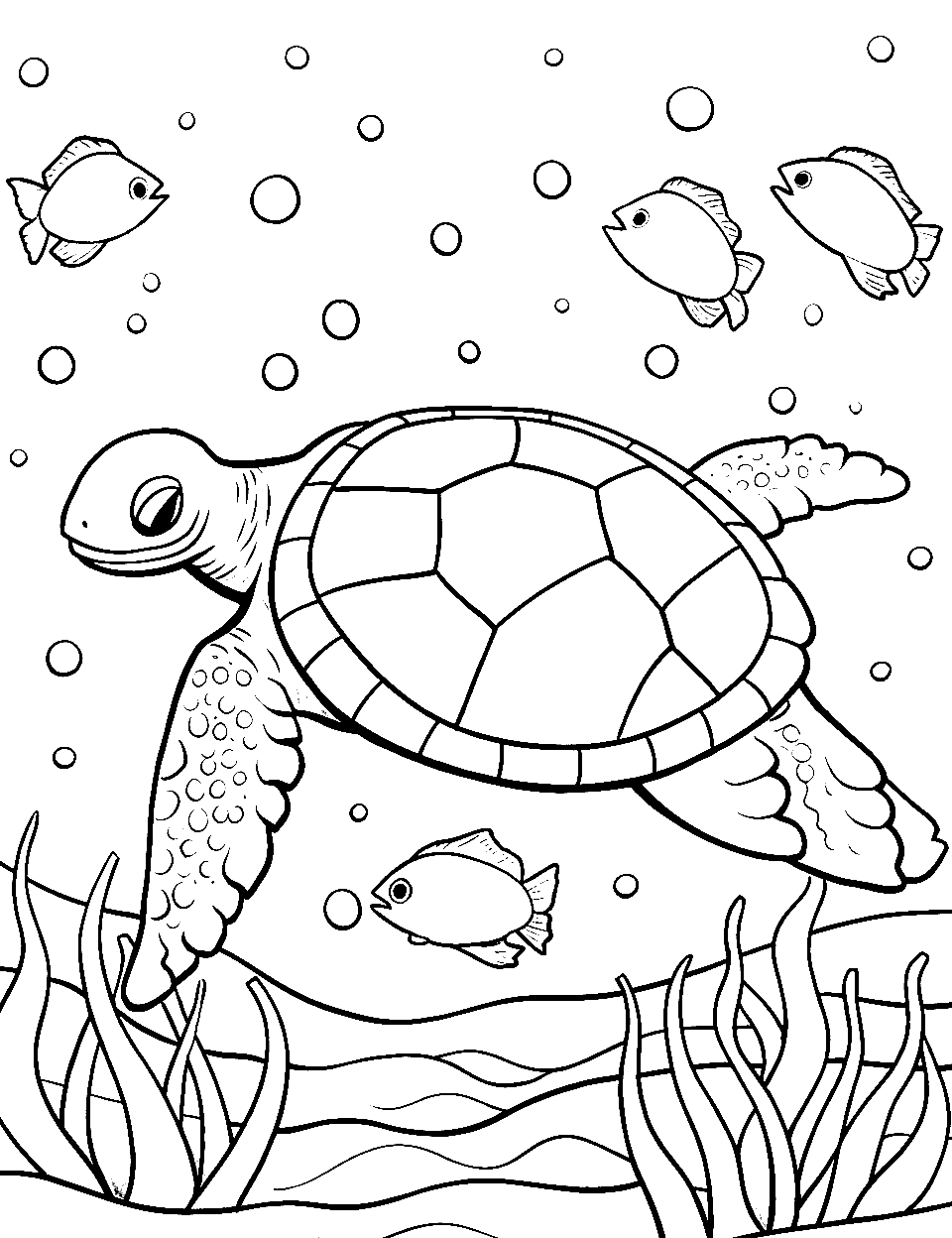
Four small fish swim around this turtle, three up above its shell and one just under its chin. Seaweed sprouts along the bottom and bubbles fill the rest of the water. Give the fish stripes and spots so the page does not turn into one flat sheet of blue.
A turtle rests on a bank of cloud with smaller clouds scattered across the sky above it. The body carries a fine scale texture while the sky is left almost entirely open. That white space is deliberate, so resist filling it and let a light blue wash do the work.
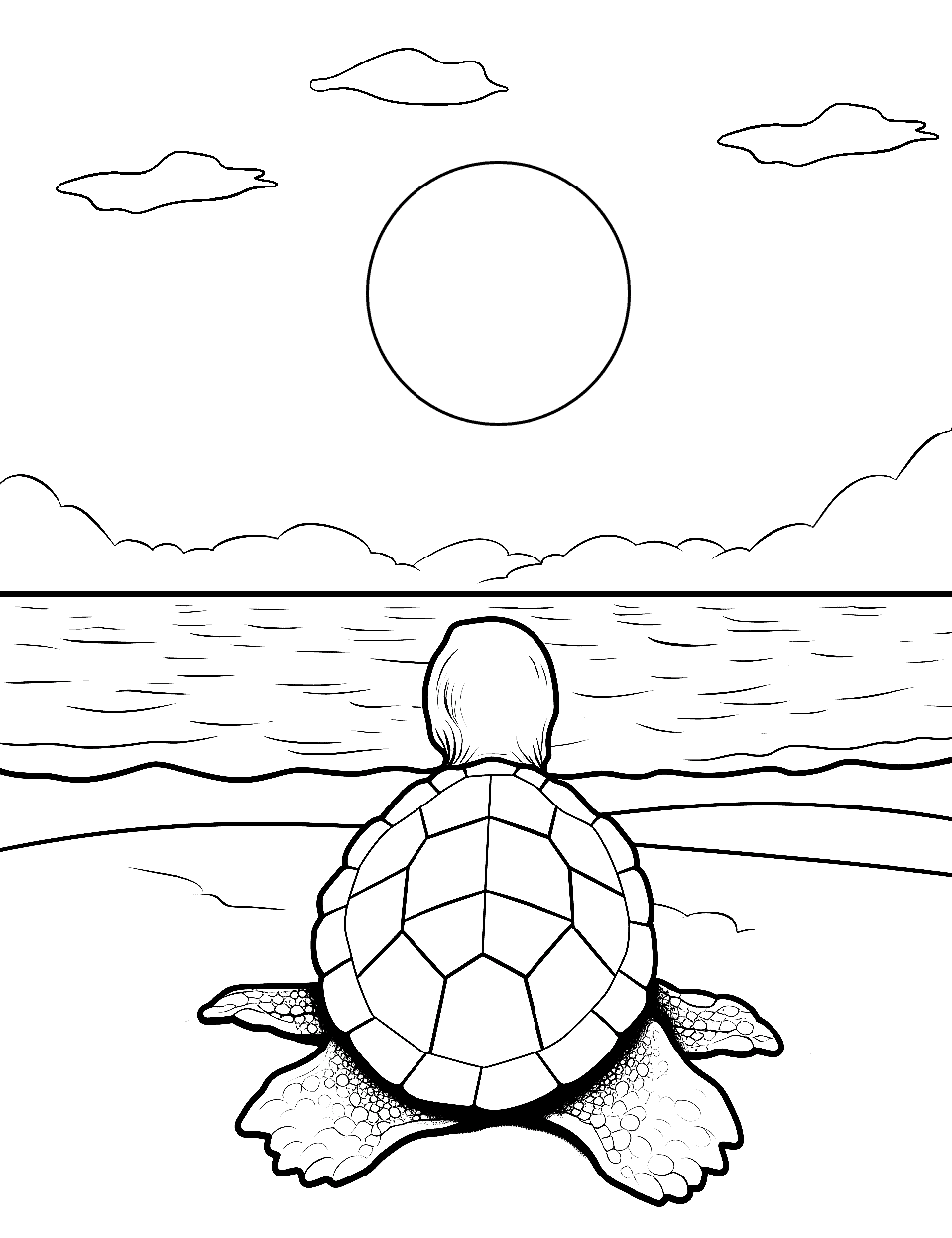
You are looking at this turtle from behind as it faces the water, with a round sun hanging just above the horizon. The shell fills the bottom of the page in even panels and the sea is drawn as fine horizontal lines. Warm the sky with orange and pink and leave the turtle dark for a striking finish.
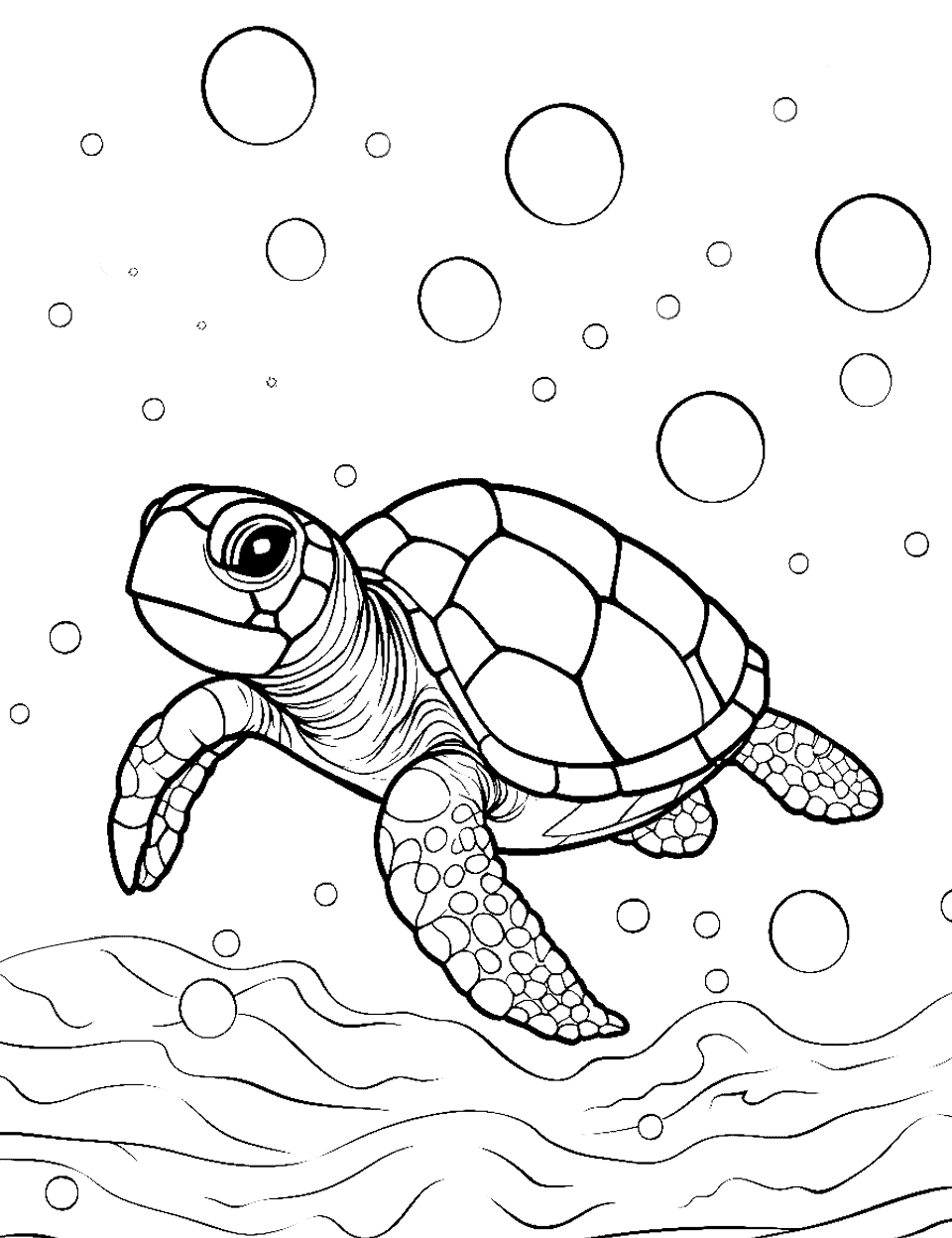
Bubbles of every size crowd the top of this page while the turtle swims underneath them. Its shell is drawn in clean panels and its flippers are pebbled with small ovals. Leave a white highlight on each bubble instead of coloring it solid and they will look like glass.
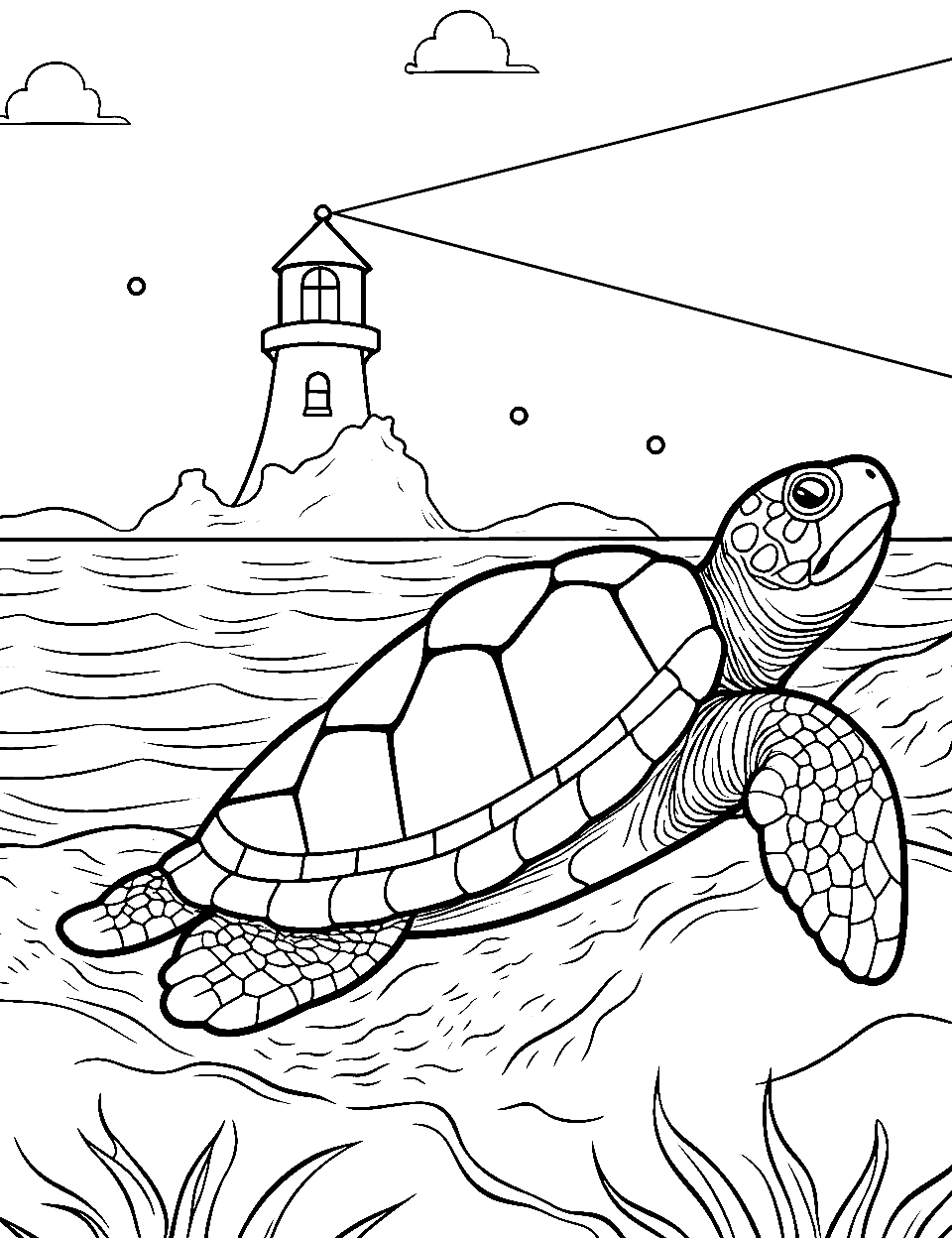
A lighthouse stands on a rocky point behind this turtle and its beam cuts across the sky. The turtle swims right at the surface line with seaweed waving below. Yellow for the beam against a darker sky makes the scene work, and it is a good pick for a child who likes adding their own boats afterward.
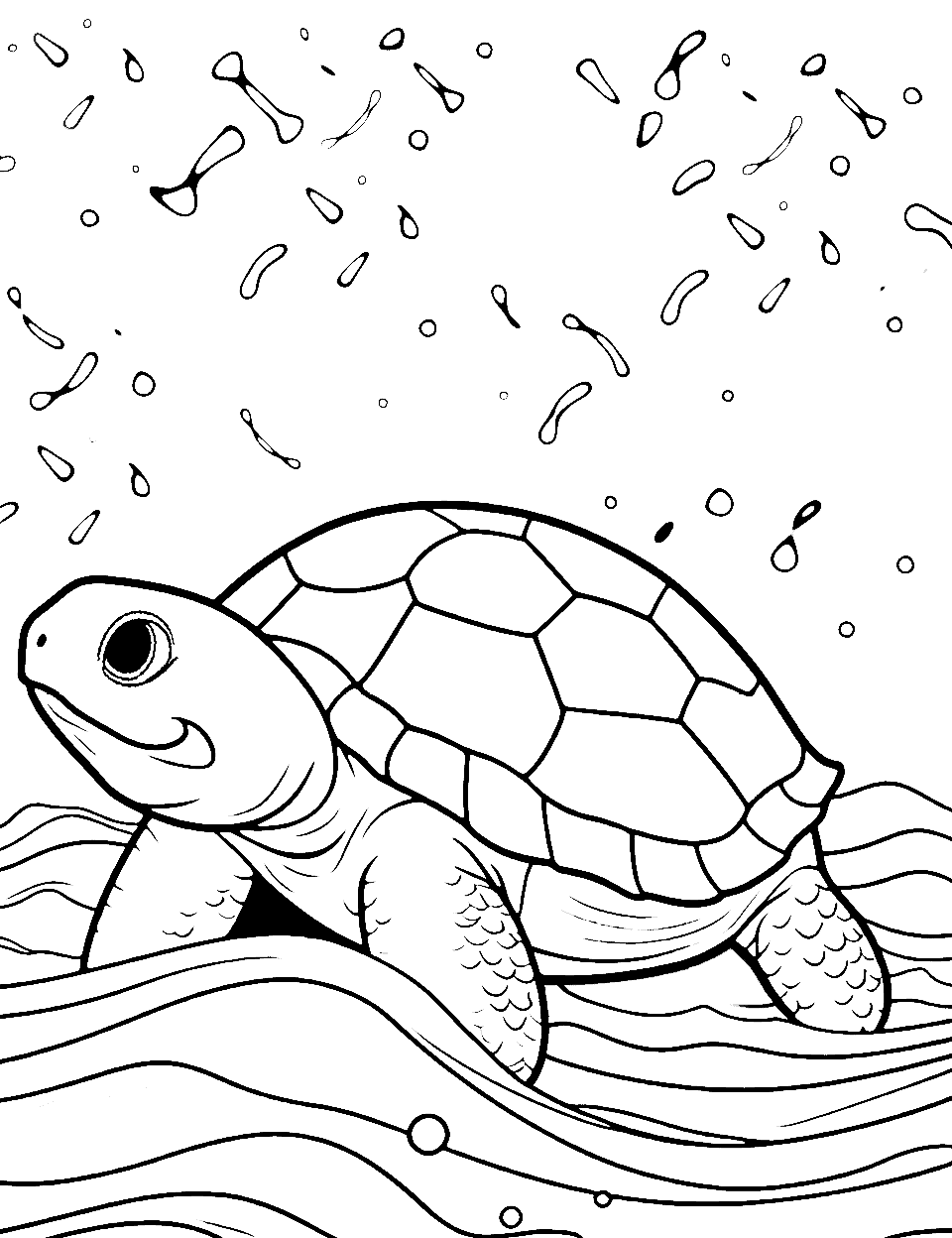
Raindrops and splash marks fill the sky above this turtle while it sits half in the water. The waves under it are drawn as long parallel lines that are easy to follow. Skip the drops or give them the palest blue so they stay readable against the sky.
By using our free coloring pages, you acknowledge and agree to our full disclaimer. All materials are for personal, non-commercial use only and all rights belong to their respective license holders.
Which Turtle Coloring Page Should You Print First?
Start with Toddlers’ Favorite Turtle or Simple Line Turtle for a child under five, then move up to busier scenes as their patience grows. Match the sheet to the child’s patience, not their birthday. The 50 pages here fall into three rough groups, and picking from the right one saves a lot of abandoned pages.
Thick Lines for Toddlers and Preschoolers
Toddlers’ Favorite Turtle, Easy-Breezy Turtle, Simple Line Turtle, and Turtle’s Kawaii Smile are built from heavy outlines and a handful of wide shapes. There is nothing narrow enough for a crayon to escape from, and each one finishes in a few minutes, which is about as long as a three-year-old stays interested.
Scenes for Early Grade Schoolers
Fishy Friends, Under the Beach Umbrella, Balloon-Tied Turtle, and Turtle and Butterfly add a background without adding fussy detail. A child who can stay inside the lines but still wants to finish in one sitting does best here, and the extra objects give them something to invent colors for.
Fine Detail for Older Kids and Adults
Sunning on a Rock, Turtle’s Big Yawn, Reeds and Stones, Ocean’s Lone Traveler, and Turtle Among the Seagrass carry dense hatching or shading on the neck and legs. These reward colored pencils, layering, and an hour of quiet. Markers flood the small shapes and lose the shading, so save them for the pages above.
What Colors Are Real Turtles?
Most turtles run in shades of olive green, brown, tan, or grey, often with a paler underside. That is the honest answer, and it is also why the fantasy pages in this set matter: nobody has to color a turtle correctly to enjoy it.
If your child does want realism, the details are worth knowing. A leatherback has no scales at all, and its shell carries seven ridges running the length of its back, which is why it looks more like worn leather than tile (1). Adults are listed at 750 to 1,000 pounds and 5 to 6 feet long, so the broad, plain-paneled shell on a page like Ocean’s Gentle Giant is closer to life than the neat hexagons on Pretty Shell Patterns.
Land turtles run smaller than kids expect. An eastern box turtle grows to roughly 4 by 6 inches, and its hinged lower shell lets it shut itself in almost completely; those turtles usually live 25 to 35 years, and some have passed 100 (2). Handy to mention while a child colors the Desert Roaming Tortoise, since that tortoise is a land animal, not a swimmer.
Activities to Do With Turtle Coloring Pages
Do not color these and stack them in a drawer. A finished sheet is the starting material for a craft, a card, or a science lesson.
3D Paper Bowl Turtles
Turn a flat page into a toy that stands up. Color the turtle’s head, legs, and tail, then cut them out. Flip a paper bowl upside down, paint it green or brown for the shell, and glue the paper parts around the rim. Simple Line Turtle works best because its parts are large and easy to cut around.
Under the Sea Mural
Tape a roll of blue paper along a wall or bulletin board for the water. As the sea turtle pages come off the table, cut them out and tape them on at different depths. Green streamers make seaweed and the fish from Fishy Friends and Turtle’s Ocean Friends can be cut out separately so they swim on their own.
Turtle Texture Rubbings
Slide something textured under the page before anyone colors the shell: a leaf, a coin, a square of sandpaper. Rub a crayon on its side over the shell area and the pattern comes through. Pretty Shell Patterns and Geometric Turtle Design take rubbings especially well because their panels are big and flat.
“I Turtley Love You” Cards
These make good greeting cards for Mother’s Day, Father’s Day, or a birthday. Set your printer to two pages per sheet so the turtle comes out card sized, color it, cut it out, and paste it on folded cardstock. Winter’s Warm Turtle and Turtle and Butterfly suit a card front, and the message writes itself: “You are turtley awesome.”
Fact-Finding Mission
Pair the coloring with a short research task. After a child finishes the Desert Roaming Tortoise or one of the sea turtle scenes, help them look up three facts about that kind of turtle and write them on the back of the page. It slips reading and biology practice in beside the crayons.
Sorting by Habitat
Print several sheets and have your child sort them into land, water, and “could be either” piles before coloring. Desert Roaming Tortoise clearly goes on land and anything with flippers, coral, and bubbles belongs in the ocean, but Turtle Among the Seagrass starts an argument. That argument is the lesson.
FAQs
What Is the Difference Between a Turtle and a Tortoise?
Tortoises live on land while turtles spend most of their lives in water. Real land tortoises walk on thick, stumpy, column-like legs, while sea turtles have long paddle-shaped flippers built for swimming. Shell shape helps too, since land tortoises carry a tall domed shell and swimmers carry a flatter, more streamlined one.
What Are the Best Colors for Turtle Coloring Pages?
Green, brown, tan, and grey read as realistic on any turtle sheet, with a lighter yellow or cream for the underside. Sea turtles take well to a warmer treatment, with hints of amber and orange across the shell plates. For the cartoon pages such as Turtle’s Kawaii Smile or Turtle’s Cloud Daydream, ignore all of that and go purple, teal, or neon; the drawing is not trying to be accurate.
Can I Use Watercolor on These Pages?
Yes, as long as you print on heavier paper first. Plain copy paper buckles, pills, and eventually tears once it is properly wet. Cardstock or mixed-media paper holds a wash without warping, and it also stops heavy markers from bleeding through onto whatever is underneath.
Do Sea Turtles Really Eat Jellyfish?
Yes, and leatherbacks are the specialists. NOAA Fisheries describes their sharp-edged jaws and pointed, tooth-like cusps as adapted for soft-bodied open ocean prey such as jellyfish and salps, and records dives of about 4,000 feet lasting up to 85 minutes. It is also the reason a floating plastic bag is dangerous to them, which is a conversation worth having while a child colors an ocean scene.
Why Are Some Sea Turtle Hatchlings Male and Some Female?
The sand decides it. Sea turtles have no sex chromosomes the way people do; the temperature of the nest sets the outcome, with cooler sand producing males and warmer sand producing females (3). One nest can therefore hatch a mix, depending on how warm each part of it sat during incubation.
Why Can’t a Turtle Leave Its Shell?
The shell is part of the skeleton, not a house it climbs into. In the carapace, the bony plates over the ribs are fused to the ribs themselves, the plates over the backbone are fused to the neural spines, and the shoulder and hip girdles attach to the inside of the shell (4). Cartoons showing an empty shell get it backward, which makes a good talking point on any page with clear shell plates.
Which Turtle Coloring Pages Are Best for Toddlers?
Start with Toddlers’ Favorite Turtle, Easy-Breezy Turtle, and Simple Line Turtle. All three use thick outlines and only a few large shapes, so a toddler holding a crayon in a fist can still fill them in and feel finished. Turtle’s Kawaii Smile is the next step up, with slightly more shell panels but the same forgiving lines.
How Can I Make the Turtle Shell Look Shiny?
Color the shell with crayon first, then brush a thin layer of clear glue or glitter glue over the top and let it dry completely. The dried glue catches light and gives a wet, glossy finish. Leaving one small patch of the shell uncolored as a highlight does much the same thing with no drying time.