Have you ever noticed that children love to dance? Creativity and self-expression are vital to your child’s well-being, and dancing is a fun way to get your child active.
Dancing has so many pros, from physical fitness to boosting confidence and creativity. But how do you encourage it?
Your child doesn’t have to become a master dancer, but there are too many advantages to ignore. Here’s how to get your child to reap the benefits of dancing.

Physical Benefits of Dance
Now you may understand that dance is just as much an exercise as it is an art. Let’s take a look at its benefits.
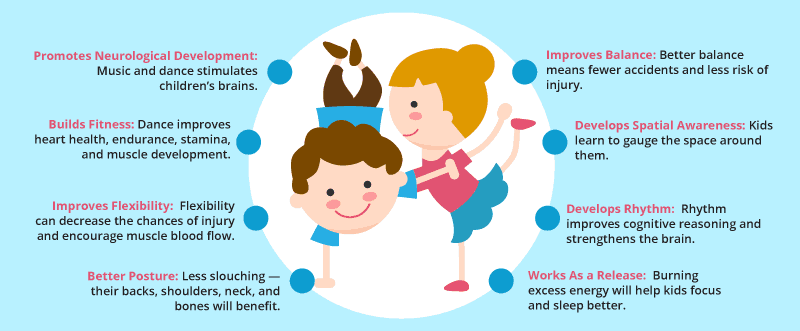
- Dance promotes neurological development: When a child enjoys music and learns to dance to its rhythms, it stimulates their brain. This improves their cognitive abilities, as well as their neurological health.
- Dancing keeps your child fit: Your child can improve their endurance, stamina, and energy by dancing. It also encourages strength and muscle development. Let’s not forget that it’s cardio, so it keeps their hearts healthy, too. Since it’s expressive, it might be an excellent solution for children who have an aversion to exercise.
- Dance improves flexibility: Look at ballerinas. Your child doesn’t have to become a contortionist, but dance can make them more supple. Flexibility can decrease the chances of injury. It also gives you a wider range of motion and improves blood flow to your muscles (1).
- Dancing encourages your child to carry themselves better: Dancing is excellent for your spine. Dancers are taught how to control their bodies to support their own weight optimally. If your child learns to dance, their posture will improve. They won’t slouch and their back, shoulders, neck, and bones will benefit.
- Dance improves balance: In line with the above, dancing also gives you better balance. Once you learn how to hold yourself correctly, your entire stance improves. This keeps you centered, and is also necessary for your muscles and back. If you’re more graceful, you’re less prone to accidents and injury.
- Dance develops spatial awareness: Likewise, dance teaches spatial reasoning — something that not all children are accustomed to. When you dance, you learn to gauge the space around you. It works on your judgment and awareness as well.
- Dancing is rhythmic: You might think that rhythm is something you feel or enjoy, but having a sense of it can improve your overall health. Like with music, it improves your cognitive reasoning, strengthening your brain (2). It also helps you stay relaxed, and improves your mental health.
- Dance is a release: Dancing takes energy. Your child shouldn’t be dancing to the point of exhaustion, but it’s an outlet for pent up hyperactivity. This can also improve their sleep, focus, and routine.
Mental Benefits of Dance
Often, if your physical condition improves, your mental health is strengthened too. A strong body makes it easier to have a strong mind. Let’s look at the psychological advantages of dance.
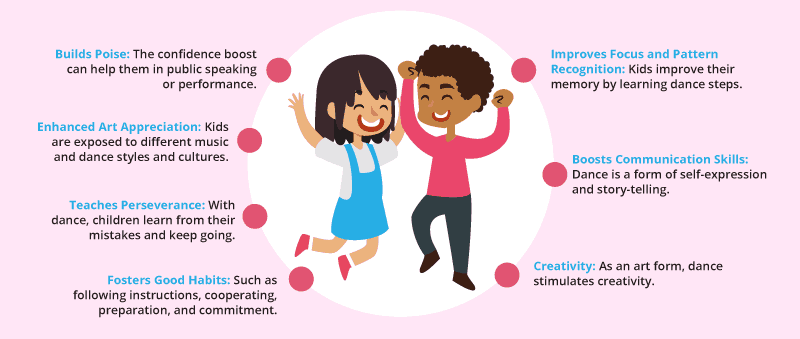
- Dance boosts confidence: This is a no-brainer. If your child is welcomed into a group and is allowed to shine, they’ll feel good. Dancing allows your child to take the lead. They’ll grow accustomed to an audience, and their self-esteem will get a boost. This can help them in other areas, like public speaking or performance.
- Dance encourages art appreciation: It’s only logical that if your child practices an art, their understanding of art itself will improve. This broadens their knowledge and tastes. Kids will be exposed to many different music styles and cultures in dance.
- Dance keeps your child motivated and inspired: As with any other sport or activity, your child will learn to persevere. It is often overlooked that dance will teach your child to learn from their mistakes and keep going. This in itself is a confidence booster.
- Dance Encourages good habits: Dance is based on routine. Your child will learn to be on time, to stick to their commitments, and to practice. Other life skills are taught too, like following instructions, cooperation, accountability, and preparation. They’ll also learn to be dedicated and take on a “work hard, play hard” attitude.
- Dance strengthens cognitive ability: I touched on this in the physical benefits, but these are mental traits too. Dance can build your child’s focus, concentration, memory, and pattern recognition. It can even teach problem solving and innovation. Once your child is comfortable enough to experiment they’ll probably start choreographing their own pieces.
- Dance can improve communication: With all of the cognitive benefits of dance, combined with the confidence boost, your child will become better at communication. Dance is a form of self-expression and story-telling. These skills will translate into other areas of their lives, like speech.
- Dance is creative: Here’s another one I don’t have to explain. Dance is an art. If your child participates in it they’ll stimulate their creativity. Dancers are always encouraged to freestyle. When your child learns to express themselves as individuals, their creativity will become a force to be reckoned with.
Emotional Benefits of Dance
It’s all connected. If your child has a strong body that can host a strong mind, they’ll experience the world differently. Remember that we’re talking about art, which has always been considered emotional, if not spiritual.
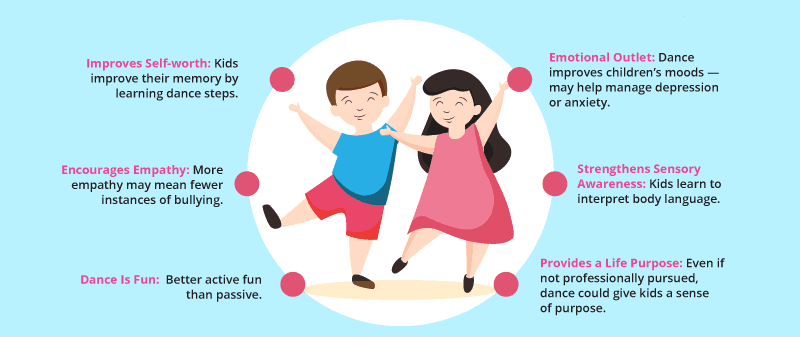
- Dance improves self-worth: Think about how this can improve your child’s self-awareness. If they have something to be proud of, they’ll love themselves more. This could even be an important method of fighting bullying, depression, anxiety, and trauma. Dancing also teaches empathy, which has the potential to reduce these problems even more (3).
- Dance is fun: It sounds cheesy, but wouldn’t you rather have your child in a dance class than wasting away in front of a TV? Or falling in with the wrong crowd? Children don’t want to be bored. Dance can improve your child’s mood.
- Dance emphasizes body language: Dance can (and will) strengthen your child’s ability to communicate non-verbally. Not only will their body language improve, but they’ll also learn to read others better. This is a valuable life skill.
- Dance is an emotional outlet: Everyone needs something they can pour their feelings into. Dance serves as a vent for your child’s emotional needs. Dancing is cathartic. It can greatly regulate your child’s behavior as well as their feelings. In doing so, it releases stress and built up frustration.
- Dance can keep your child on track: Any hobby or activity can give your child’s life more meaning. The motivation or desire to excel will give them a sense of purpose. Remember that even though your child doesn’t have to pursue dance professionally, it will open a door of opportunity if they want to. Simply put, it gives them something to work towards.
Social Benefits of Dance
Since dance is almost always a group activity, your child’s social awareness will pick up too. Public schools are notorious for invoking division among youngsters. Dance can help combat that.
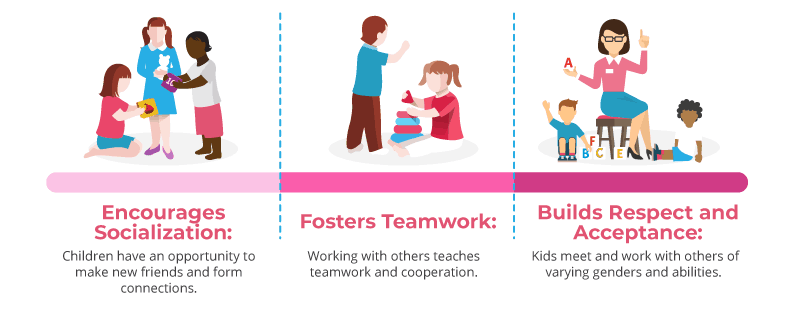
- Dance is a social activity: Dancing encourages socialization. Dance classes aren’t typically one on one. Your child will have an opportunity to make new friends. This will give them a place to fit in and feel connected to others. Dance teaches us to synchronize, which promotes empathy as well.
- Dance involves teamwork: This means that everyone has a part to play in a performance or routine, fostering a sense of teamwork and cooperation. When it’s not serious or professional, dance is not competitive. Everyone has their place and forms an important part of a bigger picture.
- Dance can teach respect and understanding: Dance doesn’t discriminate. Your child will be introduced to others of all walks of life. They’ll learn more about society and equality. Since there’s also an element of safe and structured physical contact, they’ll be taught to respect each other, too. They could even learn about different genders, identities, and sexualities.
Academic Benefits of Dance
You’ve seen how dance improves a child’s physical, psychological, emotional, and social wellbeing. Now we can look at how they all tie together to benefit their academic performance (4).
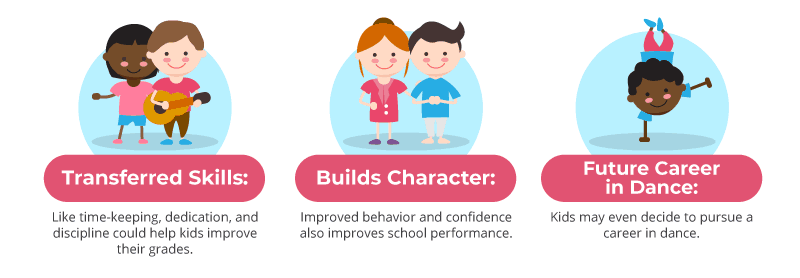
- Dance takes practice: Everything that your child learns in a dance class, from discipline to routine to respect, can be applied in a classroom. This is a major advantage. If they learn time-keeping, dedication, and discipline, for example, their grades could improve. Dancing inspires them to work harder, which is sure to reflect in their schooling.
- Dance builds character: If dancing teaches your child better behavior and confidence, this will also show in their schooling. They’ll be more relaxed, confident, and outgoing. They’ll also learn how to follow instructions, respect themselves, their peers, and authority. Their demeanor will improve, and they’ll become better people.
- Dance is a skill: Don’t forget that dance class is academic in and of itself. Your child is learning and growing and developing a new skill or talent. If they enjoy it, you might find that they’ll pursue it seriously. It’s just as valid a career as any other, and there are many opportunities to explore.
Happy Feet
I’ll say it again: anyone can dance. It’s innate in us all, whether it’s at a party when no one’s watching, or academic. It’s a powerful practice that has much potential to really unlock your child’s skill and happiness, so why not give it a chance?
Dancing is often overlooked. Unless we’re thinking of ballerinas, it’s not as revered as other art forms such as painting, or singing. But the benefits cannot be overstated.
Your child’s entire life can be improved by participating in dance. I hope you consider it, for their sake.
FAQs

What Makes Dance Different From Other Physical Activities?
Dance combines physical activity with creativity, expression, and rhythm. It’s a comprehensive exercise that improves flexibility, strength, and endurance while also providing emotional and social benefits through its artistic and collaborative nature.

What are the Benefits of Ballroom Dancing For Kids?
Benefits of ballroom dancing for kids include improved posture, grace, rhythm, and coordination. It also teaches social skills, respect, teamwork, and can boost confidence through performances and competitions.

Why is Ribbon Dancing Good For Toddlers?
Ribbon dancing is good for toddlers as it encourages movement, creativity, and sensory play. The flowing ribbons captivate their attention and help develop gross motor skills, rhythm, and hand-eye coordination.