One of the most powerful things you can do for your child is to read with them.
Reading offers incredible benefits for kids. It positively impacts development, communication skills, and future school performance. Plus, it is a fun way to bond.
We have broken down why reading is so important for children and included some book ideas to help you get started.
When Should You Start Reading to Children?
It is never too early to start reading to your child. You can introduce books when your baby is a newborn.
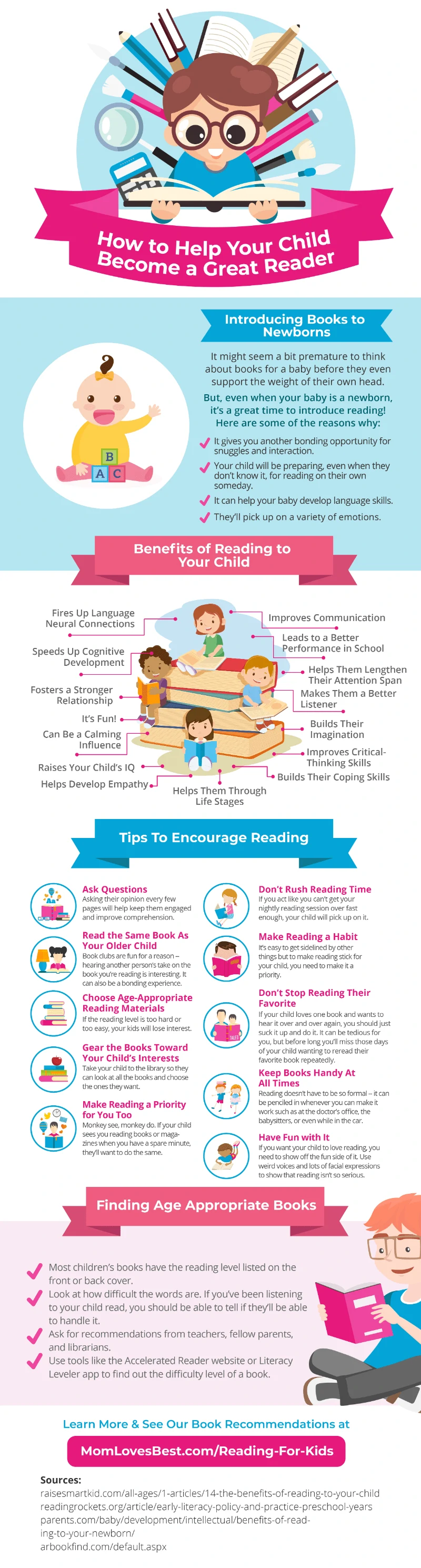
Here is why you should start early (1):
- It provides a bonding opportunity for snuggles and interaction.
- It prepares your child to read on their own someday.
- It helps your baby develop critical language skills.
- Your baby will learn to recognize a variety of emotions.
The Benefits of Reading to Children
Here are the top ways your child benefits from a good book.
1. Boosts Brain Development
Reading fuels the neural connections in your child’s developing brain. They get a major vocabulary boost just by hearing you read aloud.
Research shows that listening to reading increases a baby’s receptive vocabulary (2). This refers to the words they understand, even if they cannot say them yet.
2. Supports Cognitive Development
Your child picks up on cognitive perks while you read. They absorb what you say and learn about numbers, colors, shapes, and animals.
They also begin to understand cause and effect. Over time, their logical thinking abilities become more developed.
3. Fosters a Strong Relationship
The family that reads together stays together. Reading gives you one more way to spend time bonding.
There is something especially relaxing about reading time. Because you are actively telling a story, you cannot focus on anything else but your child. You won’t be surfing your phone. You are totally engaged in the moment. That connection is great for your relationship.
4. Reduces Stress
Having fun is a benefit all on its own. It cuts down on the stress a child feels. Yes, children experience stress just like adults do.
Time spent having fun leads to better sleep, more positive feelings, and stronger relationships (3).
5. Calms and Soothes
Young children are not exactly known for being calm. They have a knack for getting wound up right when you want them to wind down, like at bedtime.
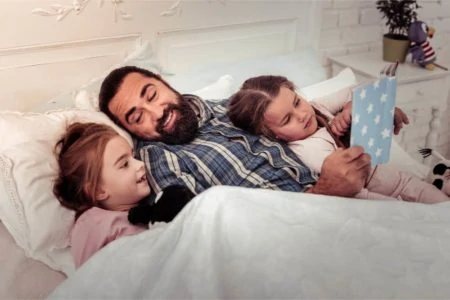
Reading helps them relax so you can both get some sleep. Try starting a half-hour before bedtime. Tuck them in, dim the lights, and read in a soft, soothing voice.
6. Improves Communication Skills
If you want a close relationship with your children where you talk about anything, reading is a good place to start.
When you read to your children, you do more than say the words on the page. You interact. You ask them questions, and they ask you some. You discuss how the characters feel or anything else that crosses your mind.
This is how communication grows. Sharing these little moments builds trust. Eventually, you will be able to broach bigger subjects.
7. Improves School Performance
Reading to your child sets them up for better grades later in life. It does not matter if they don’t understand the words yet.
Early learning experiences like reading enhance school performance (4). They learn to love reading. This is a skill they will use in every subject they tackle in school.
8. Lengthens Attention Span
The modern world works against attention spans. With video games, phones, and tablets, it is hard to get a child to stick with something that requires focus.
Reading is slower-paced than digital entertainment. That is a good thing in a click-bait world.
Pro Tip
9. Creates Better Listeners
When your child cannot read yet, their only clues about the story are the pictures and the words you say.
You open up a new world to them with the tale you spin. They listen carefully, even when you don’t think they are.
You might realize just how observant kids are when you try to have a private conversation with a friend, only to find your child eavesdropping! Quiet reading time gets them accustomed to active listening.
10. Builds Imagination
Have you ever watched a movie based on a book and felt disappointed? That is because your imagination created a better version in your head.
Your child’s imagination is unlocked by unsupervised play and reading. They get sucked into a make-believe world. They imagine how they would feel or act if they were the main character.
For some children, reading inspires them to create their own tales. Most writers were hardcore readers first (5).
11. Raises IQ
Reading comprehension is like a superpower. It gives you the ability to understand complicated concepts.
Remember those dreaded word problems in math class? You had to use all your concentration just to figure out what they were asking. Reading comprehension made solving those possible.
To answer a problem correctly, you must first understand what it asks. Reading comprehension builds that skill.
12. Improves Critical Thinking
It isn’t enough to just listen to the words. You and your child have to put in a little effort.
Your child has to attempt to understand the story to get the most out of the book. Encouraging this is easy. Just ask questions.
Ask what the main character should do to get out of a jam. Ask why a character made a specific choice.
13. Helps Develop Empathy
Experts say children are losing empathy (6). Empathy is how well your child understands someone else’s feelings.
To develop empathy, choose books that relate to other people’s struggles. There are many books geared toward inclusion and how being bullied feels.
Ask questions while reading. If the character had a potty training accident, ask your child if they would feel sad or embarrassed.

14. Builds Coping Skills
Seeing how others deal with emotions helps your child handle their own. They learn important coping skills from stories.
Point out when a character is mad, sad, or disappointed. Show them the picture of the character’s face. This helps them recognize the emotion and figure out ways to deal with it.
15. Helps Through Life Stages
Stages like potty training or starting kindergarten are scary for a kid. Books help children feel braver and ready to tackle new challenges.
Book Recommendations for Kids
When looking for books, consider your child’s interests and their reading level. If a book is too hard, they will lose interest and get frustrated.
Here is how to determine the right level:
- Check the reading level listed on the cover.
- Look at the difficulty of the words. If you listen to your child read, you will know if they can handle it.
- Use an app like Literacy Leveler. Scan the ISBN code to look up the level online.
- Ask teachers, parents, or librarians for recommendations.
- Use the Accelerated Reader website to find the difficulty level.
Good Ideas for Babies
Book Ideas for Toddlers
Looking for more ideas for your toddler? Read our in-depth guides:
Book Ideas for Preschoolers
Check out these great reads by age group:
Book Ideas for Elementary School Children
We have guides for older kids too:
- Books Ideas for 7-Year-Olds
- Book Ideas for 8-Year Olds
- Book Ideas for 9-Year Olds
- Book Ideas for 10-Year Olds
- Book Ideas for 11-Year Olds
- Book Ideas for 12-Year Olds
- Book Ideas about Friendship
FAQs

Why Is Reading Better Than TV for Kids?
Kids’ TV shows often lack the depth of children’s books. Books teach empathy better and force kids to use their imaginations by visualizing scenes.
Furthermore, reading improves concentration. Too much TV can actually make concentration worse.

Does Reading a Book Count as Screen Time?
No, reading a book does not count as screen time. Even if they read on a tablet or phone, it is active engagement, not passive watching.
However, physical books are often better because kids struggle to stay focused on a device connected to the internet.

What Happens to Children Who Don’t Read?
Children who do not read may struggle to develop critical thinking skills. Books allow children to step into the shoes of people facing problems regarding family, friendship, and morals.
Thinking through these stories lets them solve dilemmas in a safe environment. This builds the skills they need to handle real problems as adults.

What Age Do Children Lose Interest in Reading?
Children can lose interest in reading at any age. It often happens around age 8 or 9 (the “decline at nine”). Gently encourage your kids to read if they seem disinterested. Find genres or graphic novels that pique their interest again.

How Long Should I Read to My Child Each Day?
Aim for at least 15 to 20 minutes a day. Consistency is key. Even a short bedtime story creates a routine that builds vocabulary and strengthens your bond. If you can read longer, that is great, but don’t stress if you only have time for a short book.