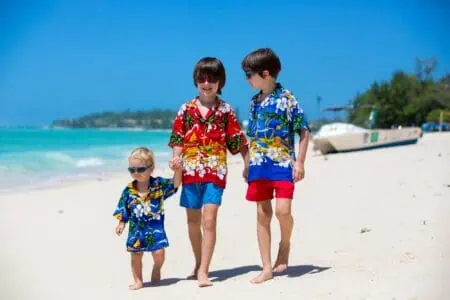
Many people are fascinated with Hawaii but don’t know much about Hawaiian last names. Hawaiian people didn’t have proper surnames until 1860, and chose them using family members, locations, or characteristics. There’s a lot to discover once you explore the history behind these naming traditions.
Hit the beach with our fun list of Hawaiian family names including a variety of origins and meanings. From different variations to the most famous namesakes, our guide has everything you need to become an expert in all things Hawaiian.
100 Popular Hawaiian Surnames
Take a tour through the islands with these Hawaiian last names for those lucky enough to call it home.
‘Akamu
‘Akamu is the native Hawaiian variation of Adam, the name given to the first man in the Bible. It also means “red clay,” which sometimes translates to “red earth,” keeping ‘Akamu grounded to the land.
- Origin: Hawaiian
- Meaning: From the earth
- Pronunciation: Ah-KAA-Muw
- Popularity: Akamu is very rare worldwide and mostly used in Nigeria.
Akina
Akina is also a girl’s name, meaning “bright greens” and “autumn.” Its Japanese roots associate Akina with other meanings, which include “name” and “south.”
- Origin: Hawaiian, Japanese
- Meaning: Bright
- Pronunciation: Ah-KIY-naa
- Variations: Akinah
- Popularity: Akina is very rare worldwide and mainly used in the DR Congo.
Alana
Alana refers to a “beautiful offering” but has come to represent everything “beautiful” in Hawaiian last names. It also means “fair” and “harmony” and, as Alanna, means “elevated” or “exalted” when an Arabic girl’s name.
- Origin: Hawaiian, Arabic
- Meaning: Beautiful
- Pronunciation: Ah-LAEN-aa
- Variations: Alanna, Alannah
- Popularity: Alana is very rare worldwide and primarily used in Nigeria.
Alika
Alika is the Hawaiian equivalent of the unisex personal name Alex, short for Alexander. It’s rarely a given name on its own—instead, Alekanekelo, the Hawaiian Alexander, is used. Alika originally comes from the Greek Alexandros, meaning “guardian of the people,” and has come a long way since then.
- Origin: Hawaiian, Greek
- Meaning: Of noble kin
- Pronunciation: Ah-LIY-kaa
- Variations: Aleeka, Alicca, Alikah, Alycka
- Popularity: Alika is rare worldwide, mostly used in Nigeria, and ranked 1,020th in Togo in 2014.
Alohi
Alohi means “brilliant” and is slightly different from Aloha. Aloha is the traditional greeting in Hawaii, meaning “splendor” and “brightness.”
- Origin: Hawaiian
- Meaning: Shining
- Pronunciation: Ah-LOW-HHiy
- Variations: Aloha
- Popularity: Alohi is extremely rare worldwide, with just 14 known occurrences in 2014, mainly in Benin.
Anakoni
Anakoni is the Hawaiian equivalent of the male Anthony. It originally meant “of the Antonius family” in Latin and “priceless one” in Greek. It’s so rare that Anakoni has no popularity statistics as a surname.
- Origin: Hawaiian, Greek
- Meaning: Valuable
- Pronunciation: Aen-ah-KOW-Niy
Ano
Ano seems like one of the more cute Hawaiian surnames on the list and has multiple origins. It means “pristine” in German and “chaste” in Armenian. Ano is similar to Ani, meaning “beautiful” in Hawaiian, and Anno, a Japanese surname.
- Origin: Hawaiian, German
- Meaning: Reverence
- Pronunciation: AH-Now
- Variations: Anno
- Popularity: Ano is rare worldwide and primarily used in the Ivory Coast, where it ranked 371st in 2014.
Aukai
Aukai also means “seafarer” and “sea traveler” as both a surname and a Hawaiian boy’s name. In 1920, there were approximately six Hawaiian families named Aukai. Since then, it rarely appears outside of Hawaii.
- Origin: Hawaiian
- Meaning: Sailor
- Pronunciation: Aou-KAEY
- Variations: ‘Aukai
- Popularity: Aukai is extremely rare worldwide, with 90 known occurrences in 2014, mostly in the U.S.
Auoli
Though Auoli looks and sounds almost like “aioli,” it’s not a sauce made with garlic! Auoli is the Hawaiian form of the English Howard and means “army guard.” It has no available popularity information as a surname.
- Origin: Hawaiian
- Meaning: Chief
- Pronunciation: AOW-liy
Elikapeka
Elikapeka is a Hawaiian form of Elizabeth. Elizabeth itself derives from Hebrew, meaning “promise of God.” Like many other Hawaiian girls’ last names, Elikapeka is also a first name for girls who like to dance in grass skirts.
- Origin: Hawaiian
- Meaning: God is my oath
- Pronunciation: EH-liy-Kaa-BEH-kah
Etana
Etana also means “the strong one” in Swahili and dates back to Sumerian kings. When Etena, it’s the Greek female form of Alexander, meaning “defending men.” Etana is also a Hebrew girl’s name meaning “dedication” and “strength.”
- Origin: Hawaiian
- Meaning: Strong
- Pronunciation: EH-taa-Nah
- Variations: Etaina
- Namesakes: Etana, the 13th Babylonian king of the ancient Sumerian kingdom of Kish.
- Popularity: Etana is rare worldwide and mainly used in Ethiopia, ranking 1,064th in 2014.
Eusebio
Eusebio comes from the Greek “eusebés,” meaning “the merciful.” It’s better known as a Spanish and Italian boy’s name taken from Eusebius, meaning “devout” or “pious.”
- Origin: Hawaiian, Greek
- Meaning: Worships well
- Pronunciation: Eay-uw-SEY-biy-Ow
- Variations: Eusebius
- Namesakes: Tony Eusebio, a Dominican baseball player for the Houston Astros. Bobby Eusebio, the Filipino mayor of Pasig from 2007 to 2013 and 2016 to 2019.
- Popularity: Eusebio is rare worldwide, primarily used in the Philippines, and ranked 524th in the Dominican Republic in 2014.
Haku
Haku may be associated with the occupation of a “supervisor,” but it also means “crown of fresh flowers” and “pure” in Japanese. Haku is the name of a river spirit depicted in the anime film Spirited Away.
- Origin: Hawaiian
- Meaning: Manager
- Pronunciation: HHAA-Kuw
- Variations: Ha’iku, Haiku
- Namesakes: Shinkun Haku, a Japanese member of the House of Councillors from 2004 to 2021. Kiyoko Haku, a Japanese manga artist known for the story Chotto dake Biyaku.
- Popularity: Haku is very rare worldwide and mostly used in India.
Halia
Halia means “reminiscence” in Hawaiian, yet has roots in Greek mythology as the daughter of Thalassa. It’s also the name of an Austronesian language in the multiple islands in Papua New Guinea. Halia ranked in Hawaii’s top 50 girls’ names as a first name in 2021.
- Origin: Hawaiian, Greek
- Meaning: Remembrance of a loved one
- Pronunciation: Hhah-LIY-ah
- Variations: Halya
- Popularity: Halia is very rare worldwide and mainly used in Indonesia.
Haoa
Haoa is one of many Hawaiian boy last names derived from a first name. It’s the Hawaiian equivalent to Howard and means “exalted protector” and “chief guardian.”
- Origin: Hawaiian
- Meaning: Chief
- Pronunciation: HHOW-Ah
- Variations: Haki
- Popularity: Haoa is extremely rare worldwide, with 210 known occurrences in 2014, primarily in Chile.
Haukea
Haukea has roots as a first name for anyone who is a Pacific Islander. It’s made up of the Hawaiian “hau,” meaning “snow” and “kea,” meaning “white.” Haukea is the word used for the majestic snow-capped mountains in certain parts of Hawaii.
- Origin: Hawaiian
- Meaning: White snow
- Pronunciation: HHAO-kiy-Ah
- Variations: Haukeah, Haukia, Haukiah, Haukiya, Haukiyah
Haunani
Haunani is also a girl’s name composed of the Hawaiian “hau,” meaning “snow,” and “nani,” meaning “beauty” and “glory.” It also means “beautiful dew,” along with “handsome (and splendid) ruler.”
- Origin: Hawaiian
- Meaning: Beautiful snow
- Pronunciation: Hhuw-NAA-niy
- Variations: Haunanee, Haunaney, Haunanie, Haunany
- Popularity: Haunani is extremely rare worldwide, with just 12 known occurrences in 2014, mostly in Croatia.
Havika
You may not guess that Havika is the Hawaiian variation of David, meaning “dearest.” Similar last names like Havikari are used entirely in Finland, while Havik is a Dutch surname on its own.
- Origin: Hawaiian
- Meaning: Beloved
- Pronunciation: Hhae-VIY-Kah
Hawea
Hawea is also “a sacred drum” used in Hawaiian temples. It has Māori origins too, which is why it’s common in New Zealand and means “sacred water.” Hawea is the name of one of three ships in the Royal New Zealand Navy.
- Origin: Hawaiian
- Meaning: Peacemaker
- Pronunciation: Hah-WEAY-ah
- Popularity: Hawea is very rare worldwide, mainly used in New Zealand, and ranked 1,883rd in Fiji in 2014.
Healani
Healani is extra rare among Hawaiian family names considered more modern. It wasn’t used until the 20th-century and is made up of the Hawaiian “hea,” meaning “mist,” and “lani,” meaning “sky.” Healani is the name of the boat house of King Kalākaua, the last king of Hawaii.
- Origin: Hawaiian
- Meaning: Haze from the heavens
- Pronunciation: Hhu-waa-LAA-niy
- Variations: Halolani
Hekekia
Not only is Hekekia uncommon, but it’s based on an obscure ancient name from the Bible. It’s the Hawaiian equivalent of the Hebrew Hezekiah, the king of Judah in the Old Testament.
- Origin: Hawaiian, Hebrew
- Meaning: God has strengthened
- Pronunciation: Heh-keh-KIY-ah
- Variations: Hezekiah
- Popularity: Hekekia is extremely rare worldwide, with 79 known occurrences in 2014, in the U.S.
Hokulani
Hokulani is composed of the Hawaiian “hoku,” meaning “star” and “lani,” meaning “heavens.” It’s based on Hoku, also meaning “heavenly star.” Hokulani seems to partly inspire Liliʻuokalani, the famous (and only) queen of the Hawaiian Kingdom who ruled from 1891 to 1893.
- Origin: Hawaiian
- Meaning: Star in heaven
- Pronunciation: Hhow-kuw-LAAN-iy
- Variations: Hoku
- Popularity: Hokulani is extremely rare worldwide, with just one known occurrence in 2014, in the U.S.
Honi
Honi is a traditional and less popular Hawaiian greeting, meaning “to kiss.” When greeting each other, people would “kiss” by touching foreheads and noses. Honi also means “gracious” in Hebrew.
- Origin: Hawaiian
- Meaning: Friendly
- Pronunciation: HHOW-niy
- Variations: Honee, Honey, Honie, Hony
- Popularity: Honi is very rare worldwide, primarily used in Indonesia, and ranked 603rd in the Solomon Islands in 2014.
Ikaika
Ikaika means “powerful” and “sturdy” in Hawaiian, but has lots of similar meanings. It means everything from “determination,” “vigor,” and “strength” to “brave” and “man of strength” for boys.
- Origin: Hawaiian
- Meaning: Strong man
- Pronunciation: Ih-kaey-EE-Kah
- Variations: Ikaeka, Ikaica, Ikaka, Ikayca, Ikayka
- Popularity: Ikaika is extremely rare worldwide, with 35 known occurrences in 2014, mostly in the U.S.
Ilima
There is a reason Ilima means “flower of O’ahu” since Ilimas are the official flower there. They symbolize good luck as a sacred flower to Laka, the goddess of hula, and are sometimes used for Hawaiian leis.
- Origin: Hawaiian
- Meaning: Flower of Oahu
- Pronunciation: IHL-ih-Mah
- Variations: Illima
- Popularity: Ilima is rare worldwide and mainly used in the DR Congo.
Inoke
Inoke also means “faithful woman” in Hawaiian or “he who is beautiful.” This way, it can be used as a first name for pretty girls and handsome boys who want to shine.
- Origin: Hawaiian
- Meaning: Devoted
- Pronunciation: Ih-NOWK
- Variations: Innoke
- Popularity: Inoke is very rare worldwide, primarily used in the DR Congo, and ranked 387th in Fiji in 2014.
Iona
Iona may look like Ivan or Ian, but it represents the Hawaiian version of Jonah, meaning “dove” in Hebrew. Jonah is the main figure in the biblical account of Jonah and the Whale. Iona is associated with the Scottish island of Iona and is similar to the Russian version of Jonah.
- Origin: Hawaiian
- Meaning: Gift from God
- Pronunciation: Aey-OWN-ah
- Variations: Ioana, Ioanah, Ioannah, Ioniah
- Popularity: Iona is very rare worldwide, mostly used in Italy, and ranked 327th in Cyprus in 2014.
Ionakana
Ionakana is the Hawaiian form of Jonathan, similar to Iona, a version of Jonah. It has no popularity statistics and originated with the Hebrew Yehônâthân, meaning “Yahweh has given.” In the Bible, Jonathan is the son of King Saul and a friend to King David.
- Origin: Hawaiian, Hebrew
- Meaning: Gift of God
- Pronunciation: Ay-OWN-ah-KAAN-Ah
Iosua
Iosua is a more straightforward Hawaiian variation of Joshua, once Yehoshua, meaning “God is salvation.” It’s also a well-known Romanian form of Joshua for boys.
- Origin: Hawaiian, Hebrew
- Meaning: Wise
- Pronunciation: Ay-OW-shuw-Ah
- Popularity: Iosua is extremely rare worldwide, mainly used in the U.S., and ranked 631st in American Samoa in 2014.
Iwalani
Iwalani is also represented by a “royal seagull” and wasn’t used until the 20th-century when it was most popular. It’s made up of the Hwaiian “iwa,” meaning “frigatebird,” and “lani,” meaning “sky.” Frigatebirds are symbols of the god Oro in Polynesian culture.
- Origin: Hawaiian
- Meaning: Heavenly seagull
- Pronunciation: Iy-wah-LAA-nee
- Variations: ‘Iwalani
- Popularity: Iwalani is very rare worldwide and primarily used in Malawi.
Kaanga
Kaanga is quite obscure in Hawaii and possibly means “corn.” It’s more recognizable as a gender-neutral Native American given name meaning “raven.” Kanga is also the name for an ethnic group of Northern Sudan apart of the Nuba people.
- Origin: Hawaiian, Native American
- Meaning: Corn
- Pronunciation: KAENG-ah
- Variations: Kanga
- Popularity: Kaanga is extremely rare worldwide, with 163 known occurrences in 2014, mainly in Nigeria.
Kahale
Kahale is more familiar in Arabic cultures when based on “kah,” meaning “breathed or respired.” It represents the “home” in Hawaii and means “to go home.” Kahale is also the name of a mountain village in Lebanon.
- Origin: Hawaiian, Arabic
- Meaning: The home
- Pronunciation: Kaa-HHAAL-eh
- Popularity: Kahale is very rare worldwide, mostly used in India, and ranked 1,637th in Zambia in 2014.
Kahananui
Kahananui means “the great work” and is made up of the Hawaiian “ka,” meaning “the,” “hana,” meaning “work,” and “nui,” meaning “big.” It likely doesn’t exist outside of Hawaii, so you’ll have to travel there to find it.
- Origin: Hawaiian
- Meaning: The hard job
- Pronunciation: Kaa-hah-NOAY-niy
- Popularity: Kahananui is extremely rare worldwide, with 108 known occurrences in 2014, mainly in the U.S.
Kahie
Kahie is composed of the Hawaiian “ka,” meaning “the,” and “hue,” meaning “gourd.” It’s an example of Hawaiian last names with the simplest of meanings, but Kahie also appears as Kahiye in Somali culture.
- Origin: Hawaiian
- Meaning: The gourd
- Pronunciation: KAH-hiy
- Variations: Kahue
- Popularity: Kahie is very rare worldwide and primarily used in Somaliland, ranking 254th in 2014.
Kahue
Kahue relates to the similar Kahie, meaning “gourd.” It contains the elements “ka,” meaning “the,” and “hue,” meaning “gourd.” Kahue might be related to the similar Hawaiian “kahu.” It means everything from “keeper of bones,” “administrator,” and “caretaker” to “master” or “mistress.”
- Origin: Hawaiian
- Meaning: Gourd
- Pronunciation: Kah-HUW-ey
- Variations: Kahie
- Popularity: Kahue is very rare worldwide and mostly used in the U.S.
Kai
Kai may mean “ocean” in Hawaiian, but it has many meanings from around the world. It means “from the town Gaeta,” when a pet form of Cajetanus, “spear thrower” in Celtic, and “willow tree” for some Native Americans. Kai is also the Maori word for “food” in New Zealand and, as a first name, ranked 22nd for boys in the U.S. in 2023.
- Origin: Hawaiian, Japanese
- Meaning: The sea
- Pronunciation: KAEY
- Namesakes: Toshimitsu Kai, a Japanese golfer who won the Japan Golf Tour in 1988. Haji Kai, a Tanzanian member of Parliament from 2010 to 2020.
- Popularity: Kai is uncommon worldwide, mainly used in Japan, and ranked 80th in South Sudan in 2014.
Kai’ana’ana
Kai’ana’ana comes from the Hawaiian root Kiana, meaning “the moon goddess.” In Irish, this same root means the “ancient” or “archaic one.” Unsurprisingly, Kai’ana’ana has no available popularity information.
- Origin: Hawaiian
- Meaning: The black magic
- Pronunciation: Unknown
Kaiwi
Kaiwi has Polynesian origins meaning “keepers of the ancestors.” In Hawaiian, it’s based on “ka,” meaning “the,” and “iwi,” meaning “bone.” Kaiwai represents wisdom in old age for Hawaiians.
- Origin: Hawaiian, Polynesian
- Meaning: Bone
- Pronunciation: KAEY-wee
- Popularity: Kaiwi is very rare worldwide and primarily used in the U.S.
Kalama
Kalama’s powerful meaning seems inspired by Kalama Hakaleleponi Kapakuhaili, a Hawaiian Queen whose name means “torch.” It also means “keeper” as the surname of the Kaonde tribe in northwestern Zambia.
- Origin: Hawaiian, Zambian
- Meaning: Flaming torch
- Pronunciation: Kaa-LAAM-ah
- Variations: Kalamah
- Namesakes: Benny Kalama, an American singer who wrote May Day is Lei Day in Hawaii (1938). Dave Kalama, an American surfer who helped develop the technique of big wave surfing.
- Popularity: Kalama is rare worldwide and mostly used in Kenya, where it ranked 448th in 2014.
Kalani
Kalani means “of the heavens or sky,” since the similar Kelani means “heavens” on its own. Others believe it to mean “royal one,” while Kelani is also a Persian name taken from “kalānī,” meaning “greatness.”
- Origin: Hawaiian
- Meaning: Of the heavens
- Pronunciation: Kaa-LAA-niy
- Variations: Kalany
- Namesakes: Mohammad Ja’far Kalani, an Iranian sports shooter who competed at the 1964 Tokyo Olympics. Jyoti Kalani, the Indian president of the Ulhasnagar Municipal Council.
- Popularity: Kalani is rare worldwide, mainly used in India, and ranked 1,248th in Sri Lanka in 2014.
Kalawai’a
Kalawai’a is made up of the Hawaiian “ka,” meaning “the,” and “lawai’a,” meaning “fisherman.” It’s one of the less common examples of Hawaiian surnames based on occupation.
- Origin: Hawaiian
- Meaning: The fisherman
- Pronunciation: KAA-laa-Waeyy
- Variations: Kalawaia
- Popularity: Kalawai’a is extremely rare, with 111 known occurrences in 2014, in the U.S.
Kalili
Kalili is the name of a famous Hawaiian violet, composed of “ka,” meaning “the” and “lili,” meaning “jealousy.” Its scientific name is Viola kauaiensis, and it is found on the Hawaiian islands of Kauaʻi and Oʻahu.
- Origin: Hawaiian
- Meaning: Jealousy
- Pronunciation: Kaa-LIY-Lee
- Variations: Khalili
- Namesakes: John Kalili, a Hawaiian House of Representatives member from 1851 to 1852. Maiola Kalili, an American swimmer and silver medalist at the 1932 Summer Olympics.
- Popularity: Kalili is very rare worldwide, primarily used in Tanzania, and ranked 1,338th in Namibia in 2014.
Kālua
Kālua was one of many Hawaiian family names which became known in the 19th-century for girls. It’s a traditional Hawaiian cooking method using an imu, an oven used for underground cooking. When spelled Kahlúa, it’s also the name for a Mexican rum and coffee liqueur.
- Origin: Hawaiian, Polynesian
- Meaning: The second child
- Pronunciation: Kae-LUW-ah
- Variations: Kaluwa
- Popularity: Kālua is rare worldwide and mostly used in Malawi, ranking 61st in 2014.
Kama
Kama means “child” and “person” in Hawaiian but also has other meanings. It’s also based on the Hebrew “kama,” meaning “standing grain,” and is a Turkish nickname meaning “dagger.” Kama is common for the Serer people in West Africa.
- Origin: Hawaiian
- Meaning: Child
- Pronunciation: Kaa-mah
- Variations: Kamah, Kamma, Kammah
- Namesakes: Mesuli Kama, a South African member of the Western Cape Provincial Parliament for the African National Congress since 2019. Laïty Kama, a Senegalese president of the International Criminal Tribunal for Rwanda from 1995 to 1999.
- Popularity: Kama is rare worldwide, mainly used in India, and ranked 68th in Papua New Guinea in 2014.
Kamaka
Kamaka means “the vision” as a Hawaiian surname but means “beloved child” for boys. It was the most popular during the 20th-century and means “rock” in Māori. Kamaka is also the name of a small island in French Polynesia.
- Origin: Hawaiian
- Meaning: The eye
- Pronunciation: Kaa-MAA-kaa
- Namesakes: Tor Kamaka, an American-Canadian wrestler and the 1978 PWF World Heavyweight Champion in All Japan Pro Wrestling. Kai Kamaka III, an American mixed martial artist who competes in the Ultimate Fighting Championship (UFC).
- Popularity: Kamaka is very rare worldwide and primarily used in the U.S.
Kameāloha
In addition to “the beloved one,” Kameāloha means “the affectionate one” or “the compassionate one.” It’s made up of the Hawaiian “ka,” meaning “the,” “mea,” meaning “thing,” and “aloha,” meaning “love.” Doogie Kameāloha, M.D. is the name of an American TV series based on the 1990s show Doogie Howser.
- Origin: Hawaiian
- Meaning: The beloved one
- Pronunciation: Kah-MIY-ah-LOW-ha
- Popularity: Kameāloha is extremely rare worldwide, with 51 known occurrences in 2014, in the U.S.
Kana
Kana is a nickname for the much longer Hawaiian Kanaiela, meaning “God has judged.” As a first name, it also means “powerful” in Japanese. In Hawaiian mythology, Kana is a Maui god who transformed into a rope to stretch from Molokai to Hawaii.
- Origin: Hawaiian, Japanese
- Meaning: God has helped
- Pronunciation: KAA-Naa
- Namesakes: Sébastien Ndjana Kana, a Cameroonian footballer for Union Douala. Johann Kana, an Estonian member of I Riigikogu in the 1920s.
- Popularity: Kana is rare worldwide, mostly used in India, and ranked 160th in Cameroon in 2014.
Kane
Despite standing out among Hawaiian boy last names, Kane also has Japanese and Welsh origins. It means “golden” in Japanese and “beautiful” in Welsh. There’s also an Irish version of Kane based on the Gaelic surname MacCatháin.
- Origin: Hawaiian, Japanese
- Meaning: Man of the Eastern sky
- Pronunciation: KAA-Neh
- Variations: Kain, Kaen, Kayn
- Namesakes: Nichola Kane, a Scottish broadcast journalist for STV News. Robert Kane, an American comic book writer who co-created Batman.
- Popularity: Kane ranked 1,379th worldwide and is mainly used in Senegal, ranking 29th in 2014.
Kanoa
Kanoa appears as Te Reo in the Polynesian Maori language, meaning “fire without restraint.” Today, Kanoa is the name of the New Zealand Regional Economic Development & Investment Unit.
- Origin: Hawaiian
- Meaning: The free one
- Pronunciation: Kaa-NOW-ah
- Variations: Kanoah
- Namesakes: Paul Kanoa, a Hawaiian high chief and Governor of Kauaʻi from 1847 to 1877.
- Popularity: Kanoa is very rare worldwide and primarily used in the U.S.
Kapena
Like many surnames in Hawaii, Kapena used to be unisex but is now mainly used for boys as a given name. Kapena is also the name of a 1980s Hawaiian music group known for the albums Stylin’ and Palena Ole.
- Origin: Hawaiian
- Meaning: Captain
- Pronunciation: Kah-PEHN-ah
- Variations: Kapono
- Namesakes: Jonah Kapena, a Hawaiian statesman who helped draft the 1840 Constitution of the Kingdom of Hawaii. John Mākini Kapena, the Hawaiian Governor of Maui from 1874 to 1876.
- Popularity: Kapena is rare worldwide and mostly used in DR Congo, where it ranked 963rd in 2014.
Kapono
Kapono similarly means “good, “proper or righteous one,” and “virtuous.” When meaning “the good one,” it’s composed of the Hawaiian “ka,” meaning “the” and “pono,” meaning “good” and “moral.” It’s also the surname of one-half of the Hawaiian pop duo Cecilio & Kapono.
- Origin: Hawaiian
- Meaning: Righteous
- Pronunciation: Kaa-PAAN-ow
- Variations: Kapena
- Namesakes: Jason Kapono, an American basketball player with the Miami Heat. Henry Kapono, a Hawaiian musician who founded Cecilio & Kapono, a duo awarded the 2009 Hawai’i Academy of Recording Arts Lifetime Achievement Award.
- Popularity: Kapono is extremely rare worldwide, with 154 known occurrences in 2014, mainly in the U.S.
Kawai
Kawai has many meanings surrounding “water” or “coming from water.” It also means “meeting of (two) rivers” and is the name of an ancient and noble Japanese family.
- Origin: Hawaiian, Japanese
- Meaning: Coming from water
- Pronunciation: Kaa-WAEY
- Namesakes: Ami Kawai, a Japanese actress appearing in the series Kyōryū Sentai Zyuranger. Toshinobu Kawai, a Japanese speed skater and bronze medalist at the 1992 Winter Olympics.
- Popularity: Kawai is uncommon worldwide and primarily used in Japan, ranking 101st in 2014.
Keaka
Keaka also means “person of shadows,” and, like many Hawaiian boy last names, it can be used for both sexes. Keaka was the most common in the 19th-century and is a Hawaiian variation for Jack. Keaka is also the name of a beach in Maui.
- Origin: Hawaiian
- Meaning: Of the shadows
- Pronunciation: KIY-Kah
- Popularity: Keaka is extremely rare worldwide, with 33 known occurrences in 2014, mostly in the Ivory Coast.
Kealoha
Kealoha is composed of the Hawaiian “ke,” meaning “the,” and “aloha,” meaning “love.” It appears as Te Aroha in Maori and is well known for the Hawaiian phrase, “me ke aloha,” meaning “with love.”
- Origin: Hawaiian, Maori
- Meaning: The love
- Pronunciation: KEH-ah-LOW-ha
- Namesakes: James Kealoha, the first lieutenant governor of Hawaii from 1959 to 1962. Warren Kealoha, an American swimmer inducted into the International Swimming Hall of Fame in 1968.
- Popularity: Kealoha is very rare worldwide, mainly used in the U.S., and ranked 1,089th in Samoa in 2014.
Keana
Keana is the Hawaiian variation for Diana, meaning “divine.” It appears as Kiana in Irish, meaning “ancient” or “God is gracious.” Keana is also the name of a town in Nigeria.
- Origin: Hawaiian, Irish
- Meaning: Divine
- Pronunciation: Kiy-AA-Naa
- Variations: Kiana, Kyana
- Popularity: Keana is very rare worldwide and primarily used in Kenya.
Keanu
Keanu is more detailed when referring to “the cool breeze over the mountains.” It’s made up of the Hawaiian “ke,” meaning “the,” and “anu,” meaning “coolness.” Keanu is famously associated with actor Keanu Reeves, whose father was Chinese-Hawaiian.
- Origin: Hawaiian
- Meaning: Cool breeze
- Pronunciation: Kiy-AH-nuw
- Popularity: Keanu is extremely rare worldwide and mostly used in the U.S.
Keawe
Keawe also means “southern cross,” “the strand,” and “the bearer.” It’s used in Hawaiian last names to emphasize the strands and threads of ancestral lineage. The ancient House of Keawe was a noble clan founded by King Keaweʻīkekahialiʻiokamoku of Hawaii.
- Origin: Hawaiian
- Meaning: Thread
- Pronunciation: Keh-AH-weh
- Namesakes: Genoa Keawe, a Hawaiian musician who received an honorary doctorate from the University of Hawai‘i in 2005.
- Popularity: Keawe is extremely rare worldwide, with 224 known occurrences in 2014, mainly in the U.S.
Kekepania
Kekepania is the unexpected Hawaiian version of the first name, Stephanie, from the Greek Stephanos. Like the original, Kekepania means “crown,” “laurel,” or “wreath.” Its only available popularity statistics exist for Kekepania as a first name, where it’s also extremely rare.
- Origin: Hawaiian
- Meaning: Crown
- Pronunciation: Kehk-PAY-nee-Ah
Kekoa
Kekoa uses the Hawaiian root “koa,” meaning “warrior” and “brave one.” Warrior in Hawaiian is also associated with the Koa tree. Its wood symbolizes strength and courage and was once used for making weapons and canoes.
- Origin: Hawaiian, Tahitian
- Meaning: The warrior
- Pronunciation: Keh-KOW-aa
- Variations: Kekowa
- Popularity: Kekoa is extremely rare worldwide, with 173 known occurrences in 2014, primarily in the U.S.
Kelekolio
Very little is known about Kelekolio, but it may be one of the longest ways to say “seahorse” in Hawaiian. Smooth seahorses are found in Hawaii and are symbols of strength and protection.
- Origin: Hawaiian
- Meaning: Sea horse
- Pronunciation: KIY-leh-KOW-liy-Ow
- Popularity: Kelekolio is extremely rare worldwide, mostly used in the U.S., and ranked 659th in Samoa in 2014.
Keli’i
Keli’i is inspired by Kalanimālokuloku-i-Kepoʻokalani Keliʻimaikaʻi, an 18th-century high chief. He was the brother of Kamehameha the Great, who founded the Kingdom of Hawaii, so his name naturally means “chief.”
- Origin: Hawaiian
- Meaning: Chief
- Pronunciation: Keh-LIY-liy
- Variations: Kelili
- Popularity: Keli’i is extremely rare worldwide, with 240 known occurrences in 2014, mainly in the U.S.
Keona
Keona means “divine” and “God’s gracious gift.” It’s composed of the Hawaiian “ke,” meaning “the,” and “ona,” meaning “attractive.” Keona is also the Samoan word for snow and a Native American girl’s name meaning “brown hills.”
- Origin: Hawaiian, Polynesian
- Meaning: God’s gracious gift
- Pronunciation: KIY-Ahn-aa
- Variations: Kiona, Kyona
- Popularity: Keona is extremely rare worldwide, with 68 known occurrences in 2014, primarily in Papua New Guinea in 2014.
Kim
Kim is found in Hawaii but isthe most common among Korean surnames. It’s based on the Chinese character that means “gold” or “metal.” It may signify a nickname for Kimberly, represented in Hawaiian as Kimipele.
- Origin: Hawaiian, Korean
- Meaning: Gold
- Pronunciation: KIYM
- Variations: Kin
- Namesakes: Claudia Kim, a South Korean actress known for the series Queen of the Game (2006 to 2007). Christina Kim, a South Korean-American fashion designer and founder of the design house Dosa.
- Popularity: Kim ranked 25th worldwide and is mostly used in North and South Korea, ranking number one in 2014.
Konani
Konani means “shining” but is often interchanged with the similar-sounding Konkani. The Konkani people in the Konkan region of India would have to travel far to get to Hawaii.
- Origin: Hawaiian
- Meaning: Bright
- Pronunciation: Koh-NAAN-iy
- Variations: Konkani
- Popularity: Konani is very rare worldwide and mainly used in Iran.
Lee
Li is a Korean variant of the Chinese surname Li, meaning “plum tree.” It often appears in Chinese communities in Hawaii as part of a compound name, like Lee-fong. In 2023, more than 50,000 Hawaii residents were Korean.
- Origin: Hawaiian, Korean
- Meaning: Plum tree
- Variations: Li
- Namesakes: Andy Lee, a South Korean singer and member of the boy band Shinhwa. Brandun Lee, an American boxer and the IBO Inter-Continental super lightweight champion in 2021.
- Popularity: Lee ranked 232nd worldwide and is primarily used in the U.S., ranking 21st in 2023.
Leimomi
Leimomi is made up of the Hwaiian “lei,” meaning “wreath,” and “momi,” meaning “pearl.” It means “pearl necklace” and “beautiful child” and is rarely found. It’s similar to the Hawaiian Leilani, meaning “heavenly garland of flowers” or “royal child.”
- Origin: Hawaiian
- Meaning: String of pearls
- Pronunciation: Laey-MOHM-iy
- Variations: Leilani
Leo
Leo might be recognized as a boy’s name, short for Leonard, but it’s also Hawaiian. It means “the sound” and “the voice” when appearing as Ka-Leo. Leo means “lion” for European boys but is quite common among Hawaiian surnames in Oceania.
- Origin: Hawaiian, Latin
- Meaning: Voice
- Pronunciation: LEE-oh
- Namesakes: Angelo Leo, an American boxer and the WBO junior featherweight champion from 2020 to 2021. Daniel Leo, a Samoan-New Zealand rugby union player for the Queensland Reds.
- Popularity: Leo is rare worldwide, mostly used in Italy, and ranked 35th in Papua New Guinea in 2014.
Likeke
Likeke is the Hawaiian version of Richard. Like Richard’s meaning of “powerful ruler,” Likeke in Hawaii is meant for a “courageous chief.”
- Origin: Hawaiian
- Meaning: Courageous chief
- Pronunciation: Laey-KEHK-iy
- Variations: Lekeke
- Popularity: Likeke is very rare worldwide and mainly used in DR Congo.
Lilo
Lilo is more recognizable as a girl’s name but has Hawaiian connections to the Lilo Pelekai character in Lilo & Stitch. In Hawaii, it also means “lost” and is part of the famous Hawaiian song, “He Mele No Lilo,” meaning “Lullaby of the Lost.”
- Origin: Hawaiian
- Meaning: Generous one
- Pronunciation: LIY-Low
- Namesakes: Gordon Darcy Lilo, the Prime Minister of the Solomon Islands from 2011 to 2014. Serge Lilo, a New Zealand rugby union player for the Wellington Lions.
- Popularity: Lilo is rare worldwide, primarily used in Iraq, and ranked 116th in the Solomon Islands in 2014.
Loe
Loe is the Hawaiian word for “king,” but is more typically a Norwegian surname inspired by Norwegian farms called Lo. Loe was likely best known in Hawaii as part of Umi-A-Liloa’s name, a famous Hawaiian king.
- Origin: Hawaiian
- Meaning: King
- Pronunciation: LOW-eh
- Variations: Low
- Namesakes: Olivia Loe, a New Zealand rower and gold medalist at the 2019 World Rowing Championships. Erlend Loe, a Norwegian journalist for the Norwegian newspaper Adresseavisen.
- Popularity: Loe is rare worldwide, mostly used in Indonesia, and ranked 847th in Norway in 2014.
Luana
Luana means “happiness” in Hawaiian, yet it’s also the feminine form of the Albanian boy’s name Luan, meaning “lion.” In other cultures, Luana means “daughter of the moon,” “full of grace,” and “graceful warrior.”
- Origin: Hawaiian
- Meaning: Enjoyment
- Pronunciation: Luw-AEN-ah
- Variations: Luanda
- Popularity: Luana is very rare worldwide and mainly used in Papua New Guinea, ranking 1,928th in 2014.
Luda
Luda is the Hawaiian variation of Jude, meaning “praised,” and is also a Russian girl’s name meaning “love of the people.” It’s a Hawaiian word for Jewish people, which still occurs in Oceanic locations like the Solomon Islands.
- Origin: Hawaiian
- Meaning: Praised
- Pronunciation: LUW-Dah
- Namesakes: Dvorska Luda (born Andrija Krivokapić), a Montenegrin rapper and a member of the hip-hop group Barska Stoka.
- Popularity: Luda is very rare worldwide, primarily used in the Philippines, and ranked 1,732nd in the Solomon Islands in 2014.
Lui
Lui is one of several Hawaiian family names with Asian roots. It represents the spelling in Hong Kong as opposed to Loi, which is used in Macau. Lui also means “thunder” in Chinese and is most popular among Asian and Pacific Islander communities.
- Origin: Hawaiian
- Meaning: Famous warrior
- Pronunciation: LUW-iy
- Variations: Lu
- Namesakes: Ray Lui, a Hong Kong actor known for the series The Bund (1980). Lolo Lui, a Samoan rugby union player for the Samoa Sevens.
- Popularity: Lui is rare worldwide and mostly used in Hong Kong, where it ranked 35th in 2014.
Mahelona
Mahelona is the Hawaiian variant of the ancient Hebrew first name Mahlon. It means “pardon” and is inspired by the biblical figures of Mahlon and Chilion, two brothers in the Book of Ruth.
- Origin: Hawaiian
- Meaning: Harp
- Pronunciation: Maa-heh-LOW-nah
- Popularity: Mahelona is extremely rare worldwide, with 249 known occurrences in 2014, mainly in the U.S.
Mahi’ai
Mahi’ai is one of the less common occupational surnames in Hawaii, which refers to “farmers” and “farming.” It’s also the Hawaiian variation of the boy’s name George; you wouldn’t guess by looking at it!
- Origin: Hawaiian, Greek
- Meaning: Farmer
- Pronunciation: Maa-HHIY-aey
- Variations: Mahiai
- Namesakes: John Mahi’ai Kāneakua, a Hawaiian noble and County Clerk of Kaua‘i from 1906 to 1934.
- Popularity: Mahi’ai is extremely rare, occurring 101st in the U.S. in 2014.
Mahina
Mahina means “moonlight” and is inspired by Hawaiian mythology. Mahina was the goddess of the Moon, whose name also means “light” and “sun” in Japanese. Mahina is the place name for locations in Mali and French Polynesia.
- Origin: Hawaiian
- Meaning: Moon
- Pronunciation: Maa-HHIY-naa
- Variations: Masina
- Popularity: Mahina is very rare worldwide and primarily used in DR Congo.
Mahoe
Mahoe has two very different meanings of “twins” and “small bushy tree.” Like other names, it became a Hawaiian surname in the 19th-century. Mahoe commonly refers to the Alaʻalahua, a tree species found in Hawaii.
- Origin: Hawaiian
- Meaning: Twins
- Pronunciation: Maa-HOW
- Popularity: Mahoe is very rare worldwide and mostly used in the U.S.
Makani
Makani means “wind” in Hawaiian, but is also found in the Tonga tribe of Zambia and Zimbabwe. In Hawaiian mythology, the goddess Pele rules over volcanoes, lighting, fire, dance, and wind.
- Origin: Hawaiian
- Meaning: Wind
- Pronunciation: Maa-KAA-niy
- Variations: Makany
- Namesakes: Ramo Makani, a Tanzanian member of Parliament since 2010. Sosha Makani, an Iranian footballer for Mjøndalen.
- Popularity: Makani is rare worldwide, mainly used in India, and ranked 862nd in Congo in 2014.
Manu
Manu not only refers to a “bird” in Hawaiian but all things “winged,” including the “wing of a kite.” Manu is a very popular Romanian nickname for Manuel and means “chicken” or “bird” in Indonesia. Manu is also the word for the first man in Hinduism.
- Origin: Hawaiian
- Meaning: Bird
- Pronunciation: MAA-Nuw
- Namesakes: Gheorghe Manu, the Romanian Prime Minister from 1889 to 1891. Gabriel Manu, a Romanian footballer for AFC Rocar București.
- Popularity: Manu is uncommon worldwide, is primarily used in Nigeria, and ranked 12th in Tonga in 2014.
Maui
Maui is one of Hawaii’s islands, inspired by the legend of Hawai’iola. He discovered the Hawaiian Islands, only to name one island after his son Maui. Maui is known as a trickster god and a vital character in Polynesian mythology.
- Origin: Hawaiian, Polynesian
- Meaning: Trickster god
- Pronunciation: MOW-iy
- Popularity: Maui is very rare worldwide, mostly used in Papua New Guinea, and ranked 147th in the Cook Islands in 2014.
Mauli
Mauli is a Hawaiian form of the first name Maurice. It’s best known as a dynasty of kings who ruled over several provinces in Sumatra. They ruled from the 11th- to the 14th centuries and were mostly Mahayana Buddhists.
- Origin: Hawaiian
- Meaning: Dark-skinned
- Pronunciation: MAOW-Liy
- Variations: Maulie
- Popularity: Mauli is very rare worldwide, mainly used in India, and ranked 204th in Samoa in 2014.
Mililani
Mililani can mean “heavenly caress,” but also means “to praise or exalt,” “to give thanks,” and “to treat as a favorite.” Mililani is also a neighborhood in Oahu, Hawaii.
- Origin: Hawaiian
- Meaning: Love from heaven
- Pronunciation: Miy-lee-LAA-niy
- Popularity: Mililani is extremely rare worldwide, with just five known occurrences in 2014, mostly in Botswana.
Moana
Moana’s meanings all center around the “sea,” from “vast body of water” to “deep sea” and “vast open ocean.” It’s also the title character in a 2016 Disney animated movie about a Polynesian girl. The song Moana was recorded by The Deftones in 2003.
- Origin: Hawaiian, Polynesian
- Meaning: Ocean
- Pronunciation: MWAH-Naa
- Variations: Moanah, Moanna, Moannah
- Popularity: Moana is very rare worldwide, mainly used in New Zealand, and ranked 546th in American Samoa in 2014.
Nakamura
Nakamura is one of the most common Japanese surnames that made it to Hawaii. It’s composed of “naka,” meaning “center,” and “mura,” meaning “village.” It refers to a “village in the middle” and dates back to the Yayoi period from 400 to 300 BC.
- Origin: Hawaiian, Japanese
- Meaning: Middle village
- Pronunciation: Nah-kaa-MUW-rah
- Variations: Nakamurah, Nackamura
- Namesakes: Kento Nakamura, a Japanese figure skater and the 2011 NRW Trophy bronze medalist. Yūko Nakamura, a Japanese actress awarded Best Actress by the 2001 Buenos Aires International Festival of Independent Cinema.
- Popularity: Nakamura ranked 452nd worldwide and is primarily used in Japan, ranking 8th in 2014.
Noelani
Noelani “means” heavenly dew” and “beauty from heaven.” It’s made up of the Hawaiian “noe,” meaning “mist,” and “lani,” meaning “heaven,” plus “royal” and “majesty.”
- Origin: Hawaiian
- Meaning: Heavenly mist
- Pronunciation: Noh-eh-LAH-niy
- Variations: Nohealani
- Popularity: Noelani is extremely rare worldwide, with just one known occurrence in 2014, in Denmark.
Onaona
Onaona uses the Hawaiian root “ona,” meaning “sweetness.” Onona also means “fragrant, “soft fragrance,” and “gentle disposition.” It’s one of the most floral Hawaiian girl last names there is.
- Origin: Hawaiian
- Meaning: Sweet smell
- Pronunciation: Ow-naa-OW-Naa
- Variations: Onanonah
- Popularity: Onaona is extremely rare worldwide, with just one known occurrence in 2014, in Papua New Guinea.
Ōpūnui
Ōpūnui is composed of the Hawaiian “ōpu,” meaning “belly,” and “nui,” meaning “big.” It’s one of the few Hawaiian boy last names that appears as a nickname, meaning “large-bellied.” It first occurred in 19th-century marriage records in Hawaii, and likely celebrates plumpness as a status symbol.
- Origin: Hawaiian
- Meaning: Big-bellied
- Pronunciation: Ah-puh-NOO-ee
- Popularity: Ōpūnui is extremely rare worldwide, with 55 known occurrences in 2014, in the U.S.
Palakiko
Palakiko is the unique Hawaiian version of the given name Francis. Like Francisco, it derives from the Old French “franc,” meaning “free.” Palakiko appears as anime characters’ names, including Koa Palakiko in Menagerie.
- Origin: Hawaiian, French
- Meaning: Free
- Pronunciation: Pael-ah-KIHK-oh
- Variations: Palakika
- Popularity: Palakiko is extremely rare worldwide, with 124 known occurrences in 2014, mostly in the U.S.
Palapala
If you look hard enough, Palapala is actually a Hawaiian form of Barbara, meaning “foreign woman.” A palapala is also a structure akin to a gazebo made from concrete.
- Origin: Hawaiian, Latin
- Meaning: Foreign woman
- Pronunciation: Paal-ah-PAAL-Ah
- Popularity: Palapala is very rare worldwide and mainly used in Tanzania.
Pekelo
Pakelo also means “rock,” as the traditional Hawaiian form of Peter. It’s also linked with the Portuguese and Spanish Pedro and occurred in 19th-century marriage records only four times.
- Origin: Hawaiian, Polynesian
- Meaning: Stone
- Pronunciation: Peh-KEH-low
- Variations: Pakelo
- Popularity: Pekelo is extremely rare worldwide, with 76 known occurrences in 2014, primarily in the U.S.
Peleke
Peleke is the Hawaiian variation of the Germanic Frederick. Like Frederick, Peleke means “peaceful ruler” and is also a boy’s name. Peleke occurs in Latvia, perhaps because the Latvian national dish is called Pelēkie Zirņi ar Speķi.
- Origin: Hawaiian, German
- Meaning: Peaceful ruler
- Pronunciation: Peh-LEHK-iy
- Popularity: Peleke is extremely rare worldwide, occurring 80 times in 2014, mostly in Latvia.
Pilialoha
Pilialoha can mean “loving” or “dear one.” It had less than 50 occurrences in 2014, even as a girl’s name, but all were in Hawaii. Pilialoha “Pili” Kawena is the main character in the 2021 Netflix film Finding ‘Ohana.
- Origin: Hawaiian
- Meaning: Beloved
- Pronunciation: Pih-liy-Ah-LOW-ha
- Popularity: Pilialoha is extremely rare worldwide, with 42 known occurrences in 2014, in the U.S.
Pualani
Pualani means “heavenly flower” and is composed of the Hawaiian “pua,” meaning “flower” and “lani,” meaning “heaven,” “sky,” and “majesty.” Pualani is also a location in Maui known for its gardens.
- Origin: Hawaiian
- Meaning: Heavenly offspring
- Pronunciation: Puw-aa-LAA-Niy
- Popularity: Pualani is extremely rare worldwide, with 57 known occurrences in 2014, in the U.S.
Tilo
Tilo is more common as a German boy’s name, meaning “people.” The Hawaiian meaning is unclear, but it may be associated with the 7th-century Saint Tillo. Tilo was only found in Hawaii in the 19th- and 20th centuries as a surname.
- Origin: Hawaiian, Samoan
- Meaning: People
- Pronunciation: TIY-Low
- Variations: Tillo
- Popularity: Tilo is very rare worldwide, primarily used in the Philippines, and ranked 38th in American Samoa in 2014.
Ualoheke
Ualoheke’s origins are quite hazy, but it’s part of the Hawaiian saying, “ualoheke akua,” meaning “God has listened.” Since “akua” means “God,” Ualoheke likely means “has listened.” There are no popularity statistics available, but it probably didn’t stick around after the 19th-century surname tradition began in Hawaii.
- Origin: Hawaiian
- Meaning: Has listened
- Pronunciation: UW-ah-low-HEK-eh
Ulani
Ulani was supposedly first used in the continental U.S. during the 20th-century. The very similar Ululani is made up of “uʻi,” meaning “youthful beauty,” and “lani,” meaning “sky.” Ulani may be related to the Hawaiian “ulaula,” meaning “red” or “scarlet.” “Ułani, ułani, chłopcy malowani” is a 1932 Polish film which uses the Polish Uhlans, who are cavalry armed with sabres.
- Origin: Hawaiian, Polynesian
- Meaning: Cheerful
- Pronunciation: Uw-LAA-niy
- Variations: Ulanee, Ulaney, Ulanie, Ulany
- Popularity: Ulani is very rare worldwide and mostly used in India.
Urima
Like other Hawaiian surnames with Polynesian origins, Urima refers to the “fruit of the earth.” In Japanese, it means “sell,” “trade,” or “deal.” Urima is also the name of a town on the Euphrates River in Anatolia, now modern-day Turkey.
- Origin: Hawaiian, Polynesian
- Meaning: Earth’s fruit
- Pronunciation: YUH-riy-Maa
- Popularity: Urima is very rare worldwide and primarily used in French Polynesia, ranking 327th in 2014.
Wailani
Wailani also means “royal water” in Hawaii. It’s made up of “wai,” meaning “water” and “lani,” meaning “sky.” Like other names that venerate the ocean, Wailani represents Hawaiians looking to the water for guidance and protection.
- Origin: Hawaiian
- Meaning: Heavenly water
- Pronunciation: Waey-LAA-niy
- Variations: Wainani
- Popularity: Wailani is extremely rare worldwide, with just eight known occurrences in 2014, mostly in the U.S.
Wong
Wong means everything from “monarch” and “grand” to “reign over” in Chinese. It became an alternative spelling to Wang, originating as Huang, and dates back to the ancient Chinese Shang dynasty. Wong is popular in Hong Kong, and as of 2018, Chinese Hawaiians make up over 200,000 residents.
- Origin: Hawaiian, Chinese
- Meaning: King
- Pronunciation: WAHNG
- Variations: Wang
- Namesakes: BD Wong, an American actor best known for the series Law & Order: Special Victims Unit. Alan Wong, an American restaurateur and one of the 12 co-founders of Hawaii Regional Cuisine.
- Popularity: Wong ranked 691st worldwide and is mainly used in Malaysia, where it ranked 4th in 2014.
Zariyah
Zariyah is more common as an Arabic and Russian girl’s name, meaning “scattering wind.” The alternate Zahrah means “flower,” while the Hebrew Azariah means “God has helped.” Zaria is also the name of a city in Nigeria.
- Origin: Hawaiian, Arabic
- Meaning: Blooming flower
- Pronunciation: Zah-RAEY-ah
- Variations: Zariya, Zaria
- Popularity: Zariyah is extremely rare worldwide, with 241 known occurrences in 2014, primarily in Indonesia.
Hawaiian Family Names FAQs

Do Native Hawaiians Have Last Names?
Hawaiian last names resulted from colonization, which meant that traditional Hawaiian and Japanese first names became surnames in 1860. People sometimes took their grandfather’s given name as a surname and occasionally switched this chosen last name every few generations.

What Is the Most Common Hawaiian Last Name?
Lee is the most common among Hawaiian last names. Lee ranked 232nd worldwide in 2014 and means “plum tree” in Chinese. In Hawaii, Lee means “shelter from wind given by a neighboring object.” Lee’s popularity is followed by Wong, meaning “king,” and Kim, originating in Korea, where it means “gold.”