Doo doo doo doo doo doo. That song has been stuck in parents’ heads since Pinkfong uploaded “Baby Shark Dance” on June 17, 2016, and in January 2022 it became the first YouTube video to reach 10 billion views (1).
These free Baby Shark coloring pages give all that energy somewhere to go. There are 30 sheets below, from thick chunky outlines a toddler can handle to sunken towers and kelp forests that will hold a seven-year-old for an afternoon.
Print your favorites, grab the crayons, and let the singing start.
Happy Baby Shark
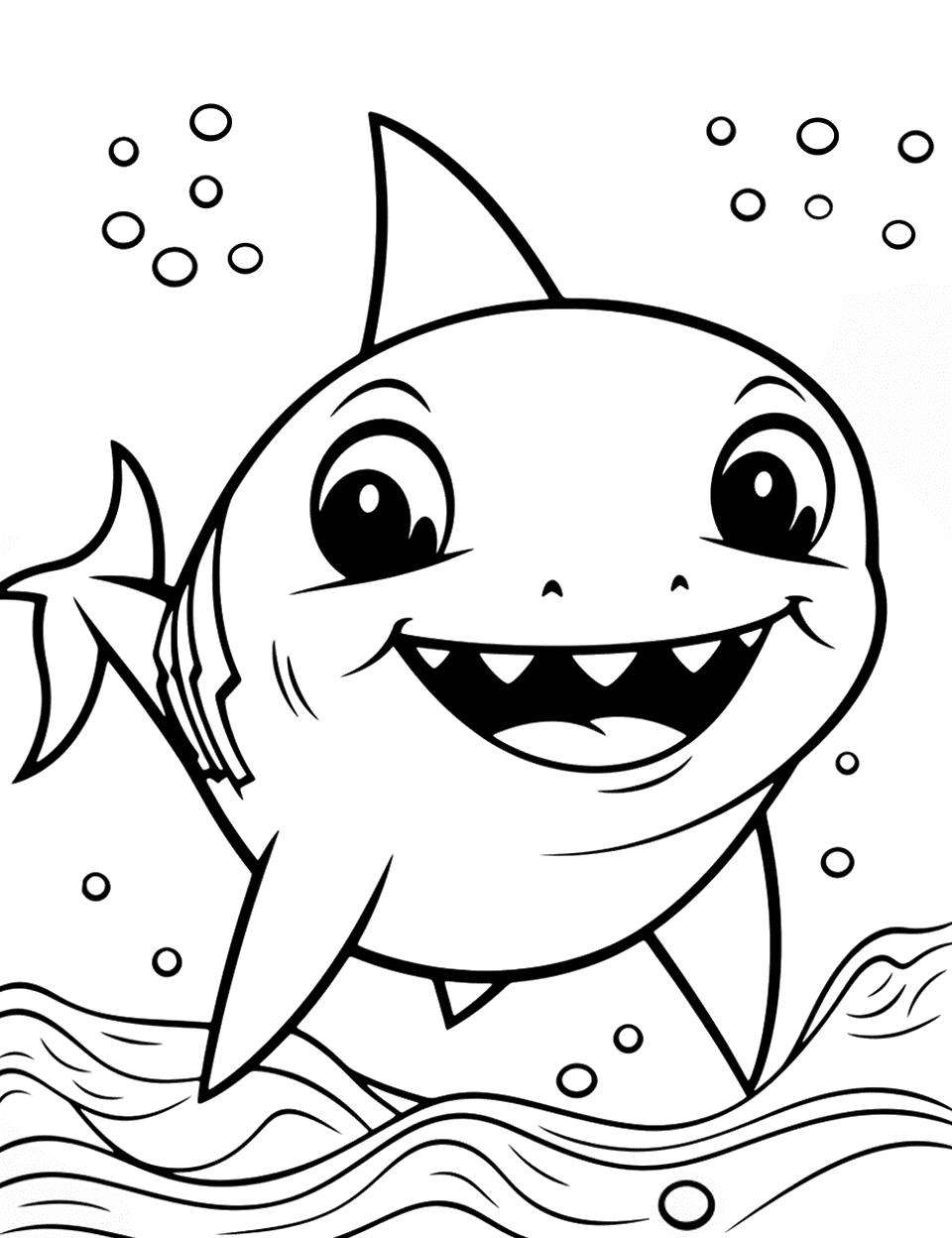
A big smiling shark fills most of this page, with a tall dorsal fin, wide eyes and a row of pointed teeth. Bubbles float in both top corners and gentle wave lines run across the bottom. The body is one large open shape, so it works for a child who is still learning to stay inside the lines. Yellow is the classic choice here, with a paler shade for the belly.
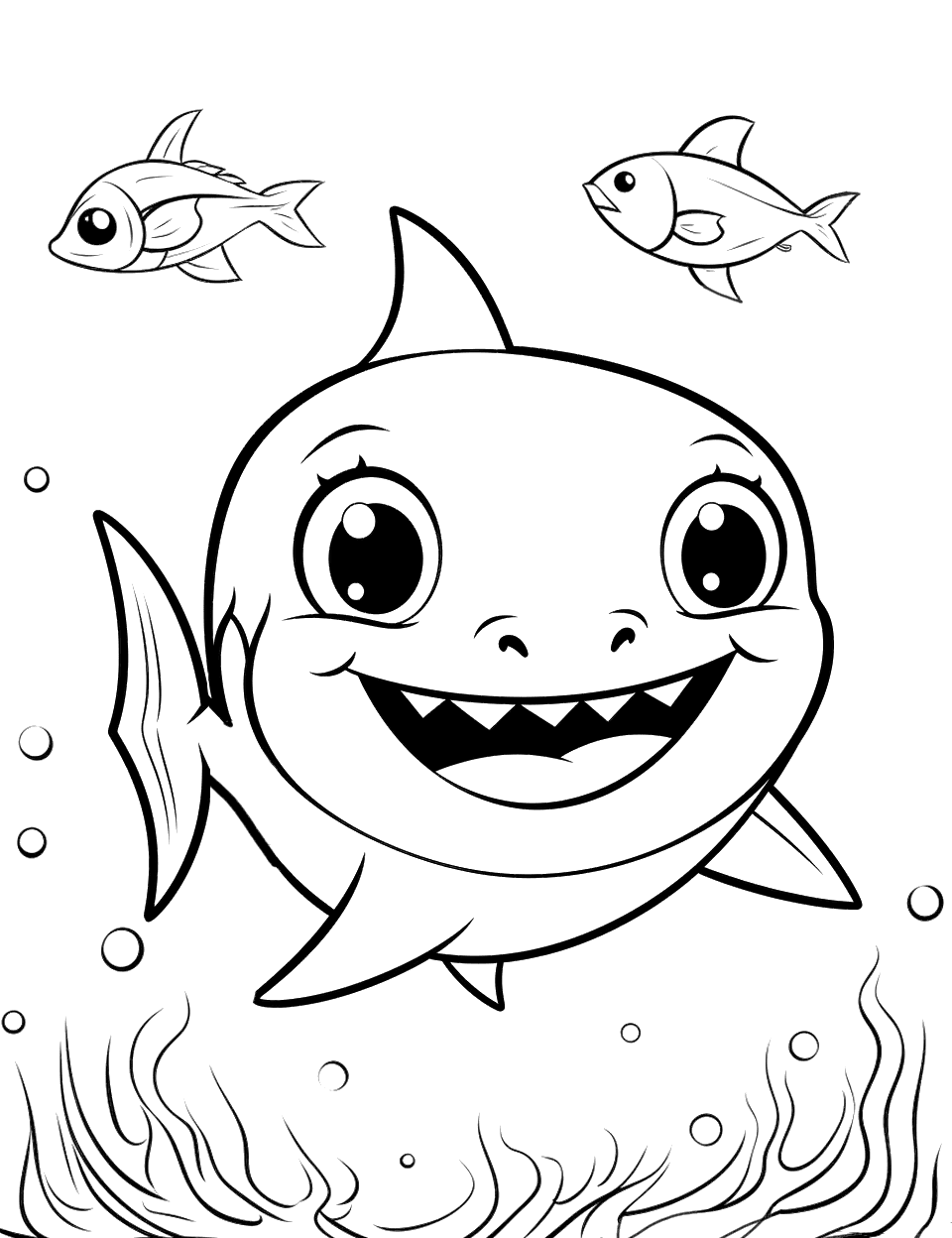
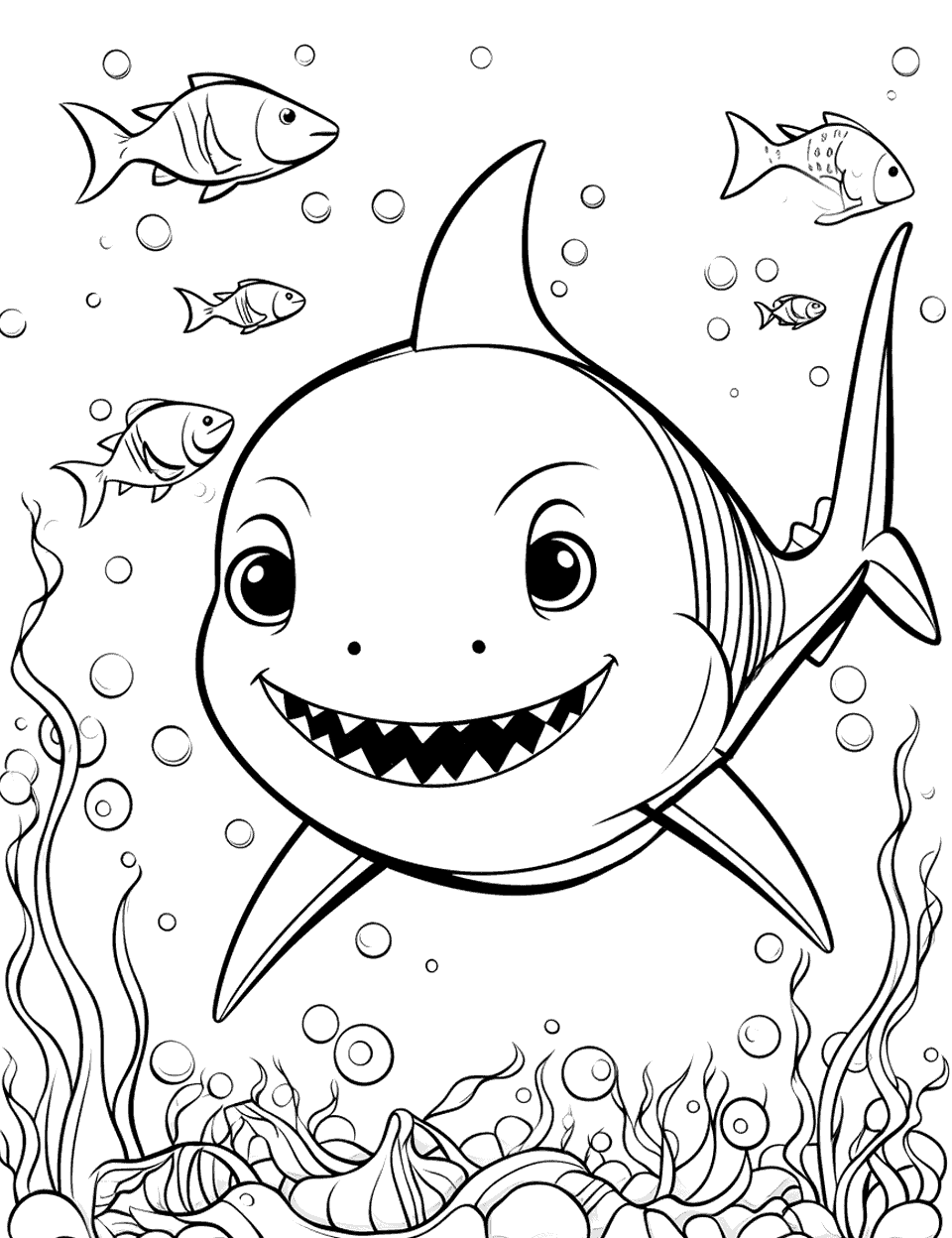
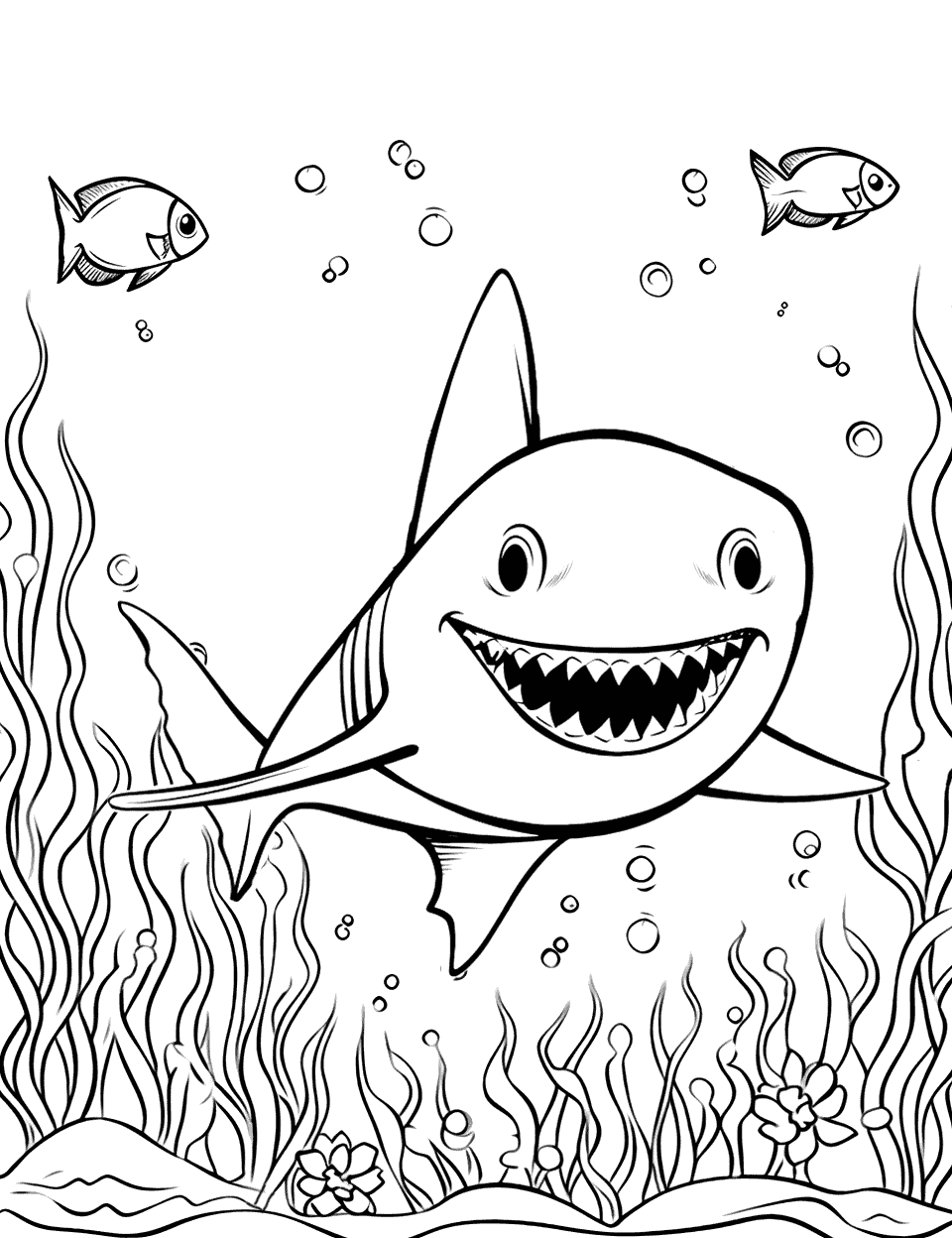
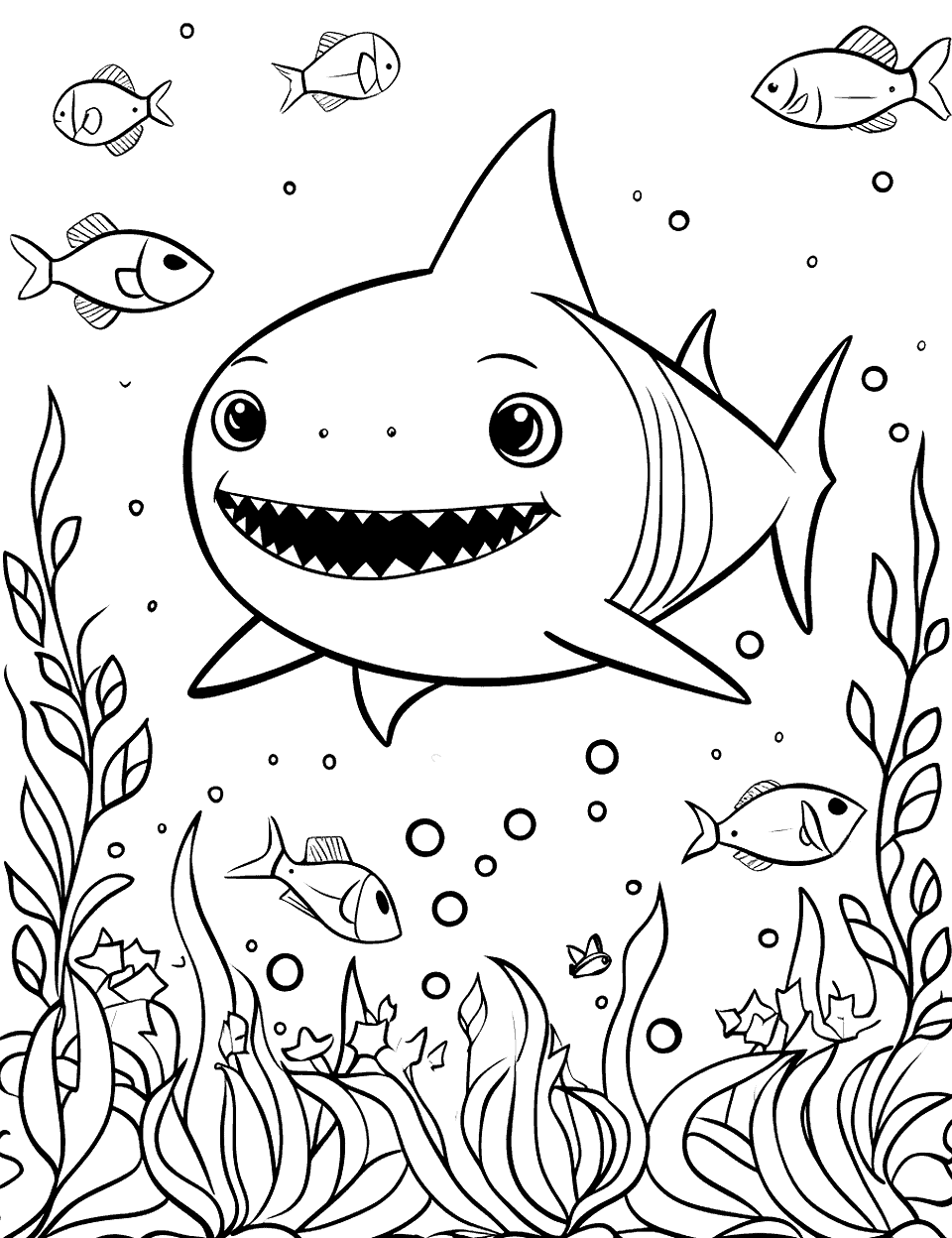
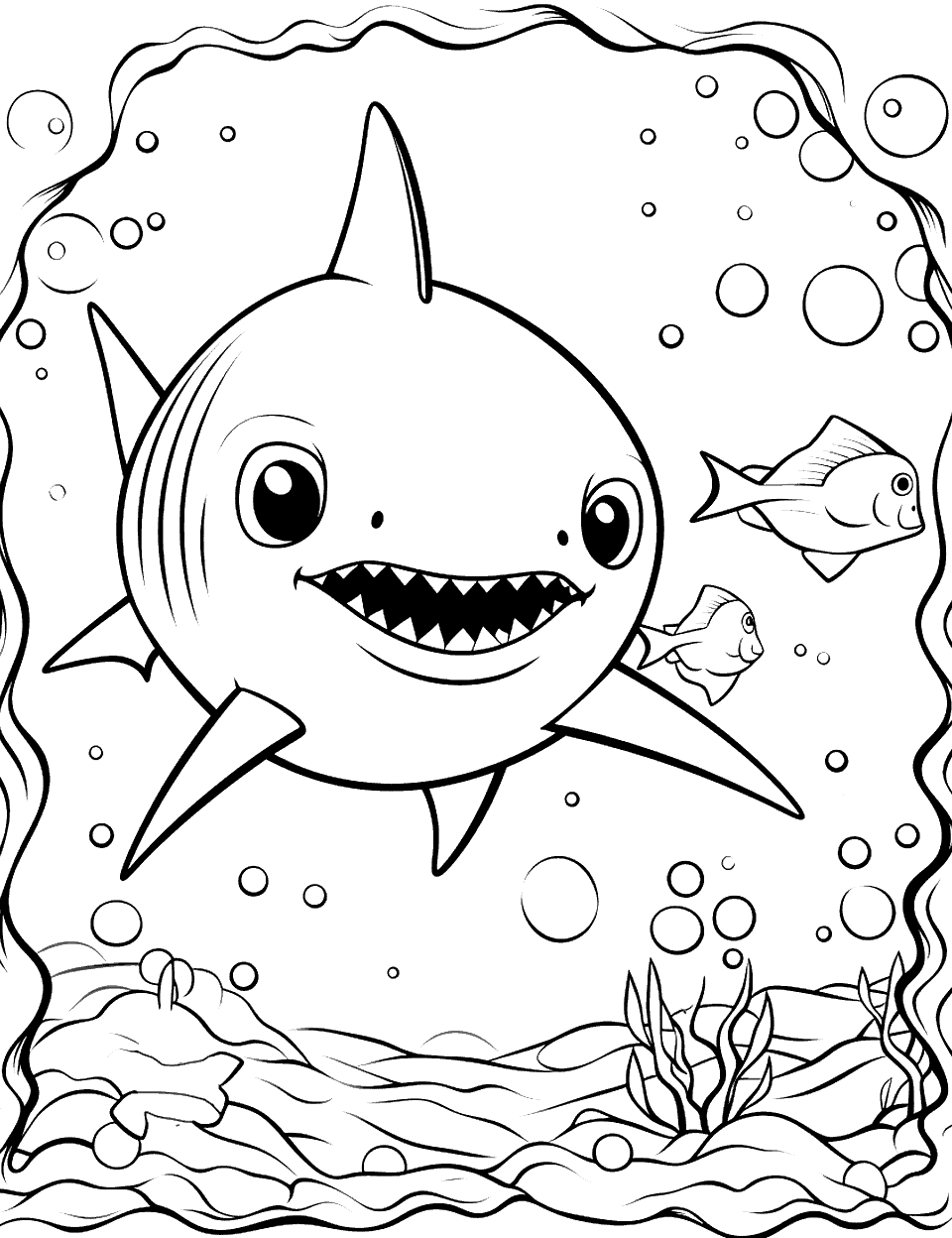
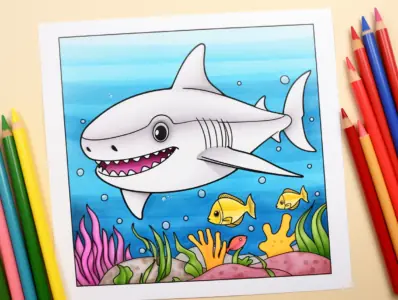
Baby Shark grins straight at you while two fish swim past above his fin. Wispy seagrass fills the bottom edge and a few bubbles drift up the left side. The two fish are simple outlines, so they are a good place to let a younger child pick any color at all. Warm colors on the fish and cooler blues in the water keep them from blending together.
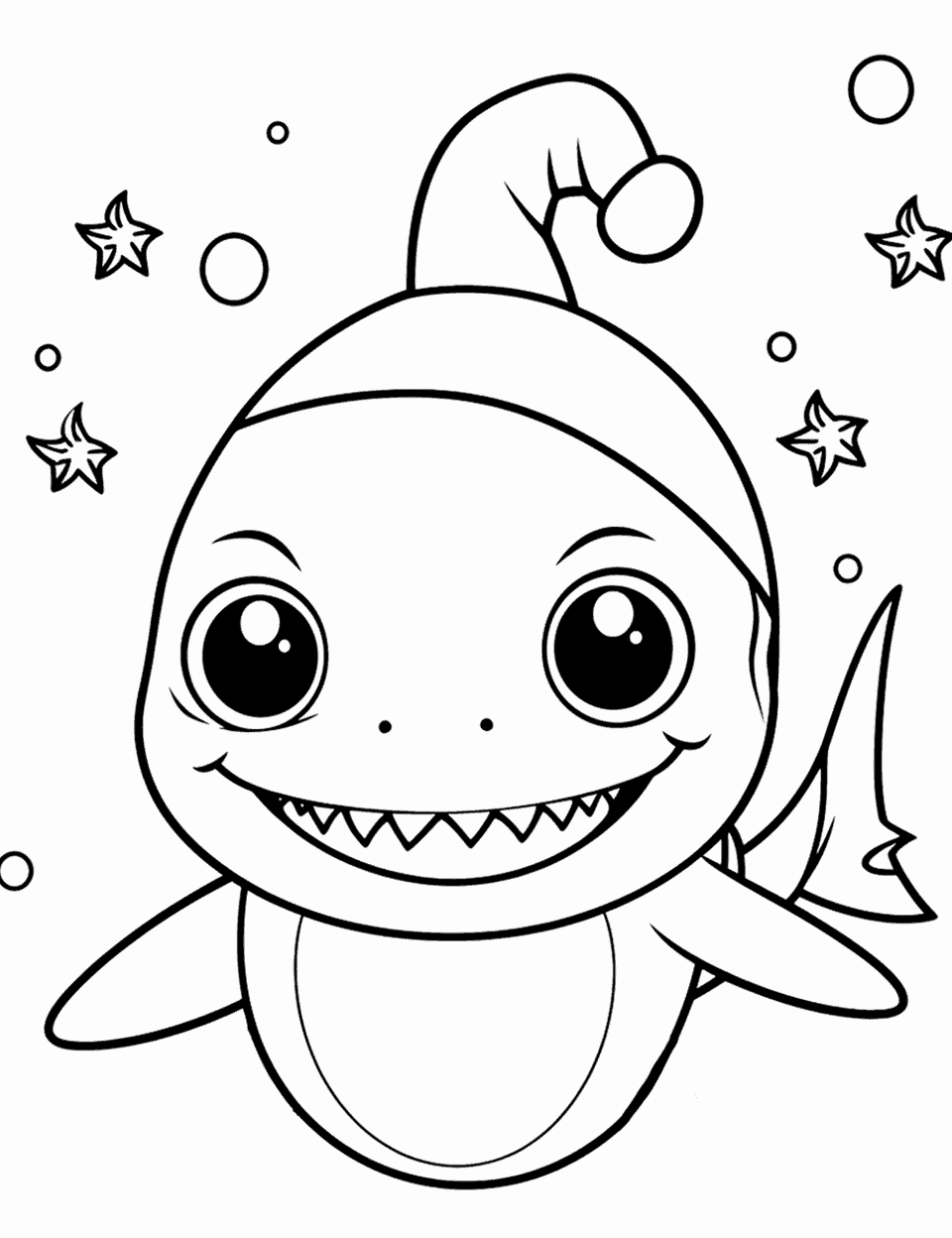
This shark wears a Santa hat with a floppy tip and a round pom-pom on the end. Starfish and a scattering of bubbles fill the space around him. Red and white for the hat is the obvious pick, and the starfish are a chance to try orange or pink. Print a few copies in December and your kids can turn them into homemade holiday cards.
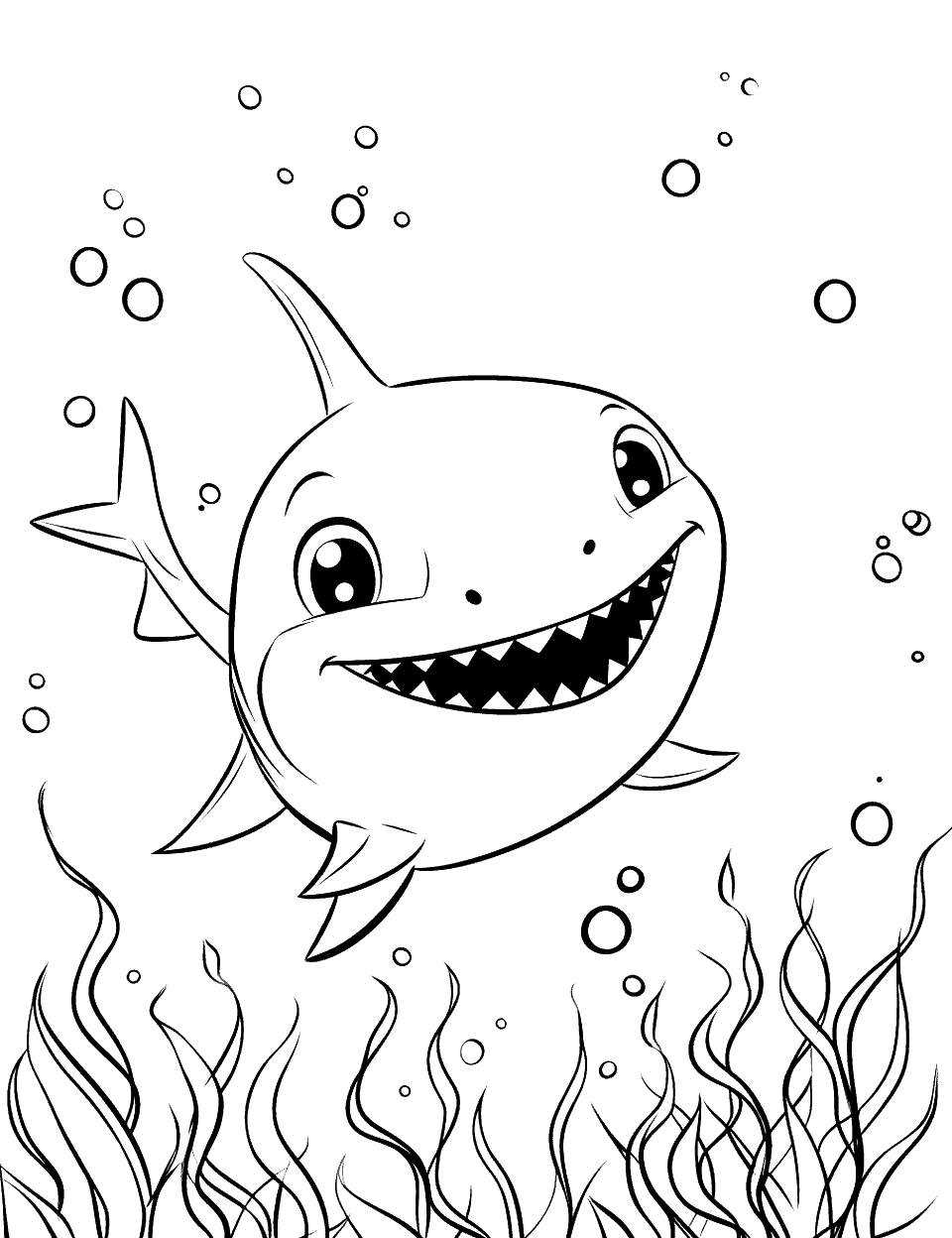
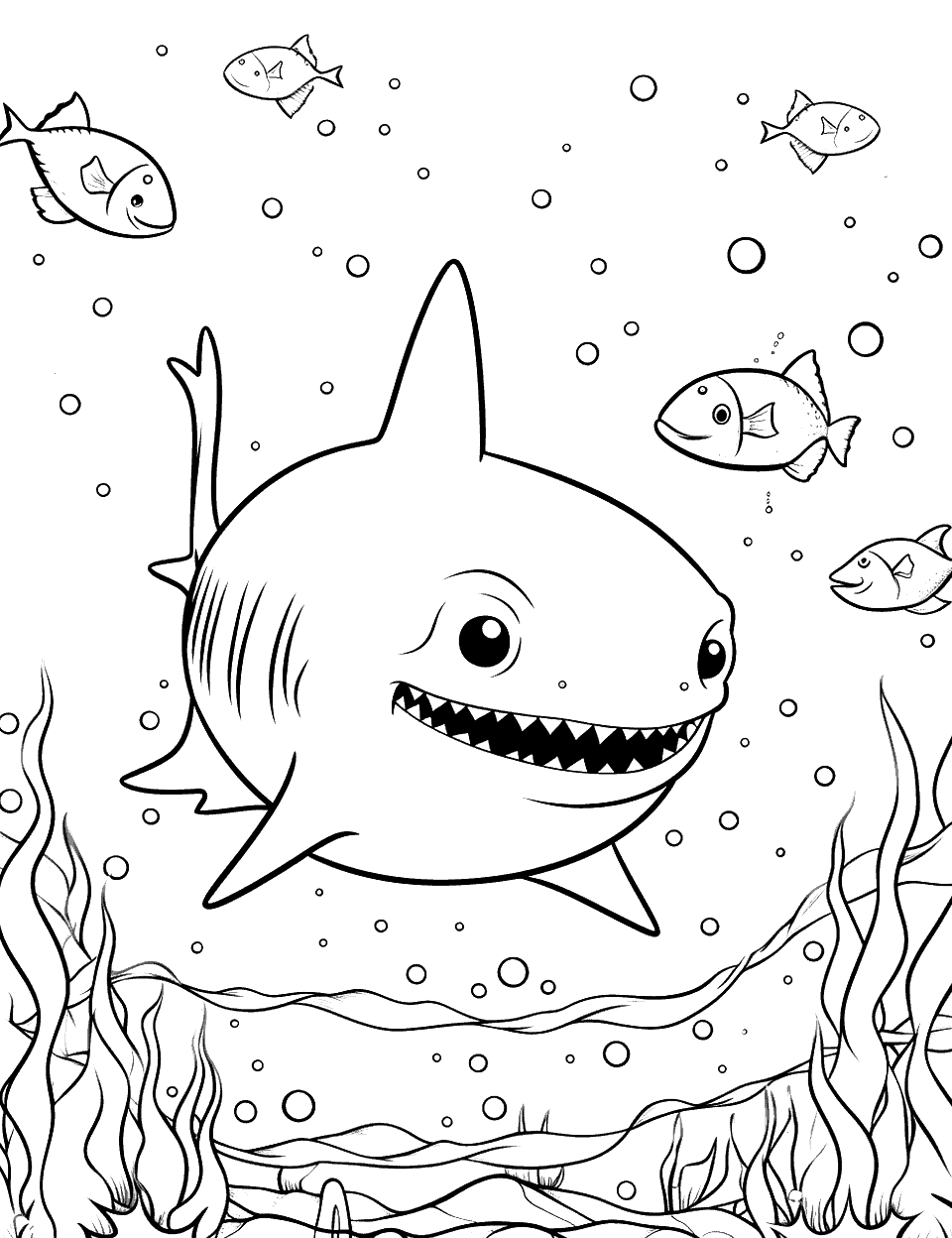
Tall strands of seaweed wave across the bottom third of this sheet while Baby Shark swims just above them. Bubbles of several sizes fill the water overhead. The seaweed is all thin curving lines, which makes it good practice for a steady hand. Two or three greens layered together give the plants some depth.
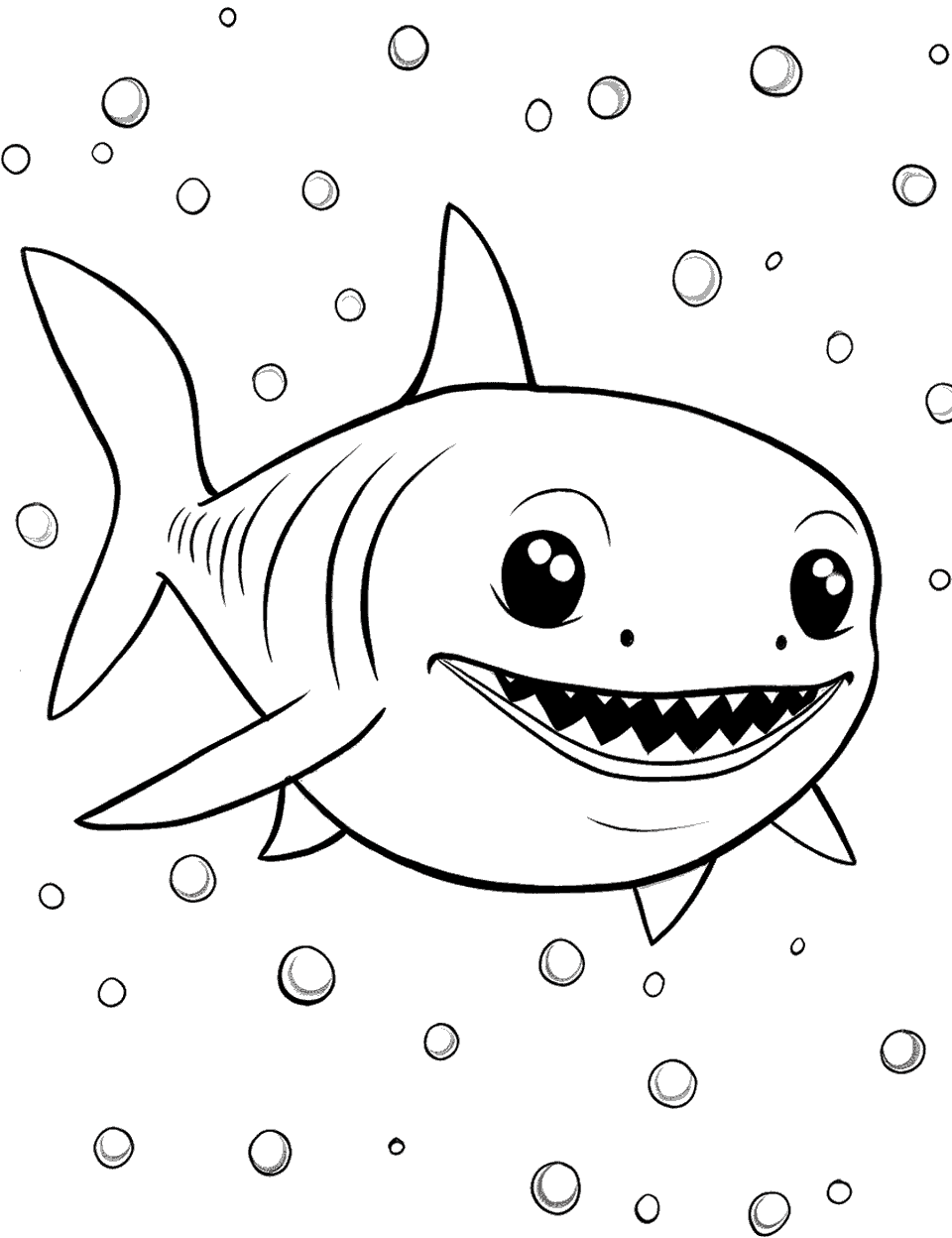
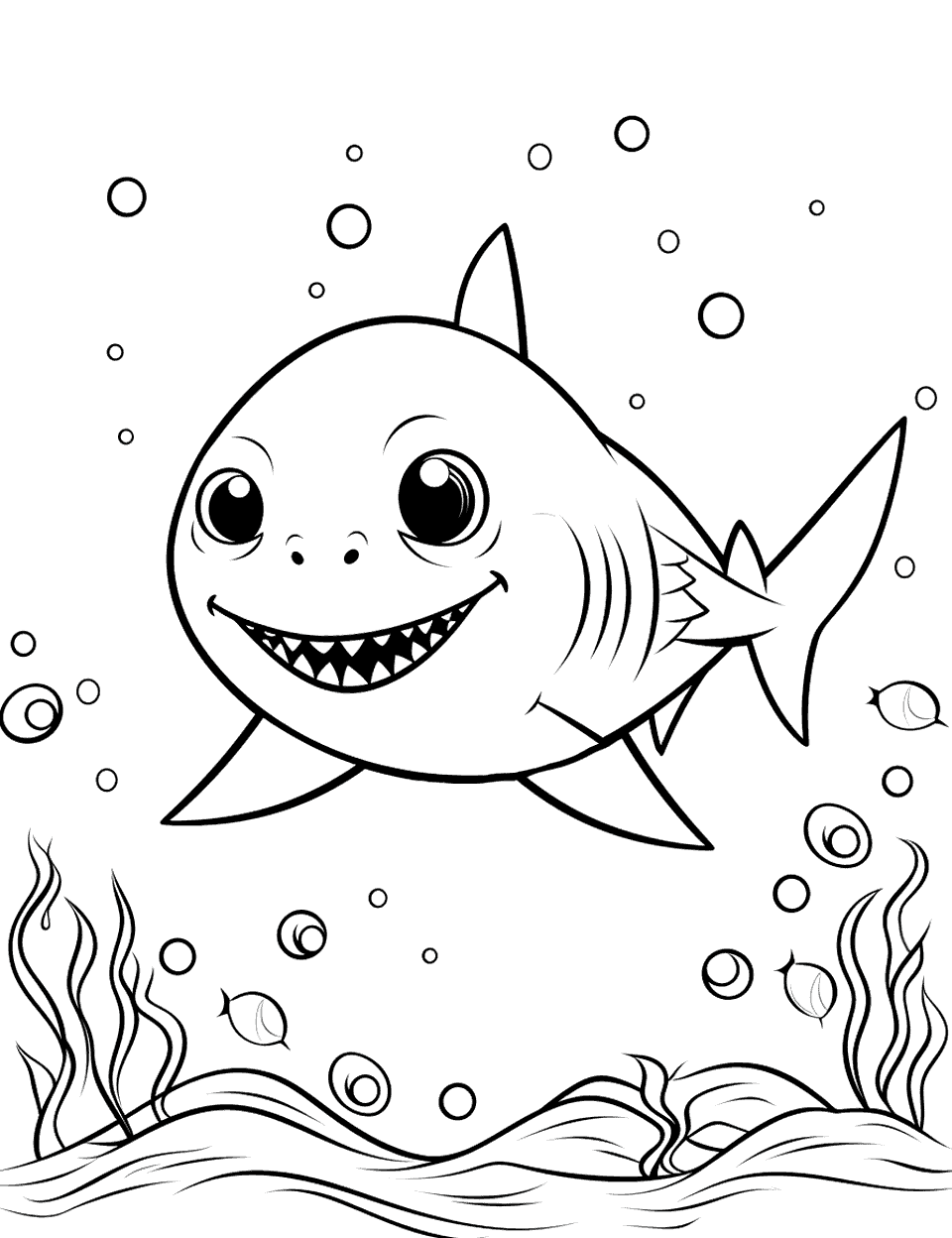
Bubbles cover this whole page, small ones and large ones, with Baby Shark swimming through the middle in profile. His grin runs almost the full width of his head. Shades of blue on the water and bubbles keep the ocean feel, though the shark himself can be any color your child likes. The bubbles fill in quickly, so this one does not take long to finish.
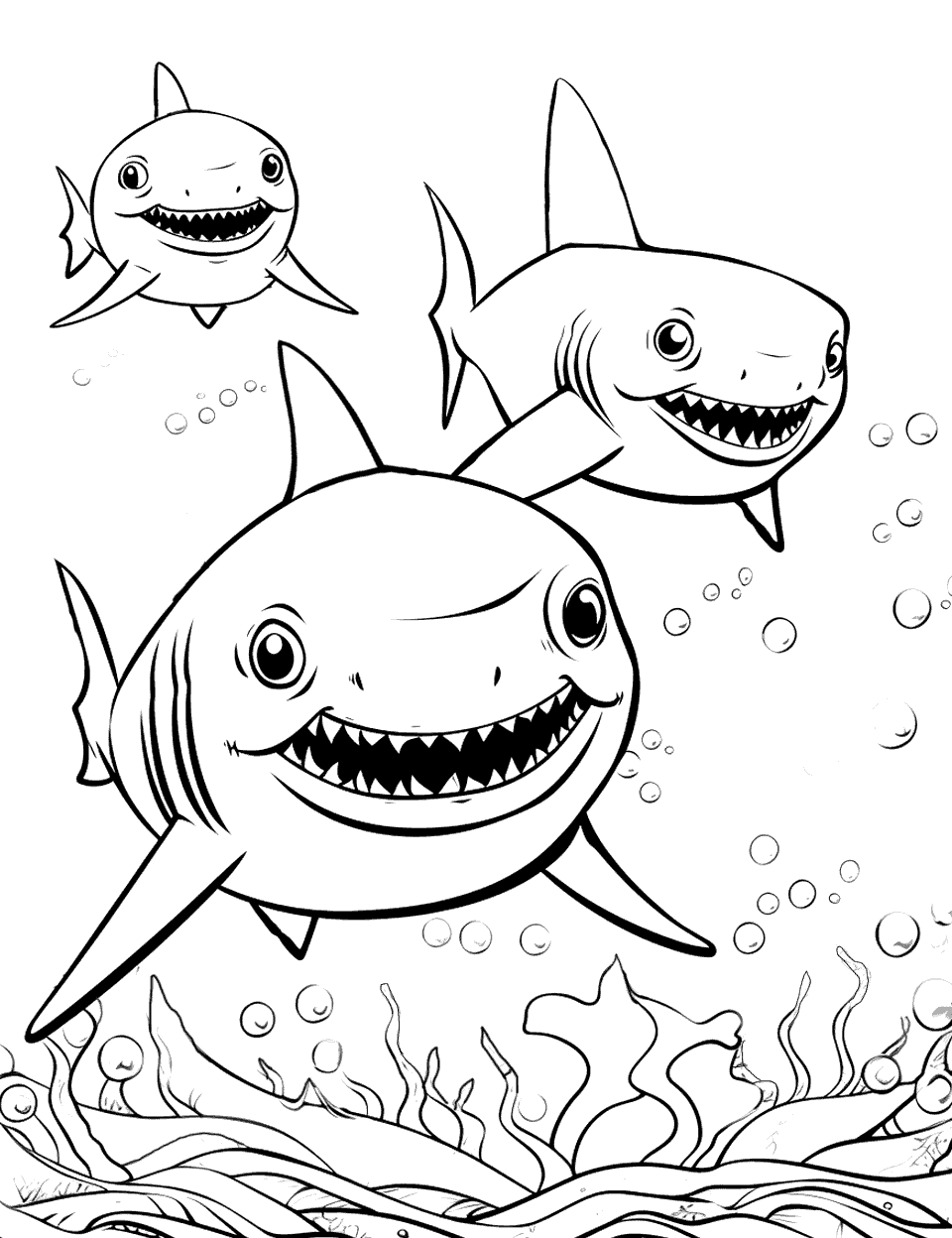
Sharks share this page: a large one in front, one swimming behind to the right, and a smaller one up in the top left corner. Bubbles rise between them and seaweed sways along the seabed. Give each shark a different color so they are easy to tell apart. The largest shark has plenty of open space if your child likes to blend or shade.
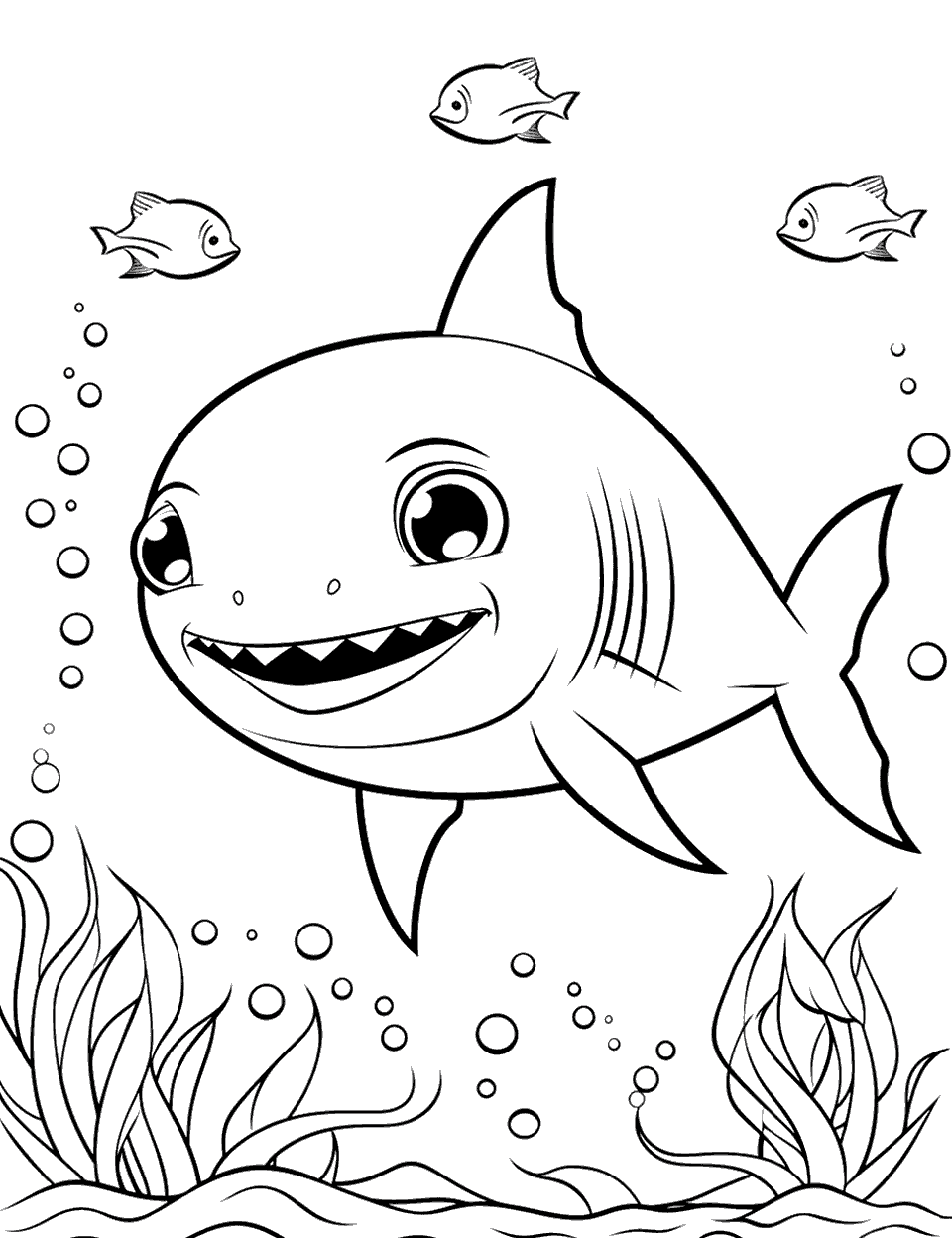
Baby Shark cruises across the middle of this sheet with small fish above him. Two streams of bubbles rise on the left and right, and seagrass fans out from the bottom corners. The fish are tiny, so they suit a fine-tip marker or a sharp pencil. Keep the background pale and the shark will stand out.
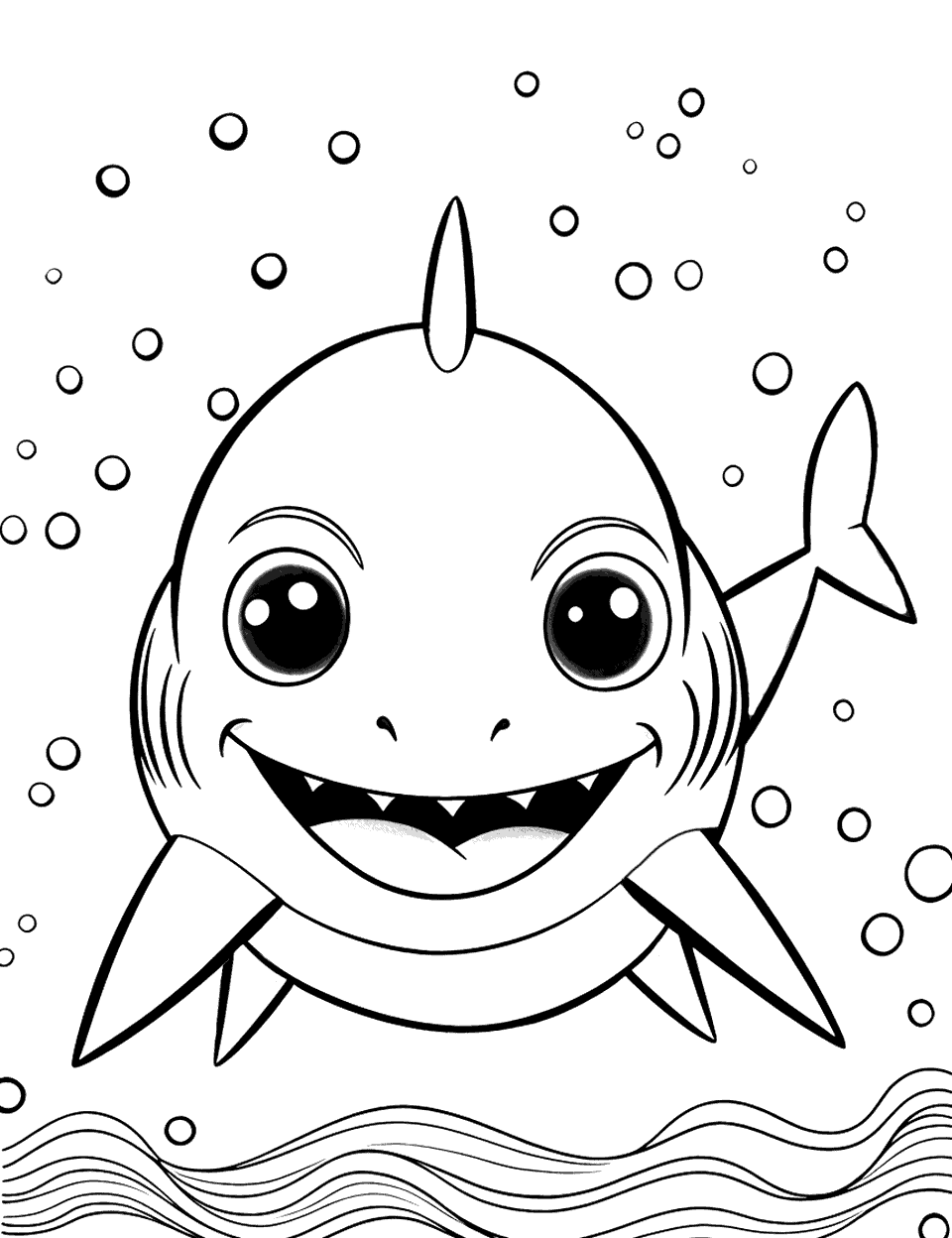
Thick, simple lines make this the easiest sheet in the set. The shark faces forward with big round eyes, a small fin on top and two side fins, and there is very little fine detail to get lost in. Bubbles float around him and a few wave lines close off the bottom, and chunky crayons make quick work of it all.
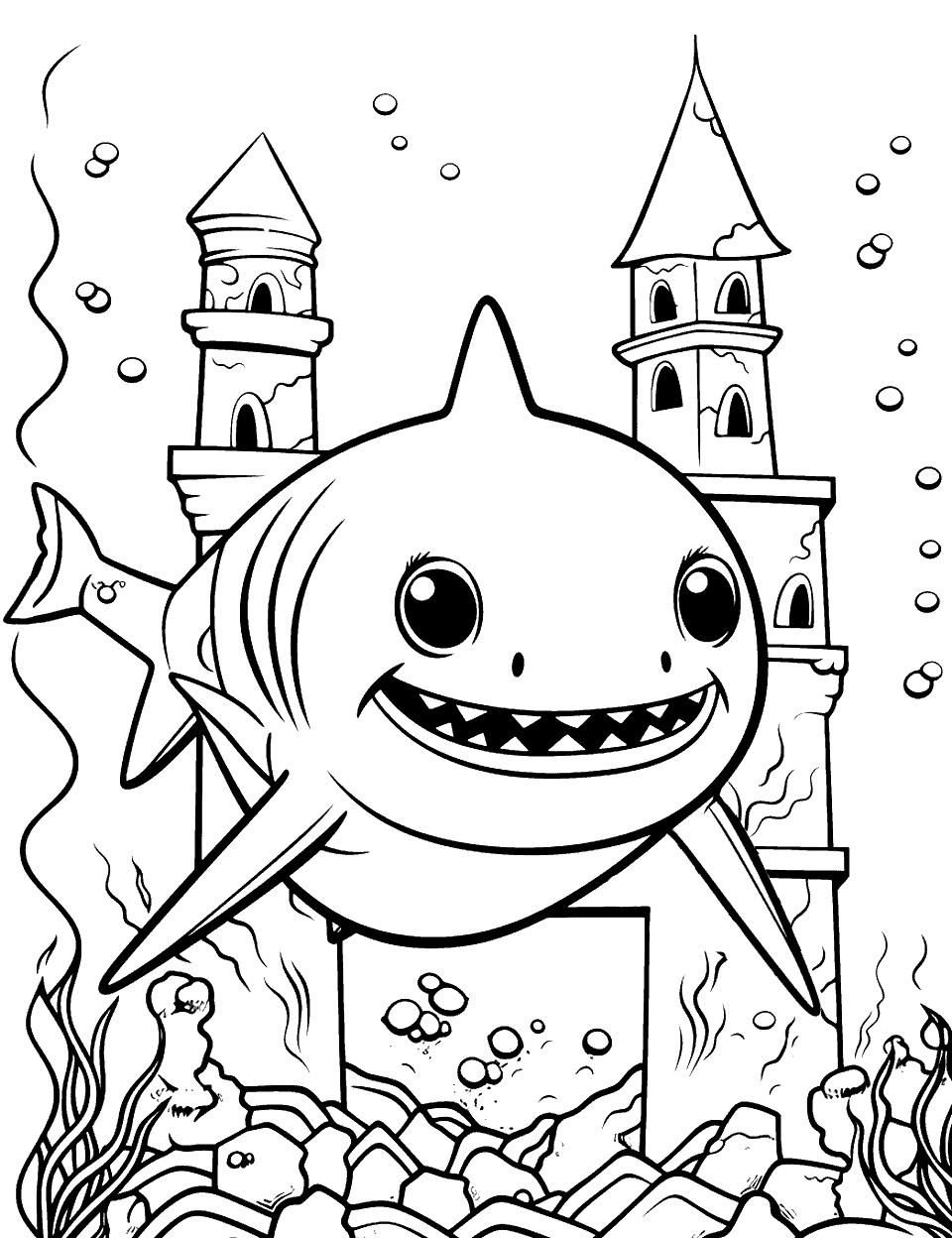
Two stone towers with pointed roofs rise behind Baby Shark, their walls cracked and their windows dark. There is a lot of small detail in the brickwork, which makes this a better fit for older kids. Rocks pile up along the seabed and long seaweed curls up the side of the page. Grays and browns suit the stonework, with a brighter color on the shark so he does not disappear into it. Colored pencils handle the cracks and windows more precisely than a thick marker.
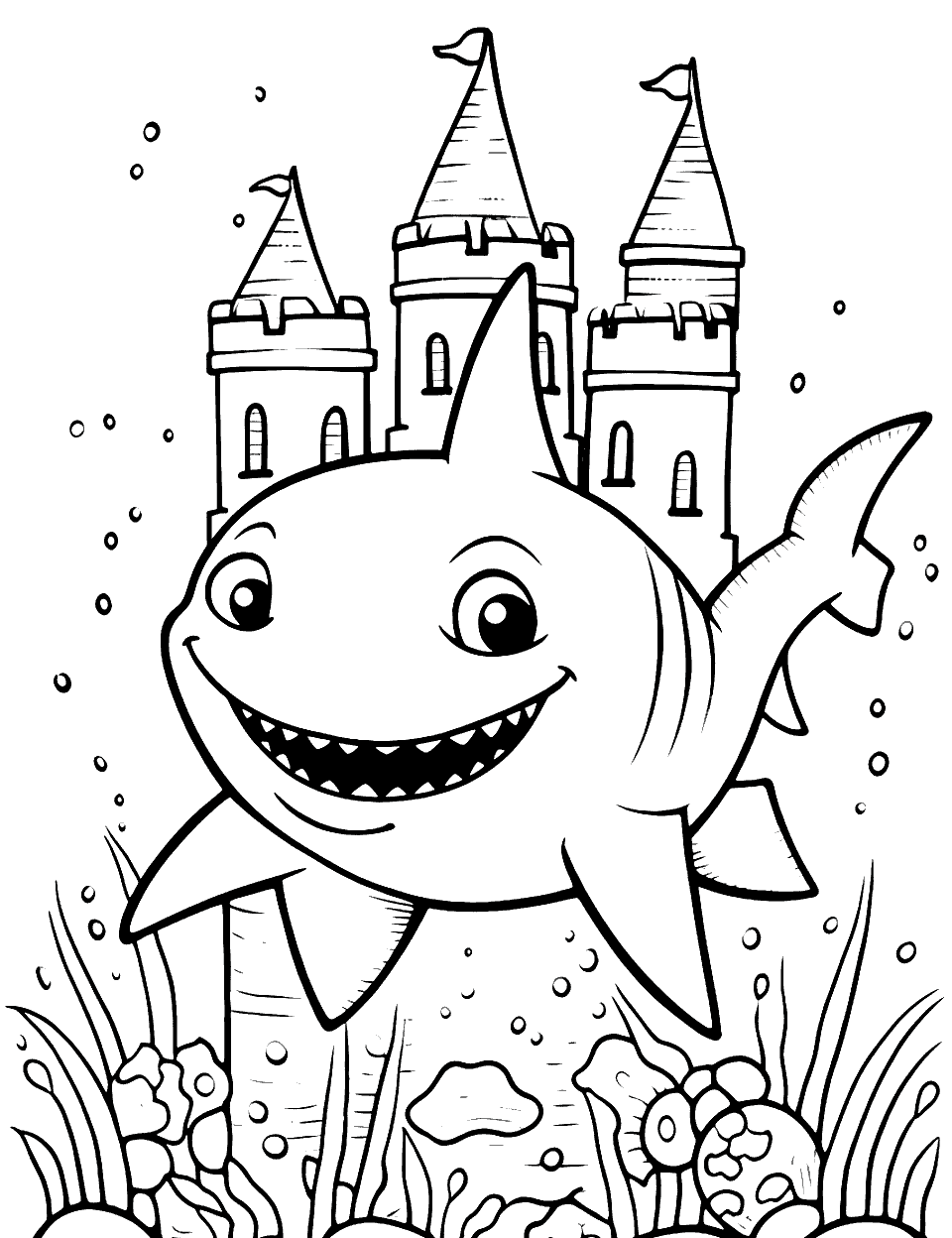
A castle with three towers stands behind the shark, each roof topped with a little flag. Narrow windows run down the towers, and round rocks and plants fill the seabed below. The flags are the smallest shapes on the page, so save your brightest color for those. Older kids can shade each tower a slightly different tone to make the castle look solid.
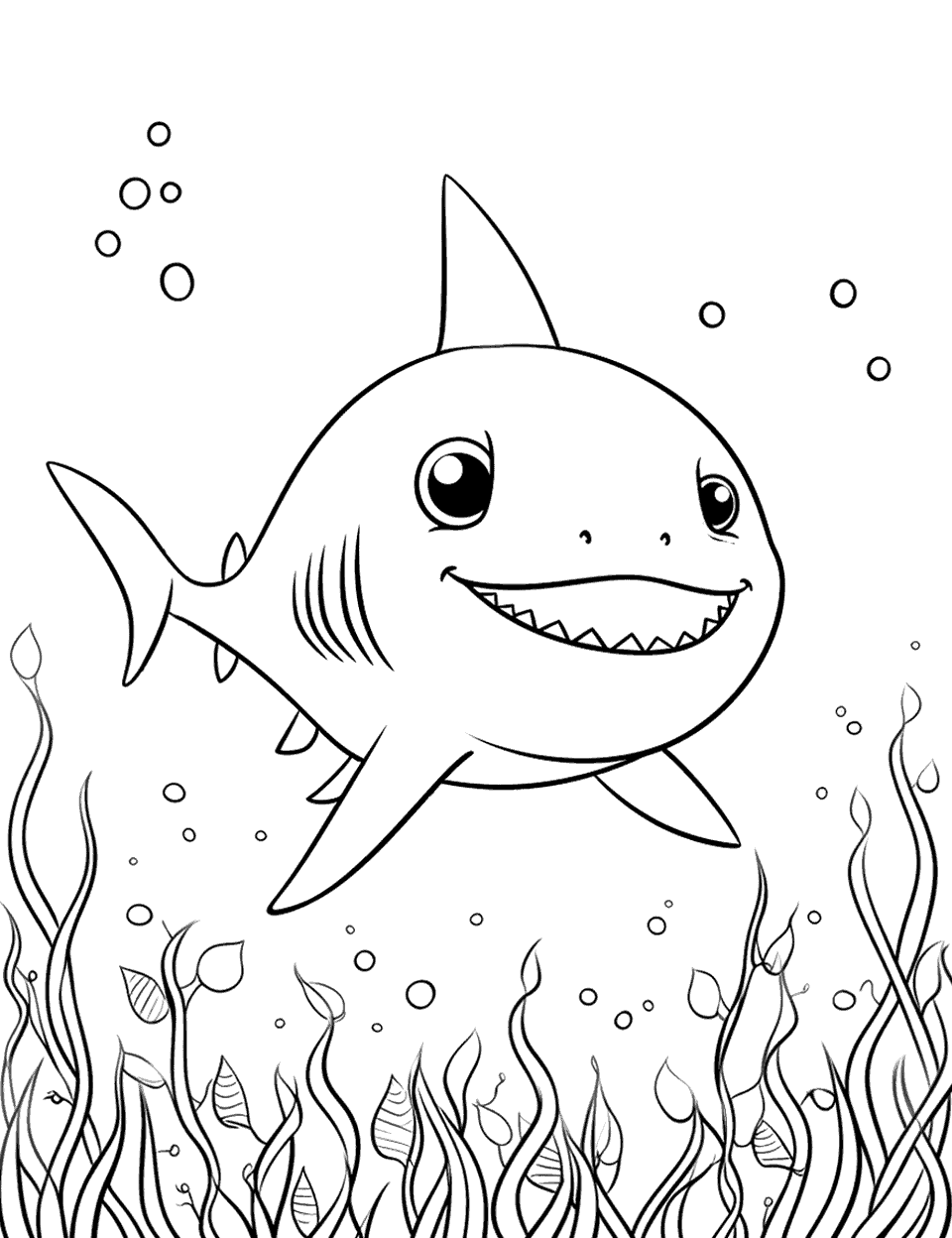
Long grass covered in small leaves fills the lower half of this page, and Baby Shark swims above it with his mouth open in a wide smile. A few bubbles drift near the top left corner. The grass rewards patience, so it is a good sheet for a child who likes to take their time. Mixing two greens keeps the field from looking flat.
A thick stand of kelp with leaf shapes and small buds runs across the bottom of this sheet. Baby Shark swims above it, and bubbles float in both top corners. This is one of the busier pages in the collection, so it suits school-age kids more than toddlers. Colored pencils give more control than markers in the narrow gaps between the stalks.
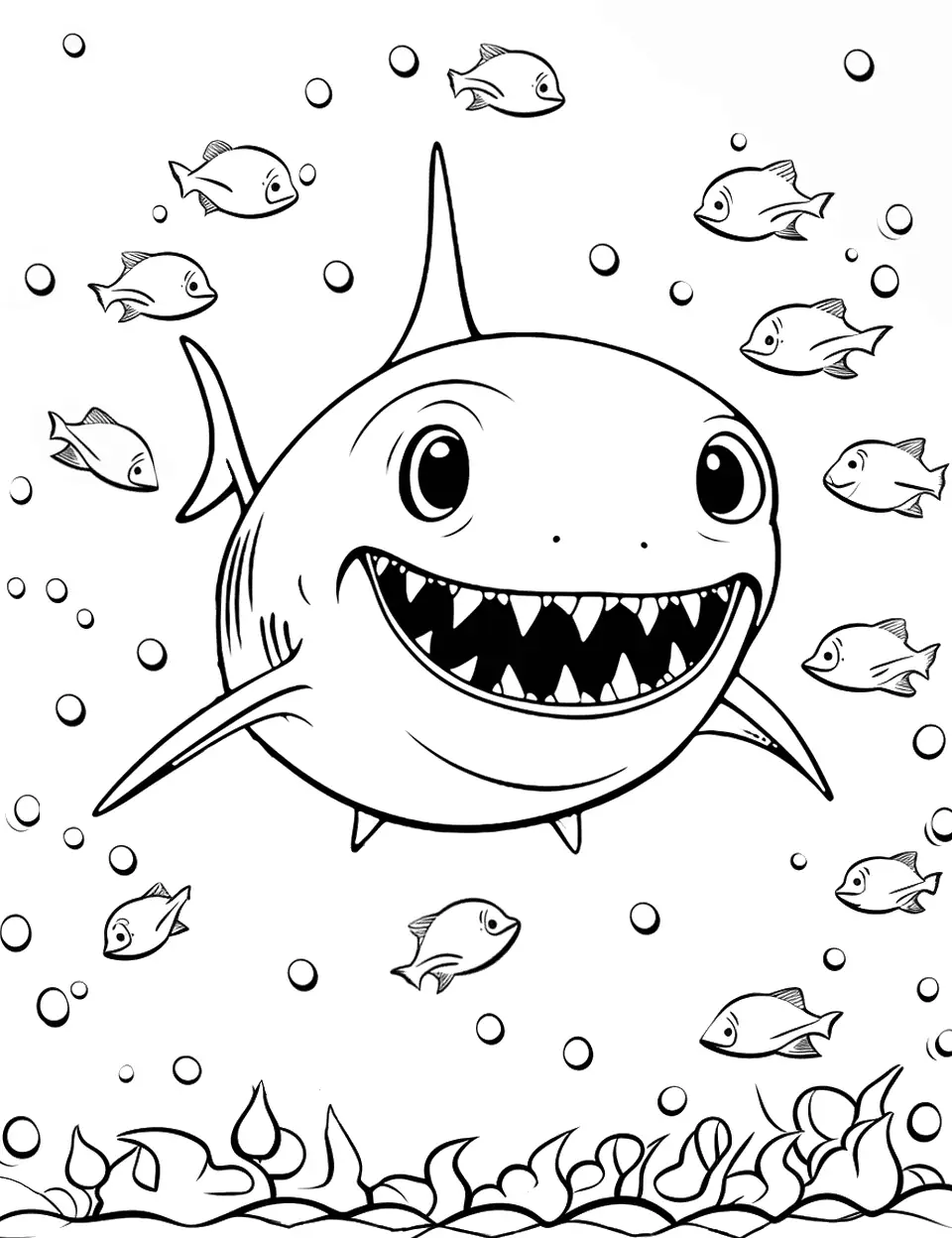
This cute round-bodied shark takes the center of the page, with a school of small fish circling him. Bubbles float between them and a row of coral runs along the very bottom. Every fish is drawn plainly, so this is an easy one to hand a child who wants to color a whole ocean. Try a different color for each fish and keep the water one soft shade.
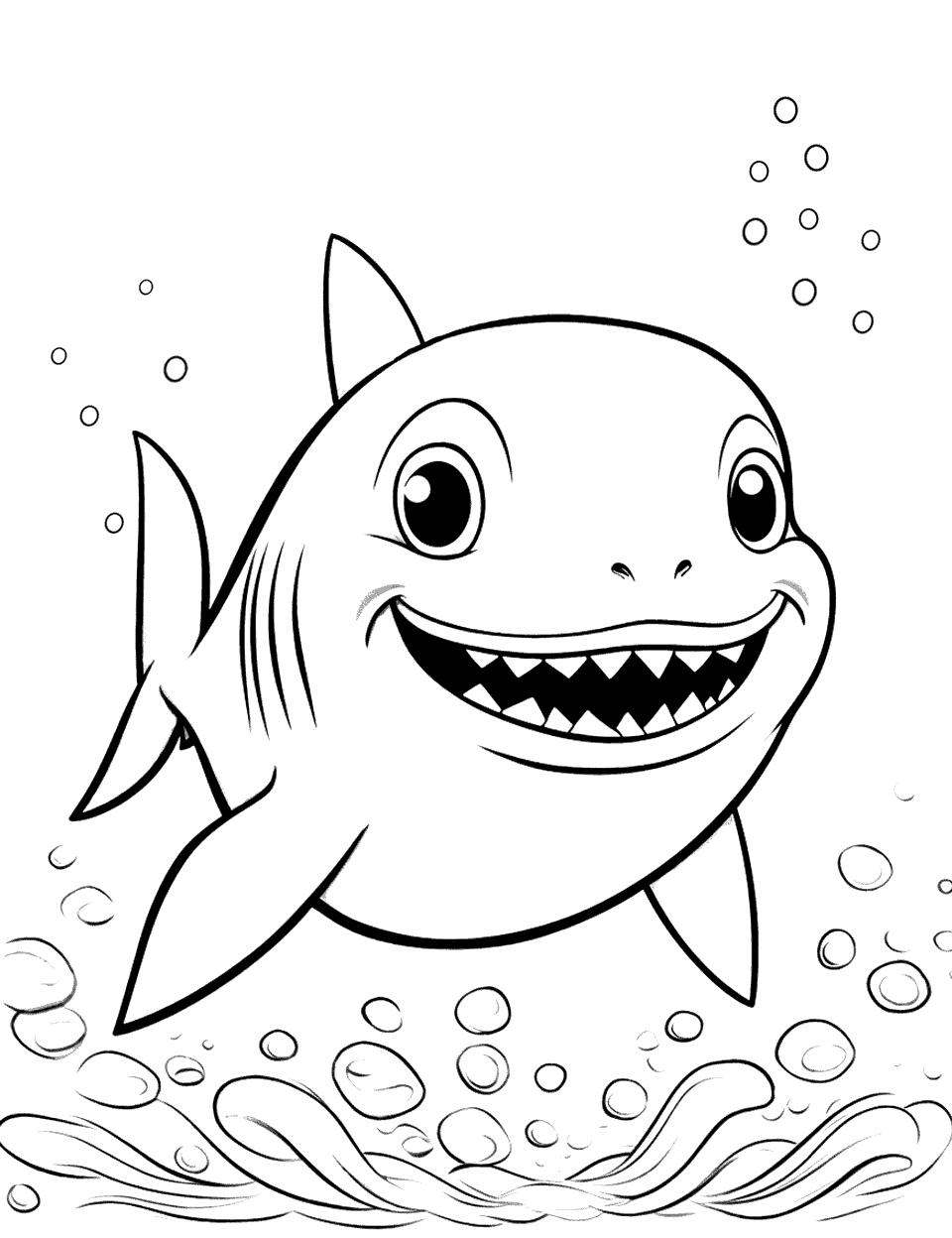
The grin is the star of this sheet: a wide open mouth full of triangular teeth takes up most of the shark’s face. Bubbles cluster in the top right corner and foamy water rolls along the bottom edge. The body is one big open shape, so it is forgiving for small hands, and a darker outline around the mouth already makes the smile stand out.
Baby Shark looks straight out at you from the middle of a busy reef scene. There is a lot to fill in here, so save it for a longer sitting or a rainy afternoon. Fish swim in the upper corners, seaweed climbs both sides, and shells and coral crowd the seabed. Deep blues and greens in the background make the shark’s own color stand out against the reef. Working from the background forward keeps the colors from running into each other.
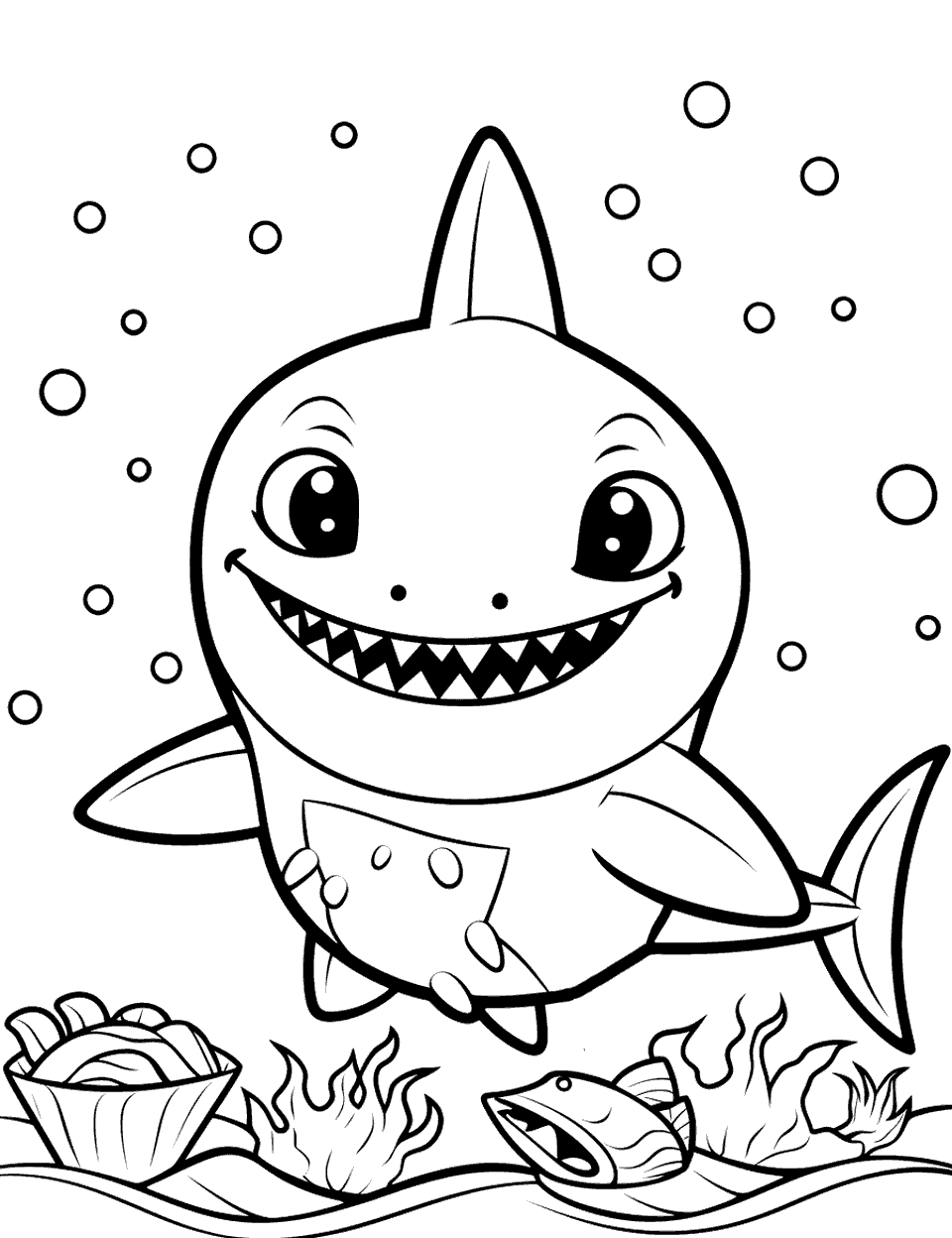
Baby Shark holds a wedge of watermelon in his fins, seeds and all. Bubbles drift around him, and the seabed below has coral, a cup-shaped plant and a small fish. Red and green on the watermelon give the page an instant focal point. It is a fun one to color before a beach day or a summer party.
Tall kelp frames both sides of this page while the shark swims through the middle with a wide toothy smile. One fish hovers in the top left, another in the top right, and small flowers dot the sand below. The kelp strands are long and thin, so this sheet suits a child who has grown out of chunky crayons. Warm colors on the flowers break up all that green.
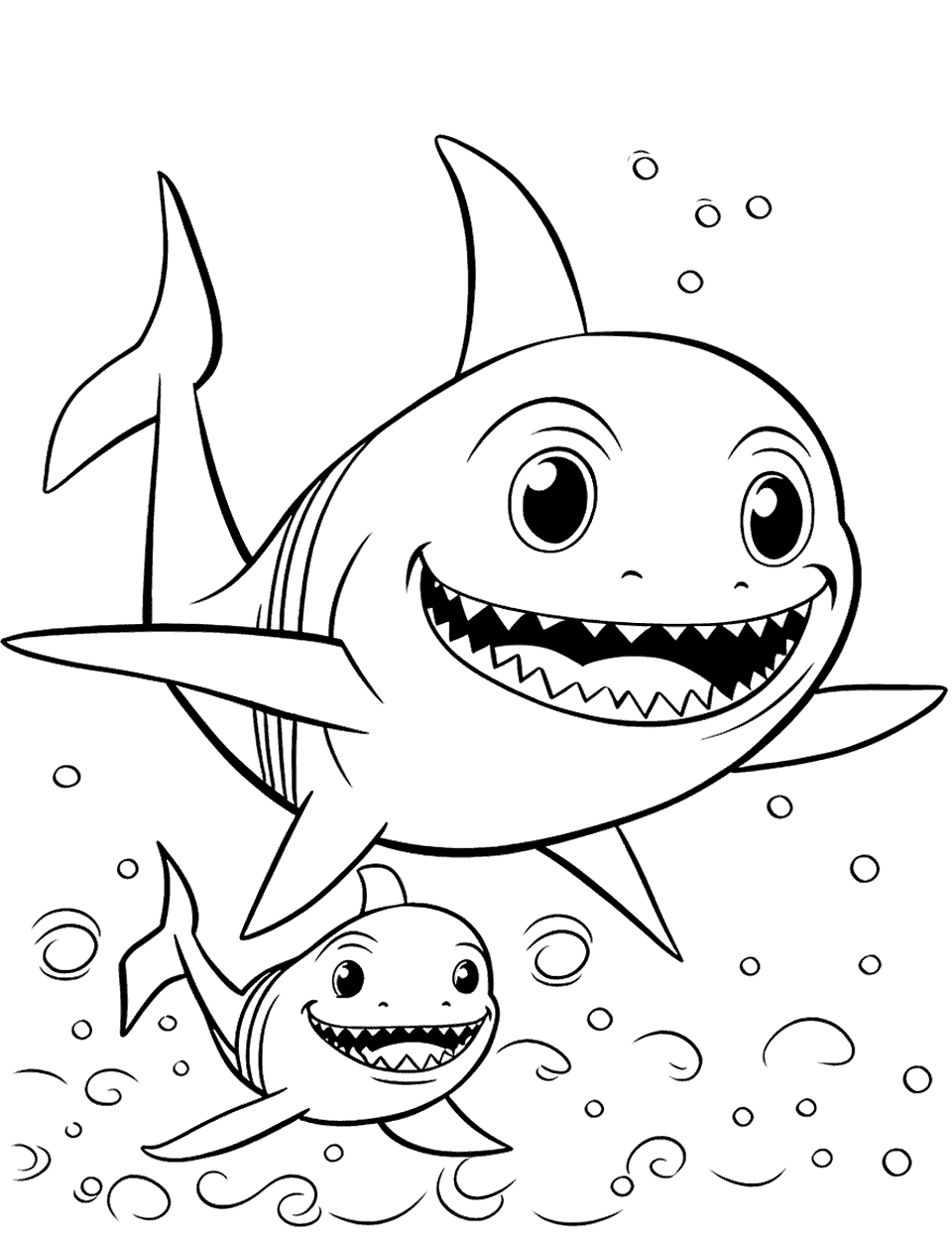
Two sharks swim together here, a big one above and a smaller one tucked below. Curls and swirls of water fill the lower half of the page instead of a seabed. That makes it an easy sheet to share, with one shark for each of two kids. Matching colors on both sharks make them look like family.
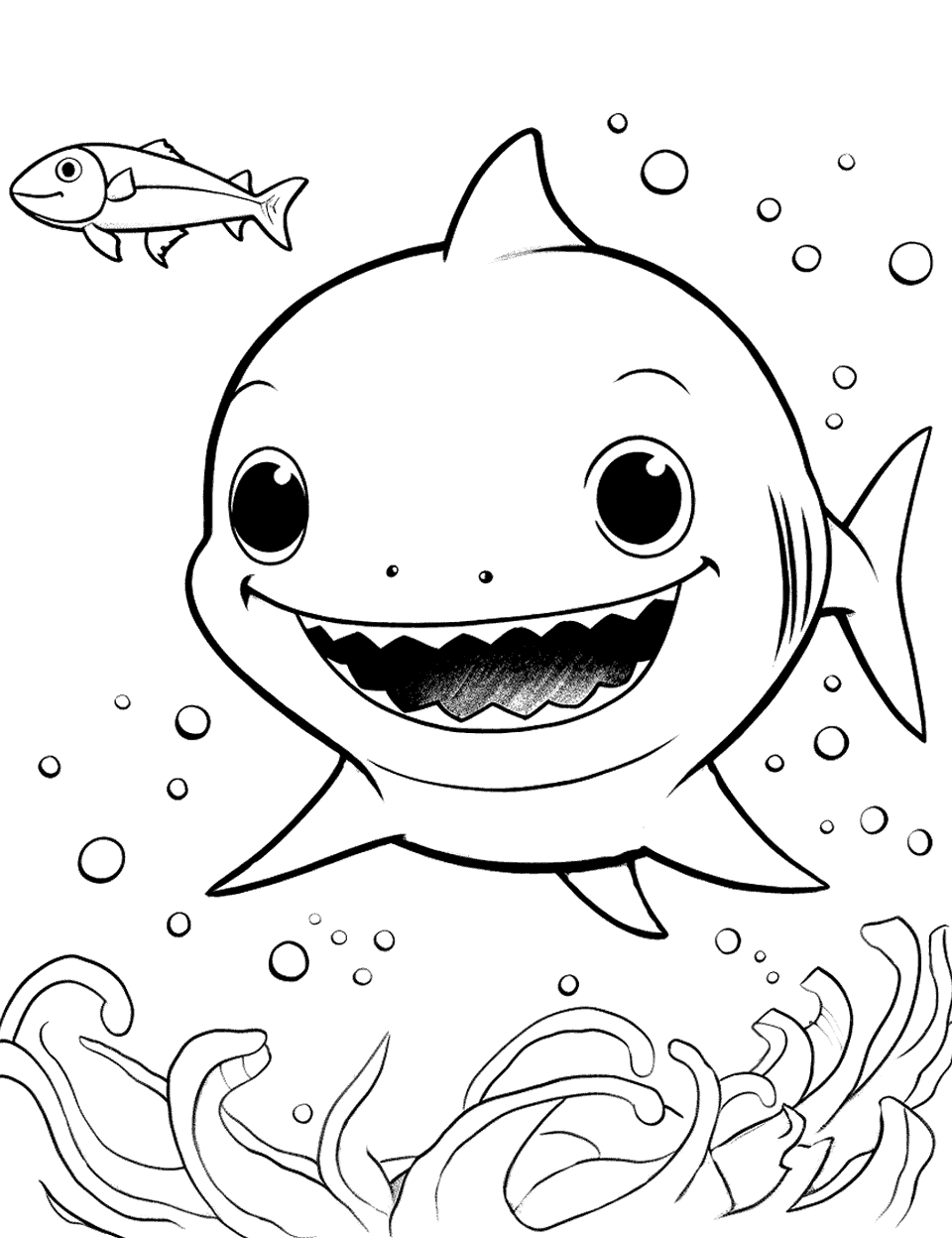
One fish swims into the top left corner while Baby Shark grins from the center of the page. Bubbles fill the space between them and curling seaweed runs along the bottom. Give that single fish a bold color so the meeting reads clearly. The shark’s open mouth is already dark in the outline, so it barely needs any color at all.
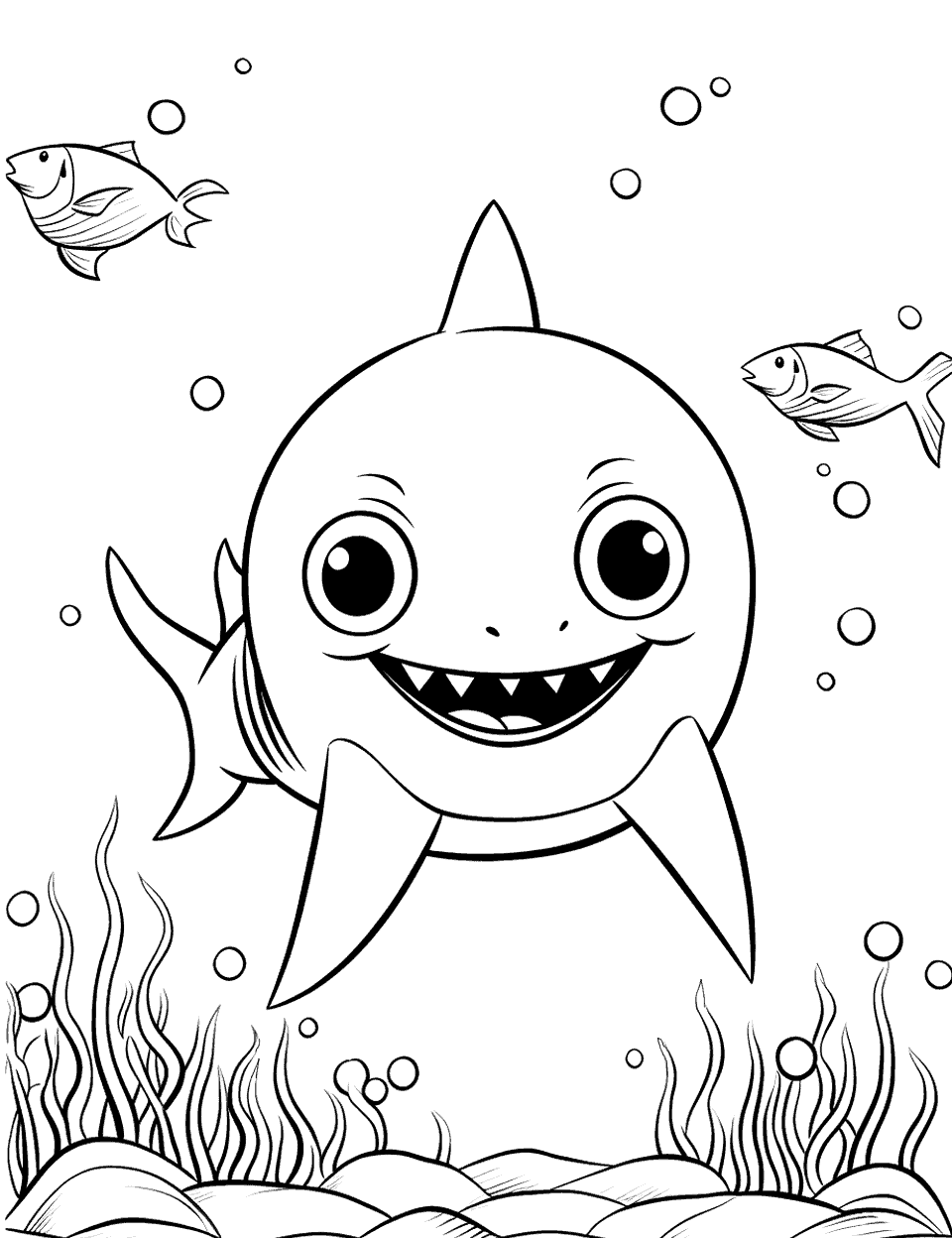
Two fish keep Baby Shark company on this page, one in the top left and one over on the right. His teeth are small triangles rather than a jagged grin, which makes him one of the friendlier looking sharks in the set. Rounded rocks and short grass line the seabed underneath. Softer colors suit this one: pale blue water over a sandy floor.
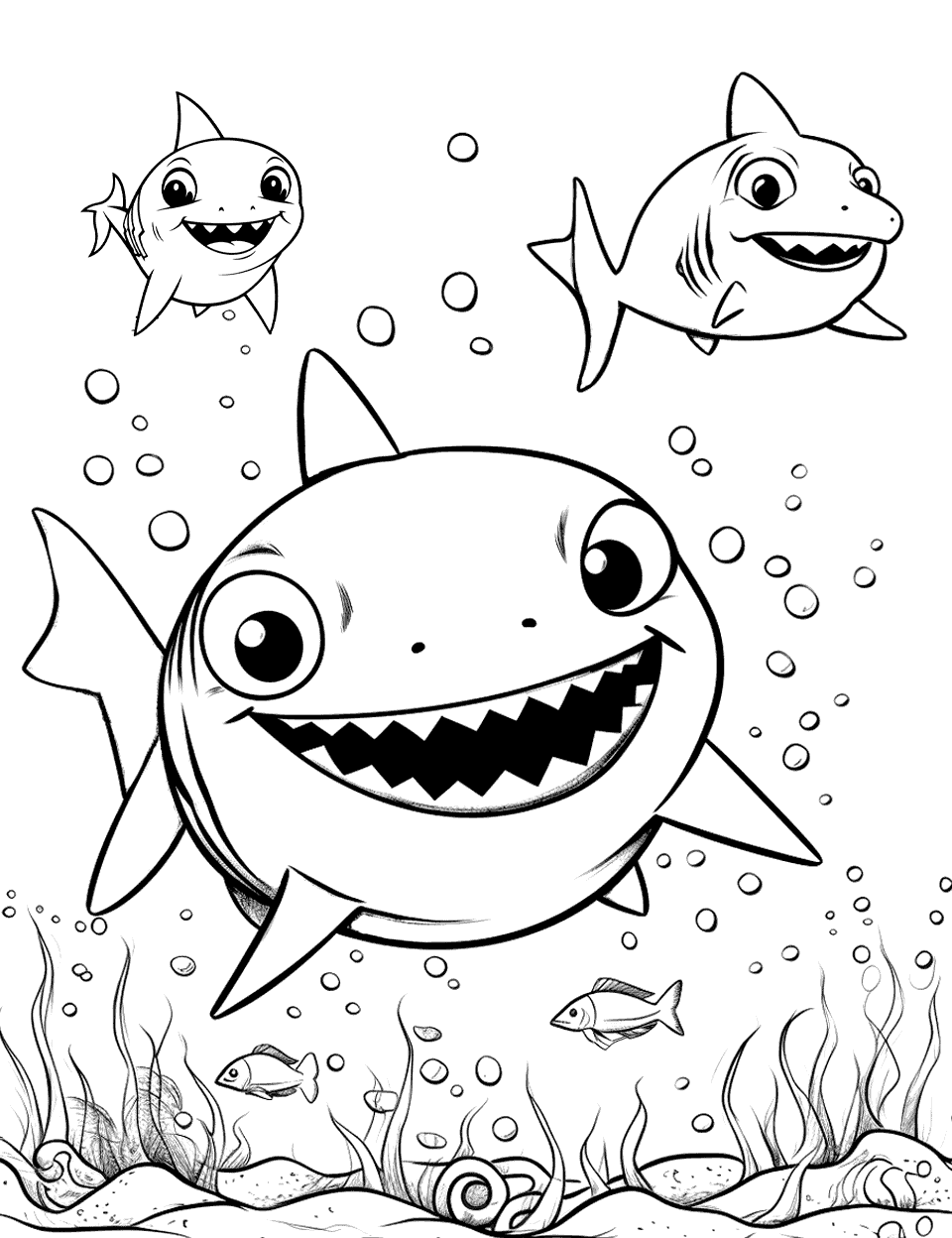
Sharks swim across this page: a small one in the top left, another in the top right, and the biggest one front and center with a zigzag grin. Two little fish poke around the seabed below, where grass and pebbles fill the bottom edge. Coloring the sharks in three shades of one color keeps them looking related. The bubbles are simple circles, so a younger sibling can help with those.
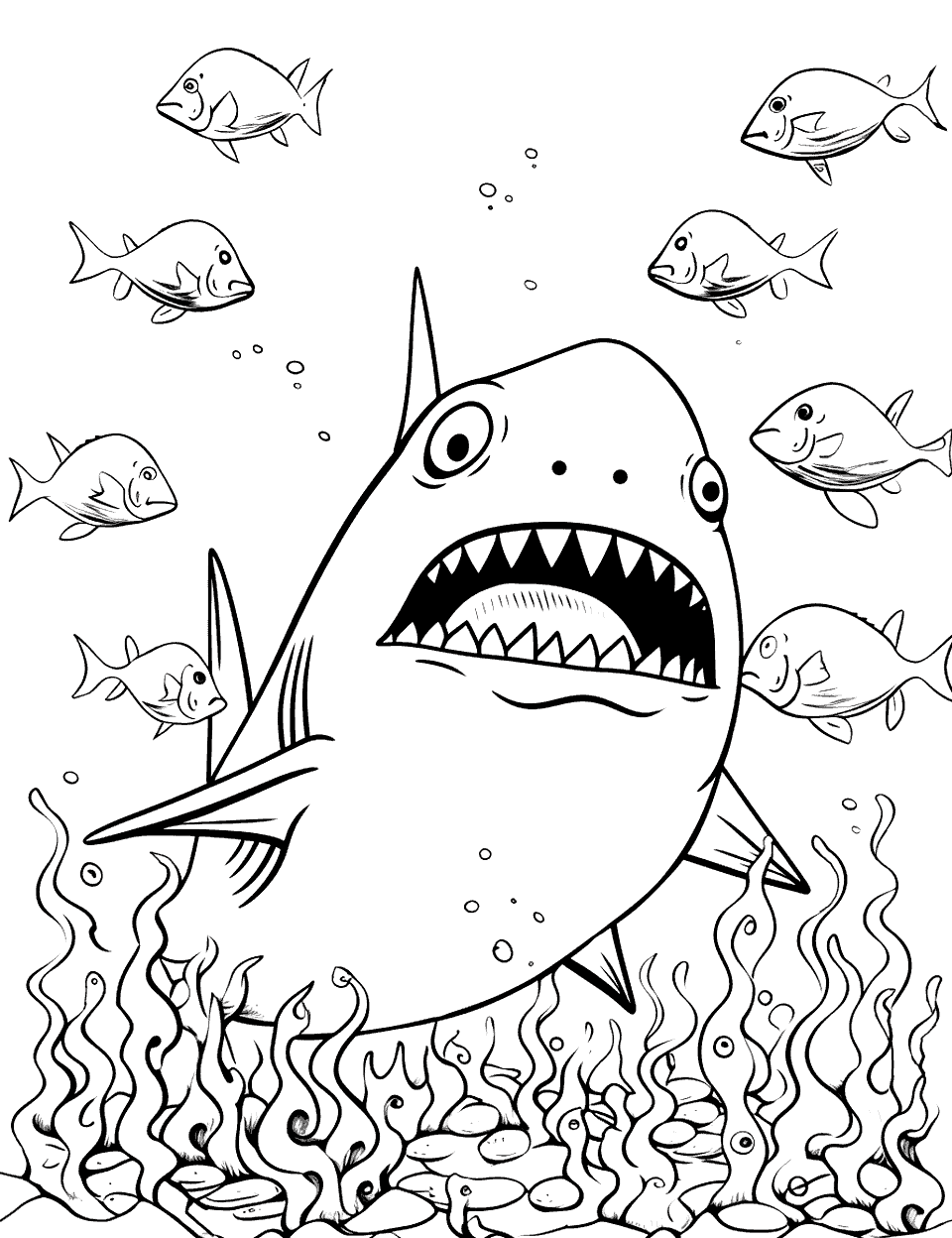
A shark with his mouth wide open takes up the middle of this sheet, showing rows of pointed teeth top and bottom. Fish swim past on every side, and kelp waves over a pebbly seabed. The open mouth is a big shape, so it is worth outlining in a strong color before filling the rest. Kids who like the scarier side of sharks tend to pick this one first.
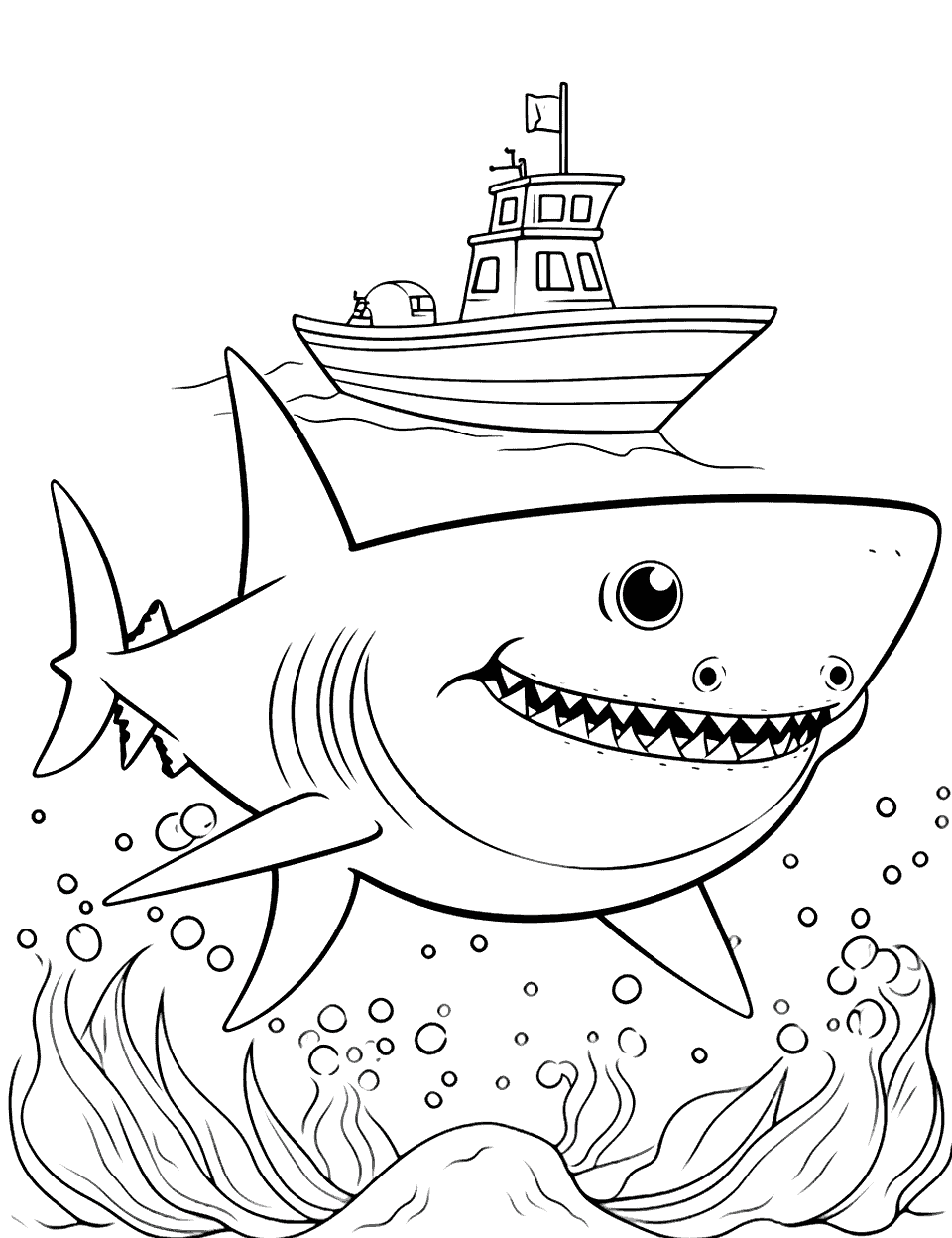
A fishing boat floats along the surface at the top of this page, complete with a cabin, square windows and a small flag. Below it, a large shark glides past with a wide toothy grin. The boat sits above the waterline and the shark below it, so the page splits neatly into two coloring jobs. A bright hull and a deep blue sea make the split obvious.
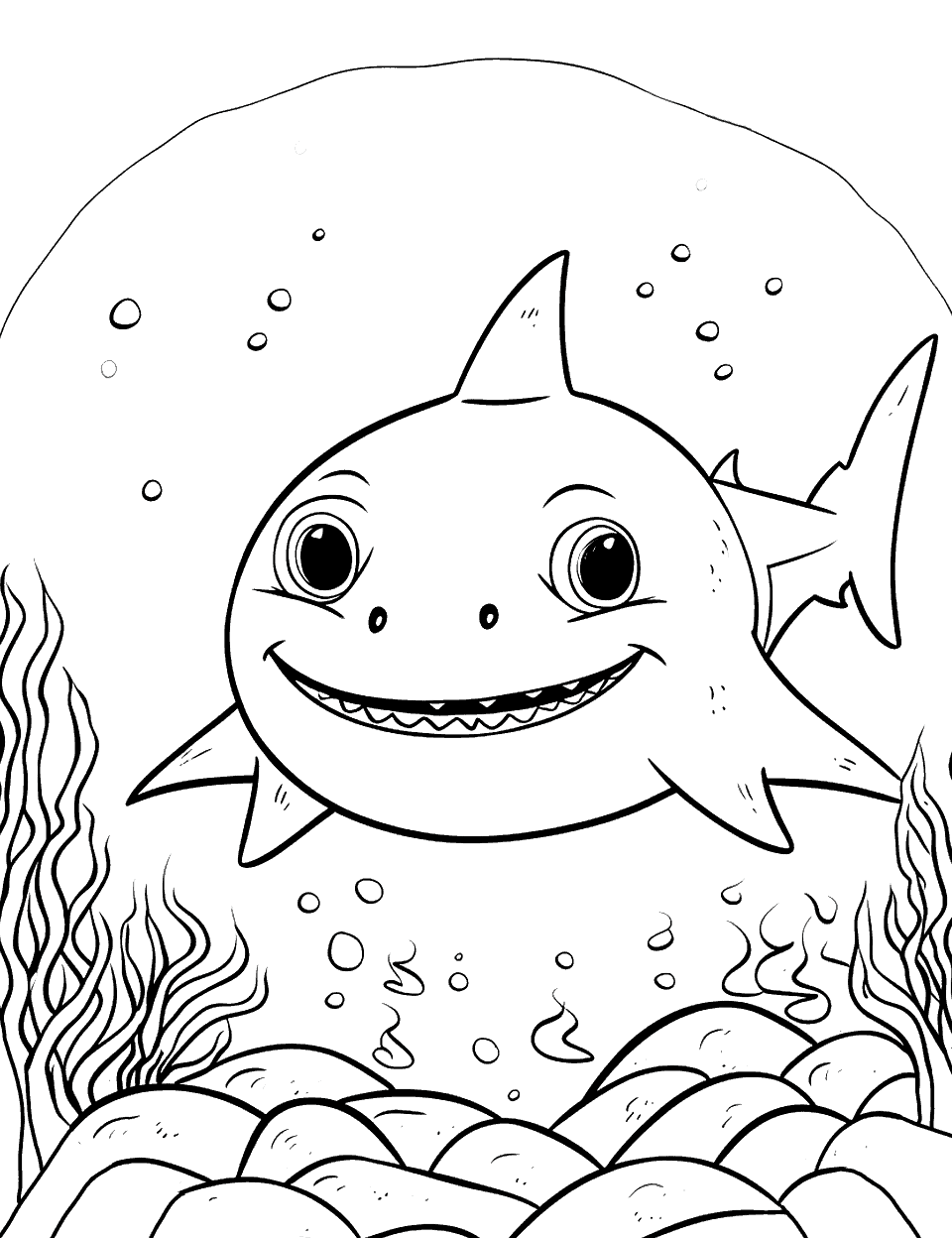
A big rounded rock arch curves over Baby Shark like the mouth of a cave. Seaweed grows up both sides of the page and smooth boulders are stacked along the bottom. Darker grays inside the arch and lighter ones on the boulders give the scene some depth. The shapes are large and rounded, so it colors faster than it looks.
Leafy plants climb both sides of this page like a garden hedge, with Baby Shark swimming between them. Fish drift above and below him, and star-shaped corals sit along the seabed. All those leaves are perfect for trying several greens at once. The fish give you a reason to break the pattern with something bright.
Bubbles trail through the water while Baby Shark swims left to right with a zigzag grin. Fish swim above him and off to the right, and long seagrass leans across the seabed. Leaving the bubbles uncolored, or coloring them very lightly, makes them read as bubbles rather than dots. Everything else can go as bold as your child likes.
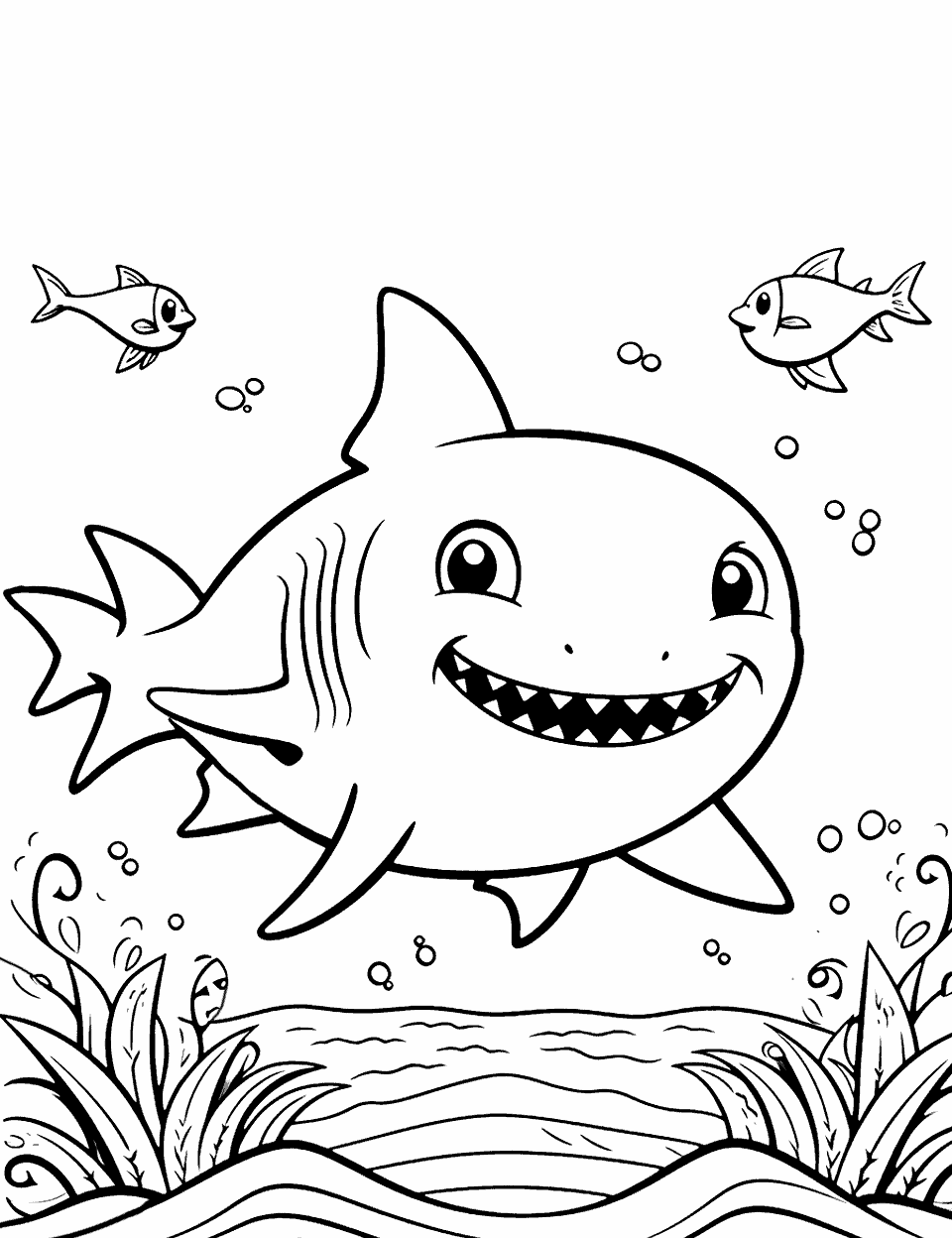
Two fish swim above Baby Shark while he glides over a rippled sandy floor. Clumps of grass sprout from both bottom corners and a few bubbles rise between them. Sandy yellows and browns on the seabed set off a brighter shark. The shapes are big and open, so markers will not bleed over the lines much.
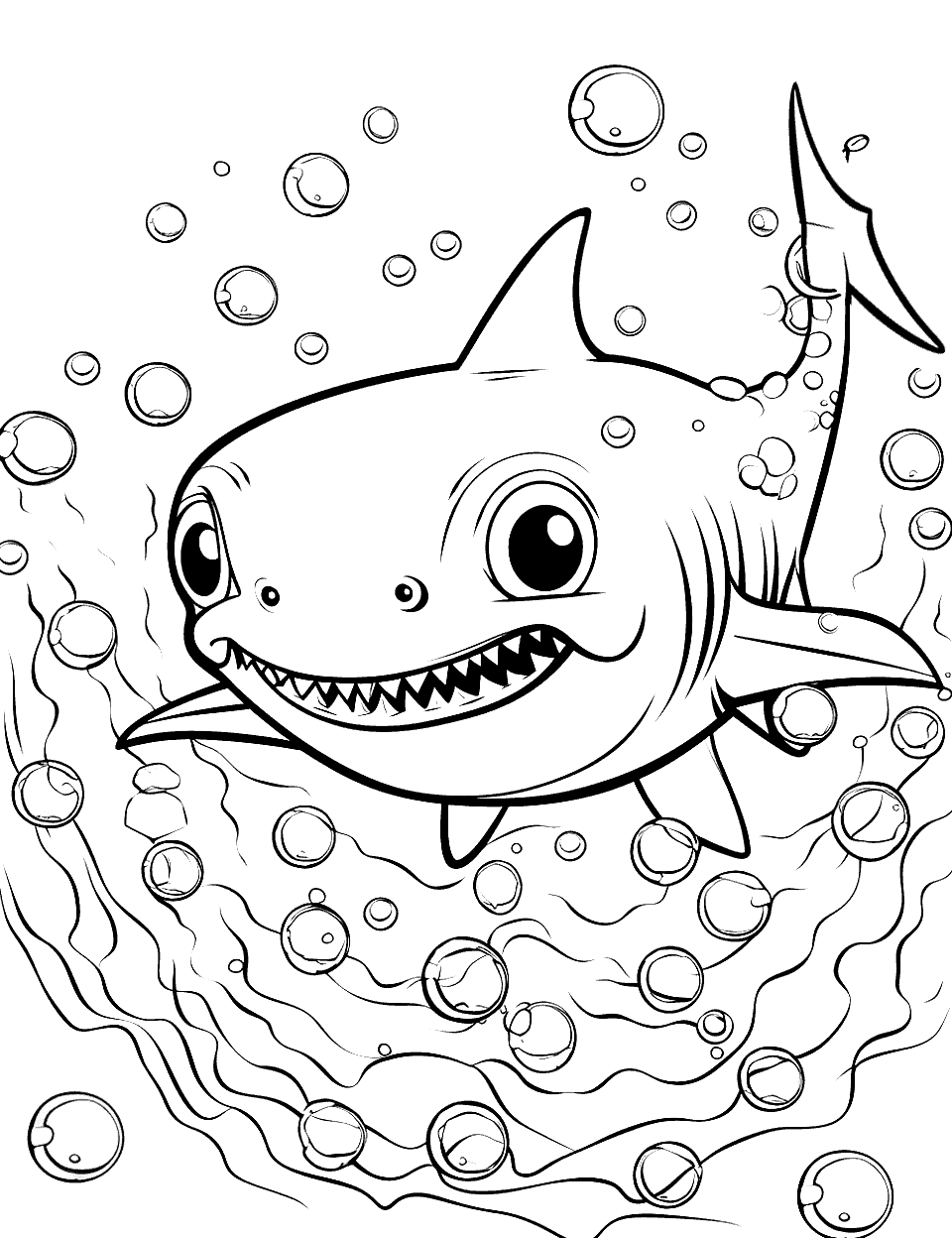
Large round bubbles surround Baby Shark on this page, with wavy current lines swirling behind them. His grin is full of pointed teeth and his tail sweeps up toward the top right corner. Coloring the bubbles in rainbow order is an easy way to keep a younger child busy. Anyone who wants a challenge can shade each bubble light on one side and dark on the other.
Wavy seaweed frames the top and both sides of this page, almost like a border. Baby Shark faces forward in the middle with two fish swimming off to his right. Bubbles fill the gaps, and the seabed below is drawn as soft ripples with a few small plants. Coloring the border first and then working inward keeps the page tidy.
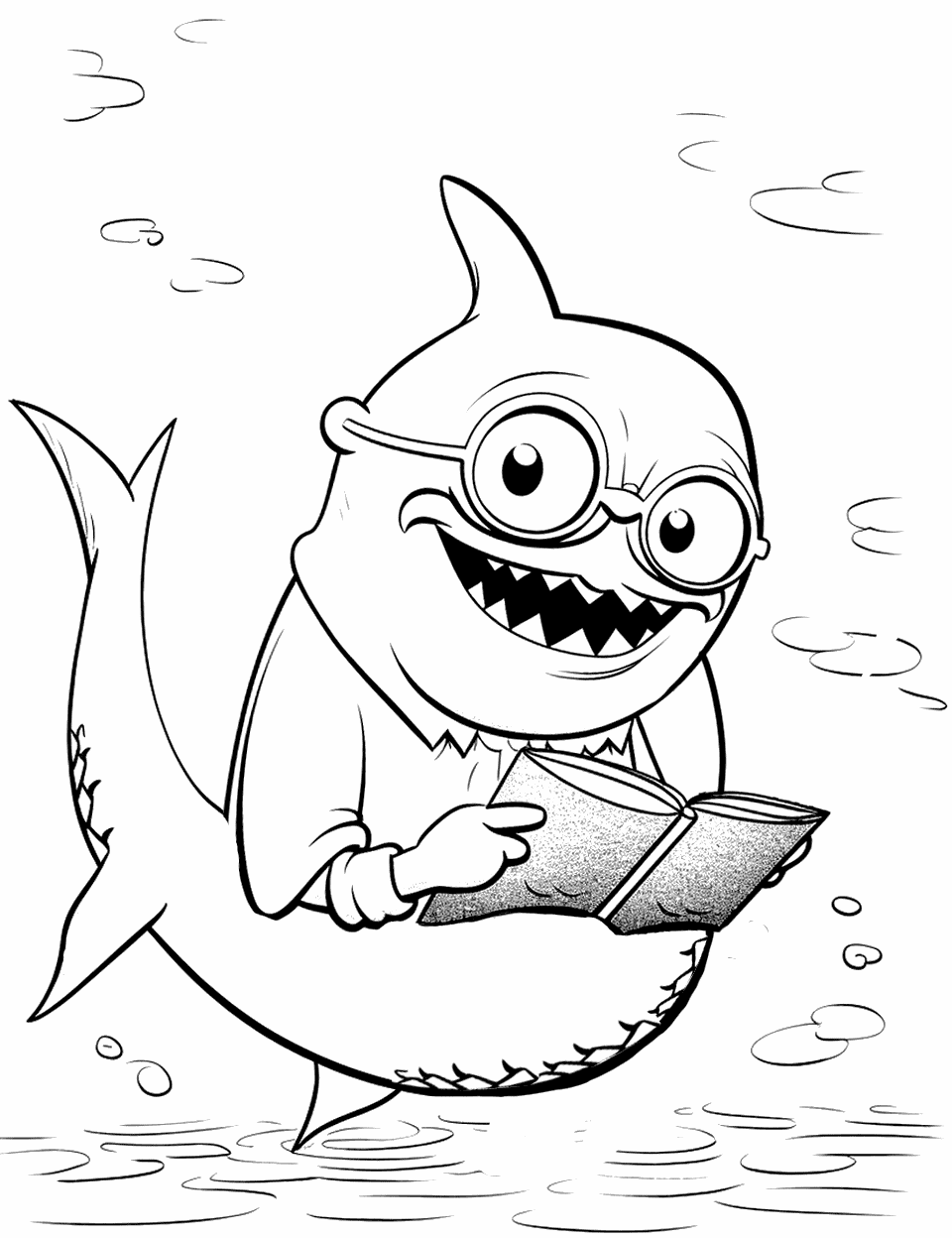
Grandpa Shark wears a pair of round glasses and holds an open book in his fins. Curly squiggles float around him and ripples run along the bottom of the page. The book is the smallest area on the sheet, so a fine tip works best there. In the show, Grandpa Shark is green, which is a fun color to try on a shark.
By using our free coloring pages, you acknowledge and agree to our full disclaimer. All materials are for personal, non-commercial use only and all rights belong to their respective license holders.
What Age Are These Baby Shark Coloring Pages Best For?
These sheets suit children from roughly 18 months to about age 8, because the set runs from thick, simple outlines to crowded reef scenes. Toddlers scribble by 15 to 18 months and can copy a circle by 24 months (2), which is exactly the point where a big open shape like Toddler Baby Shark or Happy Baby Shark stops being frustrating.
Preschoolers usually want a scene rather than a single character. Blue Baby Shark, Baby Shark’s Picnic and Playful Baby Sharks give them a few separate shapes to work through without any hairline gaps.
School-age kids can take on the detailed sheets. Baby Shark and the Sunken Towers, Baby Shark in the Kelp Forest and Ocean Adventure With Baby Shark all have small windows, thin stalks and layered background shapes that reward colored pencils over markers.
How Do You Print These Baby Shark Coloring Pages?
Save the image you want, open it, and print it at letter size in portrait with your printer set to fit the page. Every sheet here is a tall PNG, so fit-to-page keeps the whole drawing on one piece of paper instead of cropping the fin off the top.
Two settings save a lot of ink. Choose grayscale or black-and-white so the printer does not mix color ink for a black outline, and drop the quality to draft or normal, since a coloring page does not need photo settings.
Print two copies of the same sheet when you want a matching game or a puppet pair, and print a spare of the busy sheets. Kids often want a second run at those once they see how they turned out.
Activities to Do With Baby Shark Coloring Pages
The fun does not have to stop once the coloring is done. A finished sheet is sturdy enough to become a puppet, a decoration or a game, and most of these ideas need nothing beyond scissors, glue and what is already in the craft drawer.
Create Popsicle Stick Puppets
After your child colors the sharks, cut the characters out and tape or glue a popsicle stick to the back of each one. Kids can usually cut out a picture with scissors by around age 4 (3), so plan to do the cutting yourself for anyone younger. Then the whole shark family can act out the song, verse by verse.
Design an Ocean Diorama
Paint the inside of an old shoebox blue and stand it on its side. Cut out the colored sharks and fish and hang them at different heights from the top of the box using thread or fishing line. Real sand and a few seashells across the bottom finish it off, and the whole thing doubles as a shelf display afterward.
Make Shark Party Decorations
These pages make quick birthday decorations. String a row of cut-out sharks along a length of yarn for a garland, or slide a whole sheet into a plastic sleeve to use as a placemat at the cake table. The Christmas Baby Shark sheet works the same way in December.
DIY Memory Match Game
Print two copies each of several different sheets, then color the pairs to match. Cut a square around each character, flip them face down and play a standard memory game. Start with three or four pairs for a preschooler and add more as they get faster.
Personalized Greeting Cards
Fold a sheet of construction paper in half, glue a colored Baby Shark to the front, and let your child dictate or write the message inside. Grandparents get a card nobody else has, and it costs you a piece of paper.
Storytelling Stones
Glue the smaller fish and shark cutouts onto smooth flat stones with Mod Podge and let them dry overnight. Your child can then lay the stones out in any order and tell a new underwater story each time. Keep them in a jar and they become a quiet-time activity for the next rainy day.
FAQs
What Are the Names of the Shark Family?
The family is Baby Shark, Mommy Shark, Daddy Shark, Grandma Shark and Grandpa Shark, in the order the song sings them. In the cartoon Baby Shark’s Big Show!, which premiered on Nickelodeon on December 11, 2020, Baby Shark’s best friend is William Manta, an orange pilot fish. Grandpa Shark appears on the last sheet in this collection, reading a book with his glasses on.
What Colors Should I Use for Baby Shark?
Baby Shark is yellow, and in Baby Shark’s Big Show! the rest of the family is color-coded too: Mommy Shark is pink, Daddy Shark is blue, Grandma Shark is orange and Grandpa Shark is green. Those colors are handy on the sheets with several sharks on one page, because they give each character an identity. None of it is a rule, though, and a rainbow shark is a perfectly good answer.
Are These Coloring Pages Free to Print?
Yes, every sheet on this page is free for home and classroom use. Save the image, print it, and make as many copies as your kids get through. There is nothing to sign up for and no watermark to work around.
What Is the Best Paper for Coloring Pages?
Standard printer paper handles crayons and colored pencils without any trouble. Switch to cardstock for markers, watercolors or anything you plan to cut out, because the heavier sheet stops the ink bleeding through and holds its shape as a puppet or a garland. Cardstock also lies flatter if the page is going on the fridge.
Can I Use These Pages for a Classroom Activity?
Yes, print as many as your class needs. The range of difficulty helps in a mixed group: hand the thick-outline sheets to the youngest table and the reef scenes to children who finish early. They pair well with an ocean theme week or a lesson on sea animals.
How Can I Make the Pages Reusable?
Slide the printed sheet into a plastic sheet protector or laminate it, then color it with dry-erase markers and wipe it clean. One printed page can then survive a whole car trip or a week of restaurant meals. Keep a small cloth with the markers so your child can reset the page without help.
At What Age Can Kids Start Coloring?
Most children start scribbling somewhere between 15 and 18 months, so a chunky crayon and one of the simple sheets can go on the table well before their second birthday. Do not expect anything inside the lines yet: at that age the point is the grip and the arm movement. Copying a circle usually arrives around 24 months, and staying roughly inside a shape follows in the preschool years.