Real parrots come in almost every color, so hand over the whole box.
These free parrot coloring pages collect 25 printable sheets, from a macaw gliding on open wings to a cockatoo perched under falling snow. Every one is a clean black and white outline, sized for whatever paper is already in your printer.
Parrots are a forgiving subject. There are 279 parrot species, and their feathers run mostly to greens, reds, blues, and yellows (1), so almost any crayon your child grabs is defensible. Below each sheet you will find what is actually drawn on it and which supplies suit it.
Pick a page, print it, and hand over the whole box.
Parrot in a Tropical Forest
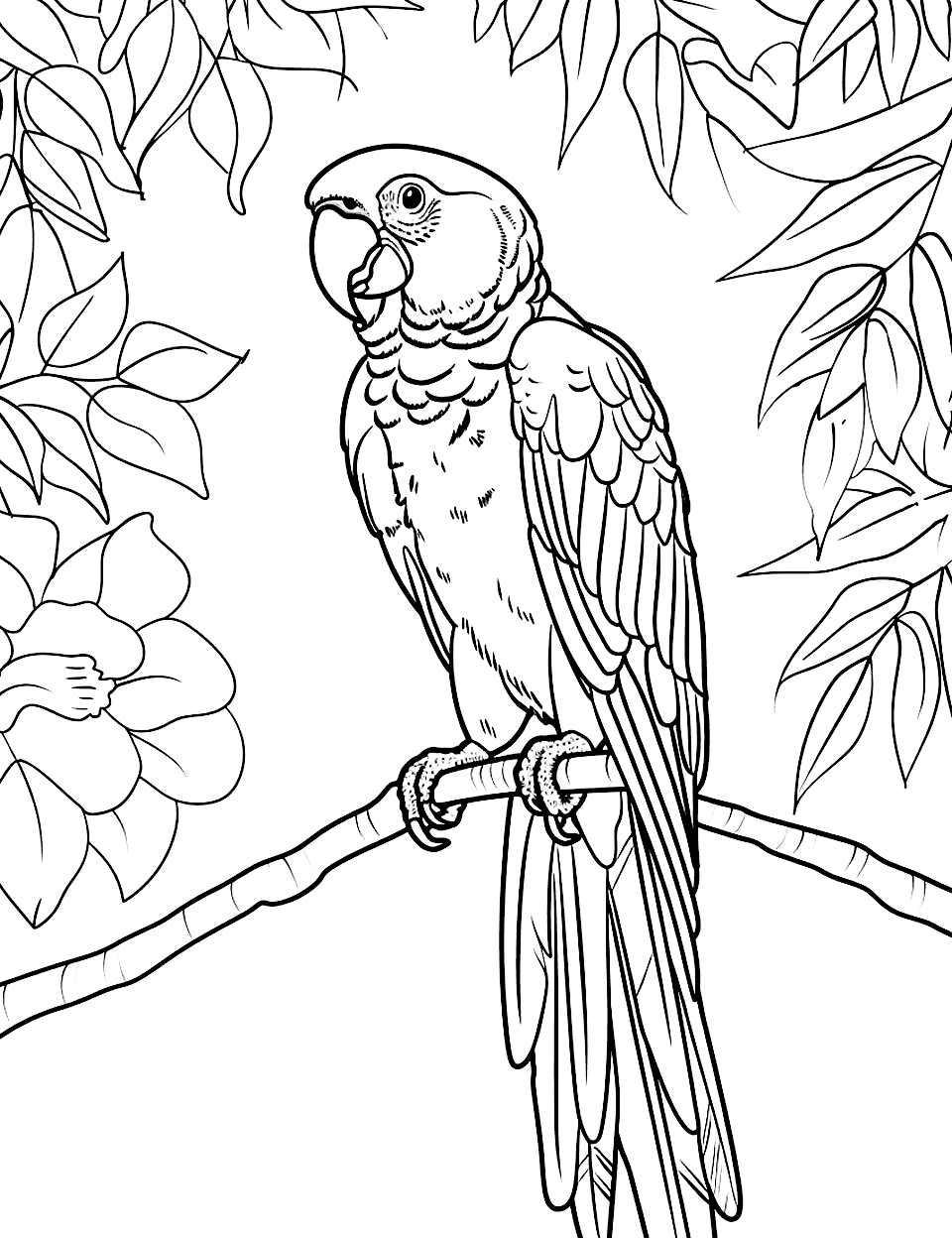
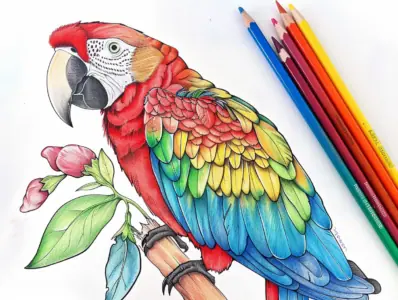
A long-tailed macaw grips a thick branch while leafy stems fill the space above it and down the right side. A wide-petaled flower opens in the lower left corner, which gives you somewhere to put a second color family. The wing feathers are drawn as separate overlapping rows, so this sheet rewards anyone who likes filling in small shapes. Colored pencils hold those lines better than a fat crayon.
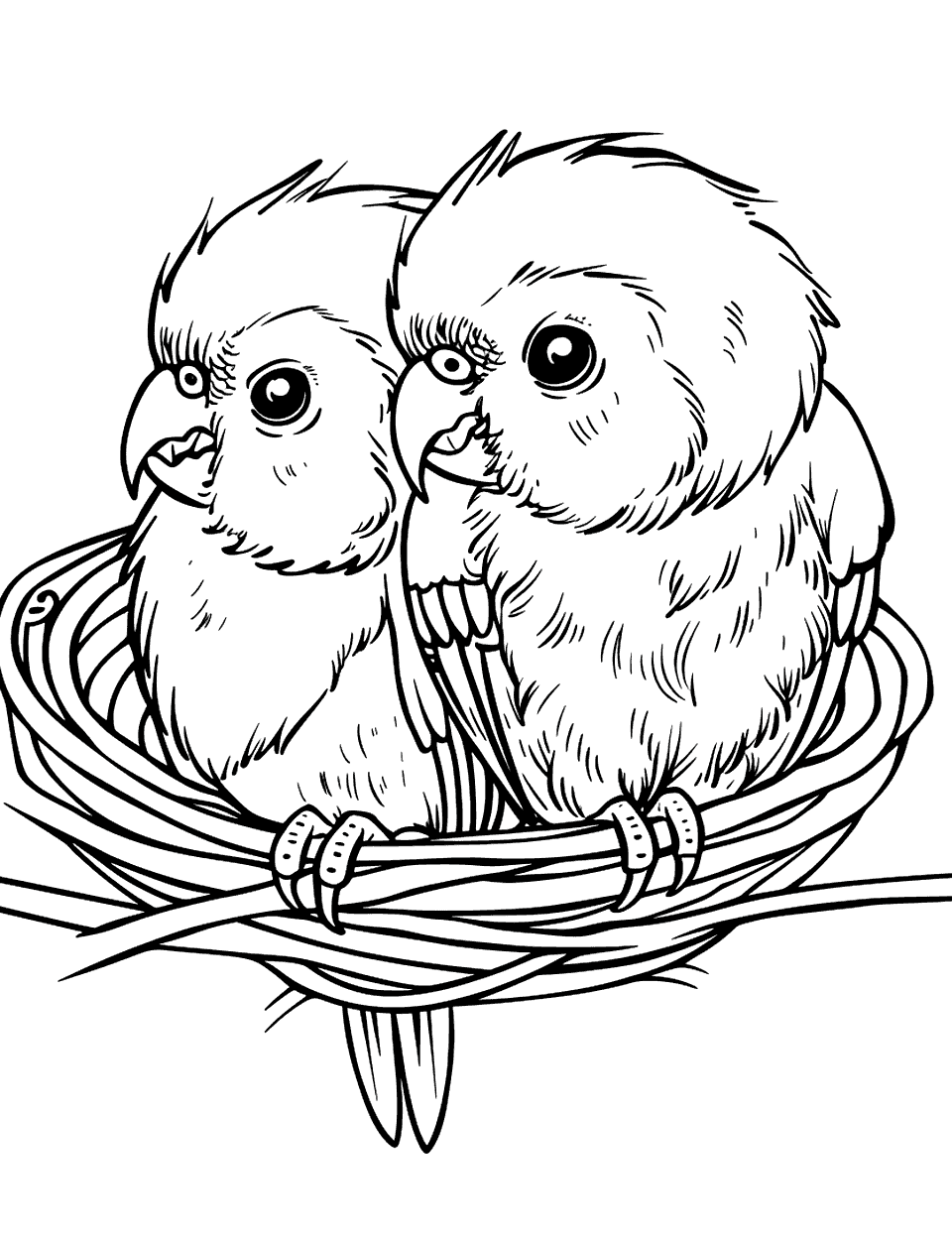
Two round chicks sit shoulder to shoulder in a woven nest. Their eyes are the biggest shapes on the page, so save a dark crayon for those and keep the down around them pale. The nest is built from loose crossing twigs, which fills fast in browns. A good pick for a younger child who wants a quick finish.
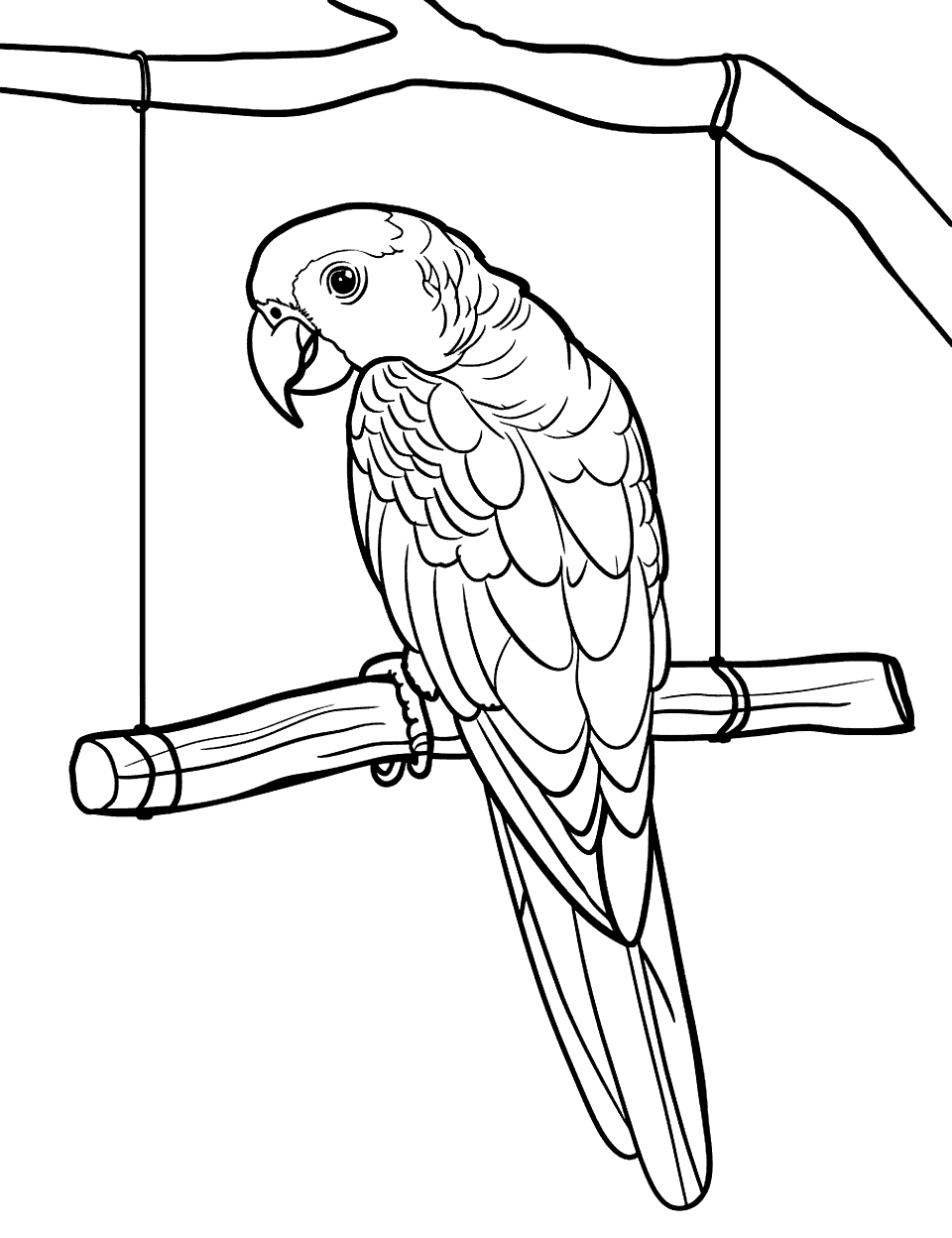
This bird balances on a wooden swing that hangs by two cords from a bare tree branch. The background is completely white, so your child can add a room, a sky, or leave it alone. Wing feathers sit in neat overlapping rows and take two shades of the same color nicely. The swing itself is a quick brown, which is a welcome break from all that feather detail.
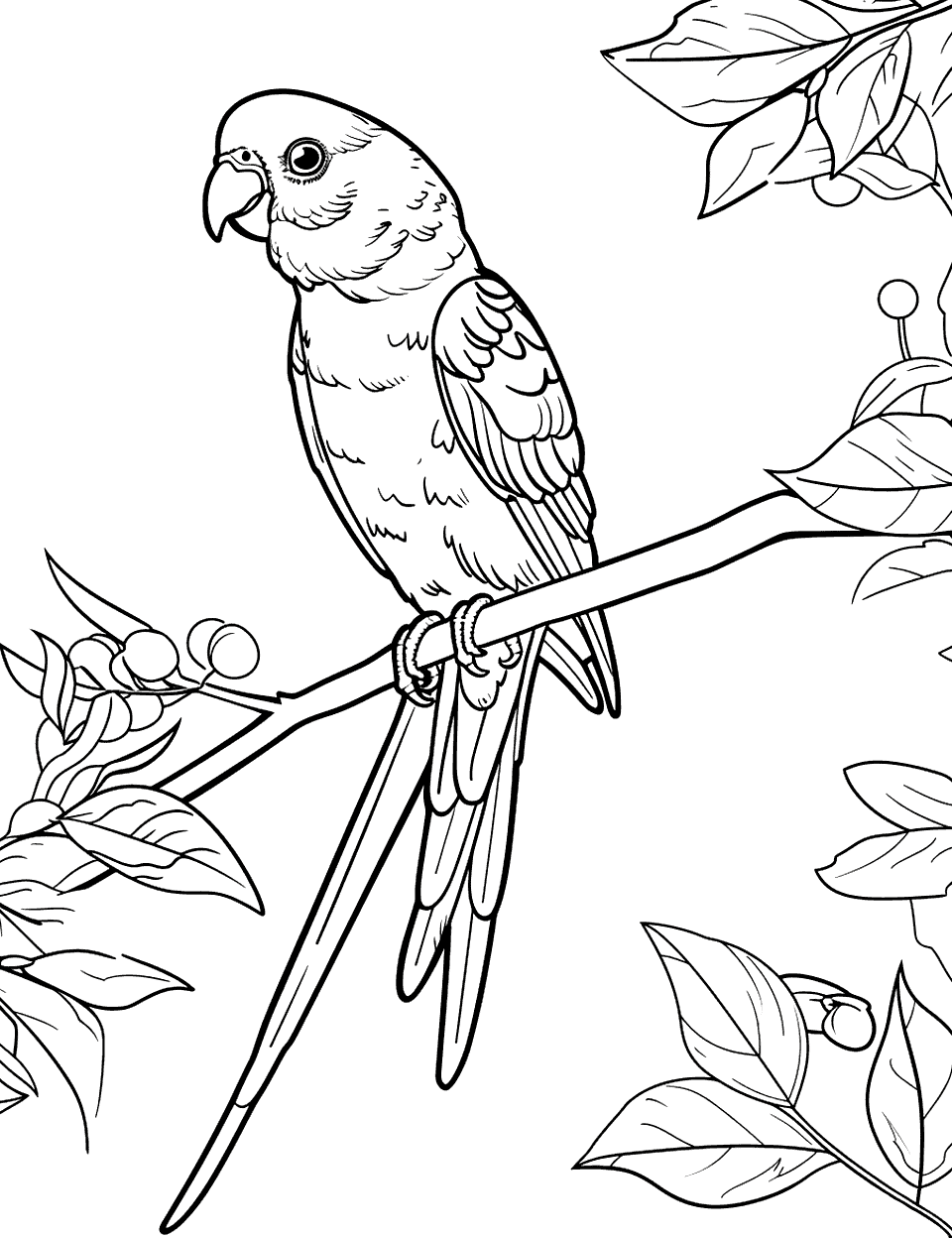
A slim, long-tailed bird perches on a thin branch loaded with round berries and pointed leaves. The berries repeat along the lower left and the upper right, so there is a natural place to use one bright color over and over. Its tail runs almost to the bottom edge of the page, which means you need a long sweep of color to finish it. Fine chest lines reward a sharp pencil.
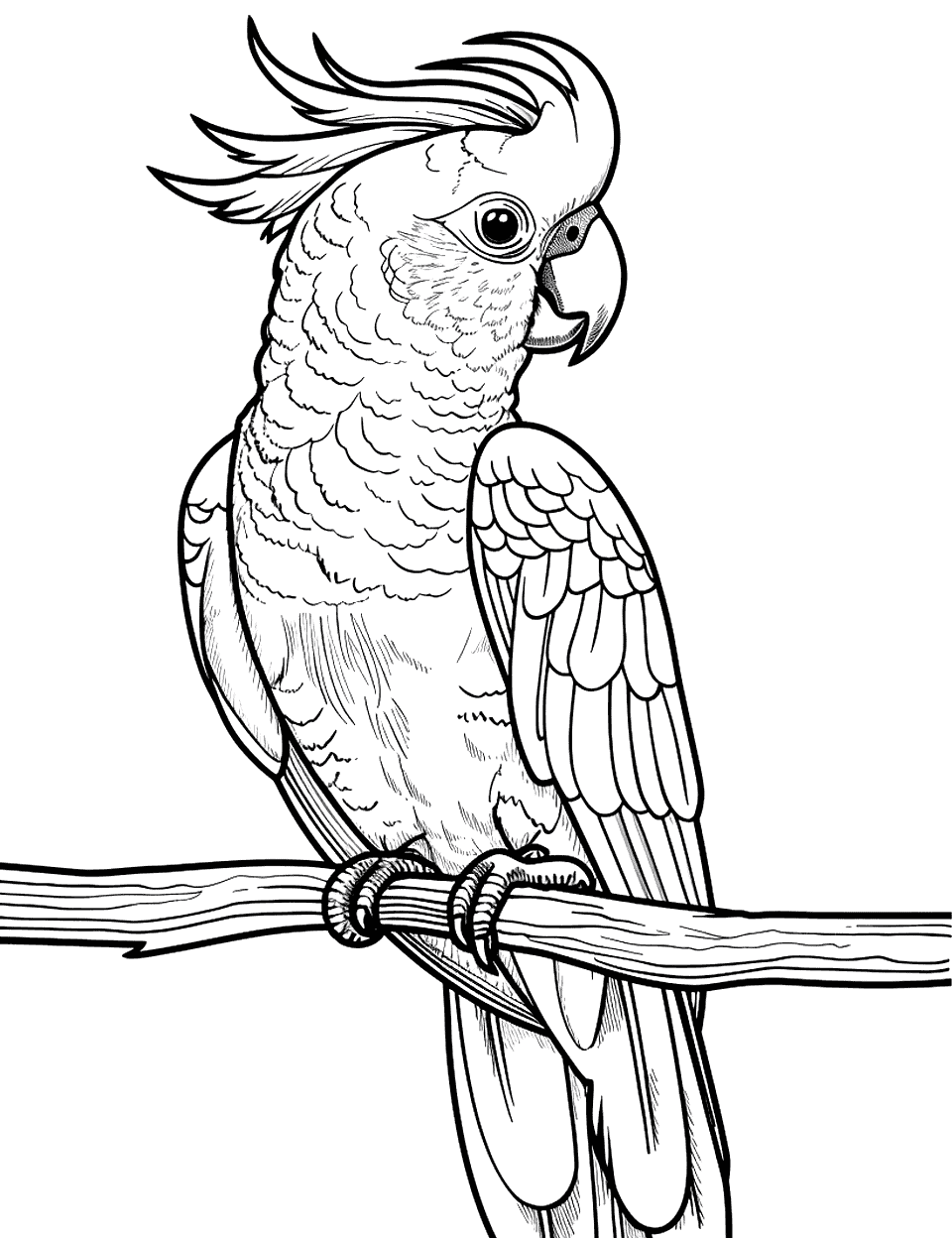
The crest on this cockatoo is fully up, drawn as separate pointed feathers fanning back from its head. Scaled chest feathers cover most of the body, so the page asks for patience more than speed. Real cockatoos raise those head feathers when they are alert, excited, or agitated (2), which is a fun thing to mention while your child works. Most cockatoos are black or white, so white with a colored crest is the true-to-life choice.
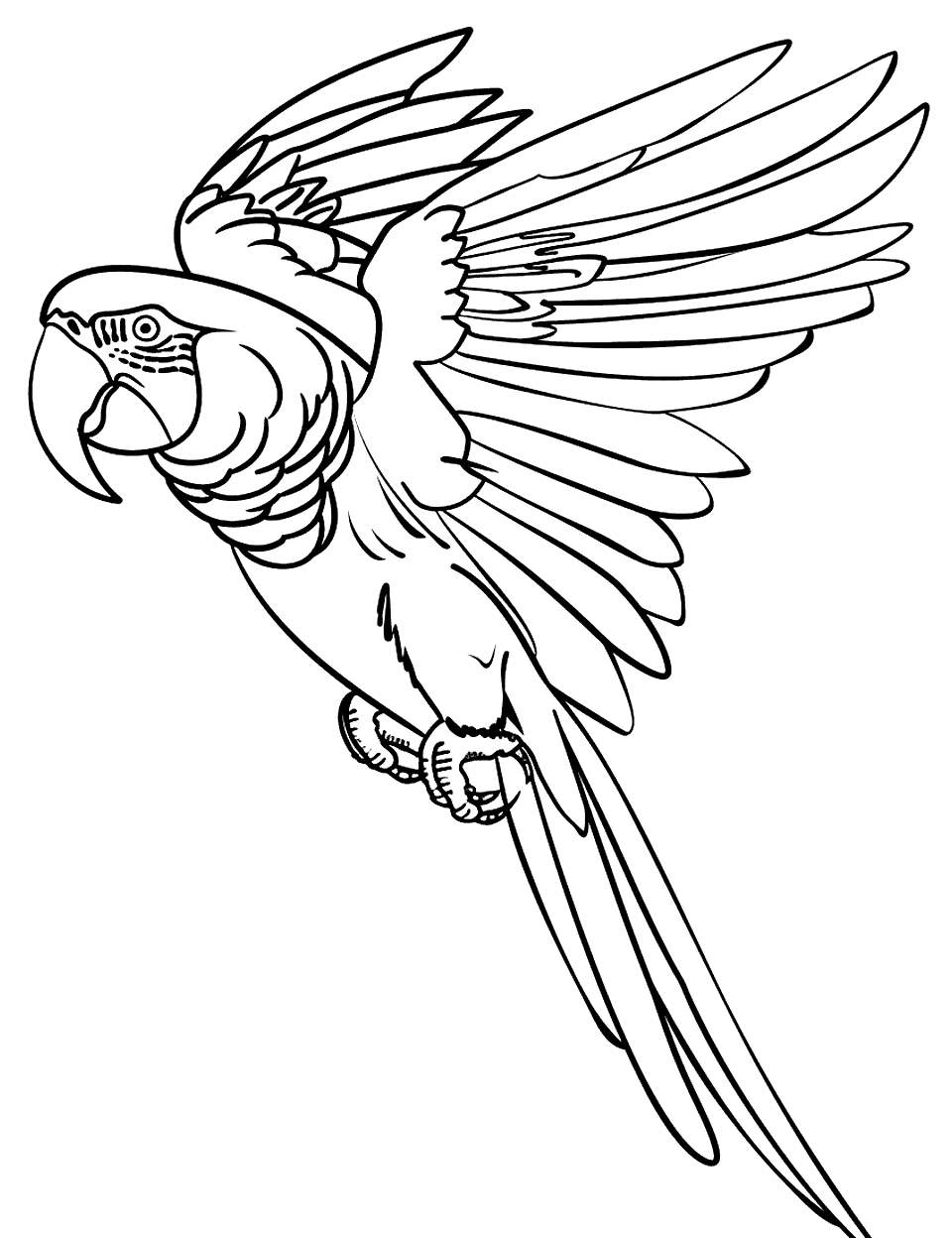
Wings sweep up and back on this gliding macaw, and every long flight feather is outlined on its own. There is no background at all, which leaves the whole page open for a sky, a sunset, or nothing. The shapes are big, so it colors faster than its size suggests. Try a warm color on the body and something cooler across the wing tips.
Two birds lean in from opposite ends of a branch and hold a round piece of fruit between their beaks. Their tails hang straight down past the branch, which balances the page. A few leaves crowd the top left corner if you want a touch of green. Coloring the two birds differently makes the sharing read more clearly.
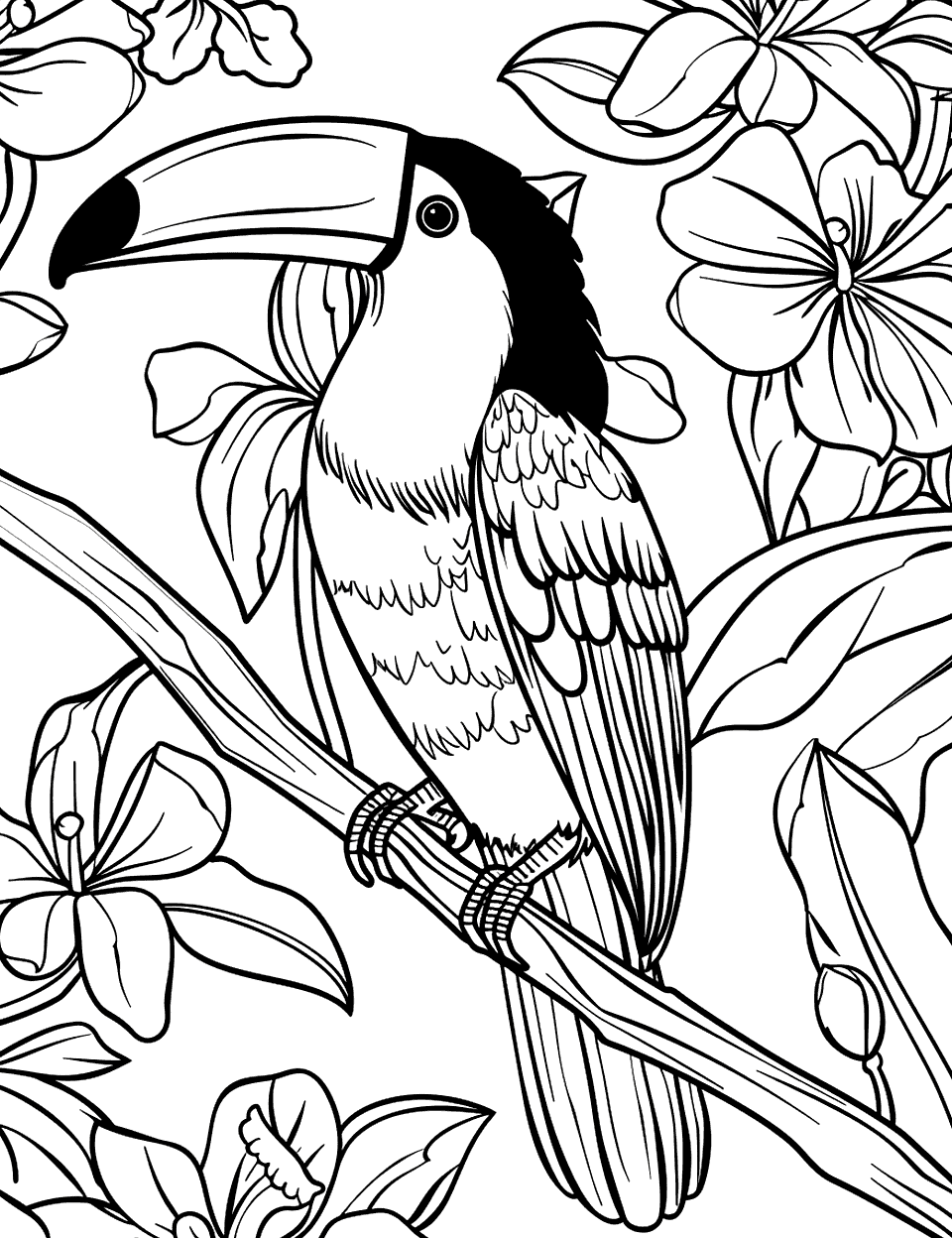
A toucan sits on a branch ringed by large open tropical flowers. Its bill already carries a solid black band at the tip, which sets the contrast for the rest of the page. Real toucans are mostly shiny black with bright whites, yellows, oranges, reds, and greens depending on the species (3), so almost any bold choice is defensible. The flowers are big and simple, making them an easy warm-up before the feather work.
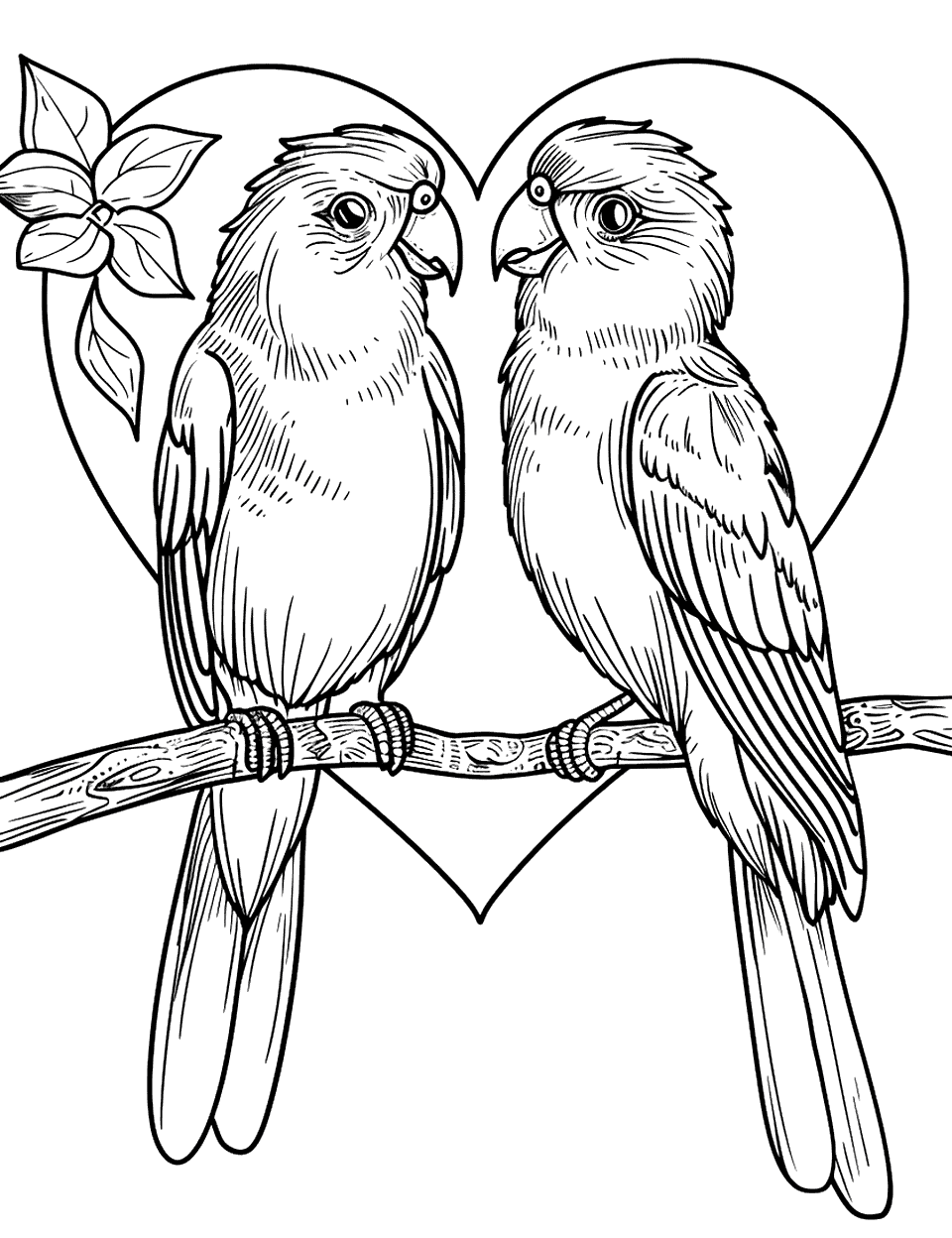
A big heart outline fills the background behind two birds sitting on a branch. A small flower with pointed leaves sits at the upper left, breaking up the curve. The heart is one clean line, so it takes a flat color or a soft gradient equally well. Long tails drop below the branch and give you room to stretch a second color.
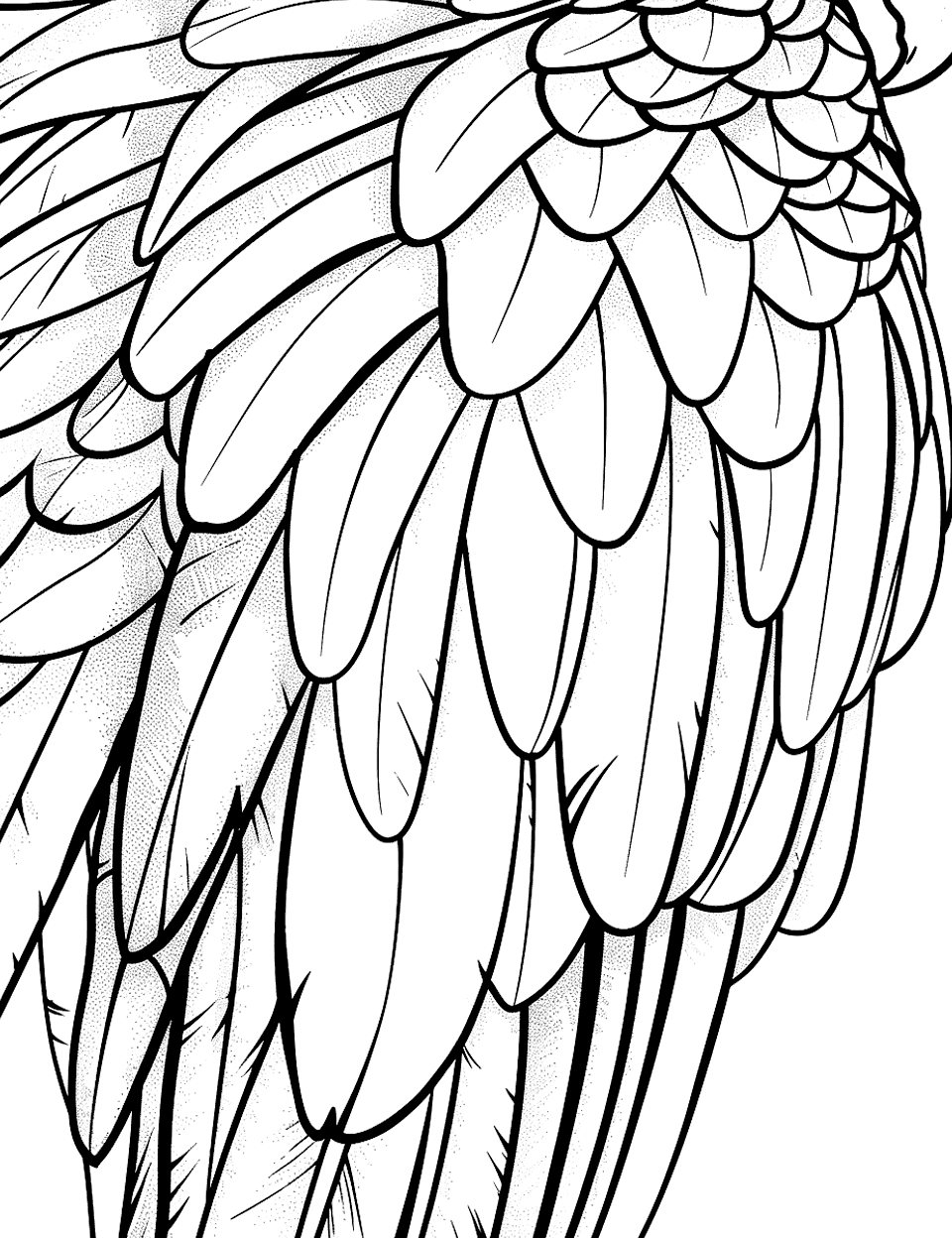
This one zooms all the way in on overlapping feathers, with no bird, branch, or background in sight. The rows step from small rounded shapes at the top to long straight ones at the bottom. Because every feather is a closed shape, it works well for practicing gradients: run one color light to dark across a single row. Older kids and grown-ups tend to like this sheet more than younger children do.
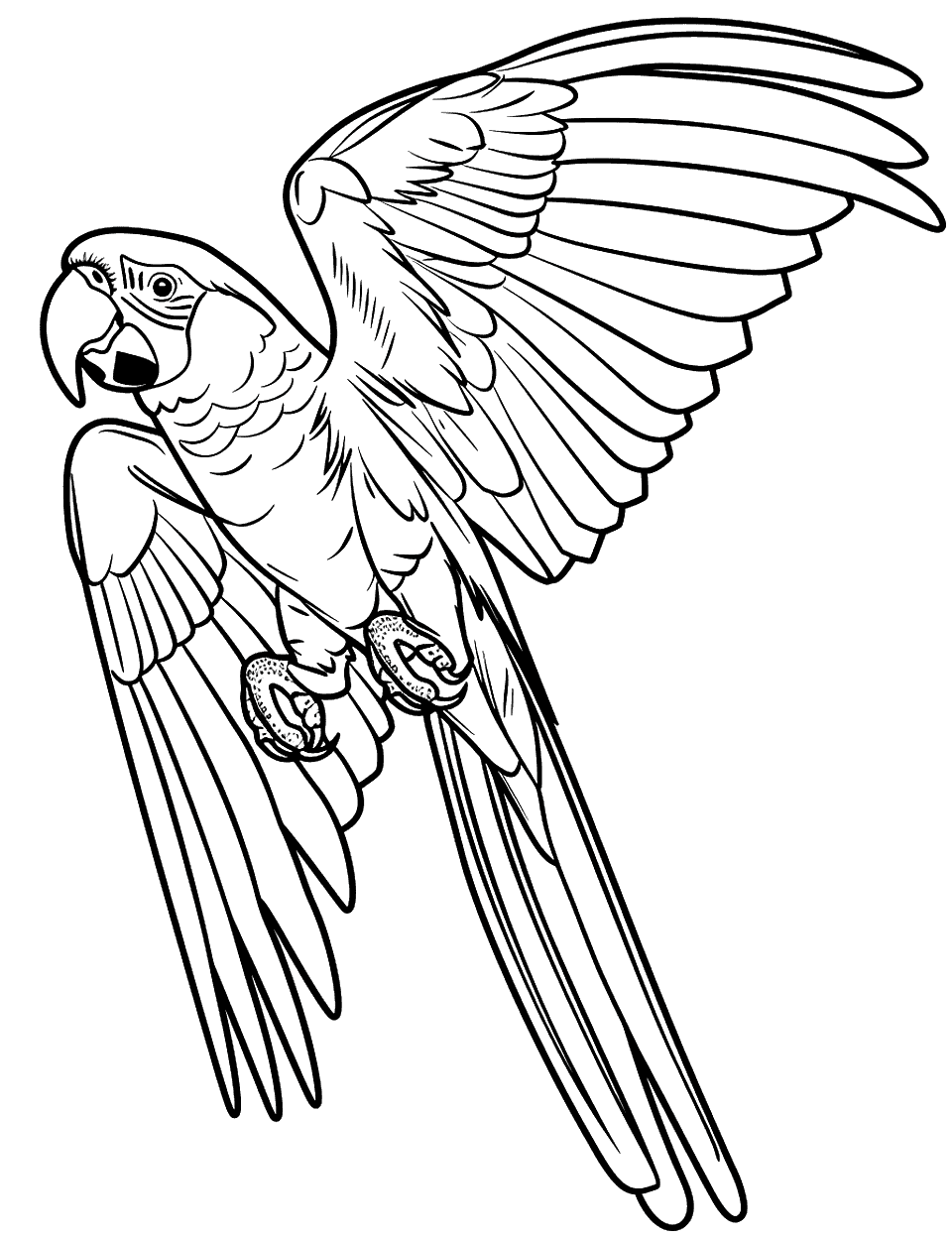
Here the macaw is caught with both wings raised and its beak open. The tail splits into long streamers that reach the bottom edge of the page. Fine feather lines ring the eye, a small detail a sharp pencil can pick out. Leave the background white and the bird reads as if it is coming straight at you.
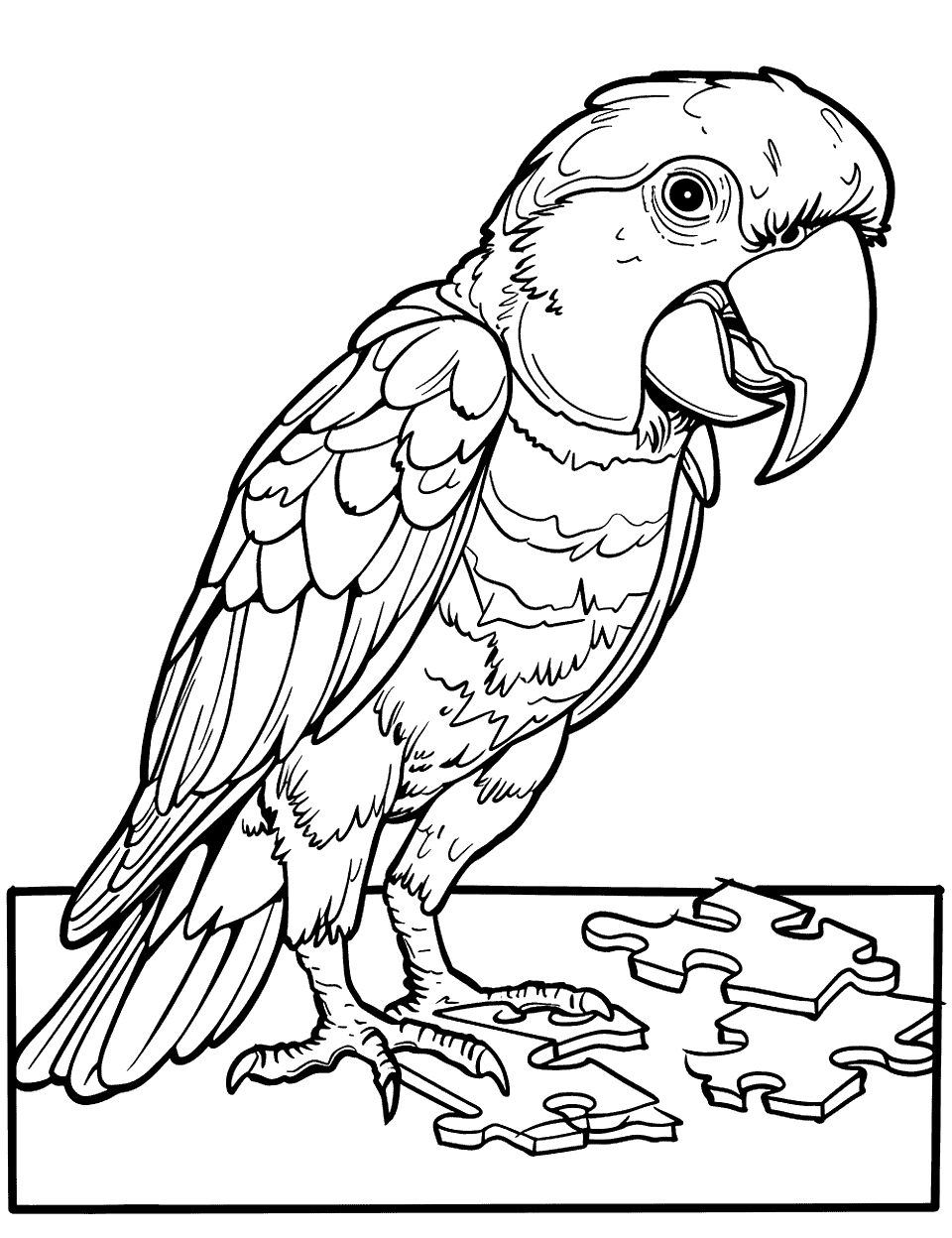
A parrot stands on a flat board with jigsaw pieces scattered around its feet, some of them still loose. The bird takes up most of the page and its long tail runs off to the left. Puzzle pieces are easy shapes, so this is a good sheet for a child who wants to finish something before tackling feathers. The San Diego Zoo Wildlife Alliance says parrots have a thick, curved beak built for breaking open nuts and seeds, and that curve is one more shape to get right once the puzzle pieces are filled in.
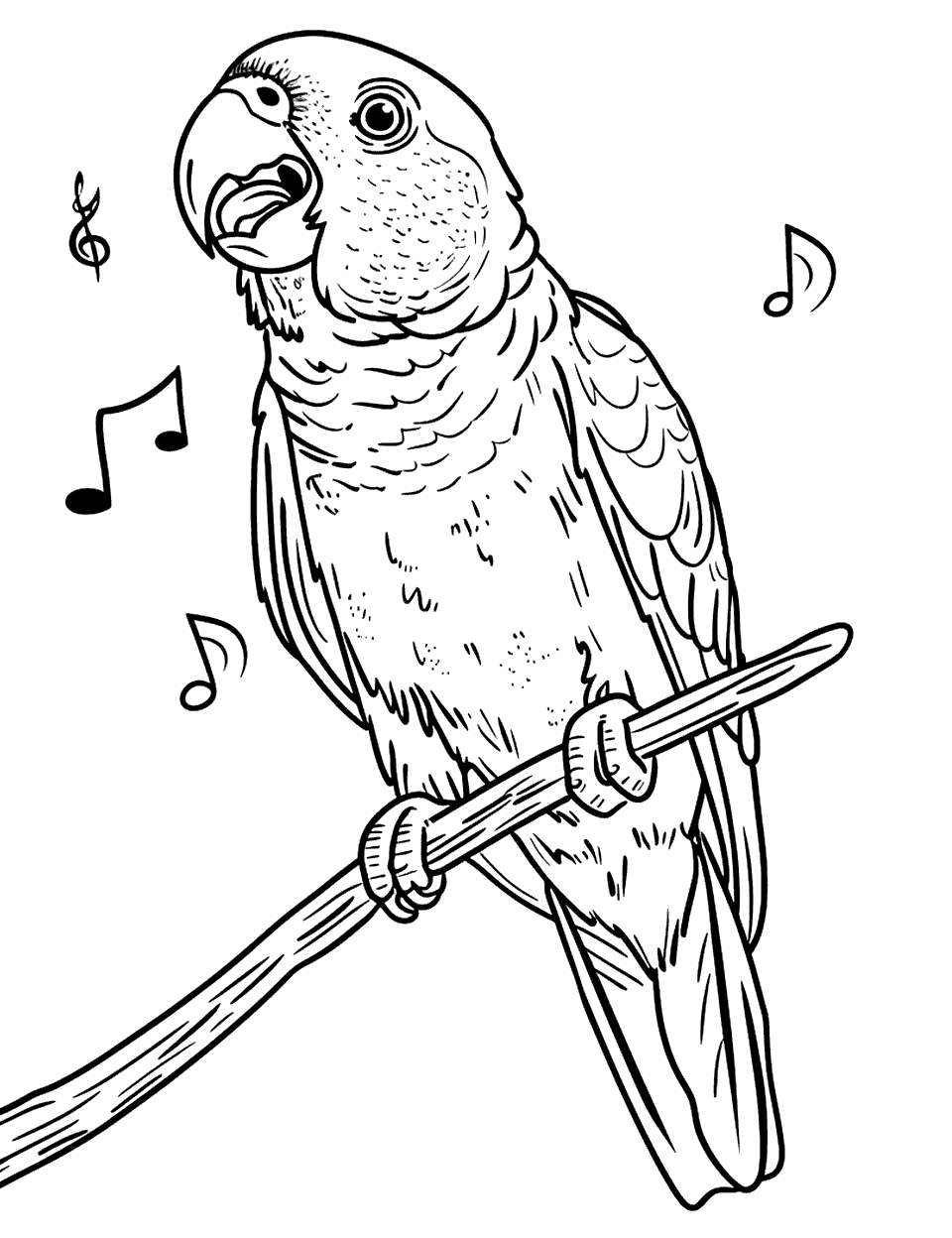
Beak open, this parrot has music notes and a treble clef floating in the space around its head. The branch runs diagonally across the lower half, which stops the page from feeling top heavy. Those notes are tiny, so hand over a fine pencil or let your child color them all one bright shade. Pair it with a song they already know and it becomes a sing-along.
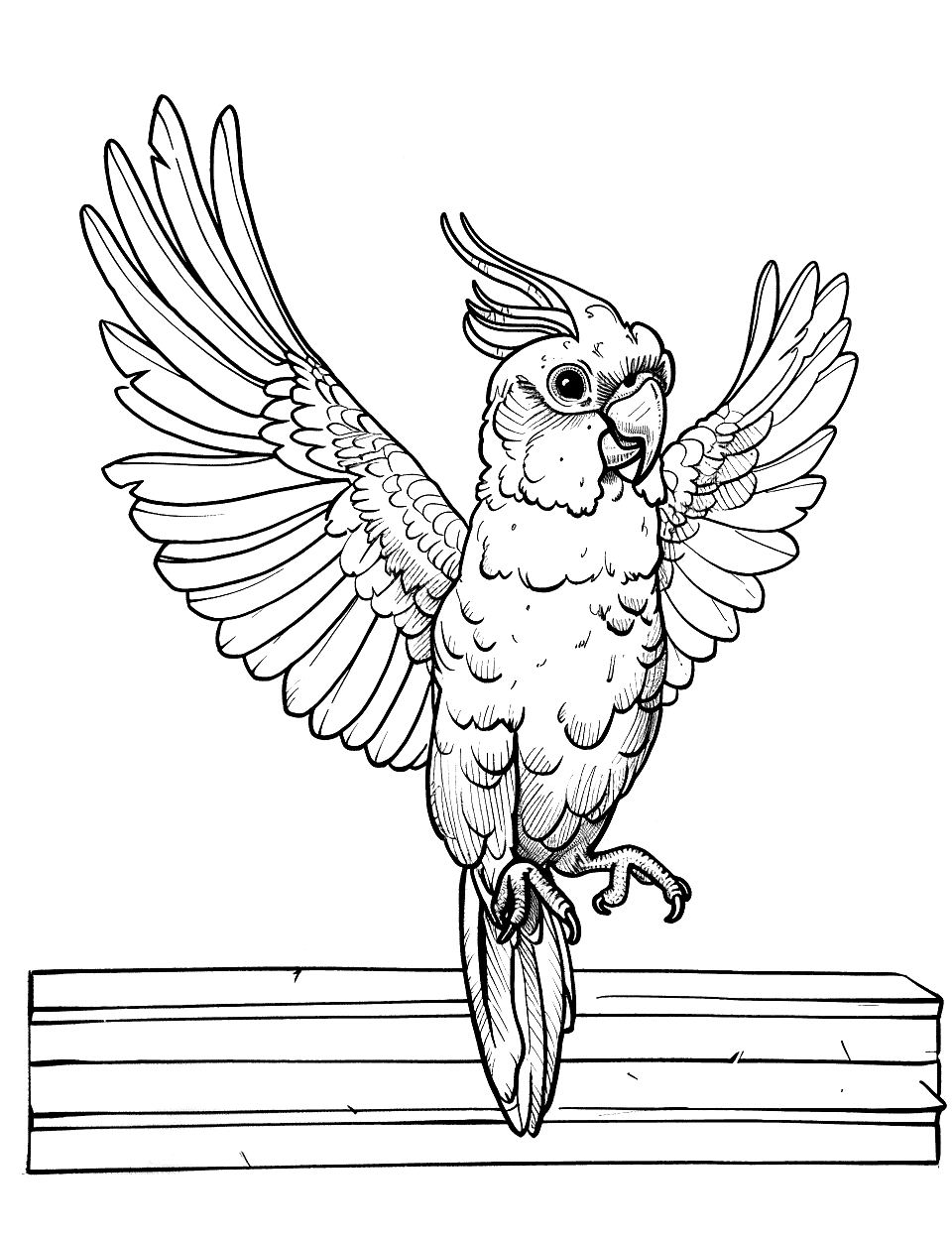
Wings out and one foot lifted, this cockatoo looks mid-step on a wooden plank. The crest is up and the wings spread wide, which breaks the page into large sections. Wide flight feathers color fast, so younger kids keep moving. Add a stage or a stripe of floor underneath if the plank looks lonely.
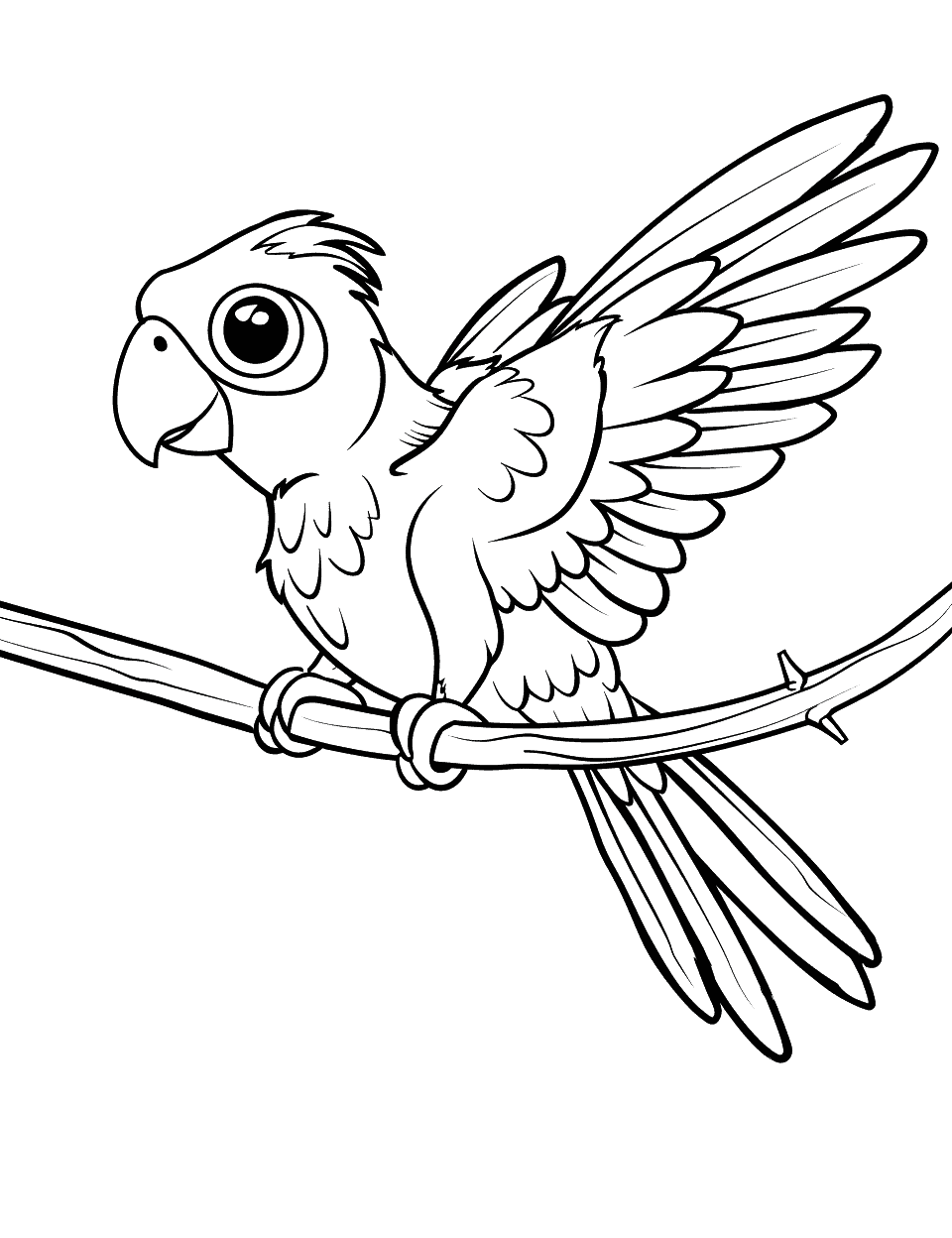
A cartoon-style chick perches on a branch with its wings thrown open. Its eye is drawn oversized, which is the whole charm of the sheet and the easiest part to color. The lines are thick and there are very few of them, so a preschooler with chunky crayons can finish it alone. Tail feathers fan out behind the branch if you want a second color in there.
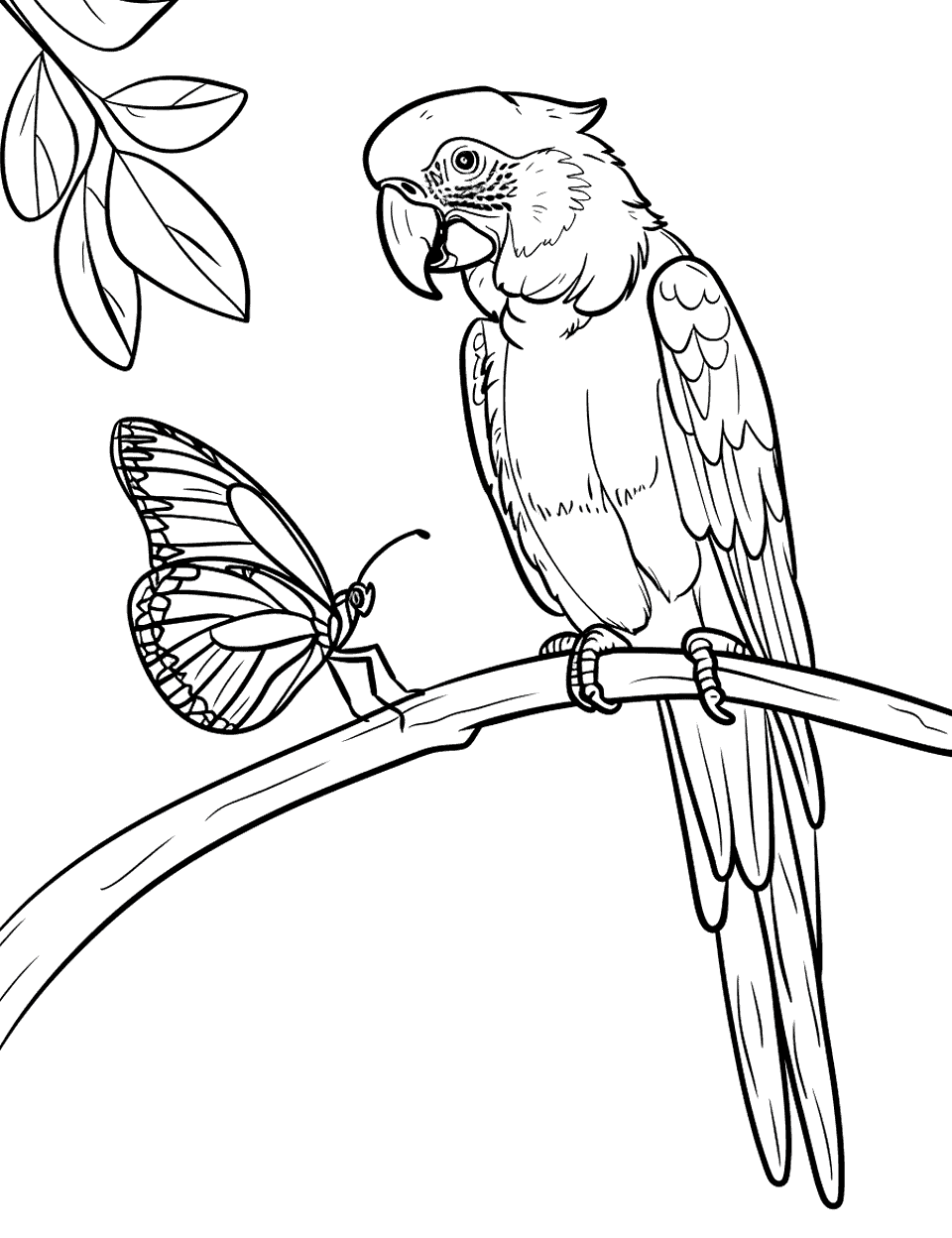
A macaw looks down the branch at a butterfly that has landed on the same curve of wood. The butterfly wings are drawn with veined panels, so they take a patterned treatment well. A leafy stem hangs into the top left corner and the rest of the background stays open. The size gap between the big bird and the small insect makes this a nice page for talking about scale.
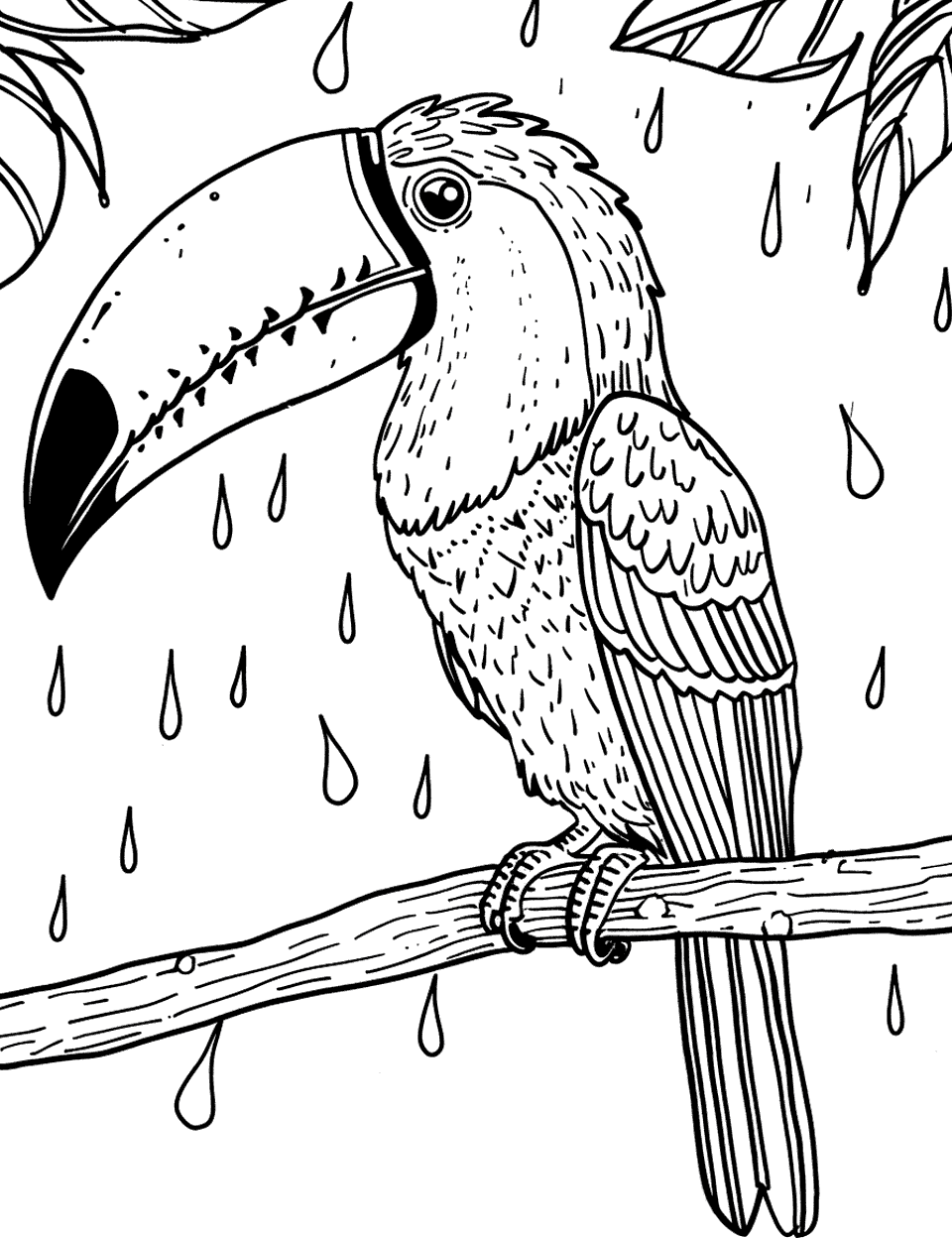
Raindrops fall in loose rows across the whole background while a toucan sits still on its branch. The bill takes up nearly a third of the page and already carries a solid black patch. Leaves hang in from the top corners, so there is green on two sides if you want it. Leaving the drops uncolored keeps the rain readable against a filled-in sky.
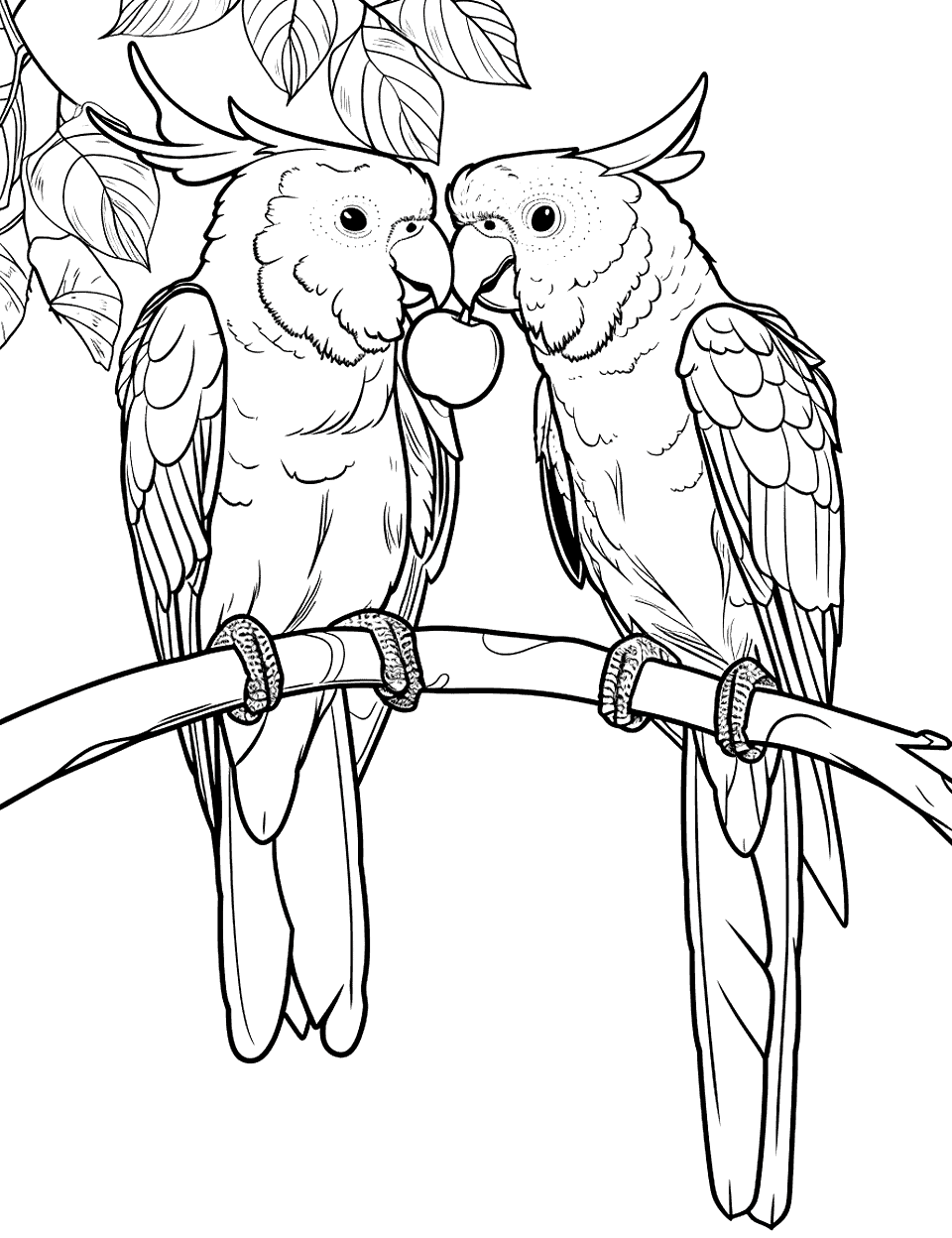
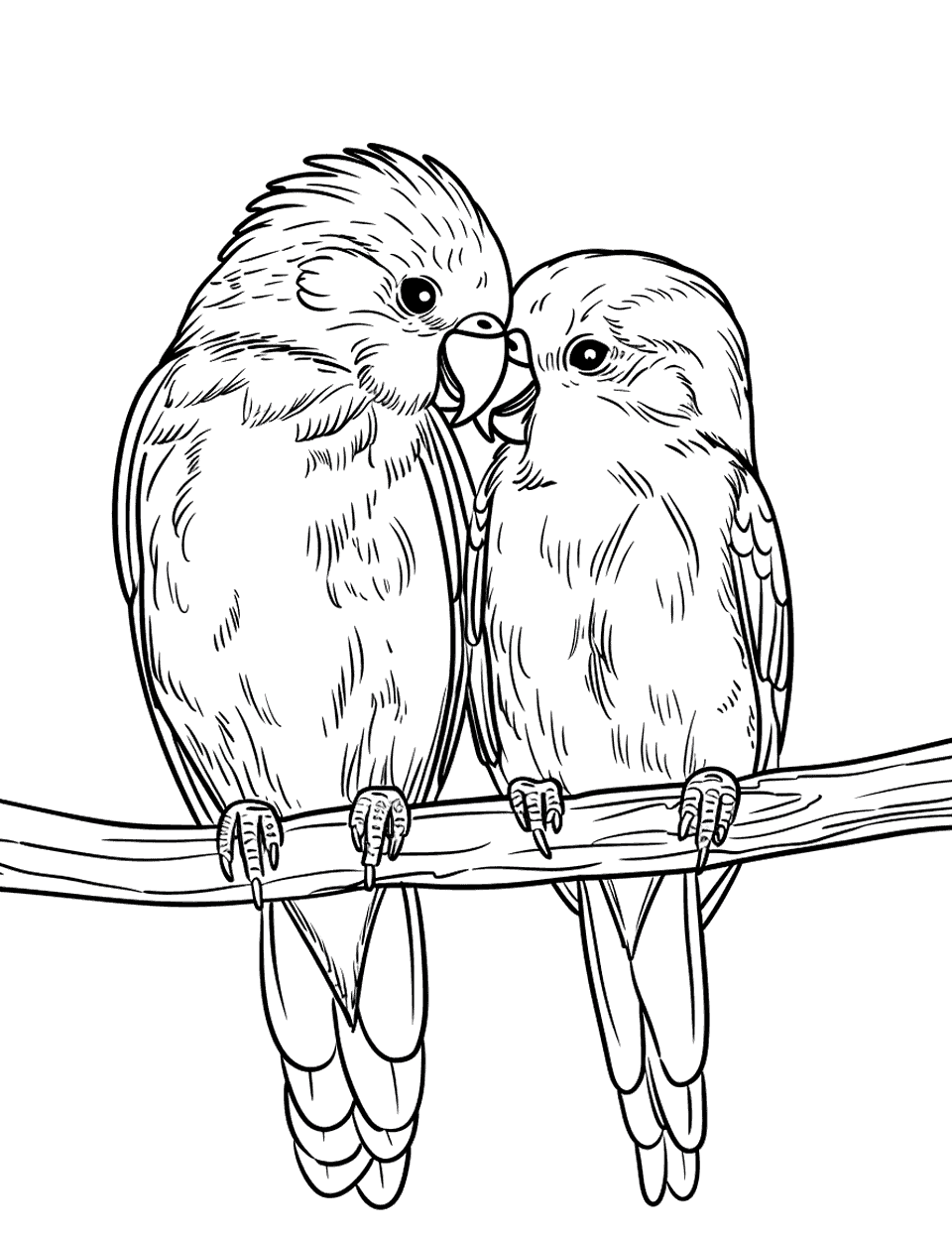
Two plump birds lean into each other on a bare branch, beaks almost touching. Their bodies are covered in short feather strokes rather than outlined shapes, which suits pencils better than markers. Long tails hang down side by side below the branch. The background is completely open if your child wants to add a nest or a sky.
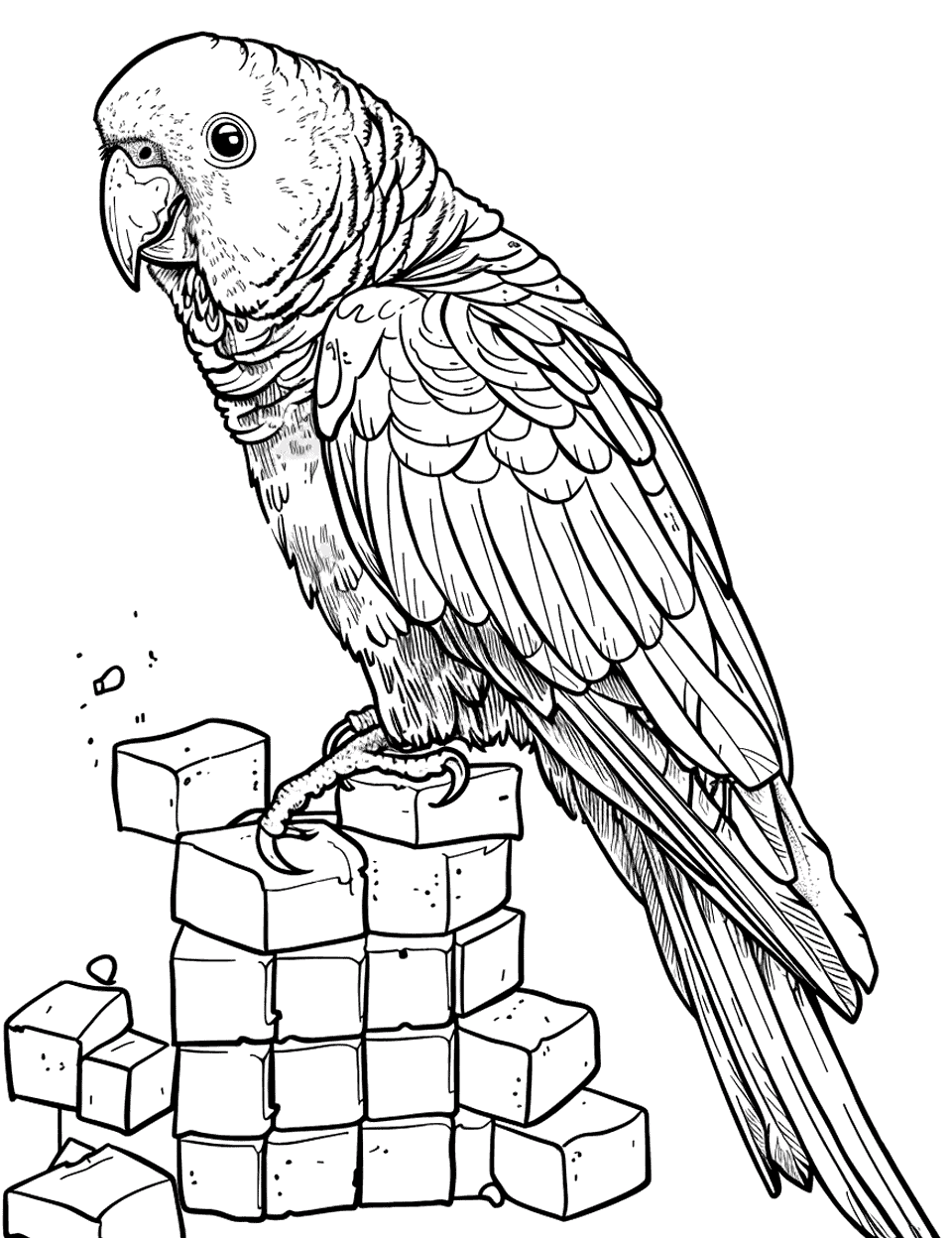
This parrot has claimed the top of a stack of cube blocks, with a few more blocks scattered on the ground beside it. The blocks are plain squares, which makes them the fastest part of the page to fill. Feather detail on the back and wing is much finer, so save that for last. Coloring each block a different shade turns the stack into a small rainbow under the bird.
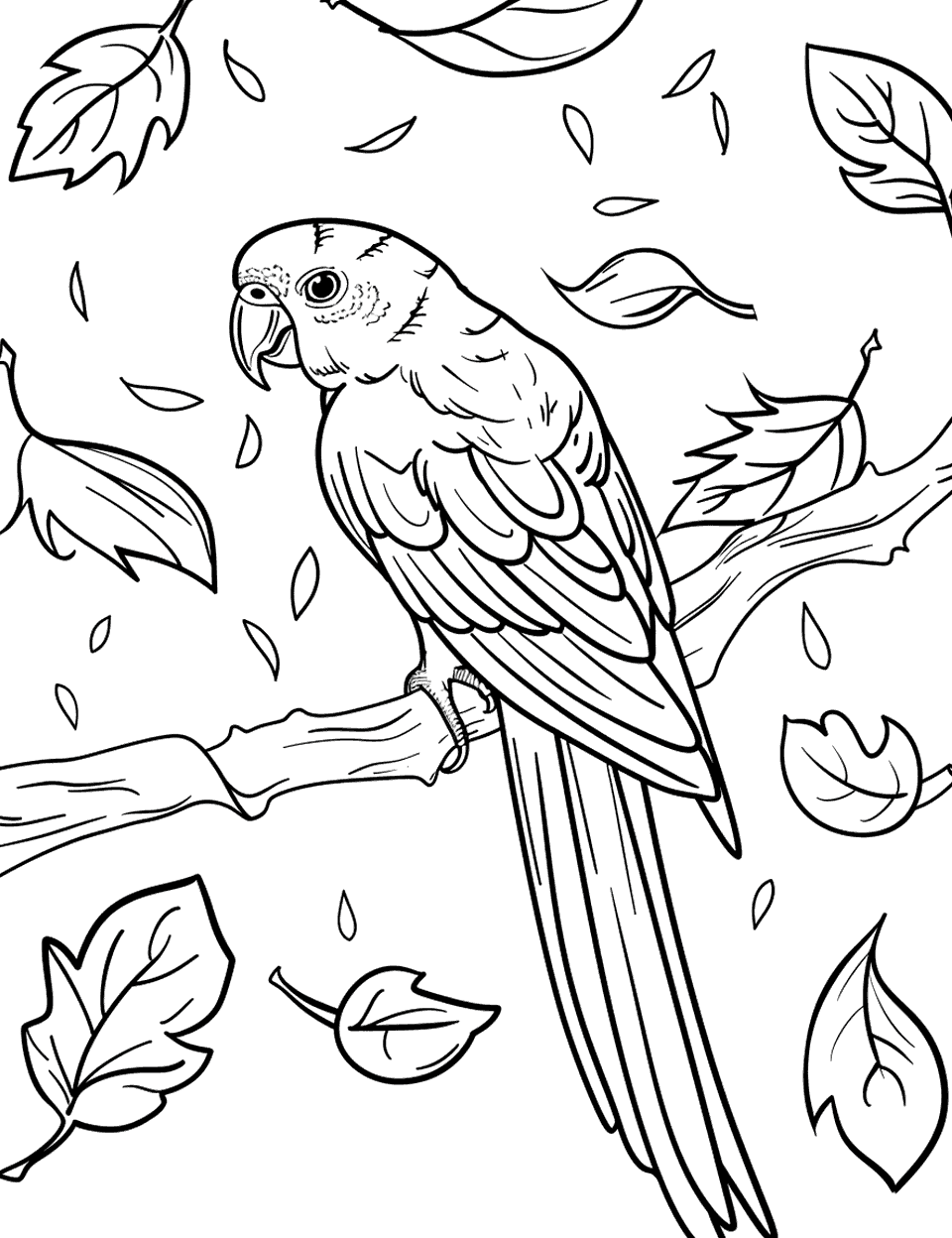
Leaves drift across every part of this page while the bird sits calmly on a bare branch. They come in several shapes and sizes, so autumn colors can shift from leaf to leaf without looking wrong. The tail runs almost to the bottom edge and gives the page a strong vertical line. A good sheet for fall, and an easy excuse to talk about why leaves drop.
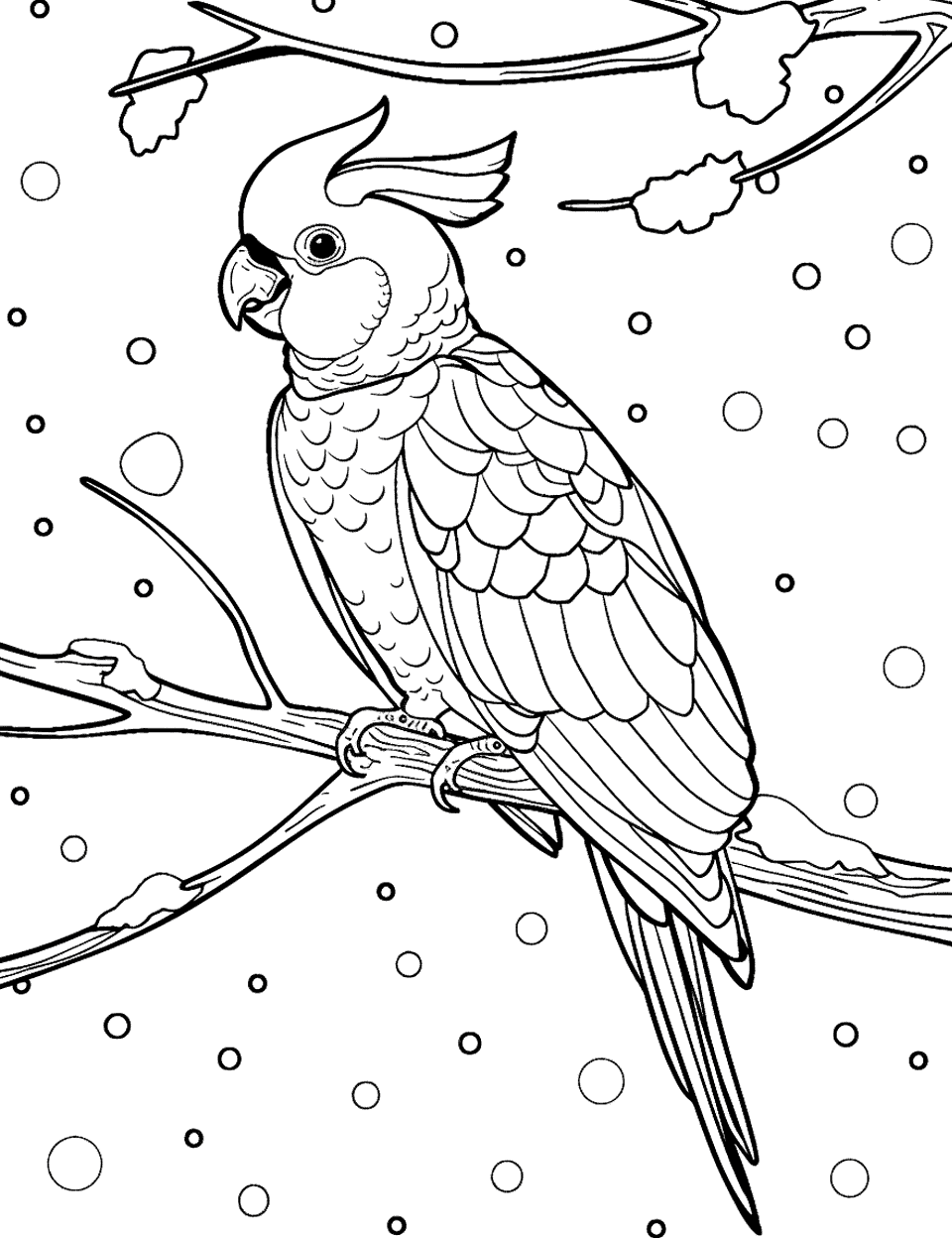
Snow falls as plain circles of different sizes, and the branch below carries little caps of it. The crest curves forward over the bird’s head, and the body feathers sit in neat scaled rows. Leaving the circles white against a pale blue sky is the simplest way to make the snow read. It is an odd setting for a tropical bird, which is exactly why kids pick it.
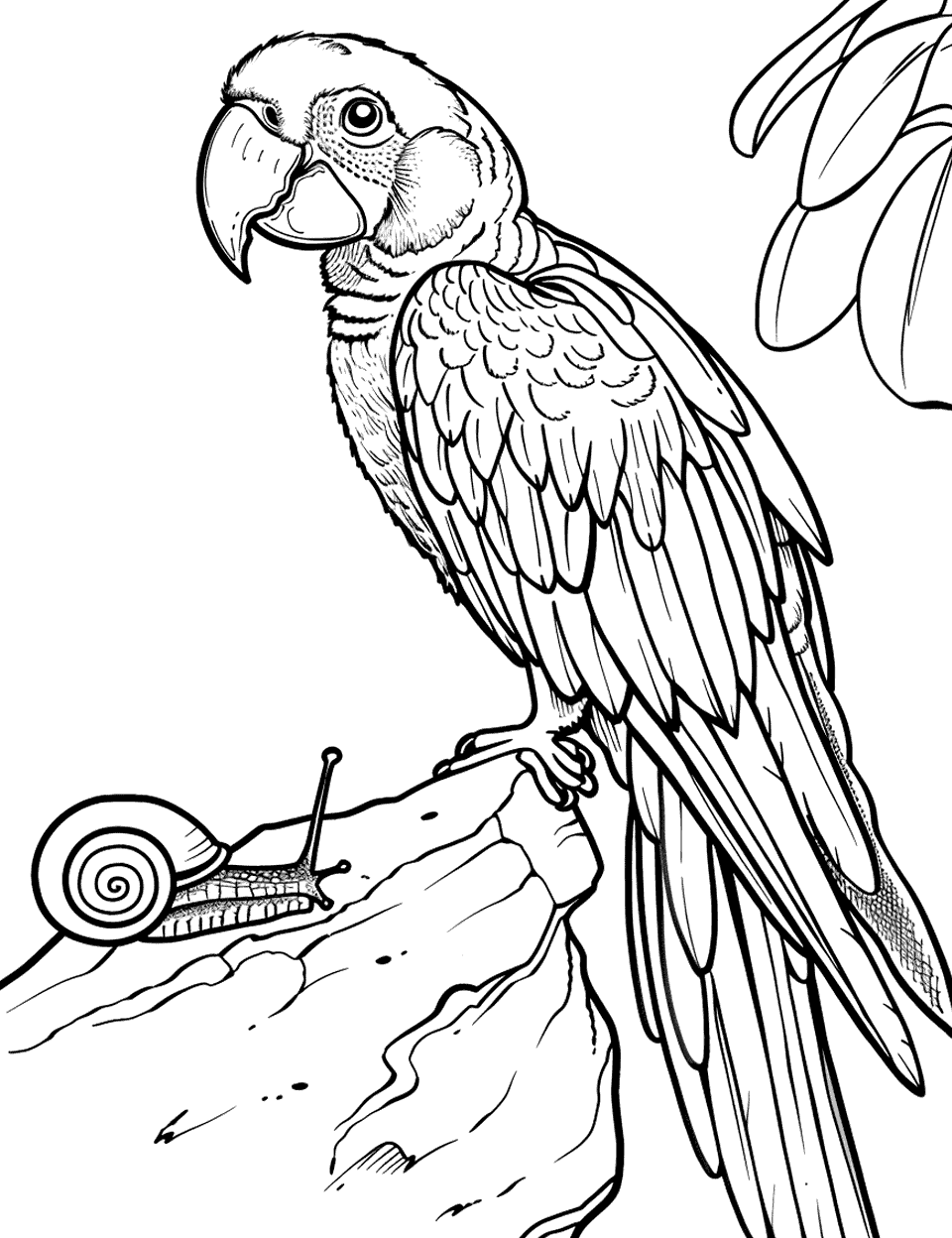
A snail crosses the rock while the macaw watches from above. The shell is a tight spiral, small enough that a fine pencil helps. A large leaf shape fills the top right corner and the rest of the page stays open. The cracked rock takes gray shading well and gives the bird’s colors something plain to sit against.
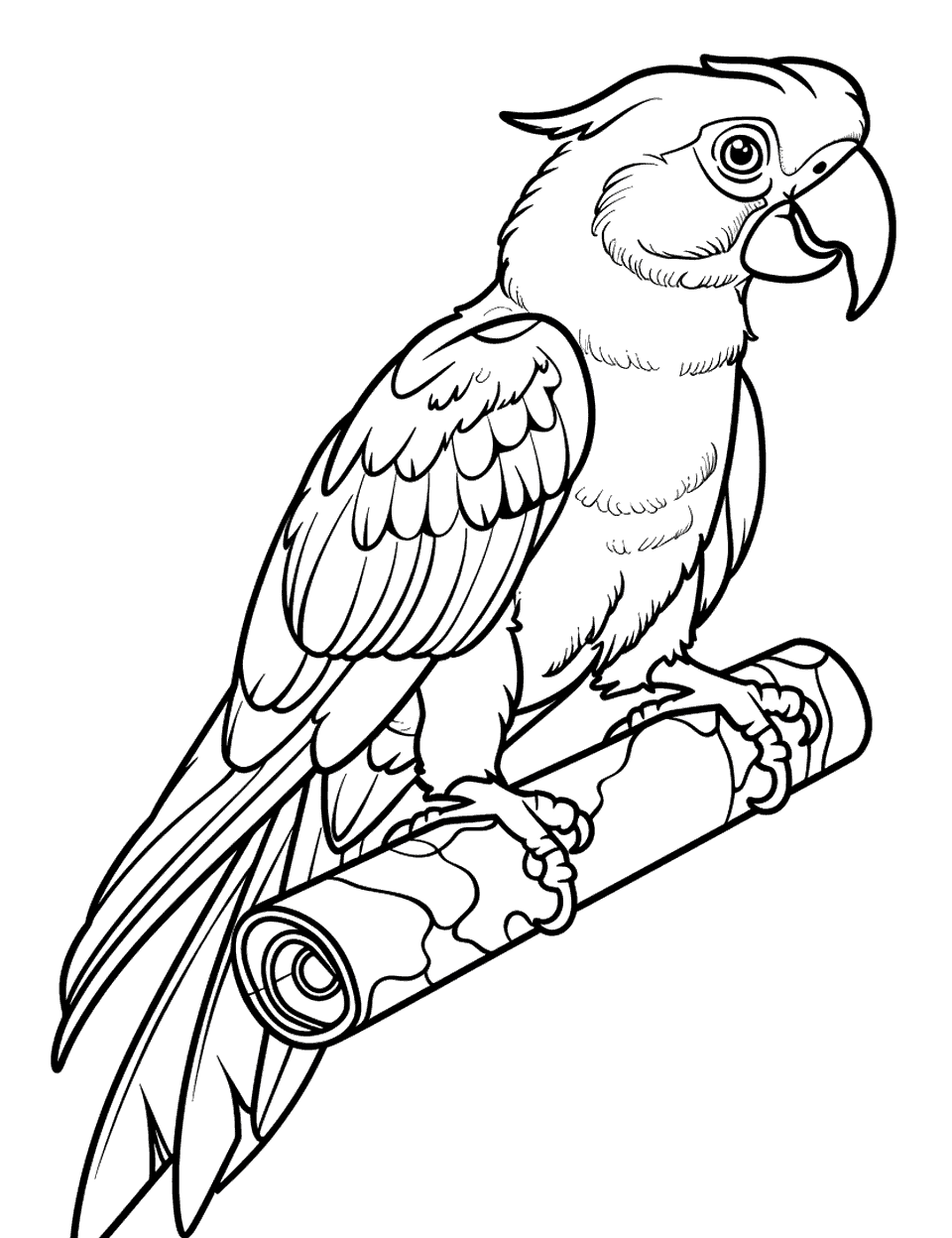
A parrot perches along a rolled-up scroll, gripping the paper with both feet. Blotchy shapes across the sheet read like islands and coastline, so it works as a treasure map without carrying any words. The scroll is one long simple shape, which makes it an easy warm-up before the feathers. Pair it with a pirate story and let your child draw an X wherever they like.
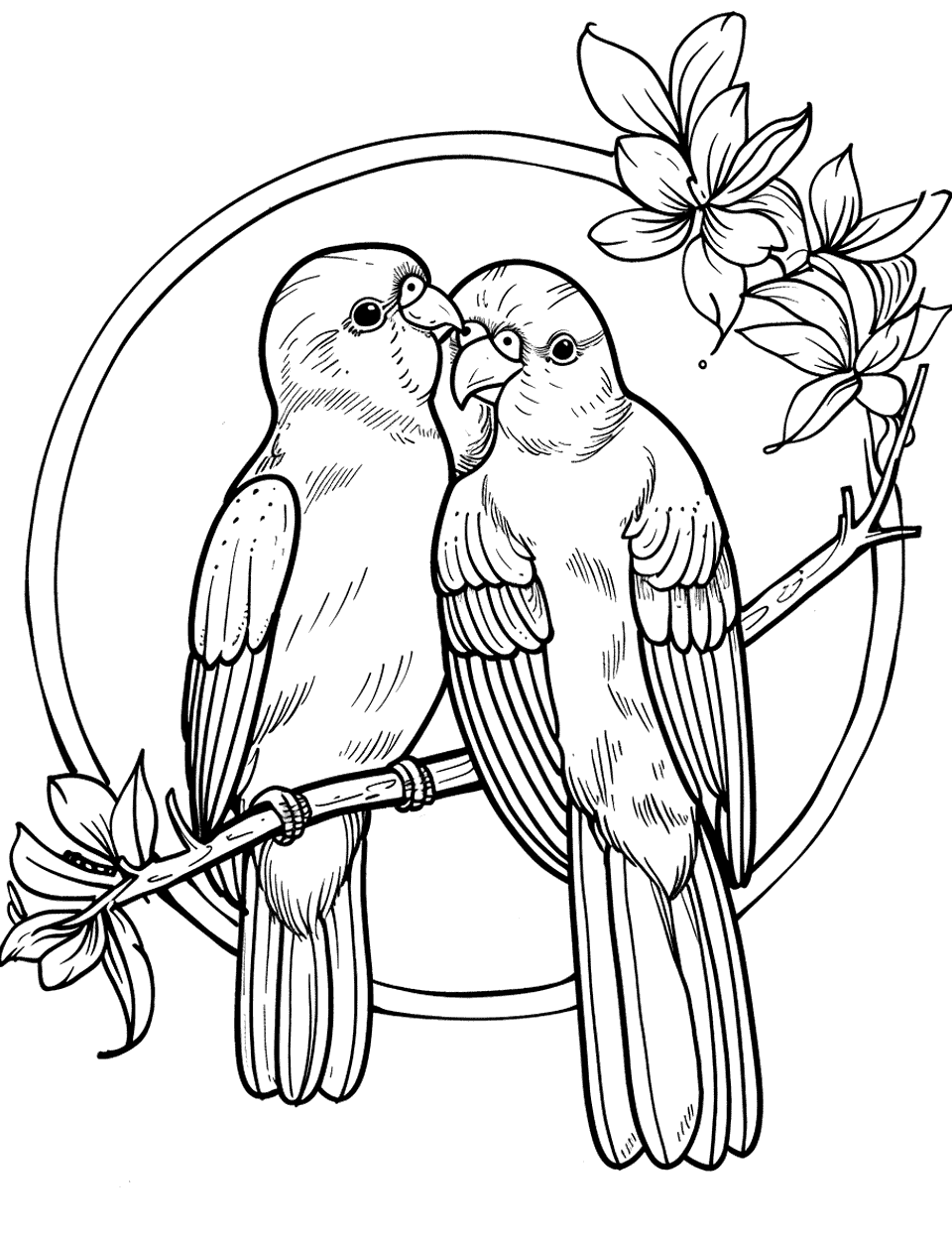
Inside a big circle, two love birds share a branch and lean their heads together. Flowering sprigs cross the ring at the top right and the bottom left, breaking up the outline. The layout is symmetrical enough to cut out and use as a card front or a door hanger. Coloring the pair to match plays up the framed look.
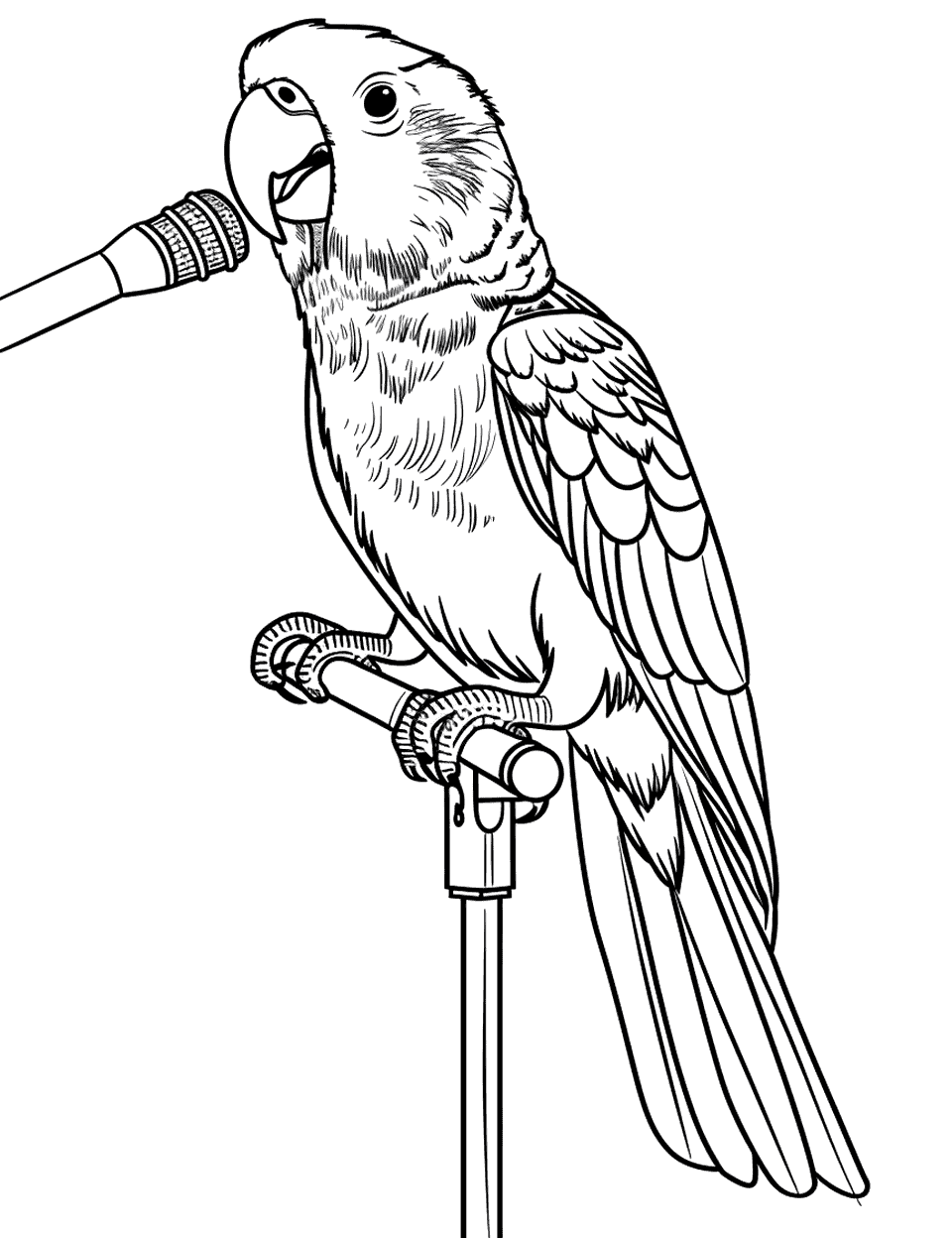
A parrot grips a microphone stand with both feet and holds its open beak up to the mic. The stand is drawn with clean straight lines that contrast with all the feather texture behind it. Its tail sweeps down the right side of the page in long strokes. Silver or black on the microphone lets the bird’s colors do the work.
By using our free coloring pages, you acknowledge and agree to our full disclaimer. All materials are for personal, non-commercial use only and all rights belong to their respective license holders.
Which Parrots Are on These Coloring Pages?
This set draws four groups of birds: macaws, cockatoos, love birds, and two toucans that are not parrots at all, plus close-ups of chicks and feathers. Knowing which is which changes how you color them.
Macaws are the biggest birds in the collection, and their sheets are drawn to match. The hyacinth macaw grows to roughly 40 inches (100 centimeters) long with a wingspan of more than 4 feet (127 centimeters), and there are 17 macaw species in all (4). That is why the two flight pages fill the paper edge to edge.
Cockatoos are the ones with the crest, and there are 20 species. The tallest of them, the red-tailed black cockatoo, reaches 26 inches (65 centimeters), according to the San Diego Zoo Wildlife Alliance. A raised crest is not just decoration: it means the bird is alert, excited, or agitated, and a cockatoo flattens those same feathers when it feels subordinate. The raised crest shows up on more than one sheet here.
The two toucan sheets are the odd ones out. Toucans belong to their own family, 34 species strong, and the same zoo puts the largest of them at 24 inches (61 centimeters). They share the rainforest with parrots, which is why they keep turning up in parrot coloring books.
Love birds appear on three pages, always as a pair on a branch. If you want something to talk about while you color, the San Diego Zoo Wildlife Alliance puts parrot lifespans at 10 to 60 years depending on species, and says cockatoos can reach 60 years or longer.
What Colors Should You Use on a Parrot Coloring Page?
Any color works, and no parrot sheet has ever been ruined by a purple macaw. But if your child wants the bird to look real, start from the family’s actual palette. Here is what the birds on these pages look like in life:
Parrots in general: greens, reds, blues, and yellows cover most of the 279 species, so mix them freely.
Cockatoos: mostly black or white, with the gray and pink galah as the famous exception. White body plus a colored crest is the safe bet.
Toucans: mostly shiny black, then bright whites, yellows, oranges, reds, and greens across the bill and throat.
Supplies matter more than color choice on a few of these. Crayons and colored pencils work on plain printer paper; markers and paint need cardstock or mixed-media paper so they do not bleed through. The close-up feather page is built from dozens of small closed shapes, so a sharp pencil beats a thick crayon tip on it.
One last trick: leave the background white on the flight sheets. The macaws are drawn with no scenery behind them, and an empty page makes the wings read as motion.
Activities to Do With Parrot Coloring Pages
The fun does not have to stop when the coloring does. These sheets turn into masks, mobiles, and flashcards with very little extra work.
Create a 3D Tropical Mobile
Cut out the two flight sheets and the falling-leaves bird, punch a hole at the top of each, and thread yarn through. Tie the strings at different lengths to a coat hanger or two crossed sticks. Hung near a window, the birds turn on their own every time somebody walks past.
DIY Parrot Masks
Print the crest cockatoo and the chatty parrot on cardstock, so the mask holds up. After coloring, help your child cut around the face and carefully cut out the eye holes. Tape a craft stick to the bottom or staple on an elastic loop, and the mask outlasts the afternoon.
Feather Texture Art
Glue real craft feathers along the wings instead of coloring them in. The close-up feather page is the best target, because every feather is already its own shape to fill or cover. It adds a texture kids want to touch, which is worth the glue mess.
Jungle Storytelling
Use the scene pages as story prompts. Ask why the parrot is standing on a rolled-up map, or what the macaw and the snail are saying to each other. Write the answer on the back of the page before it gets forgotten.
Educational Flashcards
Shrink the print size so four sheets fit on one page, color the birds to match their real coloring, then cut them apart. The cockatoo, toucan, and macaw pages make an easy first set, because the three look nothing alike. Quiz each other on which bird is which, and which one is not a parrot at all.
FAQs
What Are the Most Common Colors for Parrots?
Parrot feathers are mostly greens, reds, blues, and yellows, across 279 species worldwide. Cockatoos break the pattern by being mostly black or white, apart from the gray and pink galah, and toucans are mostly shiny black with bright trim. On these sheets that means a macaw takes almost any bright color you own, while a cockatoo looks most lifelike in white with a colored crest. None of it is a rule your child has to follow.
What Is the Best Paper to Use for Coloring Pages?
Standard printer paper is fine for crayons and colored pencils, which is what most of these sheets are designed for. Switch to cardstock or mixed-media paper the moment your child reaches for markers or watercolor, because thin paper lets both bleed through and buckle. Cardstock is also the right call for anything you plan to cut out, like the mask and mobile projects above.
Are Toucans Parrots?
No, toucans are not parrots. They belong to the family Ramphastidae, which holds 34 species, while parrots are a separate group of 279. The bill is the giveaway: a toucan’s is about four times the size of its head and nearly as long as the rest of its body, hollow inside except for a crisscross network of bony fibers, with serrated edges. The two toucan sheets are here because the birds share the same rainforest.
Which Parrot Coloring Page Is Easiest for a Young Child?
The cartoon chick flapping its wings is the easiest sheet in the set: thick lines, few shapes, and one oversized eye. The gliding macaw is a close second, since its wings are large open areas that fill quickly. Save the close-up feather page for older kids, because it is built from small closed shapes that a chunky crayon cannot handle.
How Can Coloring Help My Child’s Development?
Coloring builds grip strength and hand-eye coordination, the same fine motor control your child needs later for handwriting. Working near the lines takes steady pressure and small wrist movements, which is why the detailed feather sheets suit older kids and the thick-lined chick sheet suits preschoolers. It is also quiet, which most parents count as the real benefit.
Can I Use These Pages for a Classroom Project?
Yes, print as many copies as your class needs. The set fits units on rainforests, bird anatomy, or classification, since it includes both parrots and two toucans that are not parrots. Pair the flight sheets with a lesson on wings, or use the crest cockatoo to talk about how animals signal mood.