Ready for takeoff? Grab the crayons and pick a runway.
Forty free airplane coloring pages are lined up below, from chunky cartoon planes a three-year-old can finish before the kettle boils to a plowed-field crop duster that will absorb an eight-year-old for a whole afternoon.
Jets, biplanes, a glider, a seaplane, a stealth bomber and two helicopters are all in the set. Every sheet prints on ordinary letter paper, and nothing here costs anything.
Print a handful, spread them on the table, and let your child pick which one gets the wildest paint job.
First Solo Flight
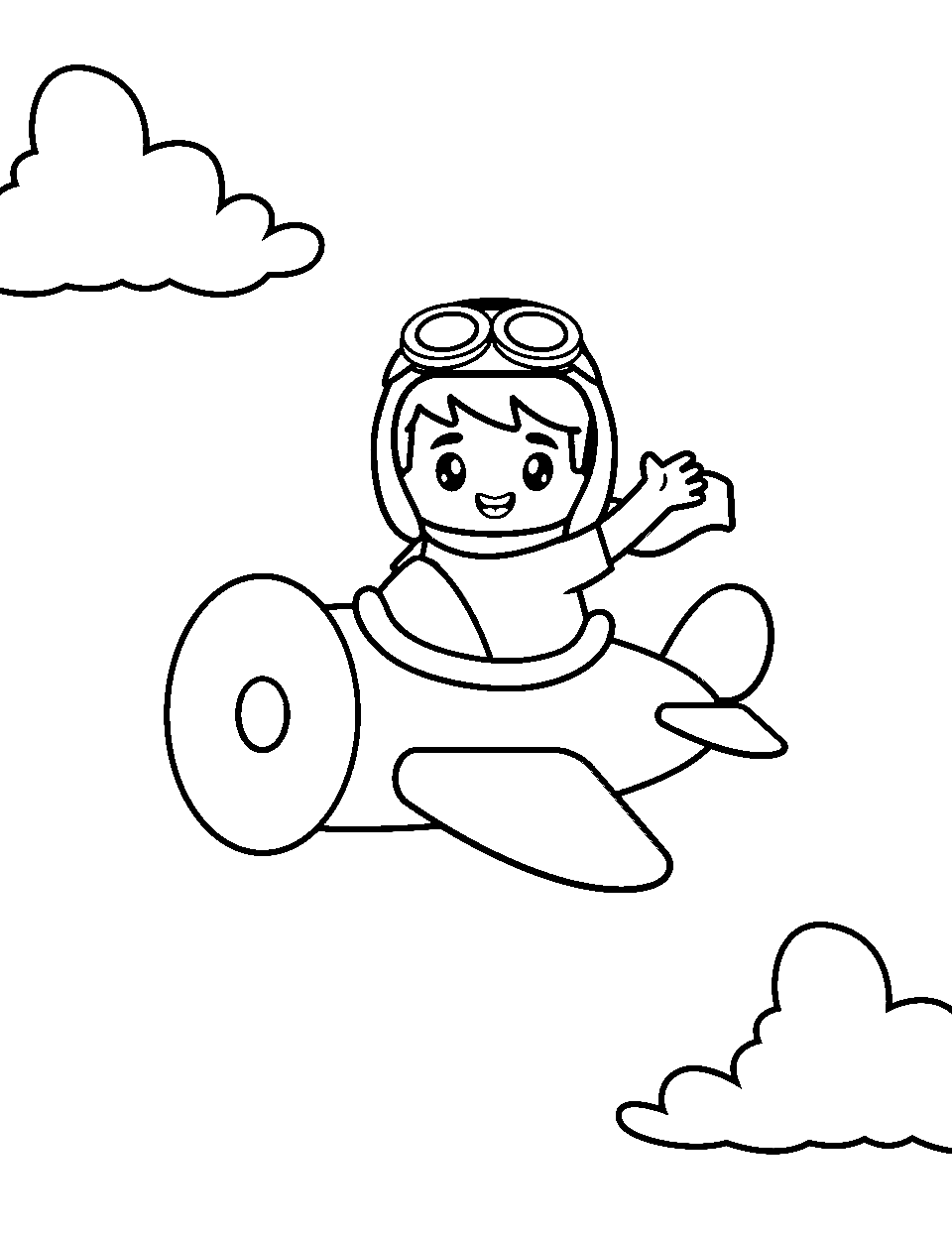
A grinning kid in a leather flying cap and goggles waves from the cockpit of a stubby little plane. The body is drawn as a few fat shapes with a big round nose, and a cloud sits in one top corner with another near the bottom. Thick lines and wide gaps make this the right starting point for a preschooler with chunky crayons. Brown cap, bright plane, and the sky left white is all it needs.
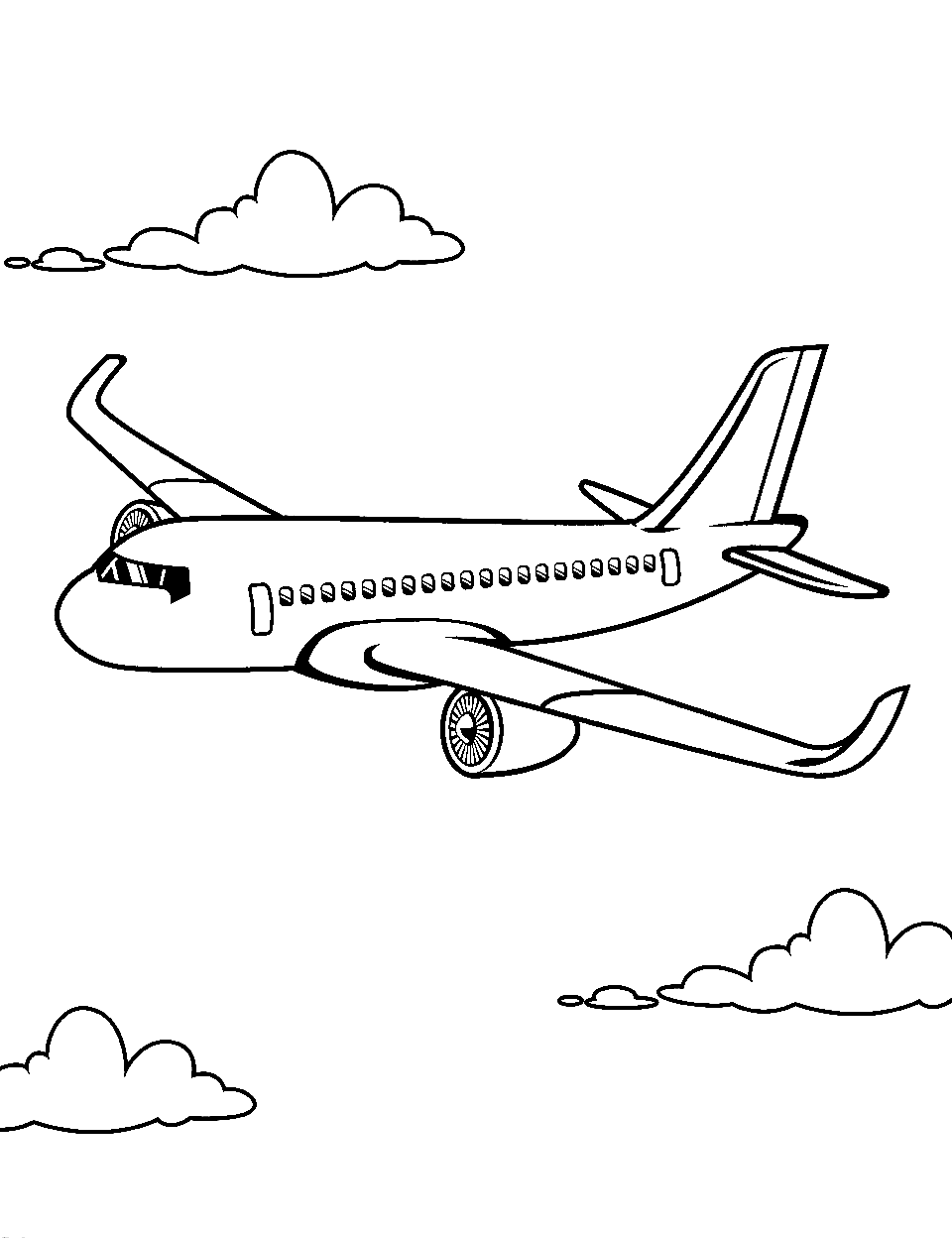
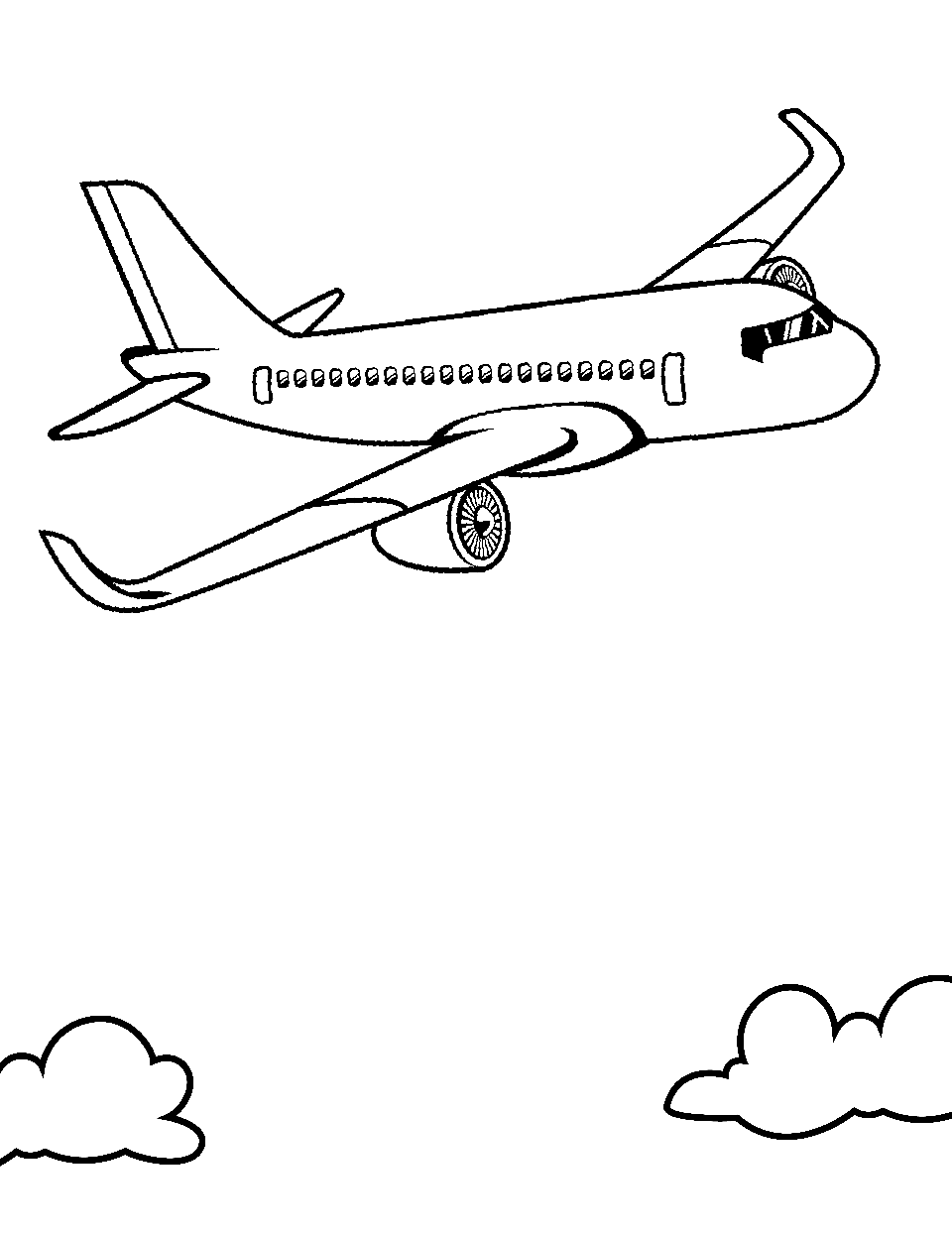
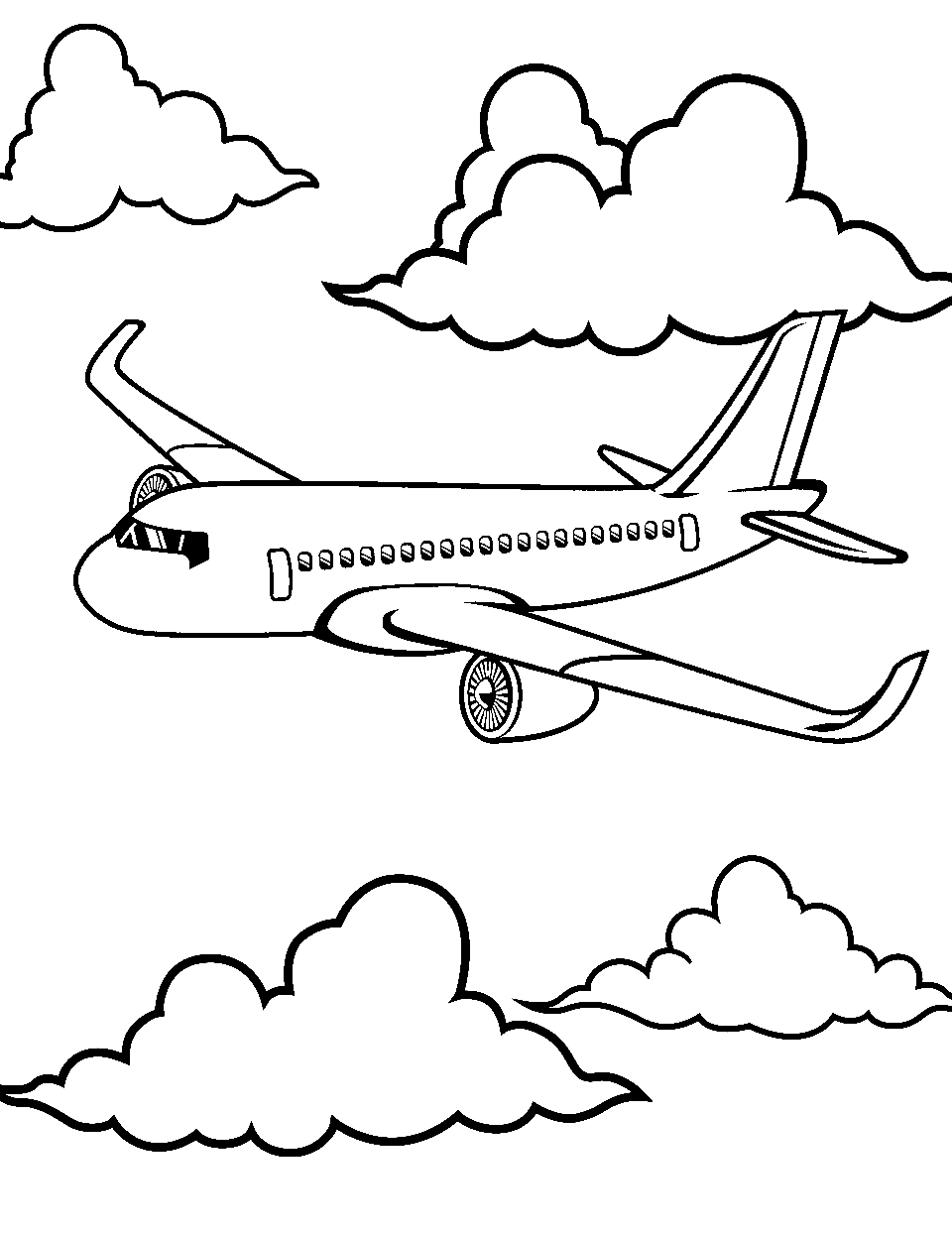
Here the artist went for realism: a modern jetliner in profile with swept wings, upturned wingtips and a long row of small cabin windows. Working along that window row one square at a time is a quiet task in itself. Grey and white keep it true to life, though a boldly colored tail fin looks great against it. Colored pencils suit the narrow shapes better than markers.
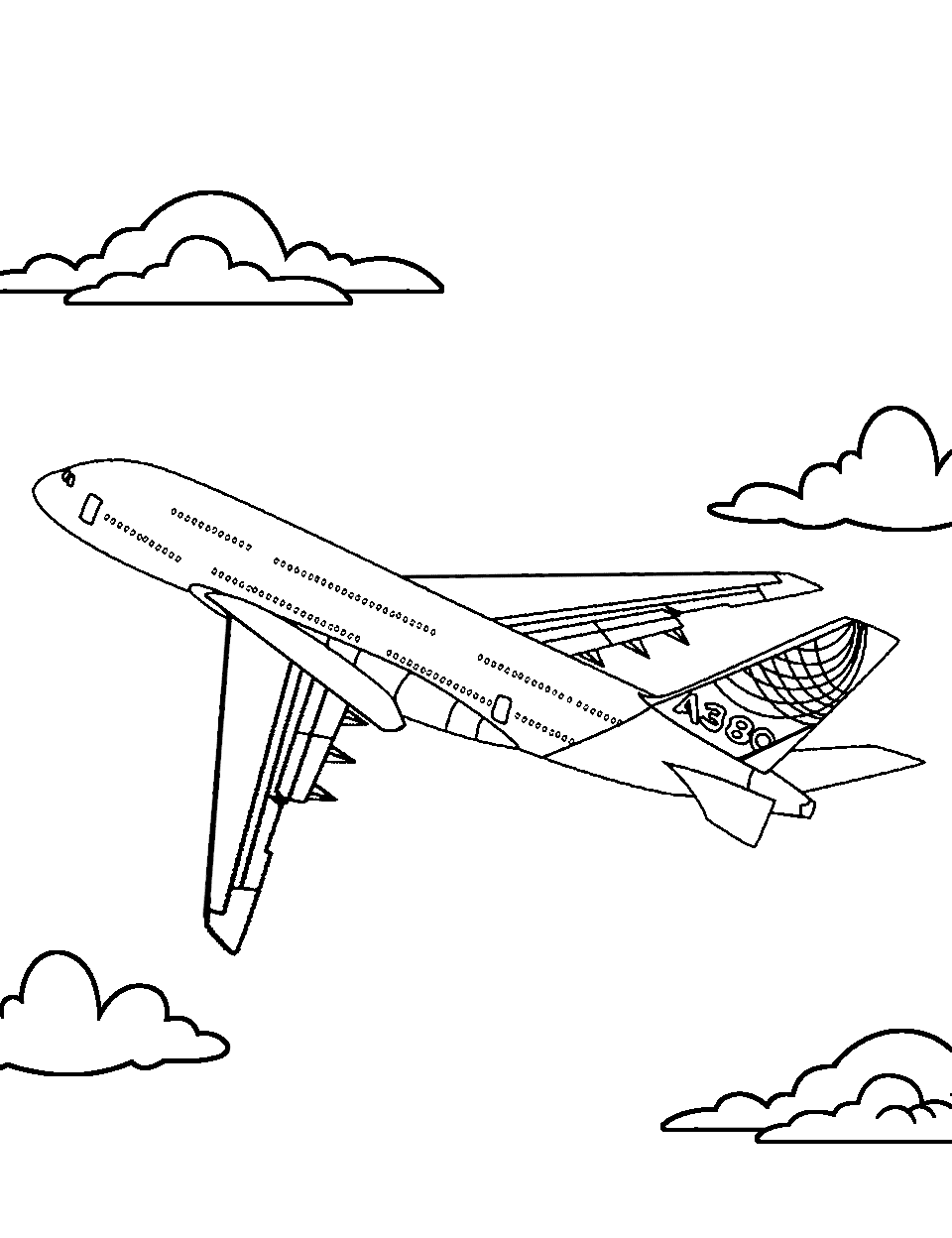
The letters A380 are printed right on the tail of this big double-deck jet, which is climbing steeply with clouds scattered behind it. Two rows of windows run the length of the fuselage, so there is a lot of small detail waiting. Fine-tip pens handle those tiny squares far better than crayons do. Hand this one to an older child who likes a long job.
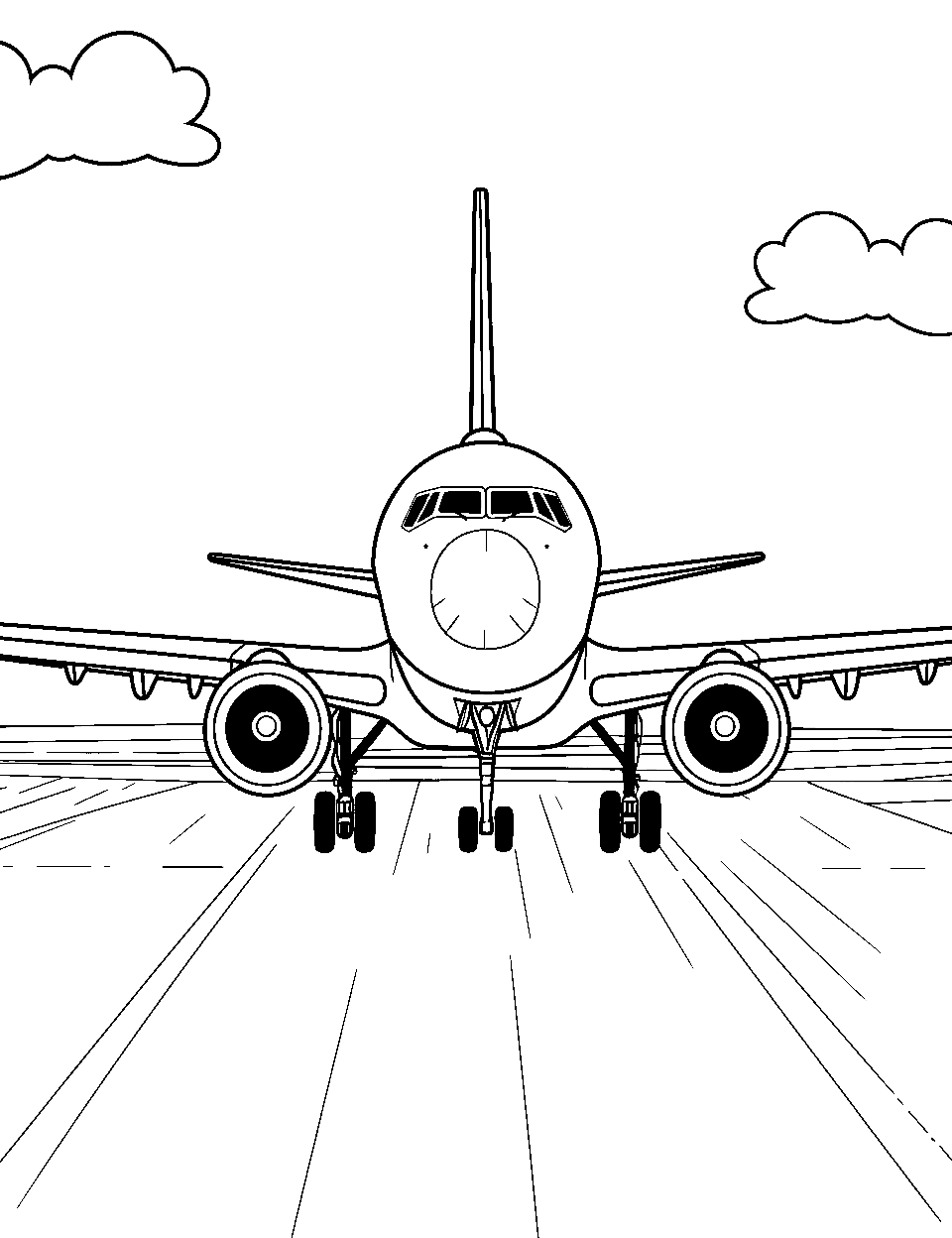
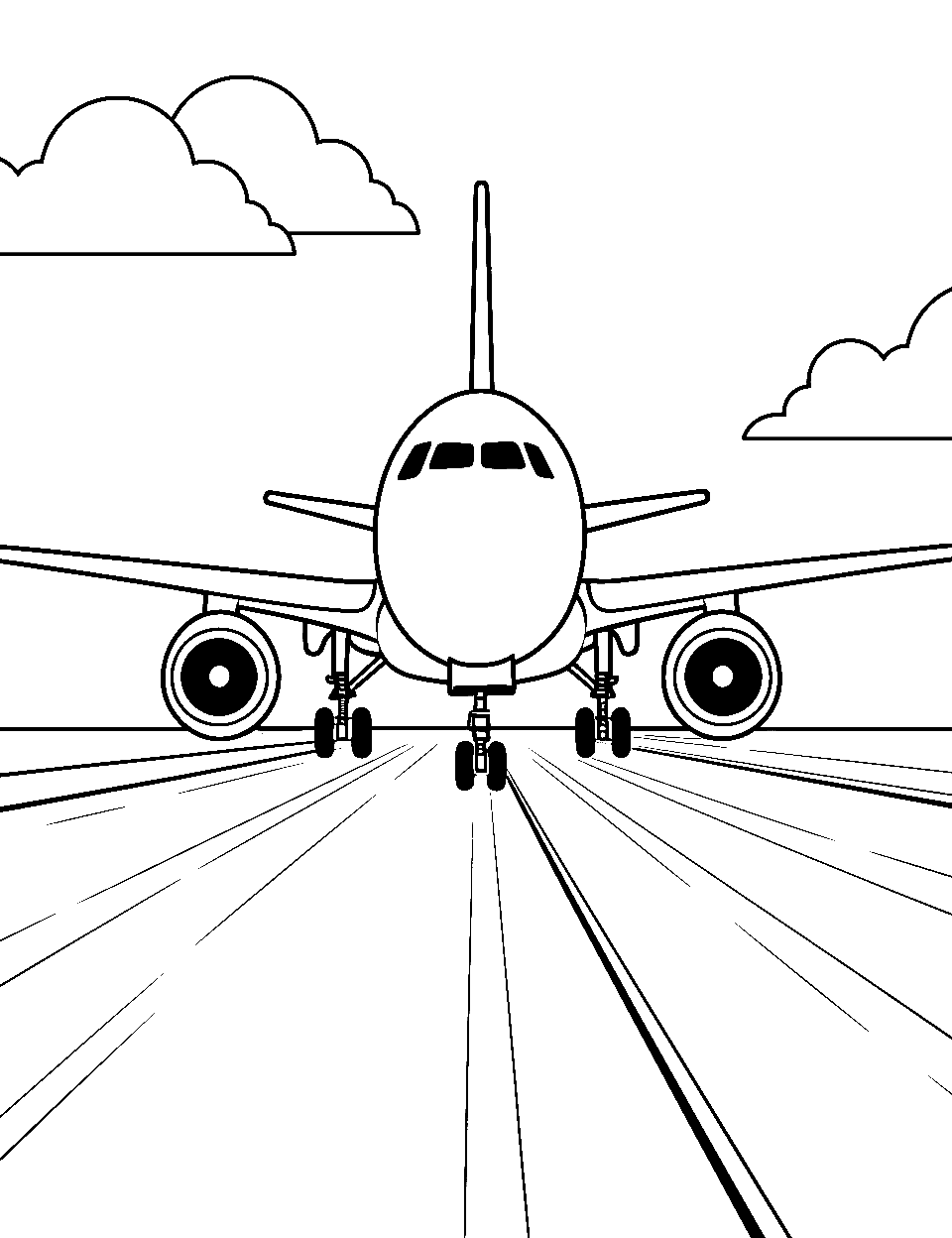
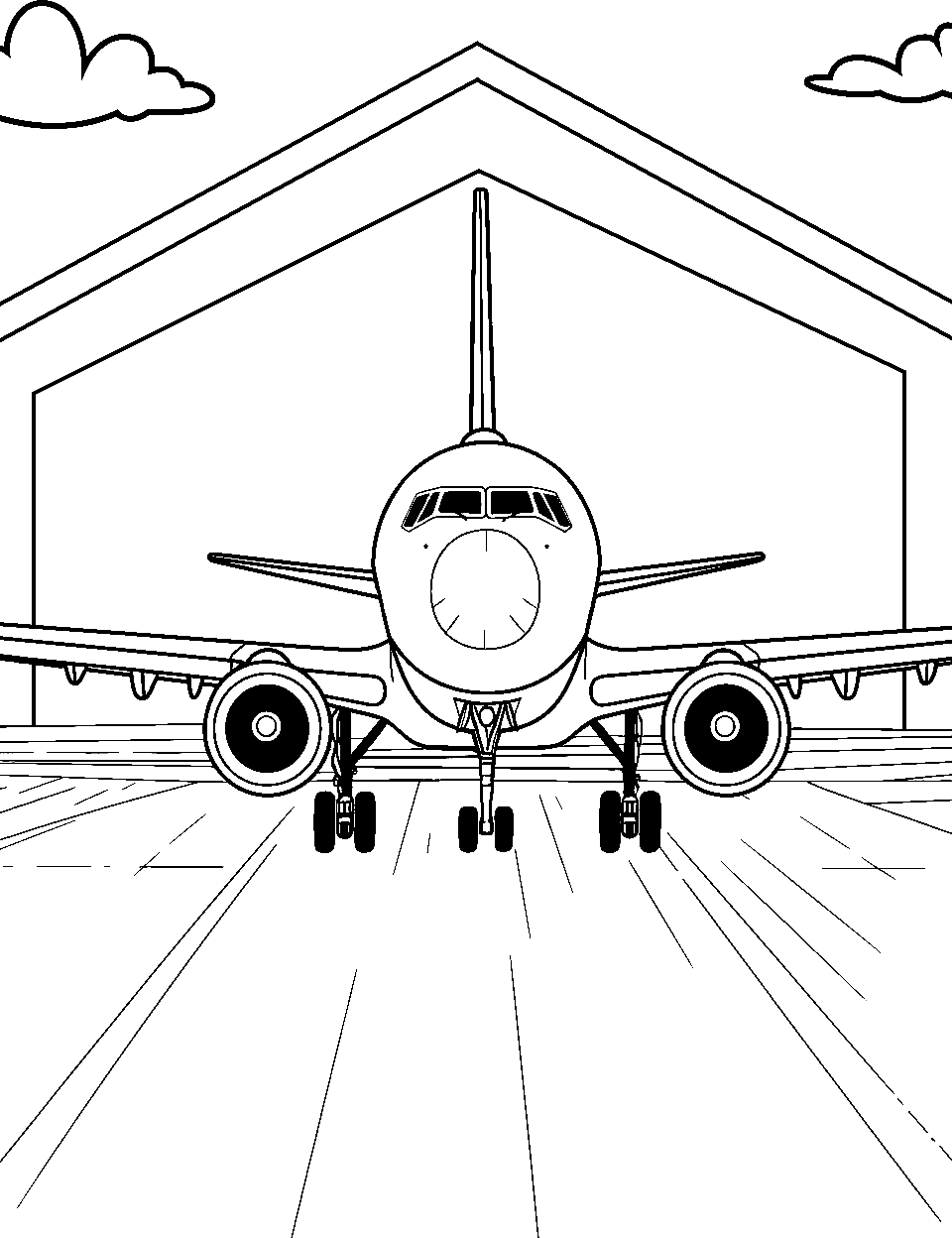
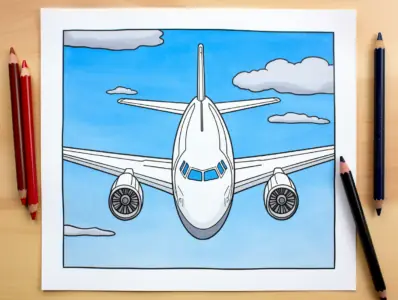
A jet faces you head-on at the end of a runway with its wheels down, and the painted centerline races off toward the bottom of the page. The nose fills the middle of the sheet while both engines hang below the wings. Those perspective lines look impressive with only two or three colors. A dark grey runway makes the plane above it stand out.
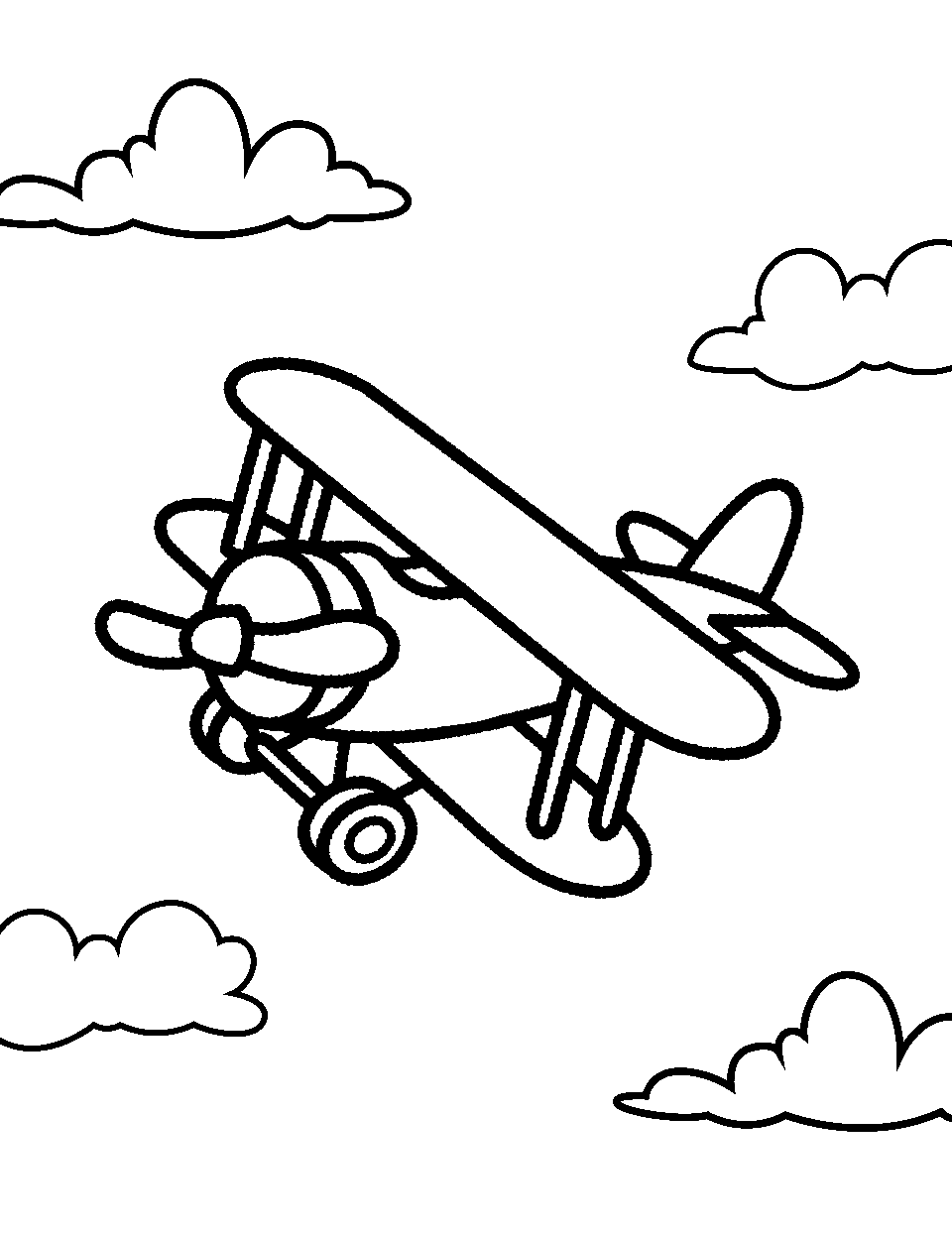
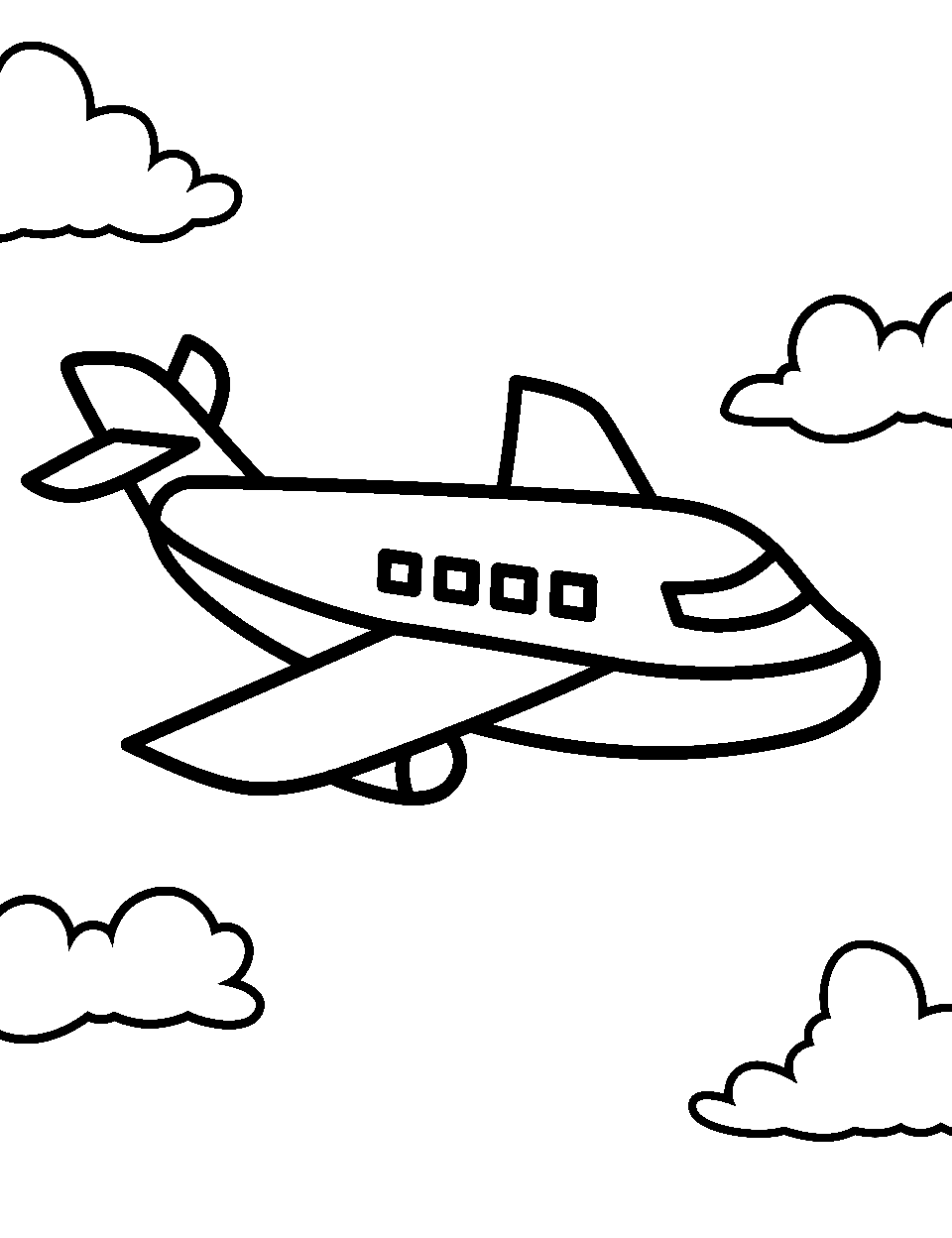
Big rounded shapes make this cartoon biplane one of the easiest sheets in the set: two fat wings, a chunky propeller and a single little wheel. It tips over on one side with a puffy cloud in each corner and plenty of white space between. Toddlers can fill the whole plane in one bold color without worrying about edges. Markers work fine here because the outlines are so thick.
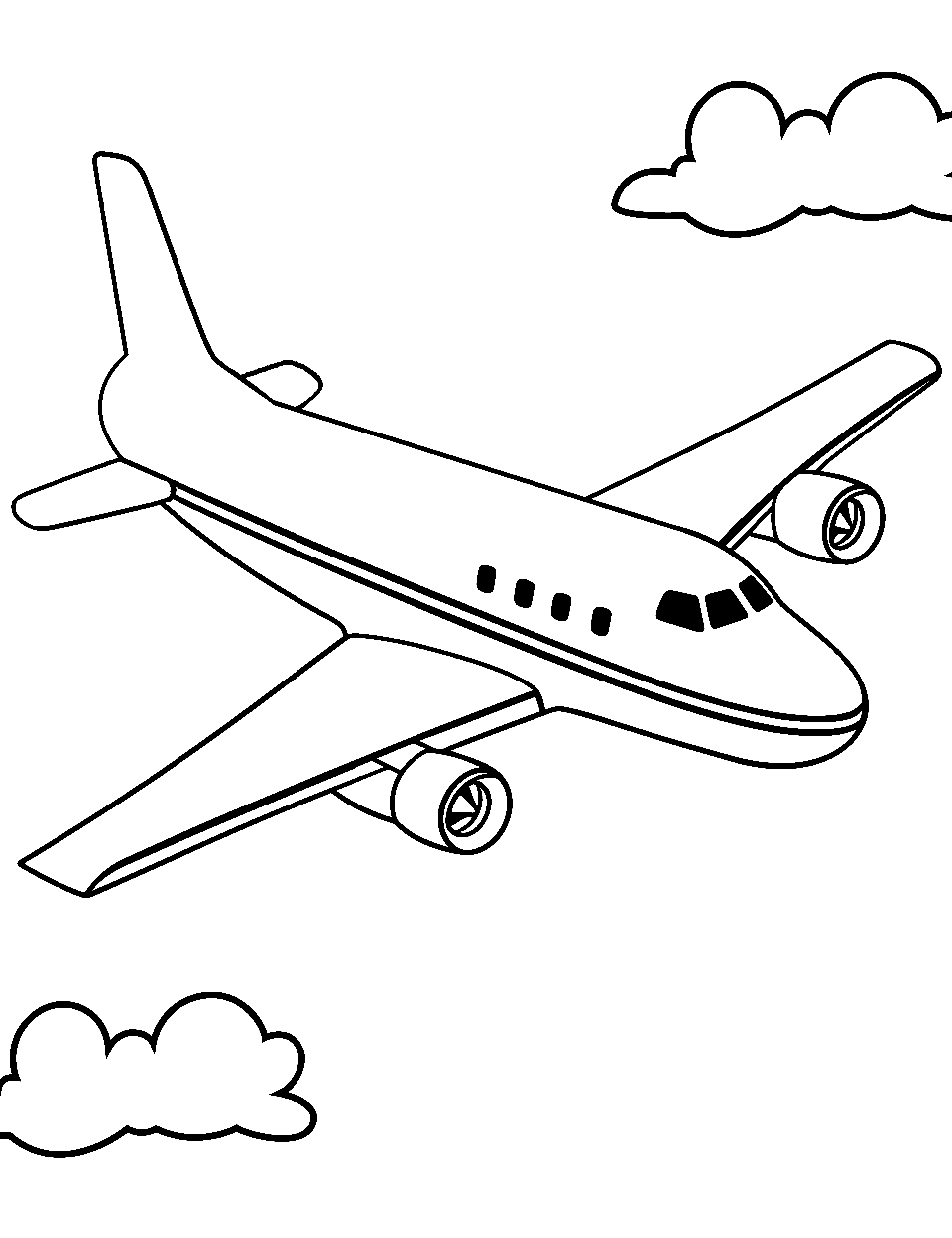
Smooth curves and a rounded nose give this passenger plane an old-fashioned look. Two engines sit under the wings, a short line of small windows runs along the side, and a couple of clouds drift past. The long stretch of blank fuselage is a good place to try blending two shades of the same color. Younger children will manage it without help.
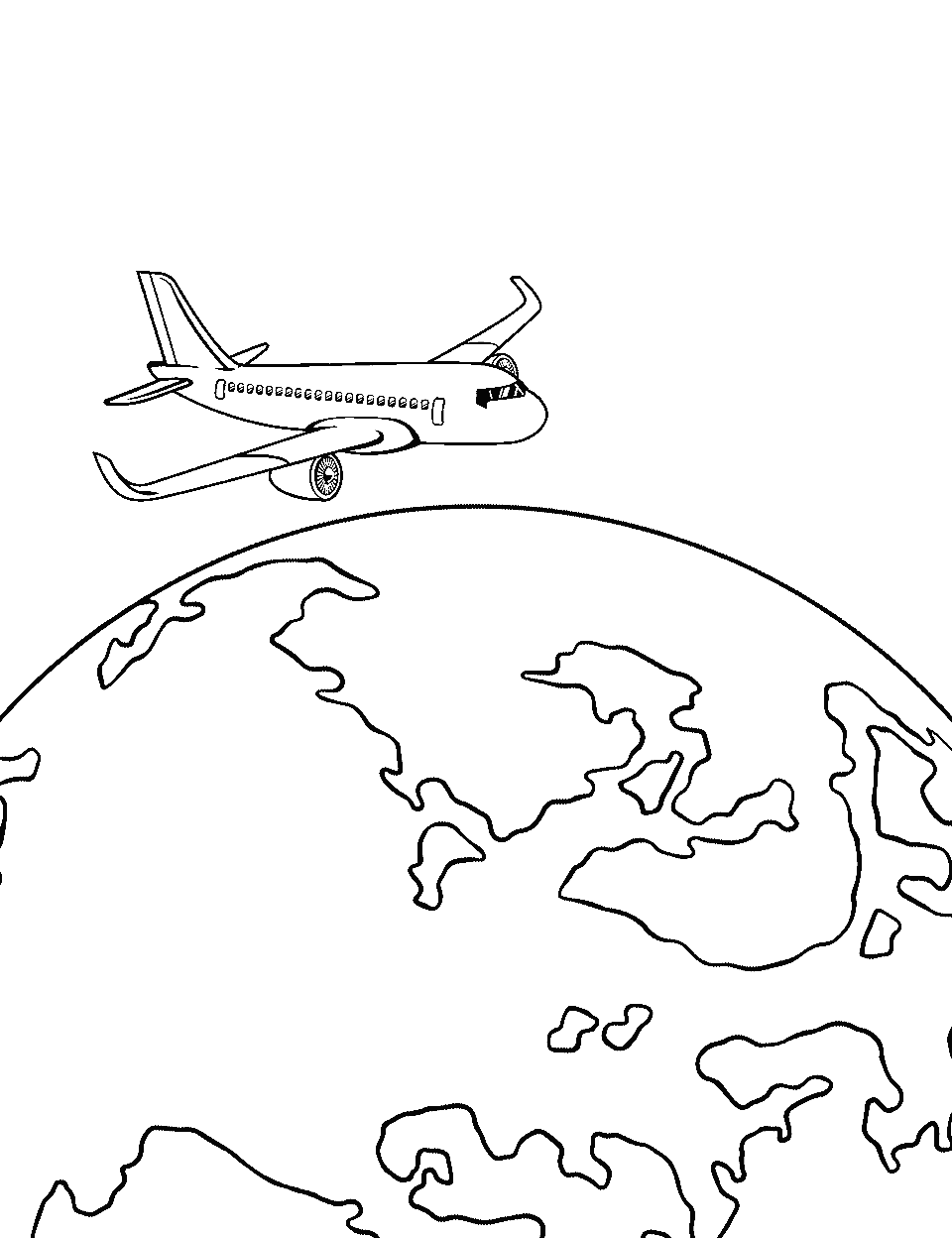
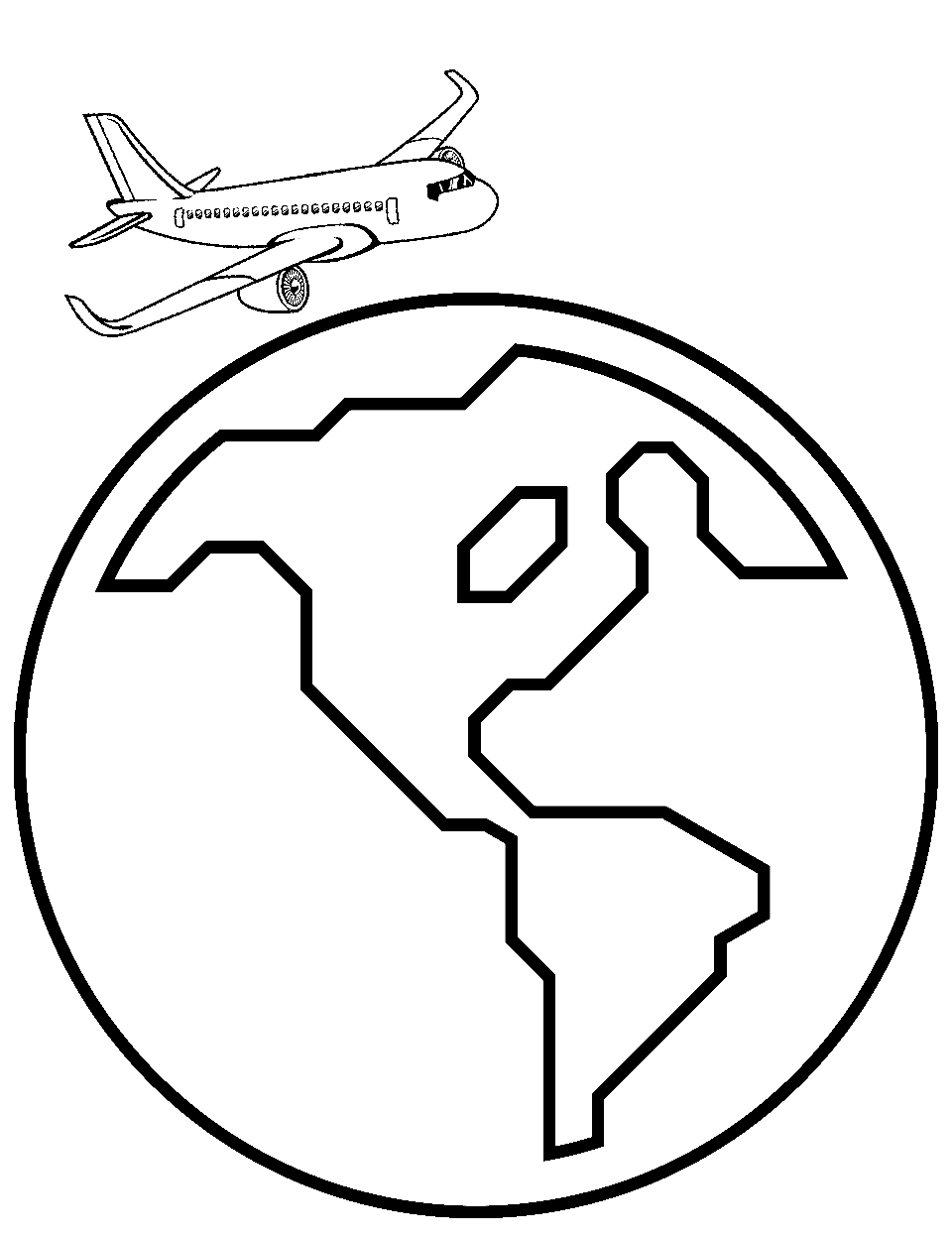
A jetliner cruises above a huge globe that takes up the bottom half of the page. The land is drawn as loose outlines rather than accurate borders, so kids can invent their own continents or pull up a map and try to match. Blue water with green land is the obvious choice, and a brightly colored plane keeps the sheet from looking like homework. Pair it with a chat about where you would fly first.
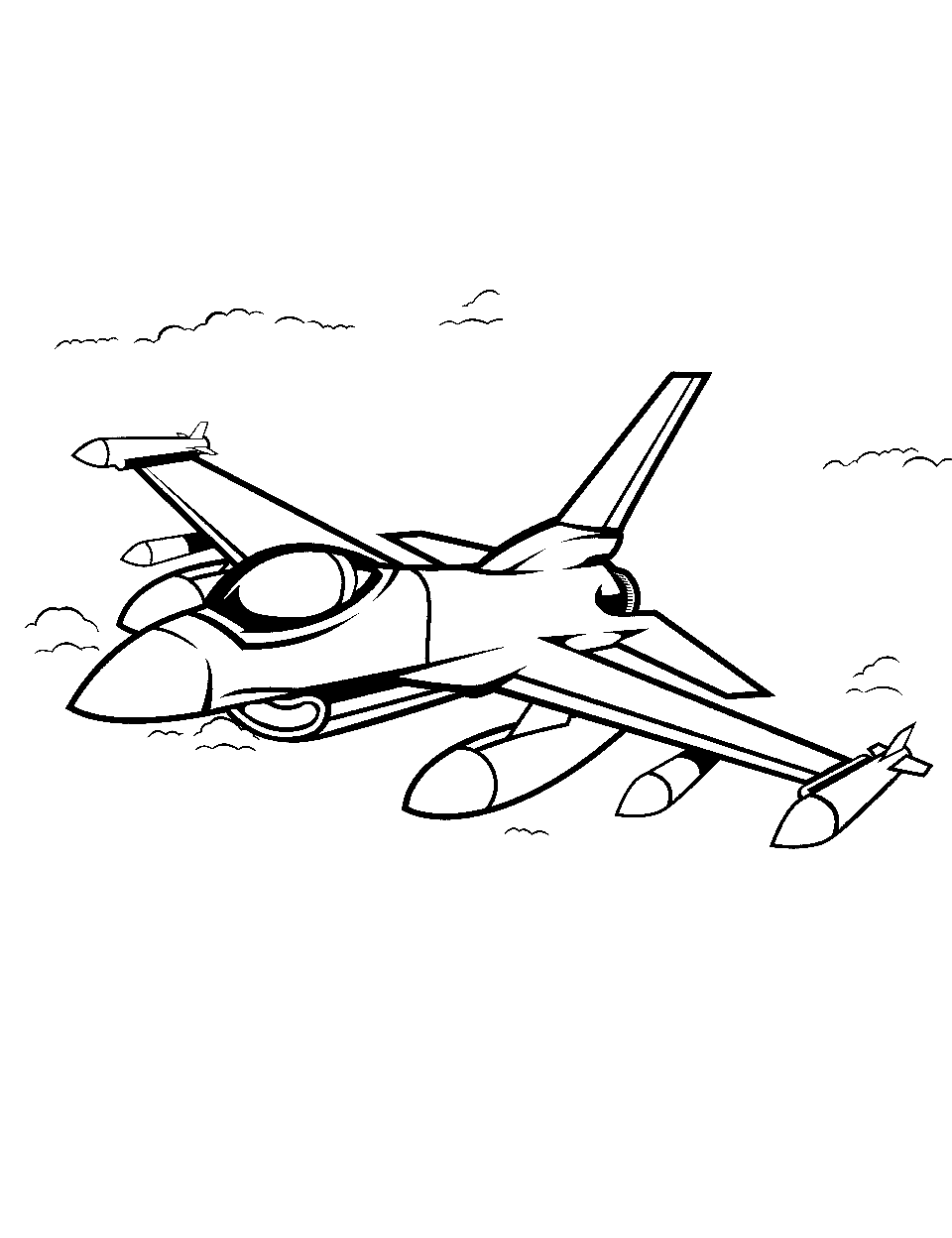
A fighter jet with a bubble canopy powers through a band of small clouds, pods slung under the wings and stores at the wingtips. Panel lines and a sharply pointed nose give it a hard, mechanical look. Grey with a colored tail stripe reads as realistic, while camouflage patches are more fun to do. This one rewards a steady hand.
Windows, a rounded body and a wing make this the friendliest plane on the page. It floats between simple clouds with a lot of open sky left over. A preschooler can finish it in a few minutes, which is the whole point. Ask your child to draw a passenger looking out of each window when the coloring is done.
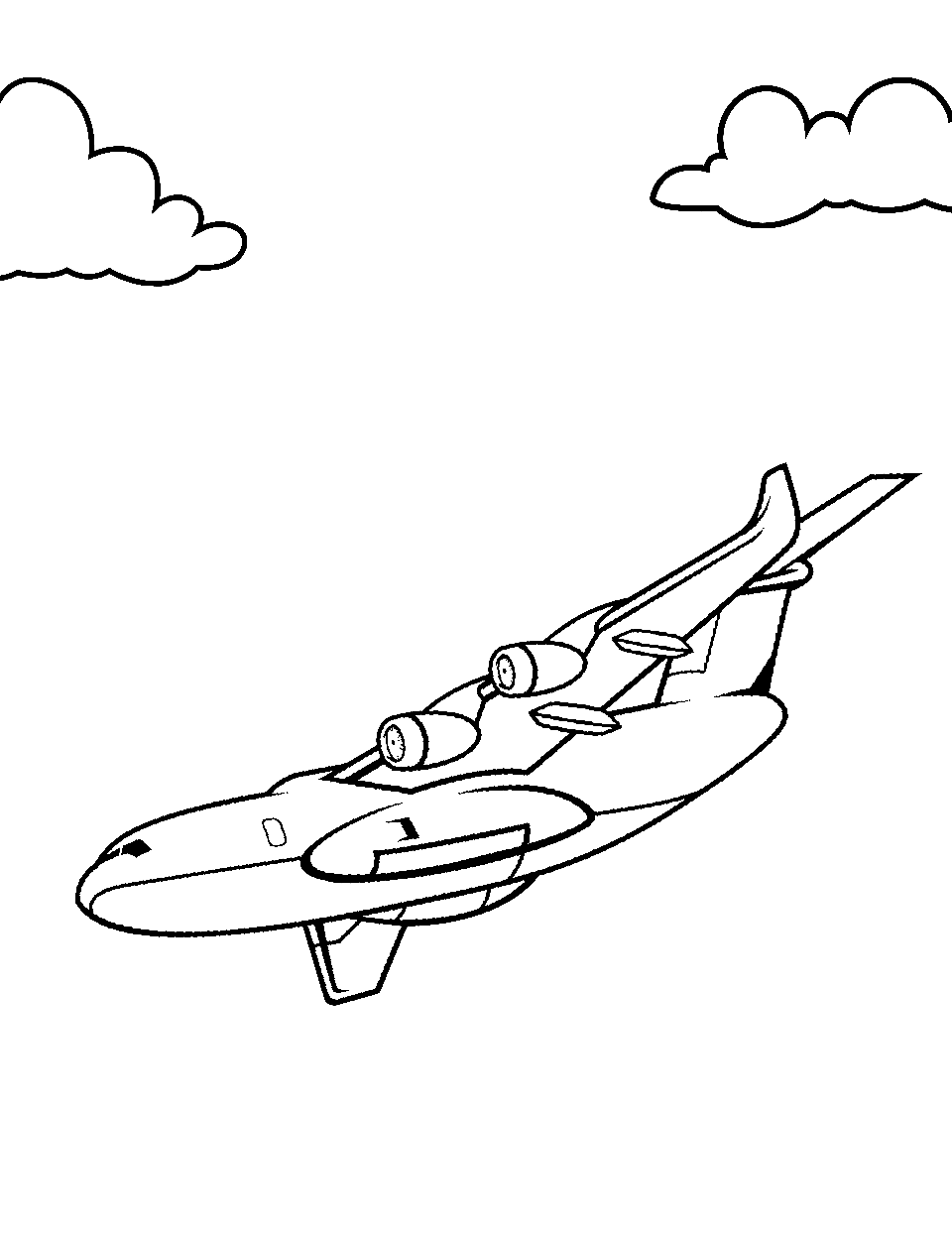
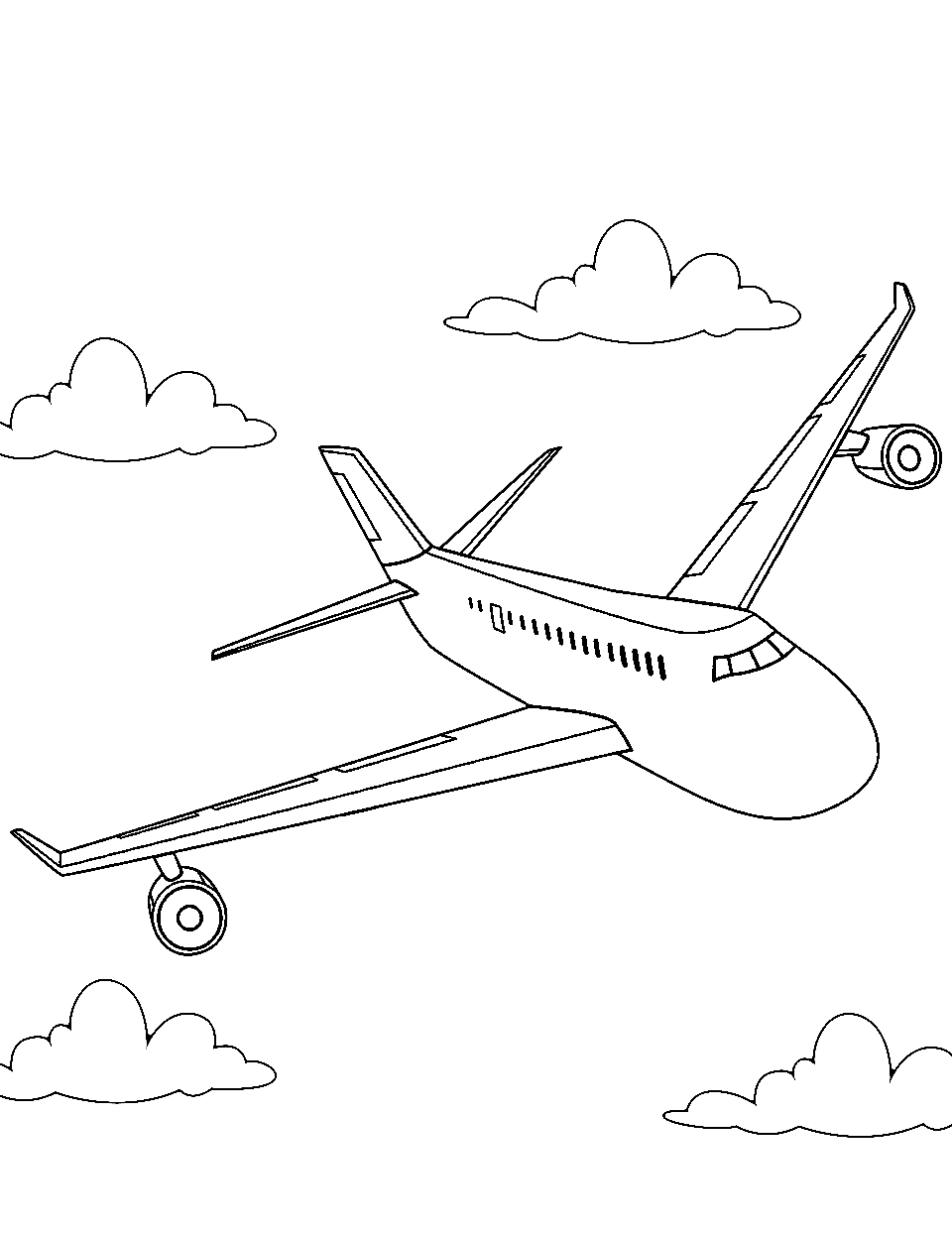
This transport is drawn from above and behind, so you look down on the top of the wing with two engines visible along it and a tall tail at the back. The unusual angle gives the sheet a real sense of speed. Olive green suits the military theme, and shading the clouds behind it adds depth. Older kids will enjoy working out the perspective.
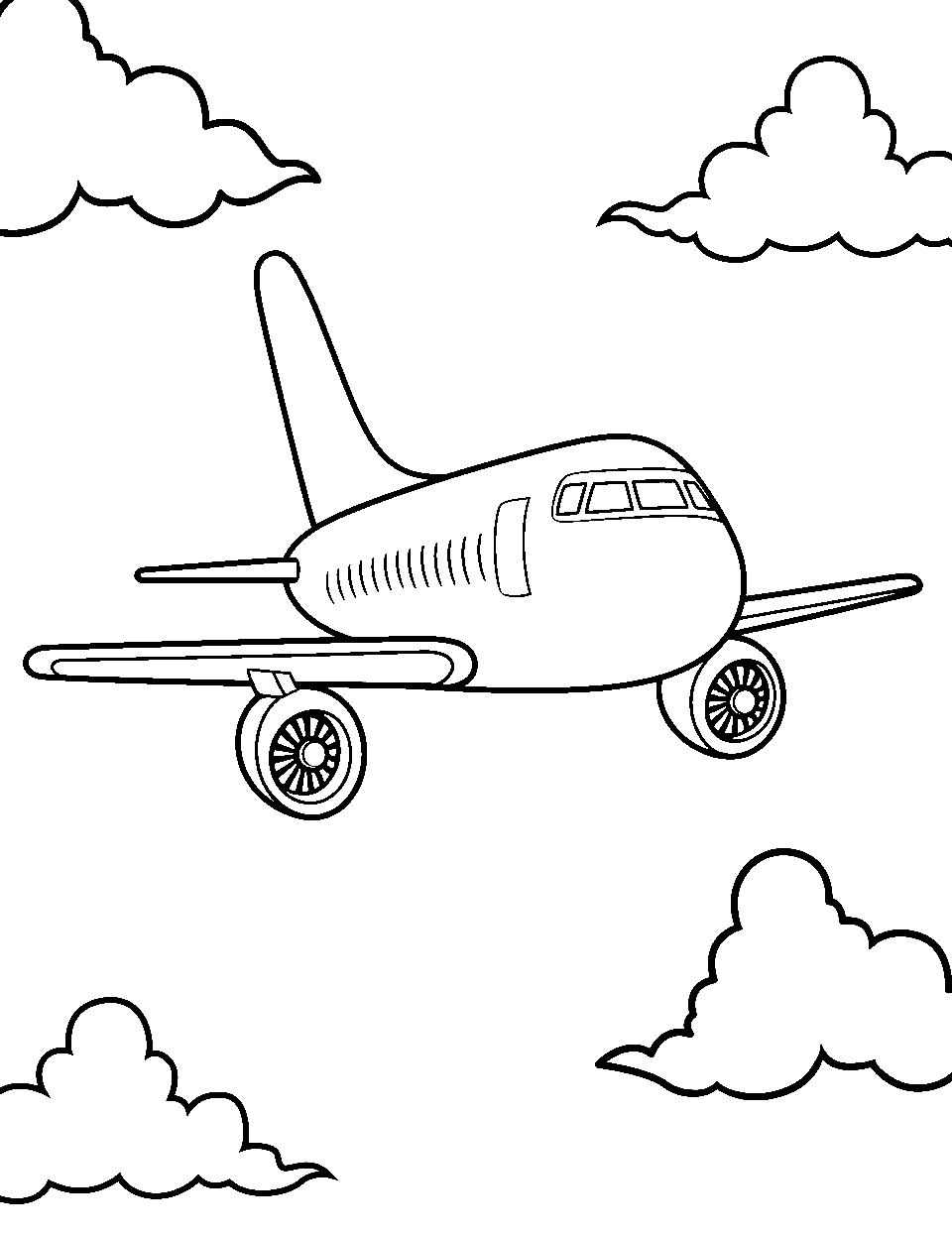
A cartoon jetliner sits front and center with a rounded nose, a strip of cockpit windows and two engines you can see straight into. Clouds fill every corner, all with thick outlines. The fan blades inside the engines are the only fiddly part; everything else is wide open space. A good step up for a five-year-old moving on from the simplest pages.
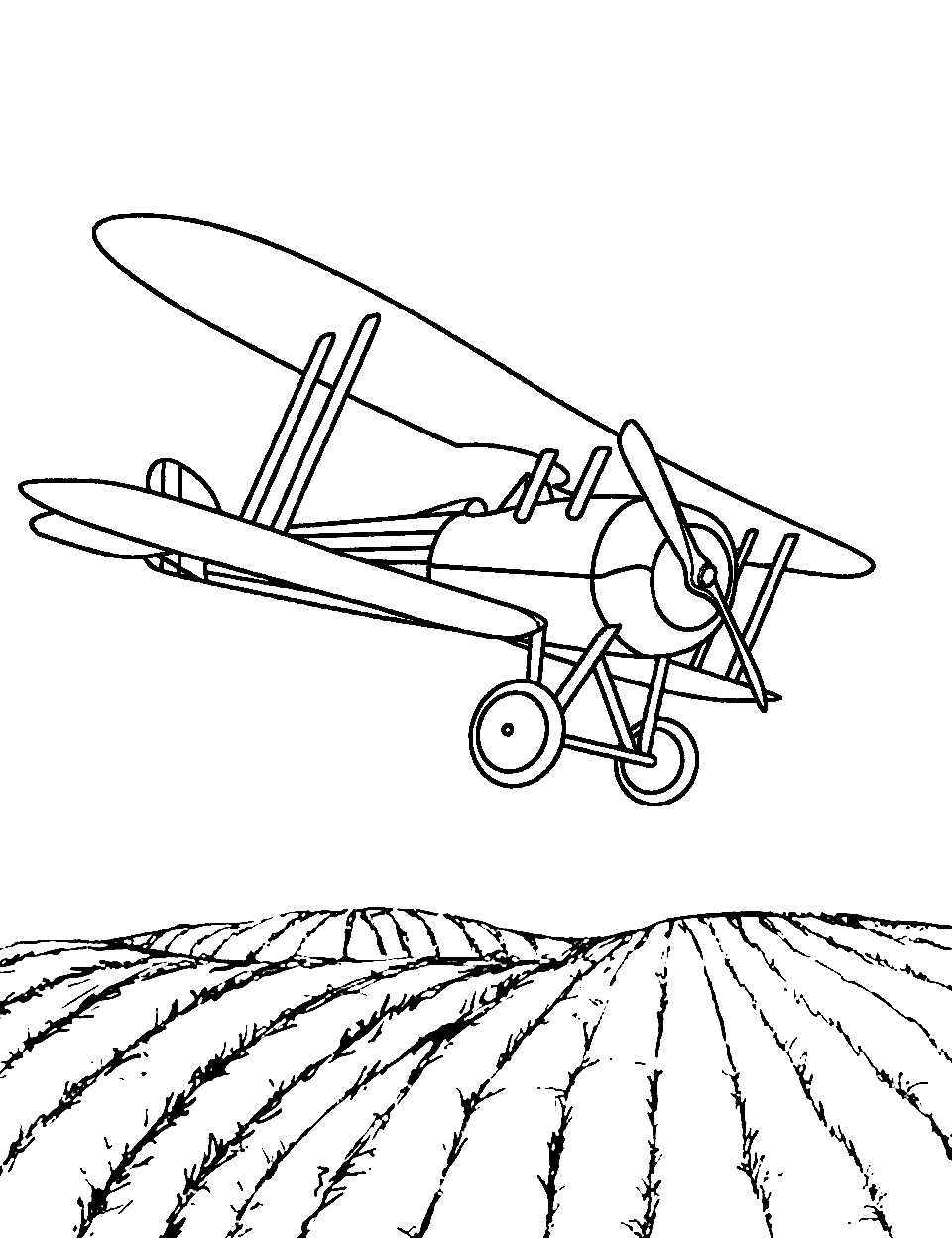
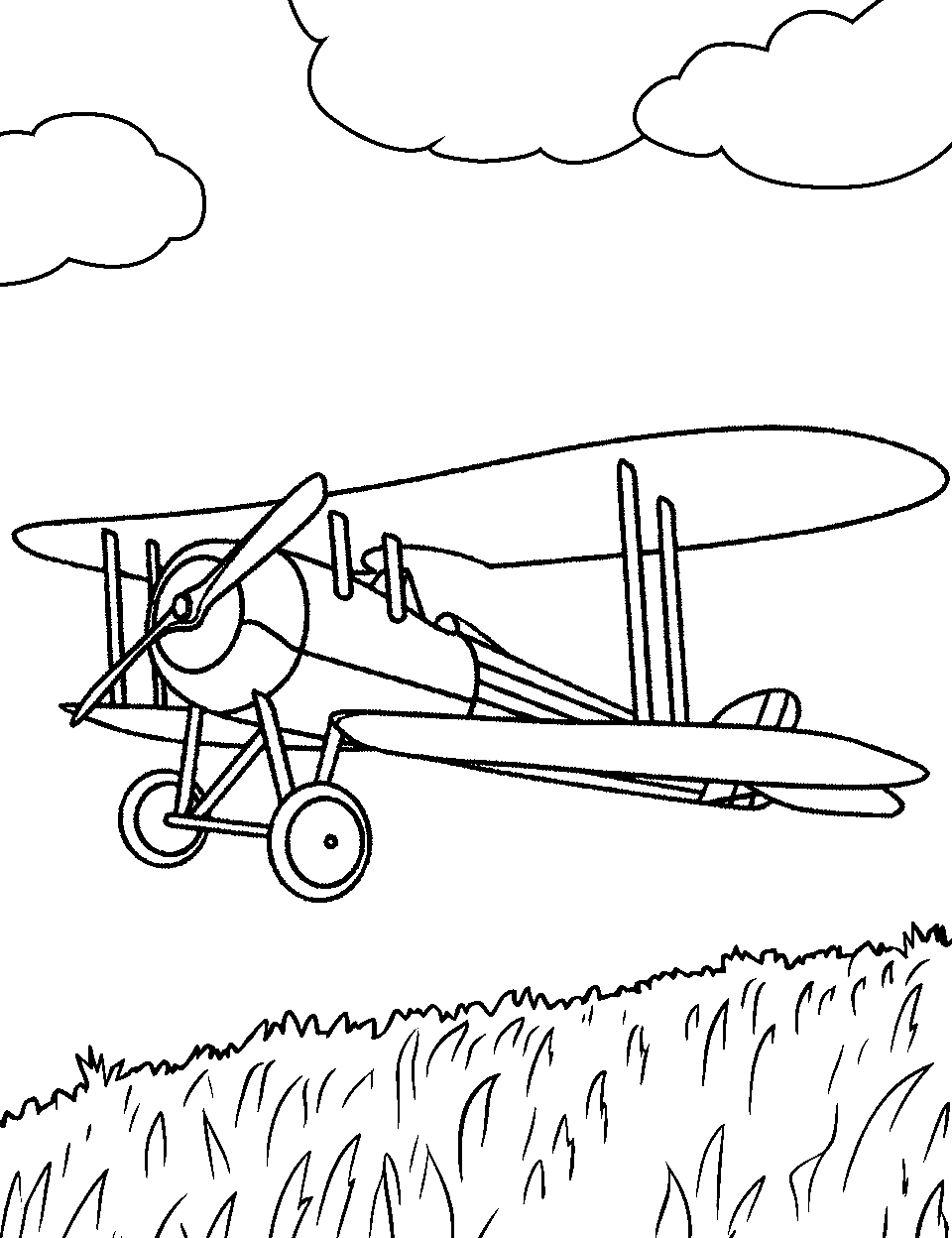
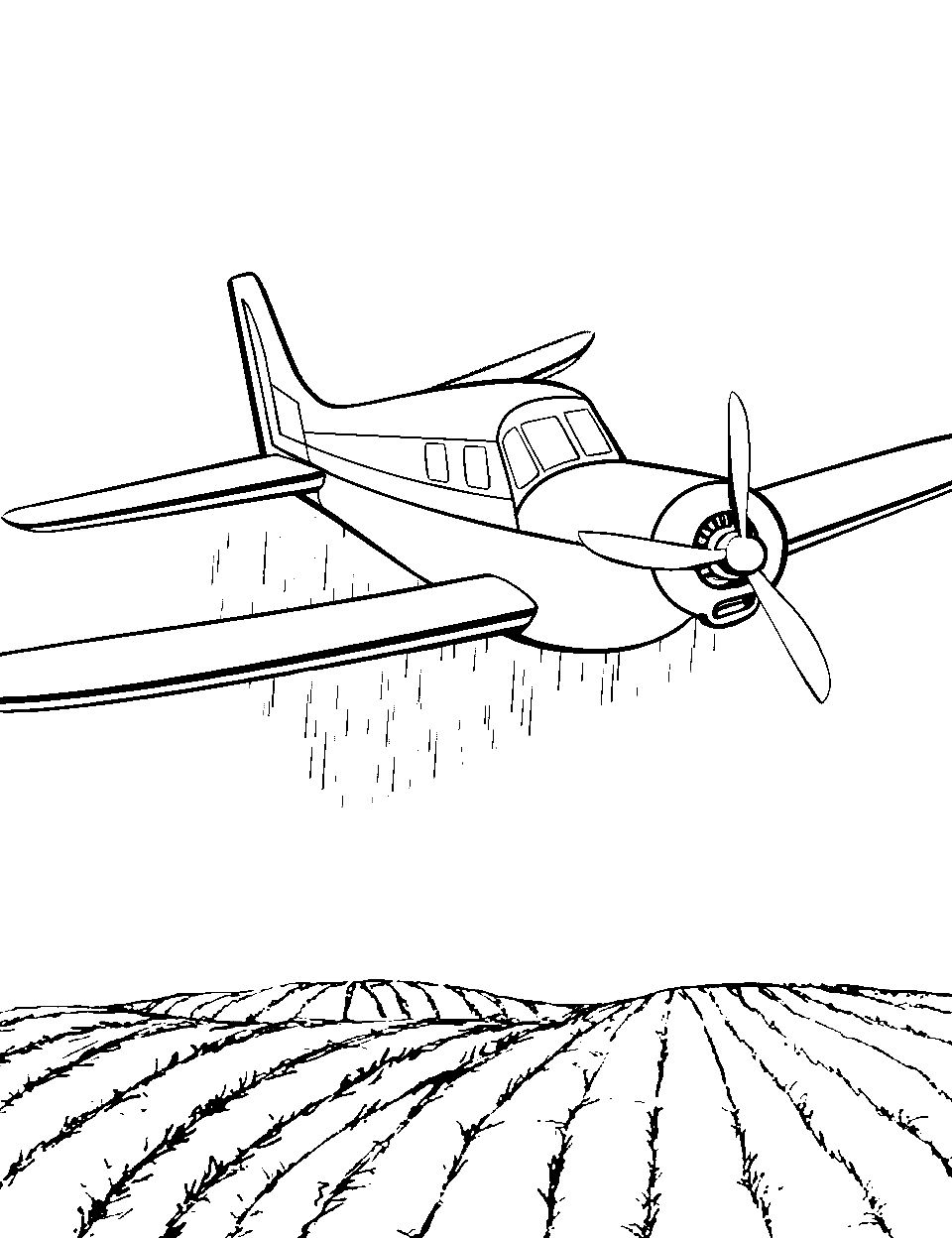
A detailed biplane flies low over a plowed field, and the crop rows are drawn as dozens of fine hatch lines running to the horizon. Wheels, wing struts and the propeller are all picked out individually. The field is one big block of texture, so pencil shading holds up better than marker here. Save this sheet for a child with patience to spare.
Long clean lines define this airliner: swept wings with curled tips, a row of cabin windows and a hatched door panel behind the cockpit. It sits high on the page with two small clouds below, leaving room to add your own sky. One color on the body plus a striped tail is a quick way to make it look like a real airline. Sharp pencils keep the thin lines visible.
An old-style biplane with a large propeller and two wide-set wheels flies over a field of tall grass. The grass is built from hundreds of quick strokes, which turns the lower third of the page into a texture exercise. Greens and yellows below with the sky left white gives the strongest contrast. The struts between the wings are thin, so go slowly there.
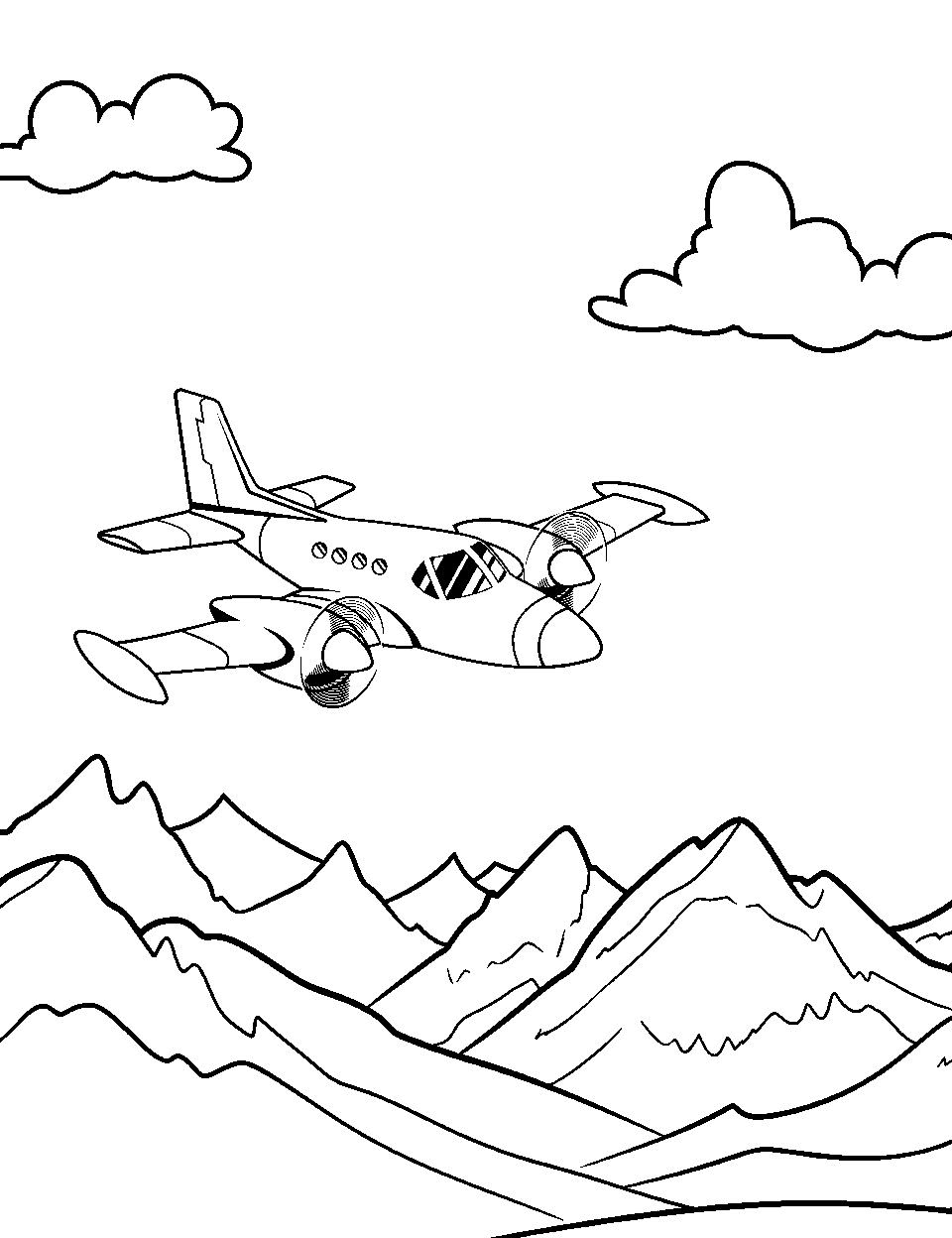
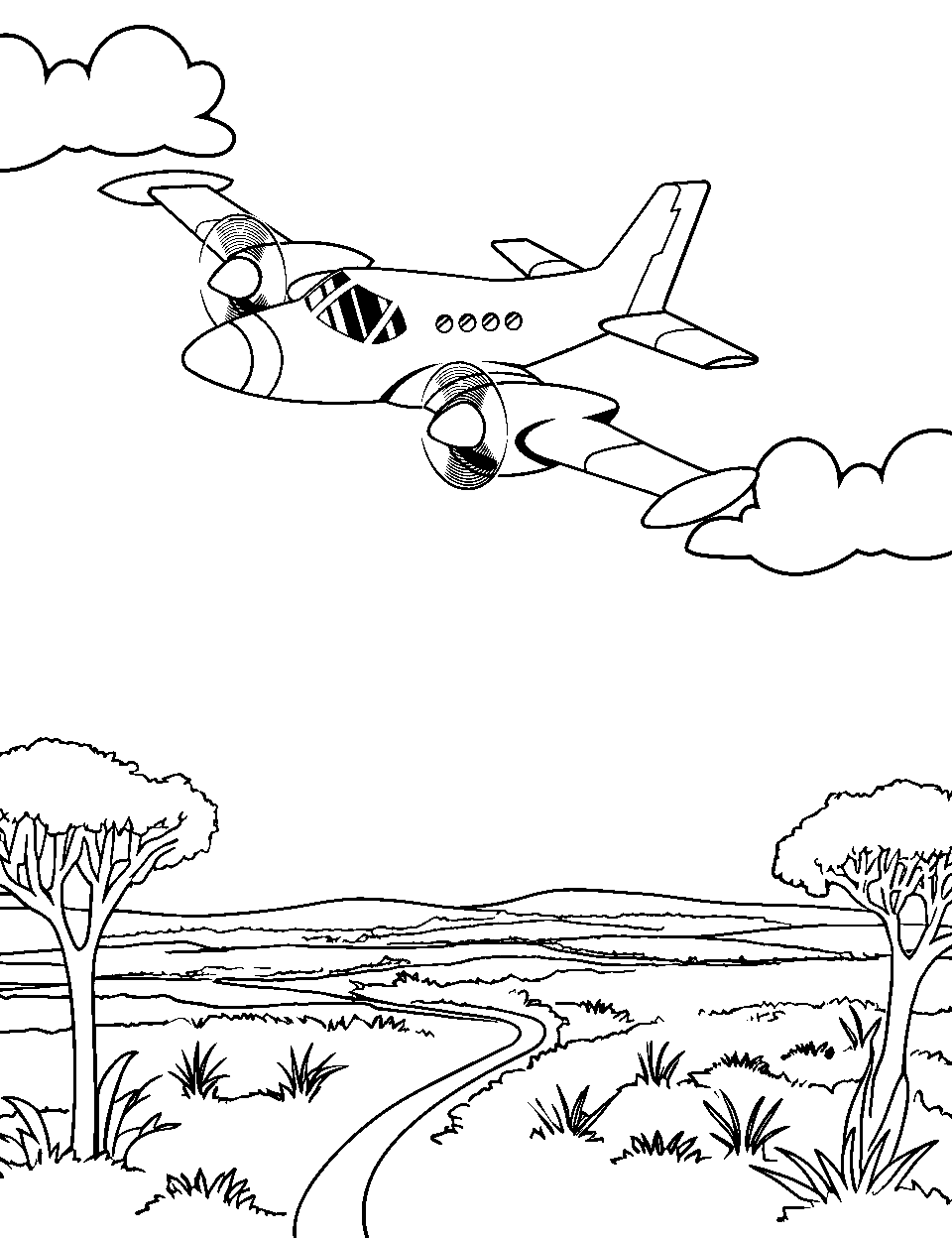
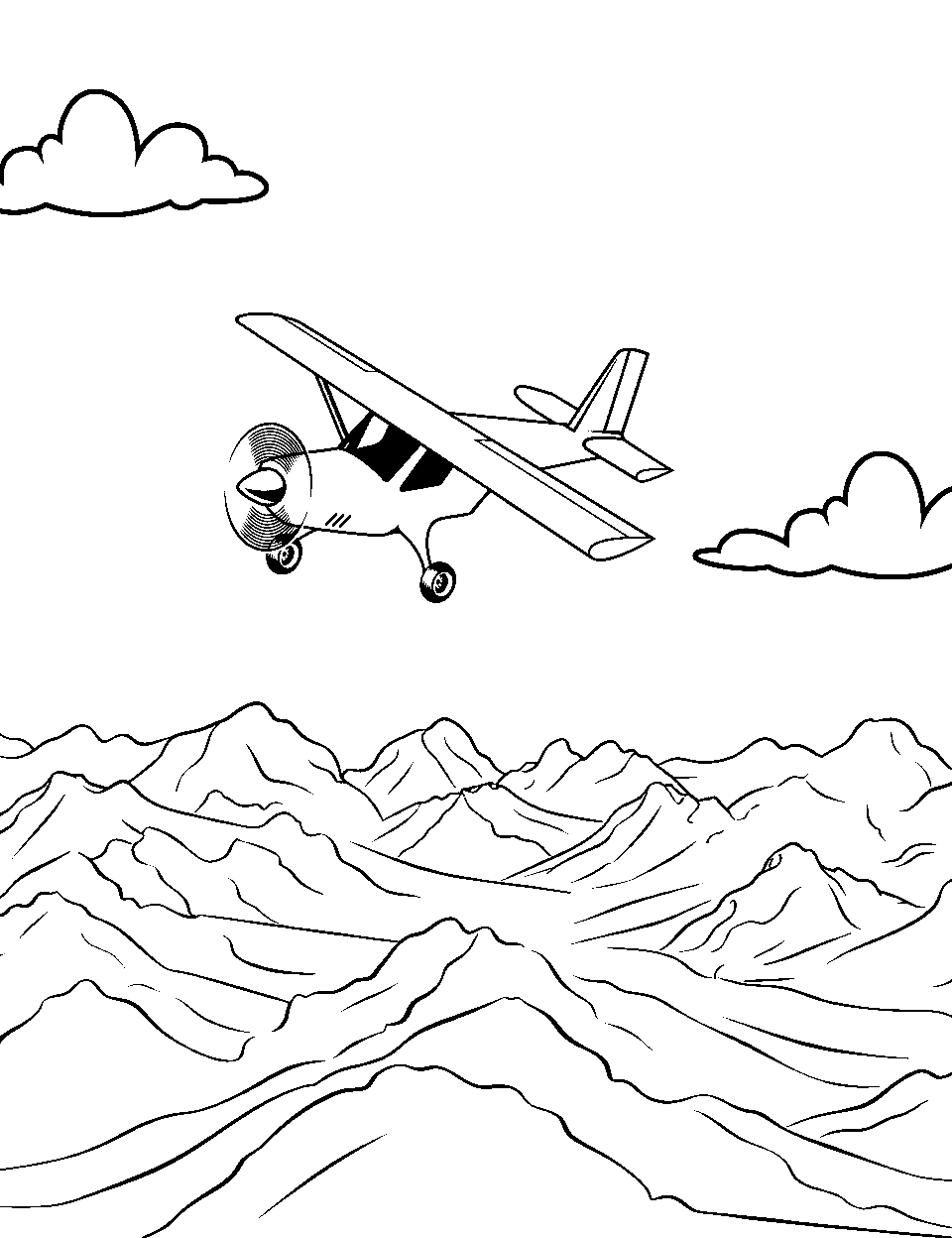
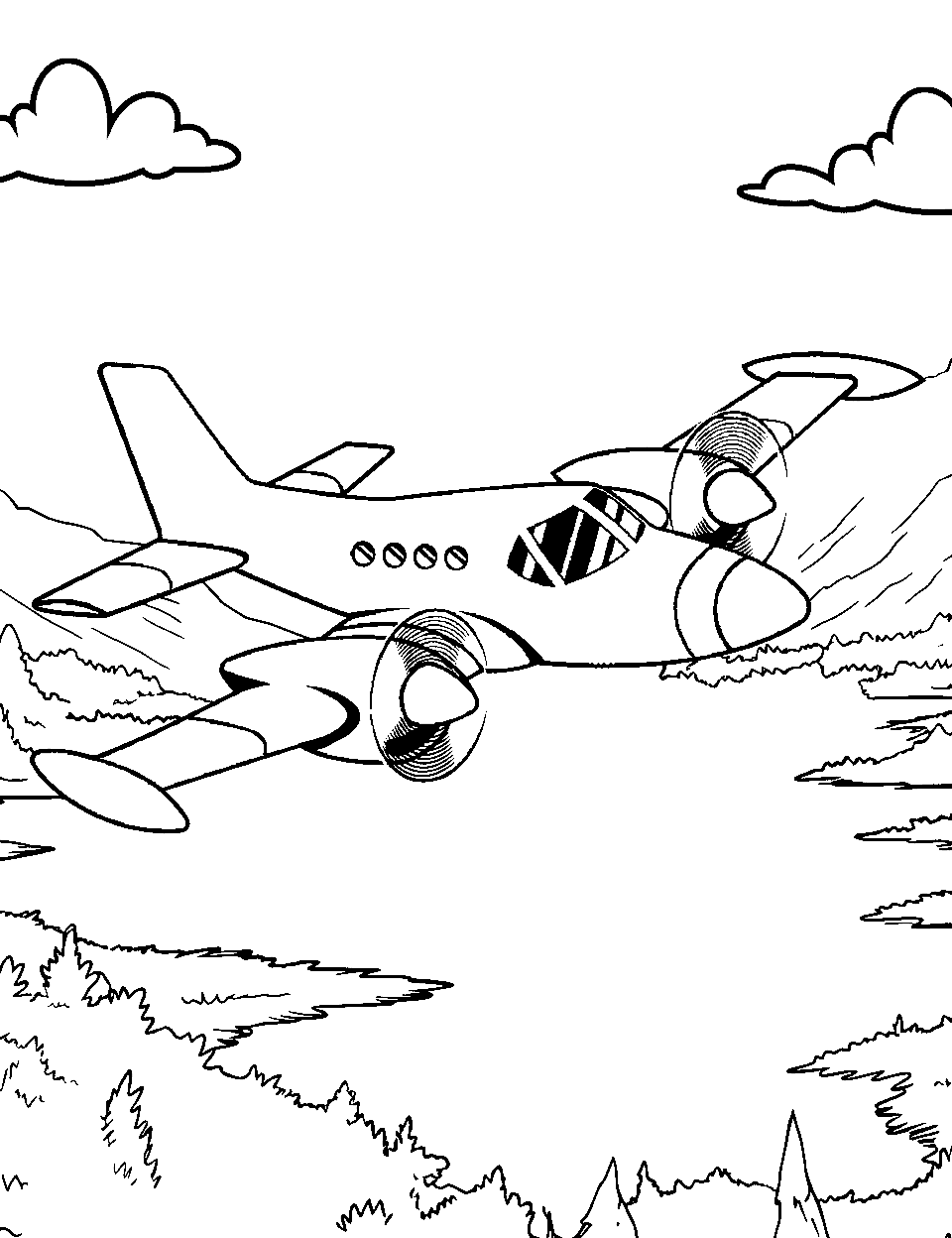
A twin-engine propeller plane banks above a long mountain range, both propellers drawn as spinning discs. Four small round windows sit along the fuselage, with a striped panel beside the cockpit. Light grey shading suits the soft ridge lines below. This one lands in the middle of the difficulty range: more parts than a toddler sheet, nothing microscopic.
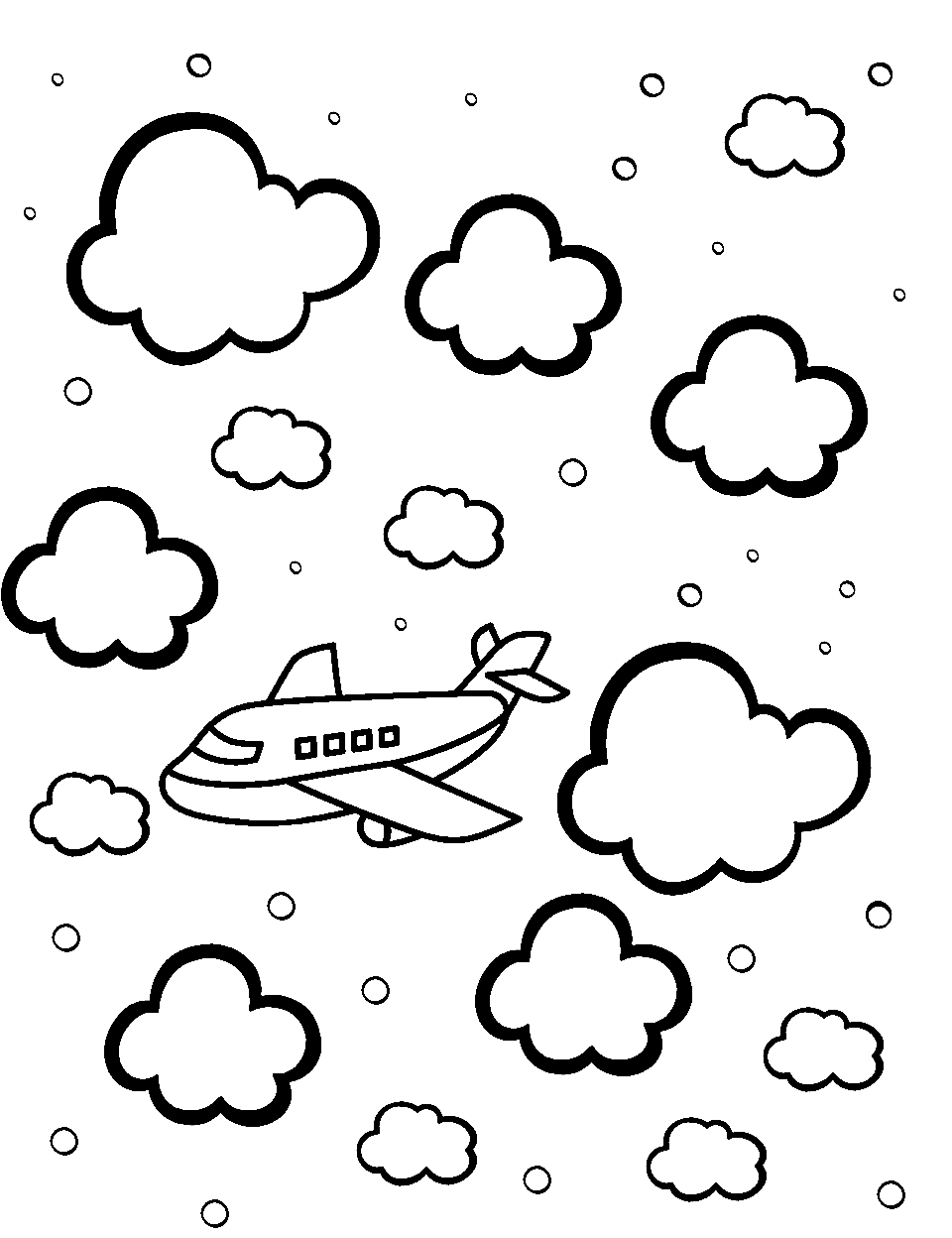
Clouds take over this page. Bold puffy shapes and small circles fill the sky around one little cartoon plane in the middle. Giving each cloud a slightly different tint of the same color turns it into a shading practice sheet. The outlines are heavy enough that markers will not run past them.
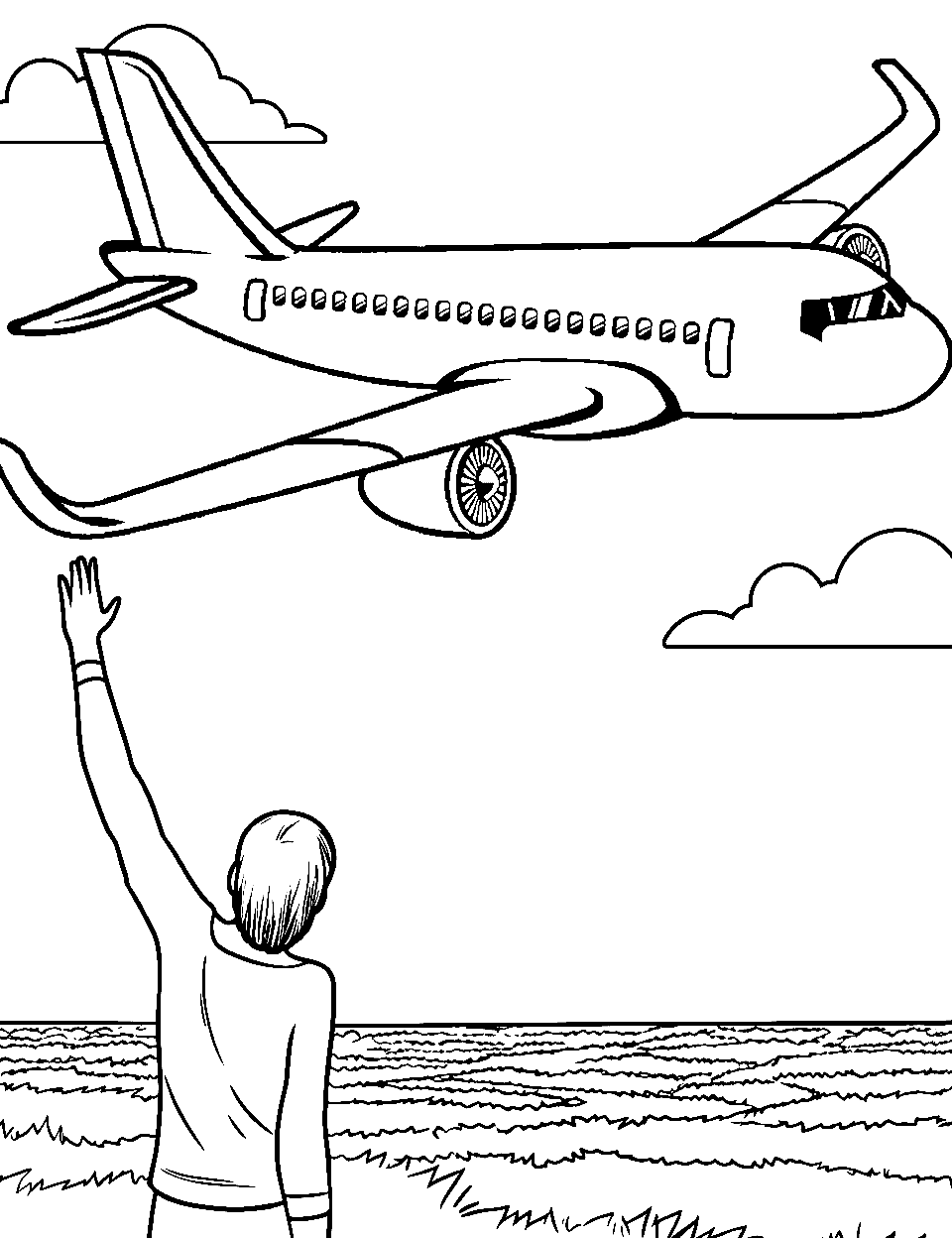
Seen from behind, a person stands in a grassy field with one arm raised, waving at a jet passing low overhead. It is the only sheet in the set with a story already built into it, and children usually decide the plane belongs to someone they know. Warm colors in the field under a cool blue sky give it an end-of-summer feel. Ask who is on board and where they are going.
Another head-on view, this time squared up on the centerline with the engines spread wide beneath the wings. Runway markings stretch toward you and two clouds sit high in the corners. Symmetry is the fun part: color the left half, then try to match it exactly on the right. A neat challenge for a child who likes things even.
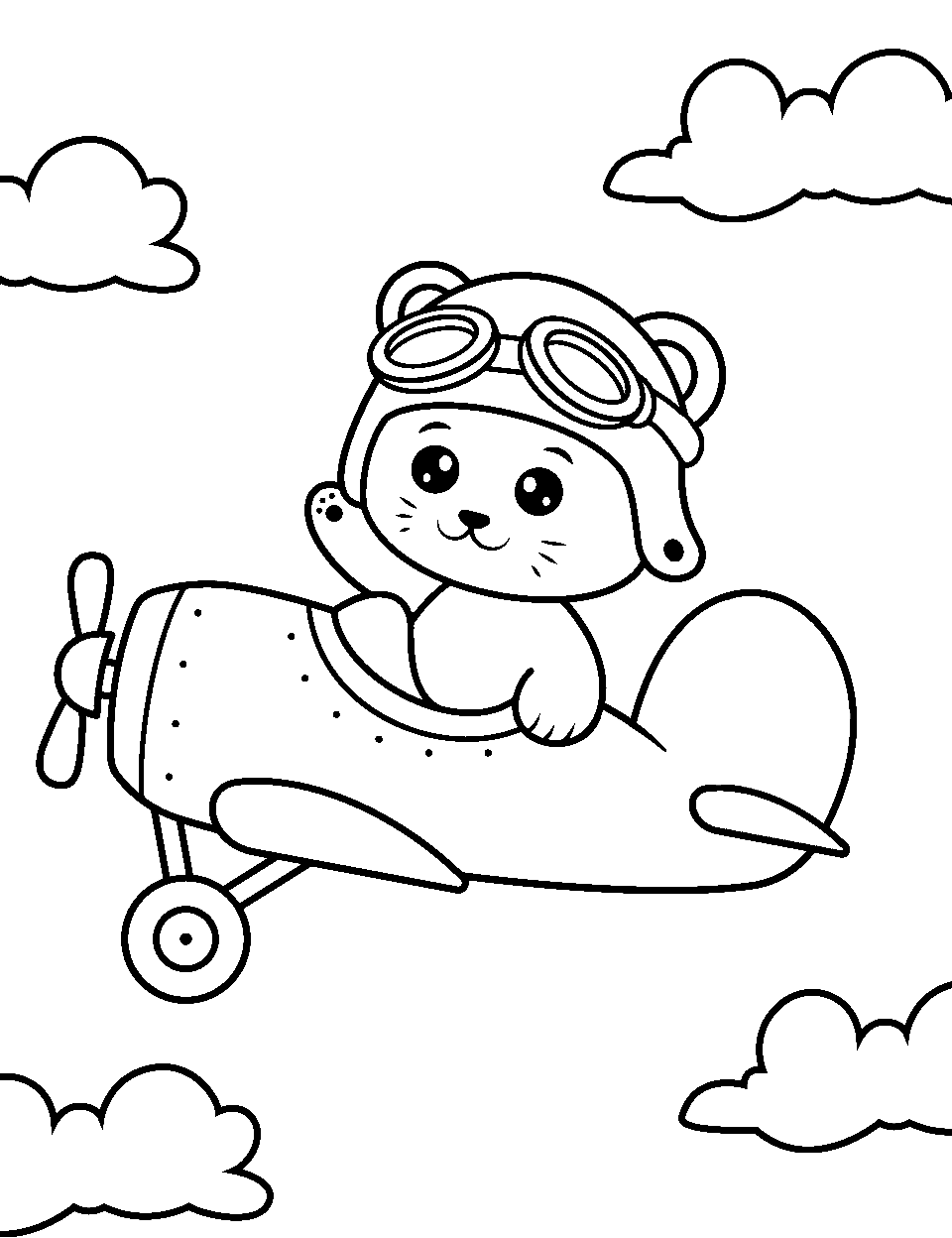
A cartoon animal in a flying cap and goggles waves from the open cockpit of a small propeller plane. Whiskers, round ears and a wide smile make it read as a kitten or a bear cub, whichever your child prefers. The plane body is dotted with little marks that are fun to fill in a second color. Big shapes and thick lines make this an easy win for young colorists.
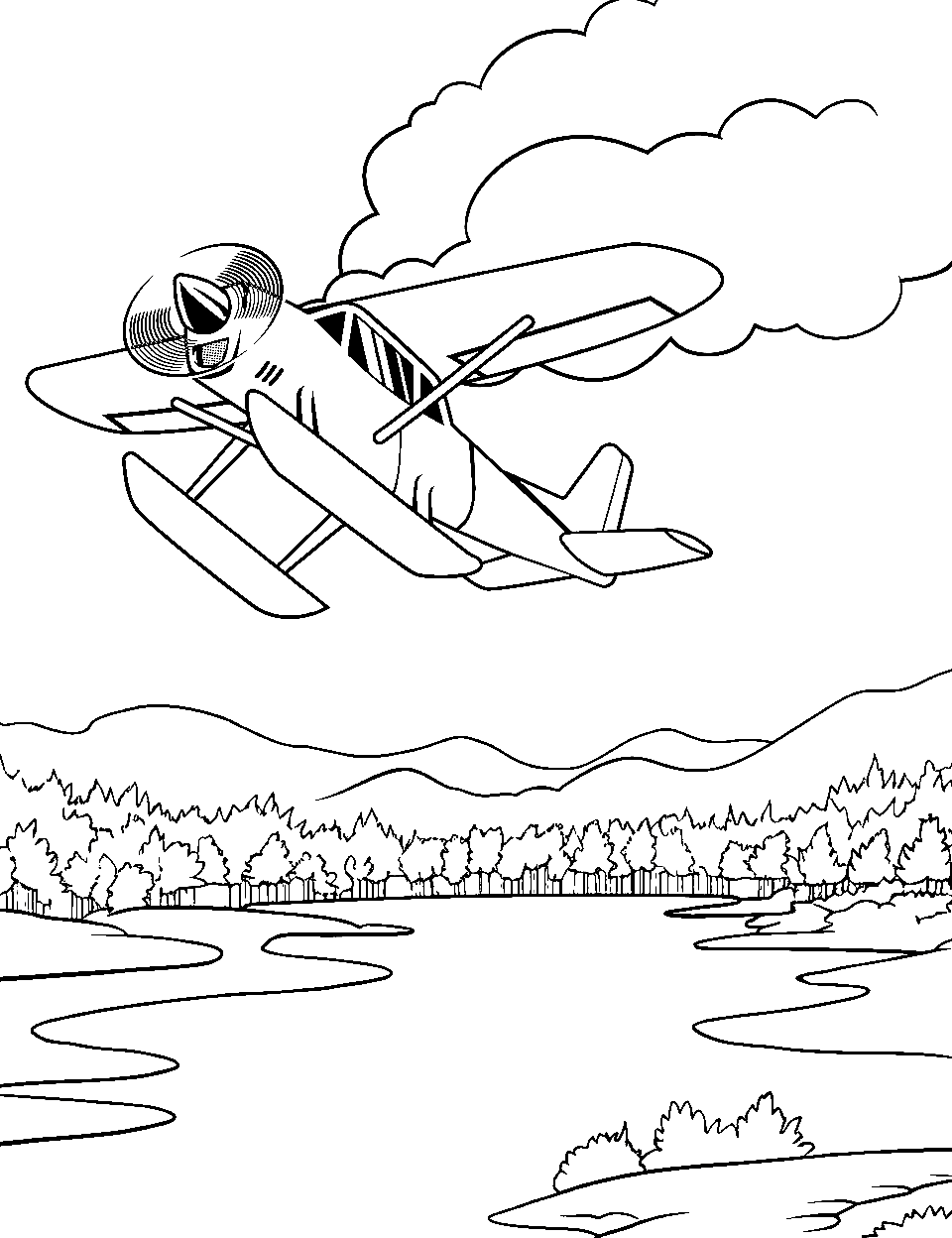
Floats instead of wheels mark this one out: a seaplane climbs away from a lake ringed with trees and low hills. The water and the treeline carry most of the detail, so the bottom half takes the longest. Blues for the lake, deep green for the pines, and a strong color on the floats so they do not disappear. Best suited to an older child.
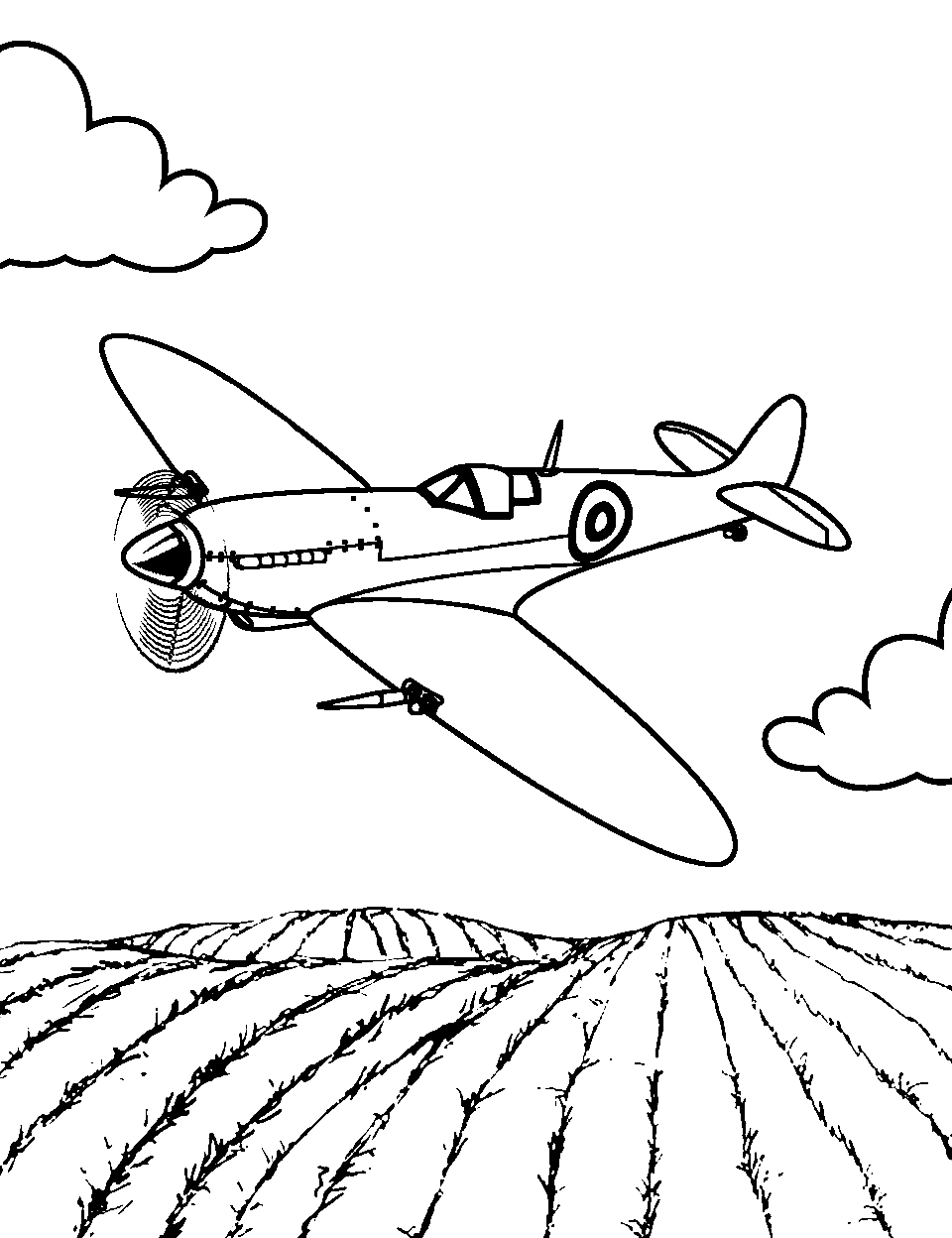
A vintage fighter with elliptical wings and a round roundel on its side flies over a plowed field, its propeller drawn as a blur. Rows of small dots along the nose stand in for panel lines and rivets. Green and brown on top with pale grey underneath is the classic scheme, and the roundel is a good excuse for red and blue. The furrowed rows below are fine work for steady hands.
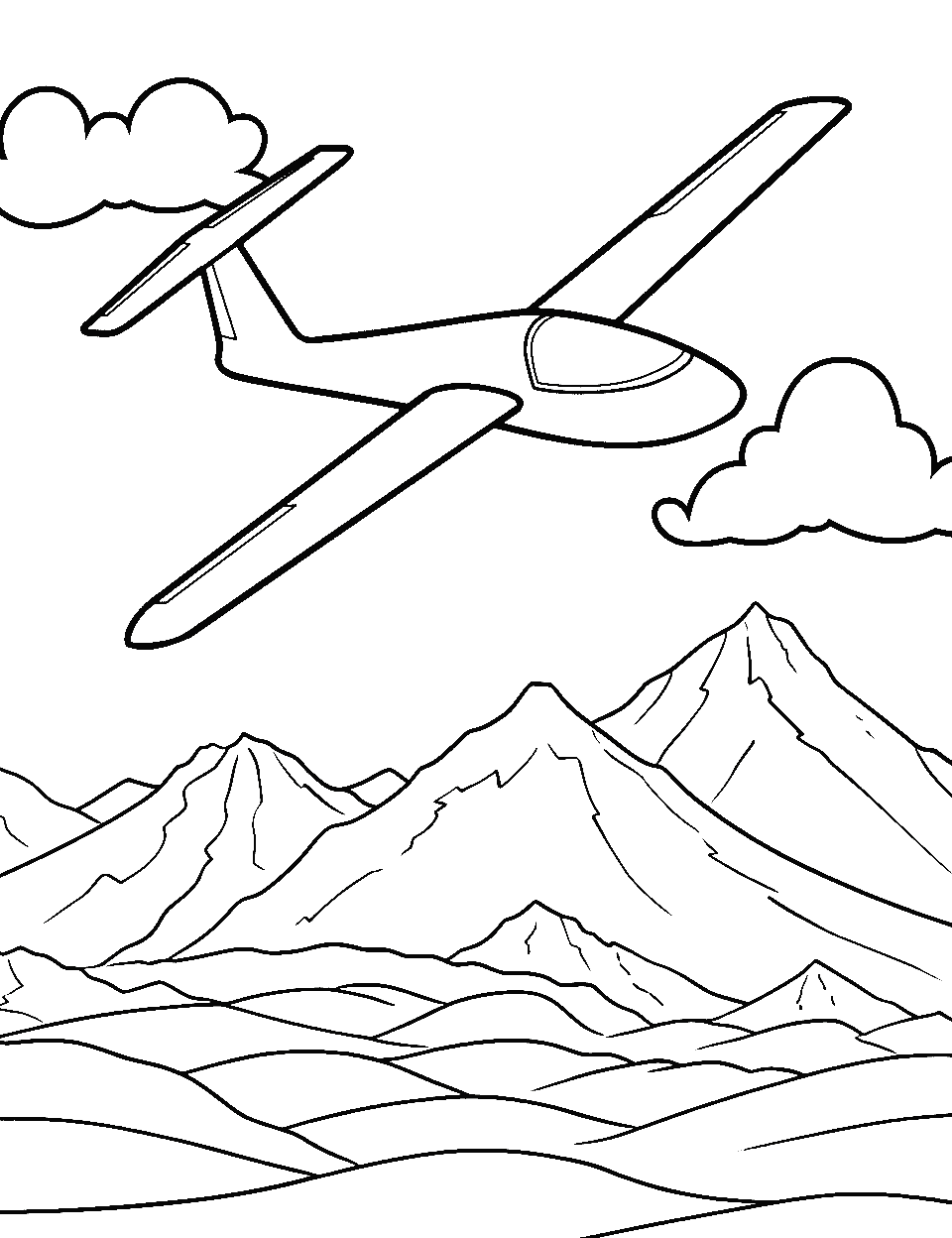
No engine, no propeller, just a long-winged glider drifting above a range of sharp peaks. The wings stretch almost the full width of the page and are easy to fill. White peaks with grey shadows look striking under a colored sky. A calm sheet for a child who wants something less busy.
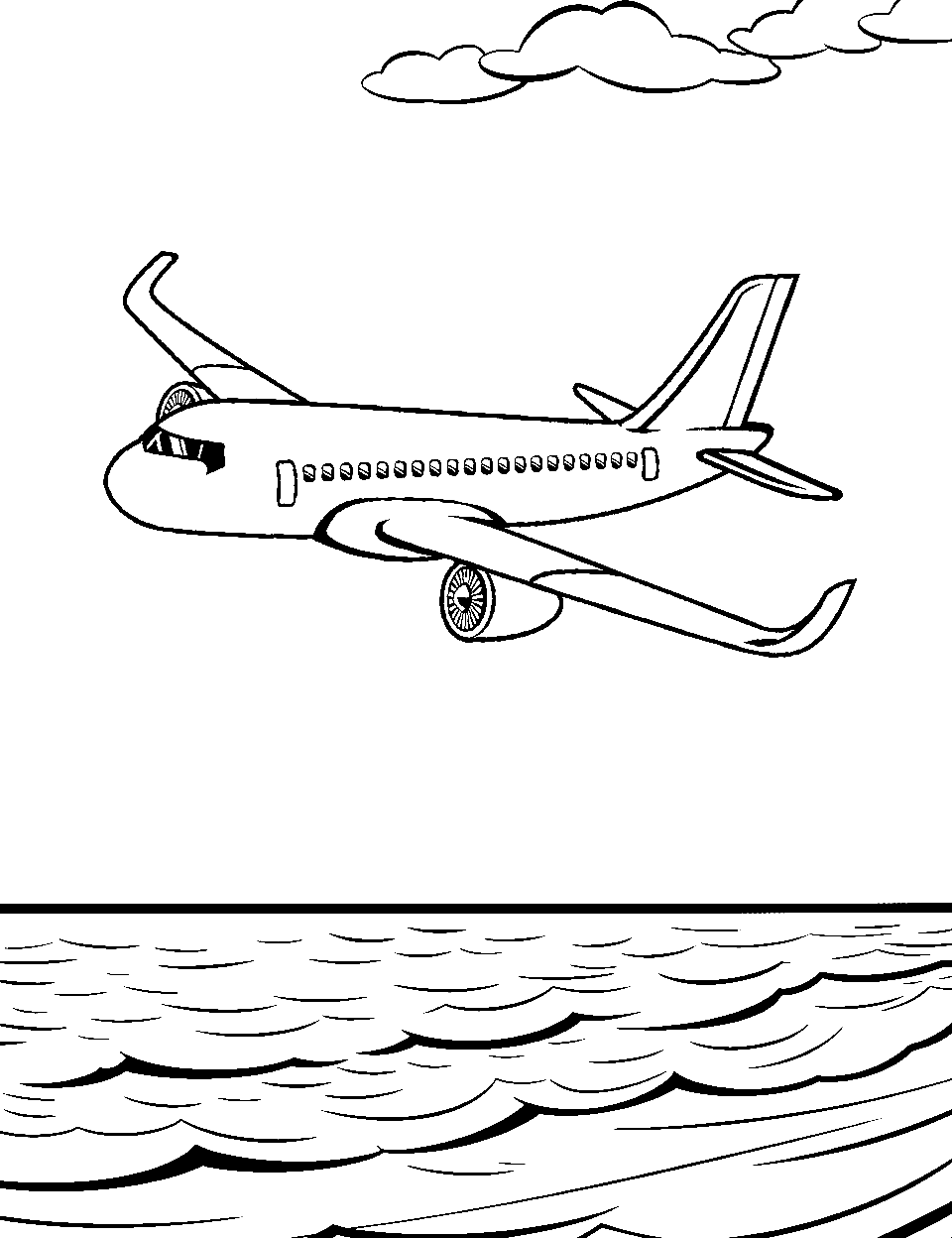
An airliner cruises above the open ocean, with rows of curling waves drawn across the bottom of the page. Those repeating waves are the perfect place to practice fading from pale blue at the horizon to deep navy at the front. The plane itself is clean and simple by comparison, so the sea is where the time goes. A good rainy-day holiday daydream.
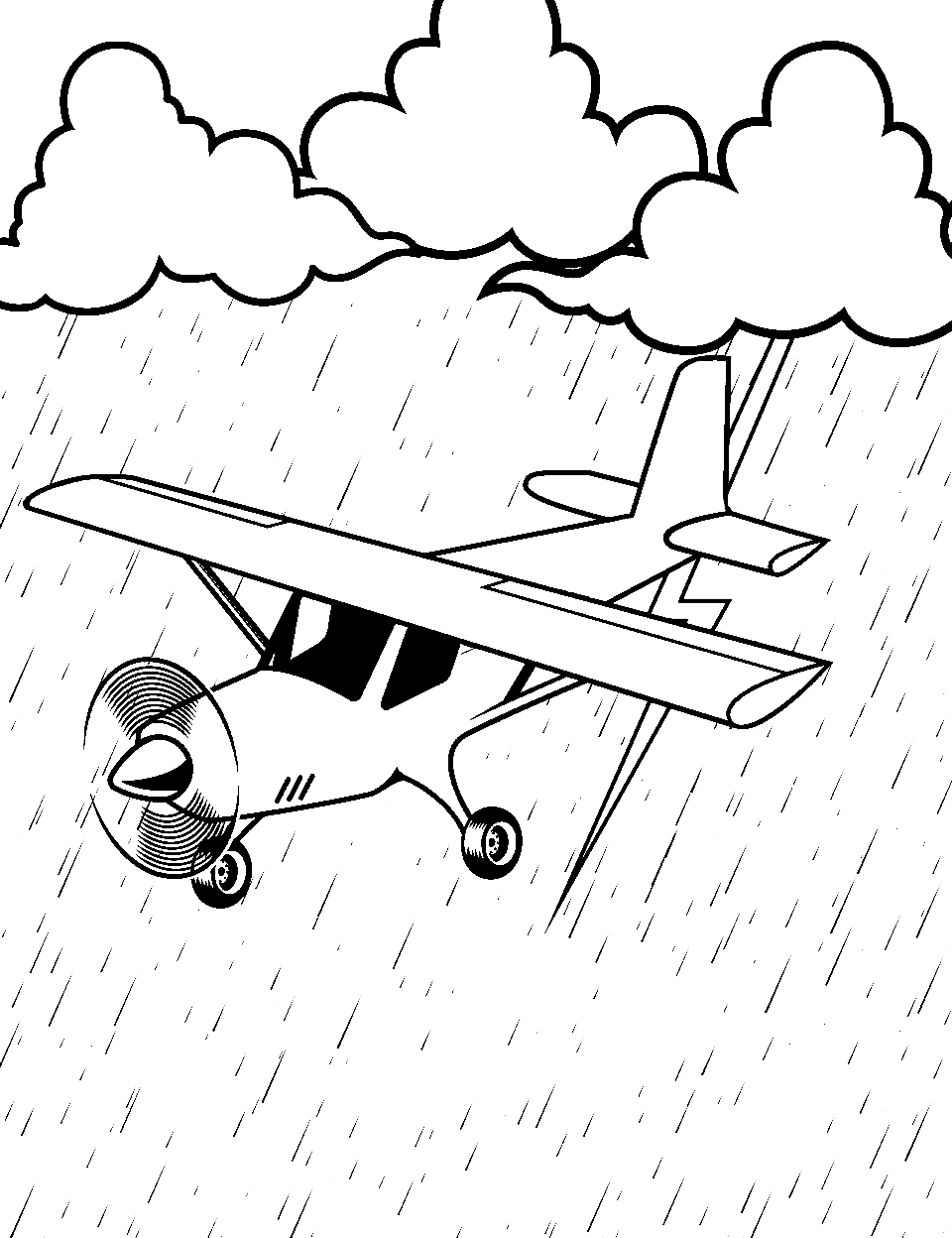
Rain streaks cover the entire page while a small high-wing plane pushes through them, a lightning bolt zigzagging near the tail. Heavy clouds bunch along the top edge. Greys and blues suit the mood, and a yellow bolt gives the sheet its one jolt of contrast. Shade the rain lightly so the plane still reads through it.
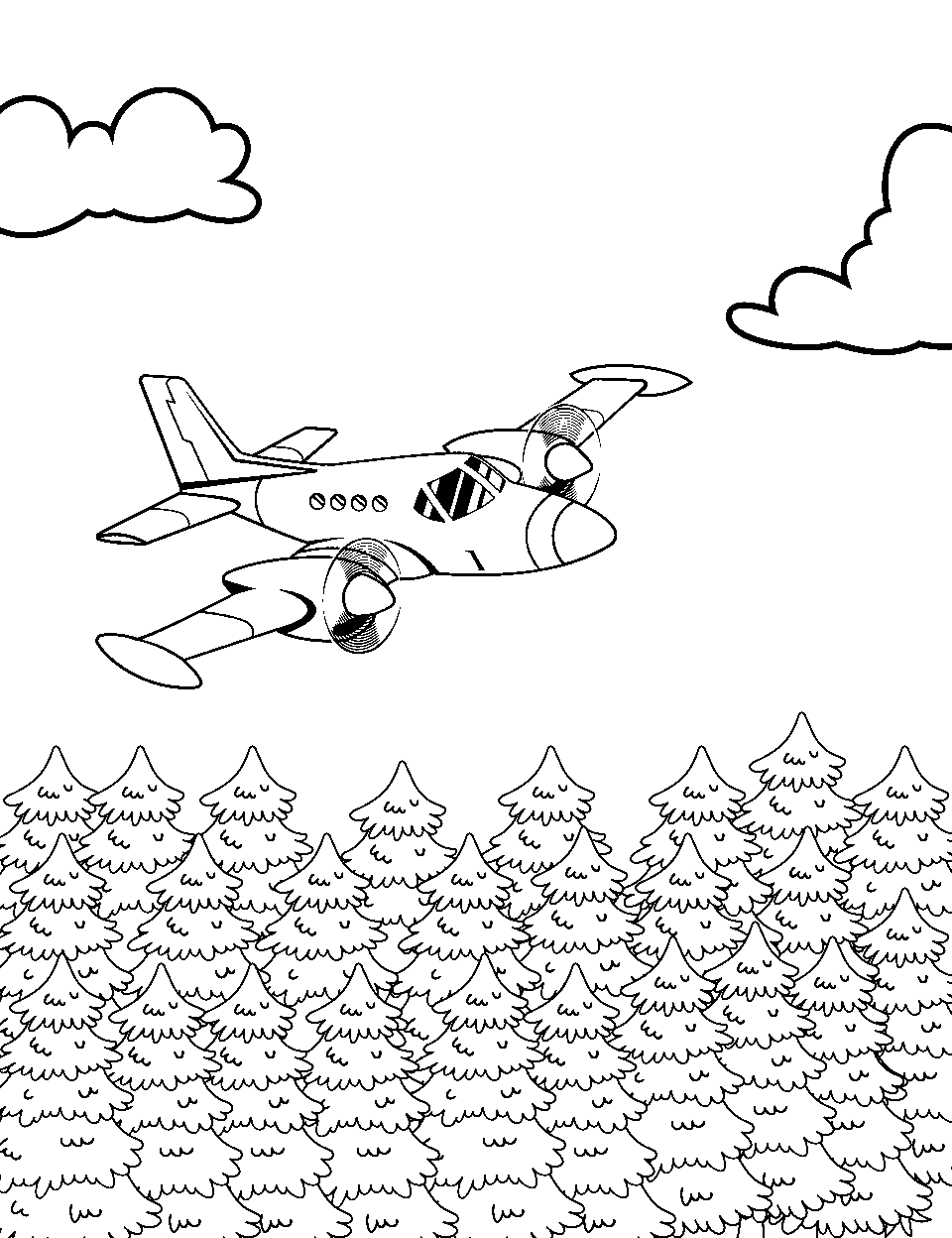
The twin-prop plane returns, this time flying above a thick stand of pine trees that fills the bottom half of the sheet. Every tree is drawn with feathered branches, so there is a great deal of small green work below the horizon. Vary the greens tree by tree rather than using one shade throughout. Set aside a proper chunk of time for this one.
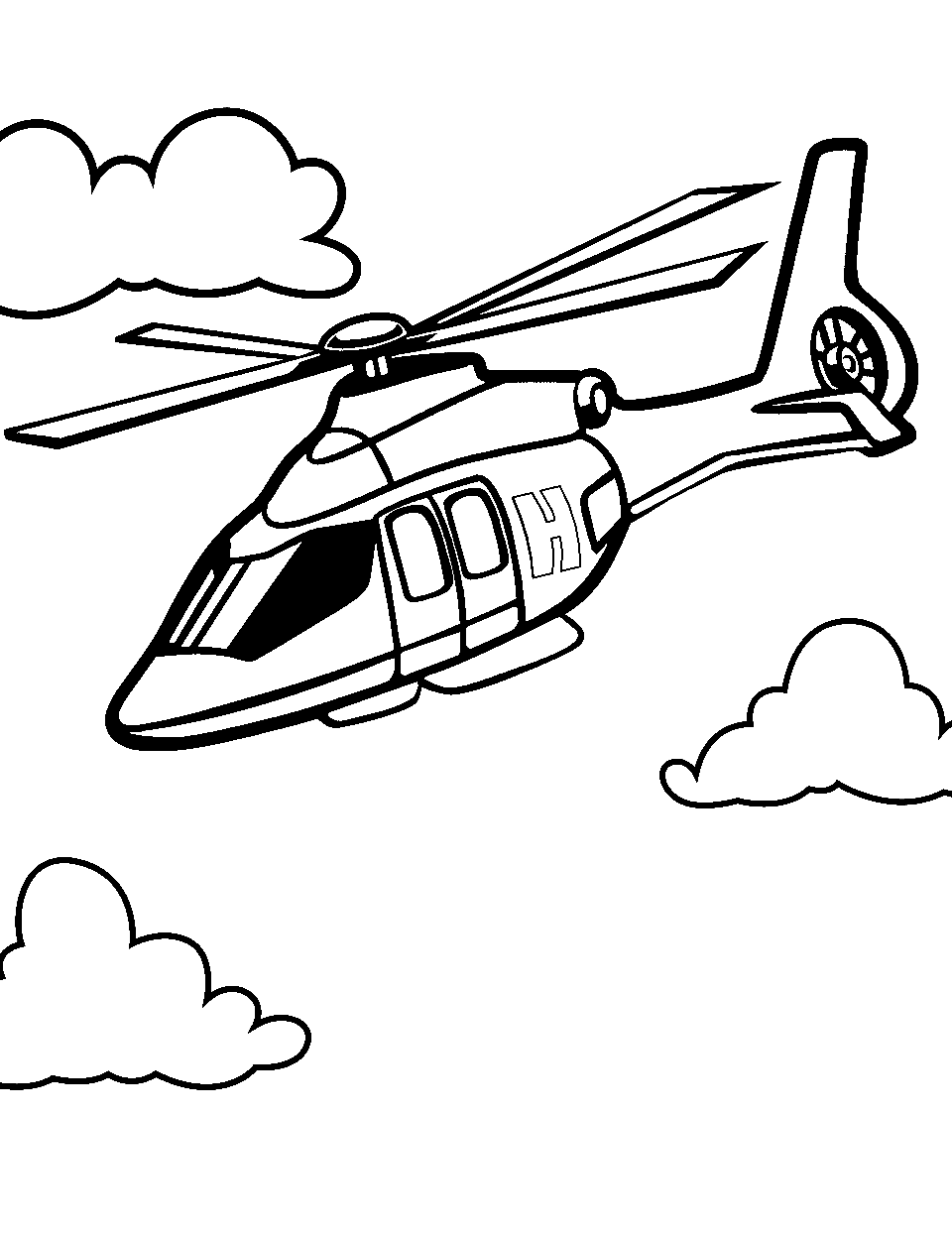
A sleek helicopter with a large letter H on its side flies among soft clouds, its tail rotor set inside a ring. The main rotor blades reach out across the top of the page. Kids can decide what the H stands for and color it as a hospital, news or police aircraft. Rounded shapes and few tiny details keep it manageable for most ages.
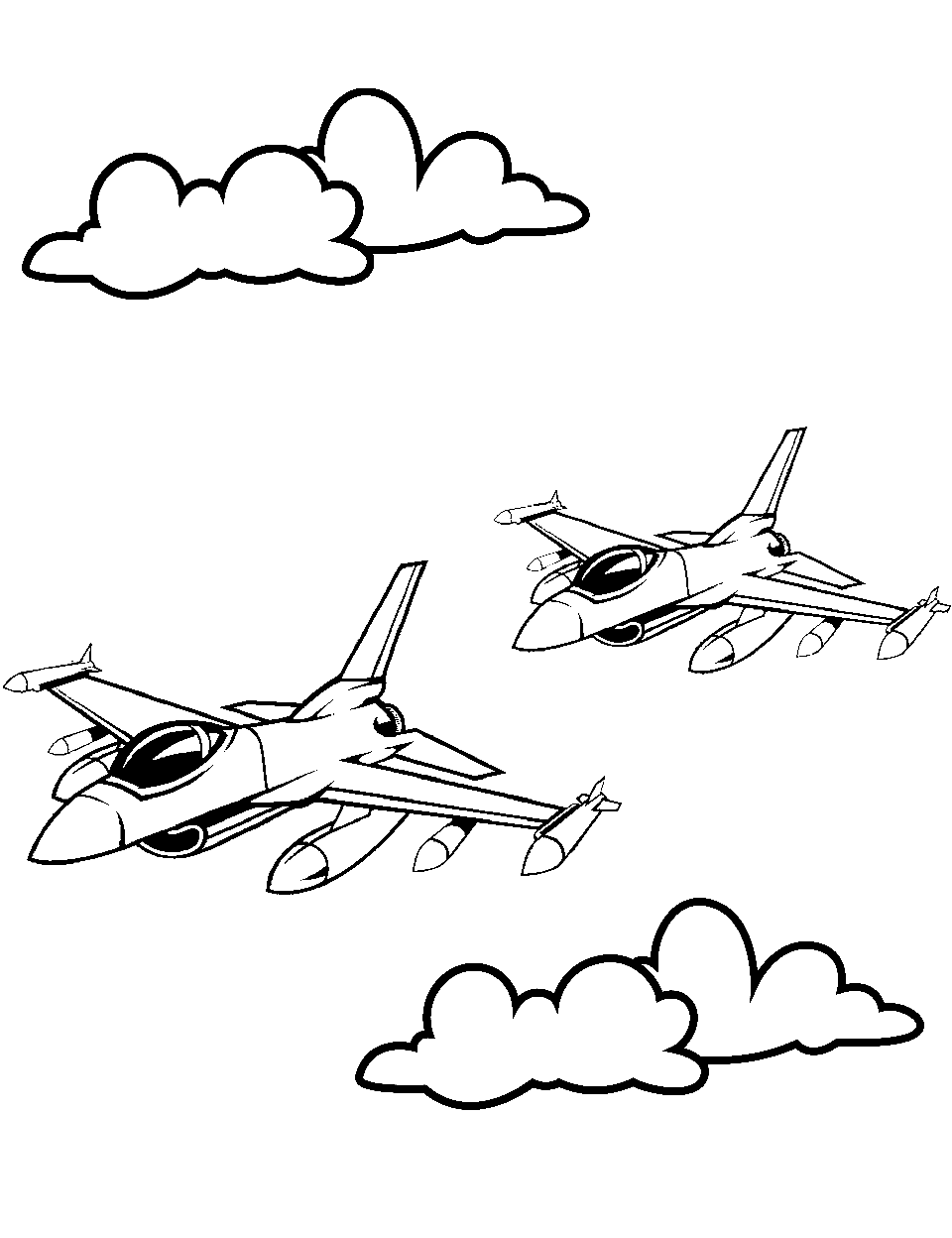
Two fighter jets fly side by side between two banks of thick cloud, one slightly ahead of the other. Their canopies are drawn dark, which makes black or deep blue the natural choice there. Matching the two paint schemes exactly is harder than it looks and makes a good test of patience. There is enough empty sky left to draw in a third jet.
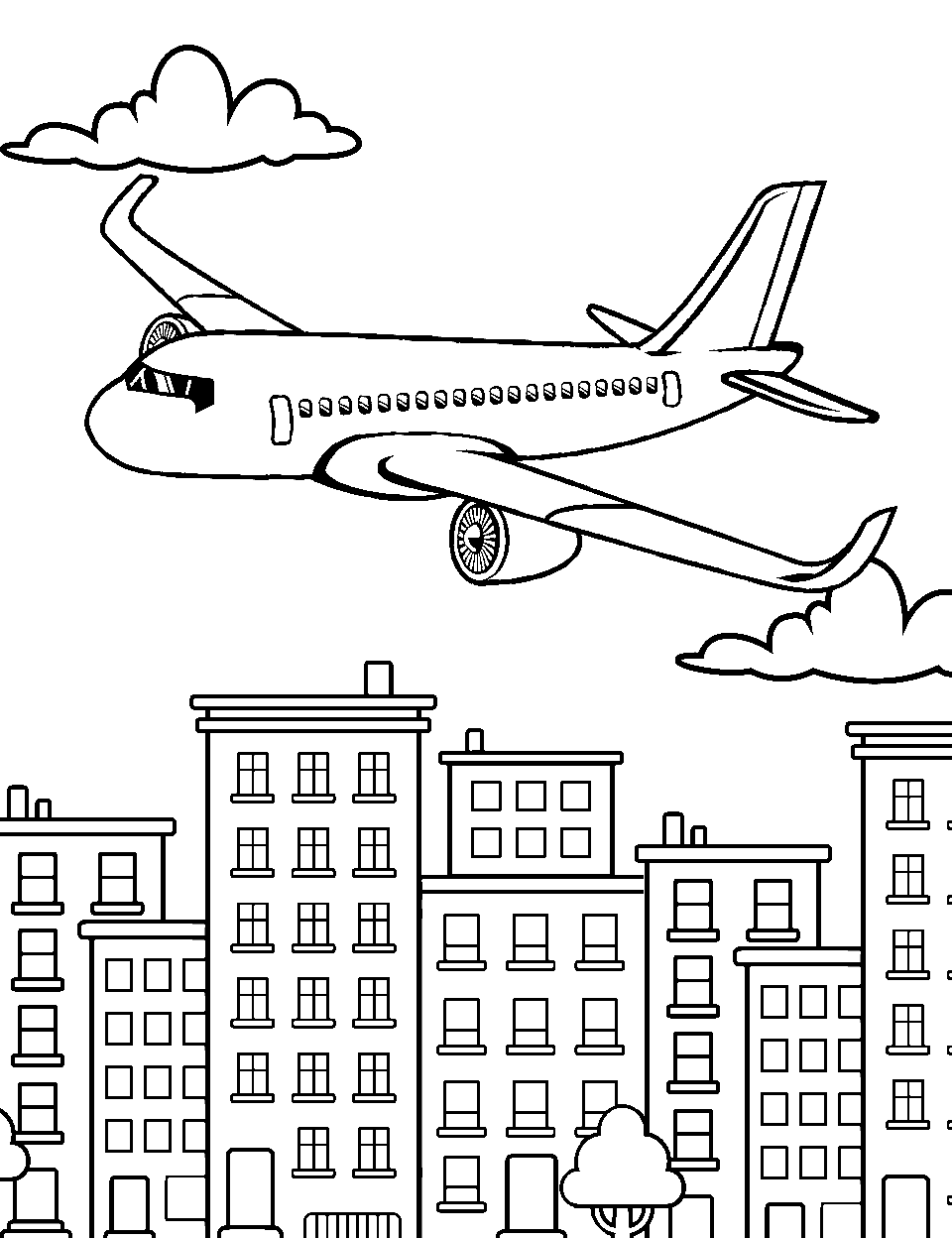
A jetliner passes above a city skyline of apartment blocks, every building packed with rows of square windows. One small tree stands at street level. The windows are the whole job here: try lighting a few of them yellow and leaving the rest blank. Older children who find repetition relaxing will happily disappear into this one.
You can actually see the spray on this sheet, drawn as fine vertical lines falling from the wings onto the crop rows below. The plane comes at you from the front with a big propeller and a row of cabin windows along the top. The field runs in neat furrows all the way to the horizon. Pale green crops with a red plane above them make the falling spray easy to spot.
A jetliner flies above a bold, simple globe showing North and South America in thick outline. Those heavy lines make it one of the easier scene sheets, since there are only a few large areas to fill. Green continents on a blue ocean is the classic combination. When the coloring is finished, kids can draw a dotted flight path from home to wherever they want to land.
A twin-prop plane crosses a wide savanna, with a flat-topped tree standing at each side of the page and a dirt track winding into the distance. Grass tufts and low bushes fill the foreground. Warm yellows and dry browns fit this landscape far better than bright green. Crayon covers the open ground quickly while pencil handles the trees.
A jet sits nose-on in front of a big hangar with a peaked roof, its wings reaching past both edges of the building. Runway lines run toward you across the bottom of the sheet. The hangar is one huge blank shape, which makes it ideal for a bold background color. A younger child can take the building while an older one works on the landing gear.
A small high-wing plane with a spinning propeller cruises above row after row of jagged ridges. The mountains are drawn in light outline with no shading at all, so every depth decision is left to you. Two clouds break up the sky above. Grey-blue ridges that fade paler toward the back build distance quickly.
Big rolling clouds sit above and below the airliner in the middle of this page, so the plane looks like it is threading between two layers. The cloud outlines are thick with plenty of room for shading inside them. Coloring only the clouds and leaving the sky white gives a soft, overcast result. Comfortable for almost any age.
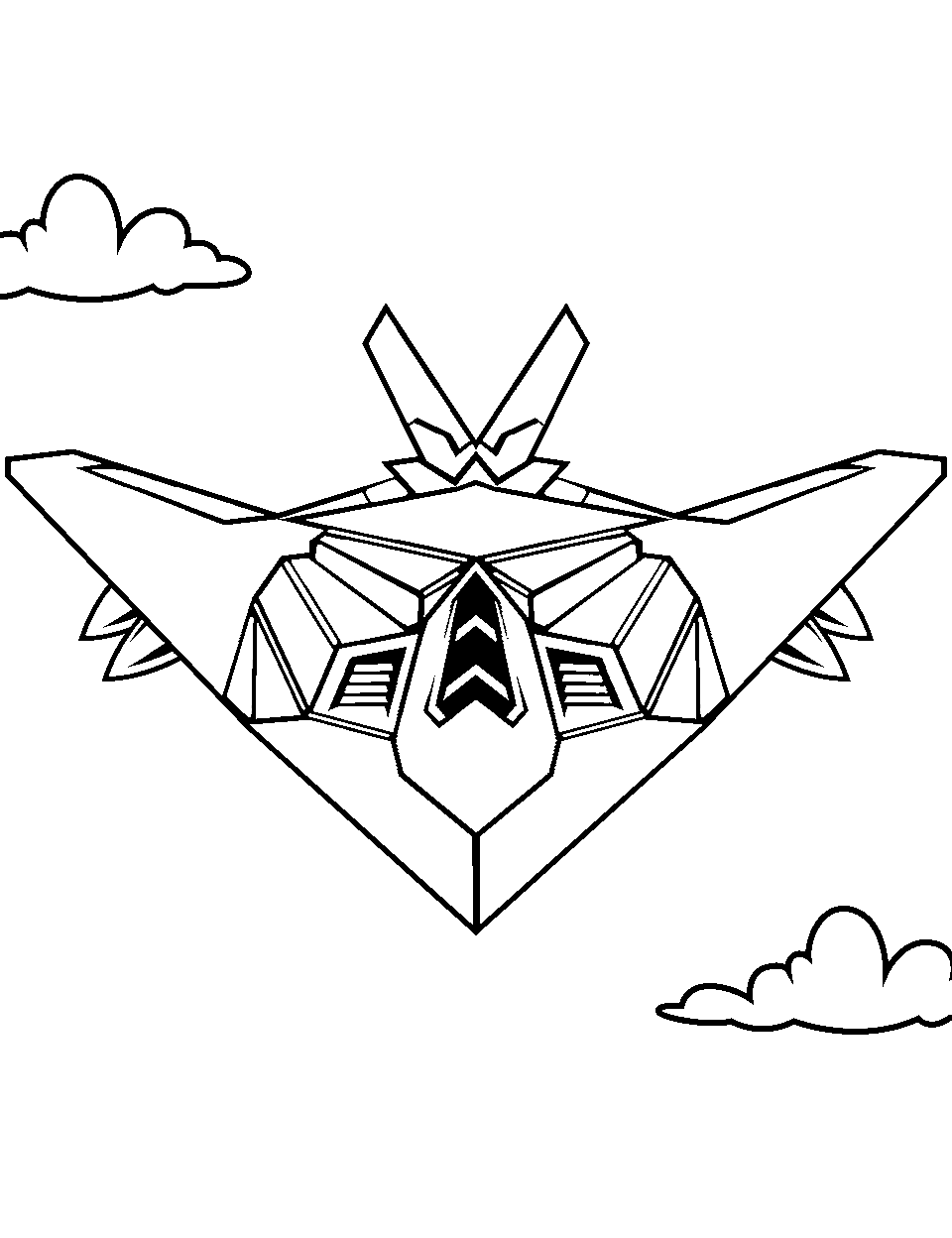
Sharp angles and flat panels make this stealth aircraft look like folded paper, seen head-on with its twin tail fins angled up in a V. There is not a single curve anywhere on it. All those straight edges suit a ruler, a marker and a graphic black-and-grey scheme. Older kids and grown-ups get the most out of this one.
This jetliner is caught in a steep bank, one wing high and one low, with a landing gear leg hanging below it. The angle makes the fuselage look short and wide, which is exactly what you see from the ground as a plane turns onto final approach. Clouds float around it. Coloring the near wing a shade darker than the far one adds real depth.
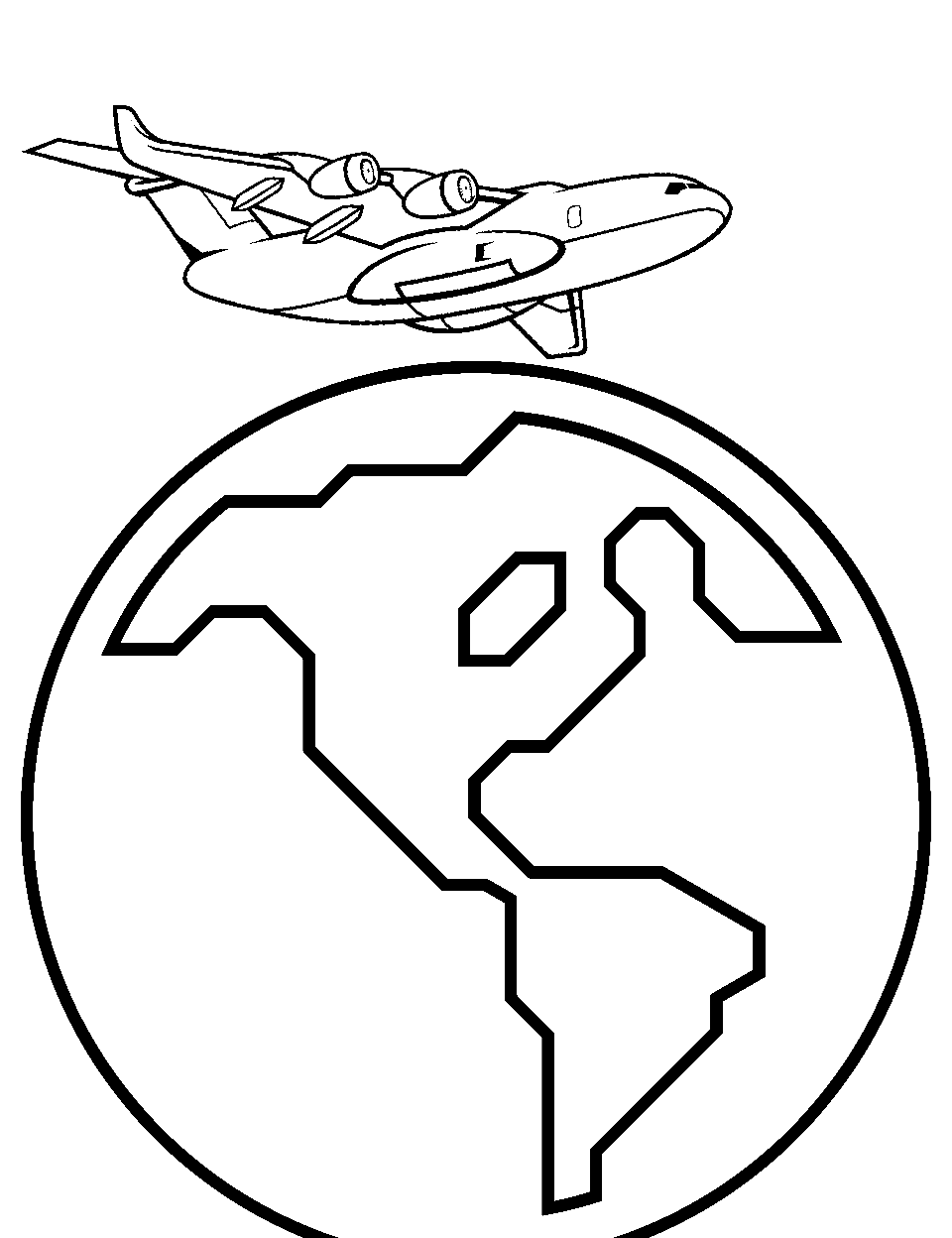
A high-wing transport with engines slung beneath the wing flies above the same bold globe, this time seen from below. The plane is small against a very large Earth, which gives the sheet a real sense of distance. Color the globe first and treat the plane as the finishing touch. That thick globe outline is forgiving for younger colorists.
Here the twin-prop plane drops low over a wooded valley, with pine trees rising on both sides and a shaded slope behind. The scenery crowds in around the aircraft, making this one of the busier pages in the set. Layer two or three greens through the trees so the valley does not go flat. A good project to spread across an afternoon.
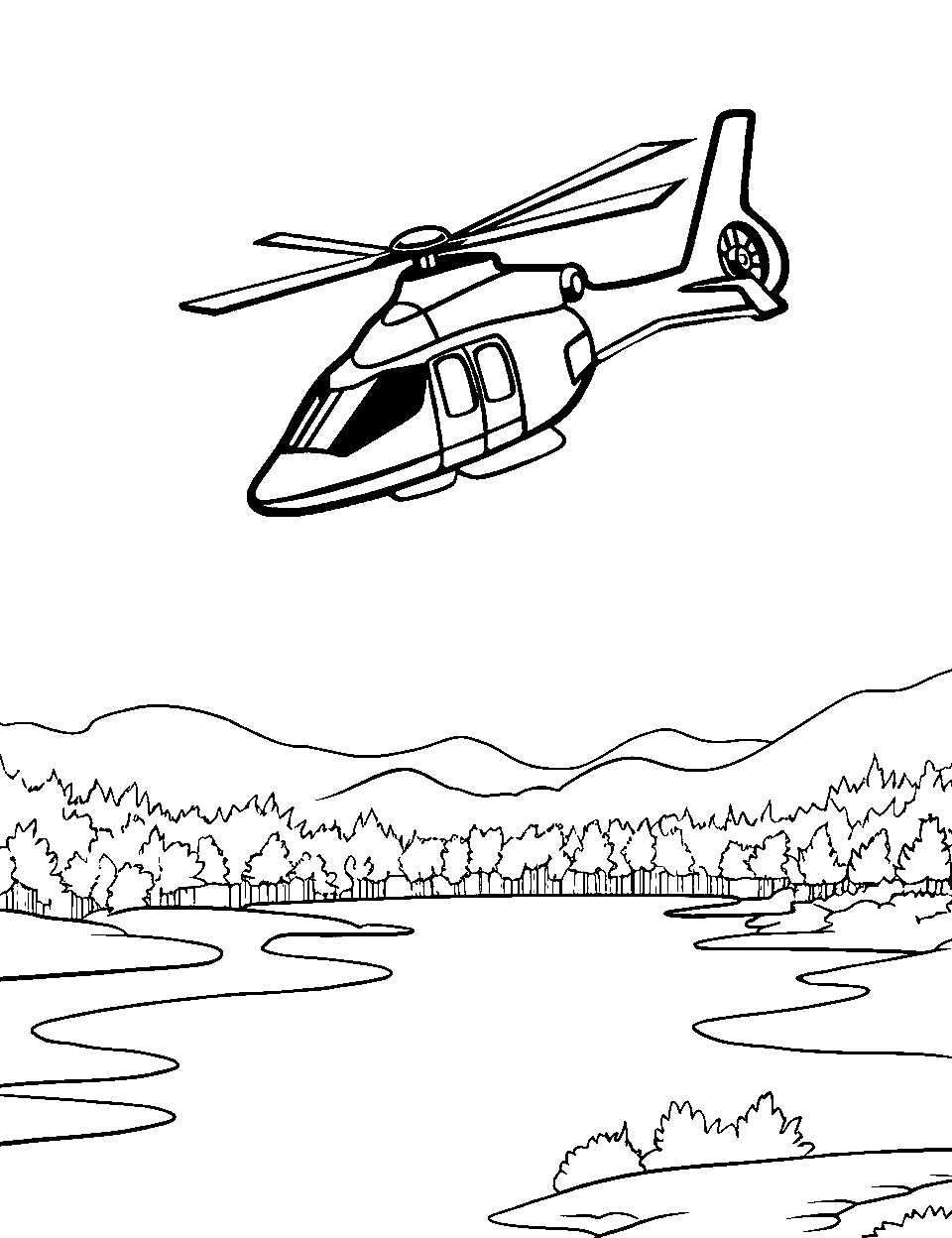
The helicopter comes back for a scenic run over a lake, with a treeline and rolling hills behind it. Its rotor blades and ringed tail rotor are clearly drawn, and the landscape below carries fine detail. Blues for the water, mixed greens for the trees, and a strong body color so the helicopter does not blend into the hills. Best for a child who does not mind thin lines.
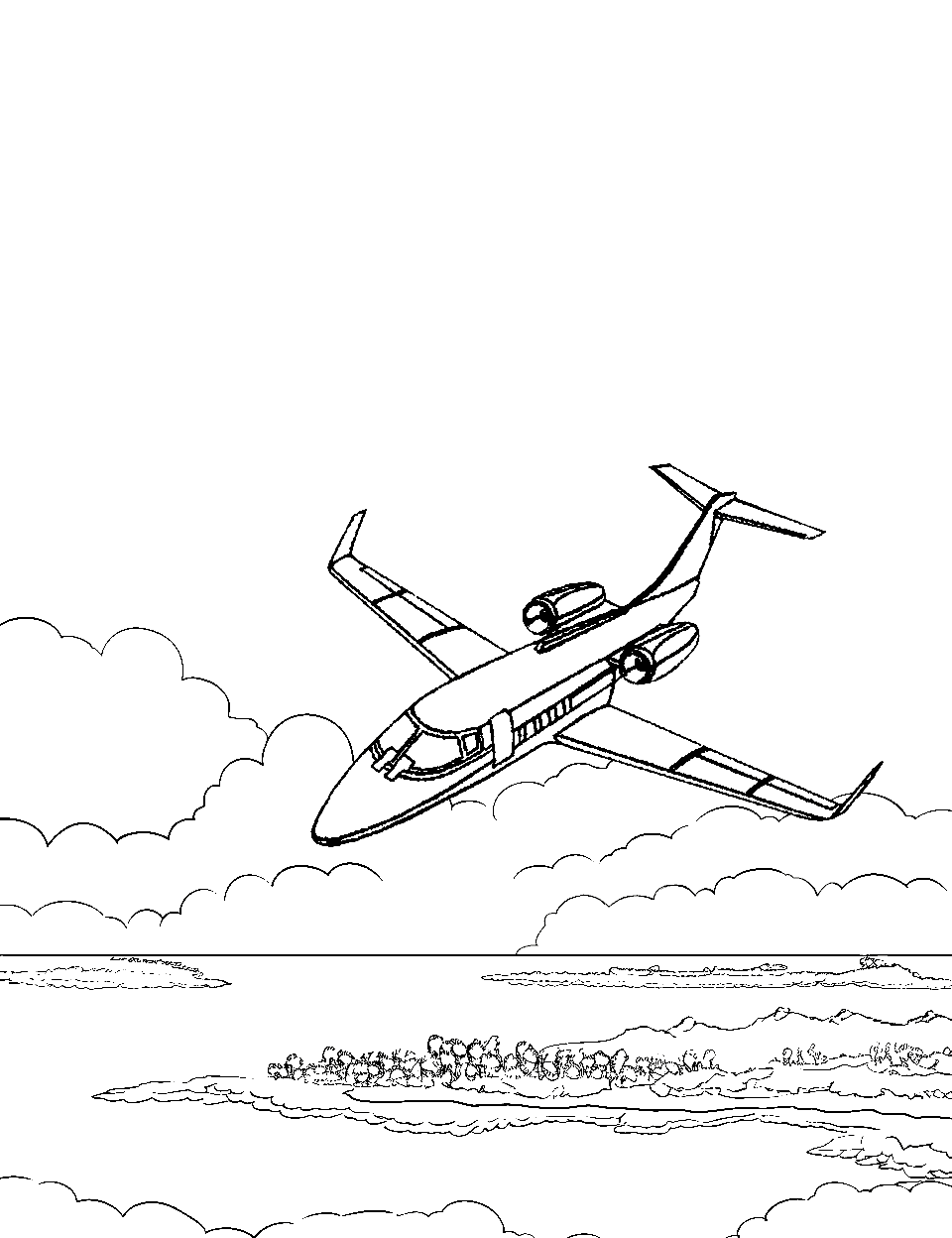
A business jet with its engines mounted at the back of the fuselage and a T-shaped tail glides over layers of cloud, with a hint of land far below. The drawing style is sketchier than the rest of the set, built from lots of light lines. That suits colored pencils much better than markers. A calm, grown-up sheet to finish the collection on.
By using our free coloring pages, you acknowledge and agree to our full disclaimer. All materials are for personal, non-commercial use only and all rights belong to their respective license holders.
Which Airplane Sheet Suits Which Age?
For the youngest colorists, the easiest pages are Cartoonish Stunt Biplane, Friendly Aeroplane Adventure and Playful Cloud Shapes: thick outlines, few pieces, and nothing smaller than a thumbprint. Match the sheet to the size of its shapes, not to how much your child likes planes.
Somewhere around five to seven, most kids can take on Chunky Cartoon Jetliner, Around the World, International Flight, Airplane Hangar, Helicopter in the Clouds and the two head-on runway sheets. Those have more parts, but the parts are still large.
The detailed end of the set is Dusty Crop Duster, Over the Pine Forest, Seaplane Adventure, Airplane Over the City and Vintage Warplane. Hatched fields, packed treelines and rows of windows take real time, and they reward colored pencils over markers. If a page is clearly too hard, hand your child the plane and take the background yourself.
What Does Coloring Actually Do for a Child?
Coloring builds the hand control a child needs for writing, one stroke at a time. The CDC lists holding a crayon between the fingers and thumb instead of in a fist among the things most four-year-olds can do (1), and copying a circle after being shown how among the things most three-year-olds can do (2). Those are the same movements your child makes filling in a wing or steering around the edge of a propeller.
A milestone in that CDC list means something 75% or more of children can do at that age, so a child who is not there yet is not necessarily behind, but raise any concern with your pediatrician.
Coloring is also quiet, which is half the reason it stays in the house. A page with big open areas suits the child who wants to finish something fast and show it to you. A page packed with crop rows or city windows suits the one who wants to disappear into a task for half an hour. Keep a few of each in the pile.
How Far Did the First Airplane Actually Fly?
About 120 feet. Orville Wright made the first sustained, powered flight on December 17, 1903, and it stayed up for 12 seconds (3). The brothers took turns three more times that day, and Wilbur’s last effort covered 852 feet in 59 seconds (4). Wilbur Wright said, “It is possible to fly without motors, but not without knowledge and skill.”
Things have moved on. The FAA’s Air Traffic Organization now handles more than 44,000 flights and more than 3 million airline passengers every day, across more than 29 million square miles of airspace (5).
Both facts land well while a child colors the runway sheets. The first airplane flew a distance shorter than the length of some of the jets on these pages, and today the FAA handles more than 44,000 flights a day.
Activities to Do With Airplane Coloring Pages
The fun does not have to land when the coloring is done. These pages turn into crafts, games and a bit of geography with almost no extra materials.
Create a Fleet of Paper Airplanes
Print the simplest designs on regular printer paper so the sheet still folds cleanly. Have your child color them first, then fold each one into a glider using a different technique. Mark a throwing line on the hallway floor and measure every flight with a tape measure. Kids who will not sit still for a worksheet will happily record distances for twenty minutes.
Design a DIY Hanging Mobile
For a nursery or bedroom, print 4 or 5 different planes on cardstock. Once they are colored, cut them out, punch a small hole in the top of each and tie on a length of thread. Attach the threads at different lengths to a wire hanger or a wooden dowel so the planes turn at different heights.
Build a Cardboard Airport
Grab a flattened box for the base and draw runways, helipads and a taxiway on it. Cut out your colored planes and use them as the traffic. A toothpick taped to the back of each cutout lets it stand up in a lump of clay, which turns a flat drawing into a busy 3D airport your child can play with for days.
The Window Seat Challenge
Several of these sheets show passenger planes with long rows of windows. Challenge your child to draw a tiny face in each one, then ask who they are. Is it the family? A rock band? A zoo full of animals? It is a simple way to turn a coloring page into a story.
Make a Pilot’s License
Use the back of a sheet to draw a pilot’s license, complete with a name, a photo box and a destination. Glue a small cutout of one of the colored planes on as the official aircraft. Sign it, date it, and the next flight around the living room becomes properly authorized.
Track a Real Flight
Pick the International Flight or Around the World sheet, then look up a live flight-tracking map together and find a plane actually in the air right now. Have your child draw its route across the globe on the page. It connects the drawing in front of them to something real happening overhead.
FAQs
How Do I Print These Coloring Pages?
Click the image or the download link under the design you want, then print the file that opens. Ordinary letter paper at normal quality is plenty for crayons and pencils. If your printer offers a ‘fit to page’ or ‘scale to fit’ setting, switch it on, because a drawing that runs to the edge can otherwise lose its wingtips.
What Type of Paper Is Best for Coloring?
Regular printer paper handles crayons and colored pencils with no trouble at all. Move up to cardstock when your child reaches for markers or paint, since that ink soaks straight through thin copy paper and marks the table underneath. Cardstock is also the right call if you plan to cut the planes out for a mobile or a cardboard airport.
Are These Coloring Pages Free?
Yes. Every sheet on this page is free to print for home, classroom and daycare use, with no sign-up and no limit on copies. Print one per child for a party or a whole stack for a rainy week. We only ask that you do not resell them or repost the files elsewhere.
Do Coloring Pages Help With Child Development?
Yes, mostly through fine motor control. Gripping a crayon between the fingers and thumb and steering it inside a line uses the same small hand muscles as early handwriting, and the CDC lists both that grip and copying simple shapes among the things most children manage by ages three and four. Coloring also gives kids practice at starting something and finishing it.
Can I Use These Pages for a Birthday Party?
Airplane sheets work well at a party, especially as the quiet station between games. Print a stack of the simpler cartoon planes, put out a bowl of crayons and let guests take their pages home in the goodie bags. The paper airplane fold above doubles as a party game if the group gets restless before the cake arrives.
How Do I Save Ink When Printing These?
Choose your printer’s draft or economy mode, since a coloring page only needs clean black outlines. Printing in grayscale also stops a color printer from mixing colored inks to make its black. For the busier sheets, such as the storm rain or the crop field, a lighter print is easier for a small child to color over anyway.