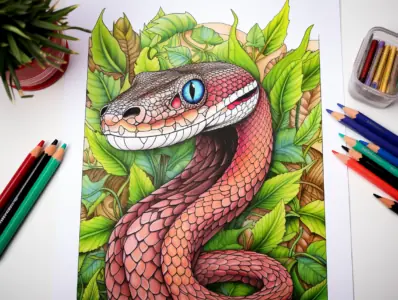
Some of these snakes smile. A few show every fang.
Snake coloring pages give kids a long, safe look at an animal most people only glimpse for a second. This set runs from chunky cartoon smiles a preschooler can fill in with fat crayons to close-up scale work that will keep an older child busy for an hour.
Every sheet below says what is actually drawn on it, so you can choose before you print instead of after. Greens, browns and yellows suit the realistic scenes; the cartoons can take any color your child likes.
Preschool Playful Snakes
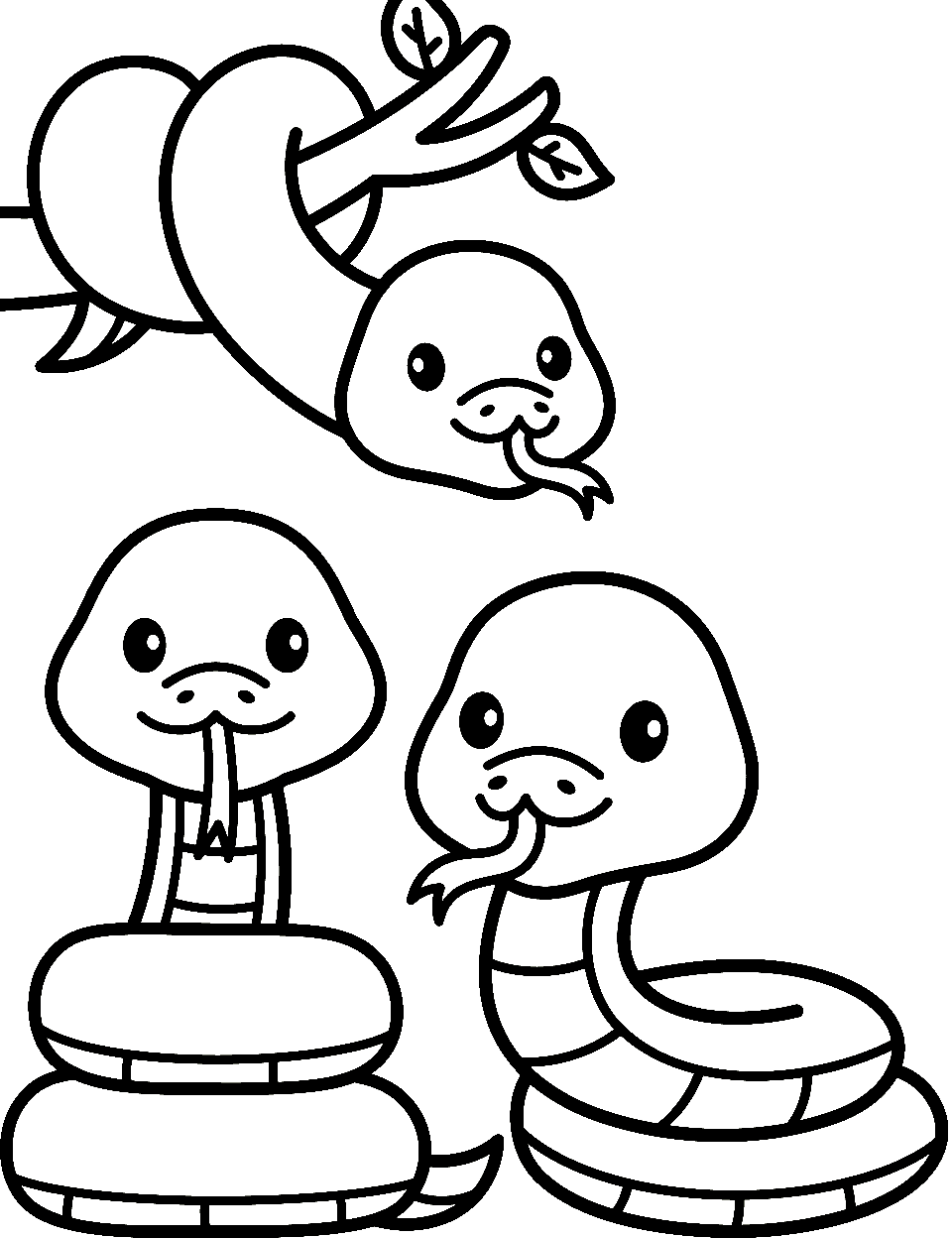
Three round-headed cartoon snakes share this sheet, one hanging from a leafy branch and two coiled into stacked rings below it. Their cute cartoon faces have wide oval eyes and forked tongues sticking out. The lines are thick and the spaces are open, so a preschooler can stay inside them with a fat crayon. Give each snake a different color and the page turns into a matching game.
A snake looks straight out at you here, its head resting above a thick coil of body while blades of grass cross the front of the picture. Every scale is drawn as its own small shape, which makes this a slow, calm page rather than a quick one. Olive and moss greens on the body with a paler belly keep it looking like a snake you might really meet. Kids who like precision can color the grass in three shades so the front blades stand forward.
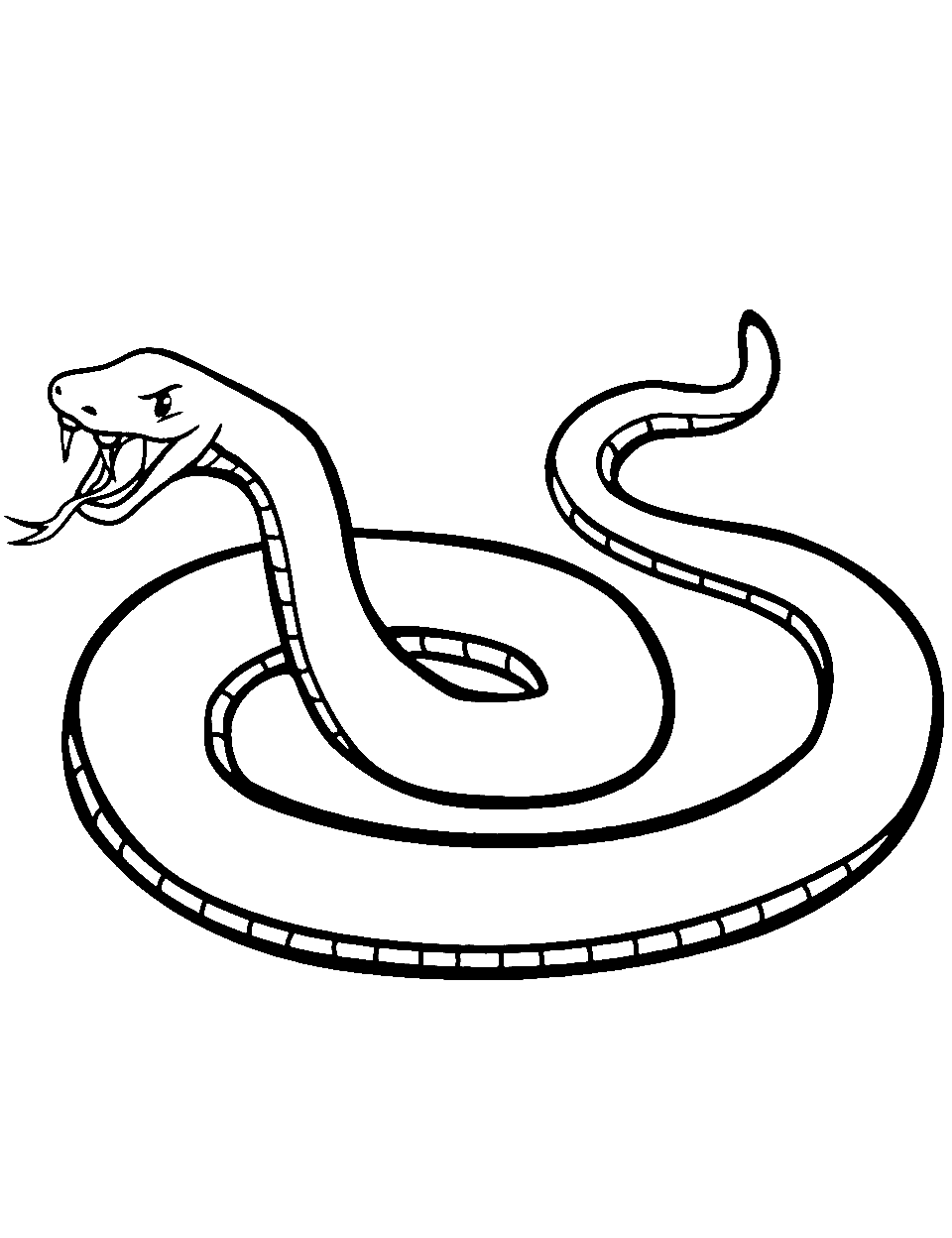
Simple bold lines here: a long body looped into a flat spiral, a raised head, two pointed fangs and a forked tongue flicking out. The belly is marked with small rectangles that are easy to fill one by one in an alternating pattern. Red and orange make it look fierce, though a purple cartoon snake is just as good. Plenty of white paper is left around it if your child wants to add a background.
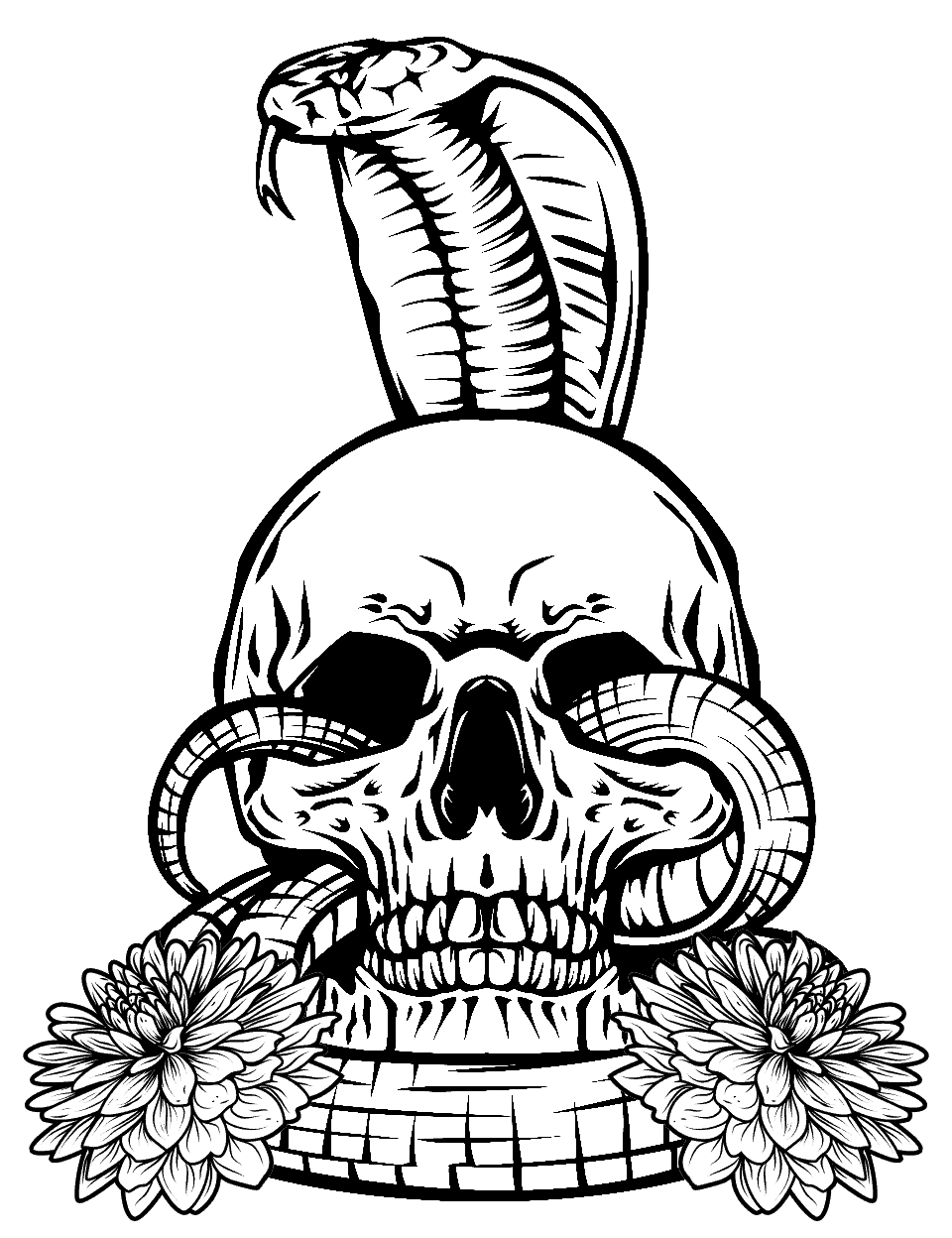
A hooded cobra rises above a human skull, its body threading around the bone and out through one eye socket. Two big chrysanthemum blooms sit in the bottom corners, which softens the whole design. Large areas are already printed solid black, so the coloring happens in the lighter gaps between them. This tattoo-style sheet suits older kids and teens who want something with an edge.
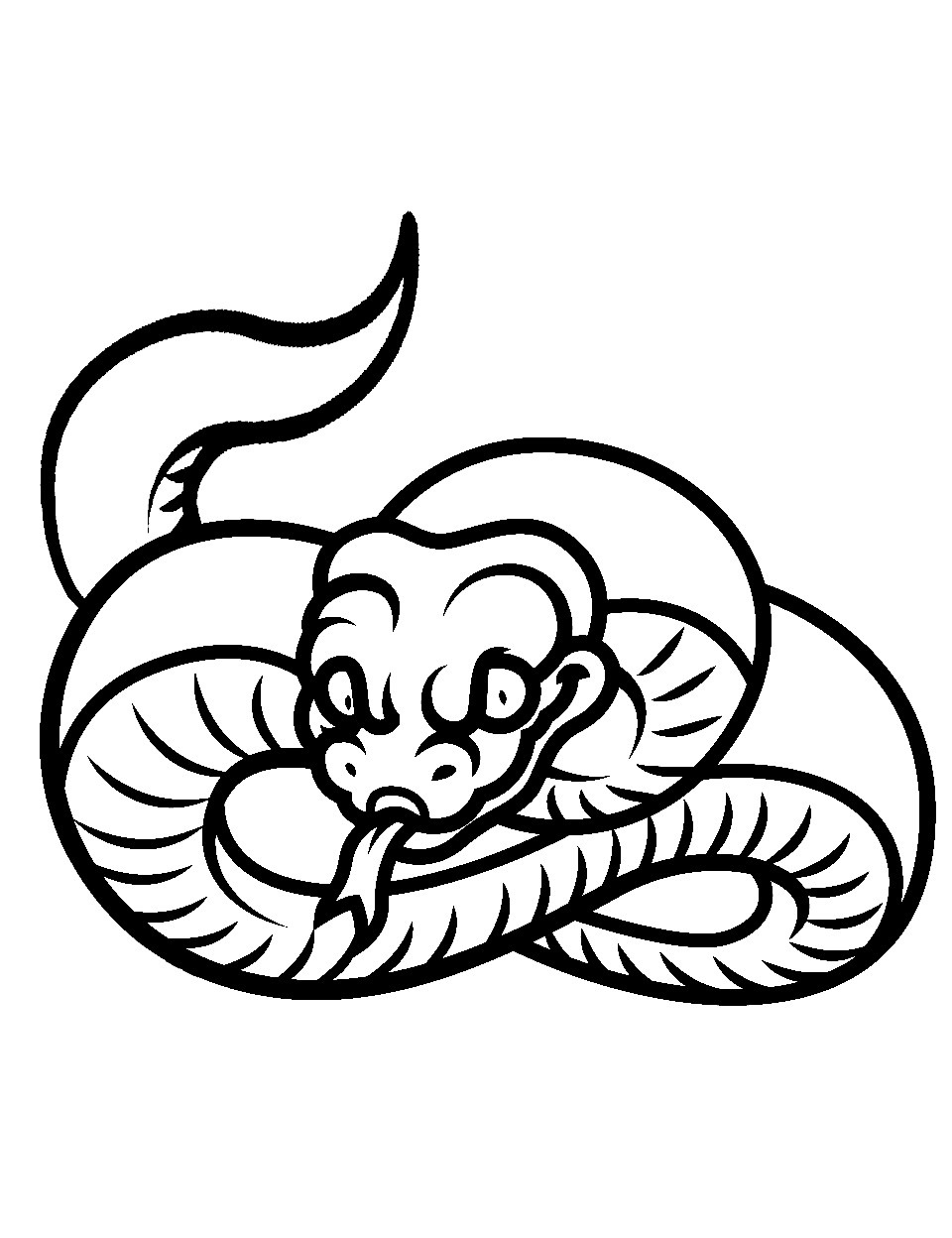
A cartoon snake sits in a loose coil with its head in the middle and the tip of its tail lifted high behind it. The face has wide eyes and a small tongue, more worried than frightening. Wide bands across the body make good stripes if you alternate two colors along the length. It is a quick sheet, so it works as a warm-up before something more detailed.
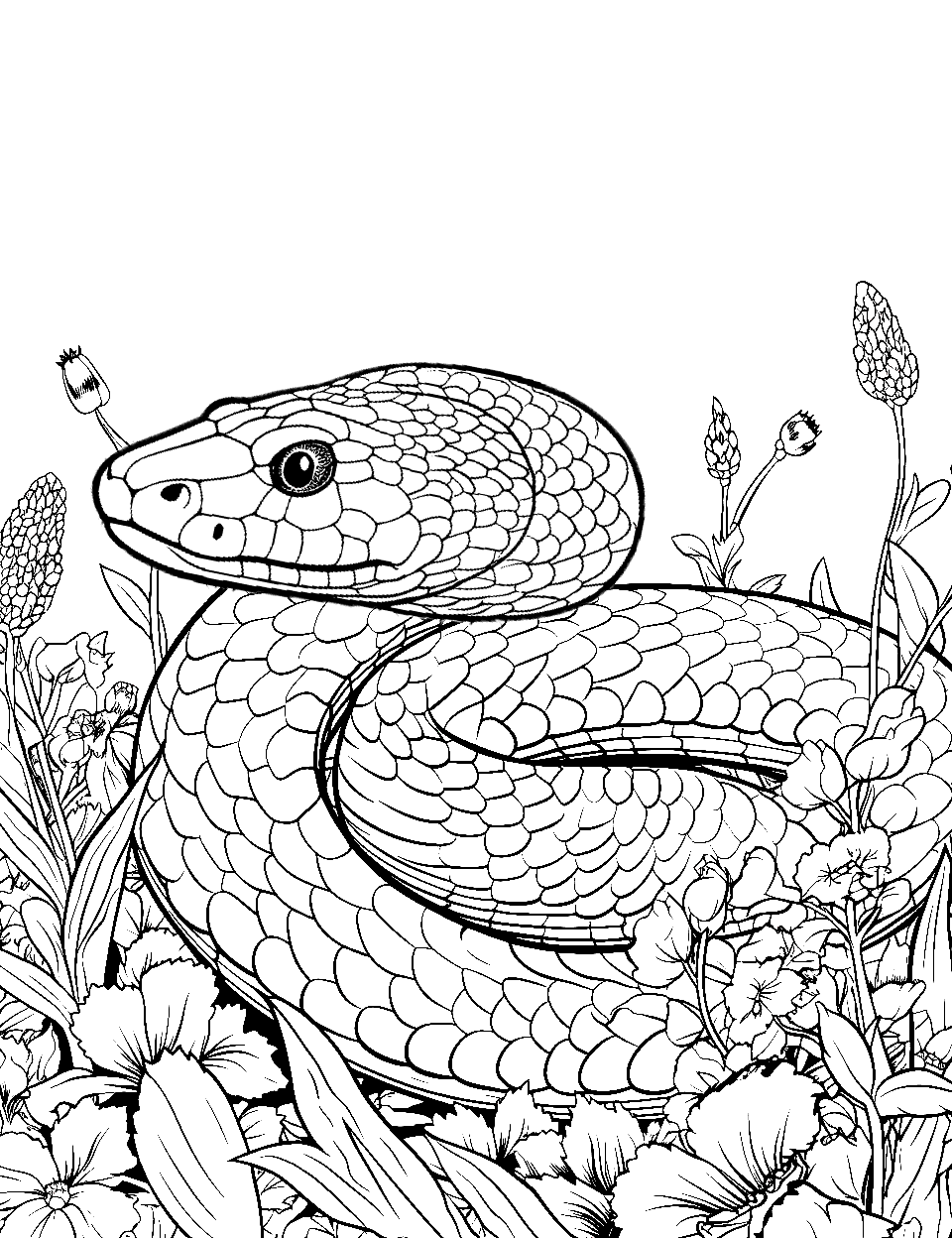
Flowers crowd every edge of this scene: petals, buds, long leaves and tall seed heads around a snake coiled in the middle. The head is drawn side-on with one round eye, and the body scales are small and tightly packed. Kids can color a garden filled with flowers in any shades they like and keep the snake earthy so it still reads clearly. There is a lot going on, so hand it to a patient colorer.
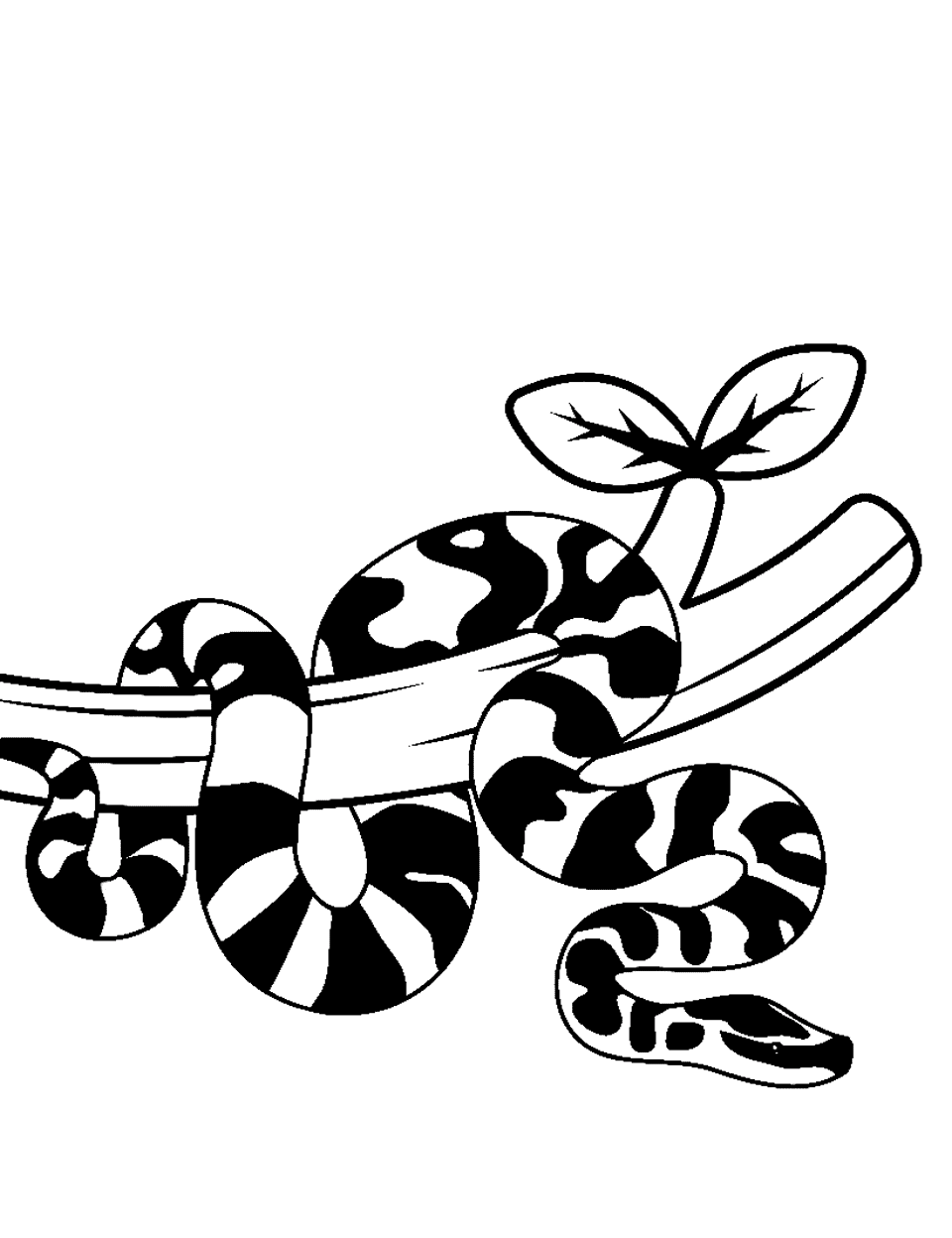
A patterned snake drapes across a bare branch with a small leafy sprig growing beside it. Big blotches along its body are already printed solid black, so the sheet is really about coloring the pale gaps between them. That makes it fast, and the finished page reads from across the room. Good for a child who tends to lose interest halfway through a detailed drawing.
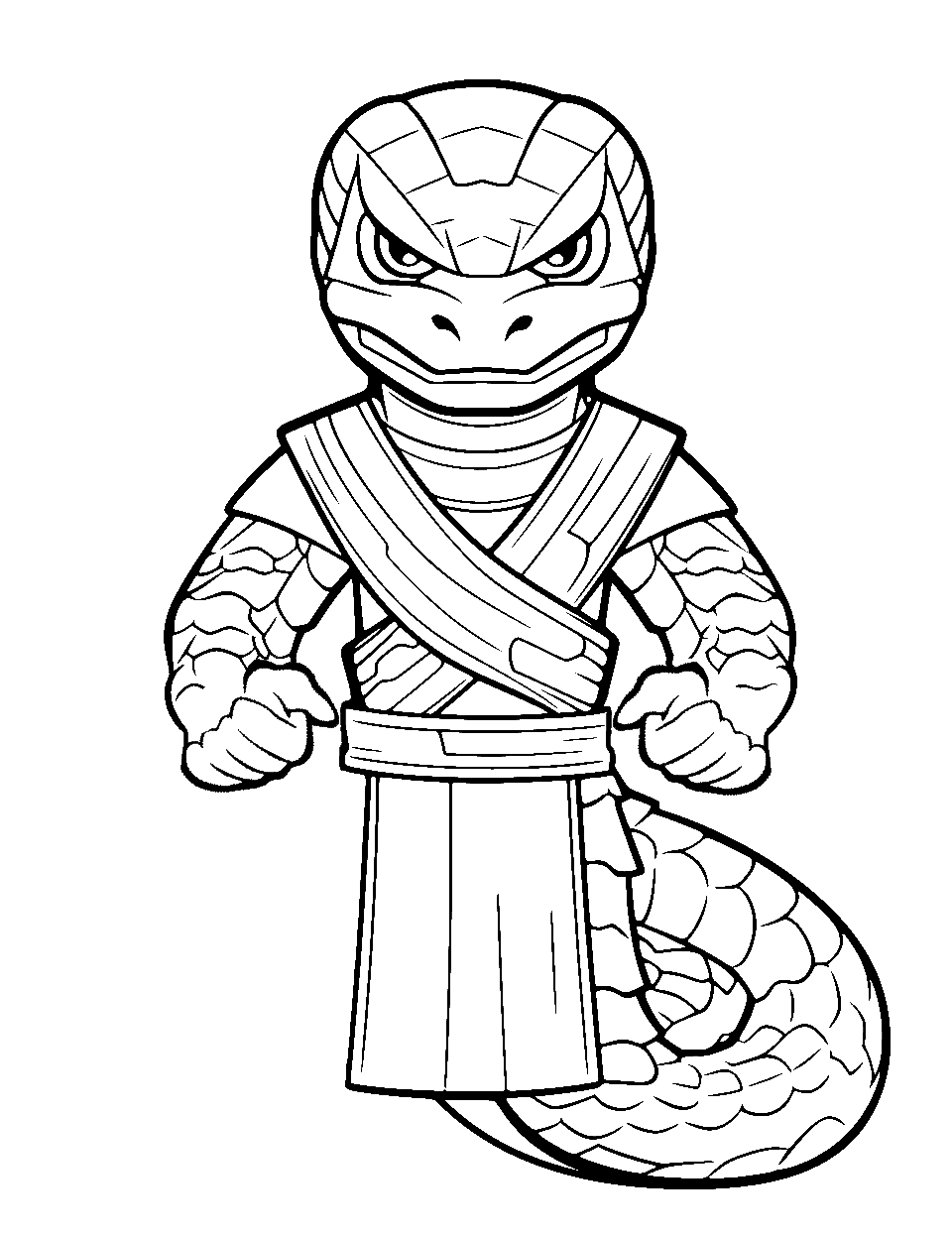
This snake stands upright like a ninja, with arms, clenched fists, a sash crossed over its chest, a belt and a long scaled tail curling out behind. The face is set in a frown and the head scales are drawn as clean panels. Sash, belt and robe can each take a different color, which makes it a good page for kids who like characters more than animals. Older children can draw a dojo or a forest behind him.
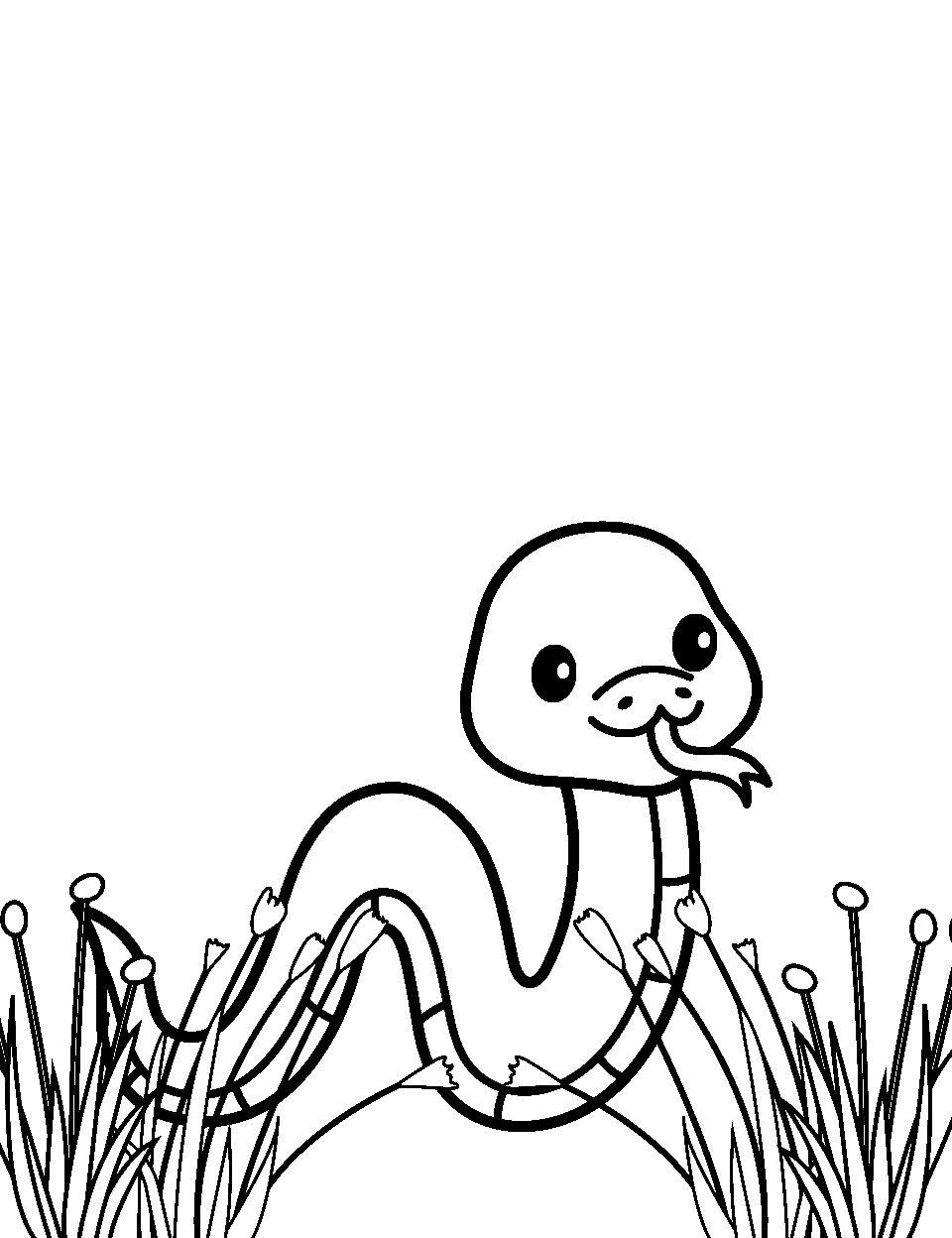
A small cartoon snake winds through a strip of grass along the bottom of the page, tongue out and eyes wide. The top two thirds of the sheet are blank white paper. That empty space is the point: ask your child to draw the rest of the habitat, whether that is a pond, a log pile or a desert. The shapes are simple enough for a four year old to manage alone.
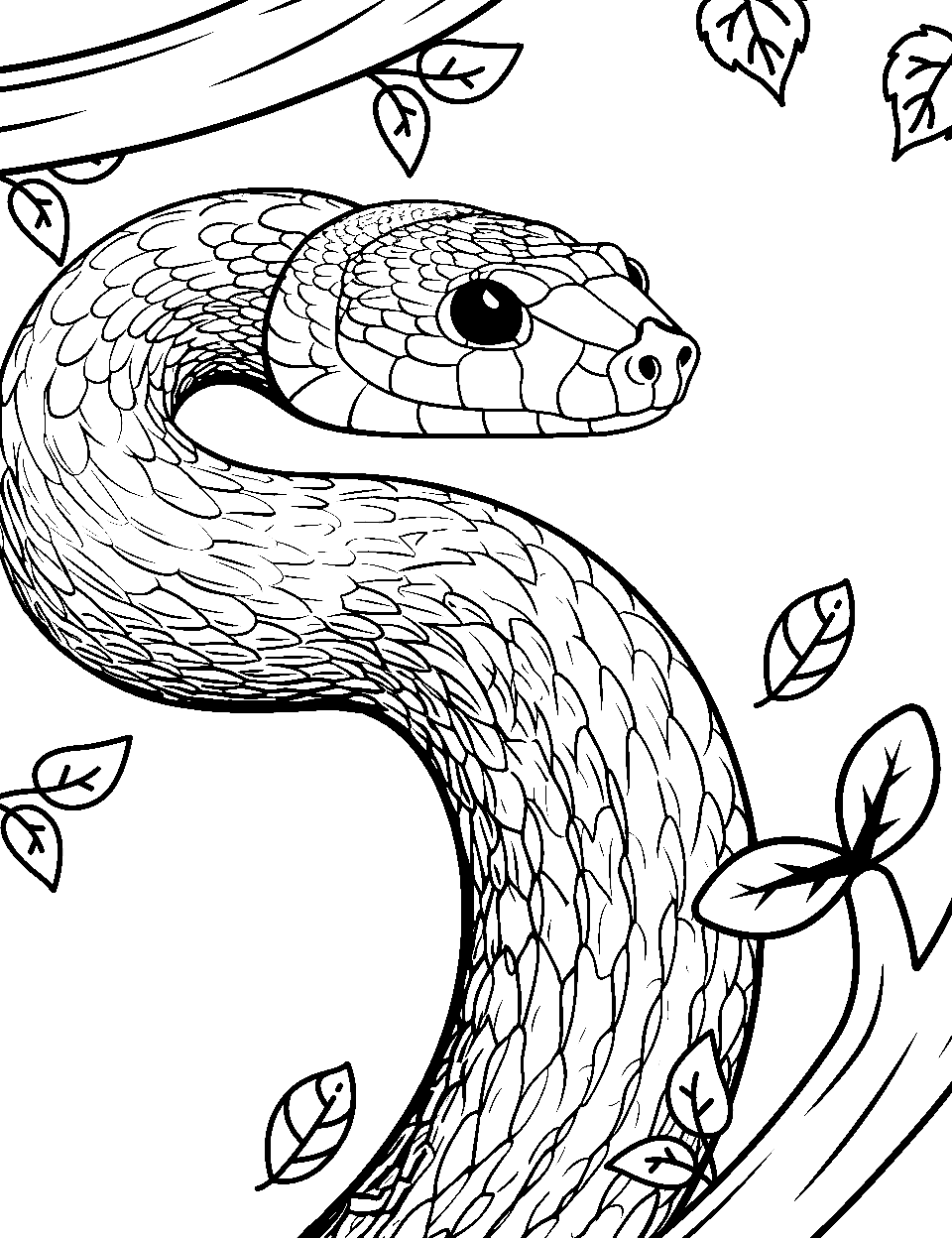
A long snake curves through the middle of this page with leaves and branches scattered around it. Its head is drawn in profile with one large black eye, and the scales shrink as they run down toward the tail. Layering two greens, a light base with a darker edge, gives the body a rounded look. The loose leaves are a good place to practice light pressure with a pencil.
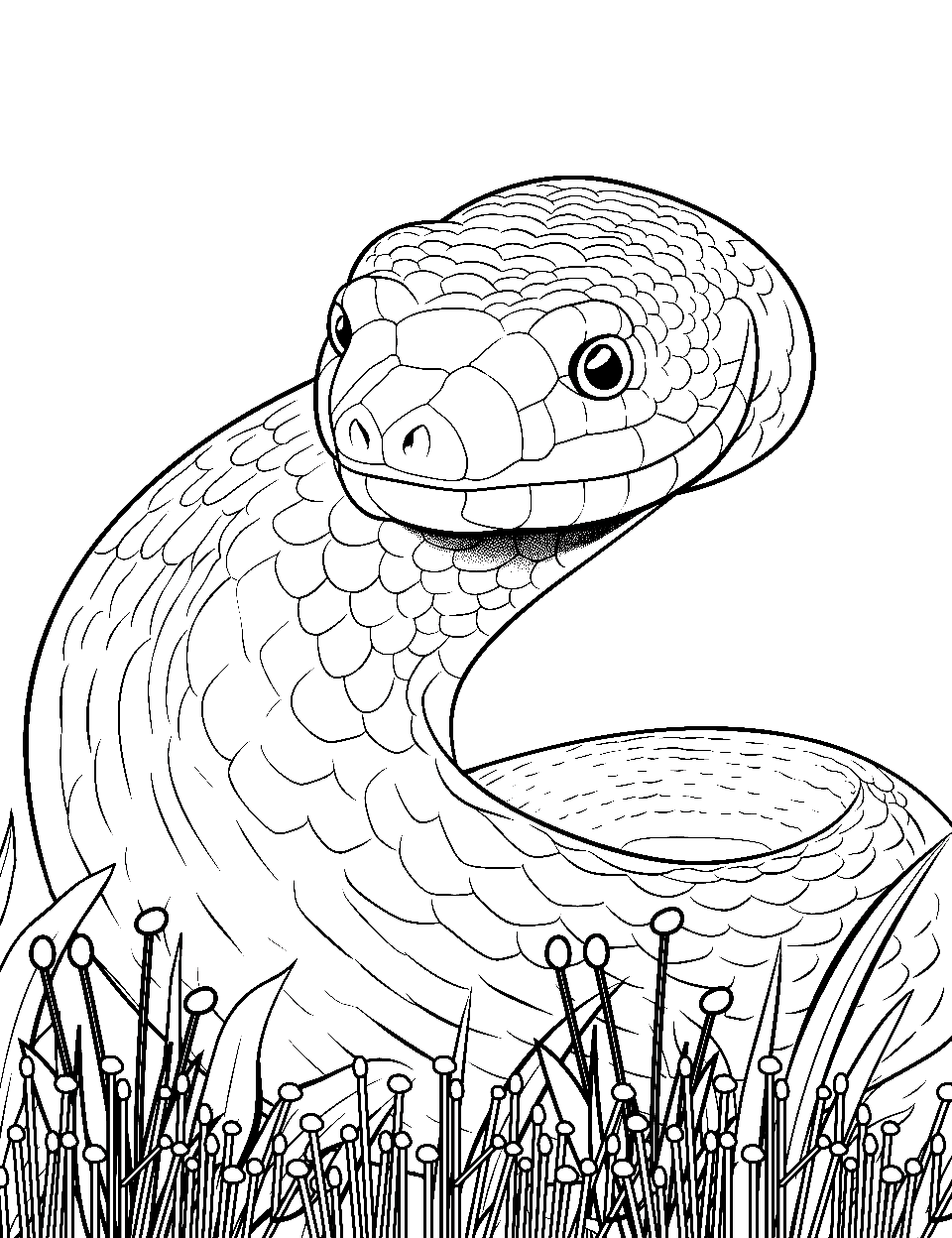
This snake lifts its head high over a coiled body while thin stalks with round seed heads fill the bottom of the sheet. The scales on the head and neck are large and clearly outlined, so they are easy to color one at a time. Try a brighter green on top fading to a duller tone underneath, the way many snakes shade from back to belly. The tiny seed heads are fiddly, so save them for last.
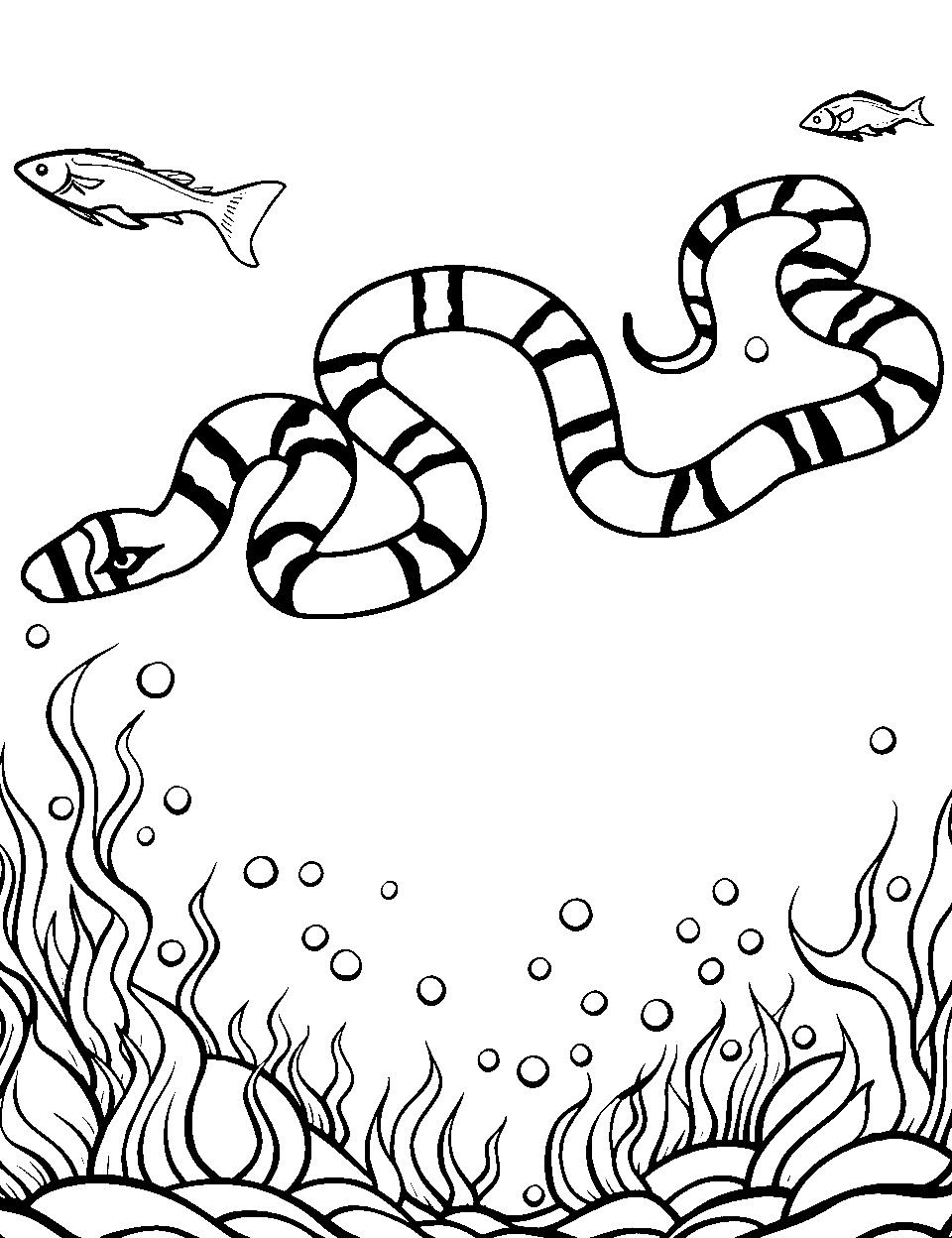
A banded snake swims across the top of this underwater scene while two fish drift nearby, one on the left and one at the top right. Below them sit bubbles, wavy seaweed and a row of rounded stones along the seabed. The bands alternate wide and narrow, giving an obvious two-color pattern to follow. A wash of blue over the background at the end pulls the whole scene together.
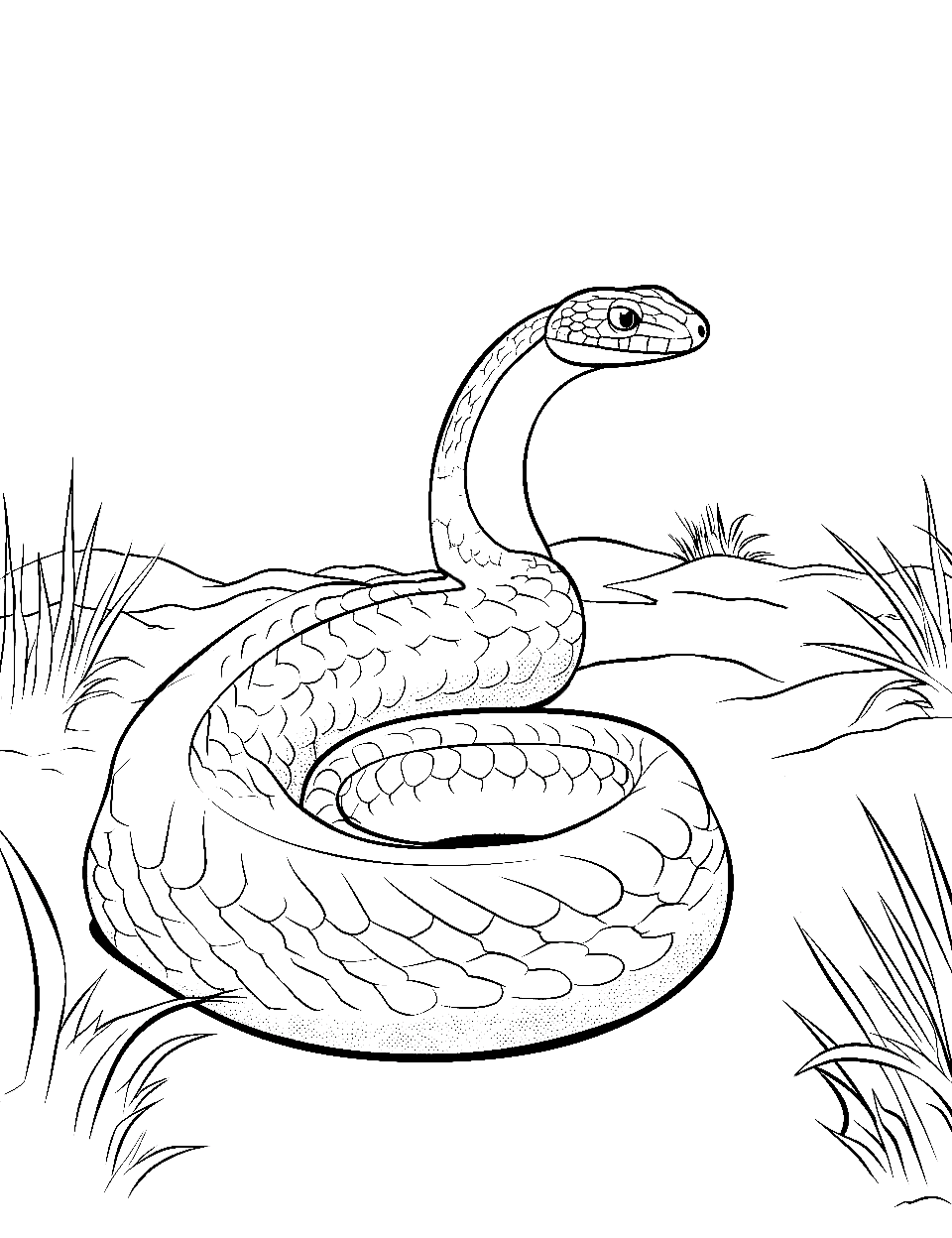
A realistic snake rests in a tight coil on flat ground, head raised and facing right, with small tufts of grass scattered around it. The scales are drawn in overlapping rows and there is light shading under the body. Sandy tans on the ground with a slightly darker brown snake keeps it camouflaged, which is the honest way to color it. This one rewards colored pencils far more than markers.
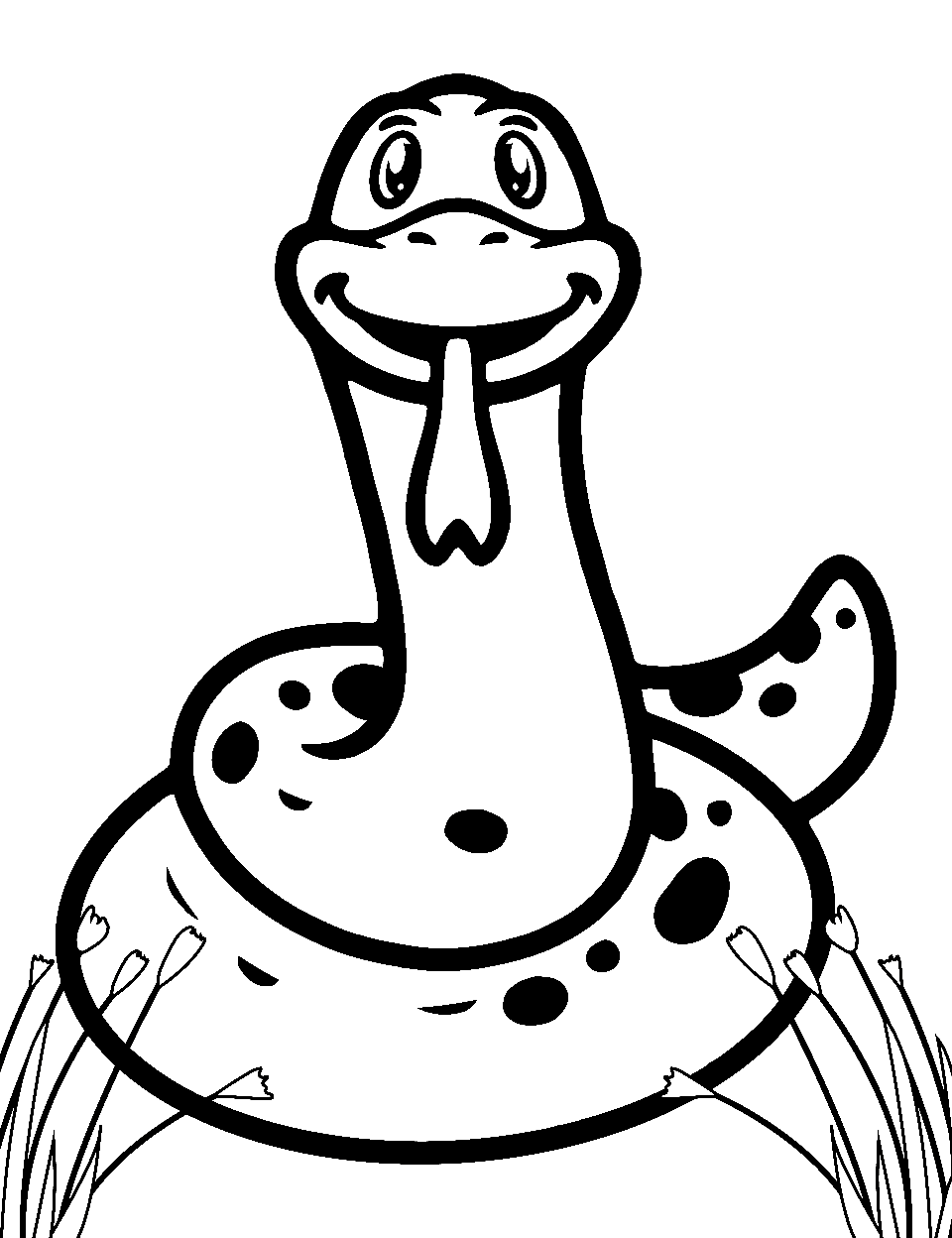
A grinning cartoon snake curls its spotted body into a circular shape, with its head popping up in the middle and its tongue hanging out. The round spots are already printed solid black, and short grass pokes up along the bottom edge. Because the shapes are big and few, this is one of the easiest sheets in the set. Little kids get to practice following one continuous curve.
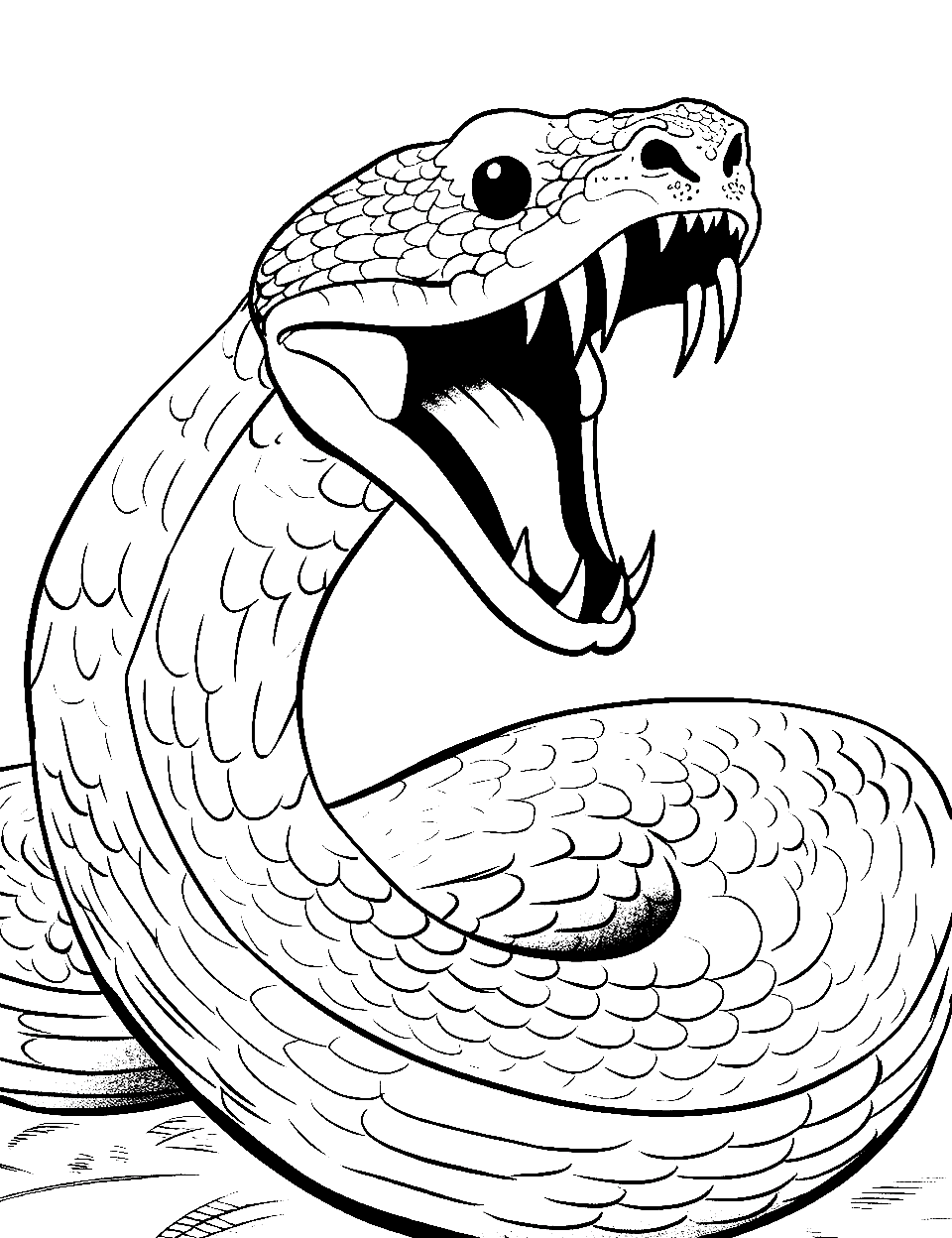
This snake rears up with its mouth stretched wide, showing long curved fangs and a dark throat. The body loops beneath it in heavy coils with rows of scales drawn across them. The open mouth is the natural spot for a splash of pink or red. It is a dramatic page, so keep it for a child who wants something that looks a little dangerous.
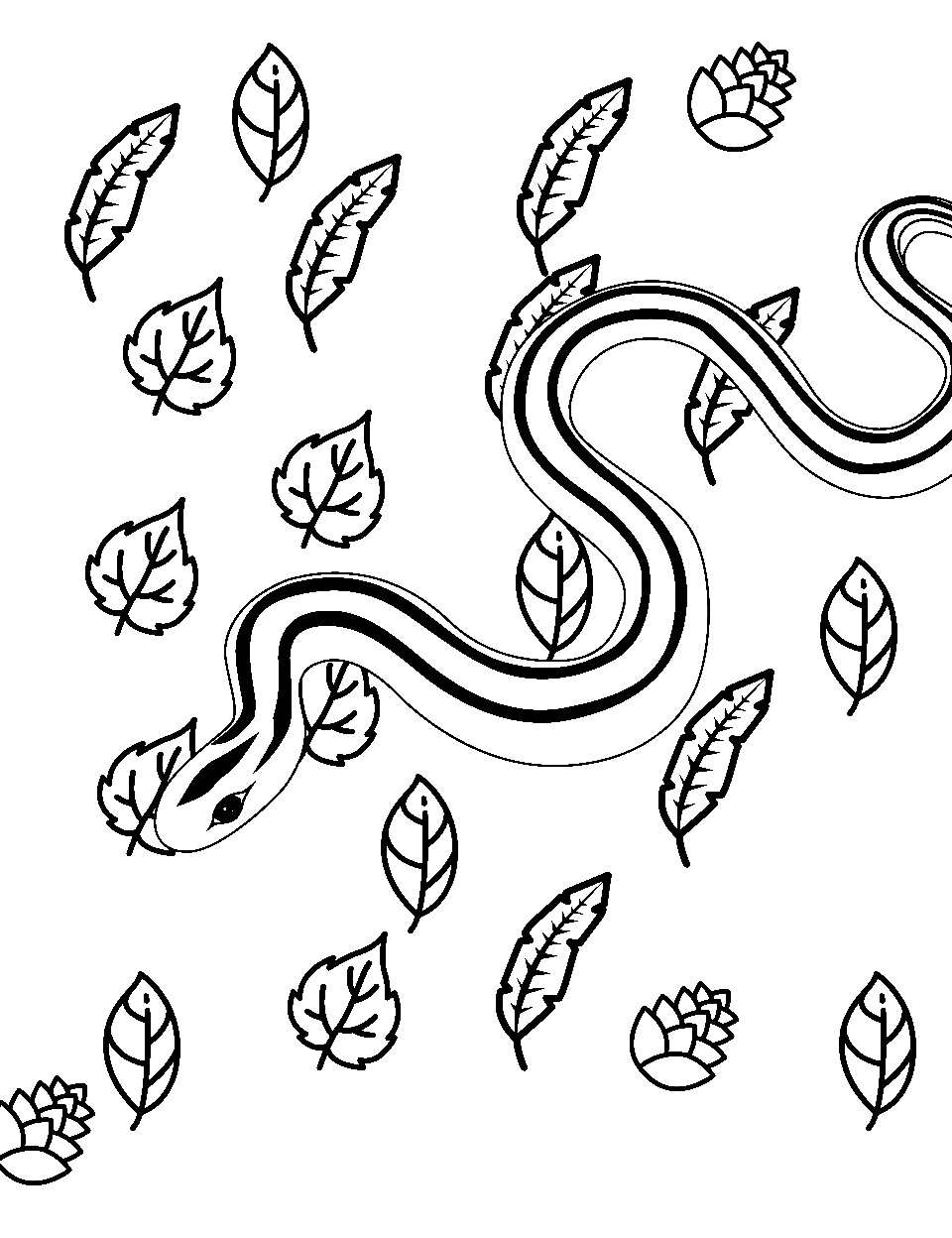
A slim striped snake winds diagonally across this page, surrounded by fallen leaves in several shapes. One bold stripe runs the length of its back, which gives you an easy first line to color. Oranges, rusts and yellows across the leaves turn it into an autumn scene in a few minutes. The scattered leaves also make it easy to put down and come back to later.
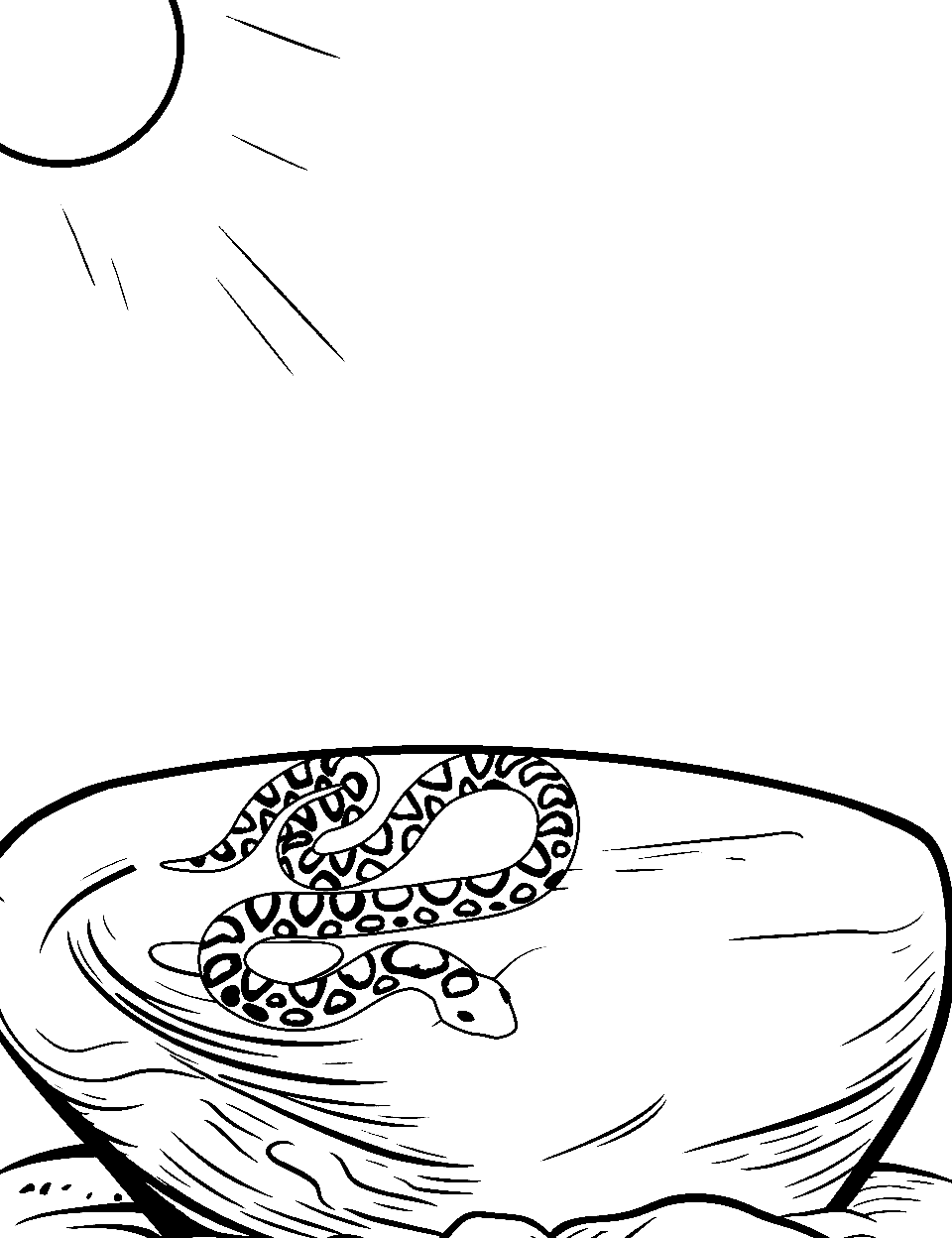
A spotted snake lies stretched across a big smooth rock while a sun with long rays shines from the top left corner. Most of the upper half of the page is empty, leaving room to add sky, clouds or a horizon line. The rock carries faint texture lines that take gray or tan nicely. Snakes really do warm up like this, so the sheet doubles as a reason to talk about why they need the sun.
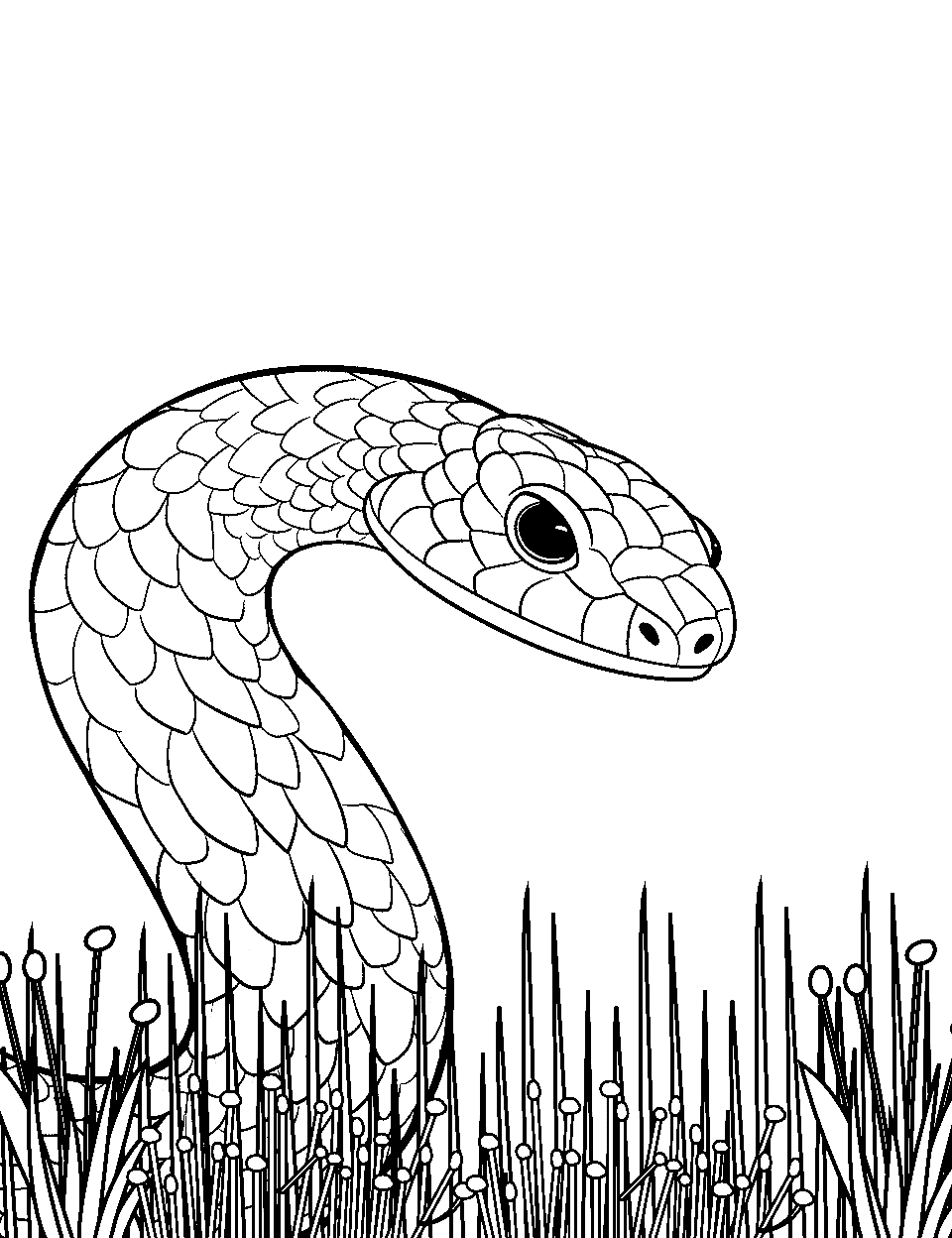
A large scaled head curves down toward a band of grass and seed heads at the bottom of the sheet. The neck fills most of the page, so the scale rows are big and forgiving. A dark patch of shading sits behind the eye already, so leave that black or go very dark around it. Kids who like drawing can carry the body off the bottom edge onto a second sheet.
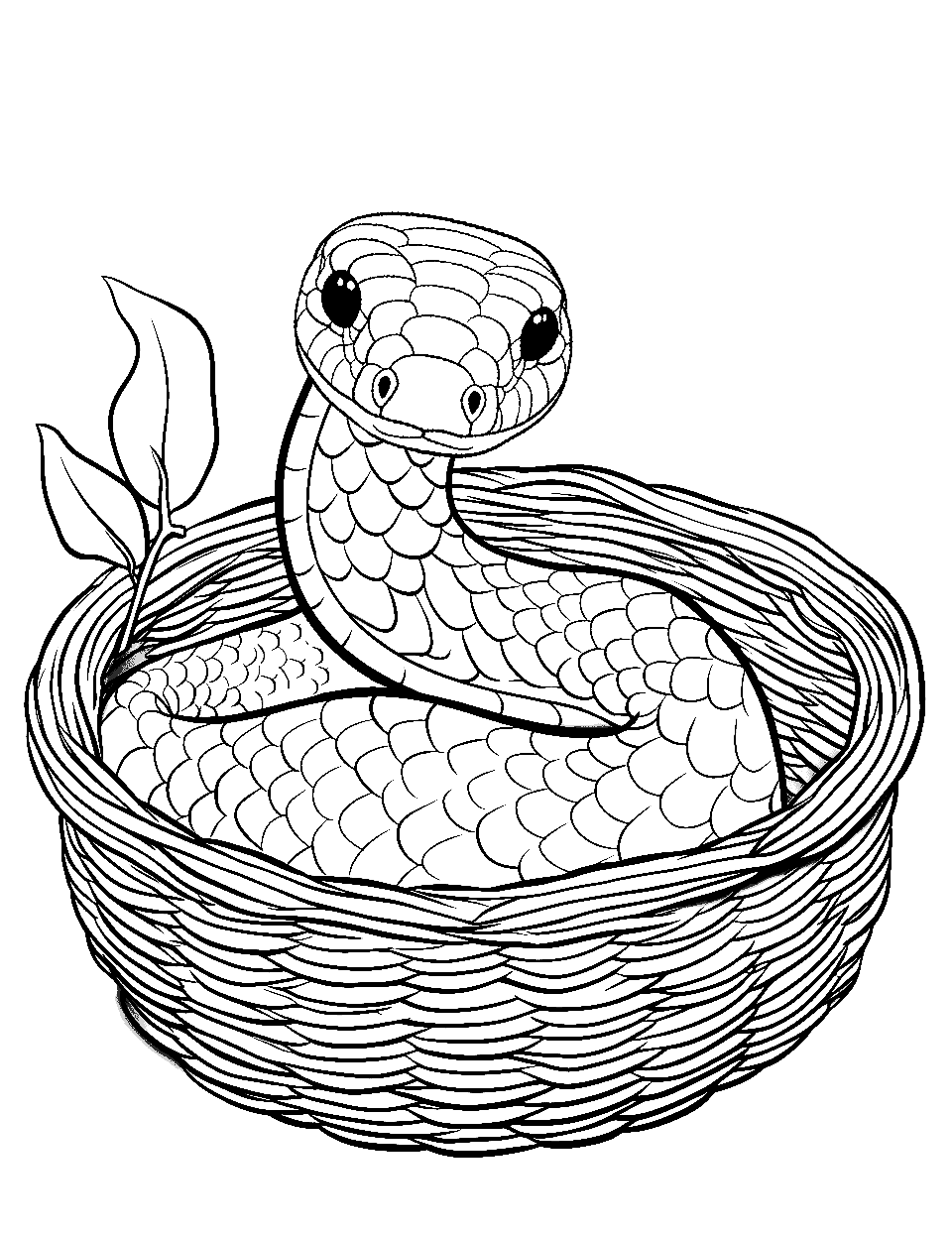
A wide-eyed snake sits coiled inside a woven basket, with a leafy sprig poking up on the left. The basket is drawn as dozens of thin woven strands and is easily the most detailed part of the page. Alternating light and dark browns across those strands makes the weave look real. The snake itself is simple, so a younger sibling can take that half while an older child does the basket.
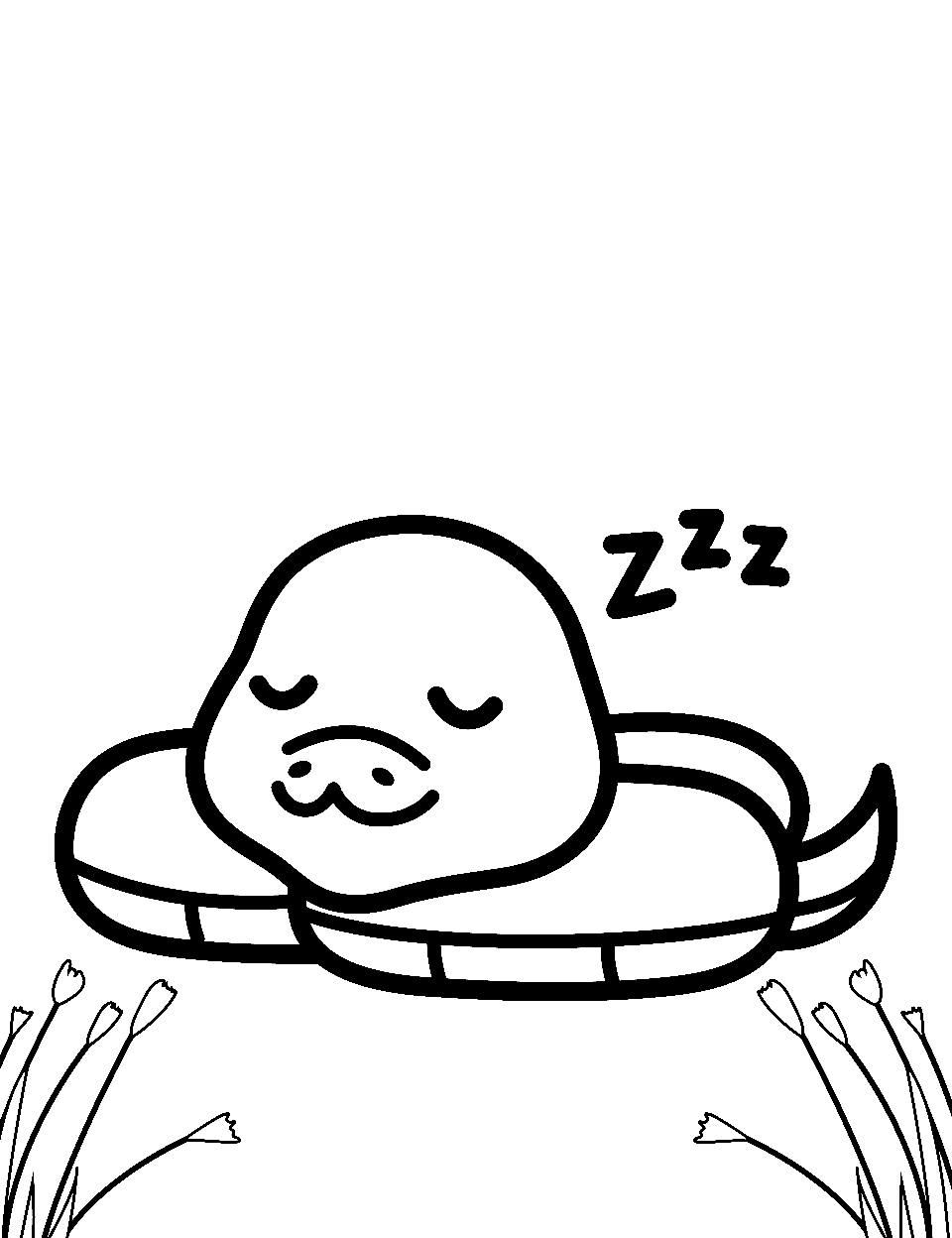
This sleeping snake has closed eyes, a soft smile and a Zzz floating above its head. The body is a plain rounded coil with a few segment lines, and small flowers sit near the ground. Nothing here is fiddly, which makes it a calm choice for the end of the day. Soft blues, lilacs and pinks suit the mood better than bright colors.
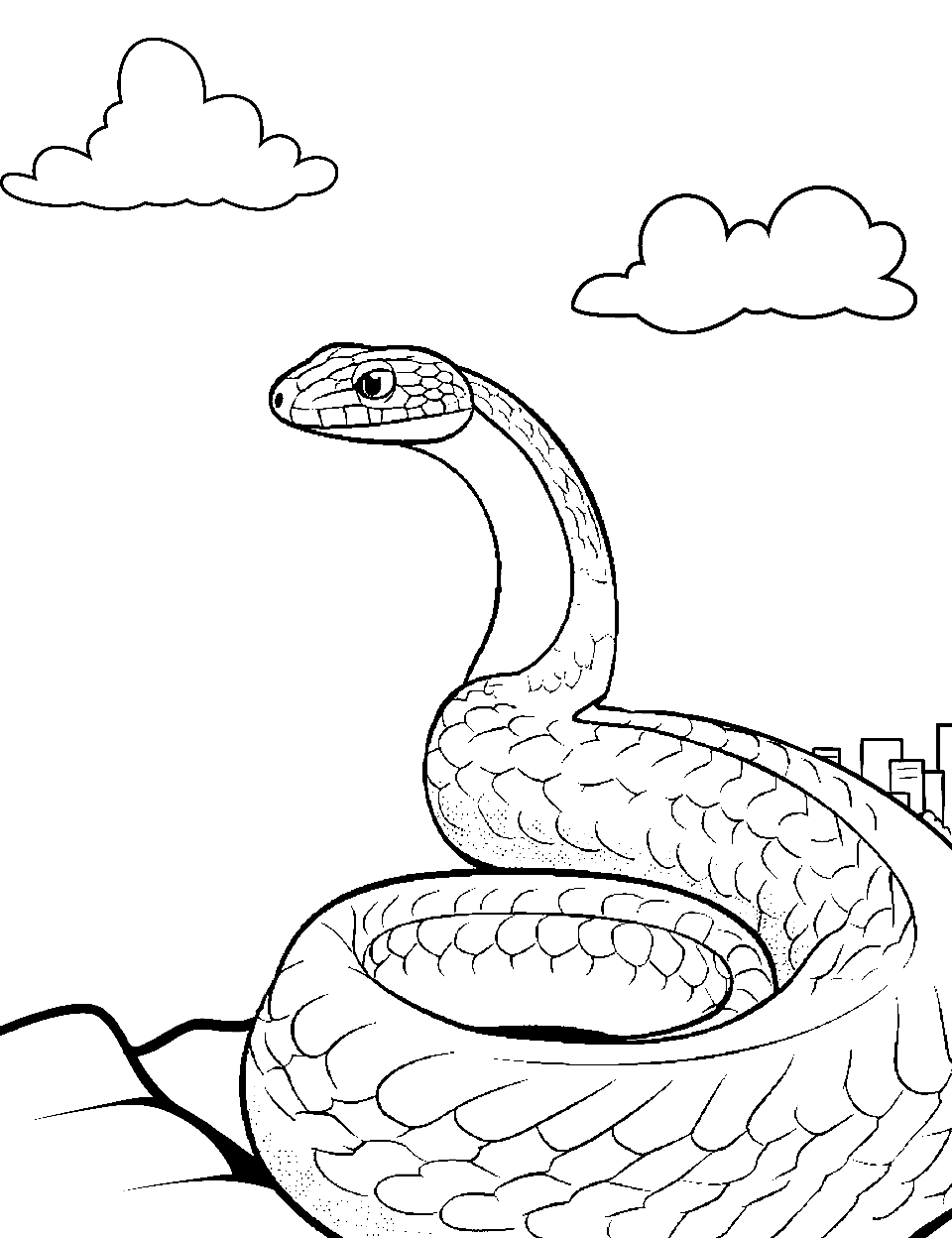
A snake raises its head over a coiled body on a rocky ledge, with two puffy clouds in the sky and the outline of a distant city skyline at the right edge. That contrast between animal and buildings is worth a conversation while you color. Sky blue behind the clouds and warm gray on the rock will make the snake stand out. Older children can extend the skyline along the horizon.
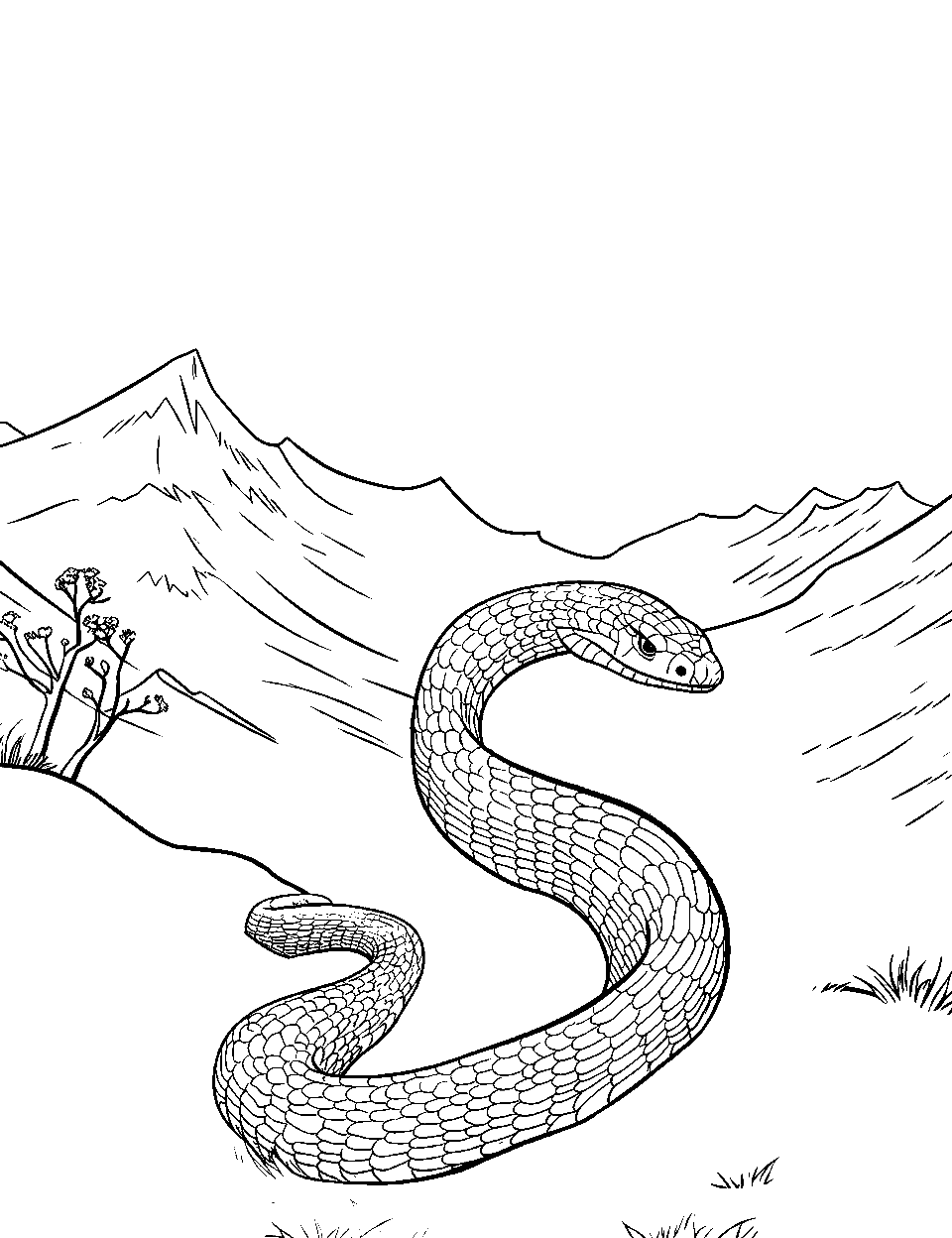
A long snake curves across open ground with a mountain range rising behind it and a bare, flowering tree standing on the left. Its body is drawn in a wide S shape, so the scale rows change direction as you follow them around. Cool grays and purples on the mountains push them into the distance and hold the snake at the front. Good practice for the idea that far-away things look paler than close ones.
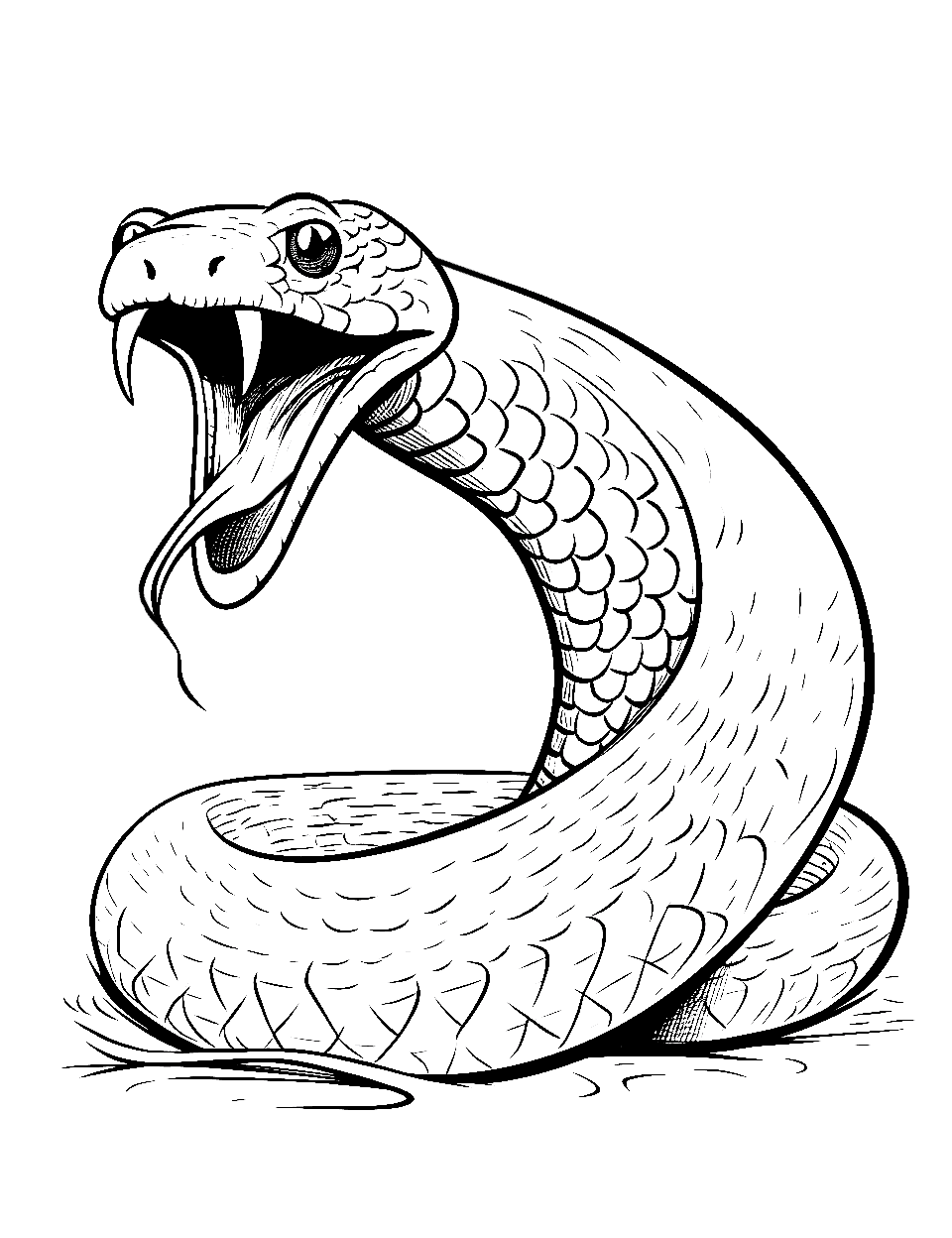
This snake fills the page with its mouth thrown open, two long fangs pointing down and a forked tongue curling out past them. The body coils tightly under the head and the scales are drawn in fine overlapping rows. Leaving the inside of the mouth dark makes the fangs look sharper by contrast. It pairs well with a chat about how snakes swallow food whole instead of chewing it.
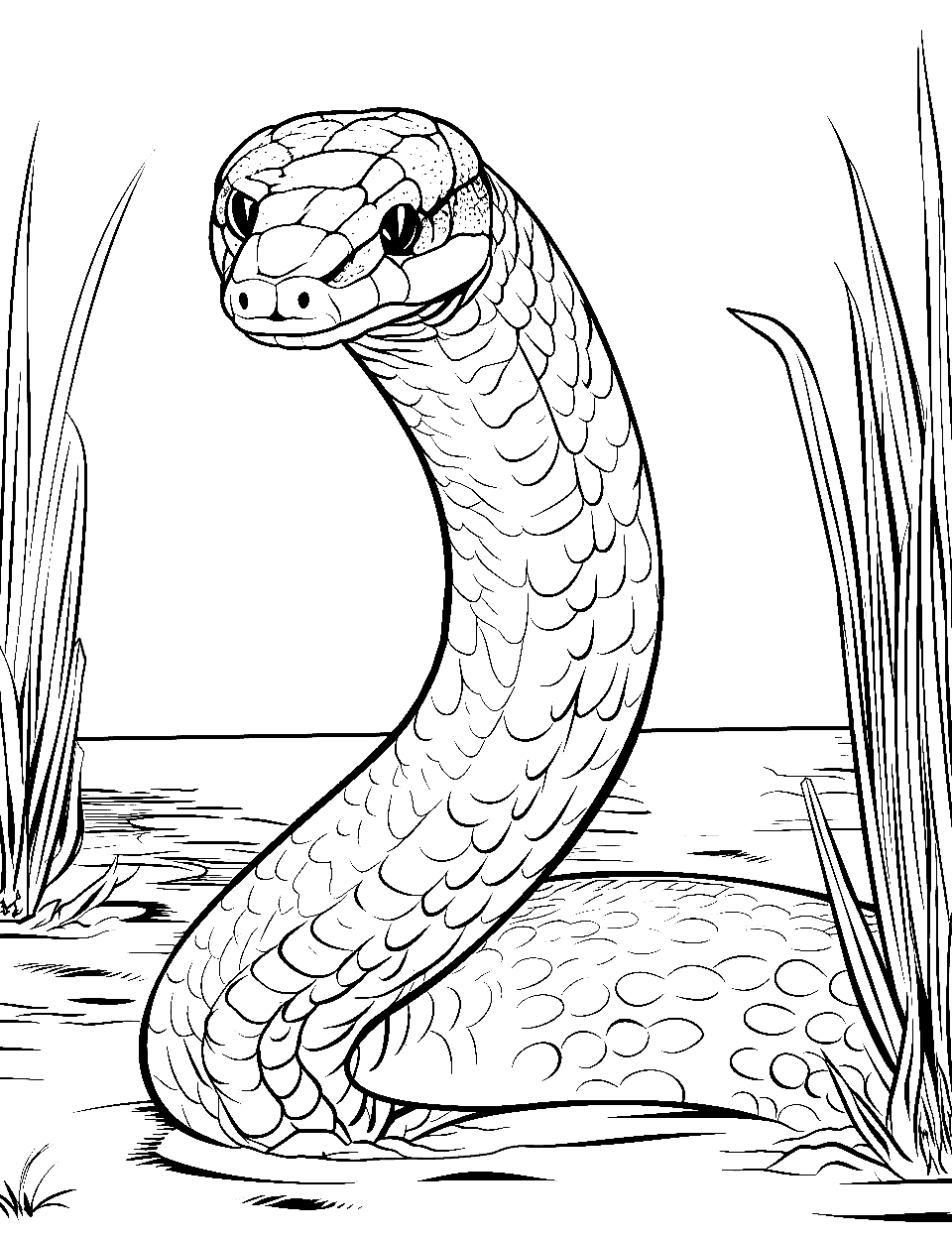
A snake lifts its head and neck between tall reed blades on both sides of the page, its body resting on flat ground behind. The face is drawn front-on with two alert eyes, and the neck scales run in neat curved rows. Greens on the reeds with a browner snake keeps everything readable rather than muddy. Add a thin blue line along the ground and it becomes a marsh.
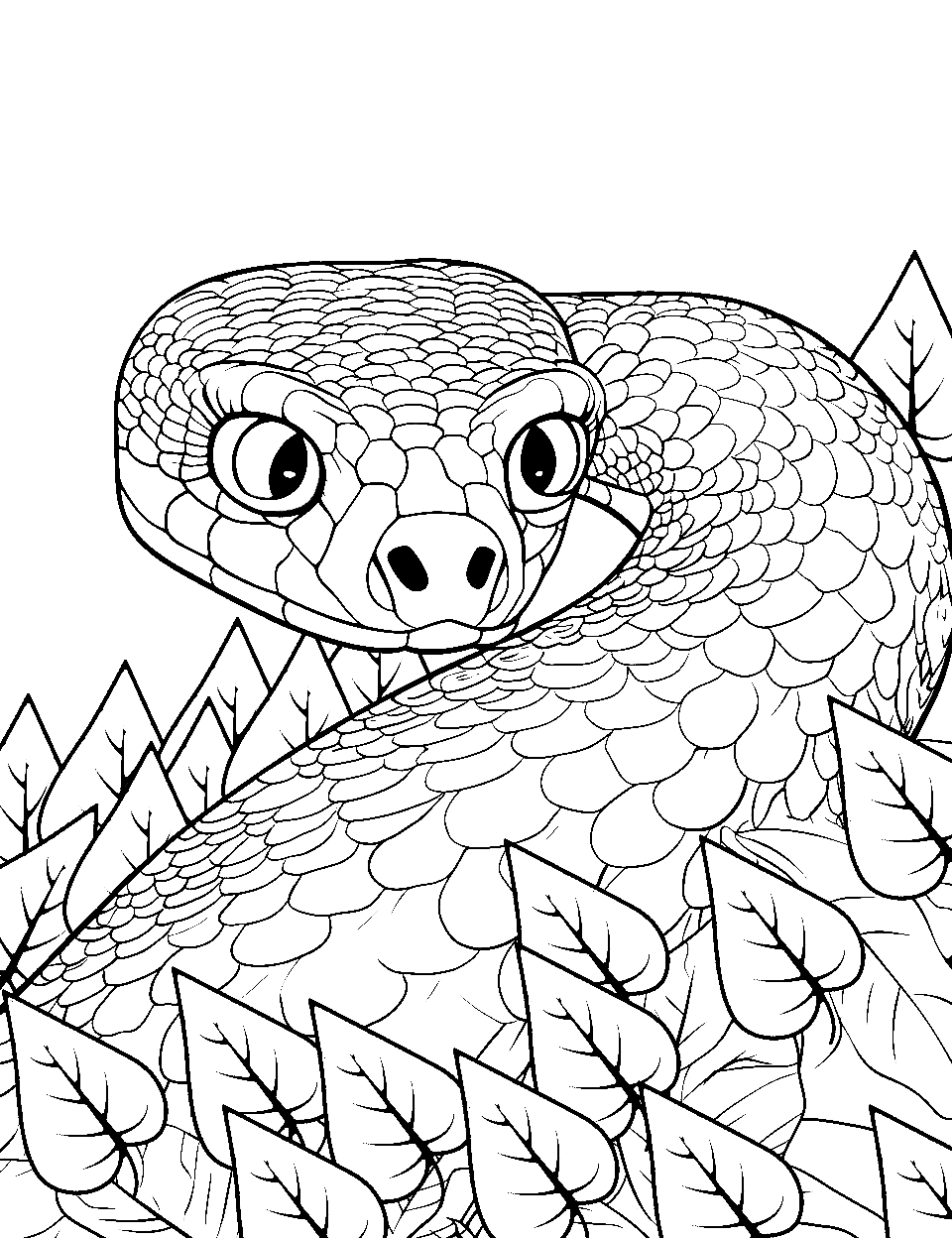
A huge snake head with round, friendly eyes peers over a row of large leaves that fill the bottom half of the sheet. The leaves have their veins drawn in and the head and body are covered in small scales. This is one of the busiest pages here, so it suits a child who likes filling every last gap. Two greens on the leaves and one strong color on the snake stops it turning muddled.
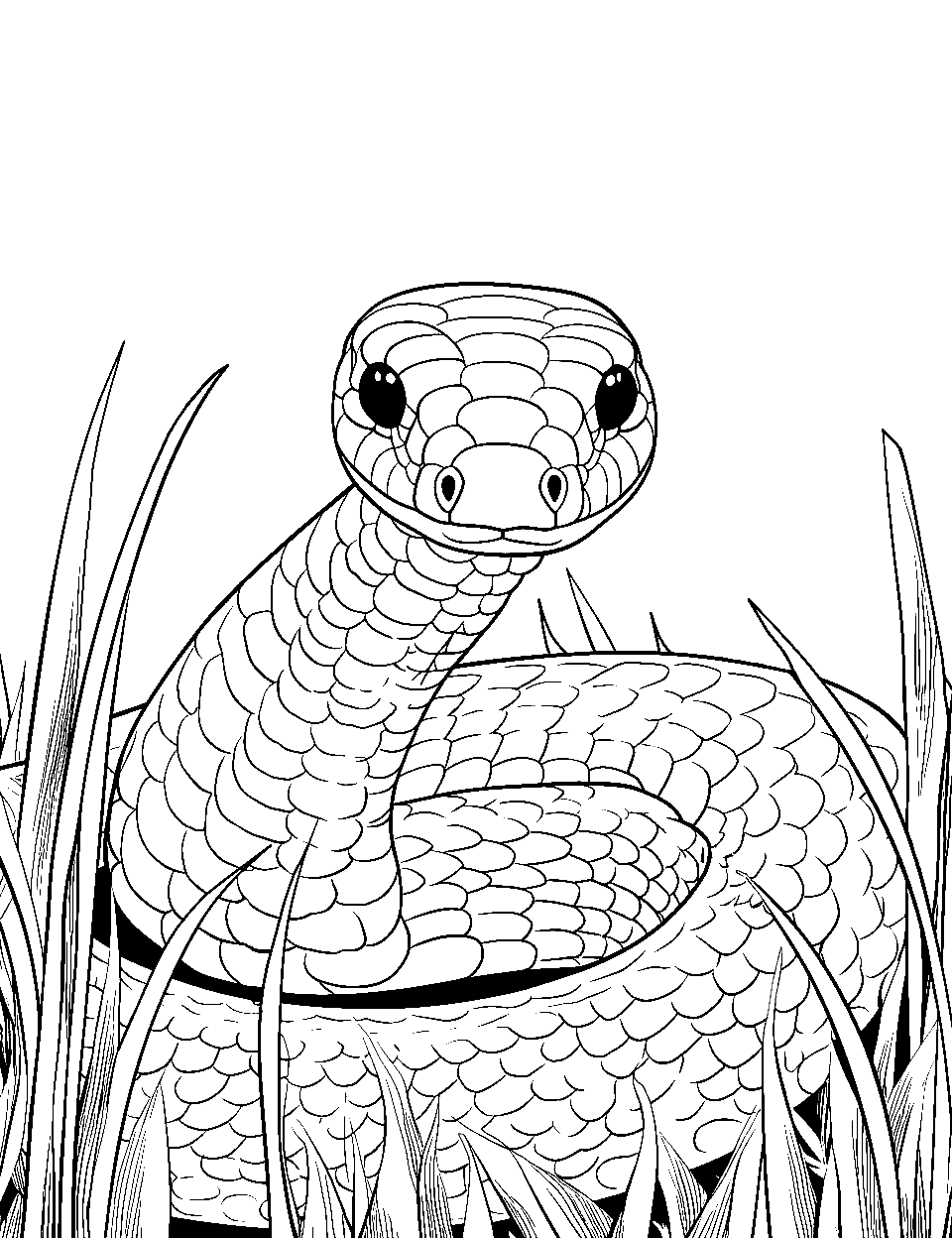
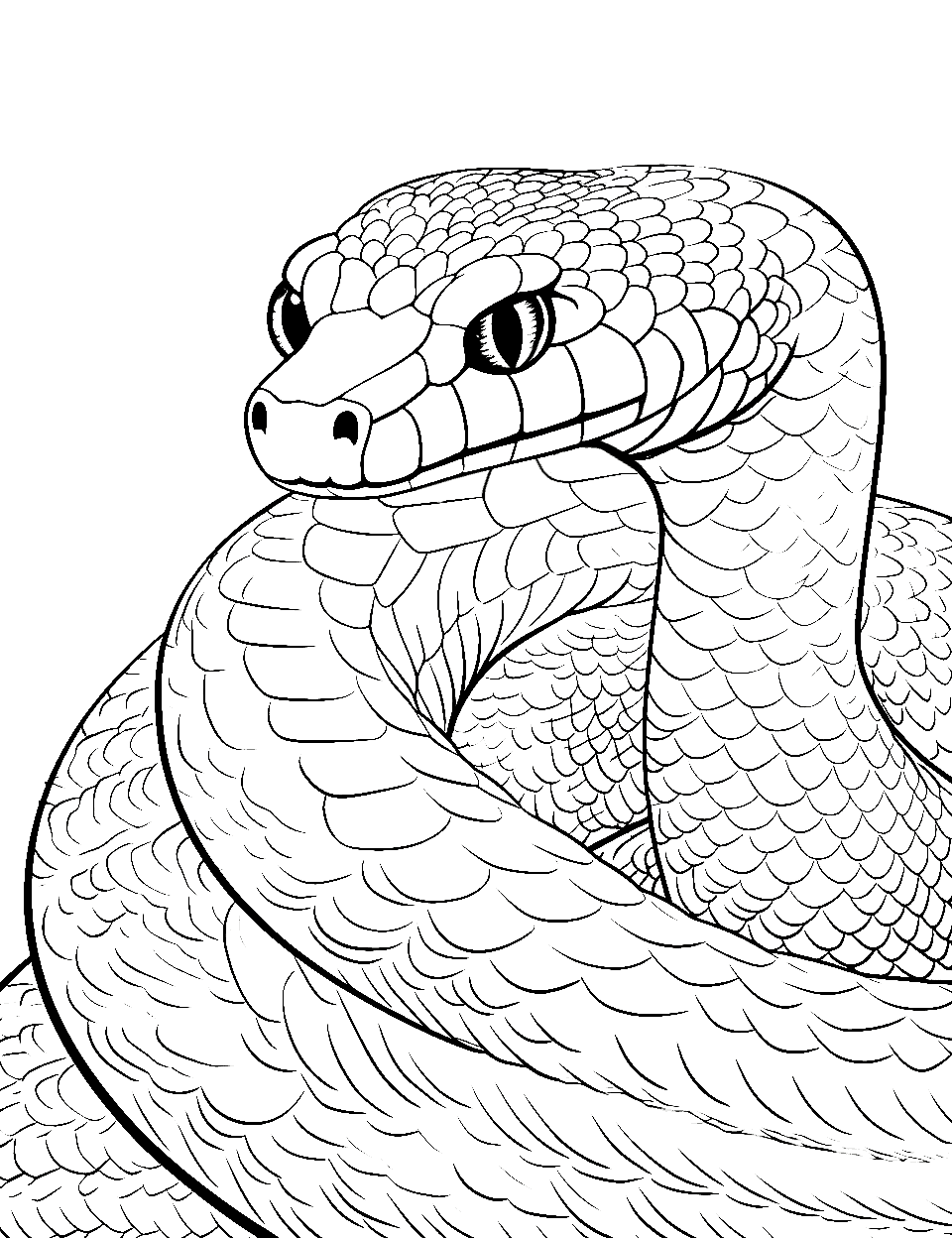
A snake’s head and coiled body fill this entire page in close-up, right down to the slit pupil in its eye. There is no background at all, just row after row of overlapping scales. Shading each row a little darker at its edge is what makes a snake look round rather than flat. Keep this one for an older child, a teenager, or an adult who wants a long quiet project.
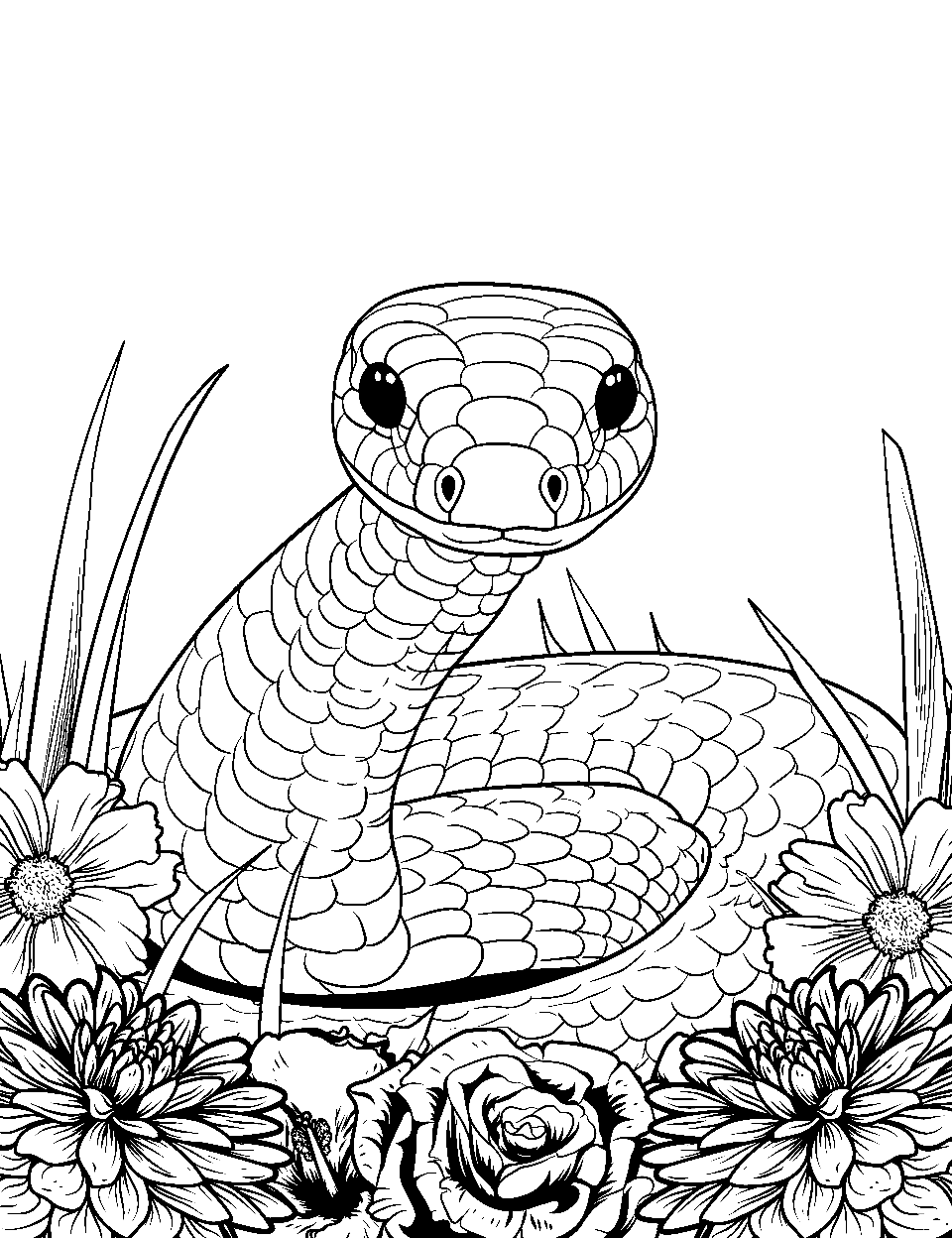
A snake faces forward over its own coil while daisies, chrysanthemums and a single rose crowd the bottom edge, with grass blades pushing up between them. The flowers carry far more detail than the snake, which flips the usual balance of these pages. Pick two or three flower colors and repeat them so the border does not turn into a jumble. The snake’s head scales are large and quick to fill once the flowers are done.
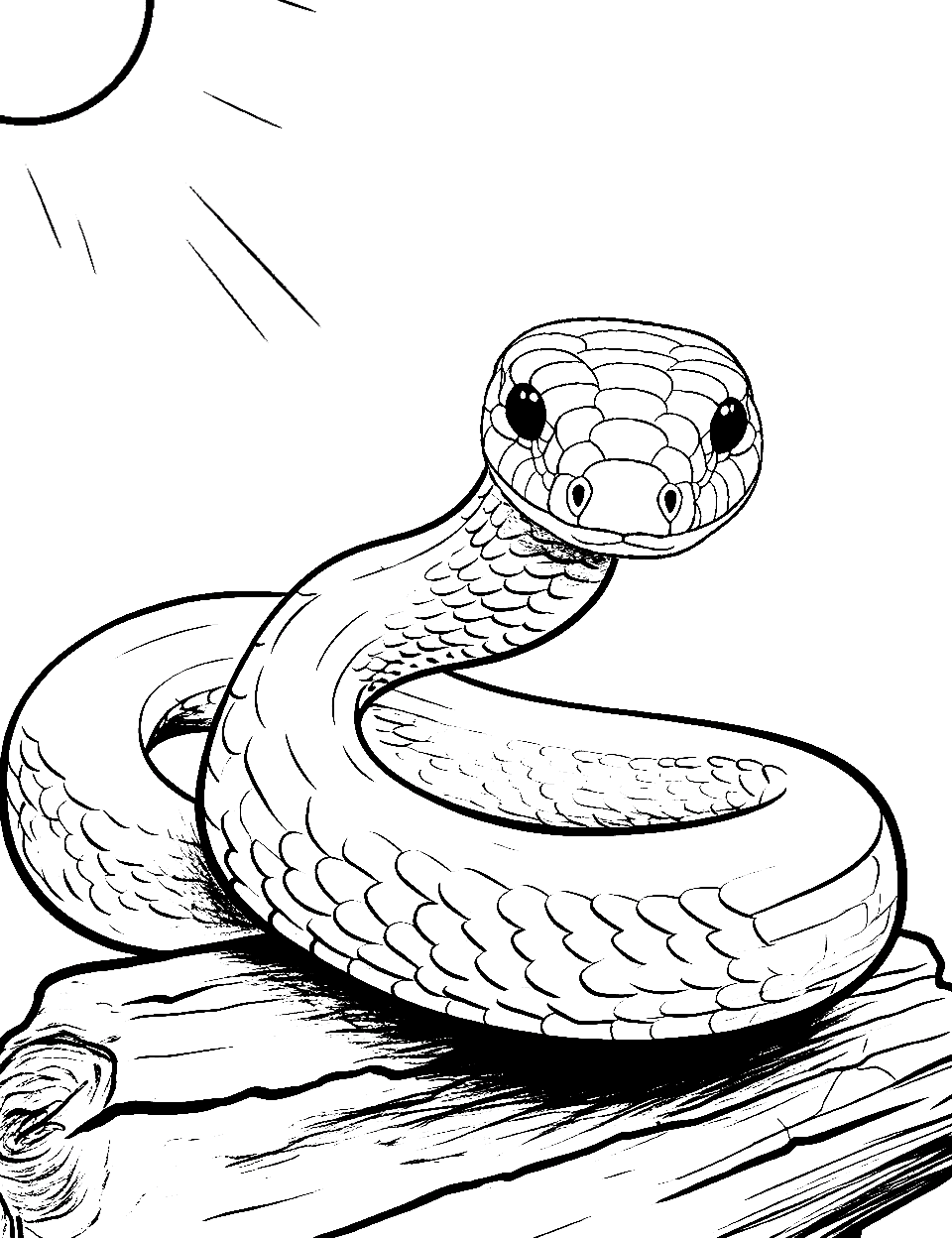
A snake coils on a fallen log while a sun and its rays sit in the top left corner. The log is drawn with long grain lines and a knot at one end, which is fun to color in streaks of brown. By comparison the snake’s body is smooth and roomy, so the page balances a fiddly area against an easy one. Warm yellows in the sky sell the heat.
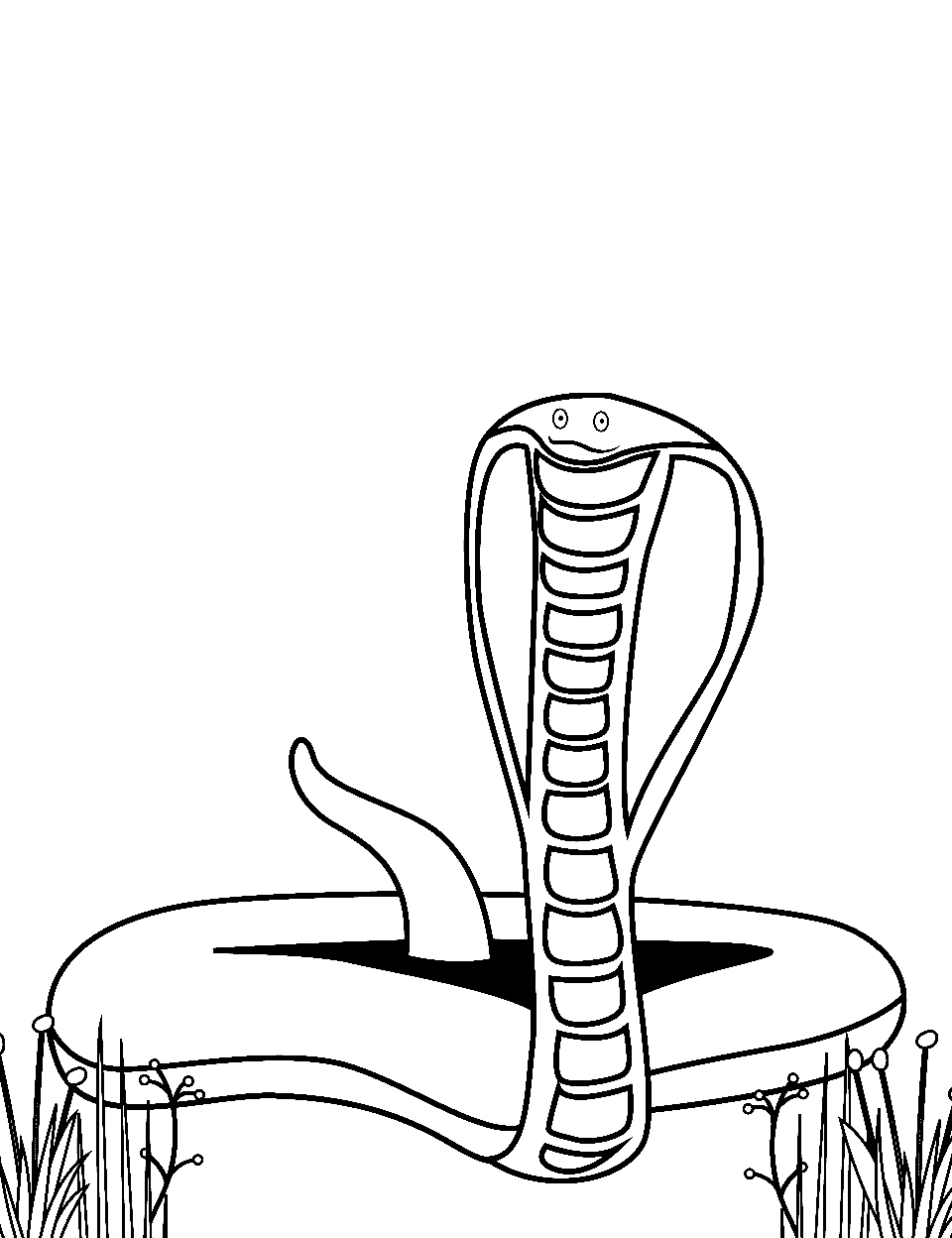
A cartoon cobra sits upright with its hood spread wide and its tail curled up behind, all in thick simple lines, with small berry sprigs along the bottom. The hood is divided into bands down the middle, which is the obvious place to try a repeating pattern. Yellow, orange and black bands look right without making it frightening. It is a solid first cobra for a younger child.
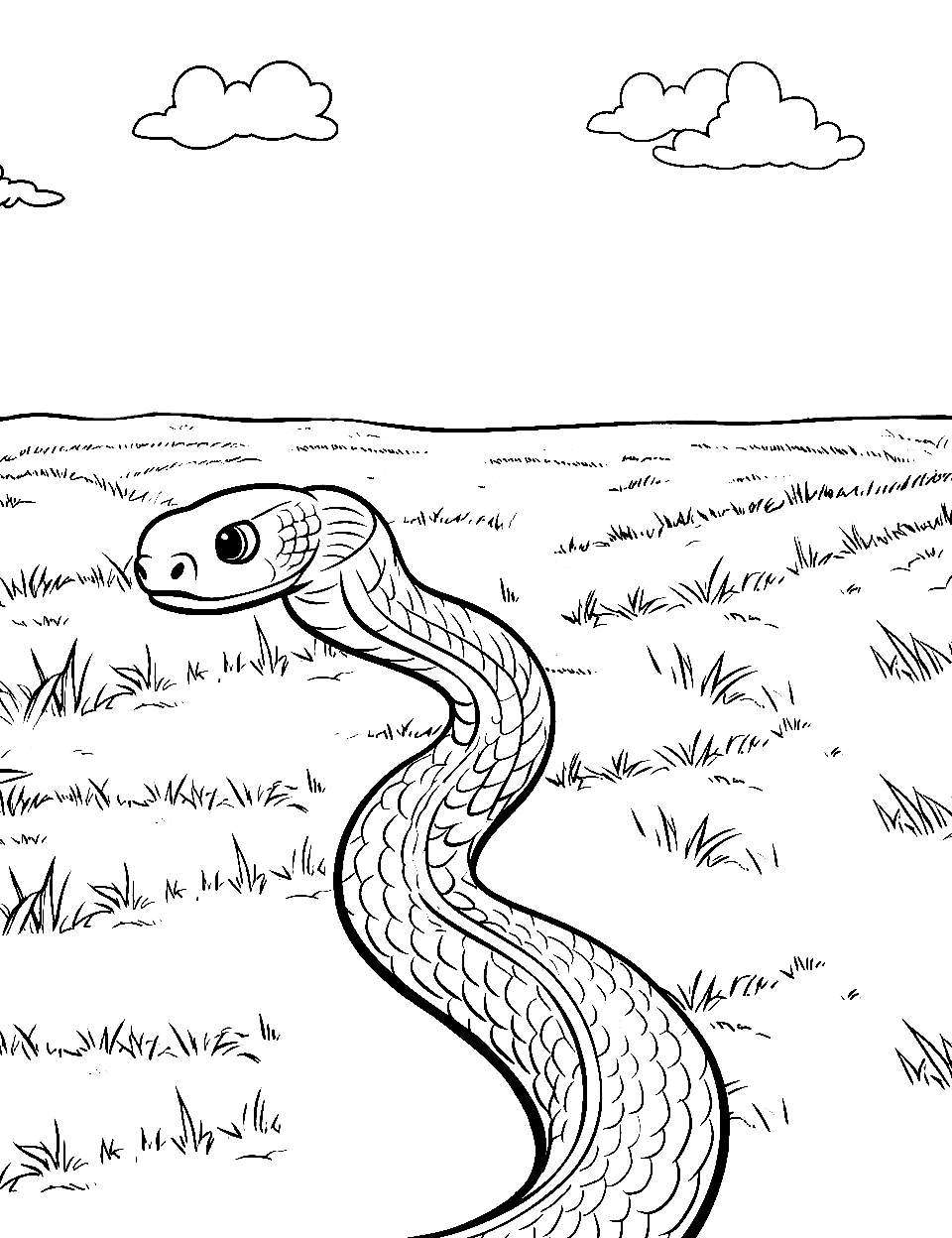
A snake winds toward you across a wide grassy field, with clouds in the sky and the horizon ruled straight across the page. The grass is made of hundreds of tiny tufts, so most kids color the ground one flat green and pick out only a few. That leaves the snake’s scale rows as the careful part of the job. The setting would sit happily next to a farmland scene if you are printing a batch.
By using our free coloring pages, you acknowledge and agree to our full disclaimer. All materials are for personal, non-commercial use only and all rights belong to their respective license holders.
Which Snake Coloring Page Should You Print First?
Start with a cartoon sheet if your child is under five, and save the close-ups for anyone who can hold a pencil steadily for twenty minutes. The thick-lined pages are Preschool Playful Snakes, Smiling Snake in a Circle, Sleepy Serpent, Cartoon Snake With Fangs Out and Cartoon Cobra With Its Hood Up: big shapes, few lines, nothing to lose patience with.
The middle group has a proper scene but still leaves large areas to fill. Sea Snake and Two Fish, Sunbathing on a Rock, Snake on a Ledge and Crossing an Open Field all give a background to color without hundreds of small parts in it.
The slow ones are Detailed Scales Close-Up, Snake Among Garden Flowers, Big Eyes Behind the Leaves and Resting in a Flower Bed. Those want colored pencils, good light and no time limit.
What Can Kids Learn From Snake Coloring Pages?
Coloring a snake is an easy opening to explain how the animal is built, because the drawing puts every part in front of you. The forked tongue is not a stinger: a snake flicks it out to get a better sense of its surroundings by tasting the air, which is how the U.S. Fish and Wildlife Service describes an eastern indigo snake tasting the air around it (1). That same species is the longest snake native to the United States at up to 8.6 feet, and adults weigh anywhere from 2 pounds to over 10 pounds.
The hood on the two cobra sheets is real anatomy, not a cartoon invention. A king cobra flattens its neck ribs into that hood and can raise the front 3 to 4 feet of its body off the ground, and the Smithsonian’s National Zoo puts its average length at 10 to 12 feet with the largest reaching 18 feet (2). Its hiss runs much lower than other snakes’, closer to a dog’s growl, and its eyesight can pick out a moving person almost 330 feet away.
Two more talking points while the crayons are out. Female king cobras lay 21 to 40 eggs and push leaves and branches into a nest pile for them, which surprises kids who assume every snake abandons its eggs. And snake scales are dry, so the shine on the close-up sheets is reflected light rather than anything wet.
Activities to Do With Snake Coloring Pages
Turn a coloring session into a whole afternoon with a few extras. Each idea below names the sheet that suits it best.
Create Textured “Scales”
Snakes are covered in overlapping scales, so try materials that feel like them. Glue down sequins, dry lentils, crushed eggshell or torn bubble wrap over the body outline. The close-up sheets work best here because the scale rows are already marked out. Toddlers who find coloring frustrating will often stay with a gluing job much longer.
Make a Spiraling Mobile
Color one of the coiled sheets, then cut along the curve of the body instead of around the outside of it. Punch a hole through the head and tie on a length of thread. Hung in a doorway, the paper snake uncoils and turns in the draft. Smiling Snake in a Circle is the easiest one to cut.
Design Your Own Species
Ask your child to invent a snake nobody has named yet. They choose the pattern, color it onto a sheet with plenty of blank body, then write on the back where it lives and what it eats. Little Snake in the Grass leaves the most empty paper for building a habitat around it.
Popsicle Stick Puppets
Print on cardstock, color, cut the snake out and tape a craft stick or a straw to the back. A shoebox on its side makes a stage. Two or three puppets are enough for a story, and the cartoon sheets survive handling better than the detailed ones.
Pattern Practice
The banded and spotted sheets are ready-made pattern exercises. Ask for red, blue, red, blue along the body, then make the sequence longer for an older child. Cartoon Cobra With Its Hood Up has clean bands down the hood that suit this perfectly.
Jungle Habitat Collage
Cut out a finished snake and glue it onto a bigger sheet of construction paper. Then send your child into the yard for leaves, twigs and dry grass to build the ground around it. The result stands up off the page and makes a decent wall display.
FAQs
What Colors Are Real Snakes?
Real snakes come in nearly every color, so there is no wrong answer on these sheets. Many are green or brown so they disappear into leaves and soil, while others carry high-contrast bands that make them obvious on purpose. The eastern indigo snake is glossy black and throws off blue highlights in sunlight, which is a fun one to try with a black pencil and a blue one over the top. Let your child pick whatever they like; the page will still look believable.
Are Snakes Slimy?
No, snakes are not slimy; their skin is dry and smooth. Scales reflect light, and that shine is what makes people expect them to feel wet. Handled at a zoo talk, a snake feels closer to a leather belt than to a fish. It is worth mentioning while your child colors the close-up sheets, where every scale is drawn separately.
How Do I Make Snake Scales Look Realistic?
Shade each scale instead of filling it flat. Press harder at the edge of a scale and ease off toward its center, then repeat down the row, and the body starts to look rounded rather than papery. Colored pencils do this far better than markers, which lay down one even tone. Detailed Scales Close-Up is the sheet to practice on.
What Is the Best Paper for These Coloring Pages?
Plain printer paper is fine for crayons and colored pencils. Switch to cardstock if your child wants markers or paint, since thin paper lets marker ink bleed through and buckles once it gets wet. Cardstock also holds up if you are cutting the snake out for a puppet or a mobile. A slightly heavier weight costs very little and saves a ruined page.
What Age Are Snake Coloring Pages Good For?
Toddlers and preschoolers do best with the thick-lined cartoon sheets, where the shapes are large and the lines are easy to follow. From about six, most children can handle a full scene, like the underwater page or the field page. The dense close-ups suit nine and up, or any adult who colors to unwind. Print one easy sheet and one hard sheet together so siblings of different ages can work side by side.
Are These Coloring Pages Free to Use?
Yes, every snake coloring page here is free for personal and classroom use. Print as many copies as you need for a rainy afternoon, a scout troop or a full class. There is no watermark on the sheets, so a finished page is worth pinning up. Teachers are welcome to run off a class set.