Crayons out, kickoff in ten minutes. Which sheet gets colored first?
These free American football coloring pages run from a chunky cartoon mascot a three-year-old can finish before halftime to shaded action scenes that will keep a ten-year-old busy all afternoon. There are 34 sheets in all, and every one prints on plain letter paper.
You will find helmets, footballs, a trophy cup, a cheerleader, a mascot, huddles, snaps, catches and celebrations. Nothing carries a team logo, so the colors are entirely up to whoever is holding the crayons.
Pick a sheet, hit print, and you have a quiet twenty minutes before kickoff.
Which Football Coloring Page Should You Print First?
Start with “Team Mascot” or “Cheerleader with Pom-Poms” for young kids, and “Linebacker in a Stance” for older ones. The choice comes down to line weight, not subject. “Team Mascot”, “Cheerleader with Pom-Poms” and “Cheering with the Ball” are drawn with thick outlines and wide open shapes, which is what a toddler or preschooler needs to stay inside them. Sheets like “Linebacker in a Stance”, “Turf-Kicking Breakaway” and “Hands on the Laces” carry fine shading lines and small details, so they suit older kids, teens and adults working with colored pencils.
Most children land somewhere in the middle. “Team Huddle from Behind”, “Two Players Stretching” and “Runners and the City Skyline” all have real detail without dense shading over the top of it.
If you are printing for a group, give each child one easy sheet and one harder one. Nobody ends up stuck with a page that is either too fussy or finished in two minutes.
Team Helmet
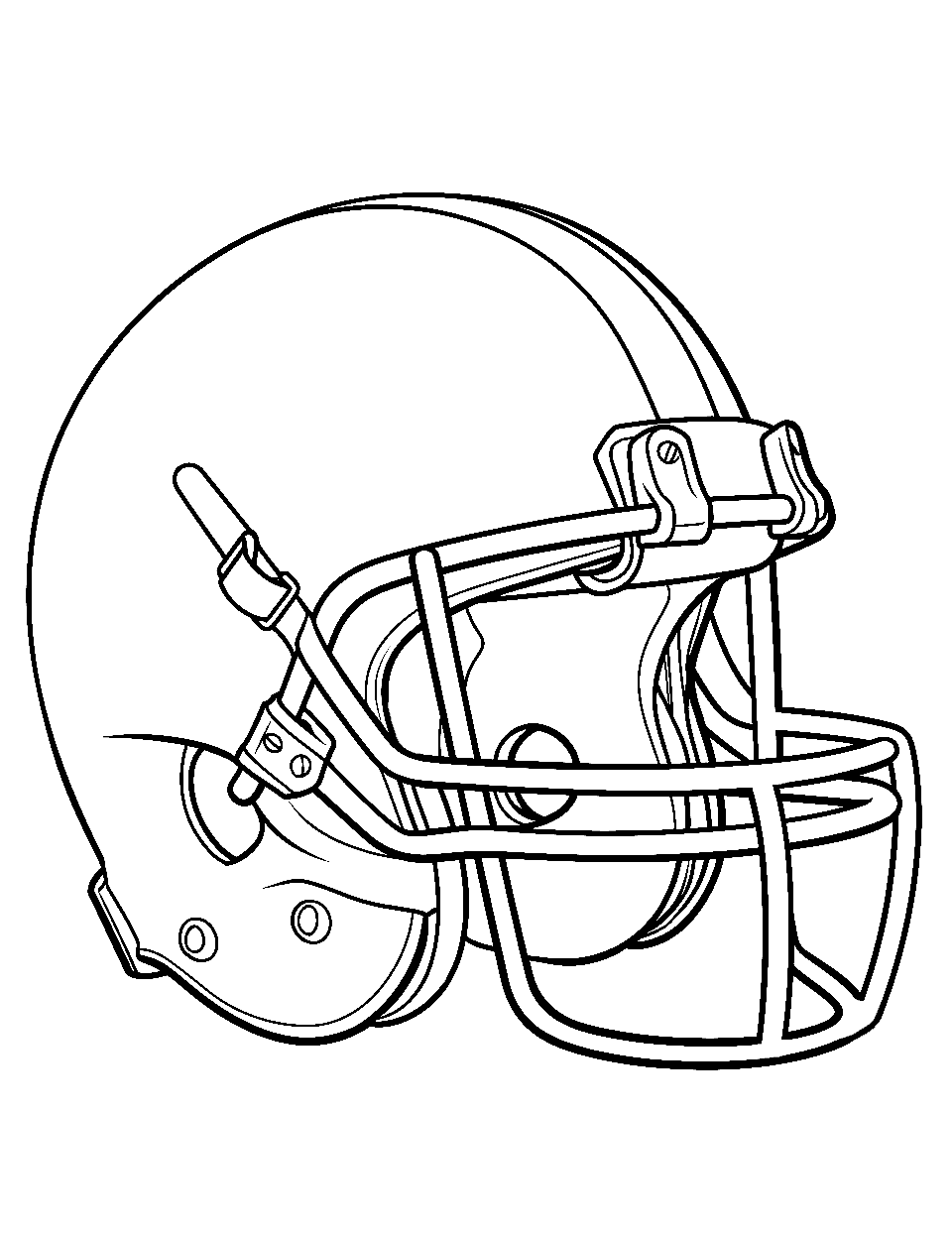
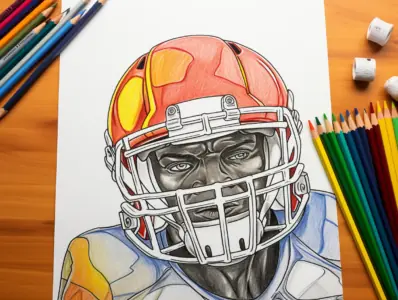
This helmet sits alone on the page with nothing else around it, so the facemask bars and the dangling chin strap are the whole job. The shell carries no logo, which leaves the side panel free for your own team mark. Two flat colors plus a darker line around the facemask is enough to finish it. Outlines this chunky are forgiving for younger hands.
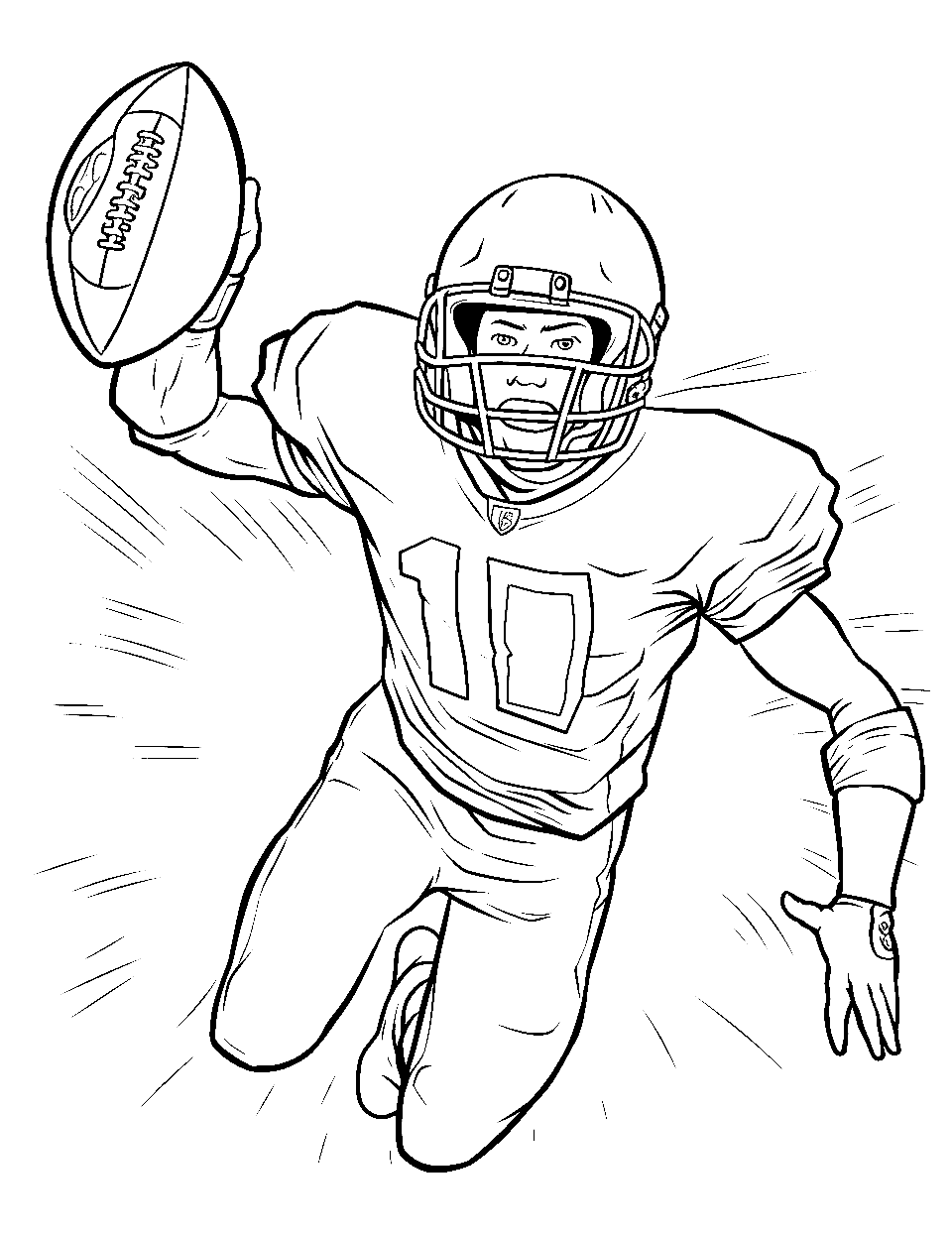
The jersey here carries a number, and the speed lines fanning out behind the player do most of the storytelling. He has the ball up in one hand with both feet off the ground, so the whole figure reads as motion. Color those streak lines a lighter shade than the uniform and they stay where they belong, in the background. The shading across the sleeves and pants gives an older colorer somewhere to practice light and dark.
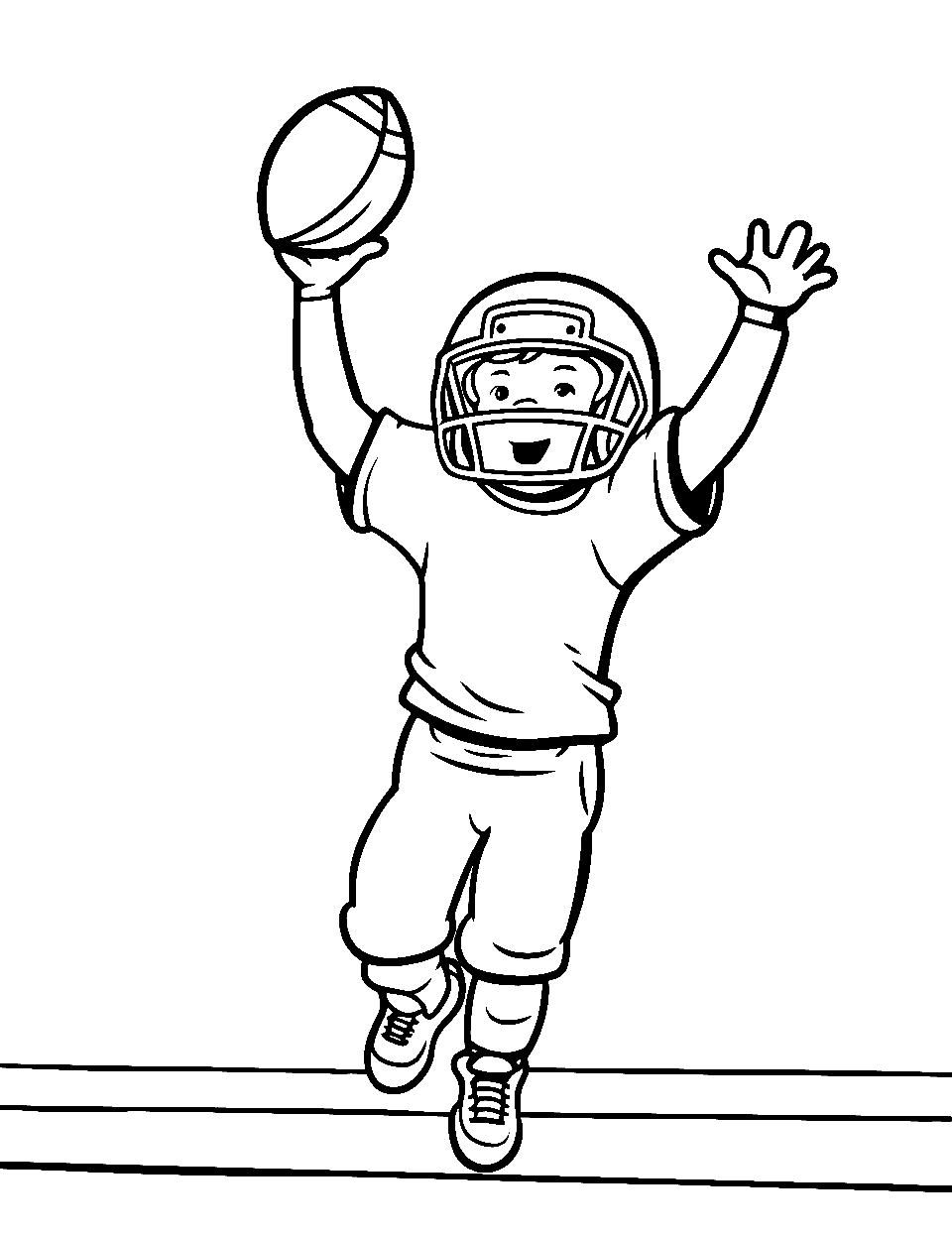
Both arms are in the air, both feet are off the ground, and a football is held up in one hand. The face behind the facemask is drawn cartoon style, wide grin and all, which suits a younger child. Two straight yard lines run under the feet and take about ten seconds to fill. A bright jersey against a plain white field keeps all the attention on the celebration.
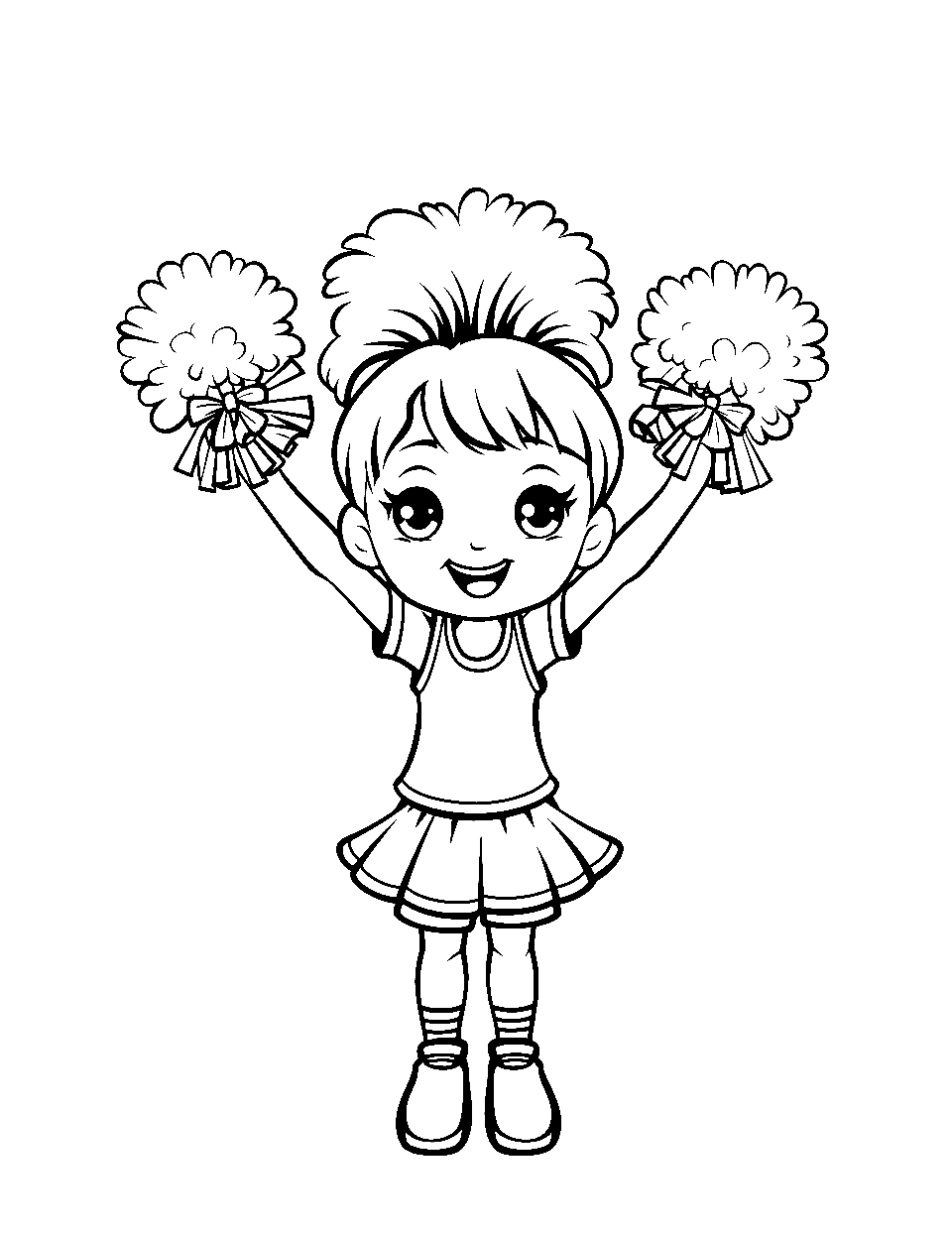
Big round eyes, a high ponytail and two raised pom-poms make this the friendliest sheet in the set. The lines are thick and widely spaced, which is exactly what a preschooler needs. The pleated skirt is the one fiddly part, and it looks good in stripes. Match the pom-poms to the skirt if you want it to read as a real squad uniform.
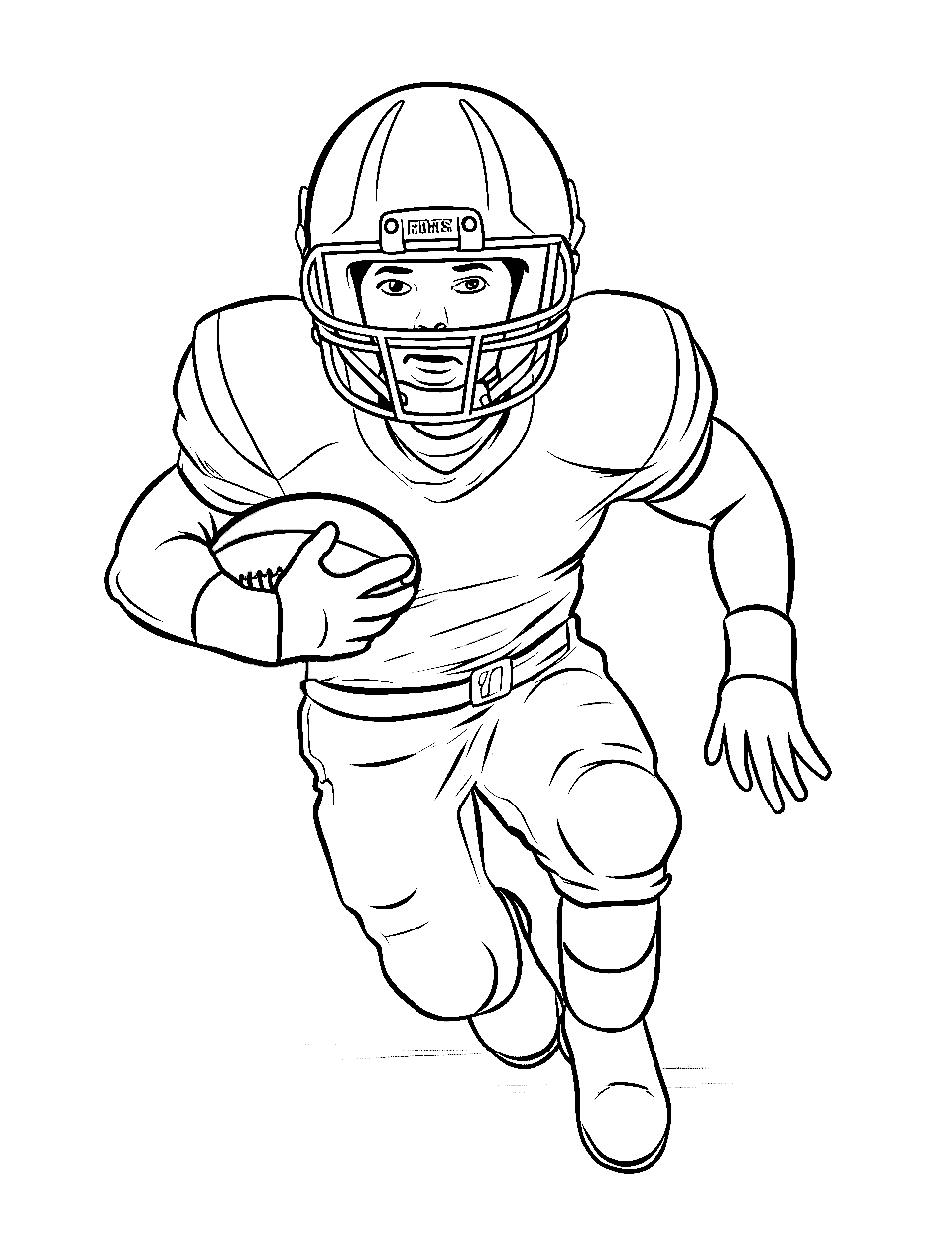
The runner comes straight at you with the ball tucked under one arm and the other arm out for balance. Every fold in the jersey and every pad line is drawn in, so this one rewards colored pencils over crayons. Shade the tucked ball darker than the uniform and it will separate cleanly from his chest. Older kids and adults will get the most out of the detail.
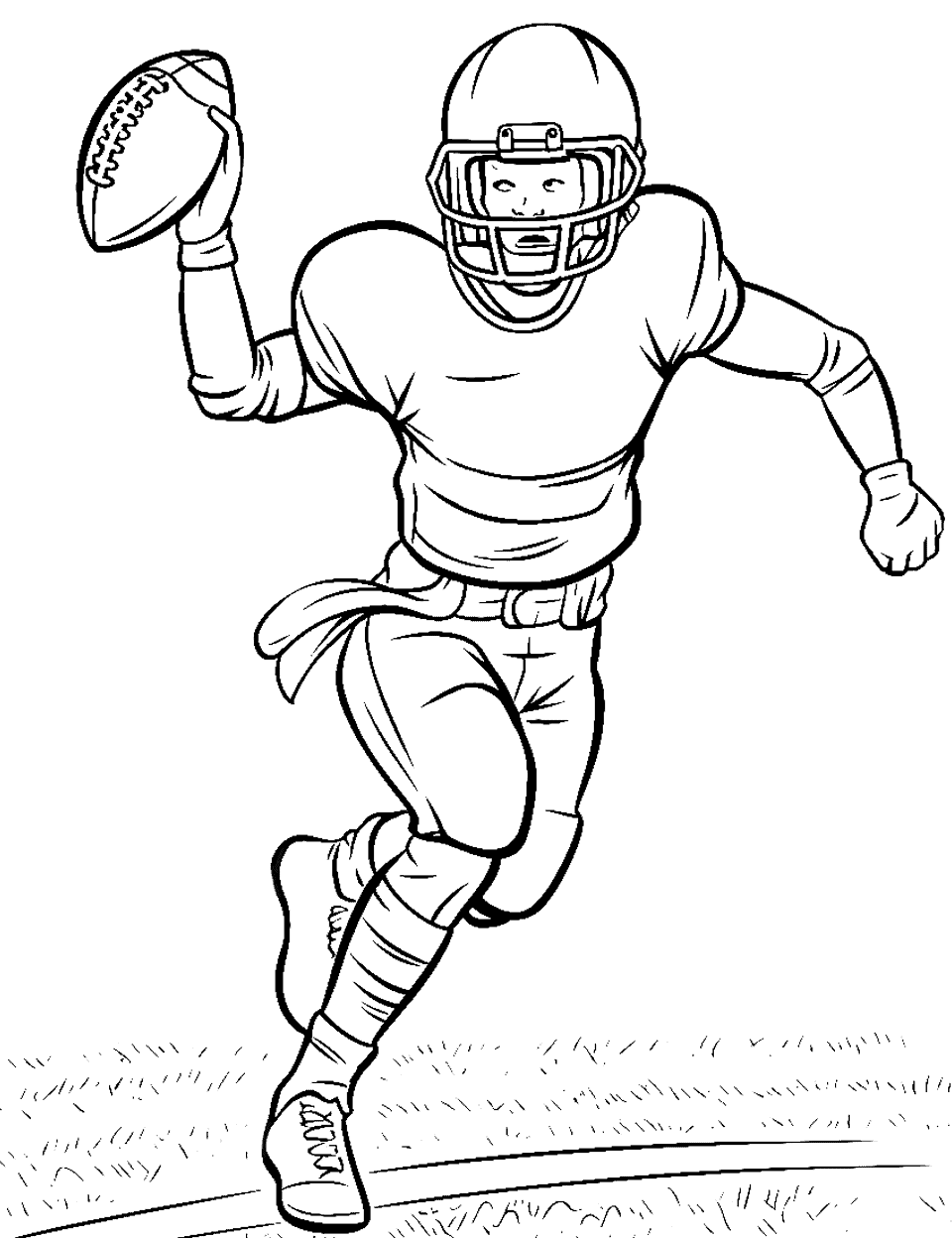
Here the ball is raised in one hand while the player is still mid-stride, with short grass strokes along the bottom of the page. One leg is tucked up behind him, which leaves plenty of open uniform to fill. Green under the cleats and a single strong jersey color is all this one asks for. That grass texture is a good place to let a child scribble without worrying about staying neat.
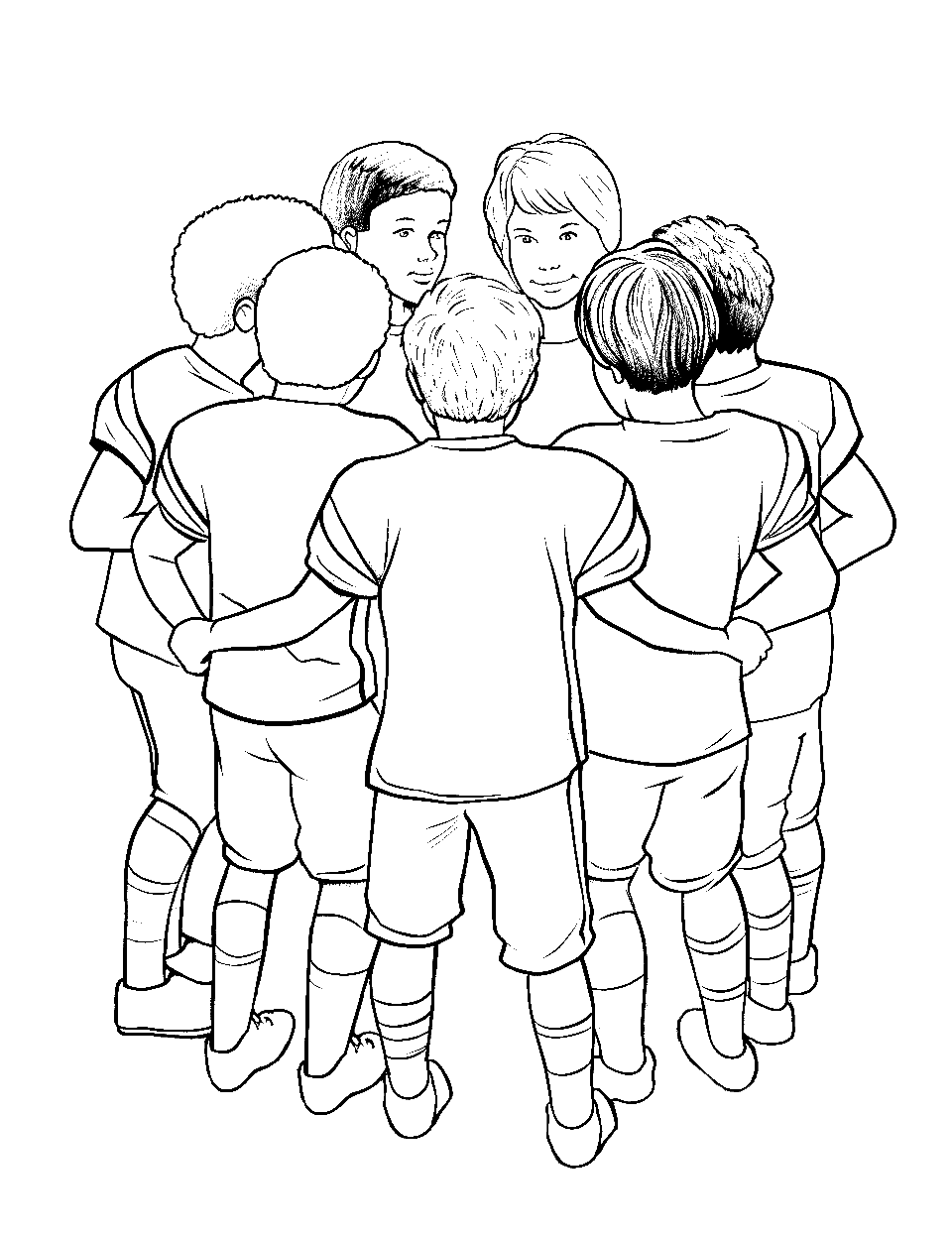
The team stands with arms around each other, drawn from behind so you see backs, socks and cleats rather than faces. A few heads are turned inward, and that is the only place any facial detail shows up. Give each back a different jersey shade and the huddle turns into a puzzle of overlapping shapes. It works well as a shared sheet, with one child starting from each side.
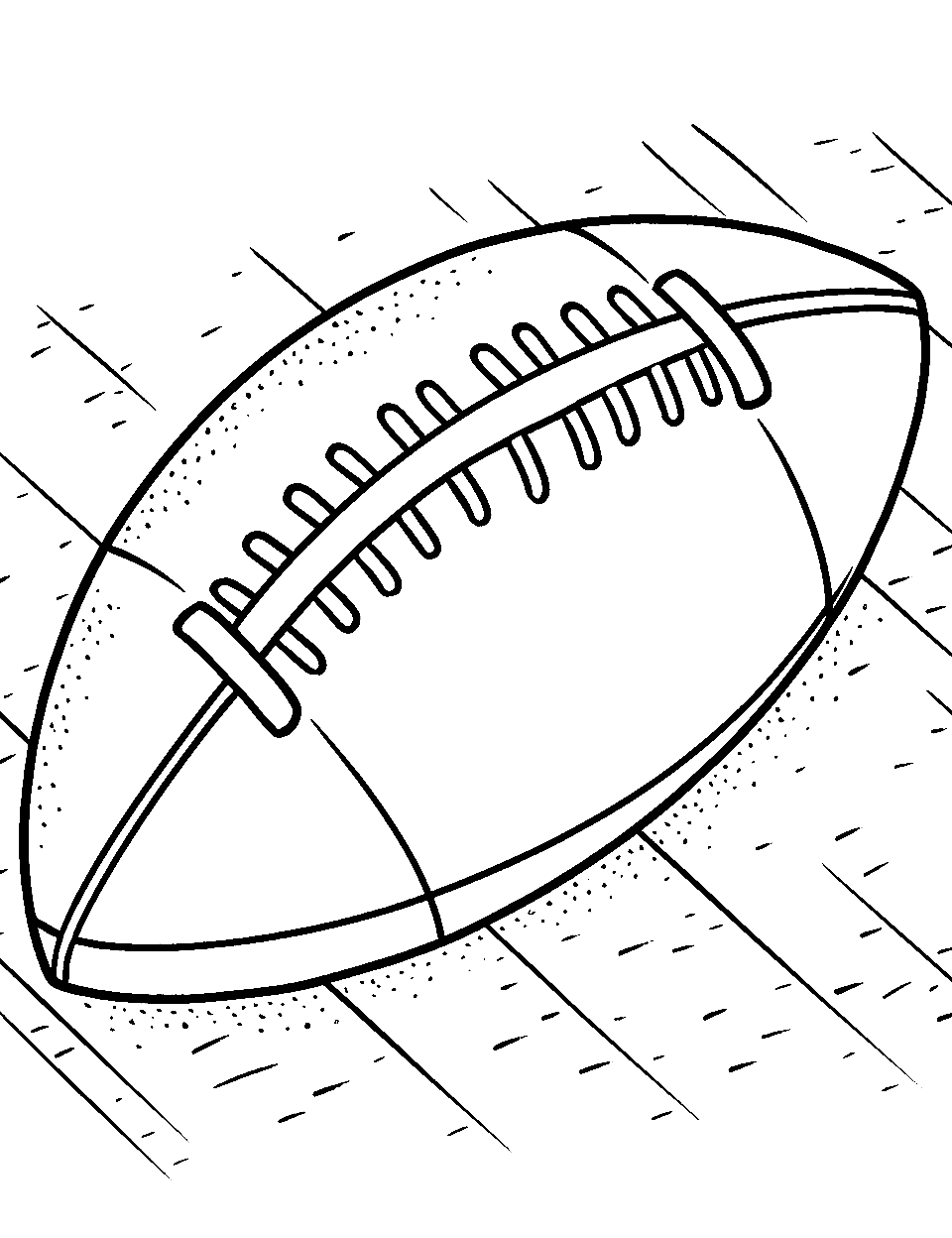
One oversized football fills the page, laces and all, with a stippled pebble texture across the leather. Diagonal strokes behind it suggest speed without adding much to color. Brown is the obvious call, but a metallic or neon ball is more fun and takes no longer. The dotted texture is a good excuse to try a lighter second pass over the base color.
This is a classic two-handled cup on a stepped base rather than a football-shaped trophy, so it fits any championship your child wants to invent. Stars of several sizes float around it and fill space that would otherwise sit blank. Gold or silver gel pen on the cup with one flat color behind the stars looks sharp. Those stars are small, so save this one for a child with the patience for them.
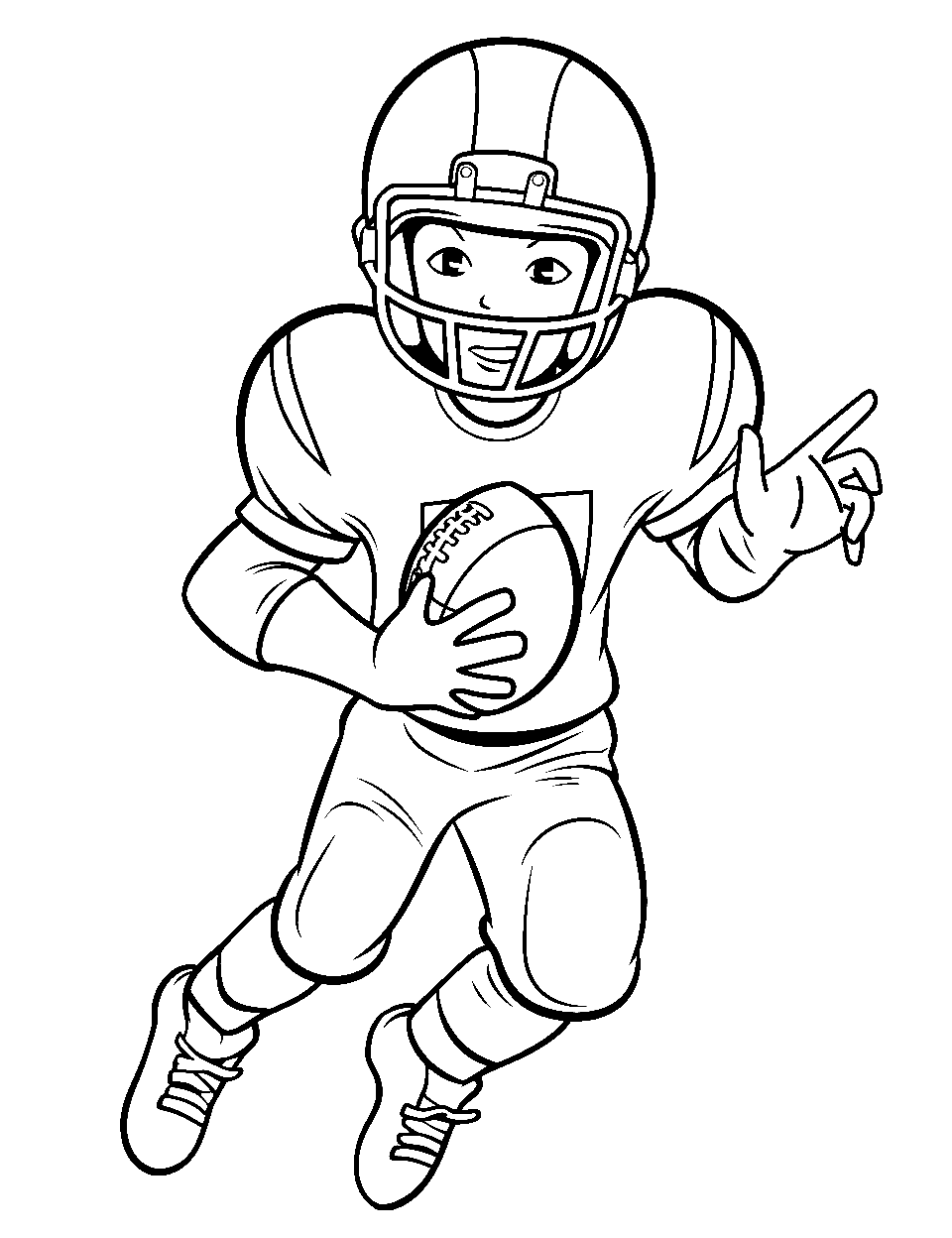
A young player carries the ball in one arm and points ahead with the other, caught mid-stride on a blank background. The face behind the facemask is simple and cheerful. With no scenery to work through, this sheet goes quickly, which suits a short attention span. Add a sideline or a crowd with a pencil if you want to stretch it out.
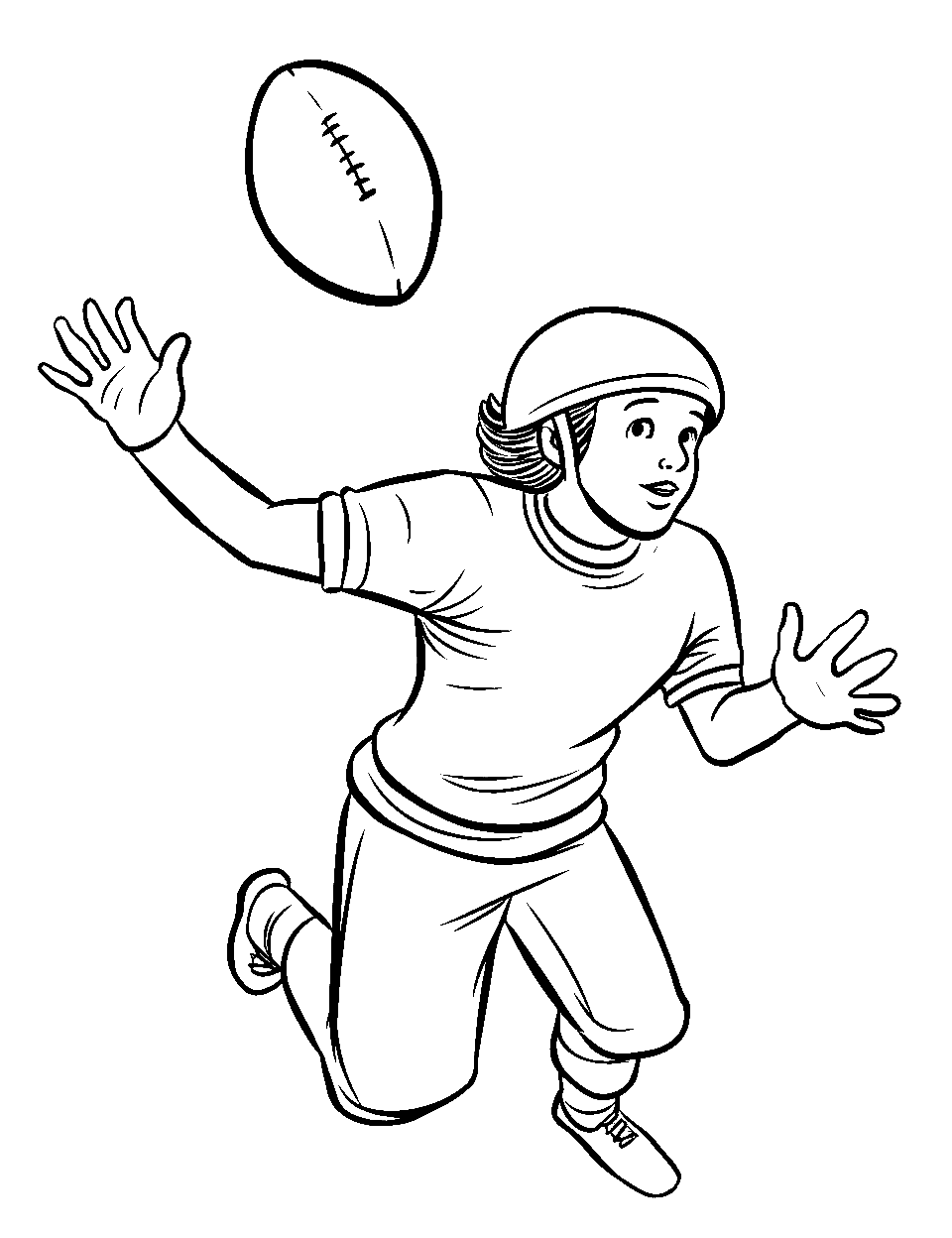
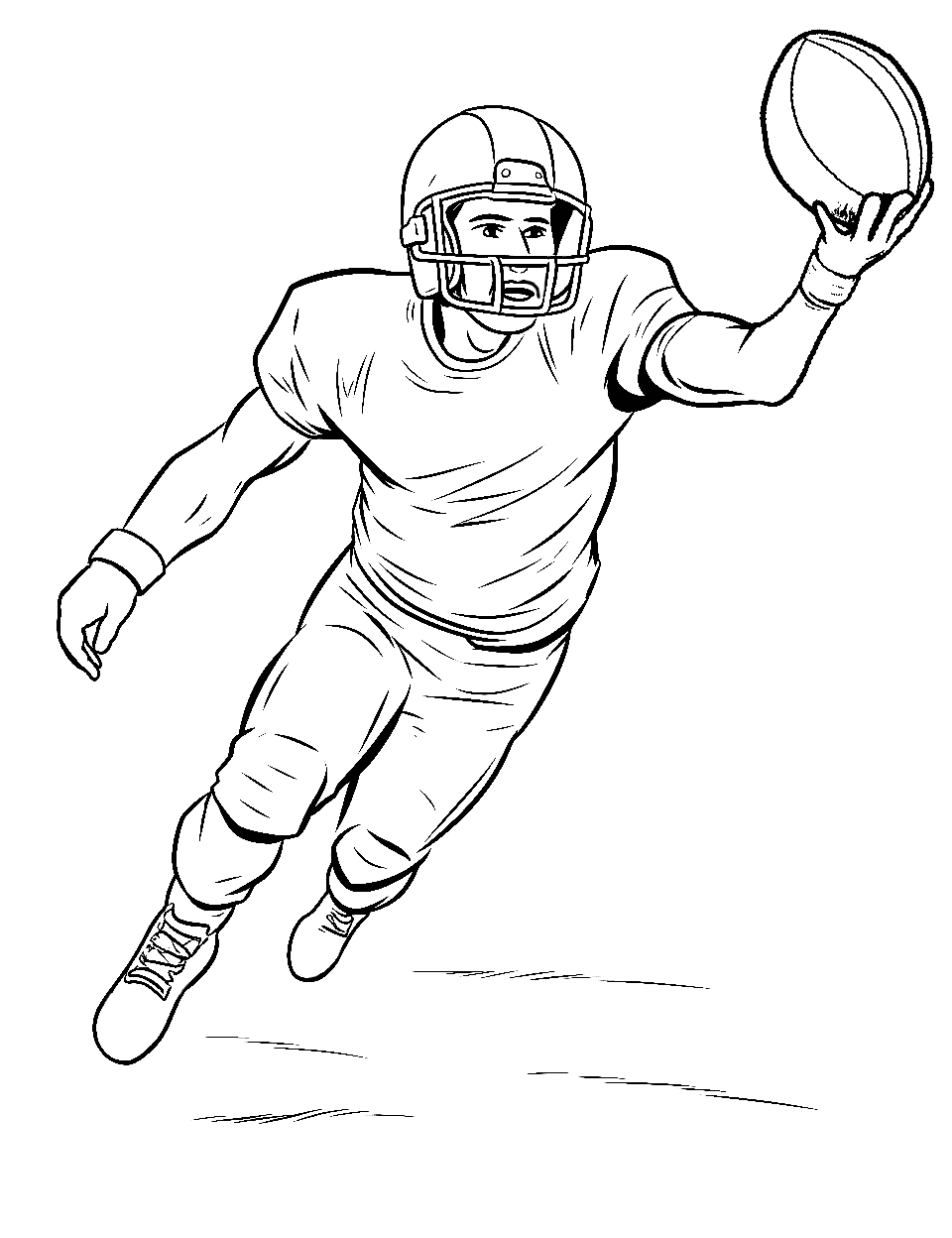
The ball is still in the air above the player’s hands, so the catch has not happened yet. Both arms are stretched up and the eyes are locked on the ball, which is the detail that makes the sheet work. Color the ball first and build the rest of the page around it. A younger child can handle this one alone.
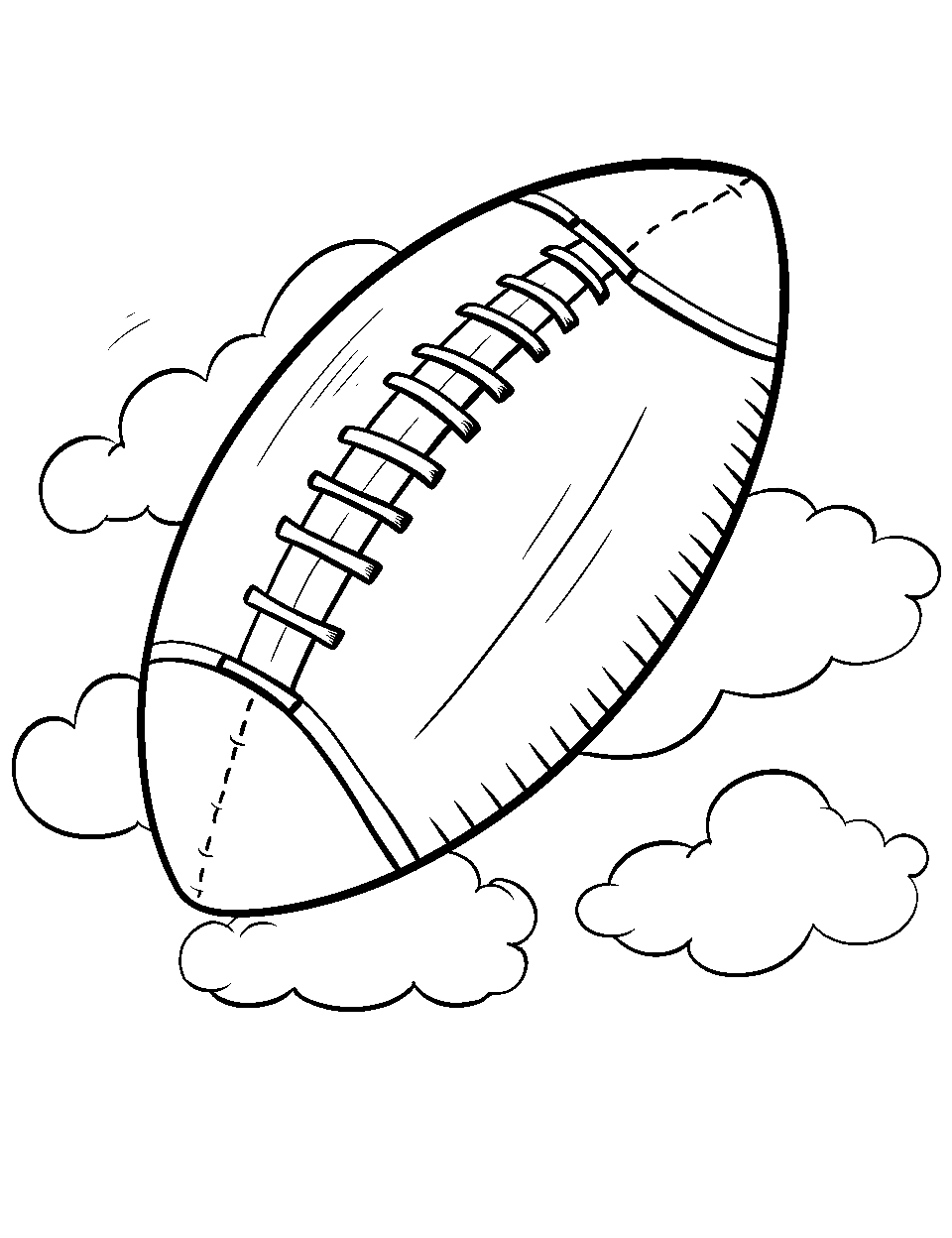
A football sails through a few rounded clouds with nothing else on the page. Those clouds are big open shapes, which makes this one of the easiest sheets here. Sunset colors behind them turn a plain sky into something worth putting on the fridge. Print it twice and let a child try a daytime version and a night version.
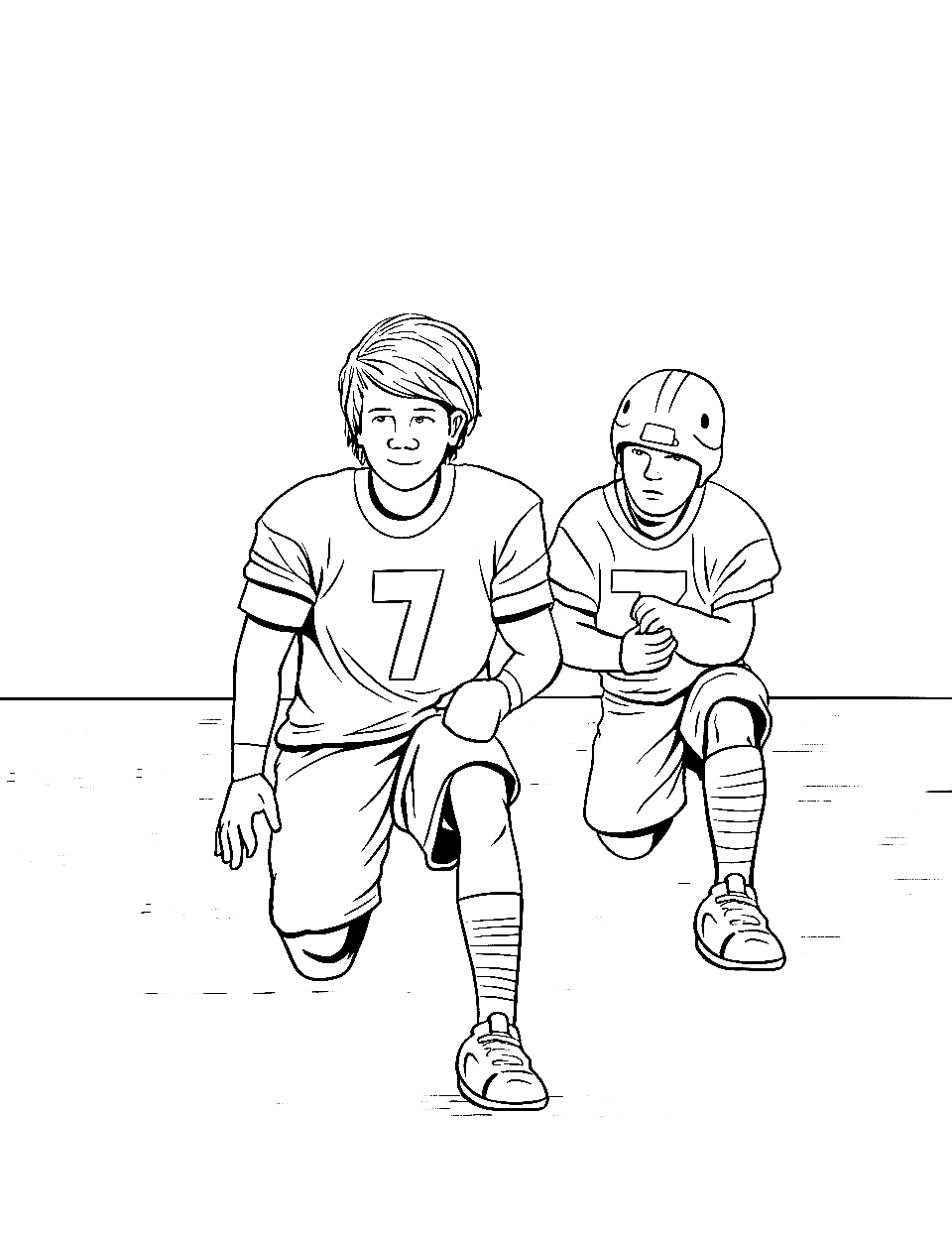
Two players kneel in a stretch, one bareheaded with a number on the jersey, the other already wearing a helmet. The pose is quiet rather than dramatic, so it is a calmer choice for a wound-up child. Matching jerseys in two shades of the same color make them read as teammates. A single floor line behind them is the only background to deal with.
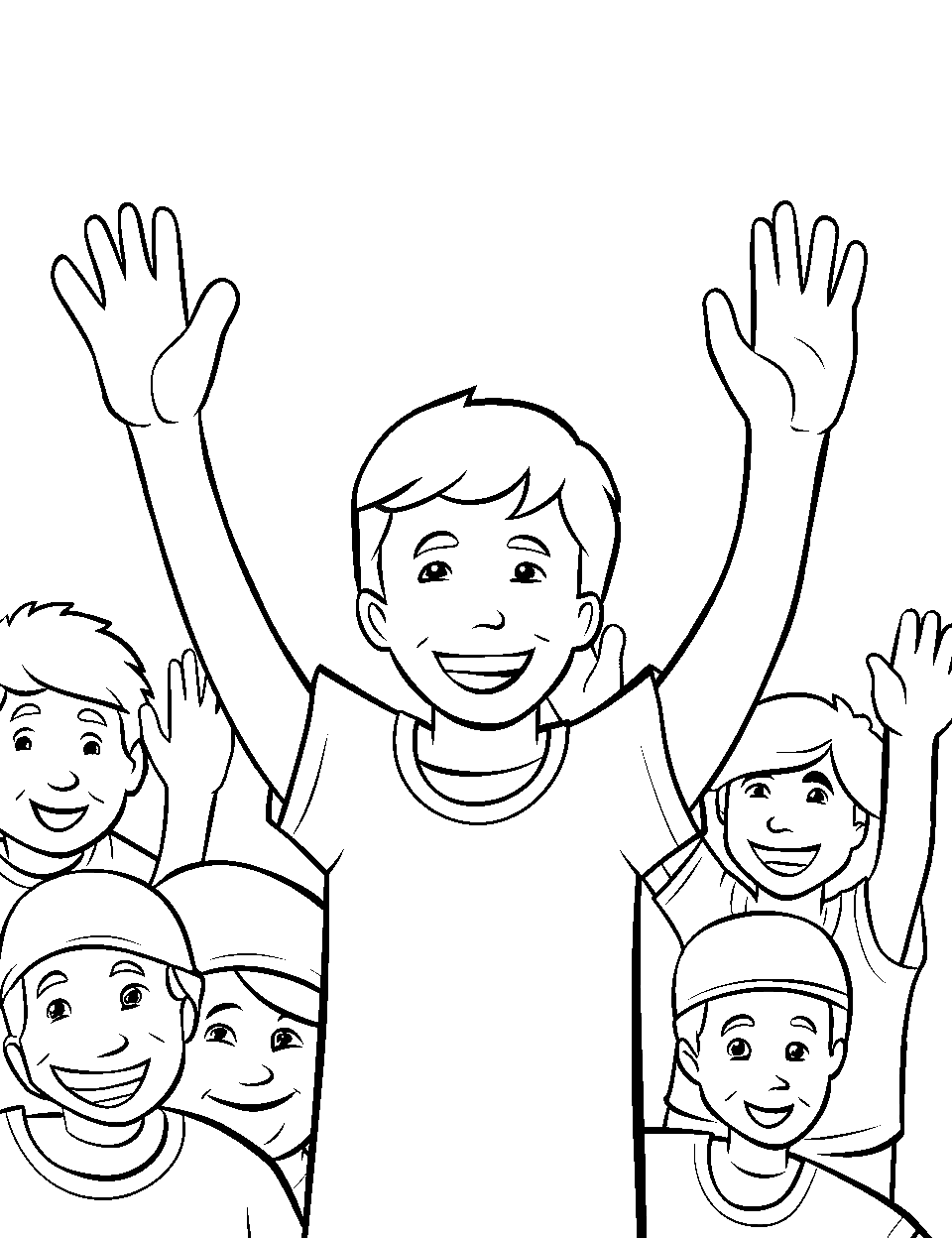
A cluster of grinning fans fills the frame, with one boy front and center, both arms straight up. Several faces crowd in behind him, a couple of them under caps, and every mouth in the picture is open. Because the faces overlap, give neighboring shirts different colors so the crowd does not blur into one shape. There is a lot of hair and skin to fill, so budget more time than the sheet first suggests.
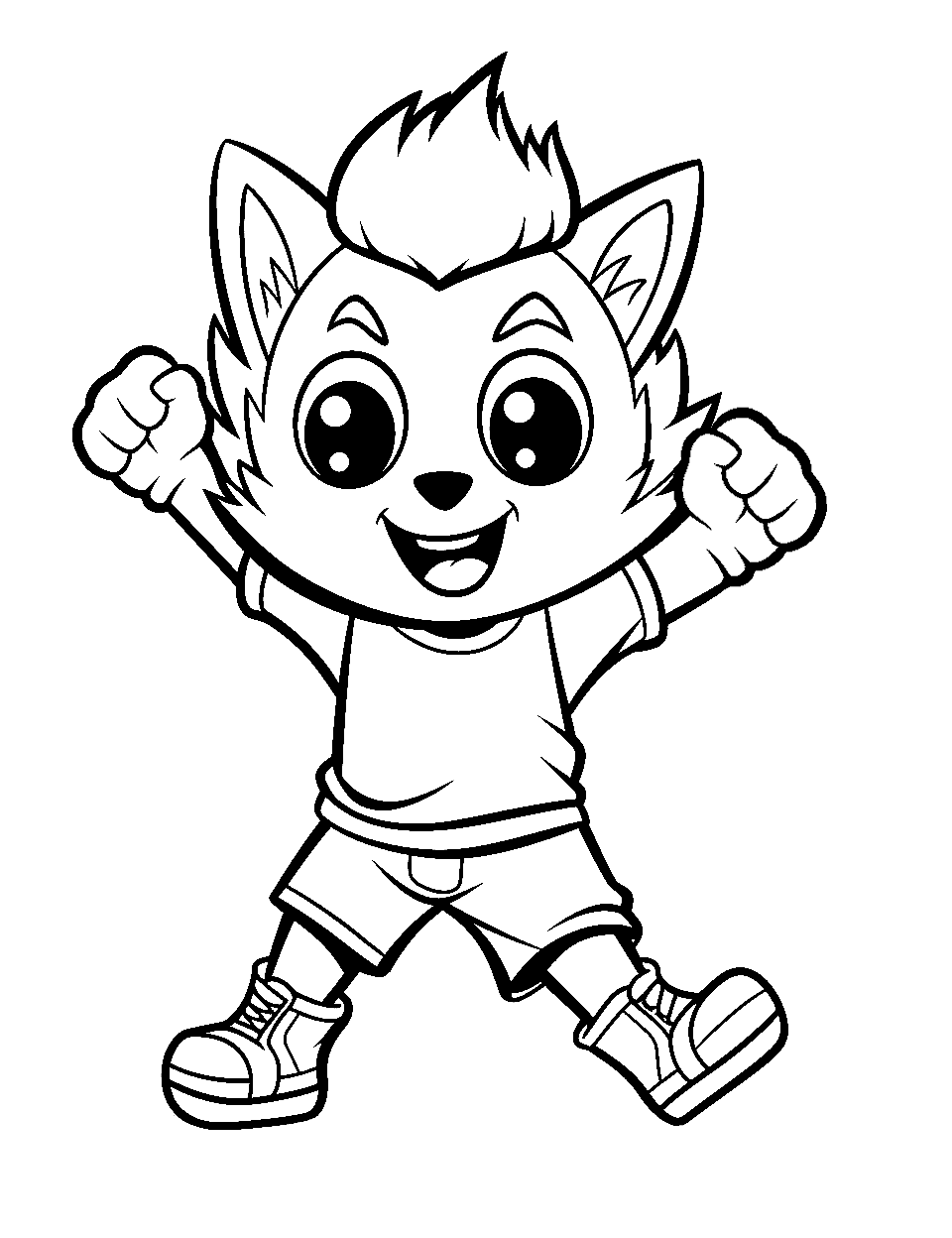
The mascot has pointed ears, a spiky tuft of hair and both fists in the air. Huge round eyes and thick outlines put this squarely in toddler territory. Whatever colors go on the shirt and shorts become the team colors, so decide those first. The fur can be one flat shade or two, and both look right.
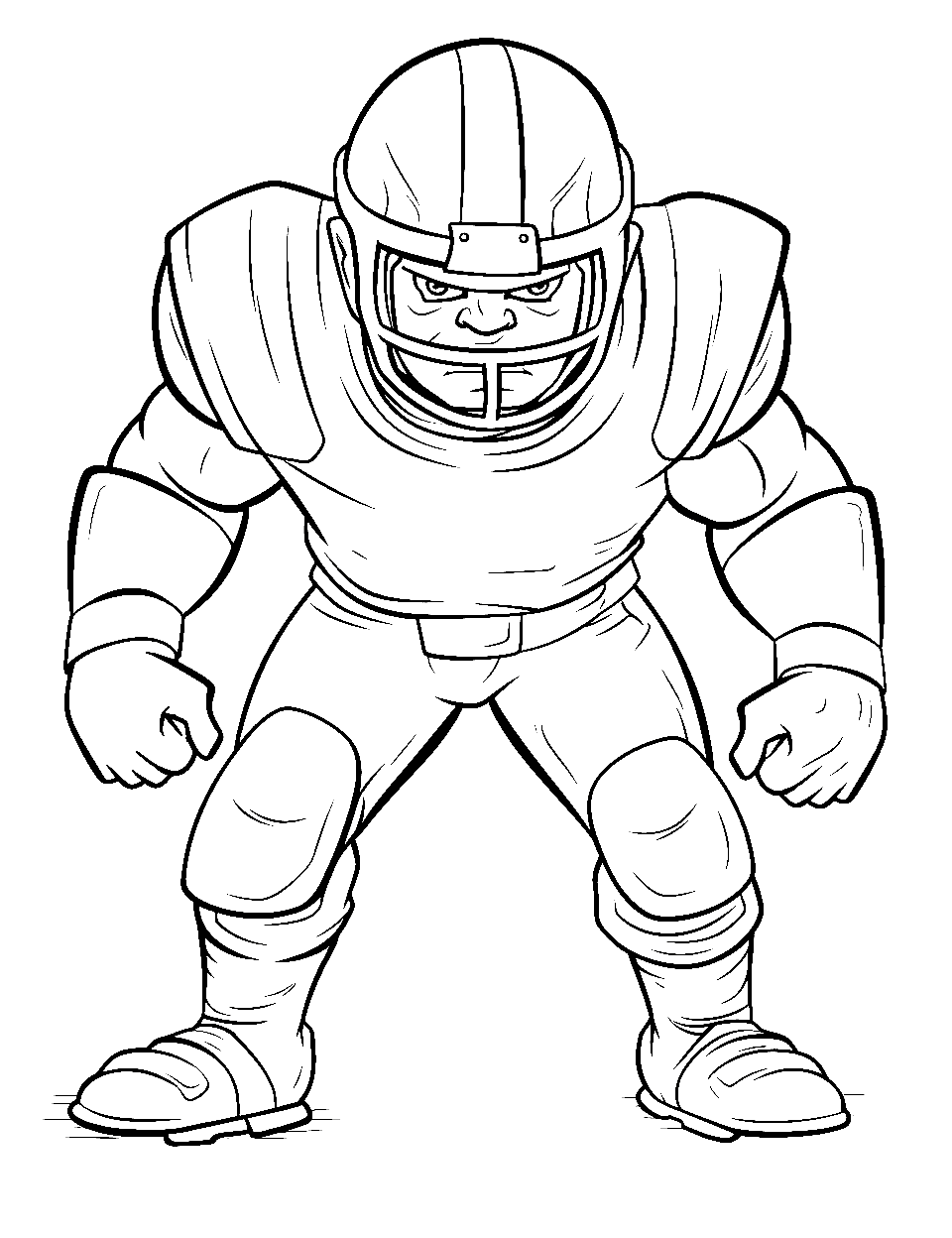
Shoulder pads, thigh pads and knee pads are all drawn in here, which is why this figure looks twice as wide as the other players. He crouches with knees bent and arms loose, staring straight out of the page. All that padding breaks the body into separate panels, so the sheet holds attention longer than most. A dark helmet over a light jersey makes the stance look meaner.
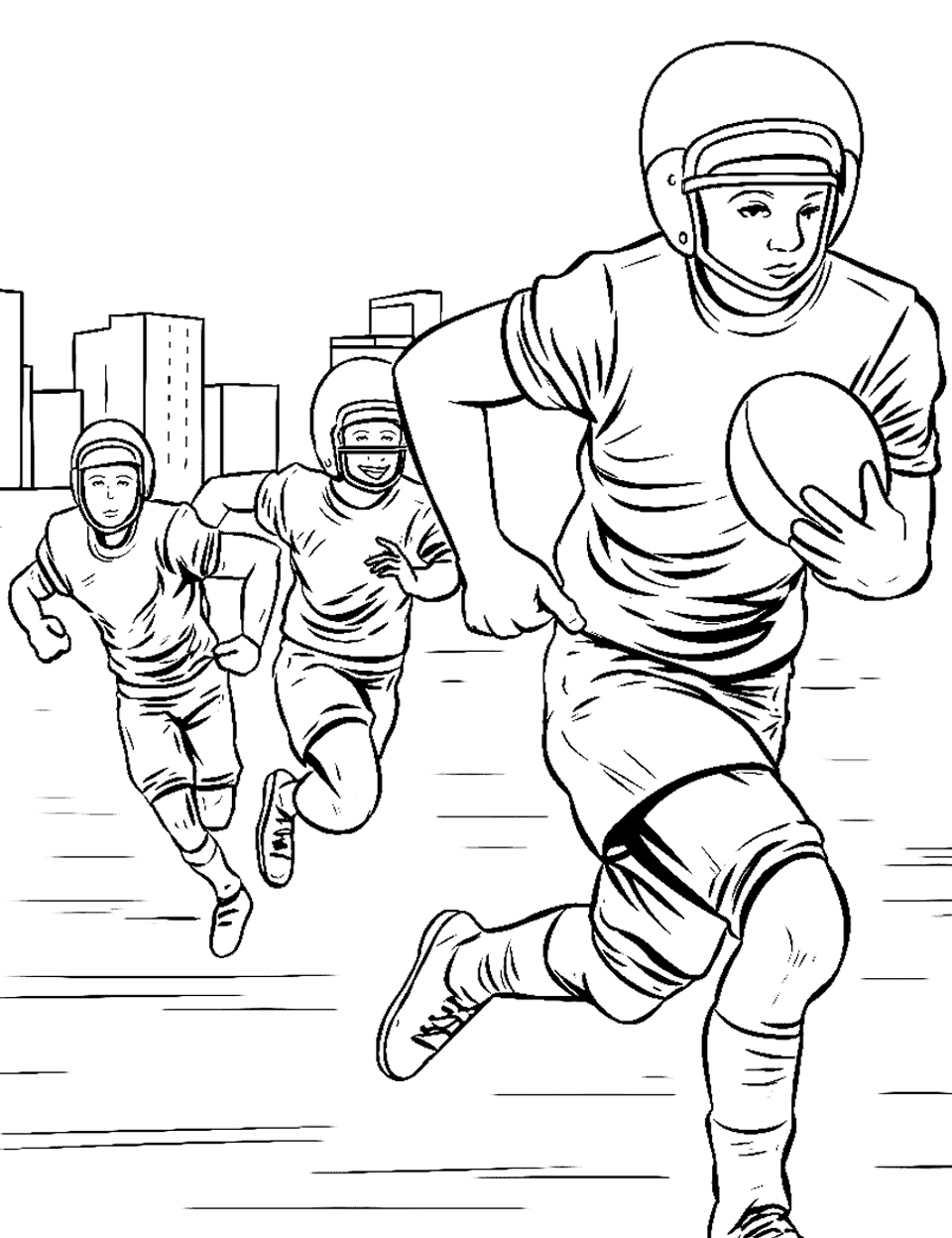
Several players run toward you, and the one in front is carrying the ball. Behind them sits a city skyline. Keep the skyline pale and the uniforms bright so the runners stay in front of it. The two players at the back are drawn smaller and lighter, which is a gentle lesson in perspective for an older child.
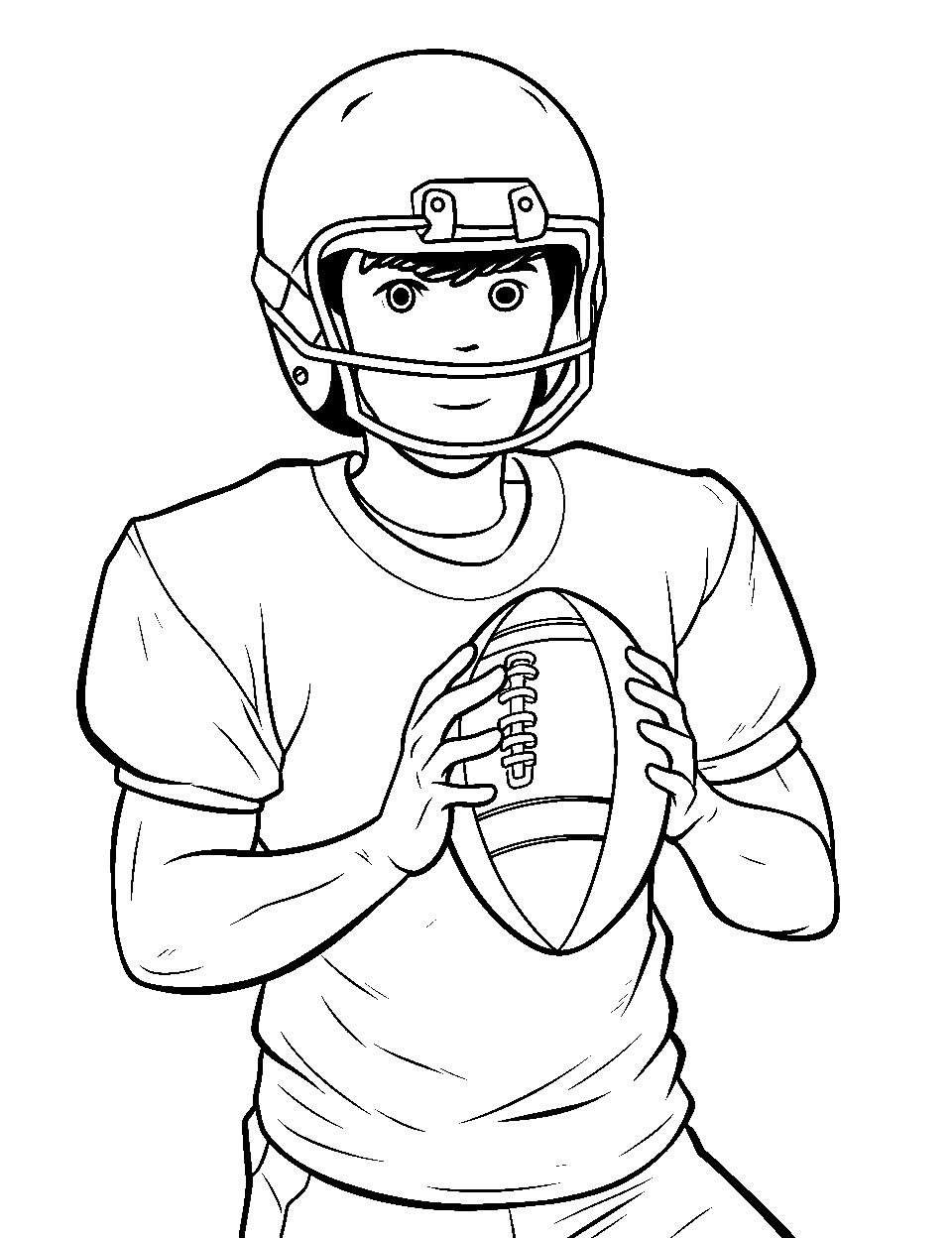
A player holds the ball with both hands at chest height, drawn from the waist up so the ball and helmet fill most of the page. The laces are clear enough to color separately from the rest of the leather. Big open areas across the jersey and sleeves make this a fast one. A bold jersey with a plain helmet keeps the ball at the center of attention.
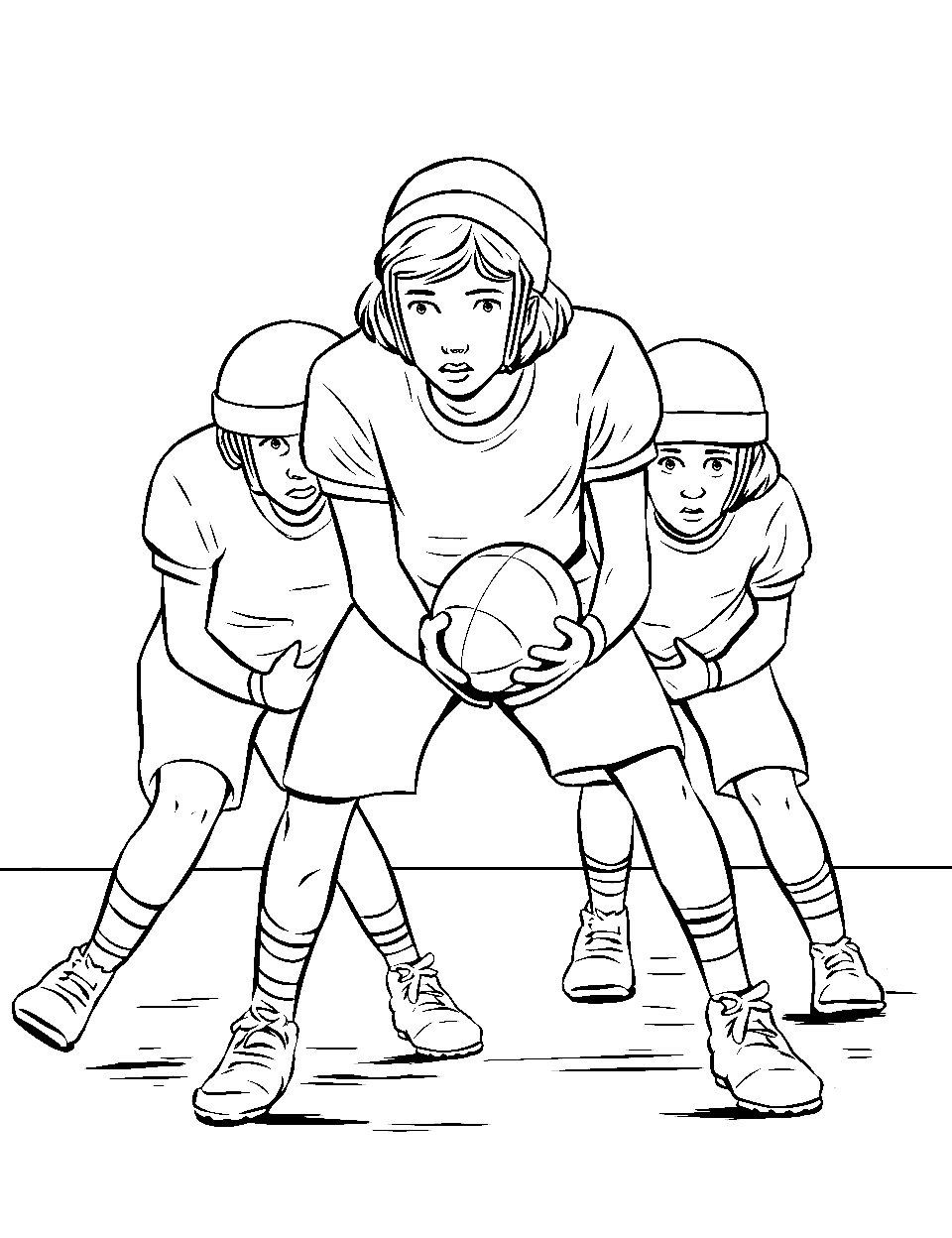
The player in the middle is bent forward with both hands on the ball, ready to send it back, and two teammates are set behind him on either side. Their legs and cleats overlap in the middle of the page, so work outward from the ball to keep track of what belongs to whom. This is the sheet to reach for if you want to explain how a play actually starts. One jersey color across all three makes the formation obvious.
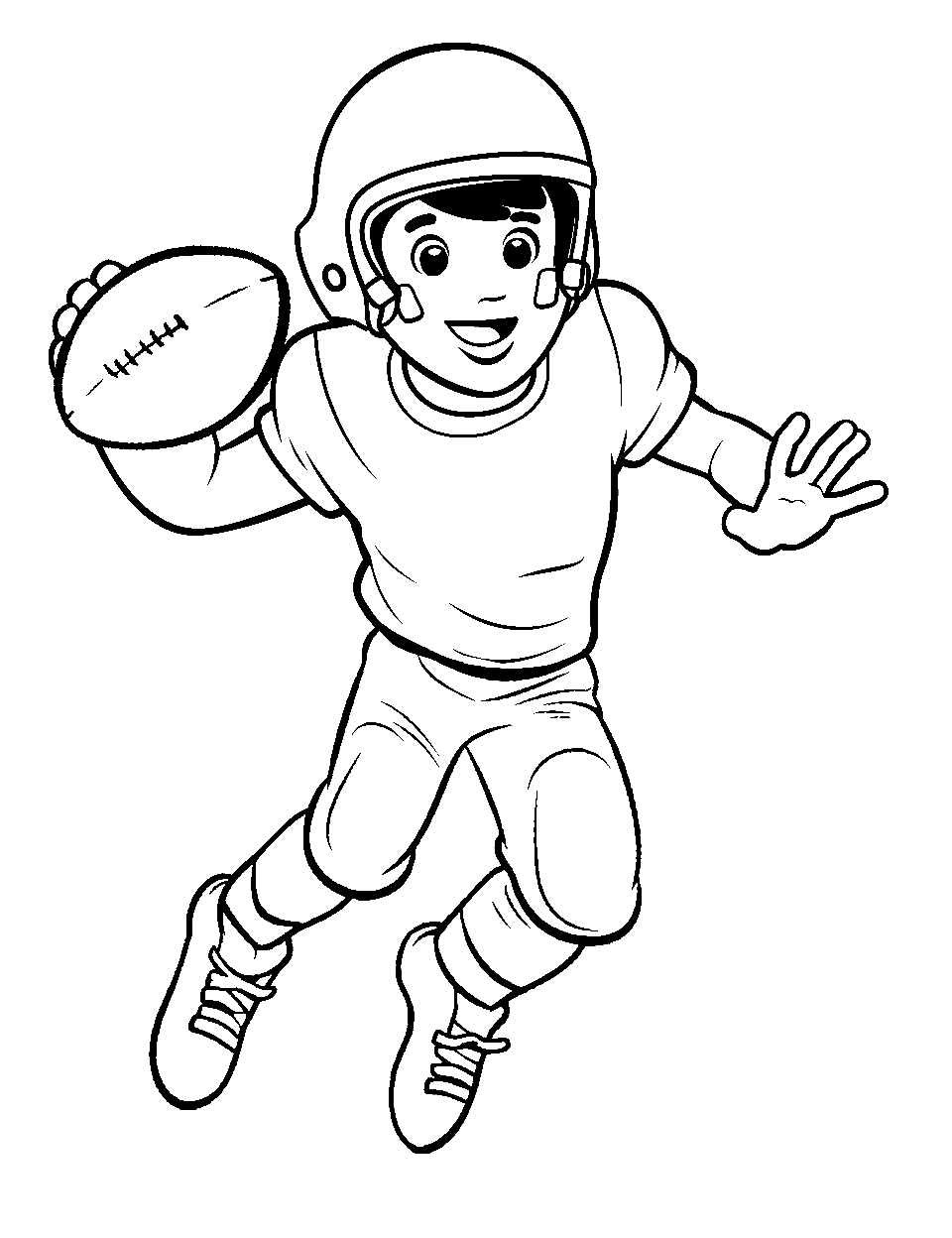
The ball is cocked back beside the ear and the front arm is out for aim, catching the throwing motion halfway through. Both feet are off the ground and the face is drawn cartoon style. Simple shapes and almost no background make it a quick win. Let your child pencil in a target before any color goes down.
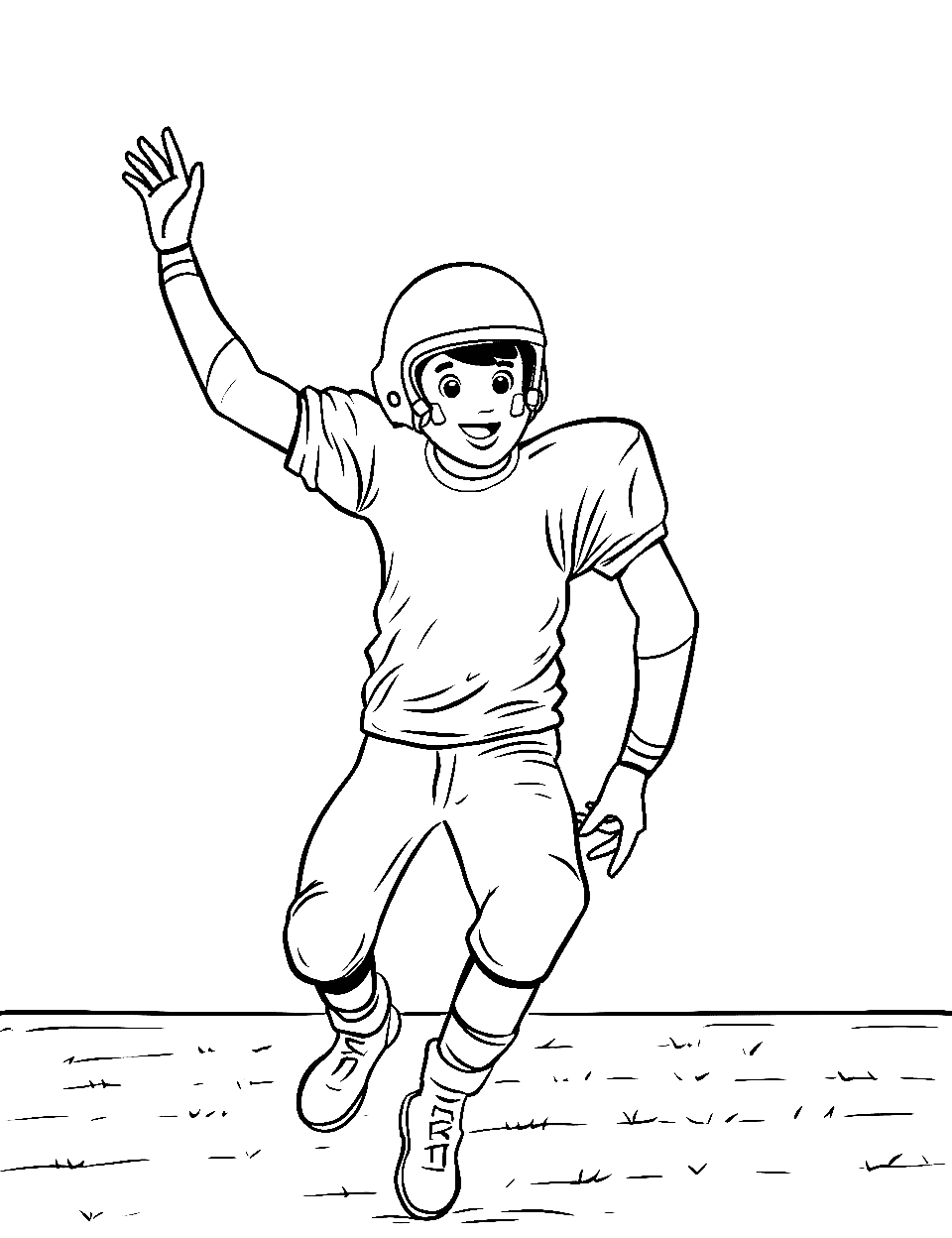
One arm goes up in a wave while the player jogs across a stretch of drawn grass. It reads as the moment after a play rather than during one. The grass is loose and scribbly and does not need to be neat. A single jersey color over a green base finishes it.
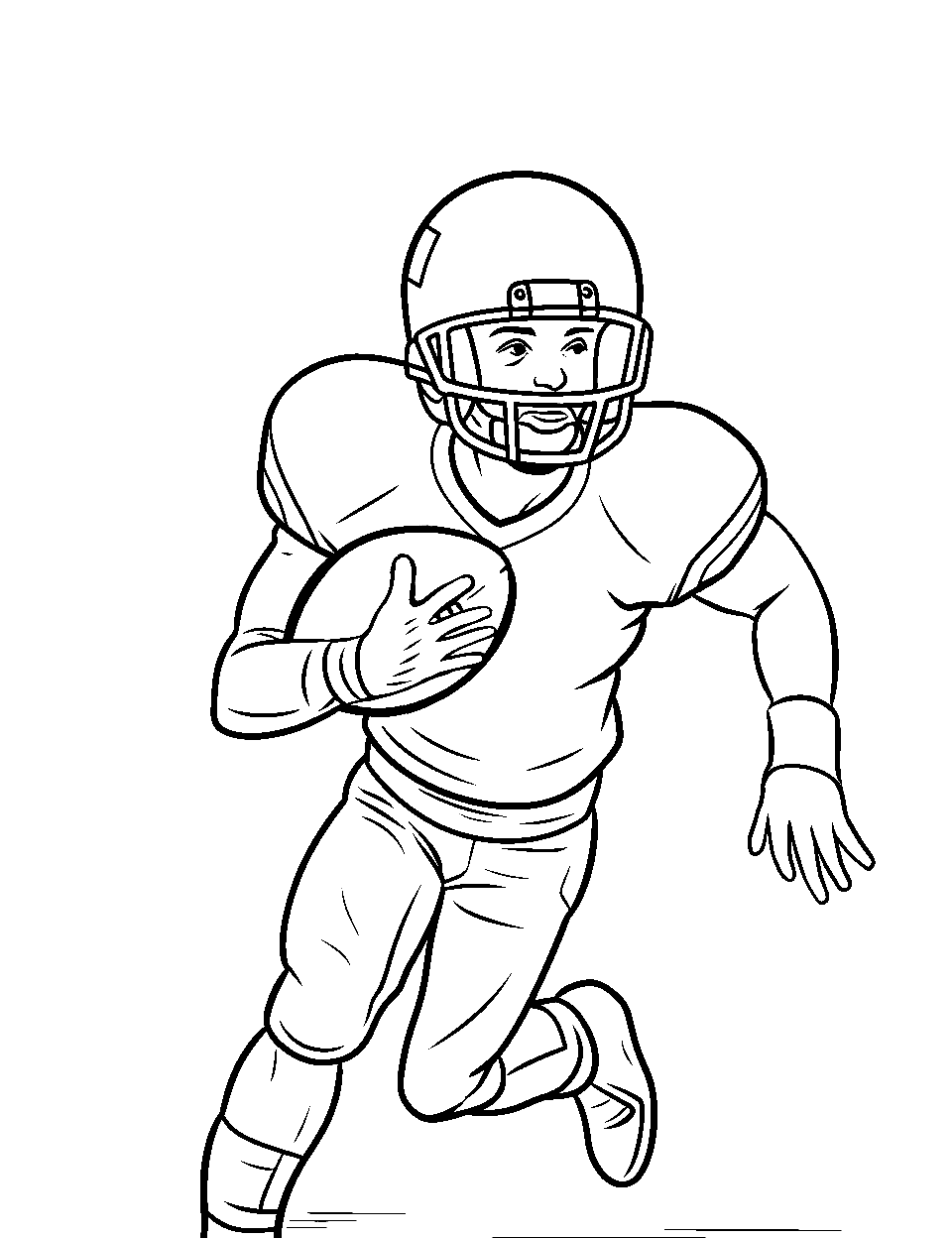
The runner has the ball tucked tight against his ribs and is heading straight out of the page. Shading lines wrap around the arms and legs, so this is another for pencils rather than fat crayons. Pick a darker tone for the ball than for the jersey or the two will blend together. Only a thin ground line sits behind him, which keeps the work on the figure.
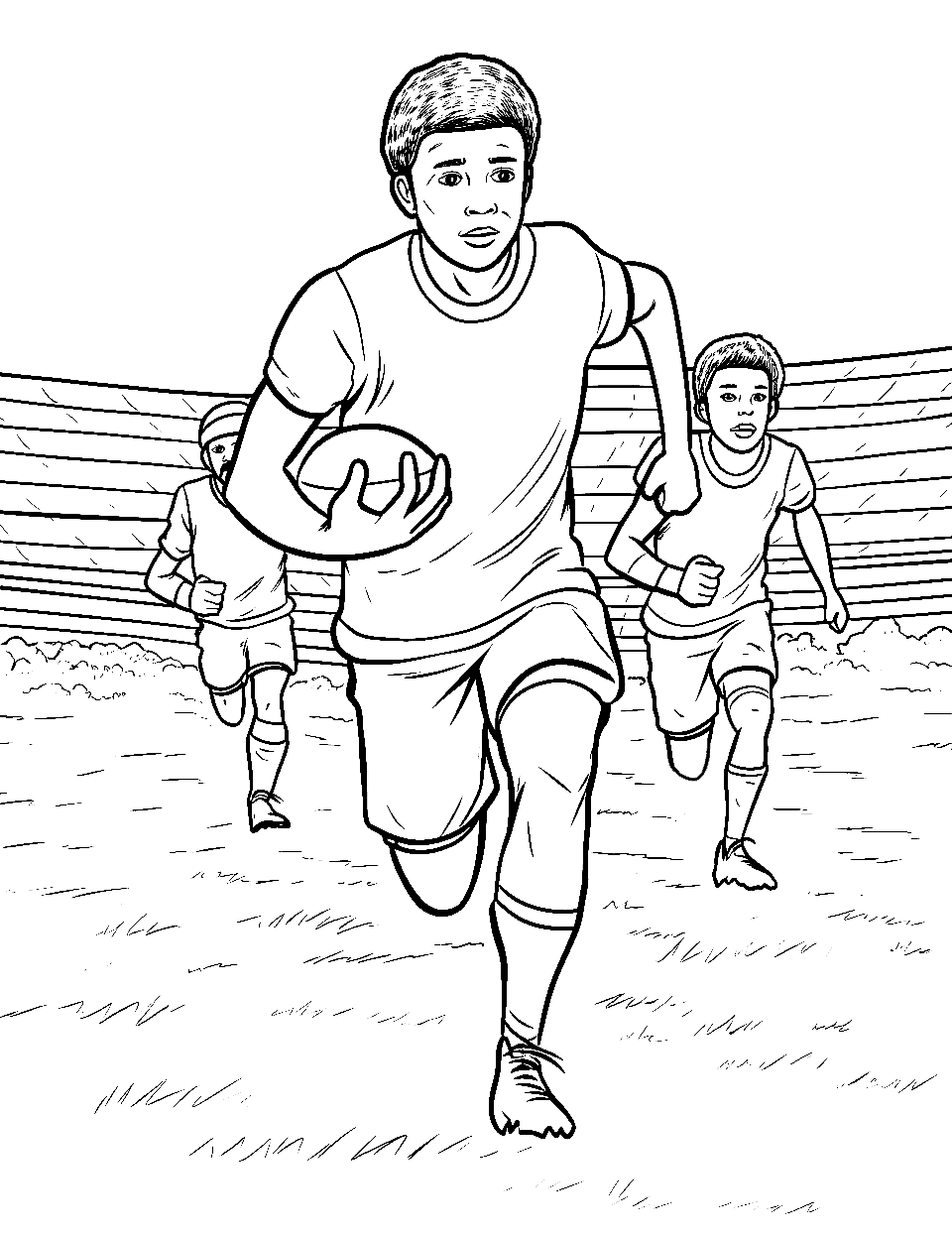
Two chasers close in on a ball carrier as all three cross a grass field, with bleacher lines drawn behind them. The grass is a scatter of short strokes, so a child can fill it loosely without spoiling the sheet. Give the chasers one jersey color and the ball carrier another and the picture reads instantly. The bleachers take a light hand, since they are mostly thin parallel lines.
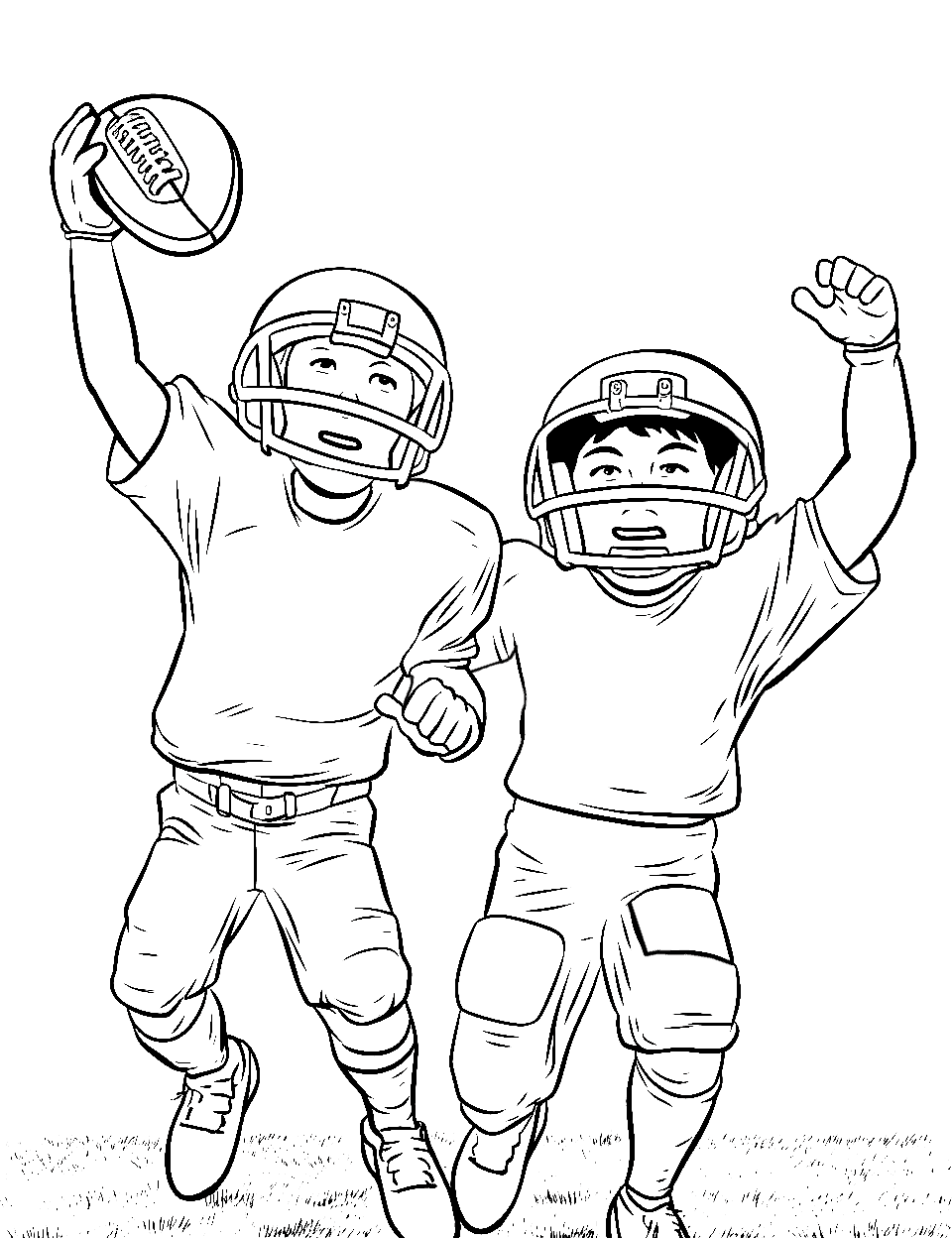
Two teammates celebrate side by side, one holding the ball overhead and the other with a fist up. Helmets, shoulder pads and knee pads are all drawn in, so there is plenty to keep hands busy. Matching uniforms sell the moment better than two different color schemes would. Use this one when you want to show what a two-point try looks like when it works.
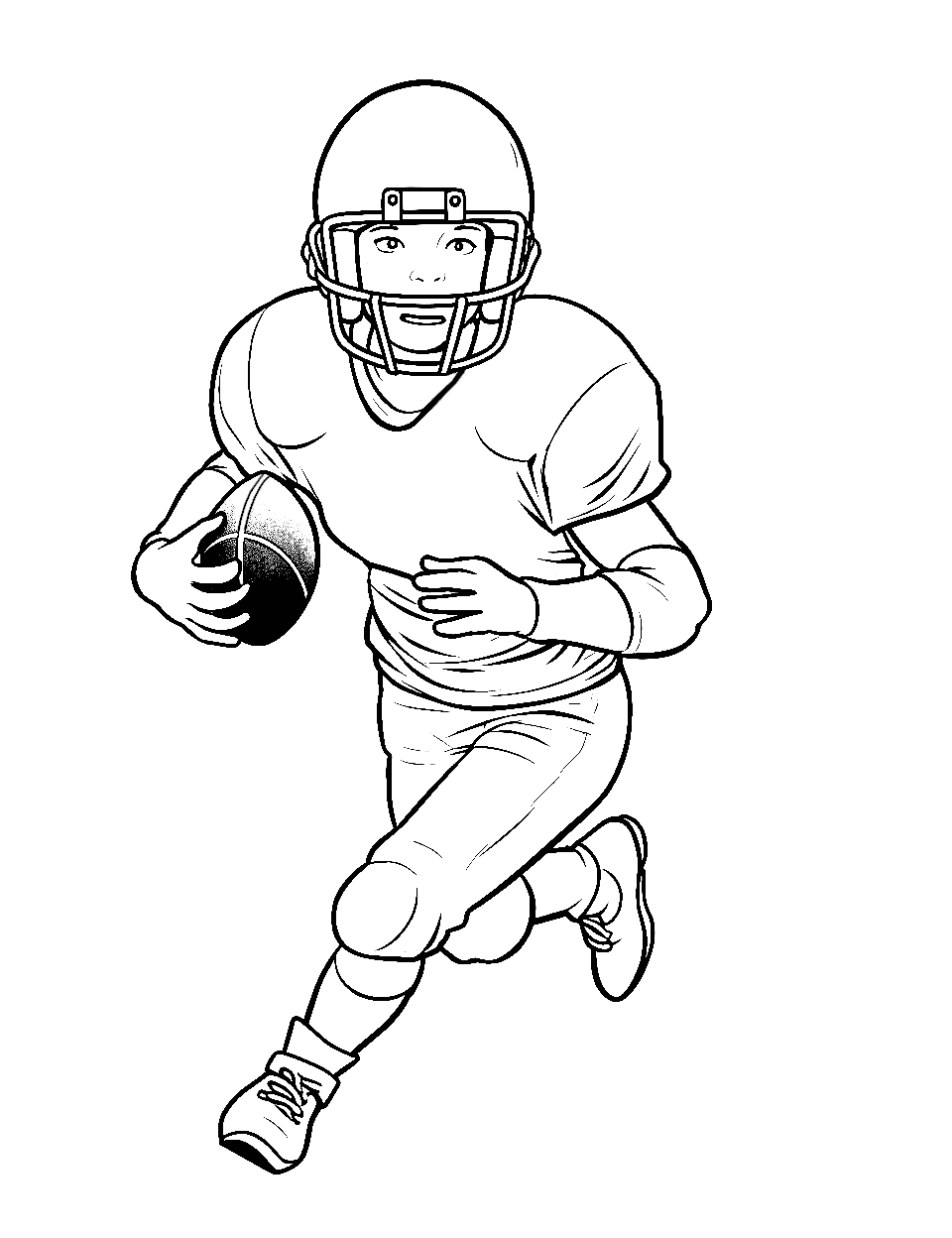
The ball is out in one hand at hip height rather than tucked away, and the other arm crosses the body. Heavy shading runs down the jersey and the pants, giving an older colorer real depth to work with. Leave the highlights on the helmet white and the whole thing looks polished. A plain background means every bit of effort goes into the figure.
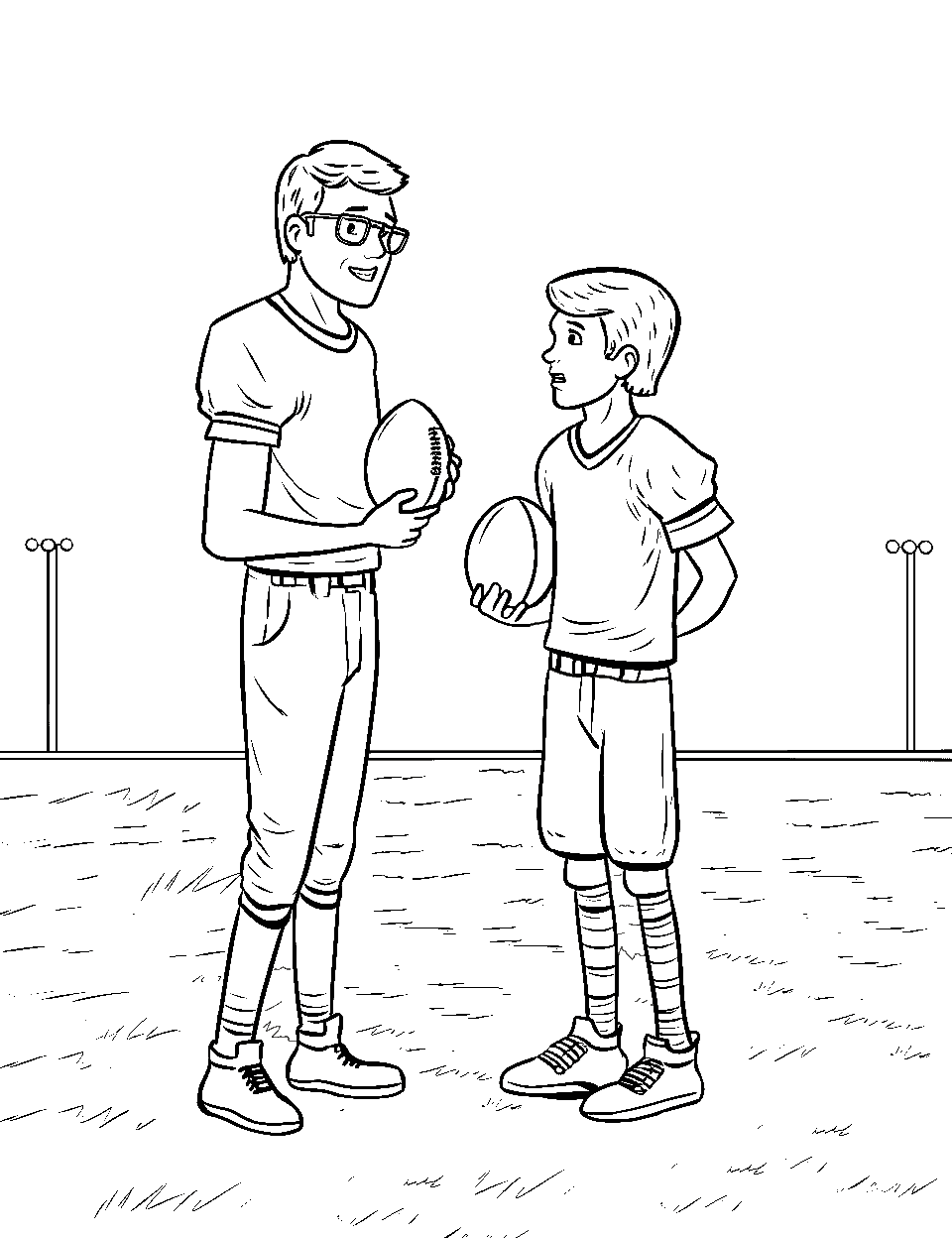
A taller figure in glasses stands talking with a younger player on a grass field, and both of them are holding a football. Tall floodlight poles run across the background on either side. Those poles are thin, so a fine-tip pen or a sharp pencil handles them better than a crayon. Two different shirt colors keep the pair distinct at a glance.
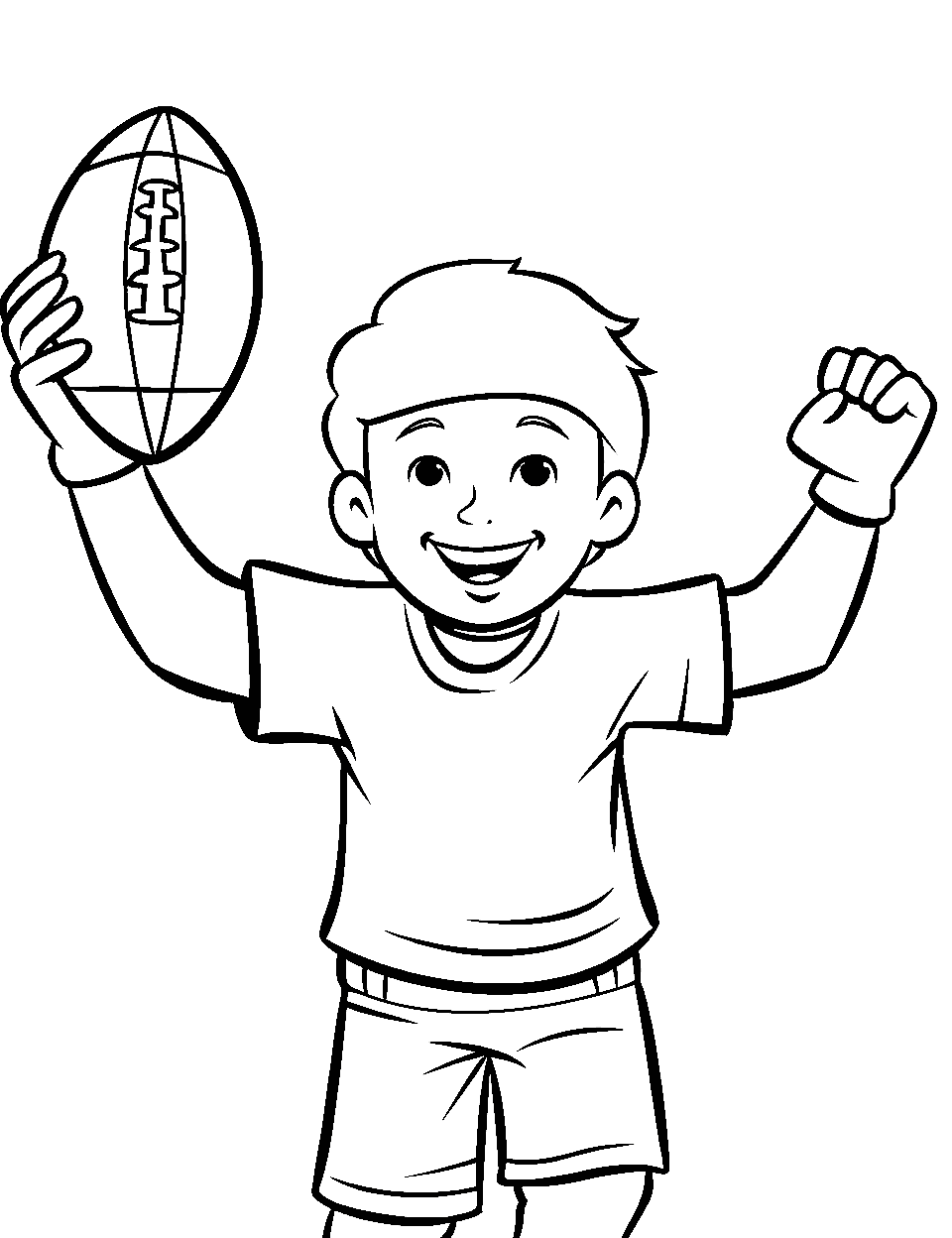
A grinning boy holds a football up in one hand and pumps the other fist, drawn from the waist up. No helmet and no pads here, just a t-shirt, so it reads as backyard rather than game day. The lines are thick and the shapes are simple, which suits the youngest colorers in the house. Let the ball be the brightest thing on the page.
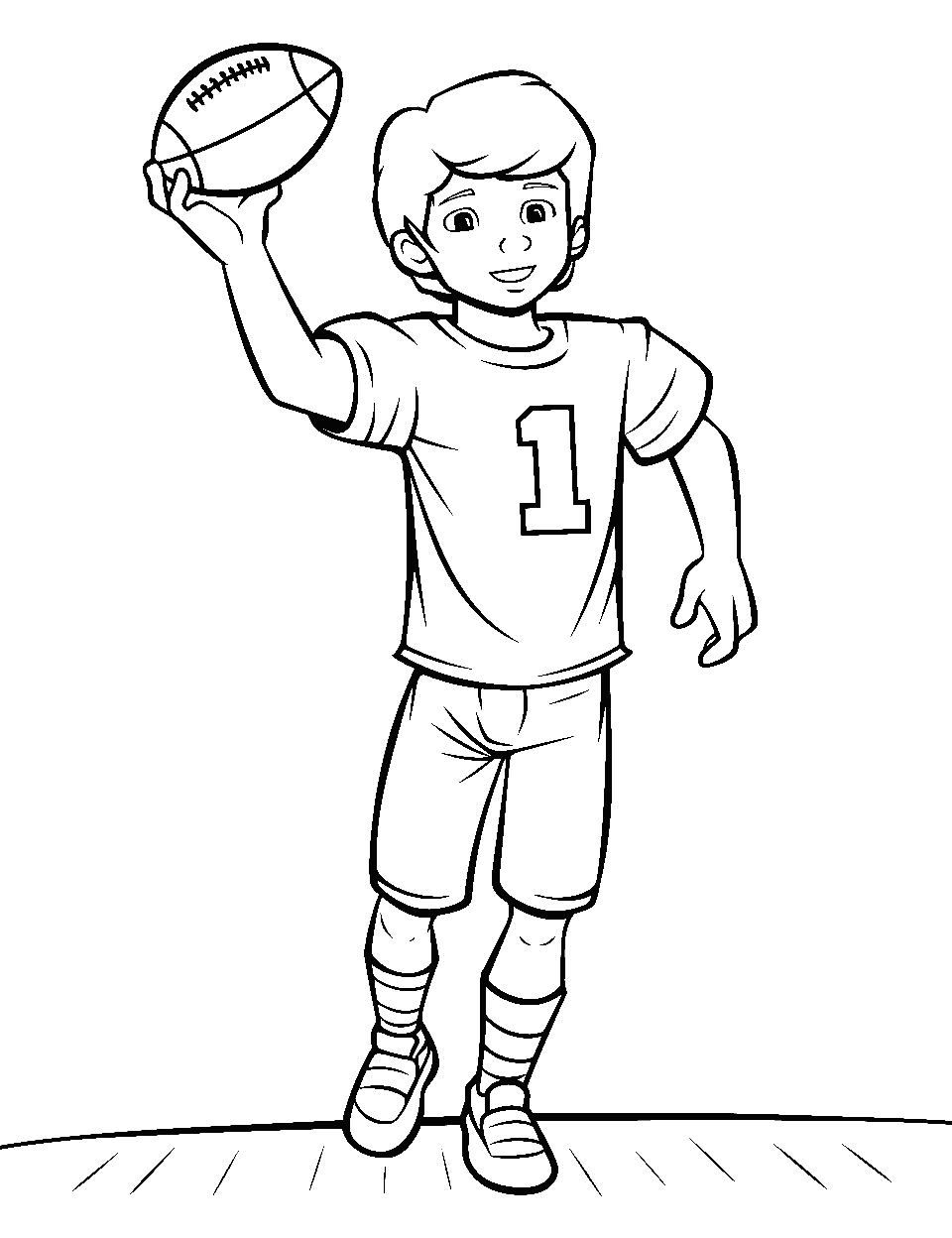
A large number sits across the chest of this jersey, and the ball is raised in one hand ready to go. The figure stands full length on a simple ground line with no other scenery. That big number is the best part of the sheet, so pick a color for it that stands well clear of the jersey behind it. Everything else is open shapes and moves fast.
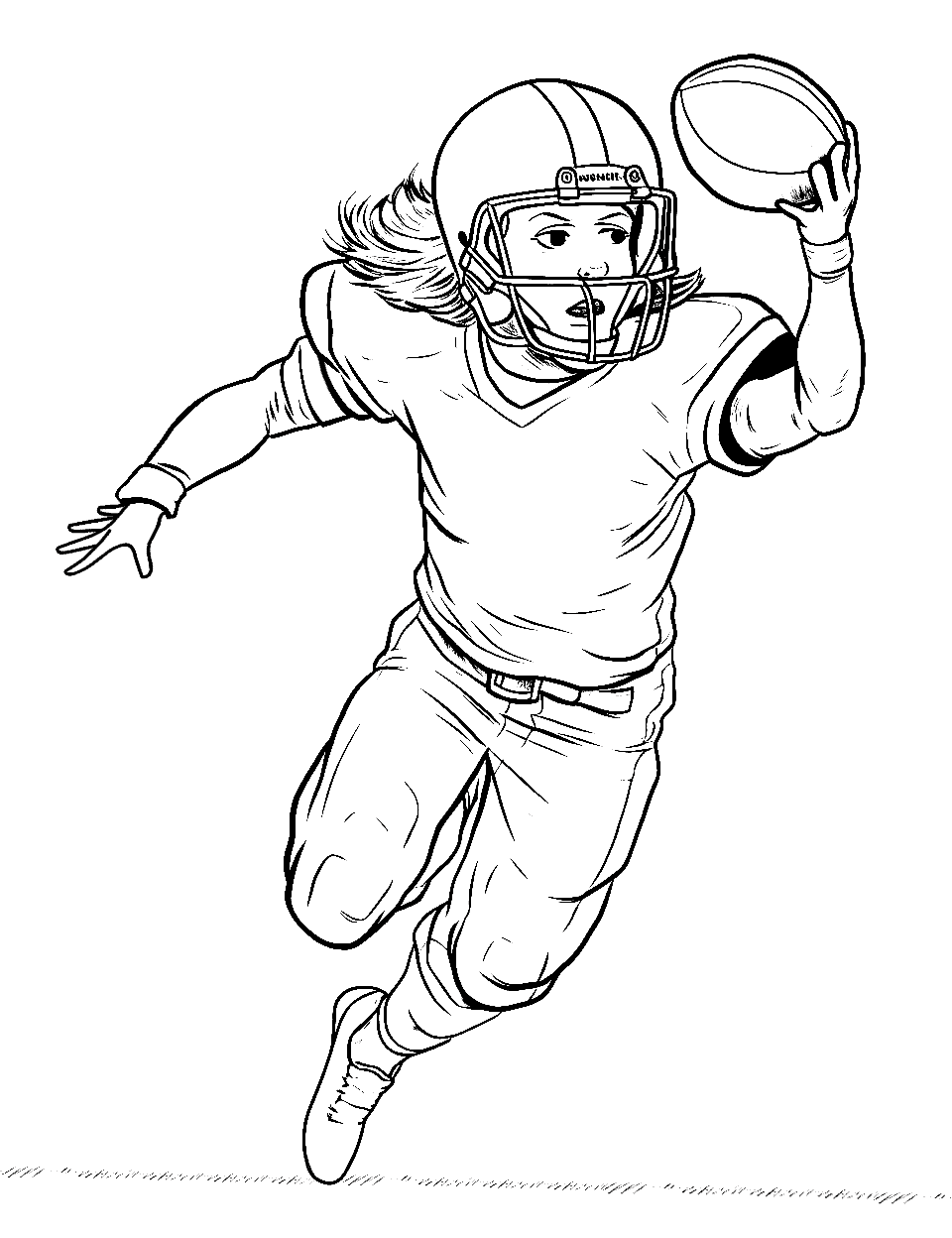
Long hair spills out of the back of the helmet on this runner, and the ball is held out to one side in a single hand. The pose is a full stride with both arms wide. The hair is the one place with fine, close lines, so slow down there. Everything else, from jersey to pants, is broad enough for a marker.
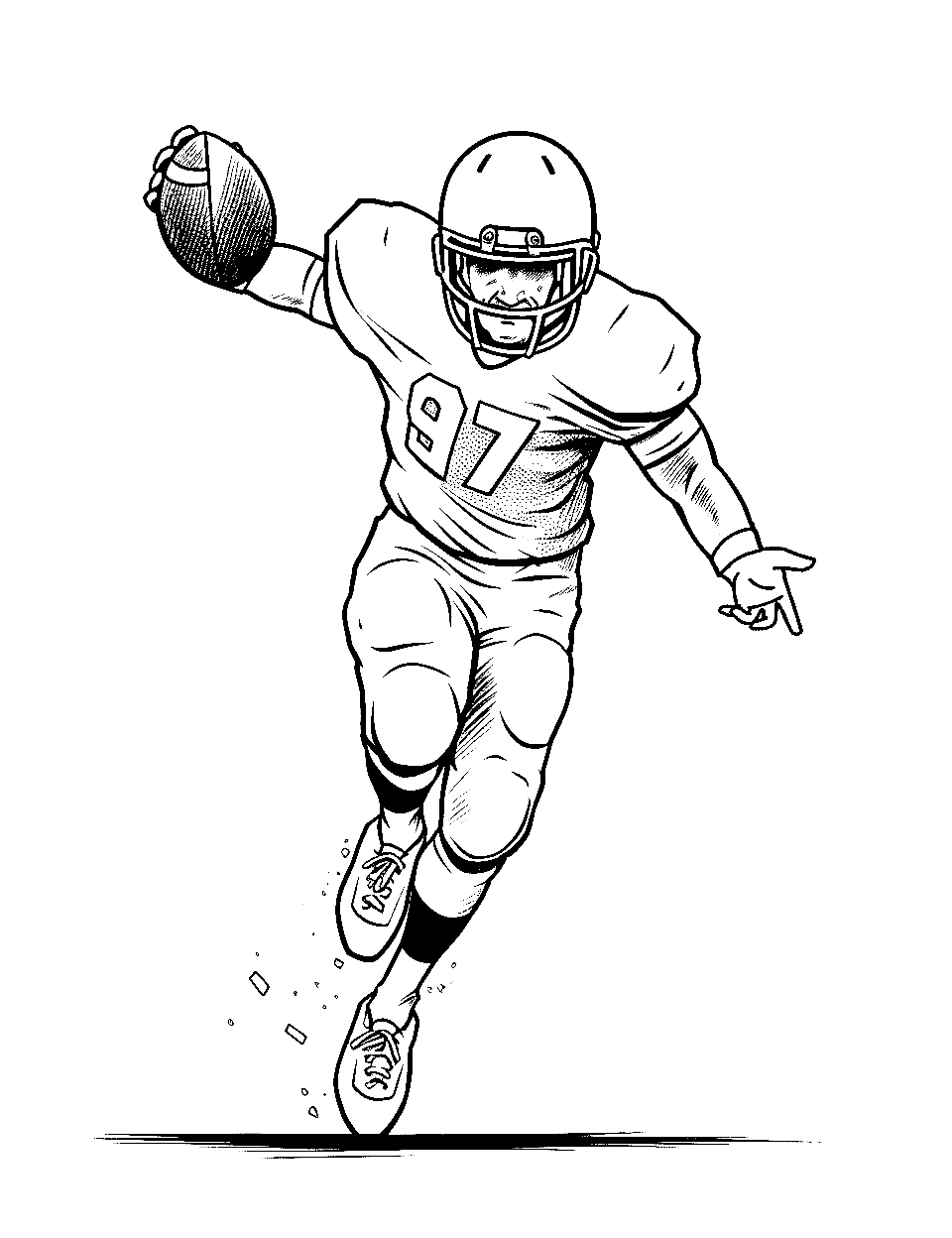
Small flecks of turf fly up behind the cleats as this player, wearing a numbered jersey, runs with the ball held out in one hand. The other arm swings back for balance. Dotted shading covers the jersey and looks best if you color under it lightly rather than press over the top. Those flying turf flecks are a small detail worth a second color of their own.
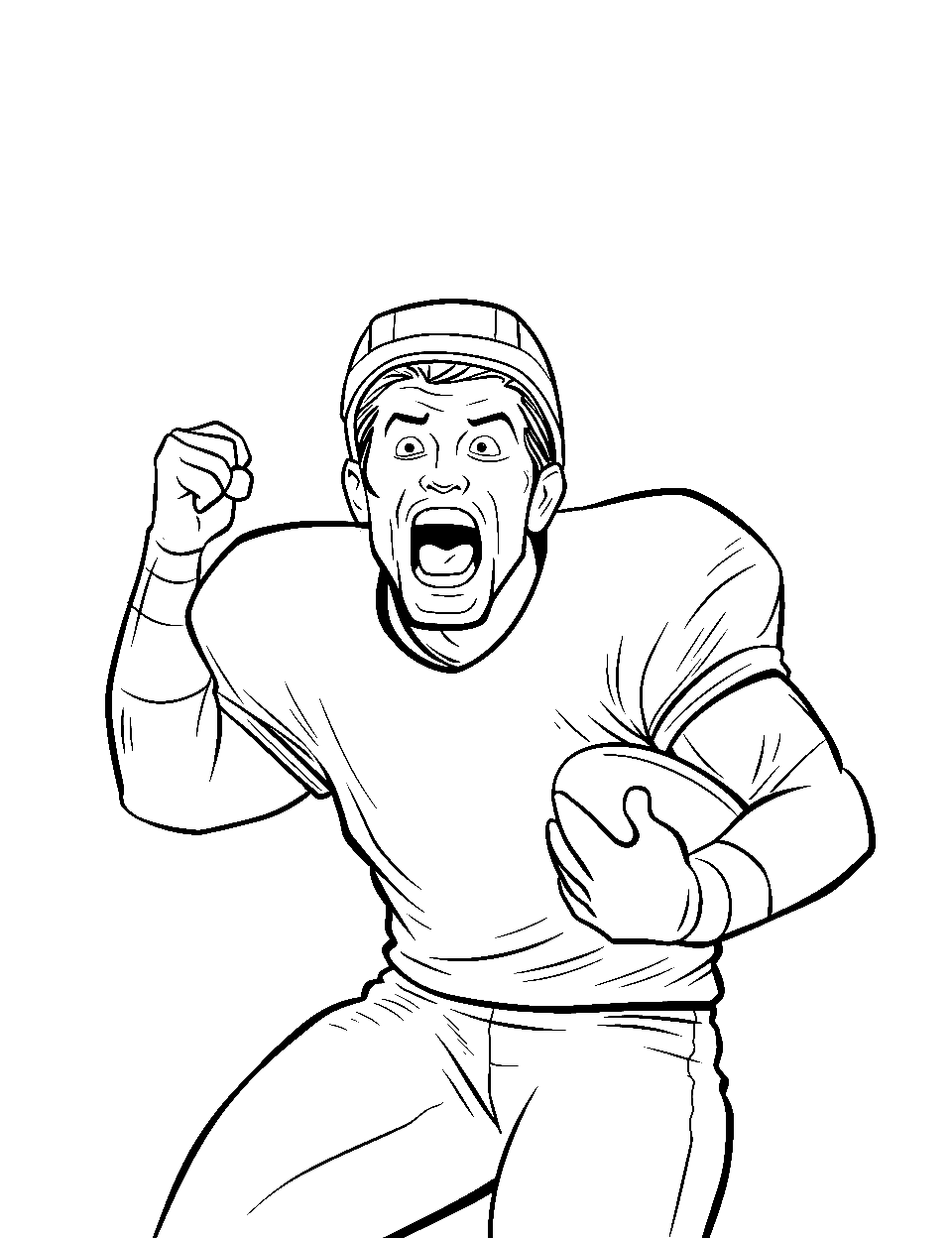
Mouth wide open, one fist up, and the ball still tucked under the far arm. The drawing stops at the waist, so the face carries the whole sheet. The open mouth and the eyes are the fiddly parts and are worth doing first, while hands are still steady. A strong jersey color against the plain background finishes it off.
Both feet leave the ground while one hand carries the ball high overhead. Motion strokes underneath show how far off the turf the jump goes. Keeping those ground strokes pale makes the leap look higher than it otherwise would. There is a lot of open uniform surface here, so it is a good candidate for markers.
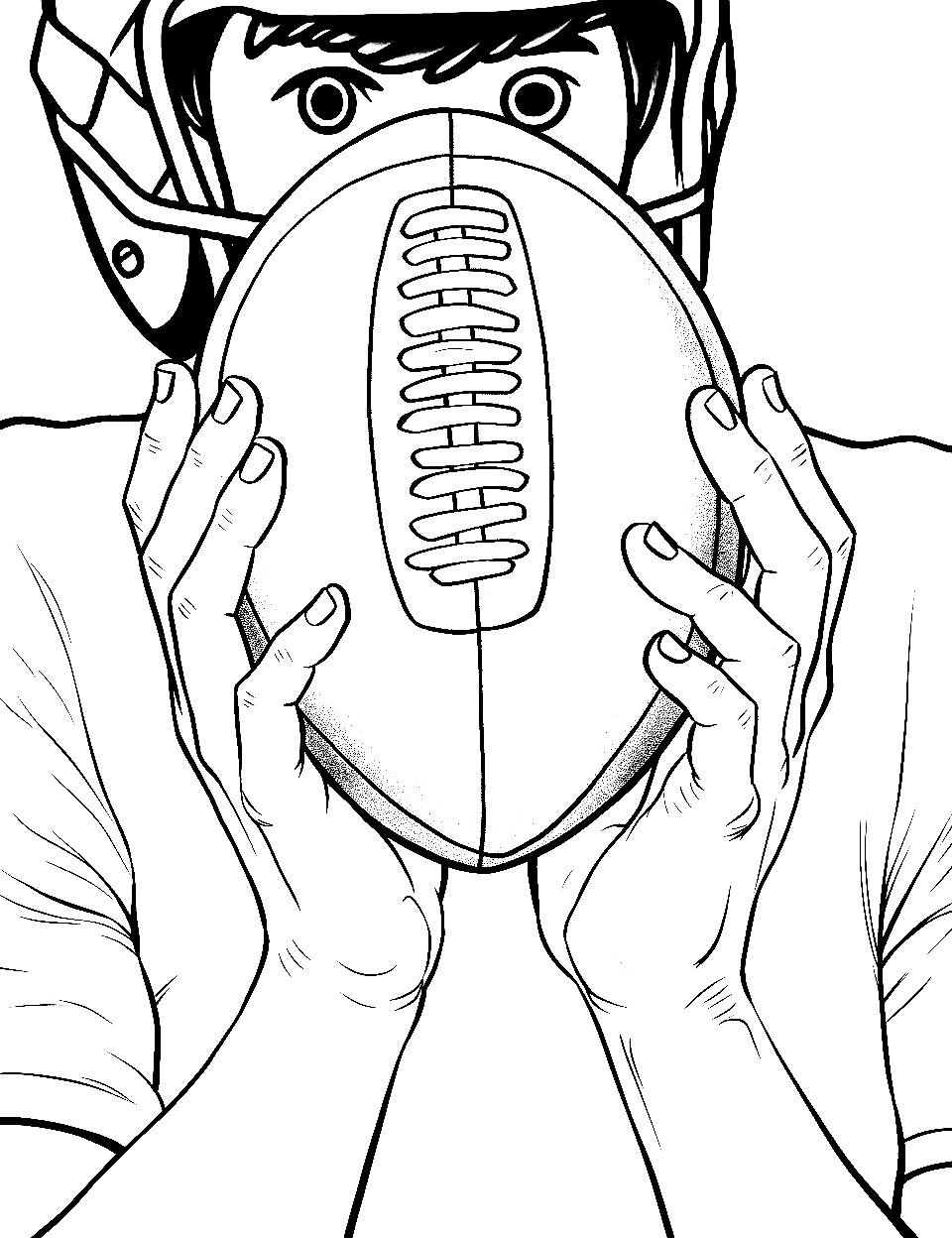
This one crops in tight on two hands wrapped around a football, fingers spread across the laces. Look above the ball and you will find a pair of eyes and part of a facemask peering over the top. Skin tones and leather are the whole exercise, which makes a nice change from uniforms. The laces sit dead center and deserve a color of their own.
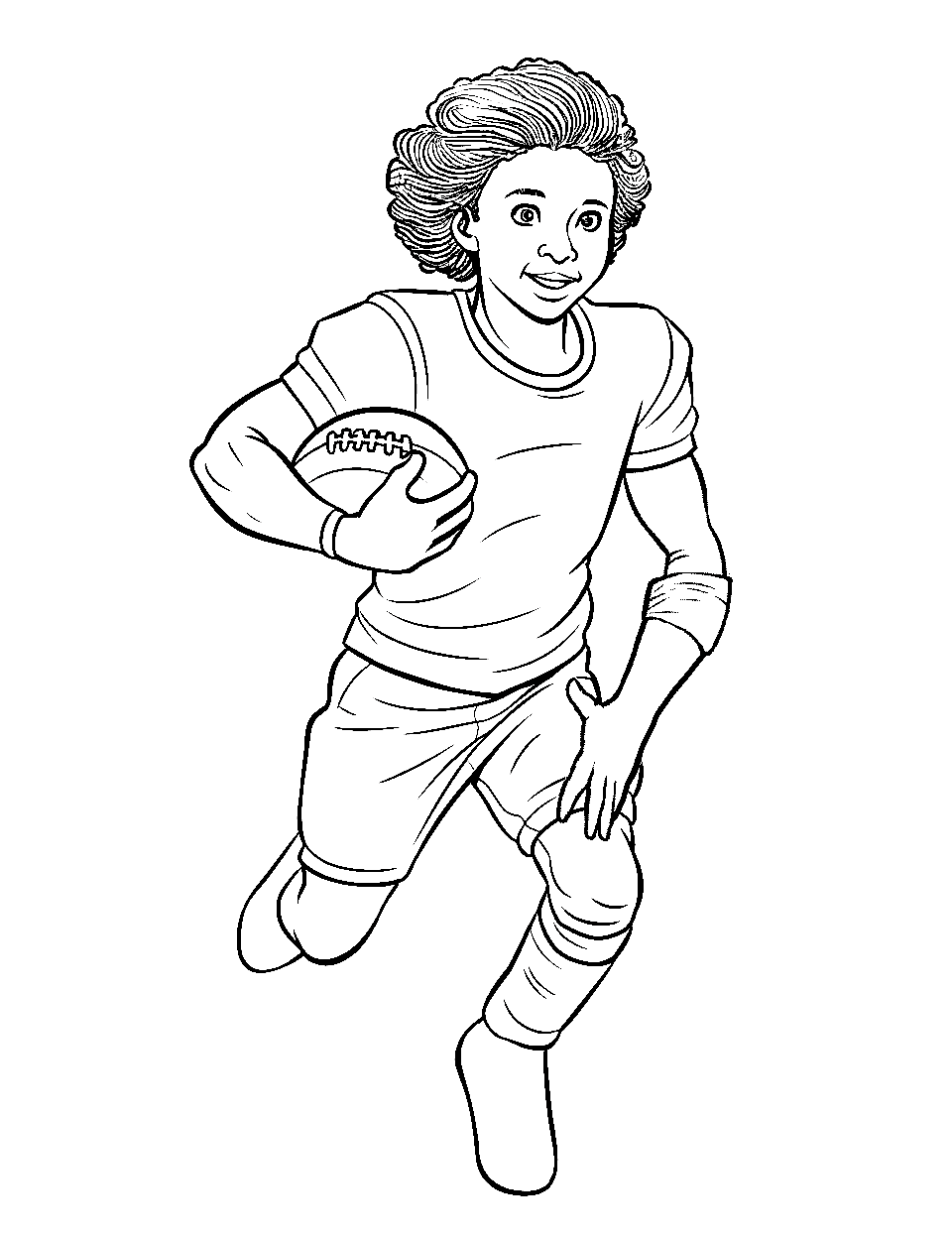
Curly hair, a plain t-shirt and no helmet in sight, with the ball tucked under one arm. The player runs straight toward you and nothing at all is drawn behind them. All that curly hair is the most detailed part of the picture and takes the longest to work through. Pick the shirt color first and build outward from there.
By using our free coloring pages, you acknowledge and agree to our full disclaimer. All materials are for personal, non-commercial use only and all rights belong to their respective license holders.
What Can Kids Learn About Football While They Color?
Coloring slowly is a decent excuse to explain what is happening in the picture, and several of these sheets line up with the basic rules. “Lining Up for the Snap” shows the moment a play begins, when the ball goes back between the center’s legs. “Team Huddle from Behind” is the meeting right before that, where the play gets chosen.
A touchdown is worth six points and is the most valuable score in the game (1). After one, the scoring team picks between kicking for a single extra point, snapped from the 15-yard line, or running or throwing the ball into the end zone for two (2). “Two-Player Celebration” is that second option paying off.
Point at “Team Helmet” while you talk about safety gear, and at “Linebacker in a Stance” for what all that padding actually covers. Both are easier to explain on paper than on a screen during live play.
Activities to Do With American Football Coloring Pages
The coloring is done and the pages are drying on the counter. Here is how to get a second afternoon out of them.
Create Your Own Fantasy Team Trading Cards
Glue the colored player sheets onto cardstock, then trim them down to whatever card size your kids pick. On the back, have them write a name, a position and a few invented stats such as speed, catches and touchdowns. The full-figure sheets work best here, since the waist-up close-ups lose their edges once you trim them. Kids who resist writing practice will usually do it for a card they designed themselves.
Design a Game Day Banner
Color several sheets, cut them out and punch a hole in each top corner. Thread twine through the holes to make bunting for a party wall or a doorway. Alternate a helmet, a football and a player so the line has some rhythm to it. “Football in the Clouds” and “Football Close-Up” are the fastest ones to finish if you are short on time.
Host a Coloring Race
Give every child the same sheet, “Team Helmet” and “Football Close-Up” both work well, and set a timer for 15 minutes. Judge on creativity rather than speed so the careful, slow colorer still has a shot at winning. Hand out prizes for the most realistic, the wildest color scheme and the best team spirit. Print a spare copy for the adult who inevitably wants in.
Play “Pin the Football on the Goalpost”
Color and cut out the ball from “Football in the Clouds”, then stick a loop of tape on the back. Draw a goalpost on poster board, or mark one out on a wall with painter’s tape. Blindfold each player, turn them around twice and let them try to stick the ball between the uprights. Keep score across several rounds so it lasts longer than a minute.
Make Stick Puppets for Storytime
Cut out the colored players, the cheerleader and the mascot, then tape a craft stick to the back of each. Kids can use them to replay a famous game, run a pretend post-match interview or invent a halftime show. It builds storytelling without feeling like a lesson. Store them in a zip bag and they come straight back out next season.
DIY Jersey Design Studio
Print several copies of “Team Helmet” plus a couple of the full-figure player sheets. Ask your kids to invent a team: a name, two colors and a logo that fits on the side panel of the helmet. Holding them to only two colors is the part that turns it into a genuine design problem. Tape the finished set up together so the uniform reads as one matching kit.
Why Is Football Such a Big Deal in American Homes?
Because a large share of American families have someone playing it or watching it. In the 2024-25 school year, 1,031,039 students played 11-player high school football, keeping it the most popular boys sport in the country (3). That sat inside a record 8,260,891 high school athletes overall, the highest total in the 55 years the survey has run.
“It is wonderful to see the interest in high school sports reach new heights,” said Dr. Karissa Niehoff, chief executive officer of the National Federation of State High School Associations.
The professional game pulls wider still. Super Bowl LIX averaged 127.7 million viewers, the largest audience for any Super Bowl and for any single-network telecast in television history (4). Super Bowl LX averaged 125.6 million viewers and peaked at 137.8 million during the second quarter (5). That is the afternoon these sheets are built for, with a printed stack on the kitchen table while the game runs in the background.
FAQs
What Supplies Work Best for These Coloring Pages?
Crayons and colored pencils are fine on plain printer paper, but markers and watercolors need cardstock or heavier stock so the ink does not bleed through. The heavily shaded sheets, such as “Linebacker in a Stance” and “Turf-Kicking Breakaway”, are easier with pencils than crayons because the lines sit so close together. A fine-tip black pen is handy for adding a team logo to the helmet once the color is down.
Are These Coloring Pages Free to Download?
Yes, every sheet on this page is free for personal and classroom use. Print as many copies as you need for your family, a team party or a whole class. There is no sign-up form and no watermark across the artwork.
Can I Use These Pages for a Classroom Activity?
Yes, and they hold up well for it. Teachers use them for art time, indoor recess and Super Bowl week, and the simplest sheets double as fine motor practice for younger classes. Pair “Team Huddle from Behind” and “Lining Up for the Snap” with a short talk about how a play gets called and you get a lesson out of it rather than filler.
How Do I Print the Coloring Pages?
Click the download link under the sheet you want, open the file, then choose Print from your browser or image viewer. Set the scaling to fit the page so nothing gets cropped at the edges. Printing in grayscale saves color ink, since every sheet is line art anyway.
Do You Have Coloring Pages for Specific NFL Teams?
No, and that is deliberate. Every helmet, jersey and uniform here is drawn without a logo, so your child can color them in any team’s colors, whether that is the Chiefs, the Eagles, the Cowboys or a team invented at breakfast. “Team Helmet” is the best sheet for adding a logo by hand.
What Age Group Are These Pages Suitable For?
Roughly age three through adult, depending on the sheet. “Team Mascot”, “Cheerleader with Pom-Poms” and “Cheering with the Ball” use thick outlines and large shapes for preschoolers, while the shaded action scenes and “Hands on the Laces” suit older kids and adults. The description under each sheet says how detailed it is, so you can sort them before you print.
How Many Football Coloring Pages Are on This Page?
There are 34 sheets here, covering helmets, footballs, a trophy cup, a cheerleader, a mascot, plus players running, catching, throwing, huddling and celebrating. Roughly a third are simple cartoon outlines and the rest carry more shading and detail. Each one prints on its own, so you never have to take the whole set at once.
Which Sheets Work Best for a Super Bowl Party?
“Trophy Cup and Stars”, “Fans with Hands Up” and “Two-Player Celebration” set the right mood for a party table. They are quick enough that a guest can finish one between plays, and they cut out cleanly for banners or place cards. Print a few copies of “Team Helmet” too, so people can color whichever team they are backing.