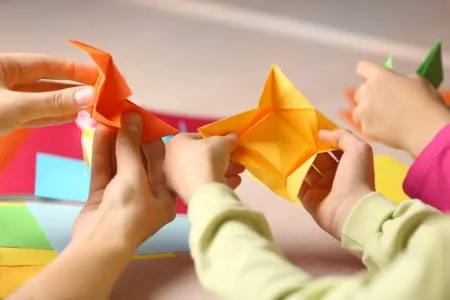
Origami feels a little bit like magic. You start with a plain, flat square of paper, make a few precise folds, and suddenly you’re holding a hopping frog or a fluttering butterfly. It’s a low-cost, high-reward hobby that keeps kids engaged without screens.
While it looks simple, origami is actually a fantastic brain workout. It blends art, history, and geometry into one quiet activity.
In this guide, we’ve rounded up 12 beginner-friendly origami projects with video tutorials to get your kids folding like pros.
Key Takeaways
- Brain boost: Origami strengthens fine motor skills, sequencing ability, and spatial awareness.
- Math in action: Folding teaches practical geometry, fractions, and measurement without a textbook.
- Resilience: It provides a safe space to fail, try again, and build patience.
- Accessible fun: You don’t need expensive gear; just paper and a flat surface.
12 Easy Origami Projects for Kids

We’ve curated this list starting with the absolute easiest folds to build your child’s confidence.
These videos guide you step-by-step, ensuring your child ends up with a cool creation rather than a crumbled ball of paper.
1. Fish Origami for Kids
This is the perfect “first fold” for toddlers or preschoolers. The tutorial moves slowly through every step, teaching the foundational concept of turning corners into diagonals. It’s rewarding because it requires very few creases to look like a recognizable fish.
If your child is under the age of six, skip the standard small paper. Their fine motor skills are still developing, so a larger canvas makes it easier to line up the edges.
We recommend using Aitoh 9.75 x 9.75 inch paper for this. The larger size is much more forgiving for clumsy fingers, and the colors are vibrant.
2. Butterfly Origami for Kids
While there are dozens of butterfly designs out there, this specific tutorial is our favorite for beginners. It takes less than three minutes to complete. Unlike flat models, this one has a satisfying 3D “pop” that makes the wings look like they are in mid-flight. It looks lovely perched on a bookshelf or glued onto a homemade card.
3. Flower Origami for Kids
Once your child has mastered the fish and butterfly, they are ready for the lily. This video walks you through the process in about three minutes. It introduces slightly more complex folds, so it’s a great bridge between beginner and intermediate levels.
The paper you choose here matters. These patterned sheets from Kool Krafts add a beautiful texture to the petals, making the final lily look like a professional craft project.
4. Origami Games for Kids
Who says origami has to sit still on a shelf? These projects are interactive toys. While they use extra materials like glue or scissors (breaking traditional rules), they are incredibly fun for playdates.
This video covers three distinct games:
- Cockroach Climbers: Requires two 8-inch squares of cardstock or thick paper, plus string and glue.
- Jumping Bunnies: You will need two strips of paper (2×12 inches), markers, and optional googly eyes.
- Caterpillar Race: The simplest of the bunch, requiring just a 2×12 inch strip of paper and a straw to blow them across the table.
5. Origami Puppet for Kids
Complex origami puppets with teeth and tongues often end in tears because the layers don’t line up perfectly. We chose this fish puppet because it is forgiving. It uses a single color, meaning you don’t have to worry about the “white side” showing through at the wrong time. It snaps open and closed easily, making it a hit for storytelling time.
6. Boat Origami for Kids
This is a classic for a reason. This origami boat actually floats on water, which adds a whole new layer of play. You can use standard 6-inch paper, but if you want a boat that can carry “passengers” (like Lego figures), try using a larger waterproof sheet or waxed paper to help it last longer in the tub.
7. Origami House for Kids
This project requires two square sheets of paper and patience. It creates a cute 3D house structure. Because aligning the roof and walls involves multiple specific folds, this is better suited for older children (ages 8+) or those with some folding experience. Using two different colored sheets creates a nice contrast between the roof and the living quarters.
8. Frog Origami for Kids
This is the star of the show. The jumping frog is an “action model” that uses the tension in the folded paper to launch itself forward when you press down on the back.
For the best bounce, use a standard 6-inch square of crisp paper. If the paper is too soft or large, the spring mechanism won’t work as well.
9. Origami Birds for Kids
Birds are a staple of paper folding. We have two options here depending on your child’s interest level.
The Swan: This is elegant, traditional, and stands up on its own. It makes a sweet handmade gift for grandparents.
The Flapping Bird: This is more interactive. By pulling the tail, the wings actually flap. It’s fascinating for kids to see how the internal creases create movement.
10. Origami Dinosaurs for Kids
Dinosaurs are timeless favorites. These projects range from difficult to easy, so pick the one that matches your child’s skill level.
The T-Rex: This uses A4 paper rather than a square. It involves complex pleating, so parents will likely need to help.
The Brachiosaurus: Requires a 6-inch square. It captures the long neck perfectly but requires precision.
The Pteranodon: This is the easiest of the three and looks great “flying” across the room.
11. Bunny Origami for Kids
Perfect for spring or Easter, these bunnies are adorable. The video uses a tiny 4-inch square, which can be fiddly for small hands. We suggest sizing up to a 6-inch square to make the ear folds easier to manage. Be prepared to help with the “squash fold” at the end, which gives the bunny its 3D shape.
12. Paper Hearts Origami for Kids
Most paper hearts are flat, 2D bookmarks. This version is “inflatable” (similar to a paper water balloon). You blow into the bottom to puff it up. While a 6-inch square works, using an 8-inch square makes the inflation step much easier (and less likely to crush the paper).
What Exactly Is Origami?

At its core, origami is the art of transforming a flat square of paper into a finished sculpture through folding techniques. The golden rule? No cuts, no glue, and no tape.
While purists stick to those strict rules, “origami for kids” is a bit more flexible. You’ll often see tutorials that allow a little snip of scissors or a drawn-on smiley face to bring the character to life.
A Brief History of Paper Folding
Paper was invented in China around 2,000 years ago. Back then, it was a luxury item used mostly by monks and royalty for recording religious texts (1).
It is widely believed that these monks were the first to practice folding paper for ceremonial purposes. As paper became cheaper and more available, the practice spread to Japan, where it blossomed into the art form we recognize today.
By the 1600s, origami (then called orikata) was a popular Japanese pastime. Meanwhile, a similar tradition of mathematical paper folding, known as papiroflexia, was developing in Spain via the Moors.
The modern word “origami” combines the Japanese words ori (to fold) and kami (paper). It was adopted in the late 1800s, solidifying the craft’s identity worldwide.
Does Paper Choice Matter?
Technically, you can fold a receipt or a napkin, but dedicated paper makes the process smoother. Here are the three main types you’ll encounter:
- Kami: This is what most people picture as “origami paper.” It is thin, crisp, and holds a crease well. It usually comes in 6-inch squares and is colored on one side and white on the other.
- Washi: This is traditional Japanese paper made from plant fibers like mulberry. It feels more like fabric than paper. It’s beautiful and durable but can be expensive and harder to crease sharply.
- Foil: This is paper with a thin layer of metallic foil on one side. It holds shape incredibly well, making it great for complex models, but the shiny surface shows every single wrinkle and mistake.
Why Kids Should Try Origami

Origami is more than just a way to kill time on a rainy afternoon. It offers legitimate developmental benefits wrapped in fun.
Here is why you should encourage the fold:
Boosts Fine Motor Skills
Folding requires precision. Kids have to pinch, crease, and align corners with care. This strengthens the small muscles in the hands and improves dexterity, which translates to better handwriting and typing skills later on.
Teaches Math Without Numbers
Origami is geometry in motion. Without realizing it, children are learning about symmetry, angles, and fractions. Folding a square in half creates two rectangles; folding it diagonally creates two triangles. It turns abstract math concepts into tactile reality.
Enhances Logical Sequencing
You can’t skip steps in origami. To get the result, you must follow instructions A, B, and C in order. This strengthens a child’s ability to focus, follow directions, and understand cause and effect. It is a vital life skill disguised as play.
Builds Resilience
Let’s be honest: origami can be frustrating. A fold might not line up, or the paper might tear. That is actually a good thing. It provides a low-stakes environment for failure. Kids learn that messing up isn’t the end of the world, they just need to grab a new sheet and try again (2).
Encourages Quiet Creativity
For kids who struggle to sit still, origami can be a calming anchor. It requires concentration, creating a state of “flow” that quiets the mind. It’s also a great confidence booster, especially for shy children, who get to show off a tangible, cool object they created with their own hands.
FAQs

What Is The Best Age To Start Origami?
Most children can start simple origami, like a basic dog face or tulip, around age four or five. However, complex origami usually requires the fine motor skills and patience found in children aged eight and older.
Do I Need Special Origami Paper?
No, but it helps. You can cut regular printer paper into a square, but it is often thicker and harder to fold precisely. Origami paper (Kami) is thinner and holds a crease better, making it less frustrating for beginners.
Why Is My Origami Tearing?
Tearing usually happens if you are using paper that is too soft (like construction paper) or if you are pressing down too hard with a tool. Use your fingertips or a fingernail to crease gently, and try thinner paper.
Is Origami Good For ADHD?
Many parents find origami helpful for children with ADHD because it provides immediate feedback and keeps hands busy. The step-by-step nature helps focus attention on a single task, though frustration tolerance can vary.
Get Folding

Origami is a timeless activity that bridges the gap between art and engineering. It’s satisfying for adults and deeply developmental for kids.
Starting is the hardest part. It can feel intimidating to look at a complex diagram, but remember: every master folder started with a simple paper boat. Grab a stack of paper, be patient with yourself, and enjoy the process of creating something from nothing.