Which one gets the racing stripes, the Mustang or the monster truck?
Grab the crayons. This collection of free car coloring pages runs fifty sheets deep, from a chunky first car a toddler can finish to a hot rod grille that will keep a teenager busy.
There are muscle cars, JDM street racers, a monster truck, a stretch limousine, a tracked work machine and a page packed with Volkswagen Beetles in here, so the kid who only wants trucks and the kid who only wants supercars can both print something.
Every sheet prints free at home on a standard printer. Pick one, send it to the printer, and let the paint job be whatever color your child says it is.
Fantastic Ford
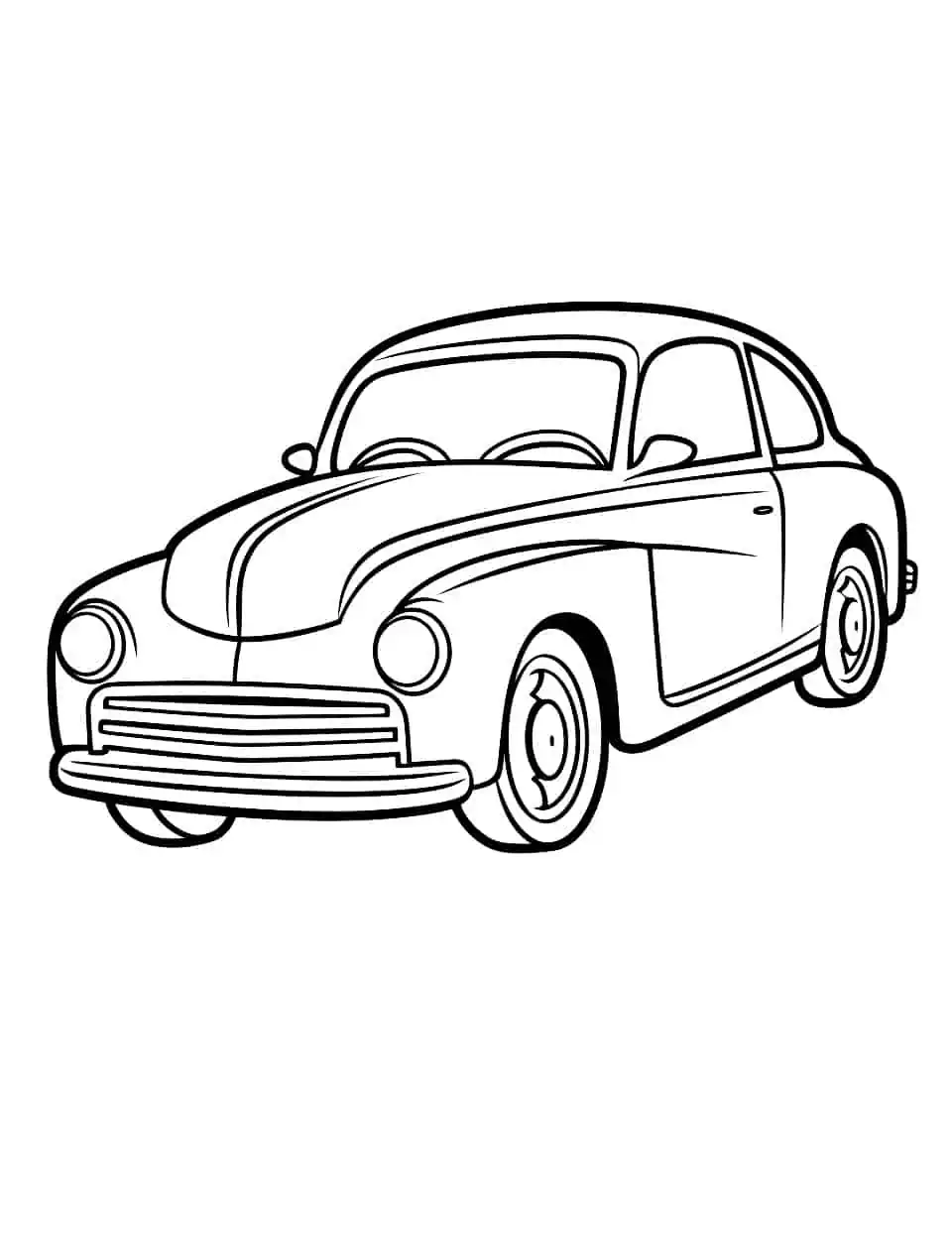
Fat fenders and a wide horizontal grille give this old Ford its 1940s shape. The panels are big and open, so a preschooler can stay inside the lines without much coaching. Two round headlights and a chunky bumper are the only small parts, and grey pencil on both reads as chrome. Whatever body color gets asked for is the right one, since nobody checks the factory options on a fantasy car.
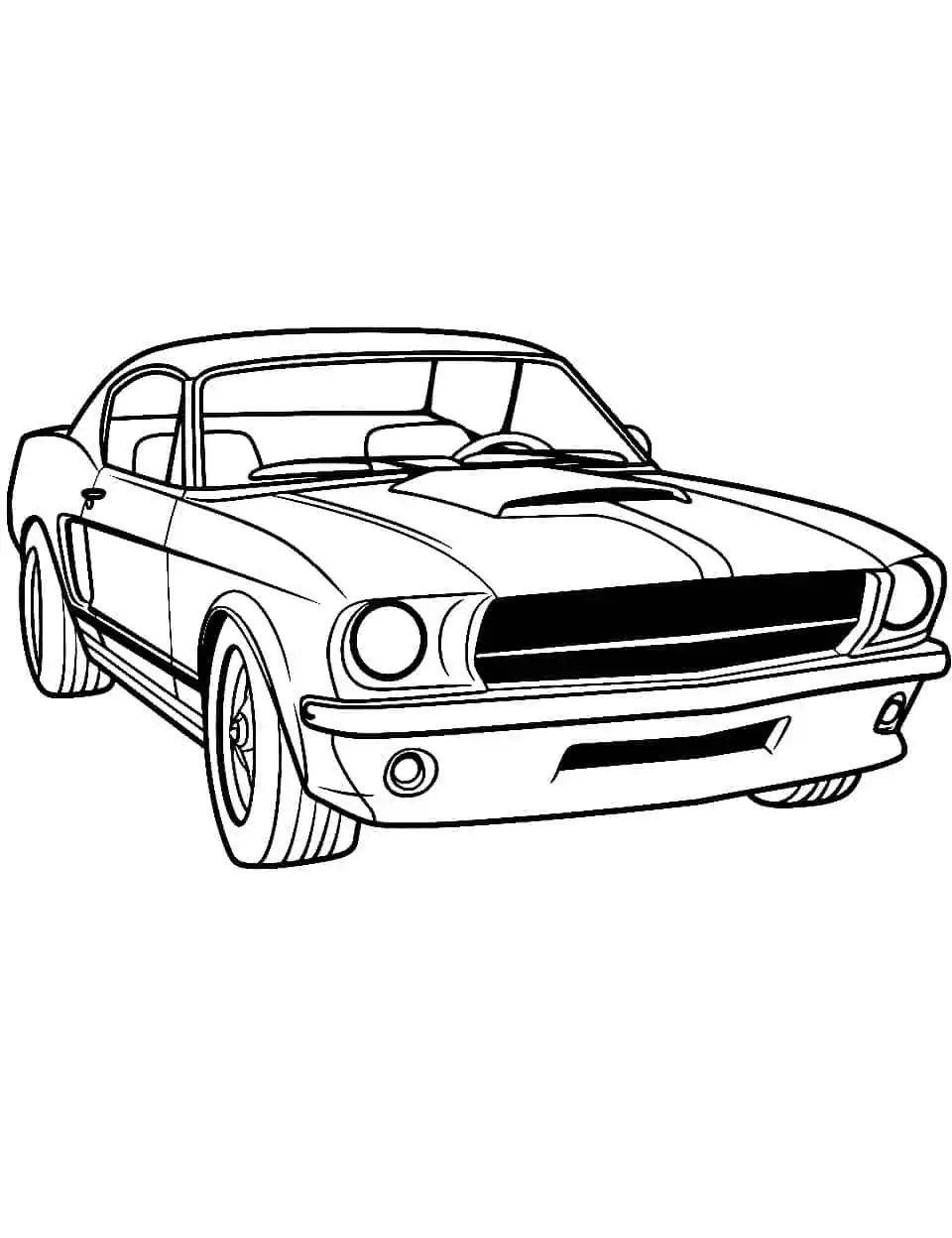
This Ford Mustang carries the muscle car look that older kids and teens like to customize. Twin racing stripes down the hood are the obvious move, though a matte black roof over a bright body looks sharper. Colored pencils let you shade the fenders so the curves read as metal instead of flat paper. Save it for a child who wants the car to look like a real one.
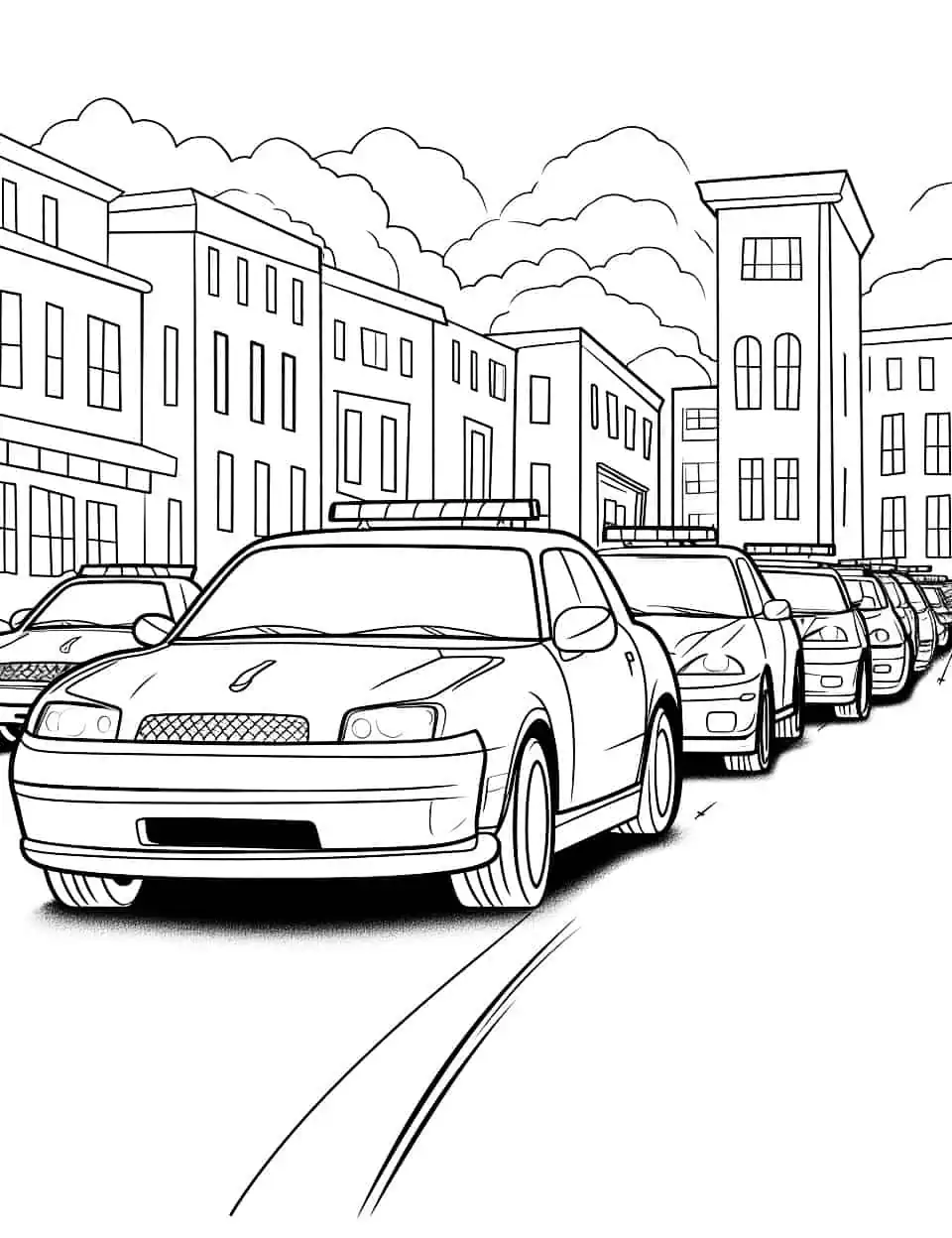
A whole column of police cars sits nose to tail along a city street. Color the roof light bars first, since red and blue set the tone for everything else, then decide whether the doors carry city markings or a made-up town name. Tall buildings and rolling clouds fill the top half of the page, and keeping those in soft grey makes the front car pop. Fine-tip markers help on the light bars, which are the smallest shapes here. Ask what the call is about while they work and the coloring turns into a story too.
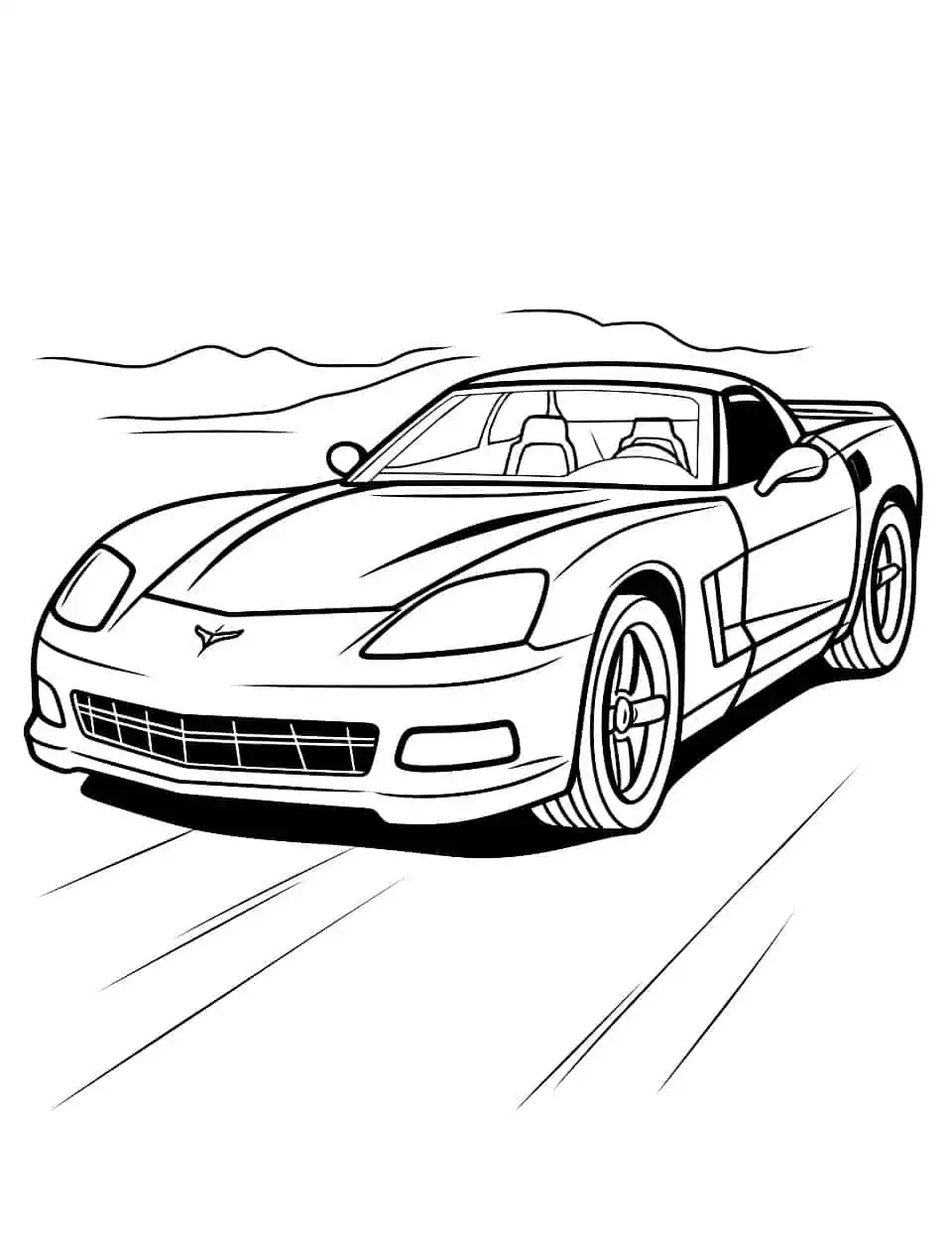
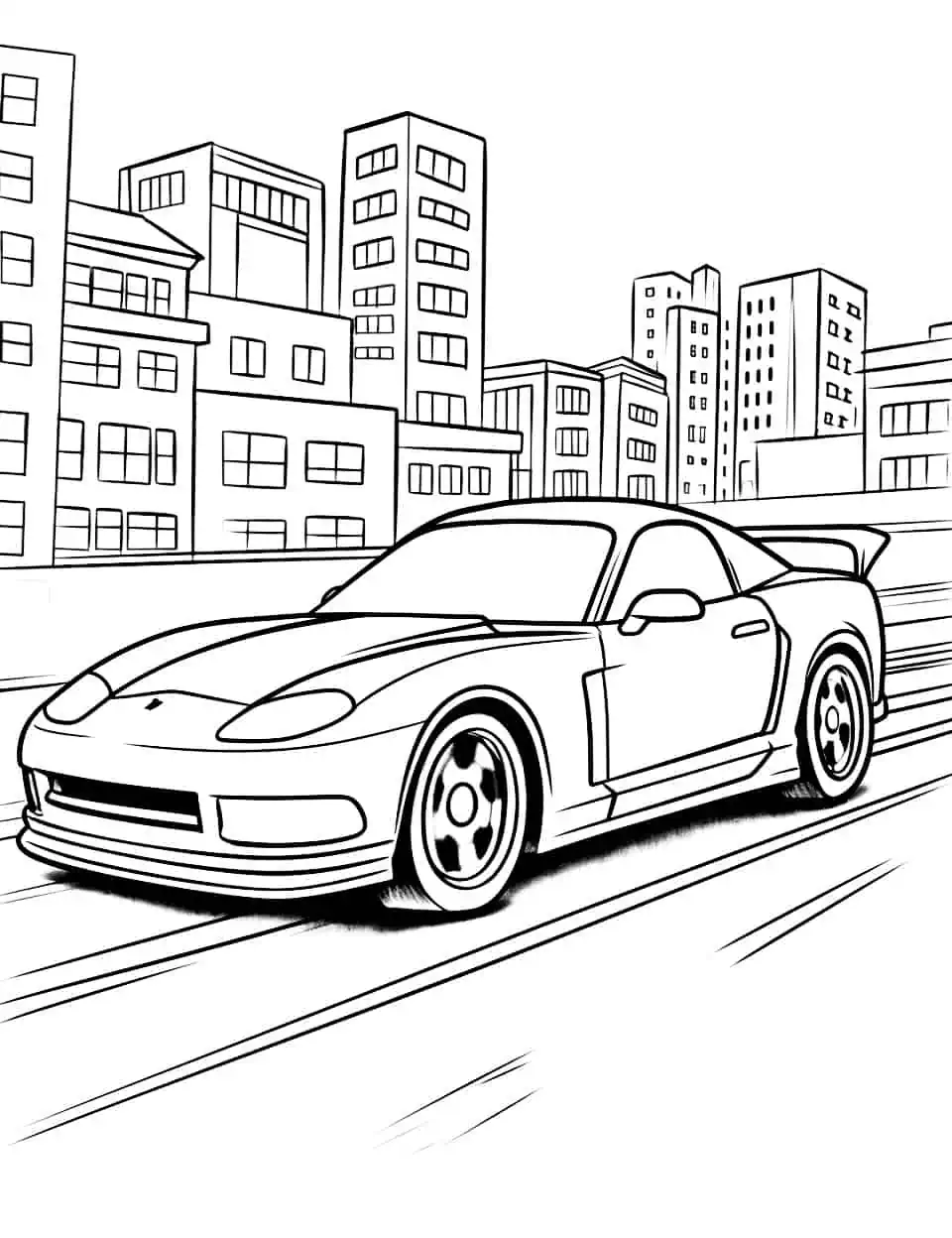
Long hood lines and a low roof mark this Corvette out as a sports car, and the crossed-flag badge sits right on the nose. The front grille is drawn as a fine grid, so that section wants a sharpened pencil while the big panels take crayon. Classic red is the expected pick, which is exactly why silver or dark green ends up more interesting. Soft hills sketch across the background and speed lines run under the tires, both easy to leave pale so the car stays the focus.
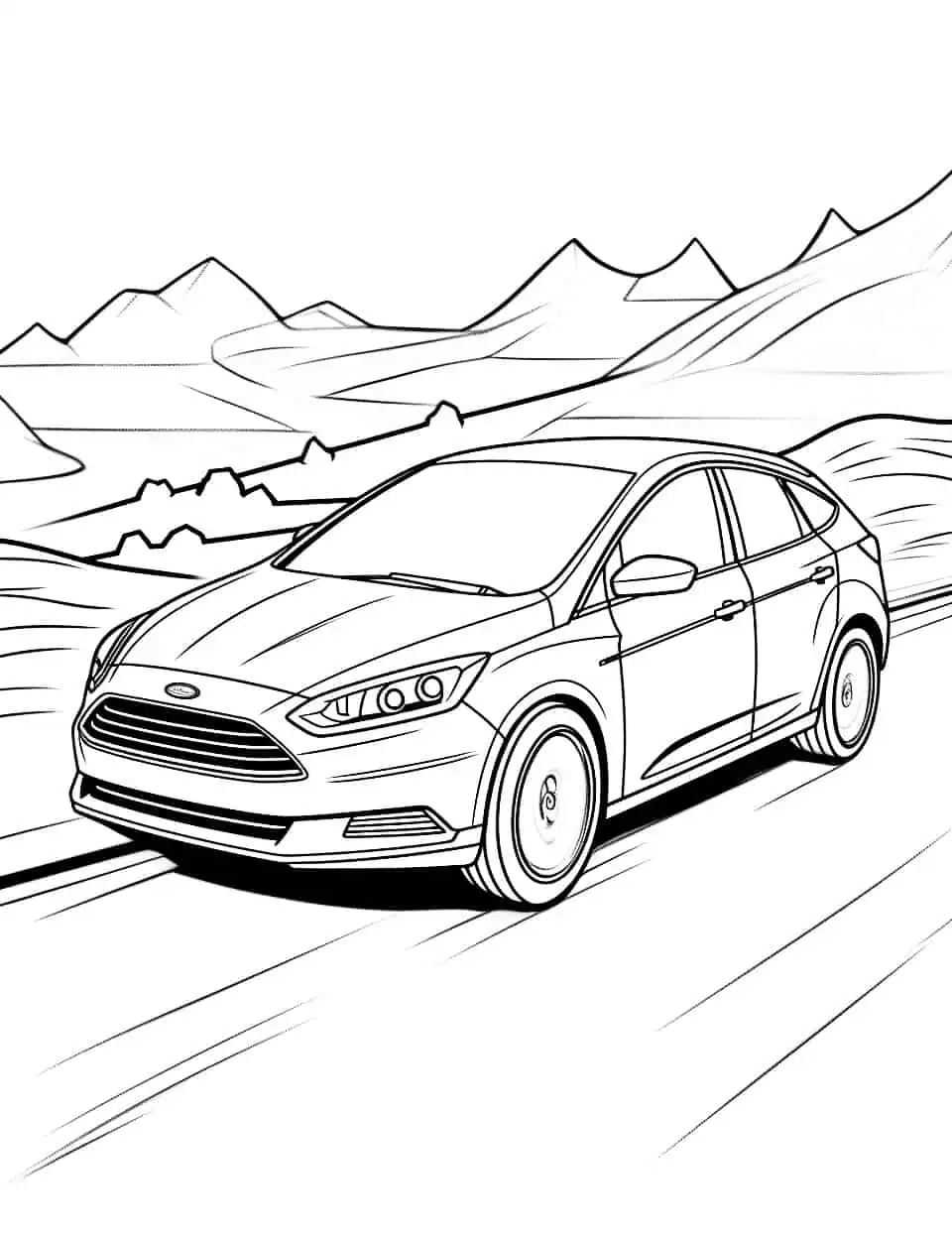
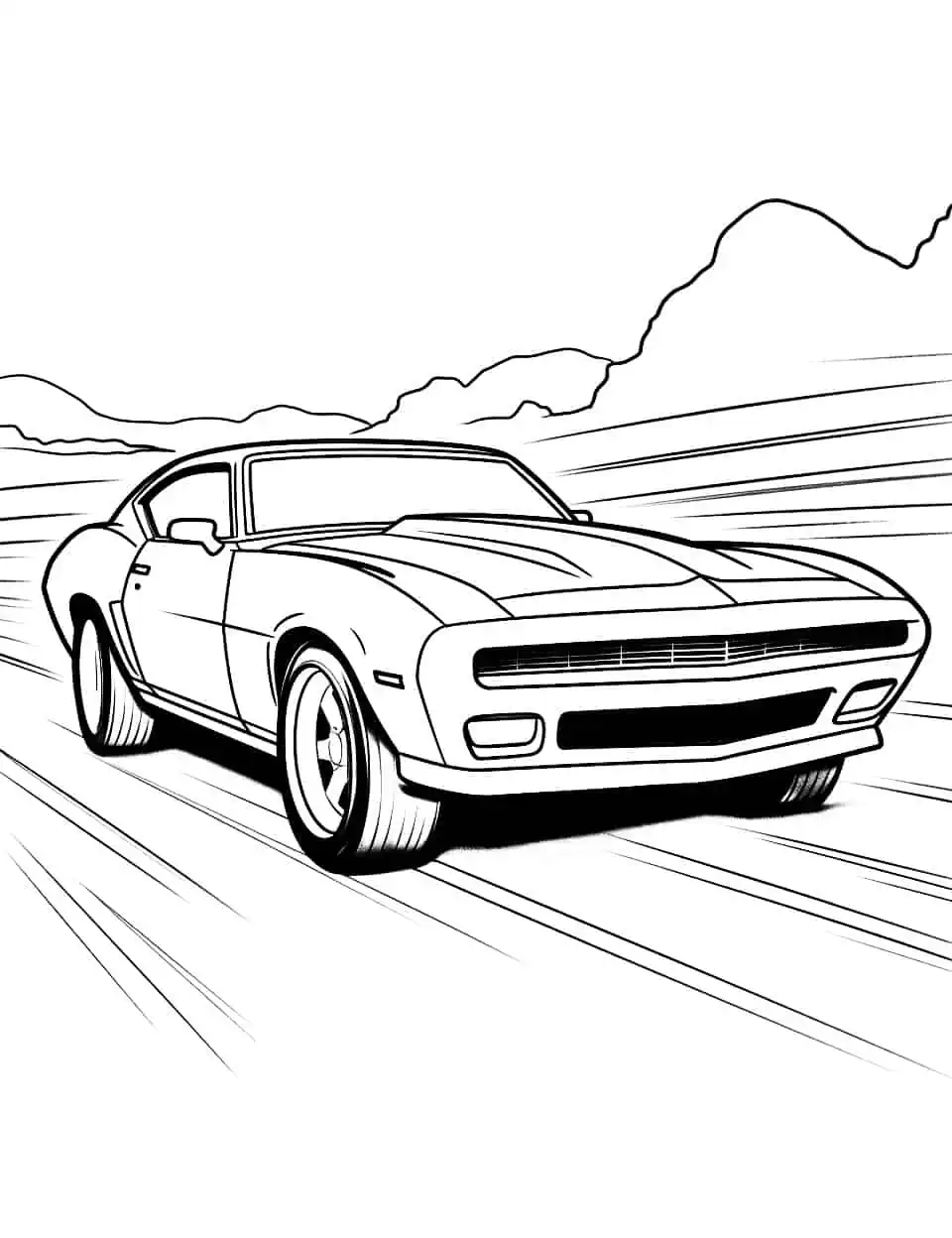
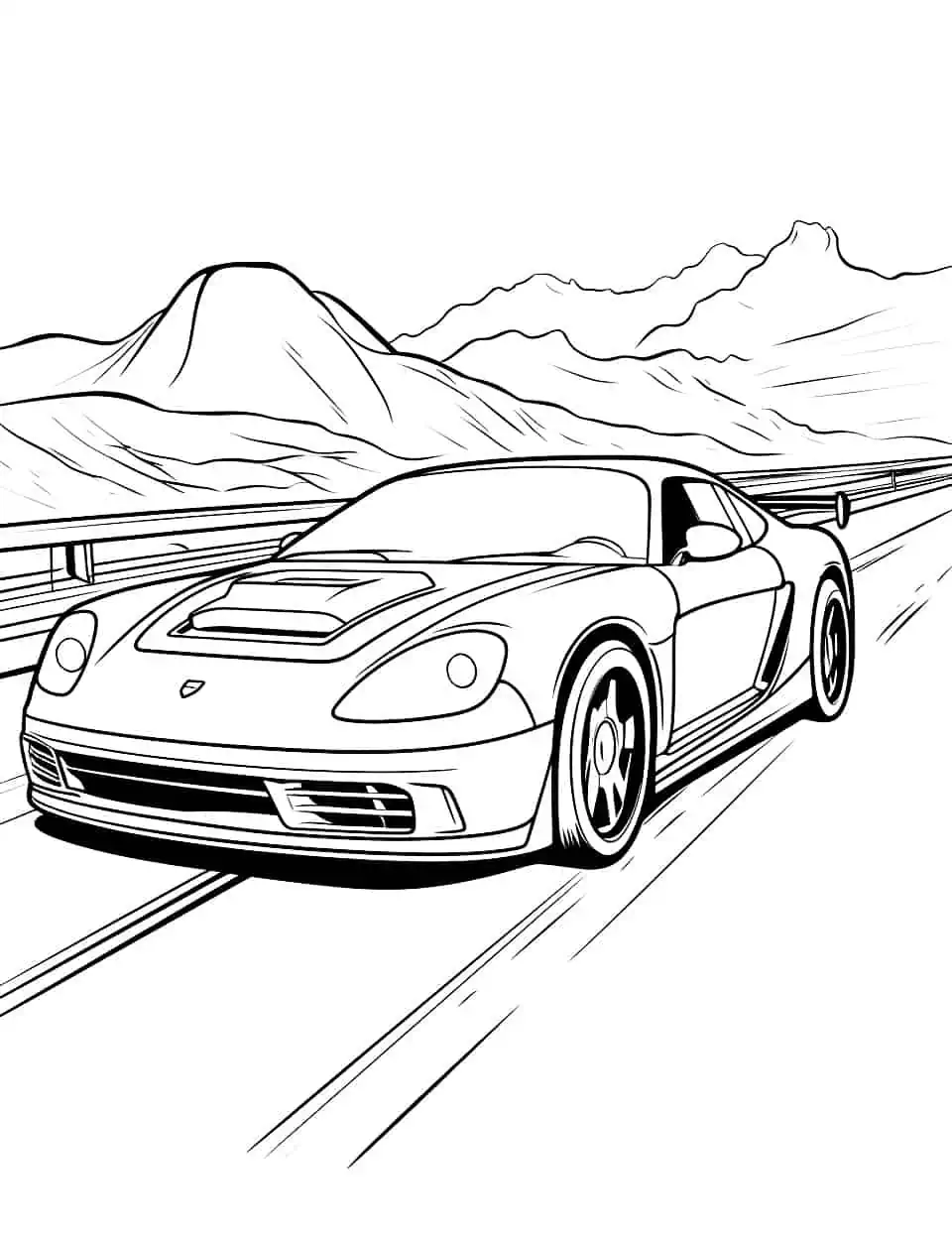
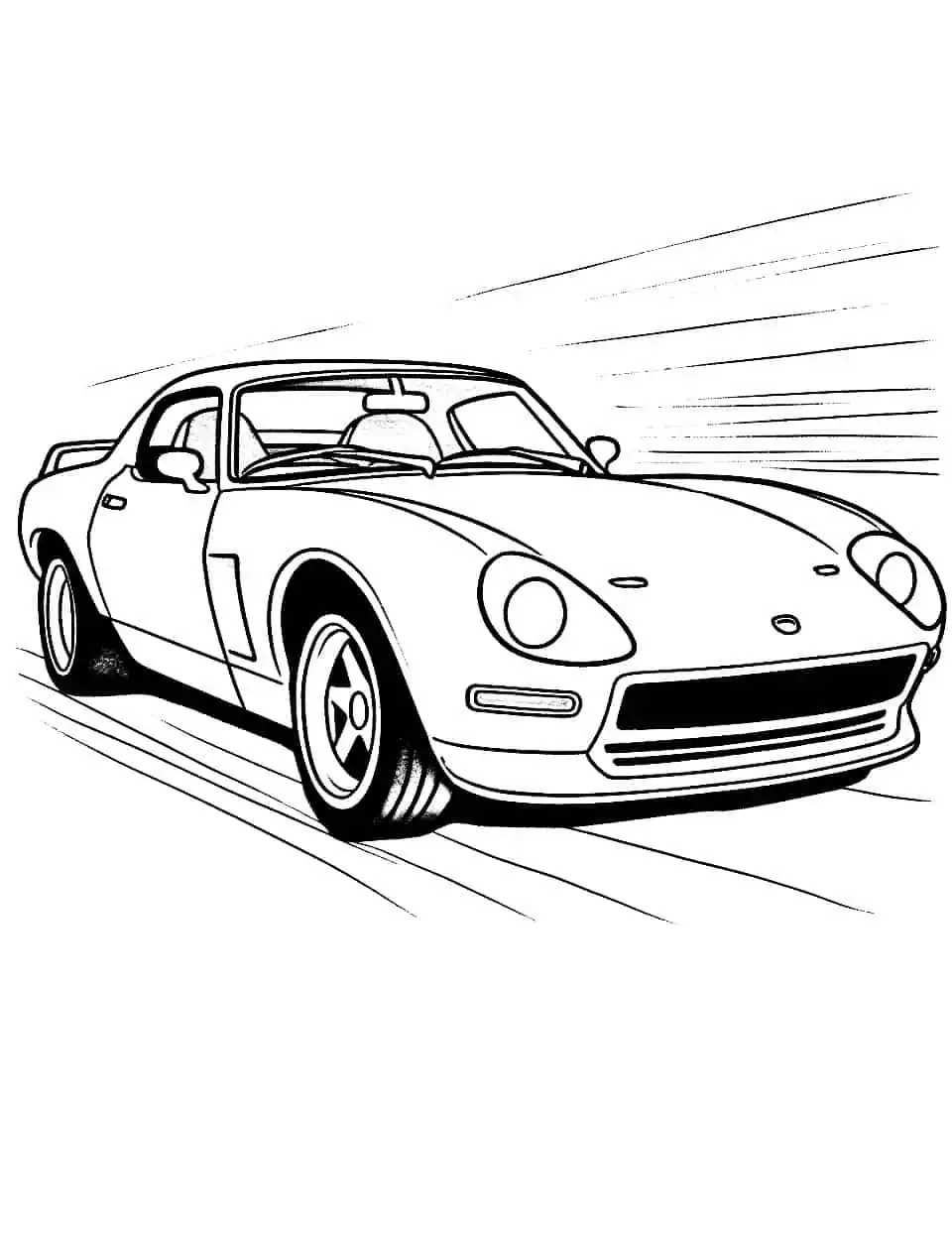
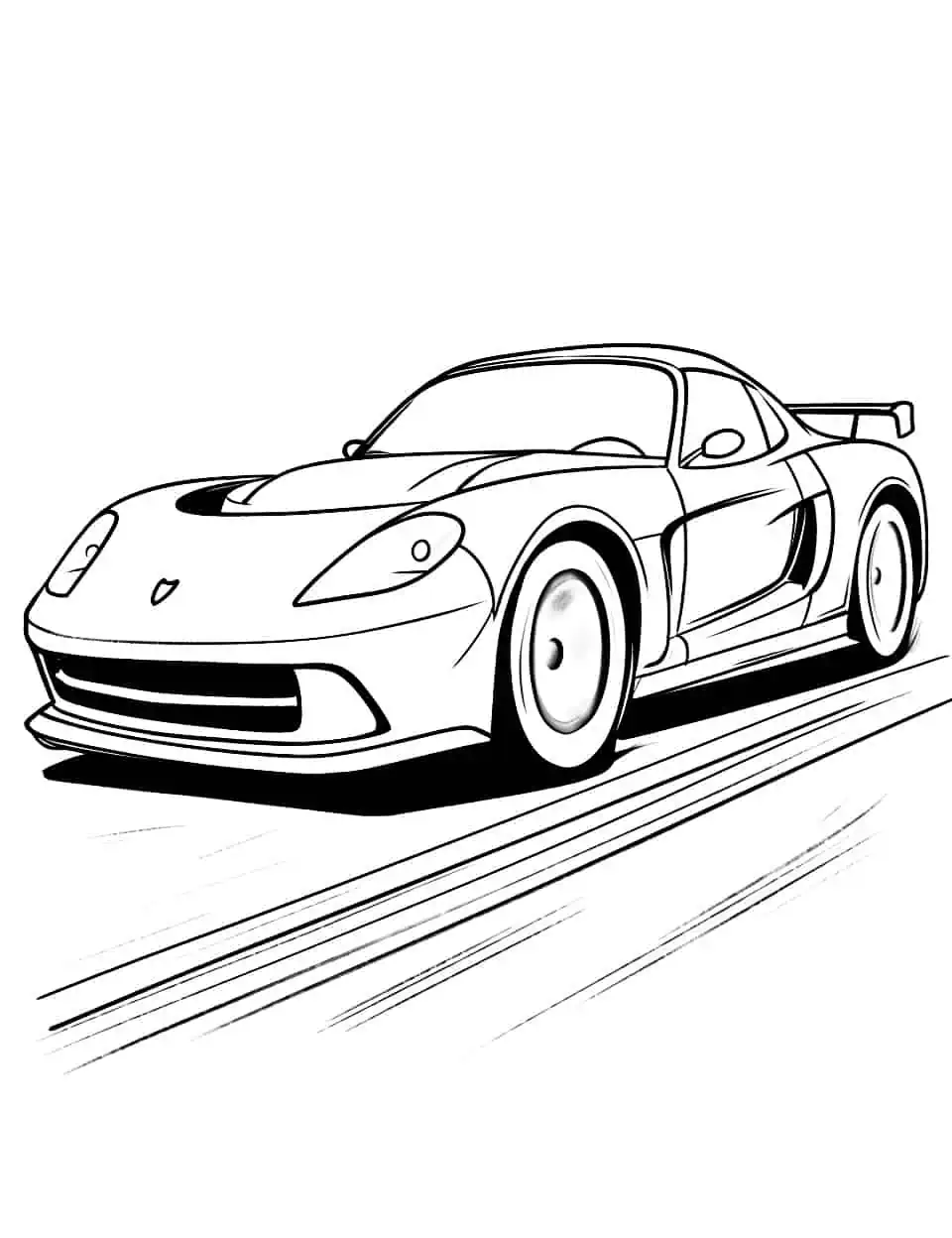
Speed lines rush past on every side of this muscle car, which does most of the work of making it look fast. The body panels are wide enough for crayons, while the slotted grille and the five-spoke wheels reward a sharper point. Ridged mountains sit low on the horizon and can stay faint so the car reads as the closest thing on the page. Pick something loud for the paint and keep the road pale underneath.
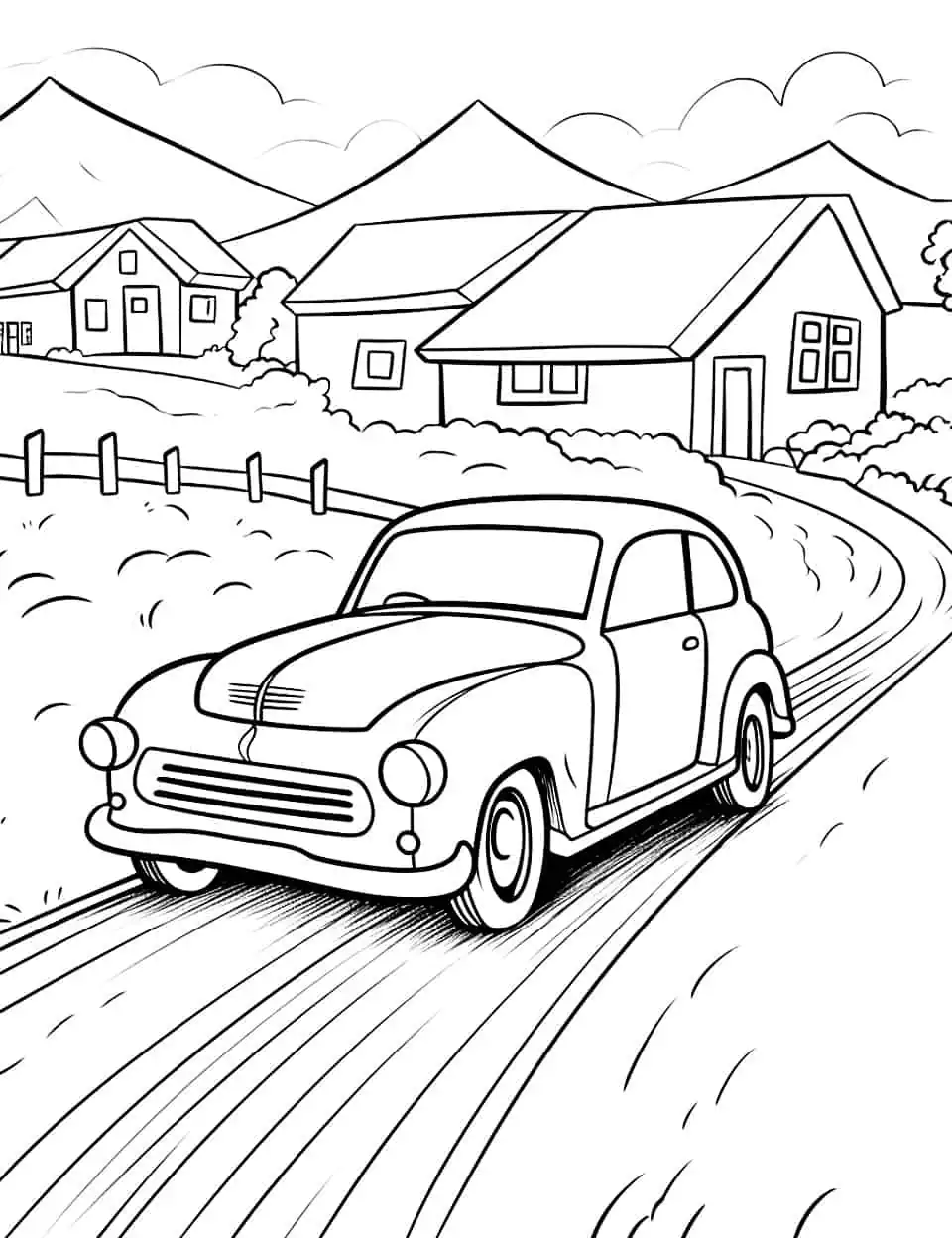
Two jobs share this page: a round-fendered old car and the farm it is driving past. Barn roofs, a house, a wooden fence and low mountains fill the top half, which suits tans, muted greens and grey. A rusty red or cream body keeps the car in the same era as its surroundings. Kids who normally rush through a car outline slow down when there is this much landscape to fill. Heavier paper helps if markers come out, because all that background eats ink.
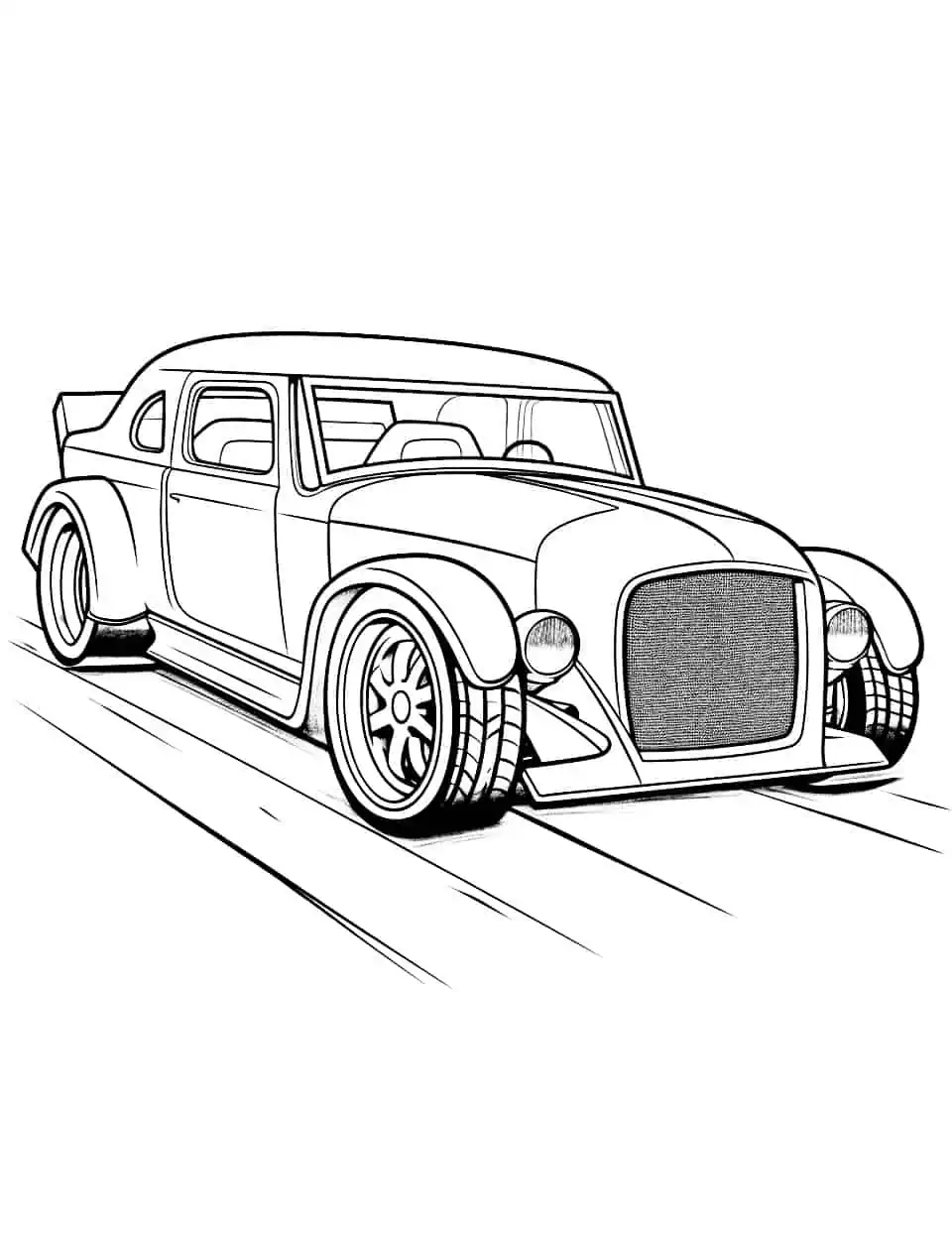
Fat tires sit at all four corners of this custom coupe, and the roof has been chopped down low over the windows. The wide mesh grille out front is the busiest area on the sheet, so start there while hands are still steady and try two greys instead of one flat tone. Gloss black or deep maroon on the body sets off the bare wheels. Flames along the fenders are not drawn in, but nothing stops a child adding them.
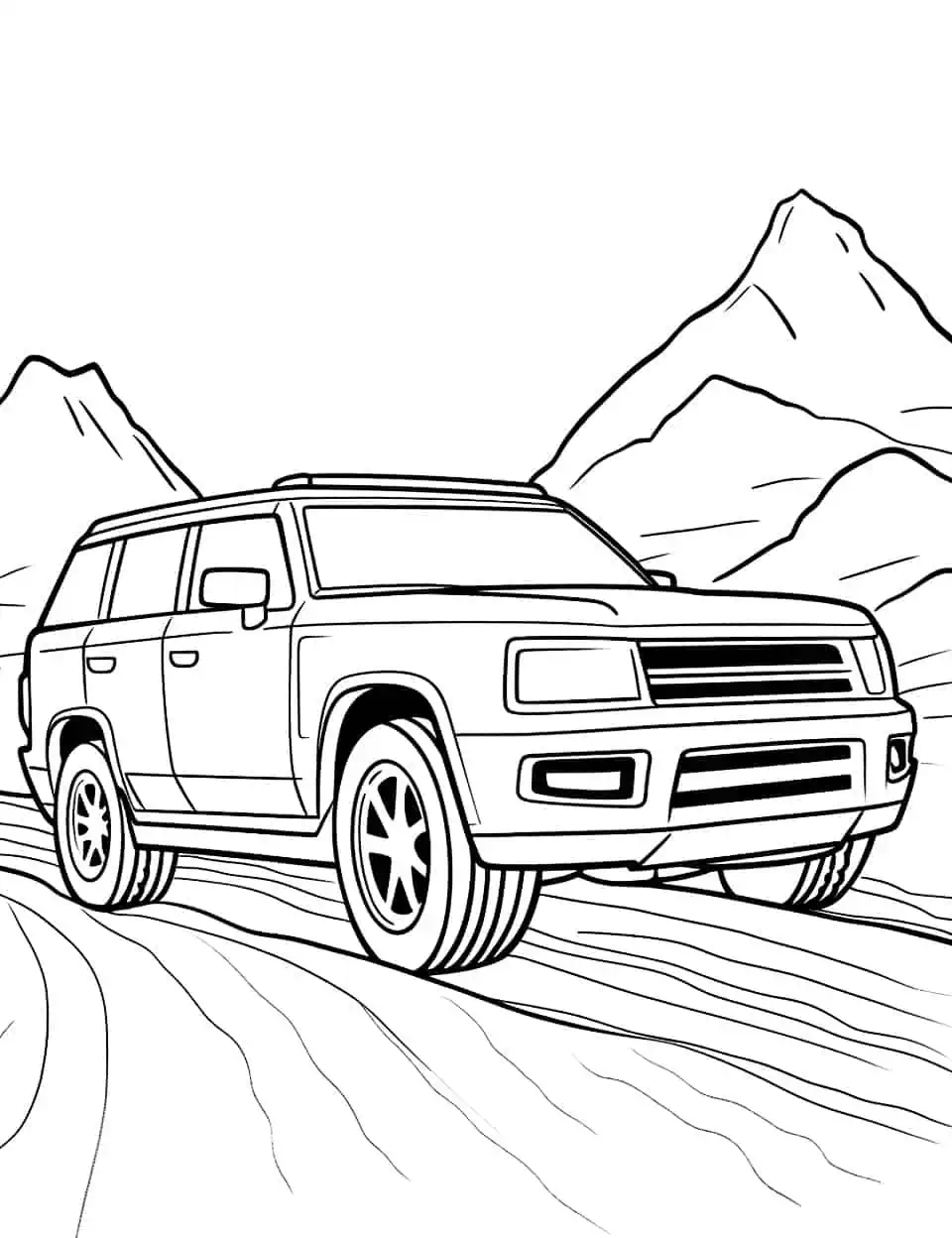
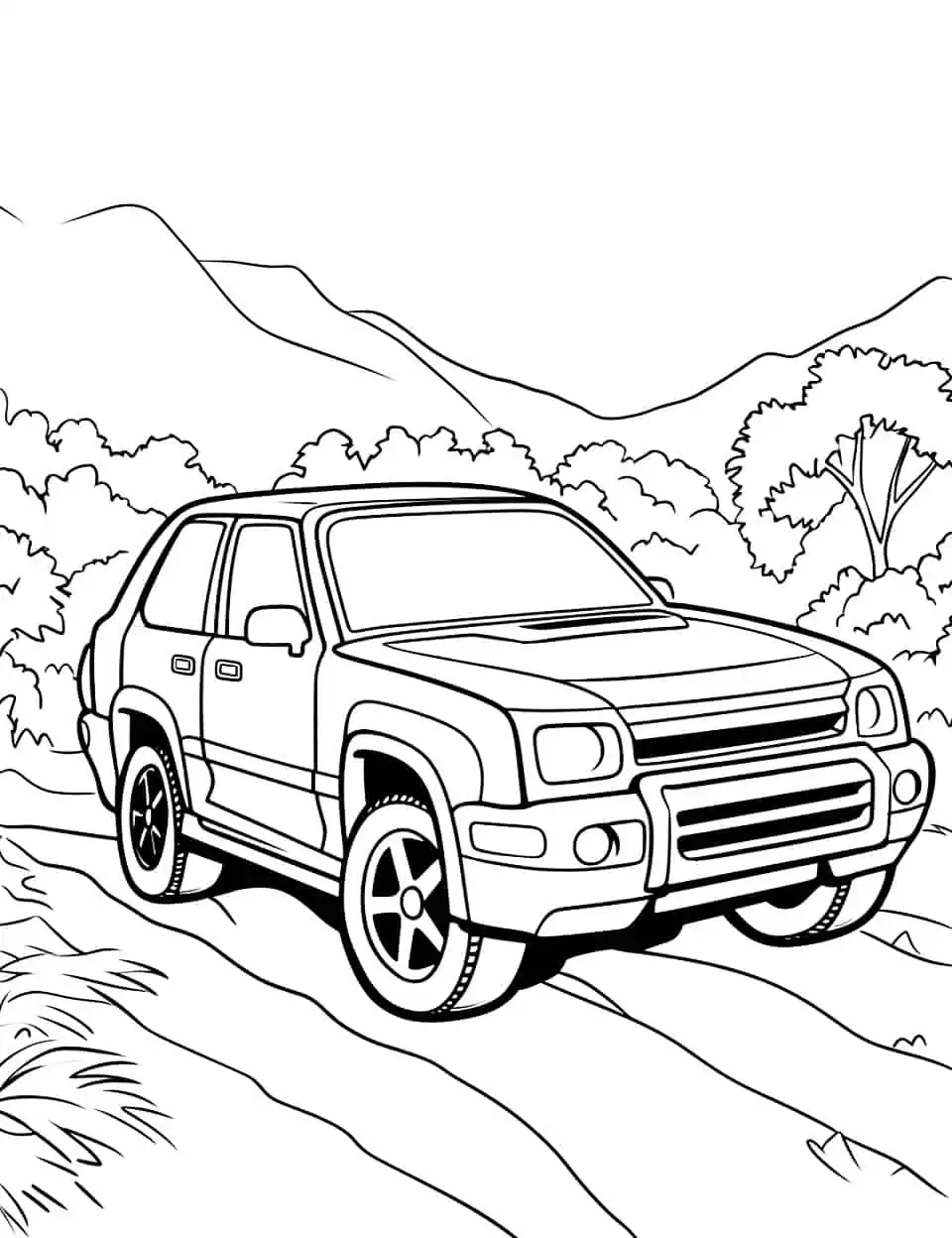
This SUV climbs a bare dirt slope with jagged mountains rising behind it. The peaks are drawn in loose outline, so light grey and blue up there keep them in the distance. The grille slats, bumper vents and spoked wheels are the fiddly parts and go faster with a pencil than a marker. Kids who want more can add rocks or scrub along the empty edges of the trail.
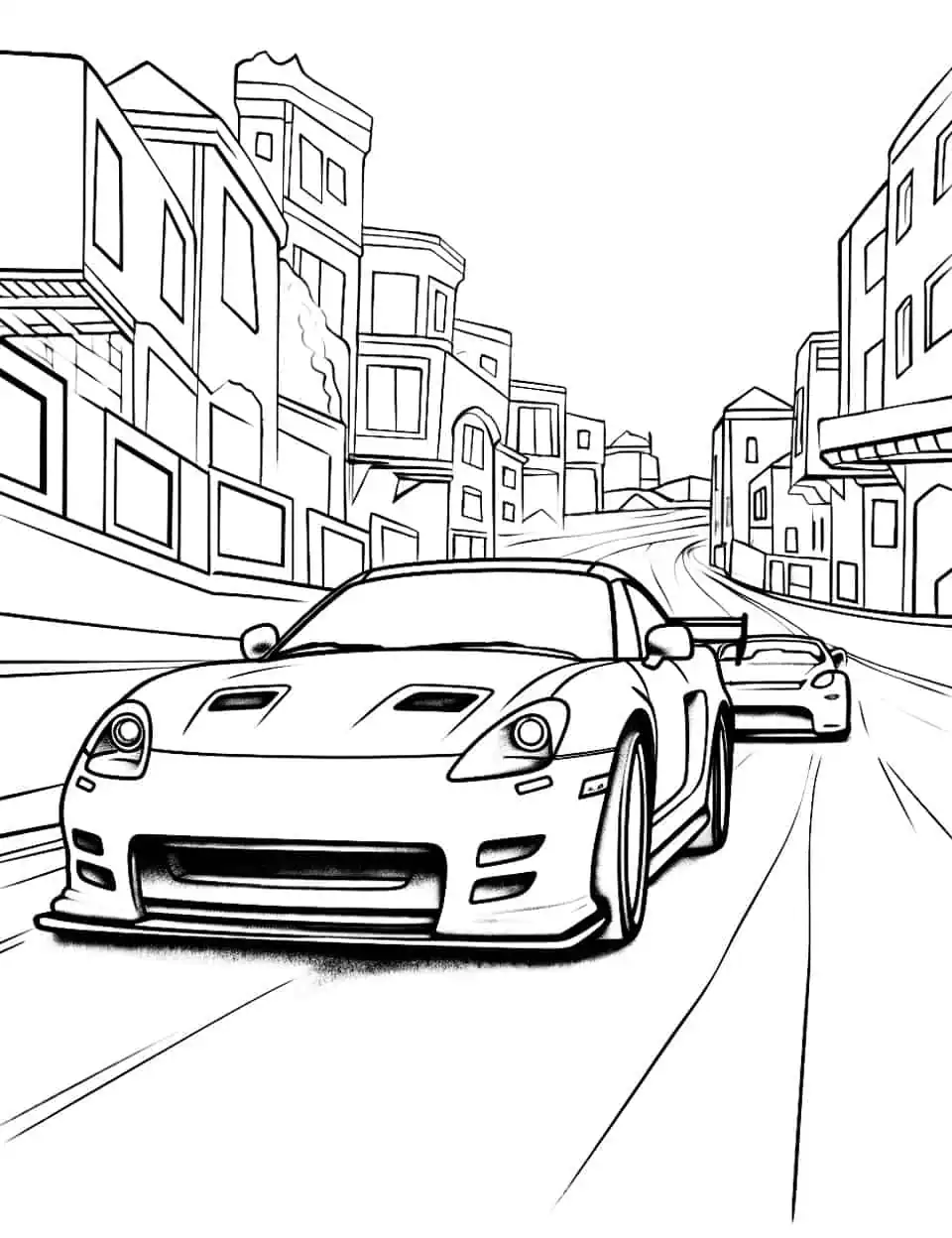
Two low tuner cars run down a city street, the lead one showing hood vents and the second a tall rear wing. Rows of narrow buildings climb the hill on both sides and give the page far more line work than the cars alone. Loud colors belong on the cars, lime green or electric blue, with soft grey on the storefronts so the two do not compete. Older kids with a steady hand get the most out of all those small window panes.
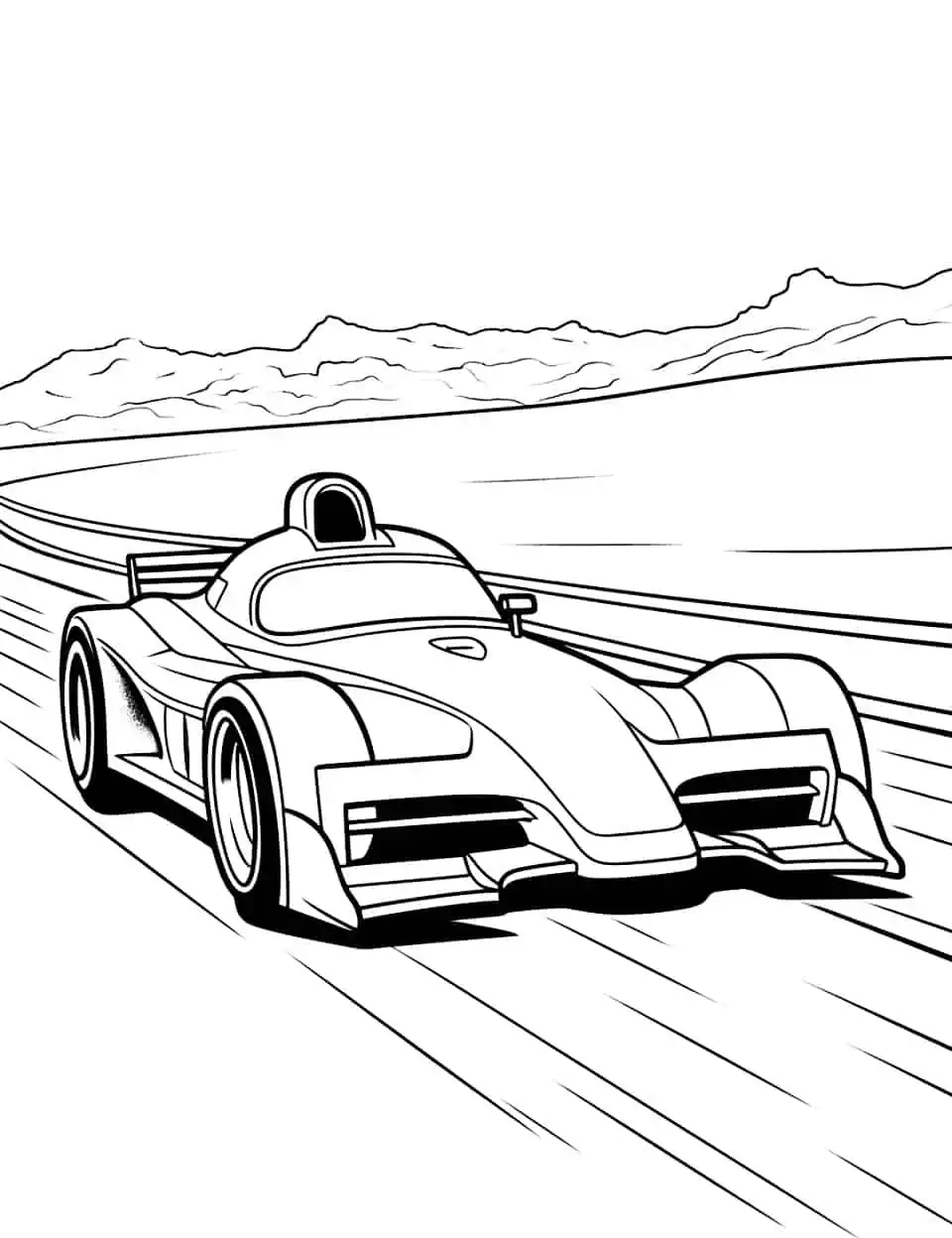
An open-cockpit race car with a bubble canopy and a wide front wing streaks along a track. Mountains ridge the far horizon and speed lines stream past on both sides, which is where a light touch pays off. Bright red, blue or neon suits the bodywork, and dark grey on the tires anchors it. The shapes are big and clear, so a child who likes finishing quickly still ends up with a sharp-looking page.
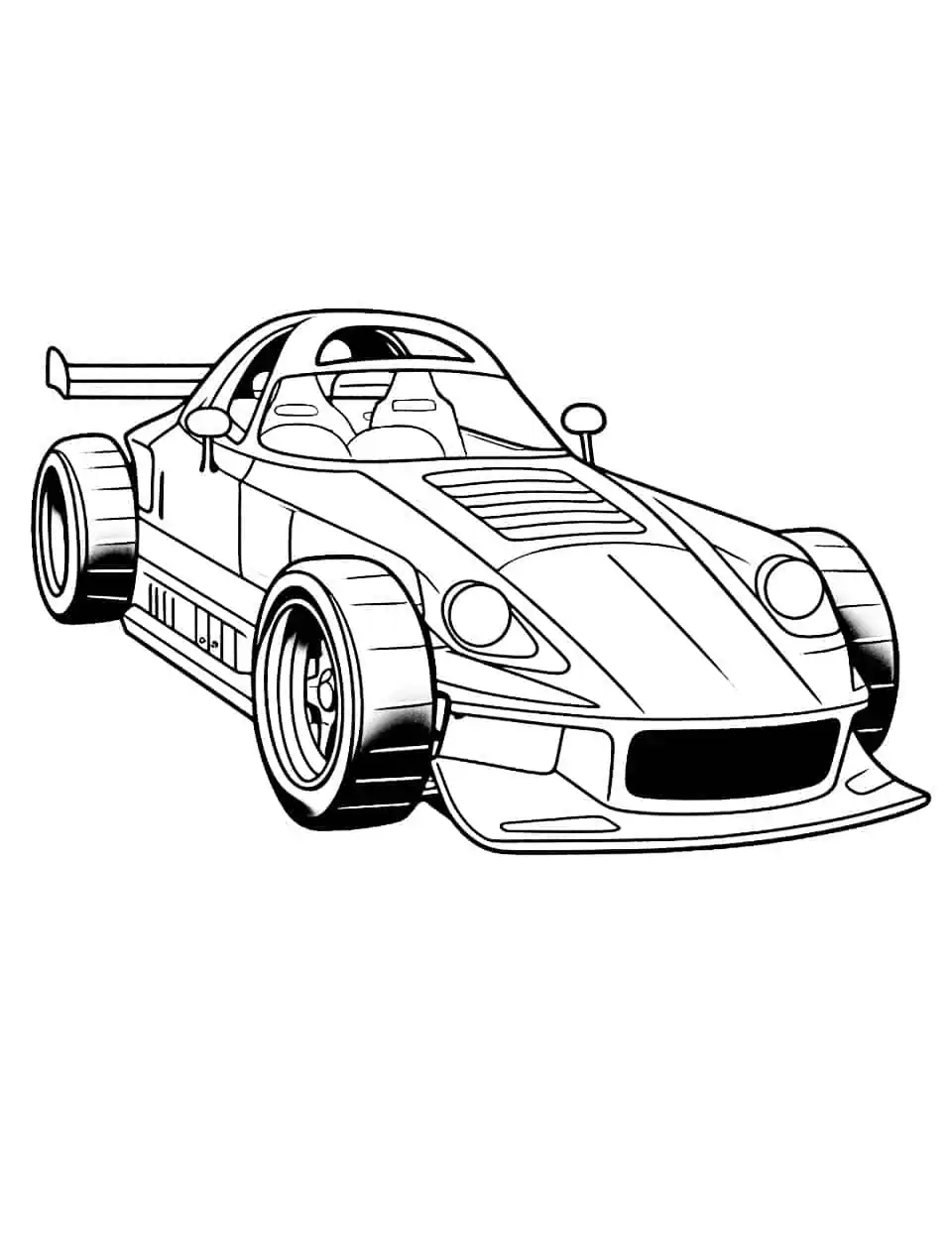
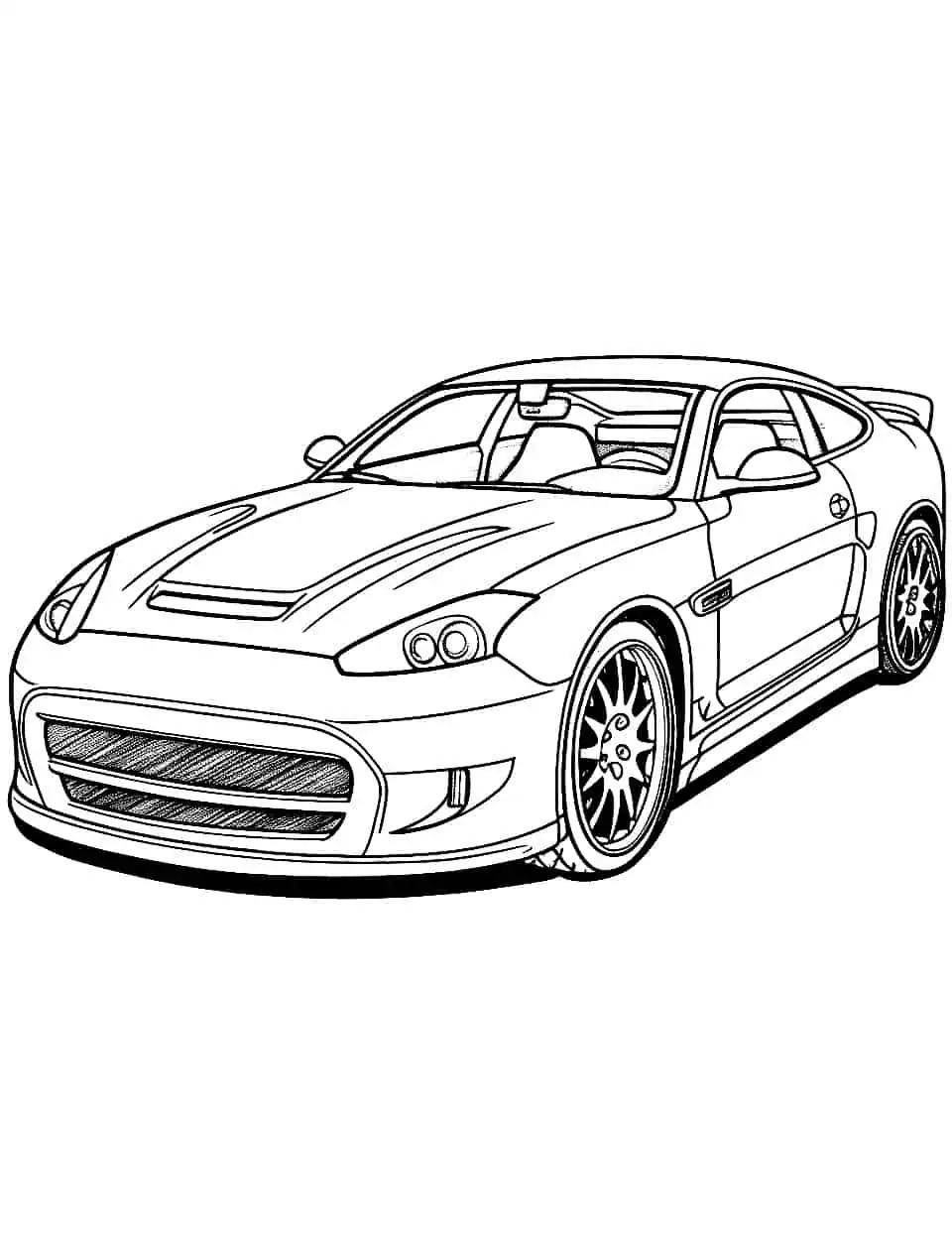
Fine lines run all over this image of a race car, from the louvred hood vents to the mirrors on their little stalks. The tall rear wing and the front splitter are the two shapes worth keeping crisp, so sharpen a pencil for those. Blank body panels along the doors are ready for racing numbers, real ones or invented. Set aside a proper half hour rather than squeezing this one in before dinner.
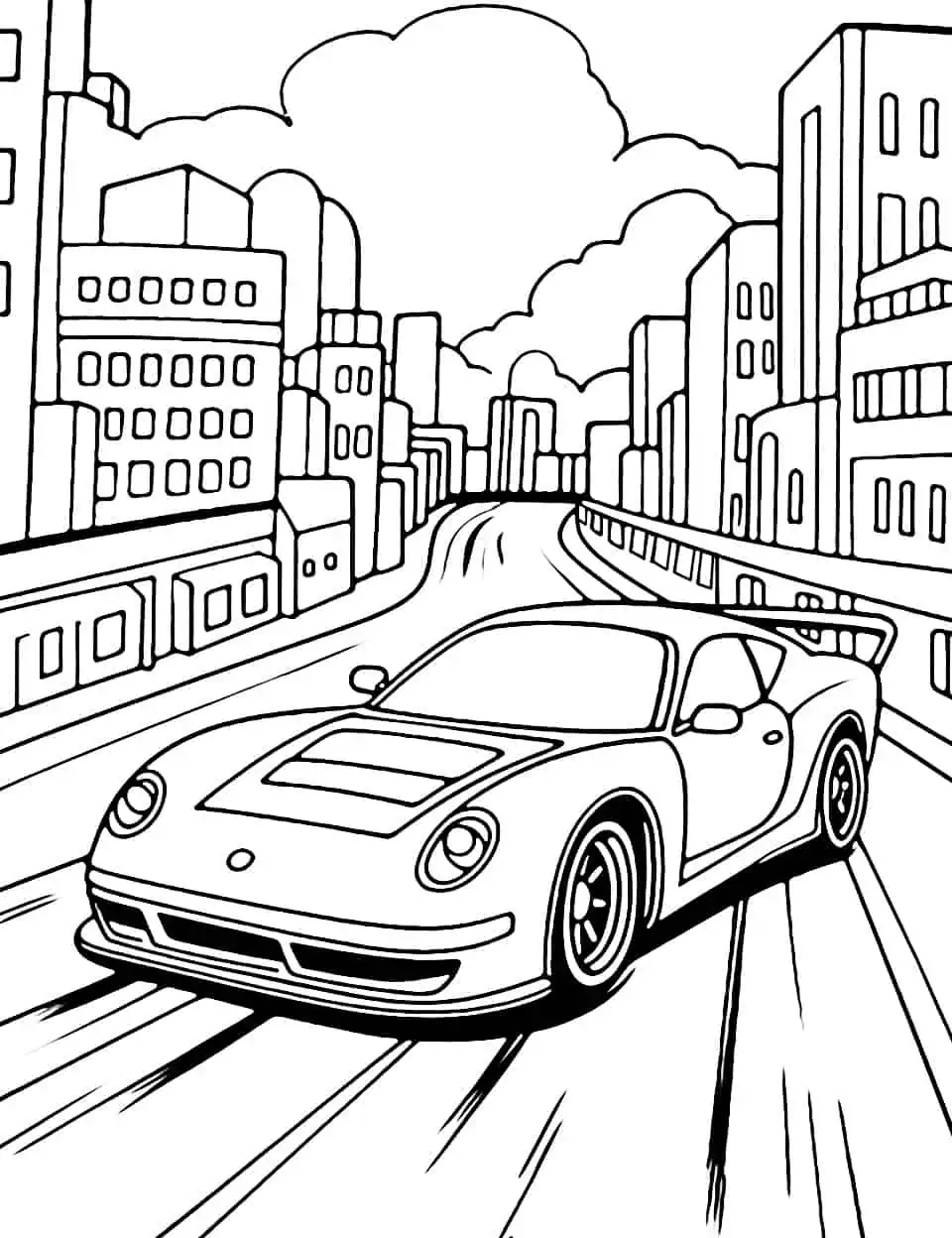
A super-fast car streaking through a city street. The buildings behind it give kids room to work on an urban background, which is where a grey and blue palette pays off against a hot-colored car. Motion lines can be traced in a lighter shade so the car still reads as the main subject.
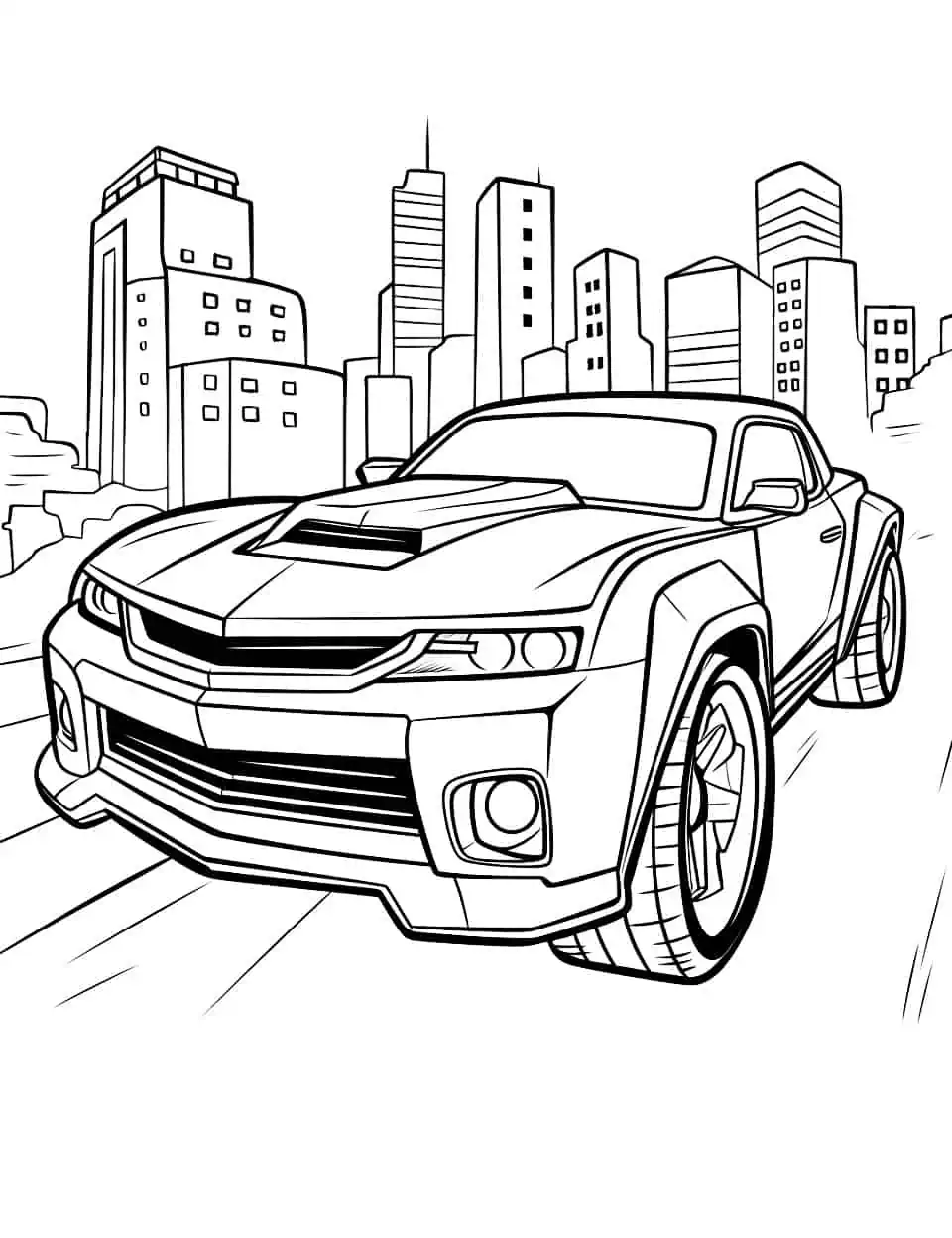
A modern muscle car fills most of this page, hood scoop raised and a city skyline stacked up behind it. Yellow with black stripes is the scheme most kids will ask for, and it suits the shape. The buildings are simple boxes and windows, so they fill fast even for a younger child. Keep the deep wheel wells and the tire treads dark and the car will look planted on the road.
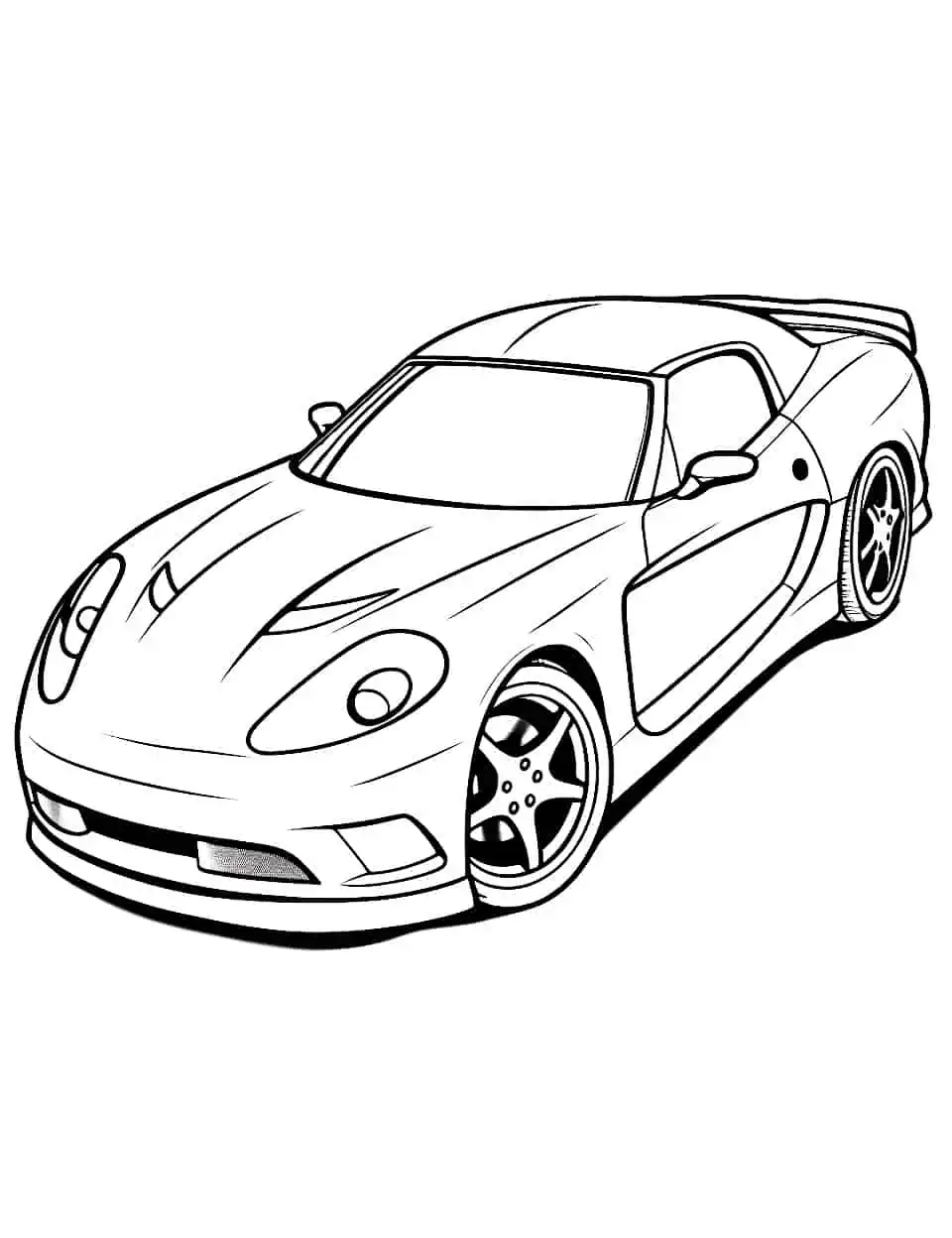
A low-profile supercar sitting flat and wide on the page. Candy-apple red and midnight blue both suit the shape, and a metallic gel pen on the wheels finishes it off if you have one. The long body panels make it an easy win for kids who want an impressive result without much fussy work.
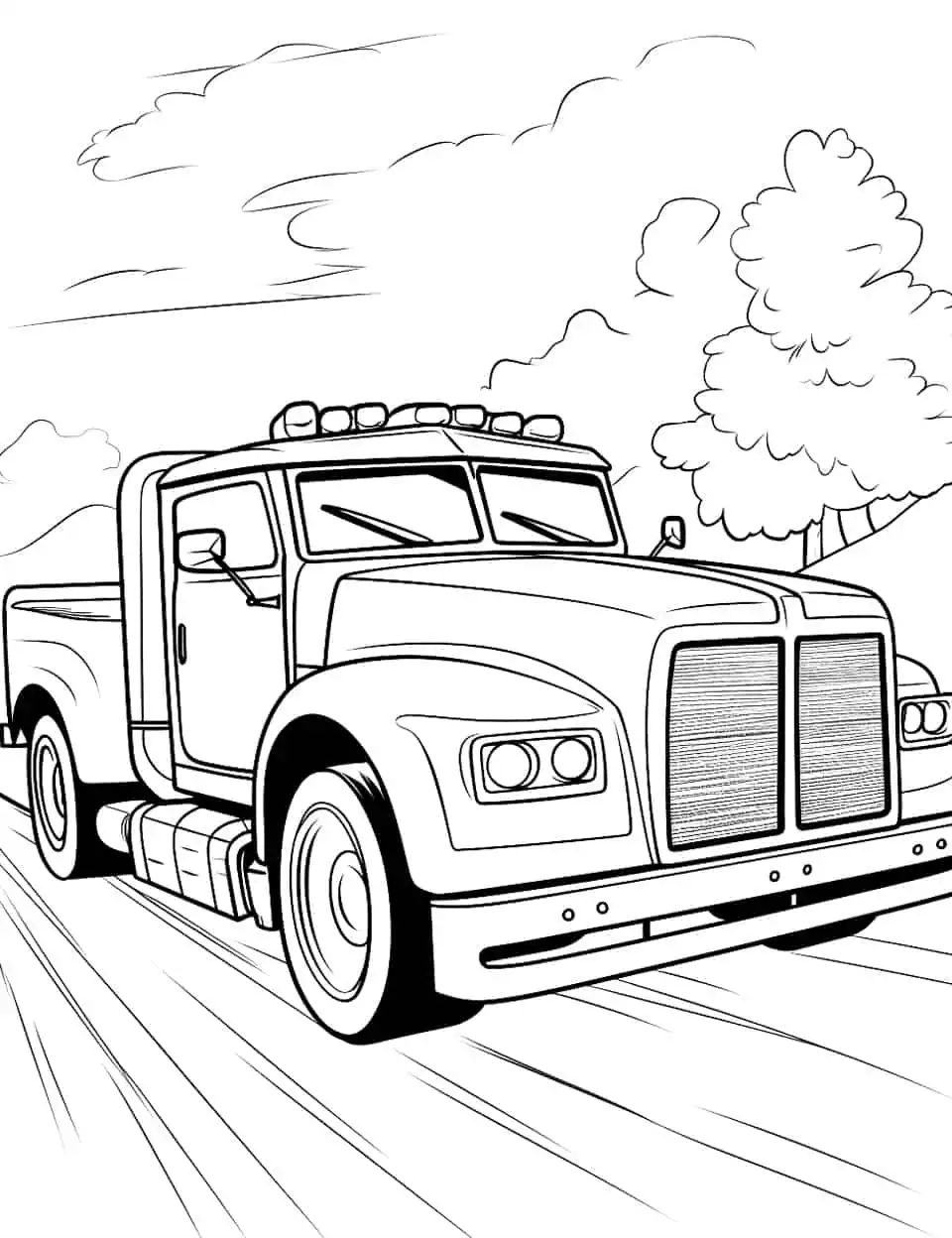
A big truck comes straight at you here, its two-piece grille ruled with dozens of fine lines. Those lines are the hardest part of the page and look best in two greys with white left showing between them. A row of marker lights along the roof, round headlights and the flat bed behind the cab give plenty of separate pieces to color differently. Clouds and a single leafy tree fill the sky, so the sheet ends up busier than it first looks.
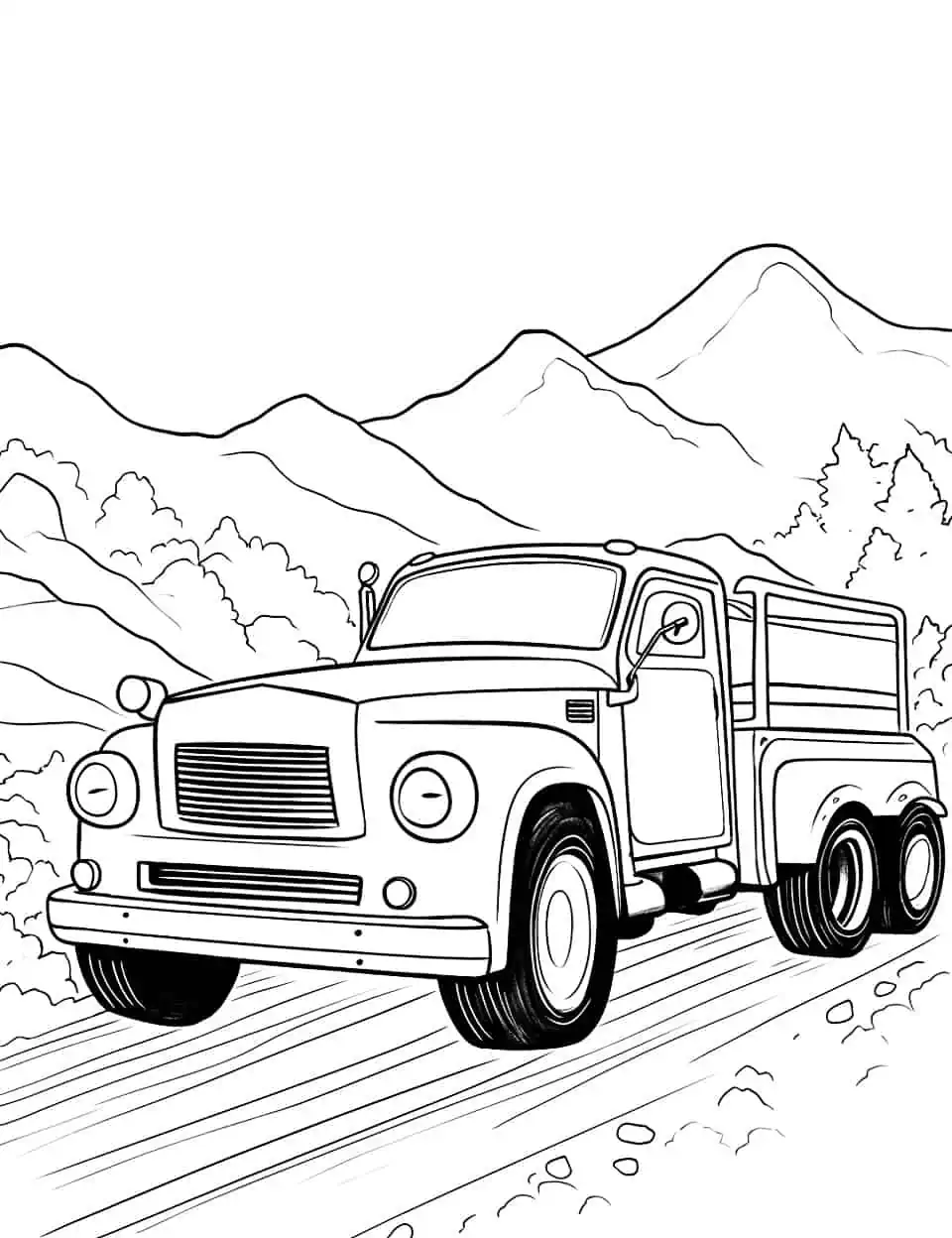
Here is a broad-shouldered powerful truck with a slatted wooden bed and doubled-up rear wheels, rolling along a dirt road. Mountains and bushy trees rise behind it and rocks scatter along the verge, so there is scenery left to fill once the truck is done. Ruled lines across the road suggest speed and look best left pale. A strong red or forest green cab against tan ground makes the whole page read clearly.
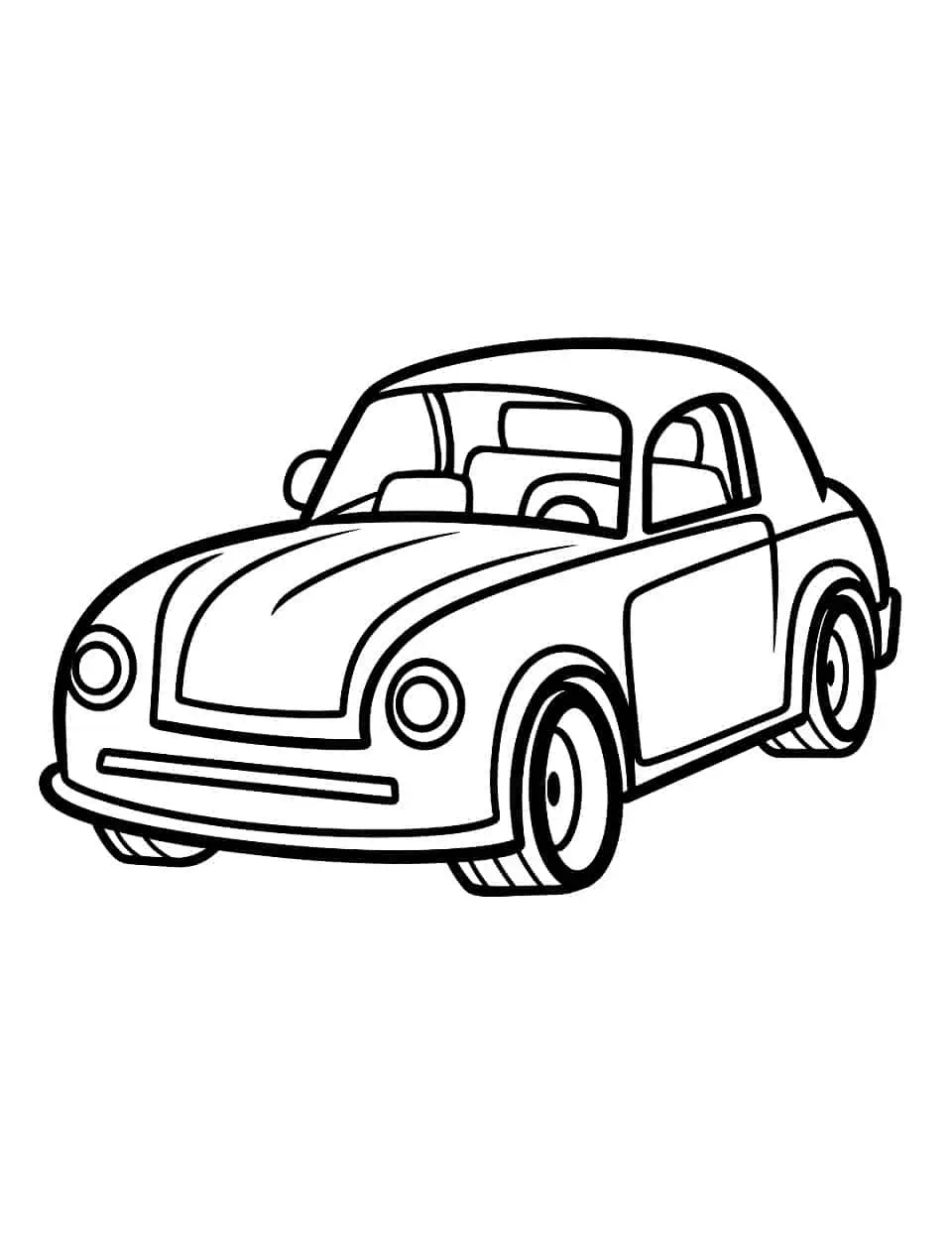
A straightforward car design with clean, wide shapes. This is the sheet to hand a toddler who is still learning to grip a crayon, since there is nothing small enough to frustrate them. One color for the body and one for the wheels counts as a finished picture at this age. Tape it to the fridge and print another.
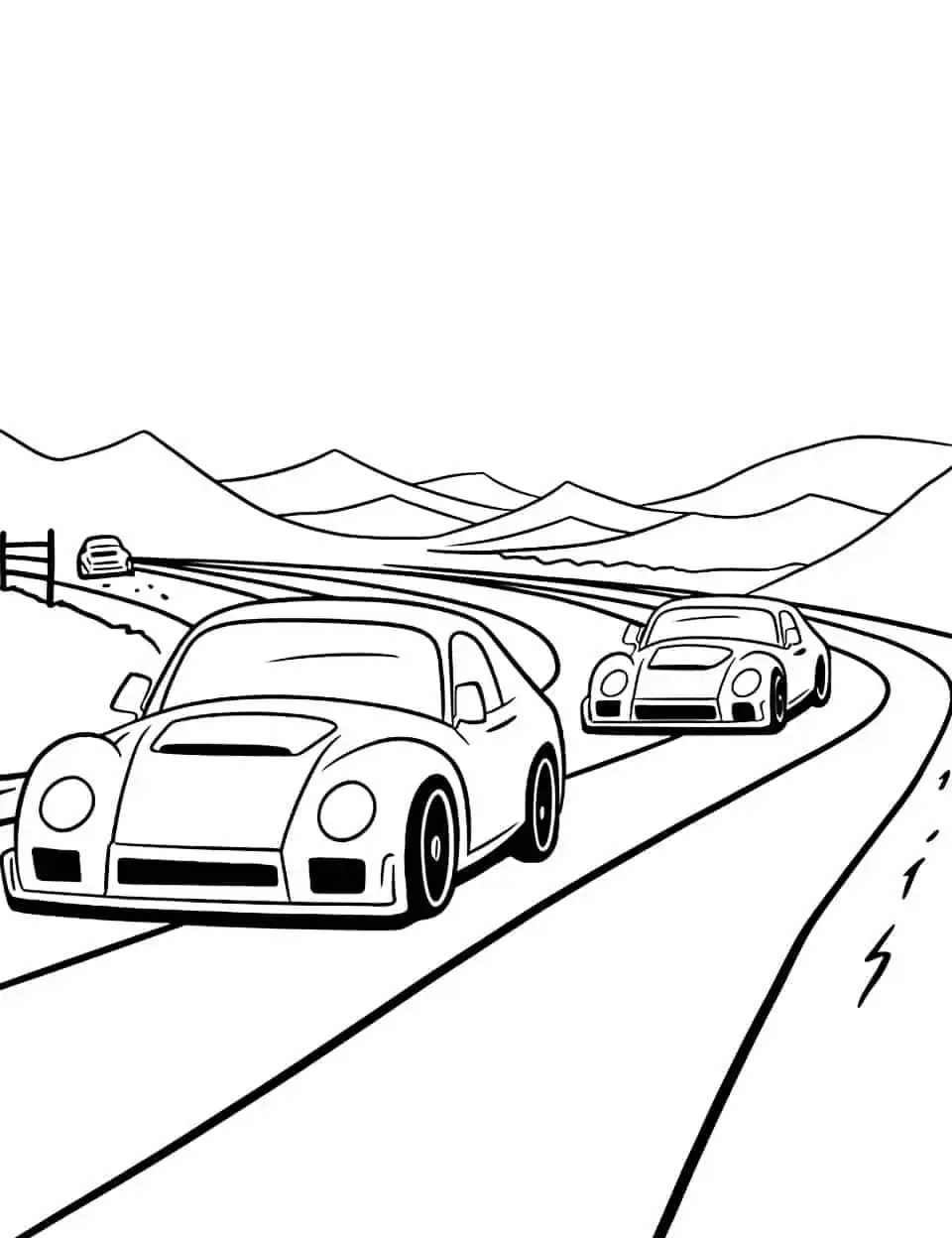
Two sports cars run side by side down a curving road, with a third already small in the distance. That size difference is a quiet lesson in depth, and it is worth pointing out while your child works. Give each car its own scheme and keep the far one pale so the effect holds. Rolling hills, a fence and the open road fill the rest, which leaves plenty for a second child to work on.
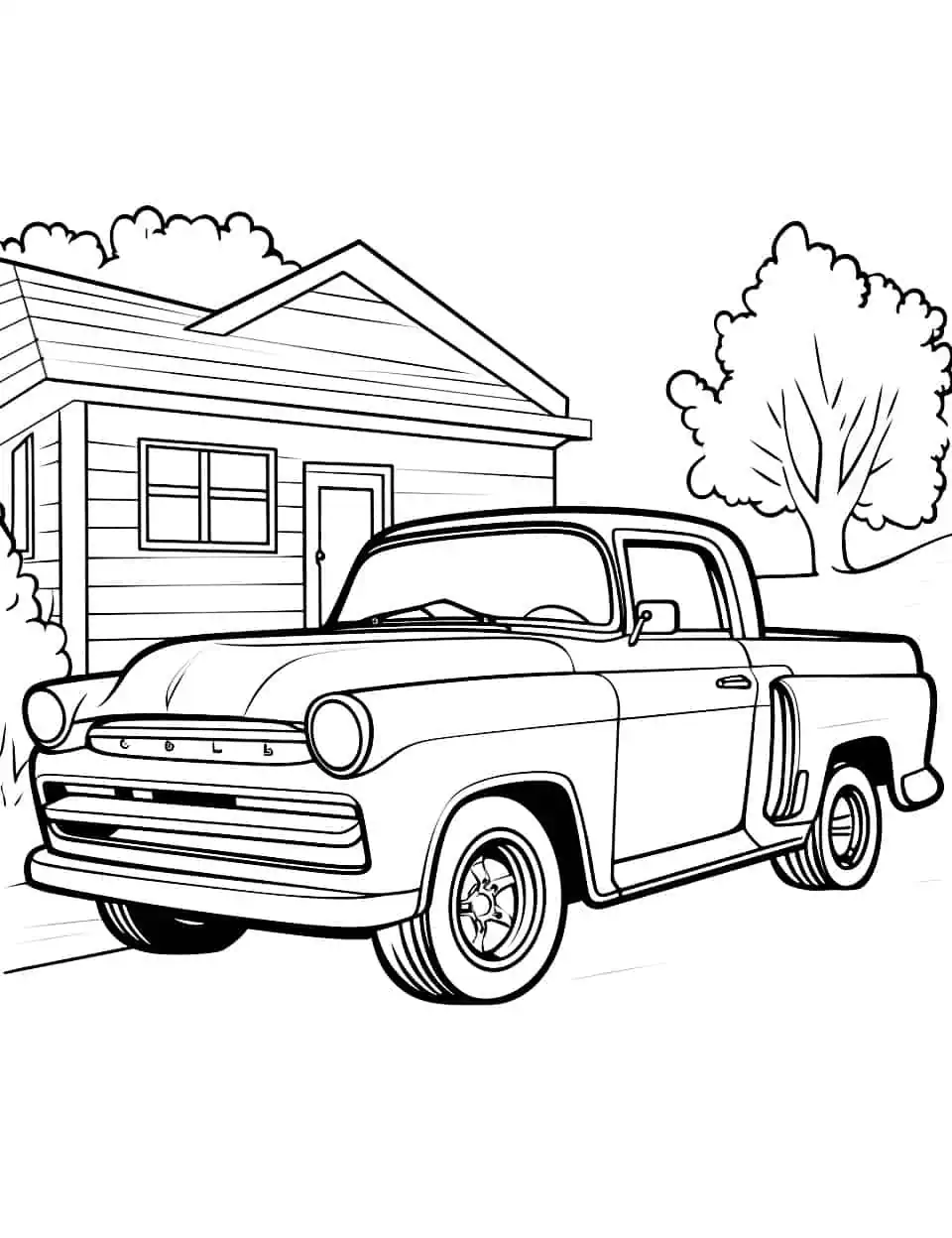
A 1950s pickup sits parked in a yard, with a clapboard house and a leafy tree filling the space behind it. Rusted orange, forest green or faded cream suits the truck better than a bright primary, which is worth saying to a child who reaches for red by habit. The house siding is drawn as long straight lines and colors quickly, so the page finishes faster than it looks. Chrome grille bars and the round headlights are the only fussy bits.
An SUV crests a rutted dirt trail with leafy bushes crowding both sides. All that foliage is a chance to mix greens instead of settling for one, darker behind the car and yellow-green where light would fall. Mountains sketched in thin outline sit at the top, so they can stay pale and stay back. It takes a while to finish, which makes it a good rainy afternoon pick.
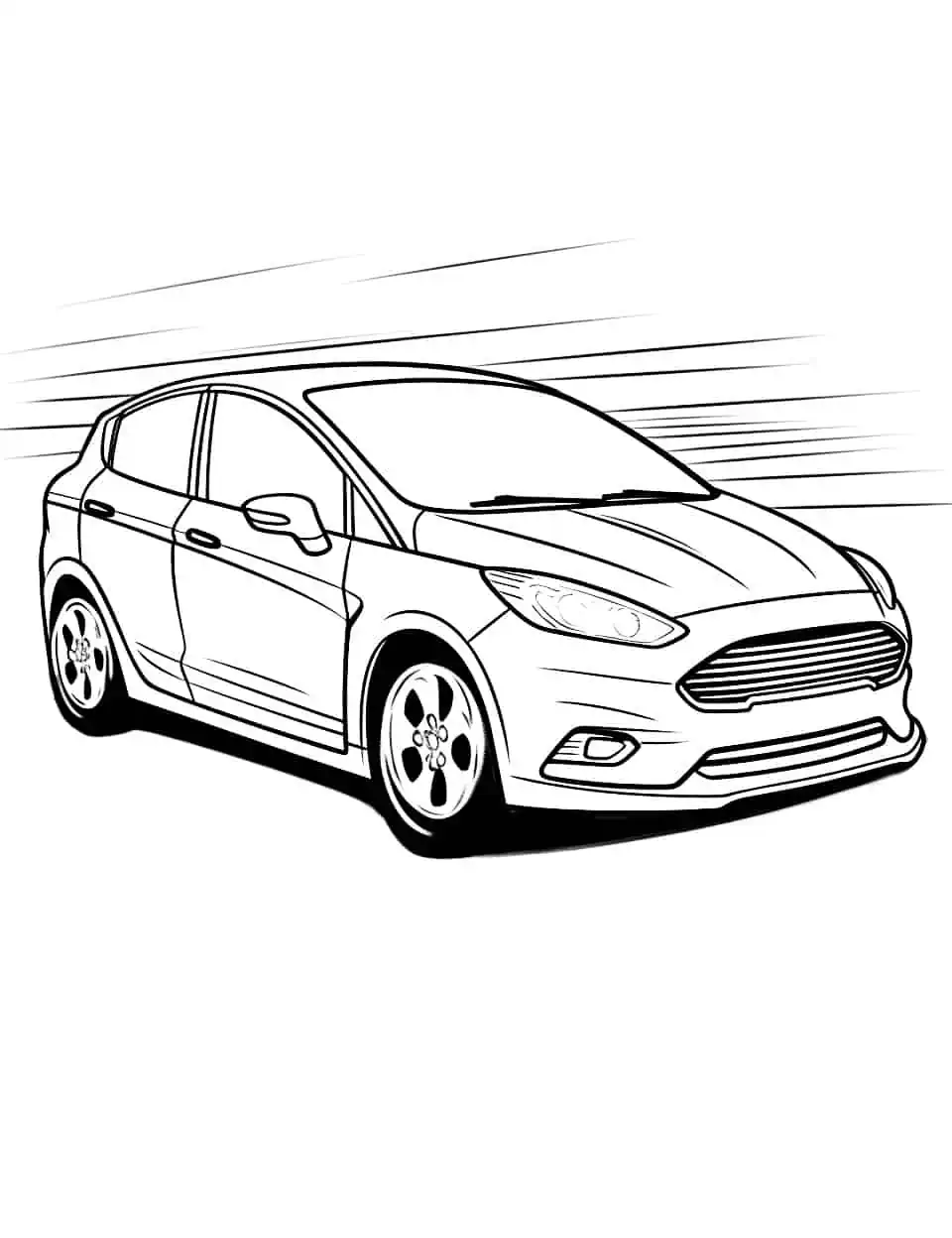
This little Ford hatchback is drawn in real detail, right down to the wiper blades and the mesh of the front grille. The alloy wheels have thin spokes and slim gaps, so they want a sharp pencil rather than a crayon. Bright yellow or sky blue suits its cheerful shape, and grey inside the grille keeps the front from going flat. Speed lines fan out behind, and leaving them almost bare is what makes the car look quick.
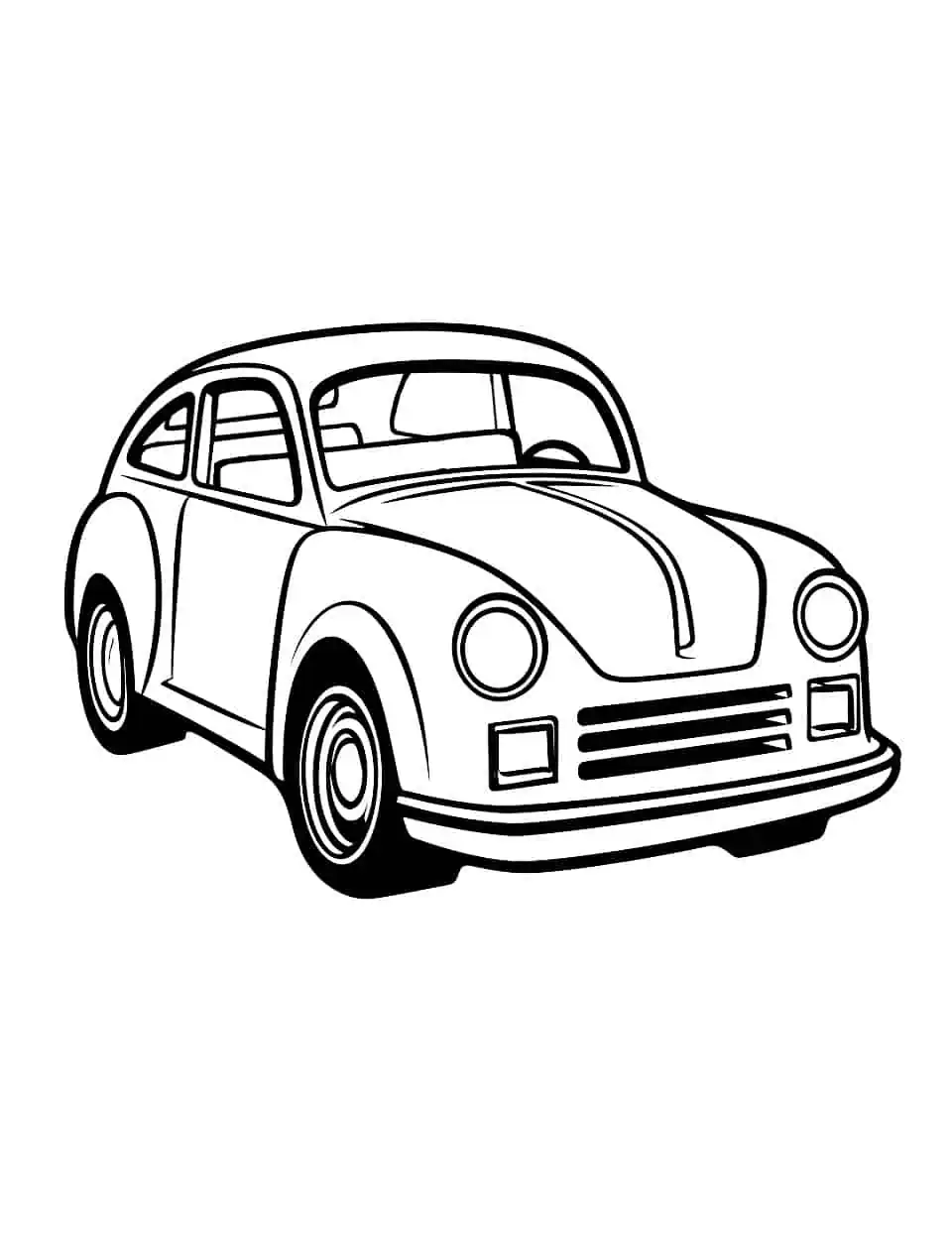
Round headlights, a curved hood and a wide bumper make up nearly all of this little car. Only the four grille bars ask for any care, so fat crayons handle the rest. It suits a quick session before school and cuts out cleanly afterwards, so use cardstock if a shoebox garage is the plan.
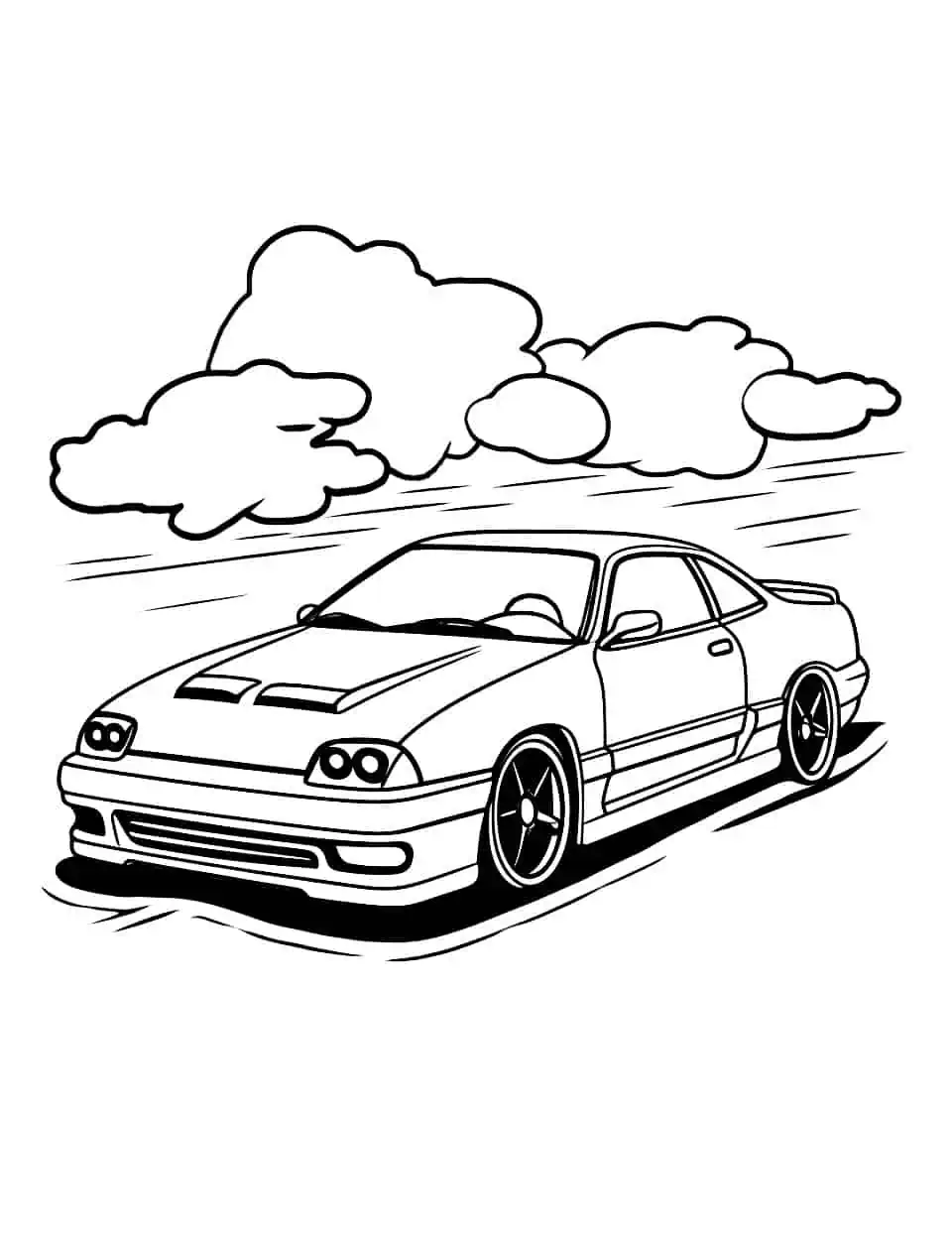
A low Japanese coupe rolls along with twin vents cut into the hood and deep-dish five-spoke wheels. Big rounded clouds sit in the sky above it, easy work in pale grey while the car takes the strong color. A two-tone scheme with a contrasting hood suits the tuner look, and the small rear spoiler is worth picking out in a third shade. The speed lines behind the roof stay best barely touched.
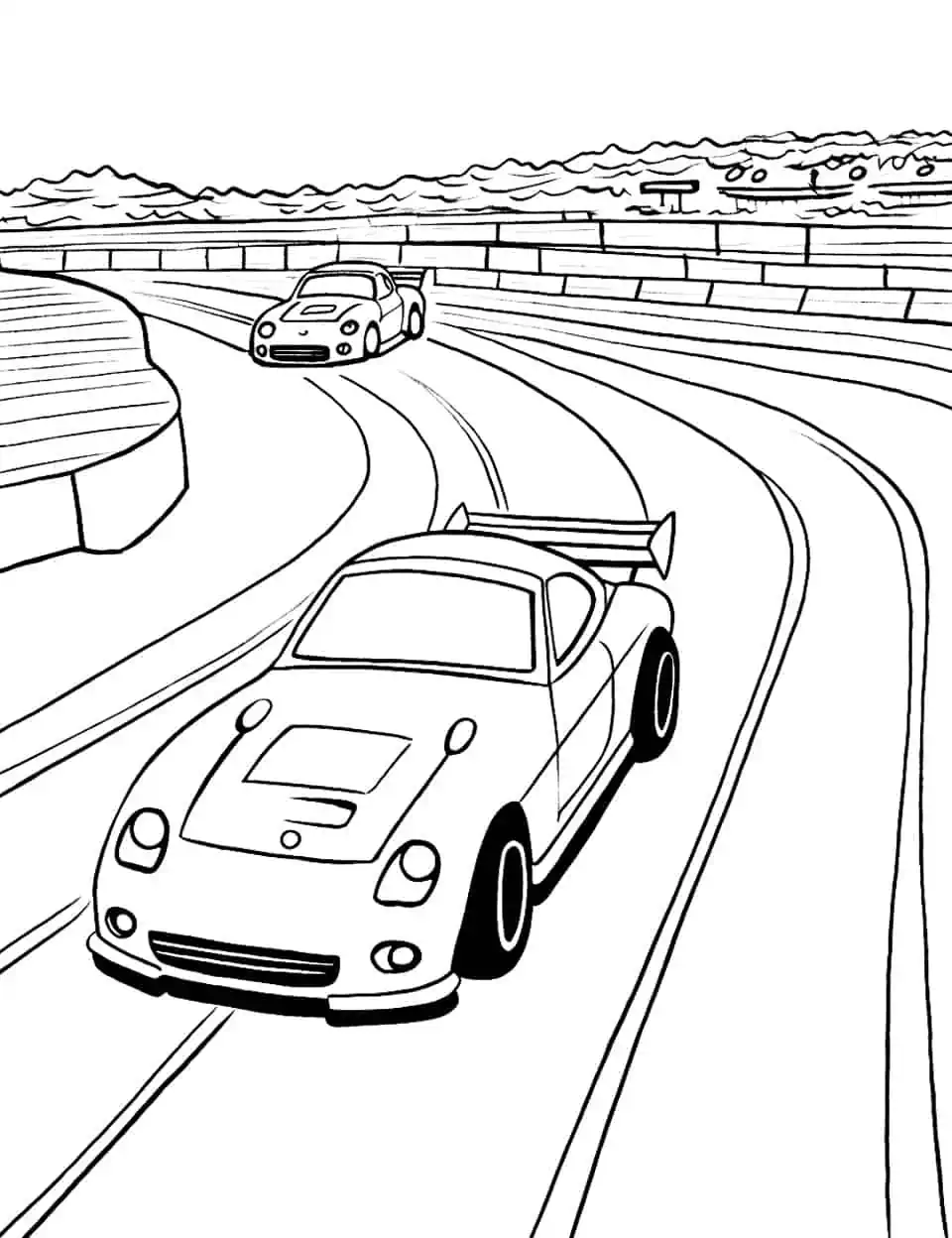
Two race cars work their way around a wide banked circuit, one right up close and one already far ahead. A low barrier wall runs along the outside and grandstands sit in the distance, both drawn as simple repeating blocks. Coloring the near car strongly and the far one lightly makes the distance obvious. The tall rear wing on the near car is the detail most kids will want to get right.
Complex rims and grille work make this luxury vehicle a page for patient hands and fine-point markers. Black, silver and deep burgundy read as expensive; neon does not. The grille is dense with small shapes, so budget the time. Teens and adults tend to enjoy this one more than young kids do.
A sports car pulls away down a highway with a guardrail running beside it and mountains bulking up behind. Motion blur is easy to fake with pencils: press hard on the car and lightly on everything else, dragging each stroke the way the car is going. The vent cut into the hood and the five-spoke wheels are the only small shapes. Pale grey on the peaks keeps them where they belong, in the distance.
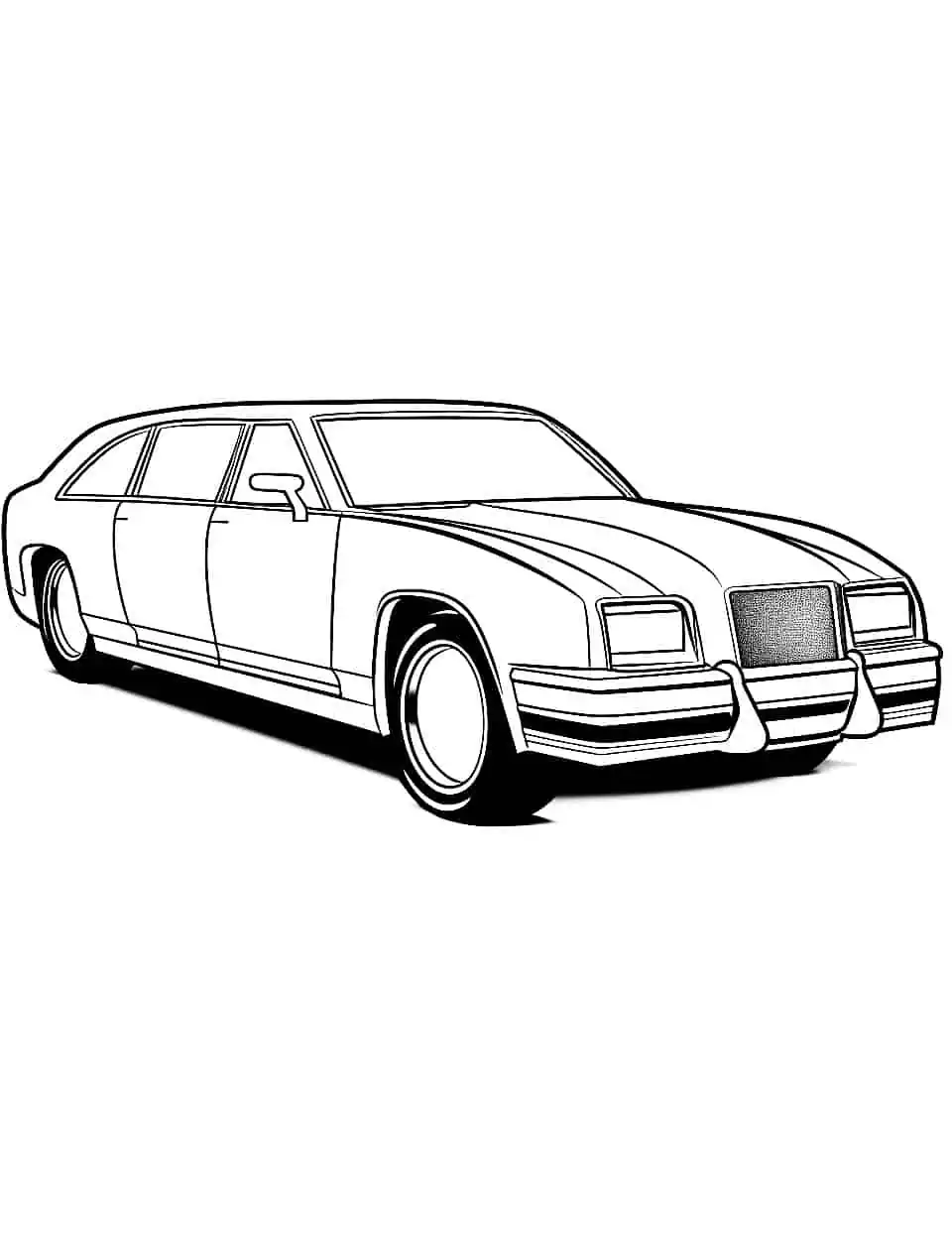
An extra-long limousine that needs a VIP color scheme, whether that is classic black, bright white or something completely unreasonable. The stretched body gives kids a lot of uninterrupted space, so it is a good page for practicing even, streak-free coloring. Add tinted windows in dark grey for a convincing finish.
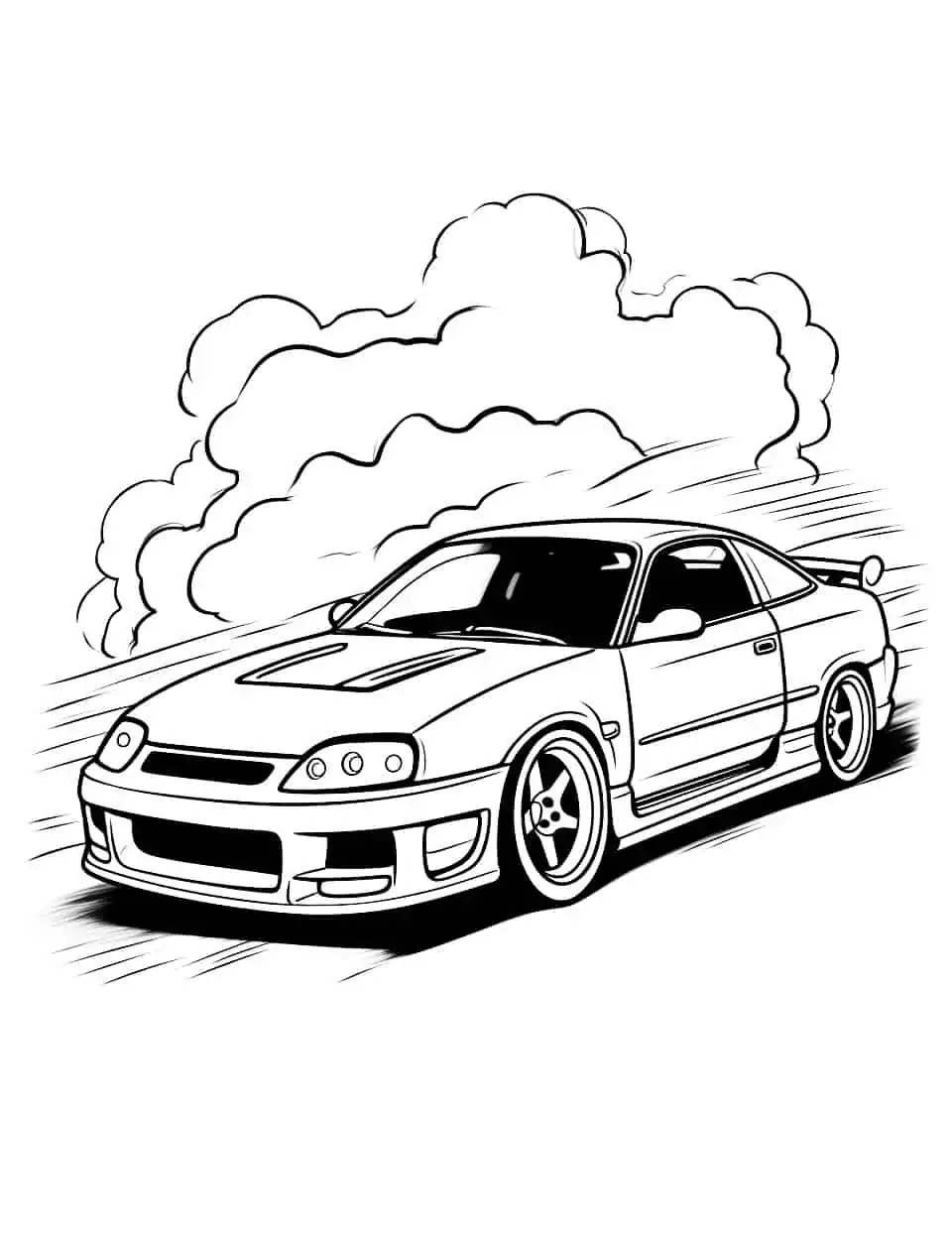
Great billowing clouds of smoke roll off behind this coupe as it powers along. Smoke is the best part to work on, light grey smudged with a fingertip or a blending stump for real texture. The car itself has hood vents, side skirts and a rear wing, all worth a different shade from the body. Older kids who like technique will spend far longer here than on a plain car outline.
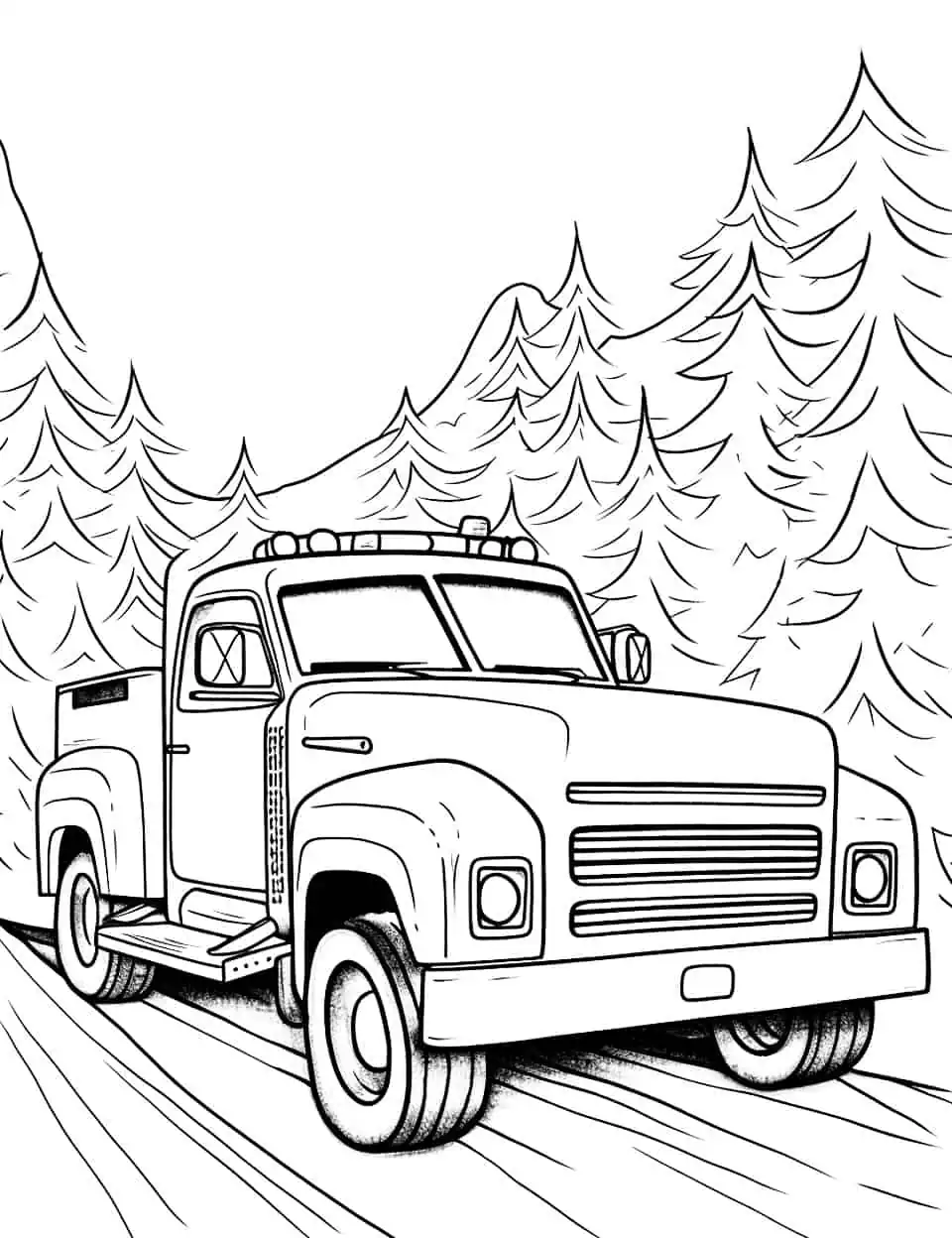
An old flatbed truck rumbles along a forest road, tall pines crowding in on both sides. The trees are drawn with rows of short strokes, so two greens layered over each other look better than one. Roof lights, a ribbed grille and the wooden bed give the truck three areas to treat differently. Splitting the job, truck first and forest second, keeps a younger child going across two short sessions.
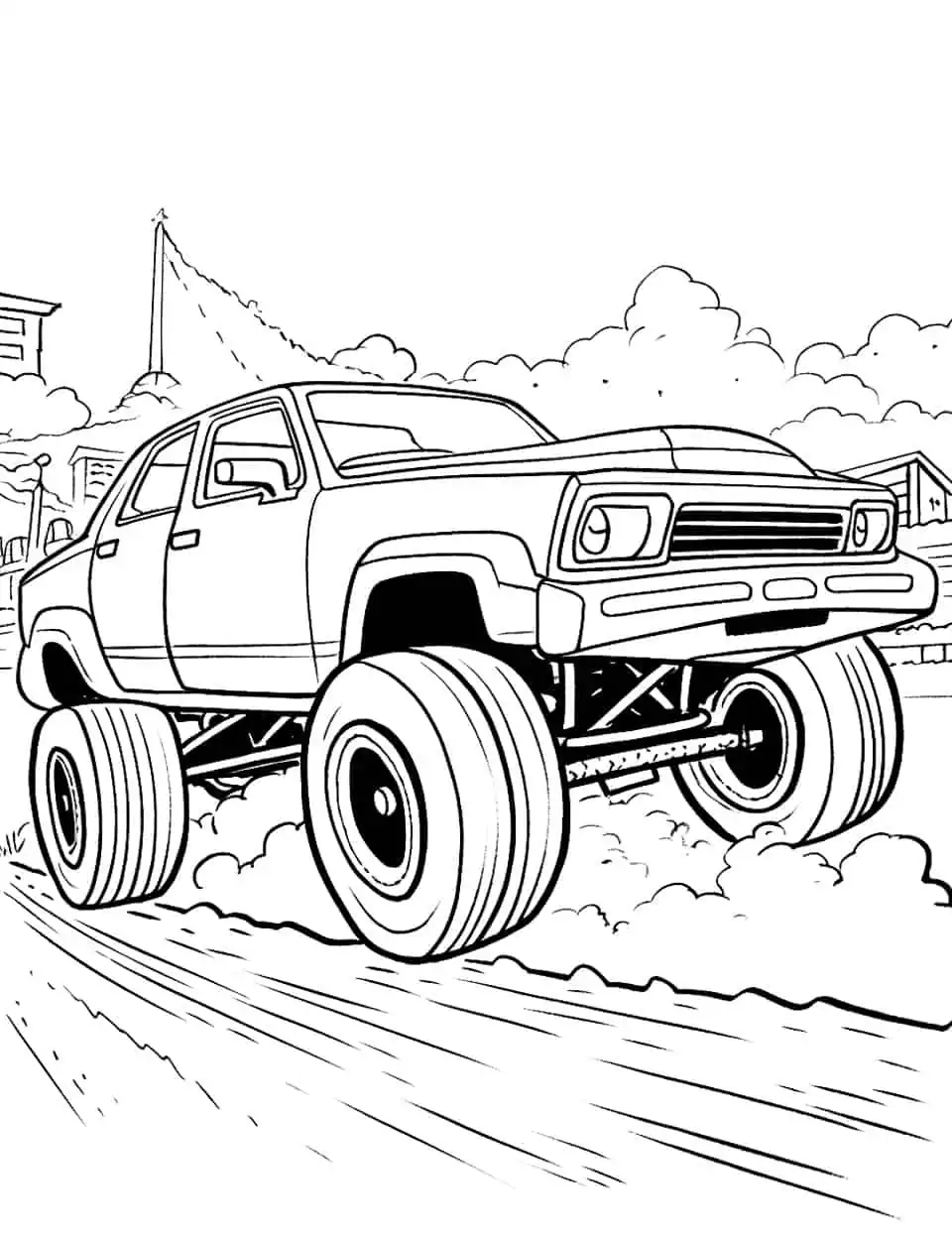
A monster truck tears across a dirt arena on tires nearly as tall as its cab. The axles and shock towers underneath are fully exposed, and silver or dark grey there sets off a loud body color above. Dust billows out around the wheels and looks right in the palest tan a child can manage. Flags and low stands sit in the background, so there is still something to do once the truck is finished.
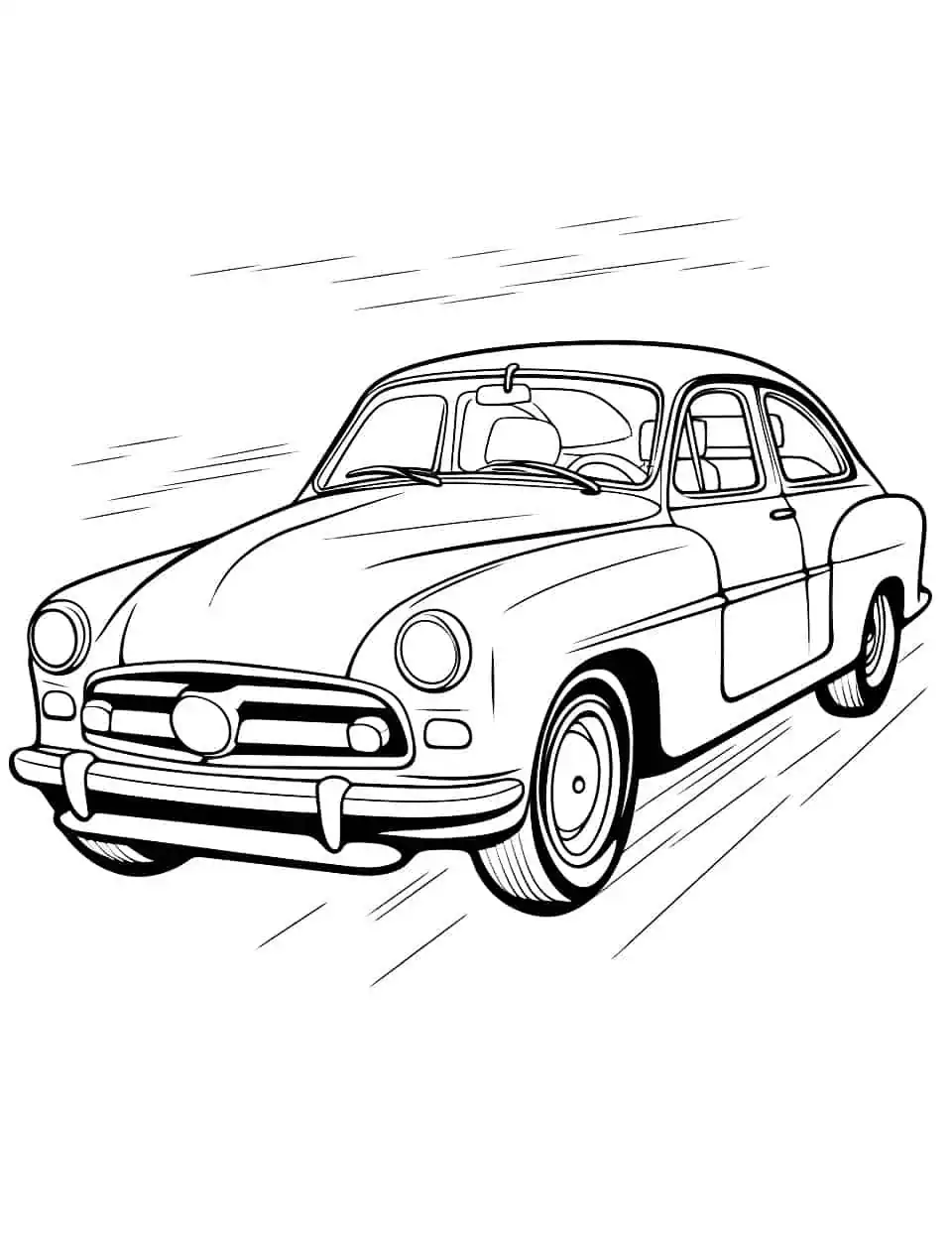
Rounded fenders and large headlights give this retro car its postwar shape. Two-tone paint suits the era, cream over pale blue or white over red, and it looks deliberate rather than accidental. Kids who like drawing curves rather than straight edges gravitate to this one.
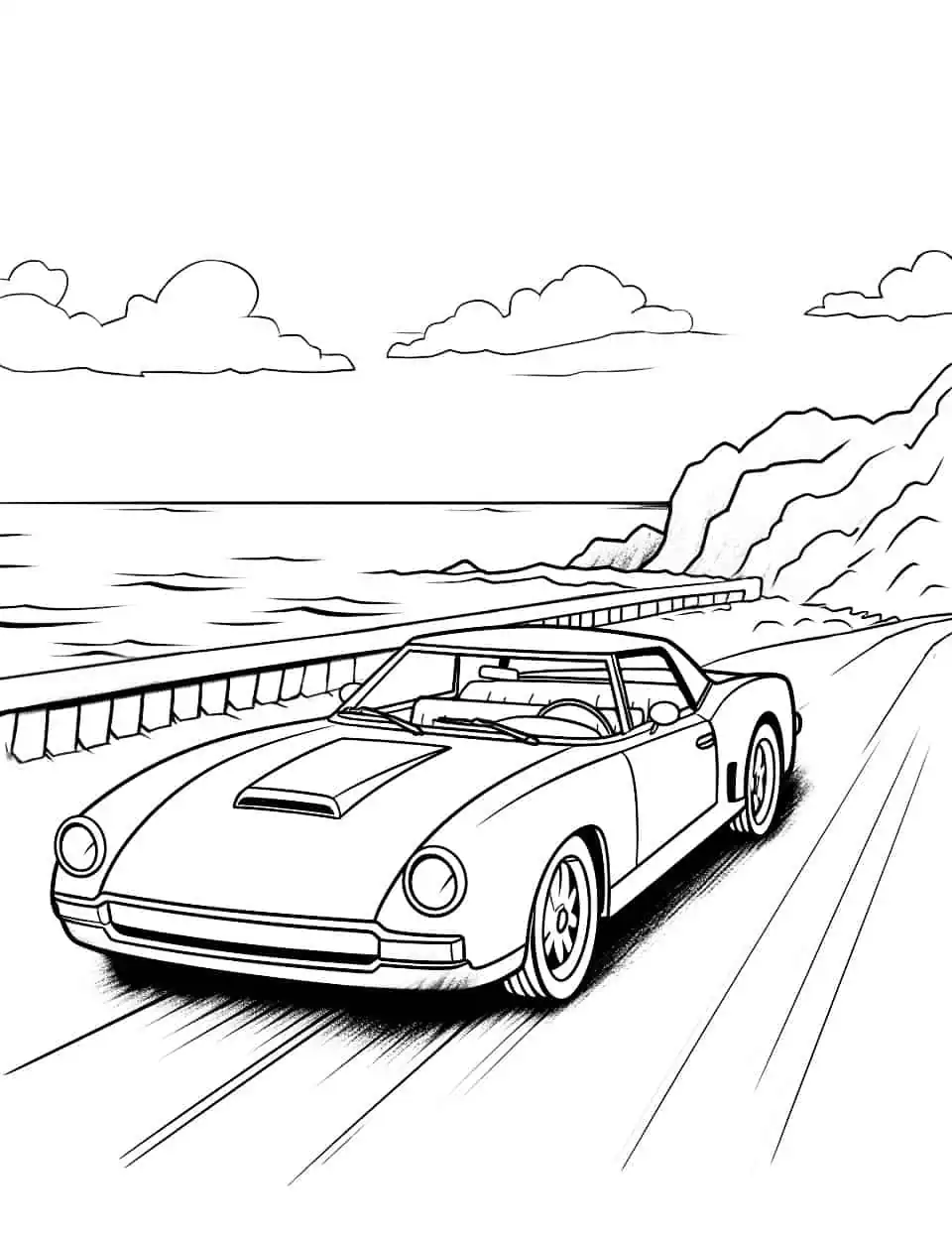
A sleek convertible driving down a coastal road, top down for the ride. Mechanical shapes and ocean scenery sit on the same page, so a child can switch between careful work on the car and loose work on the water. Blues and sandy tans in the background make almost any body color look right.
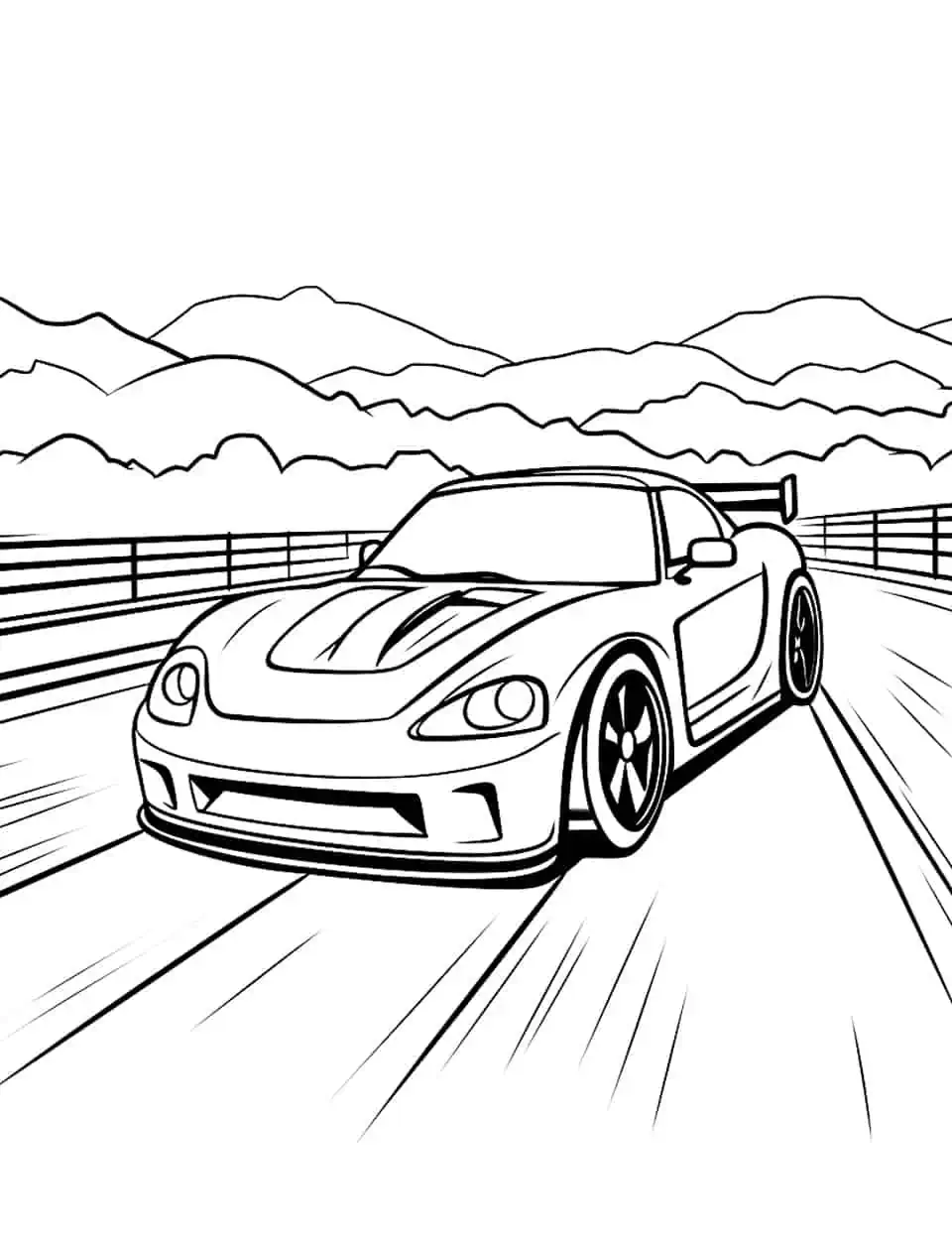
A race car with a raised rear wing sweeps down a wide track, fence rails running along both sides. The mountains behind are drawn as ragged outlines and take a pale wash better than heavy color. Bright shades suit the car, and the vented hood is a natural spot for a contrasting stripe. Speed lines flood the lower half, so leave most of that paper alone and the car will look quicker for it.
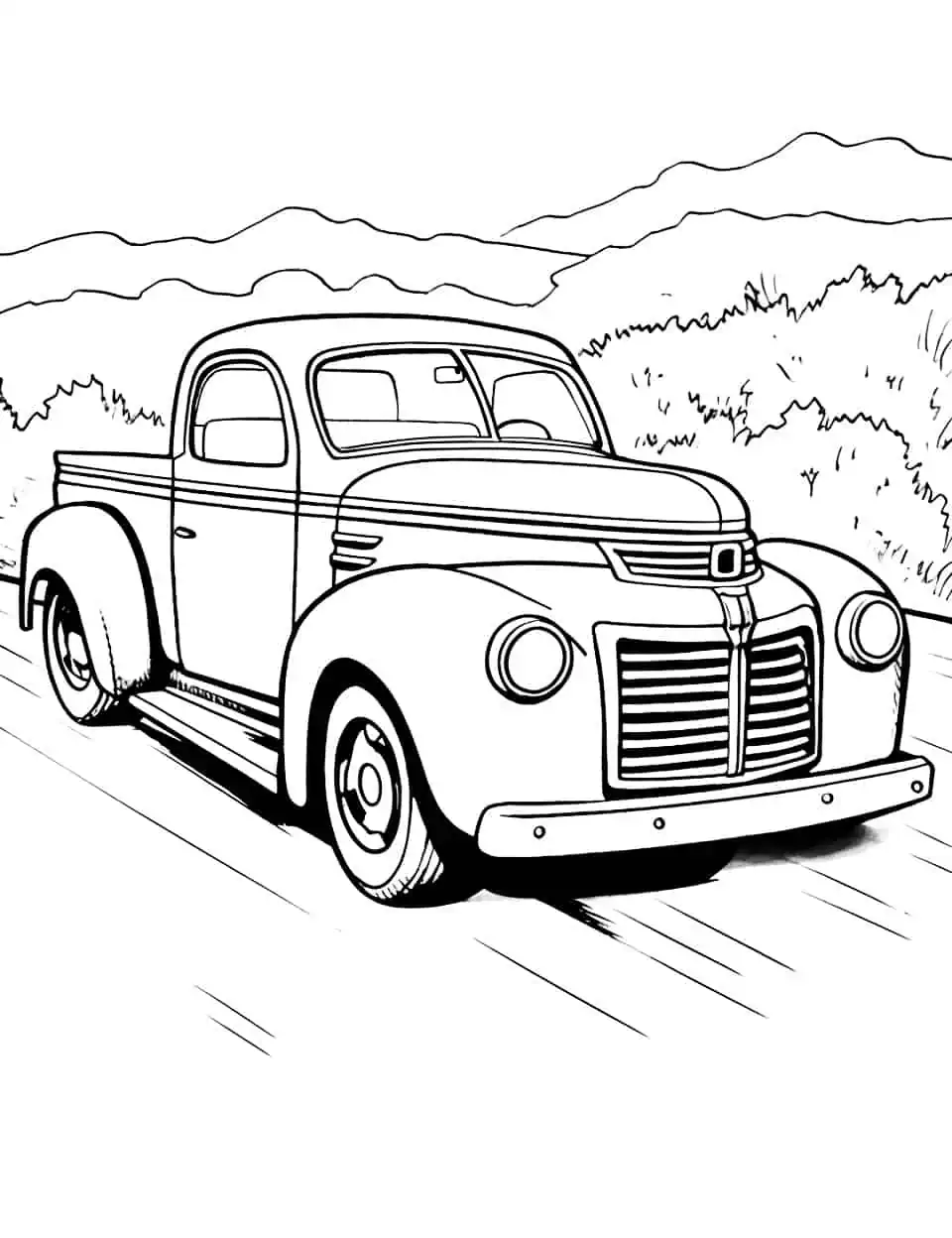
Big round fenders and a ribbed upright grille date this pickup to the 1940s. A two-tone job, dark body with a cream roof, looks right for the era and gives the shape some structure. Scrubby bushes and a low ridge fill the background, quick work compared with the truck itself. Running boards and the wheel arches are there to shade if a child wants a challenge, and fine left flat if not.
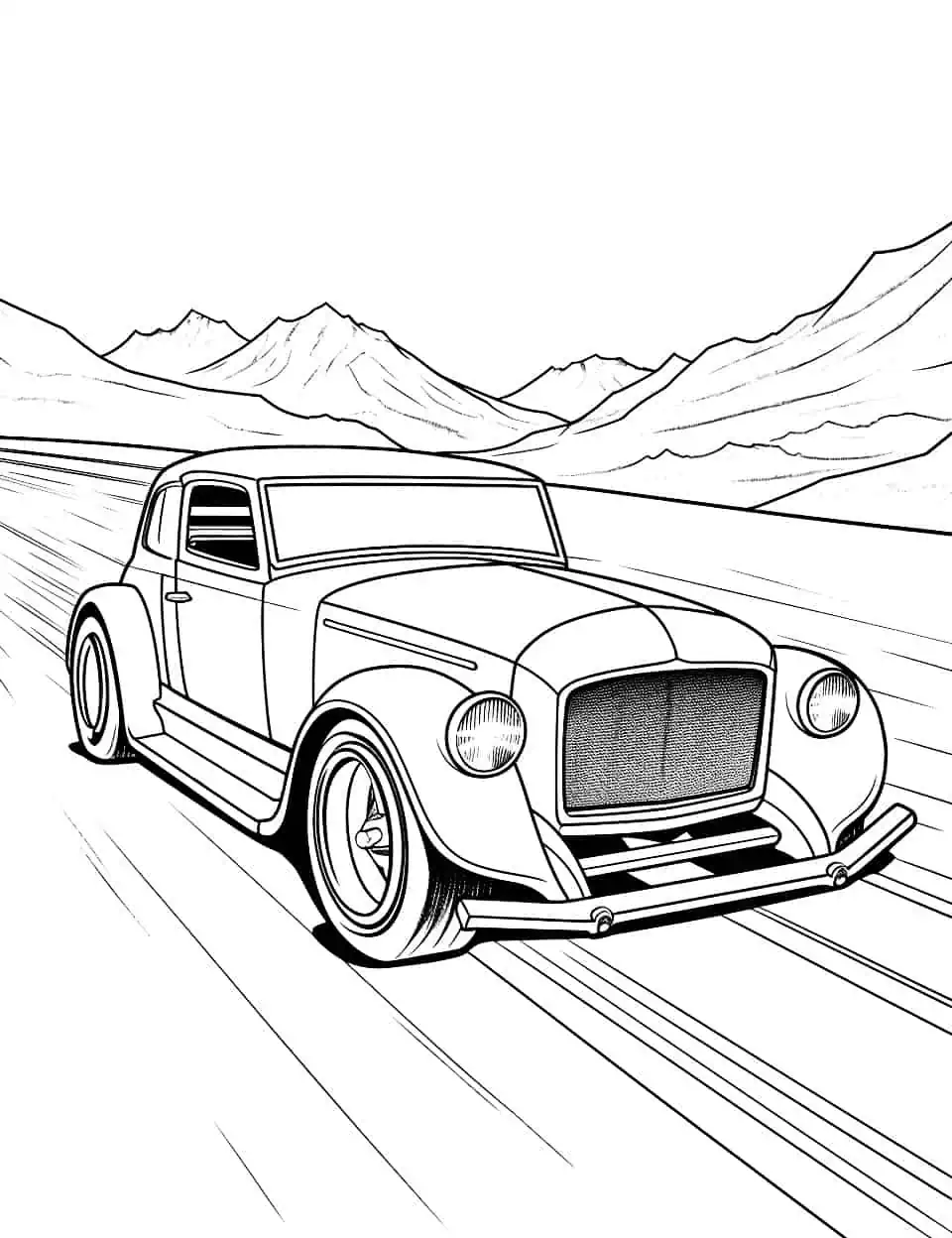
This hot rod leans into a long straight road with mountains ridged along the horizon behind it. The tall grille and the chrome bar across the front are the parts to slow down on. A single stripe over a dark body suits its stripped-back look. Speed lines run right off the bottom of the page, and leaving them almost bare is what sells the motion.
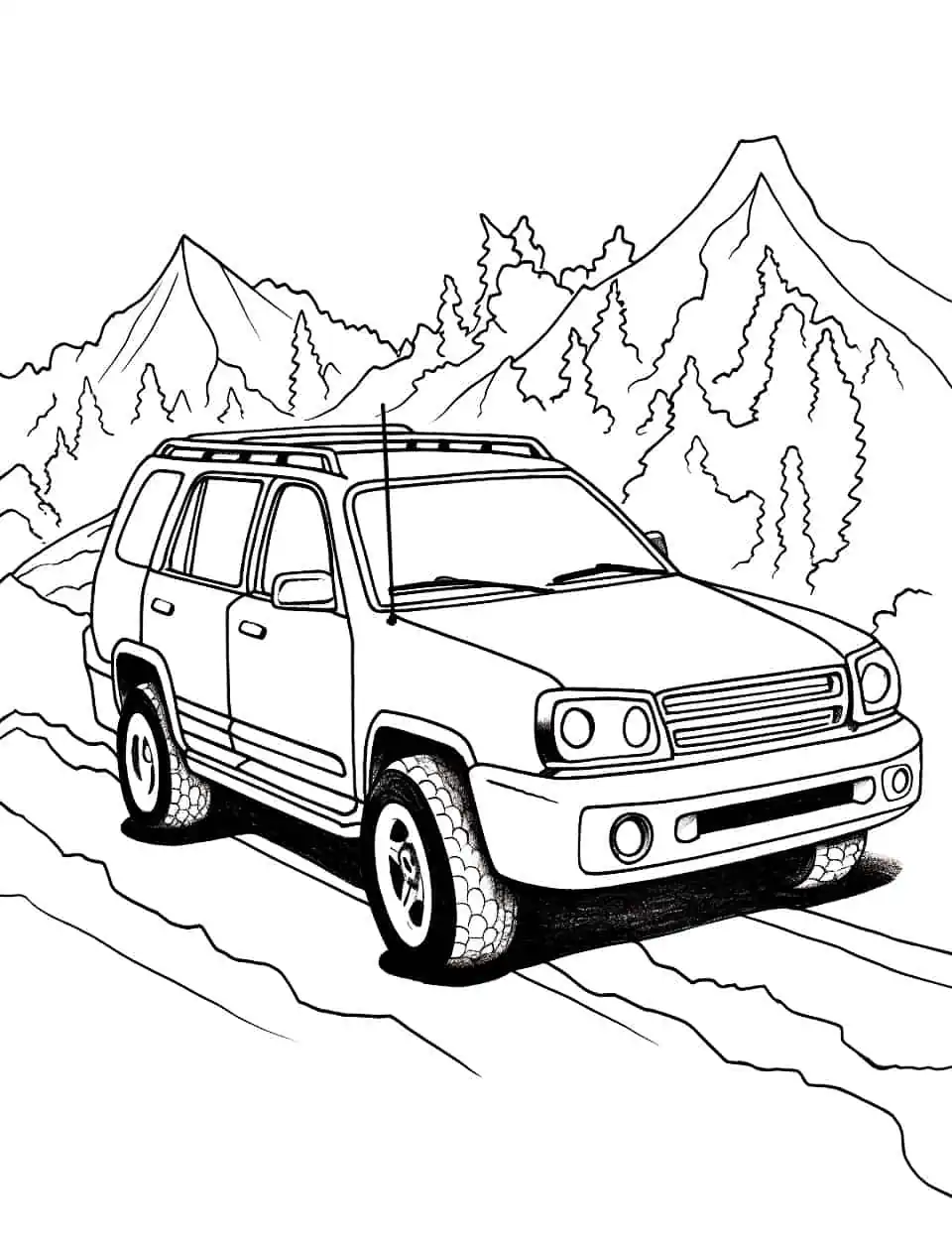
Roof rails and a thin whip antenna mark this SUV out as kitted for the backcountry. It sits on a rough trail with pine trees and sharp peaks stacked behind, so greens and greys carry most of the page. The tire treads are drawn as rows of little blocks and look great picked out in dark grey. Kids who like maps and camping stories take to this sheet quickly.
A modern Ford hatchback takes up the middle of this page with hills and low peaks behind it. The sky is left completely empty, which is an invitation to try a soft gradient rather than one flat blue. Its badge, slim headlights and mesh grille are the fine parts, so save a sharp pencil for the nose. Wide green bands behind fill quickly and make even a plain hatchback look like a day out.
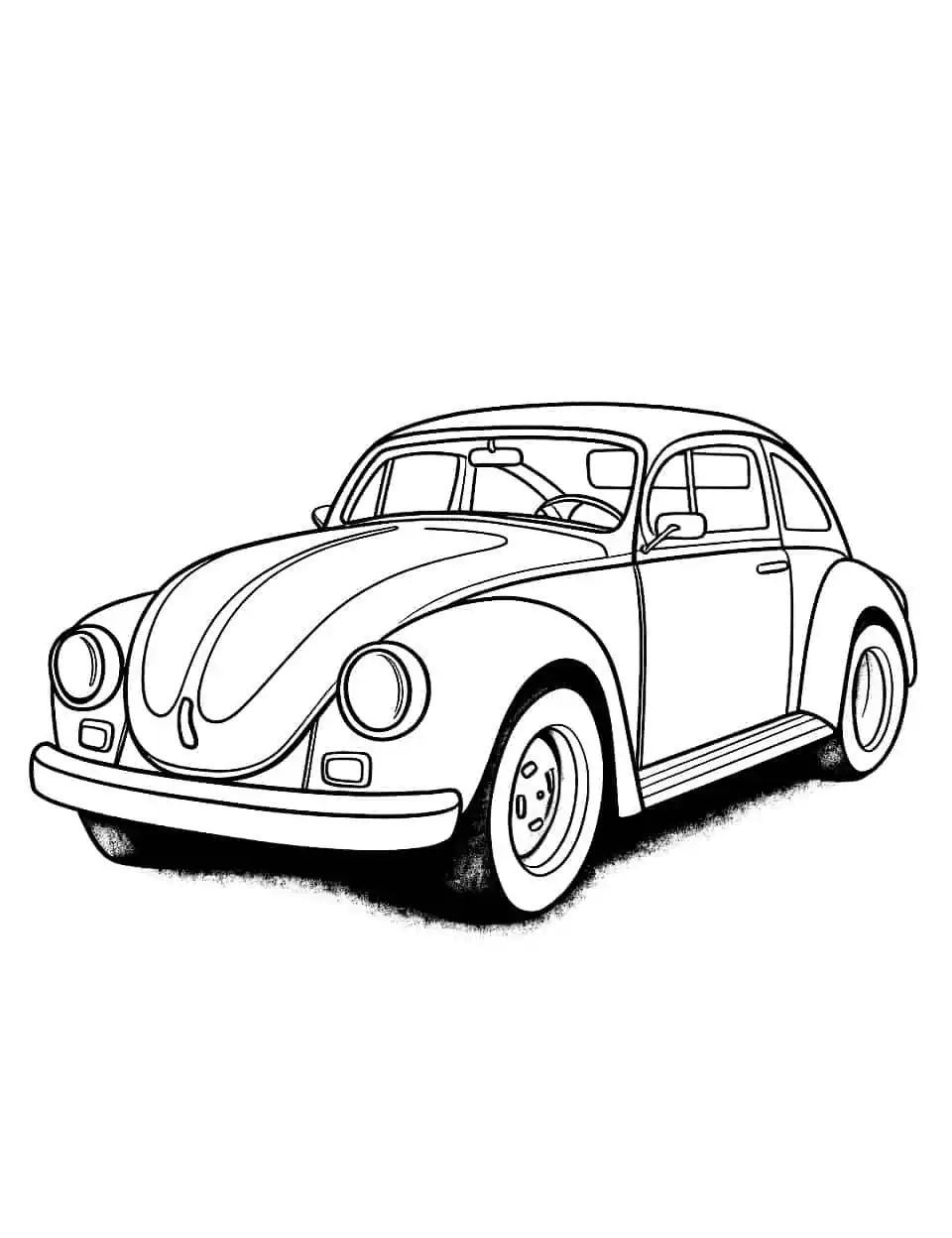
The humped hood and round headlights of a Beetle make this one of the friendliest shapes in the set. Nothing here is narrow enough to trap a crayon, so a preschooler can work fast and still land inside the lines. Pale blue or buttercup yellow with white wall tires looks the part.
A long-hooded Japanese sports coupe sits low against a run of speed lines. Its front is nearly all open grille, so blocking that in dark first gives every other color something to work against. The five-spoke wheels and the tucked-in door handle are the small parts worth a sharp pencil. A teen who wants the car to look like theirs can add racing numbers along the doors.
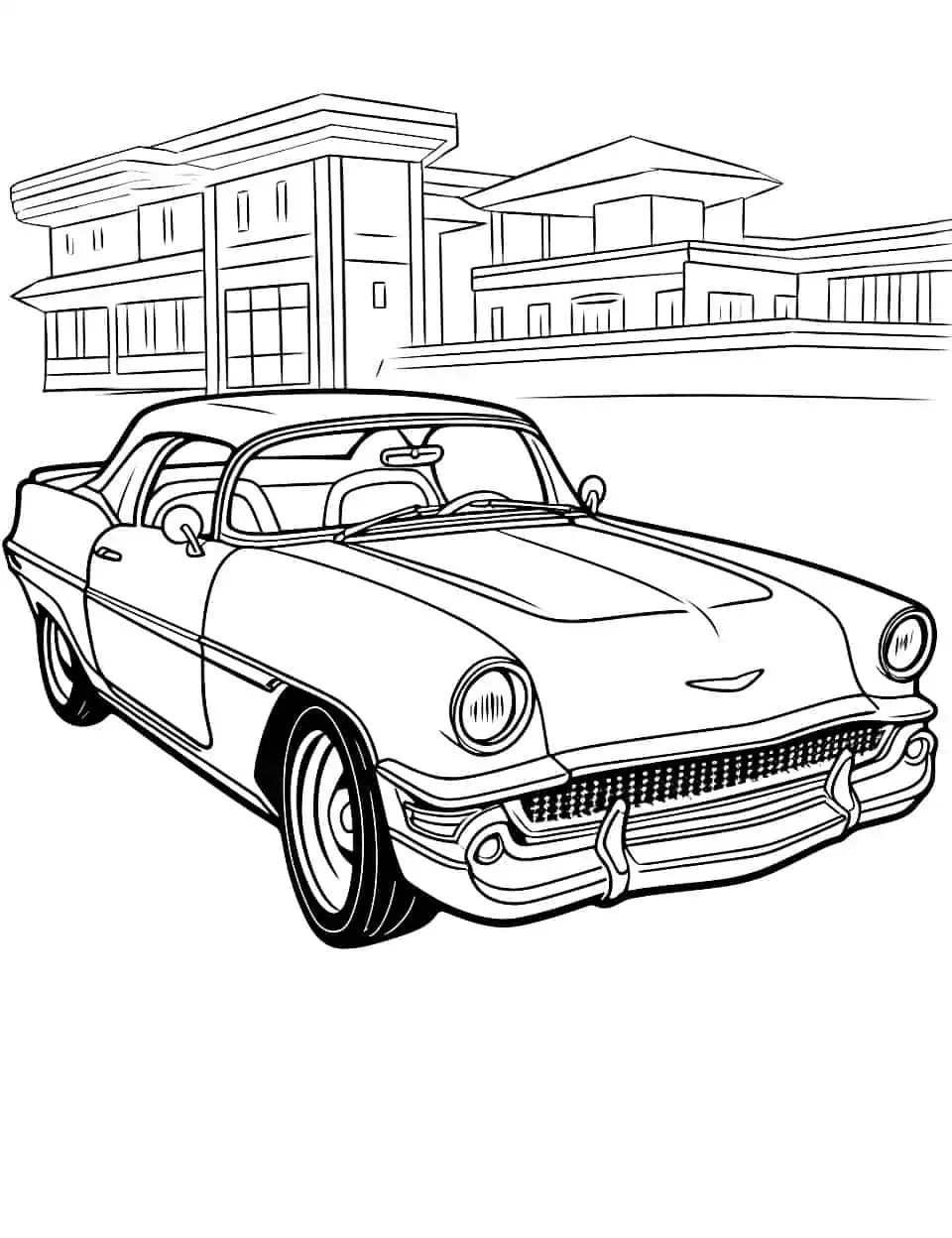
A finned classic with a wraparound windshield sits outside a low mid-century building. The grille is a dense field of tiny squares, so that is the patient part, while everything else is broad and quick. Two-tone paint fits the period, cream over turquoise or white over red. Leaving a white gap along the chrome bumper is a simple trick that makes the finished car look polished.
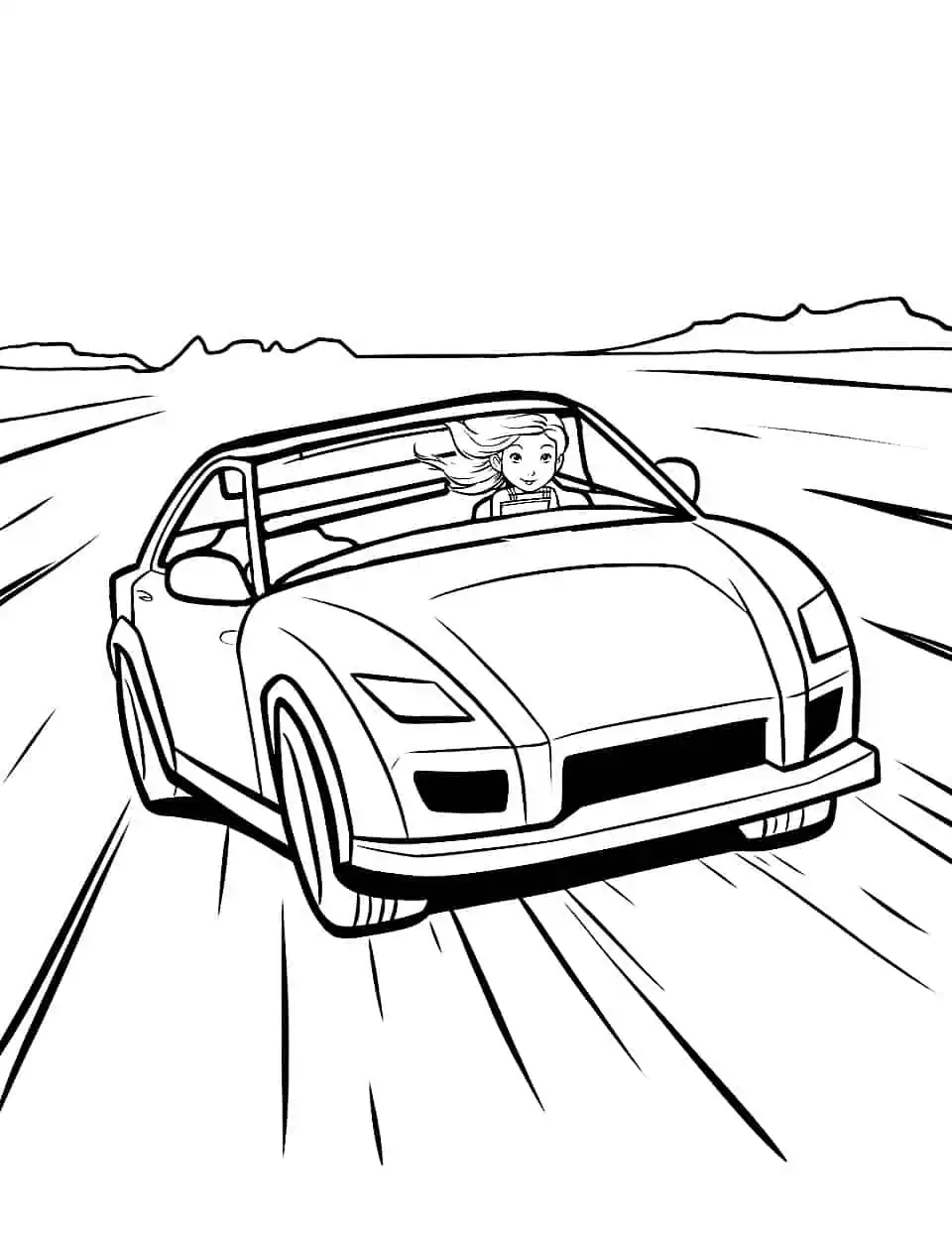
A driver with her hair streaming back grins from behind the wheel of this open-top racer. Faces need the lightest touch on the page, so pick a pale pencil for skin and save the strong colors for the bodywork. Speed lines run past on both sides and a low ridge of hills marks the horizon. Nothing here has to look realistic, so let your child choose whatever loud scheme they want.
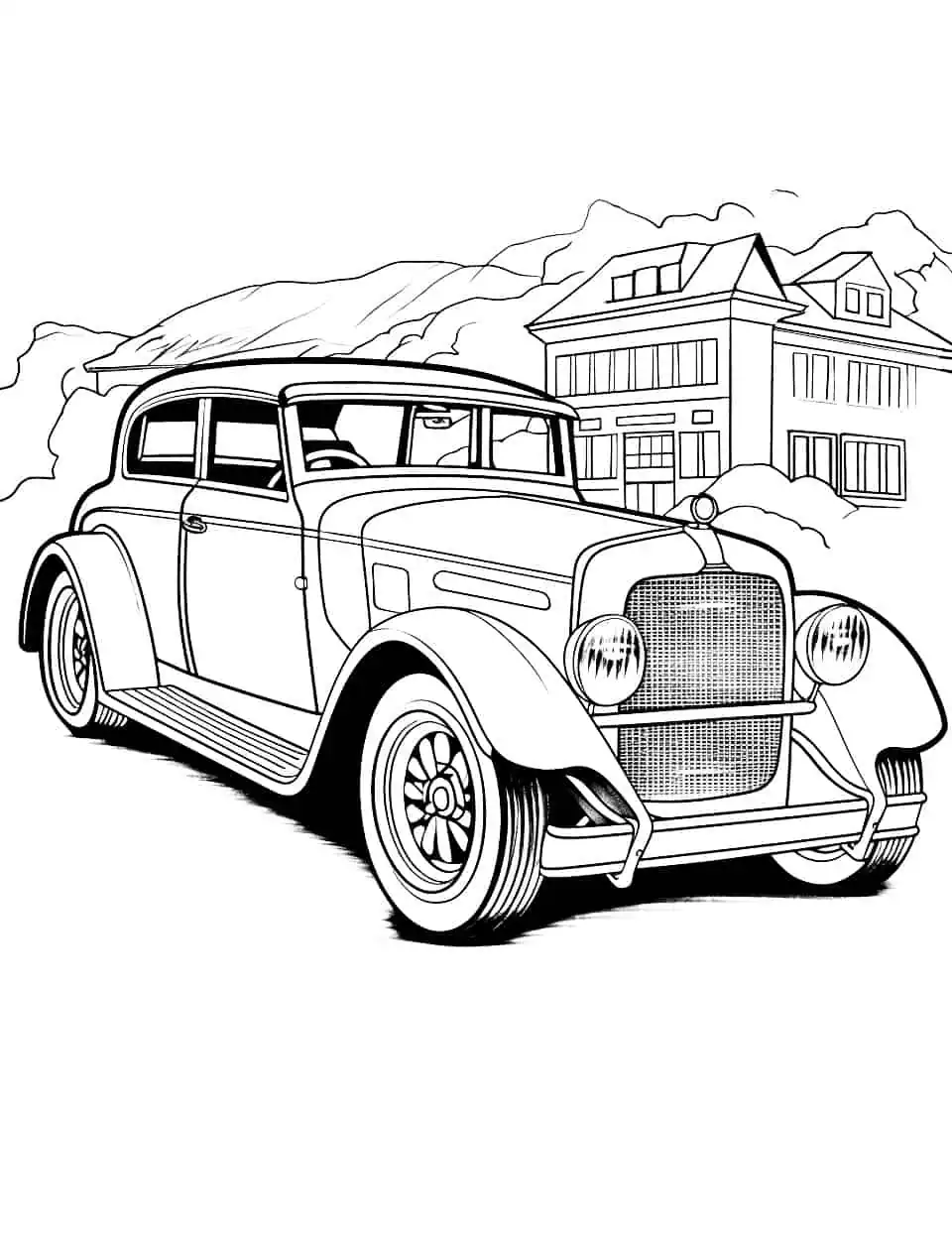
Spoked wheels, whitewall tires and a mesh radiator grille fill this vintage sedan with small repeating shapes. The mesh takes patience and looks better in two greys than one flat tone. Behind it stand a big gabled house and a run of mountains, both loose enough to finish quickly. This is the sheet adults tend to borrow from their kids.
A sports car with a tall rear wing races up a wide city street lined with tall blocks. The buildings are drawn as plain rectangles and rows of windows, so a child can work through them without much precision. Big clouds sit between the towers and can stay white, which throws the car forward. Save the boldest color for the car and keep the street a flat grey.
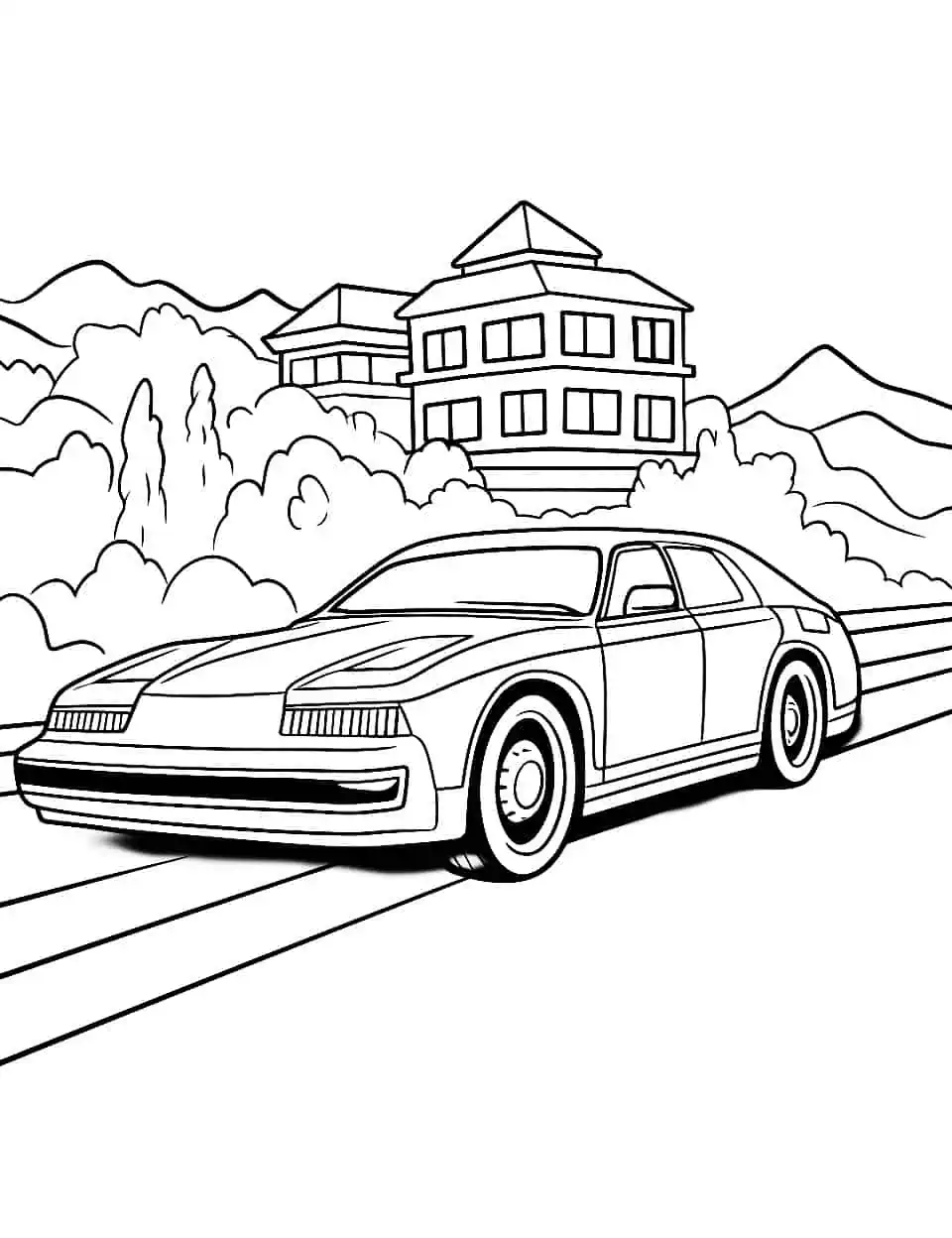
A sedan cruises a country road with a tall house standing on the hill above it. Bushy trees, grass tufts and rolling mountains fill the rest, so greens and blues cover ground fast. Older kids can pick out the house windows one by one while a younger child blocks in the hills. Keep the road pale and the car will stand out without any extra effort.
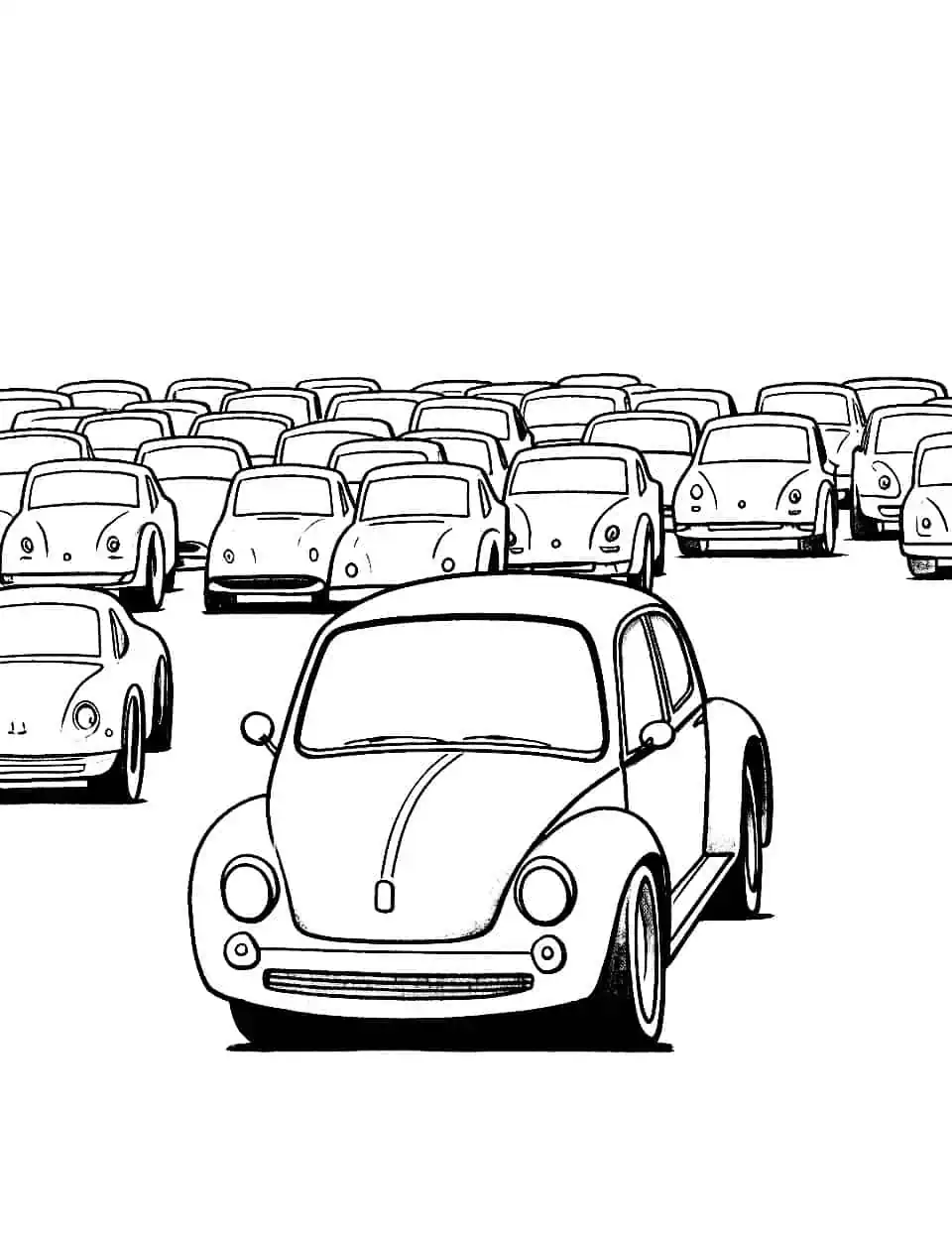
Row after row of Beetles fills this page, with one big one parked right at the front. The crowd behind is drawn simply, which makes it a good place to try a different color on every single car. Pastels suit these round shapes better than anything aggressive. Working front to back stops a child losing their place among all those matching roofs.
Nothing surrounds this sports car except the streak of speed lines trailing off behind it. That empty page is the point, so keep the car crisp and let the lines stay loose and scribbly. Kids enjoy being told to be messy on purpose for once.
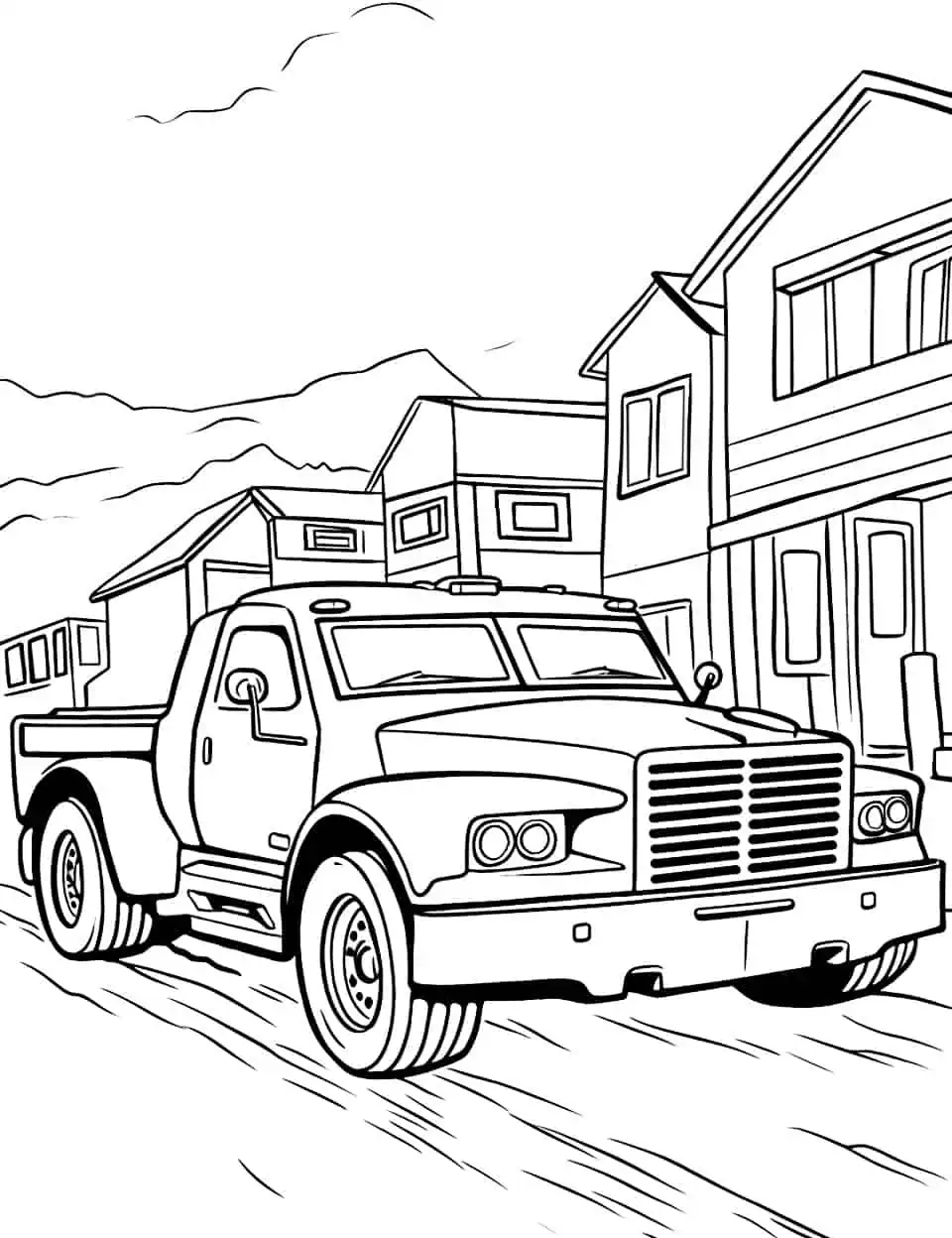
A heavy flatbed truck sits on a street of two-story houses with mountains beyond the rooftops. Its ribbed grille and twin round headlights are the fine parts, while the empty bed and the house walls are wide open. Yellow or deep red on the cab reads well against grey siding and pale hills. Kids who ask to stop and watch roadworks tend to like this one.
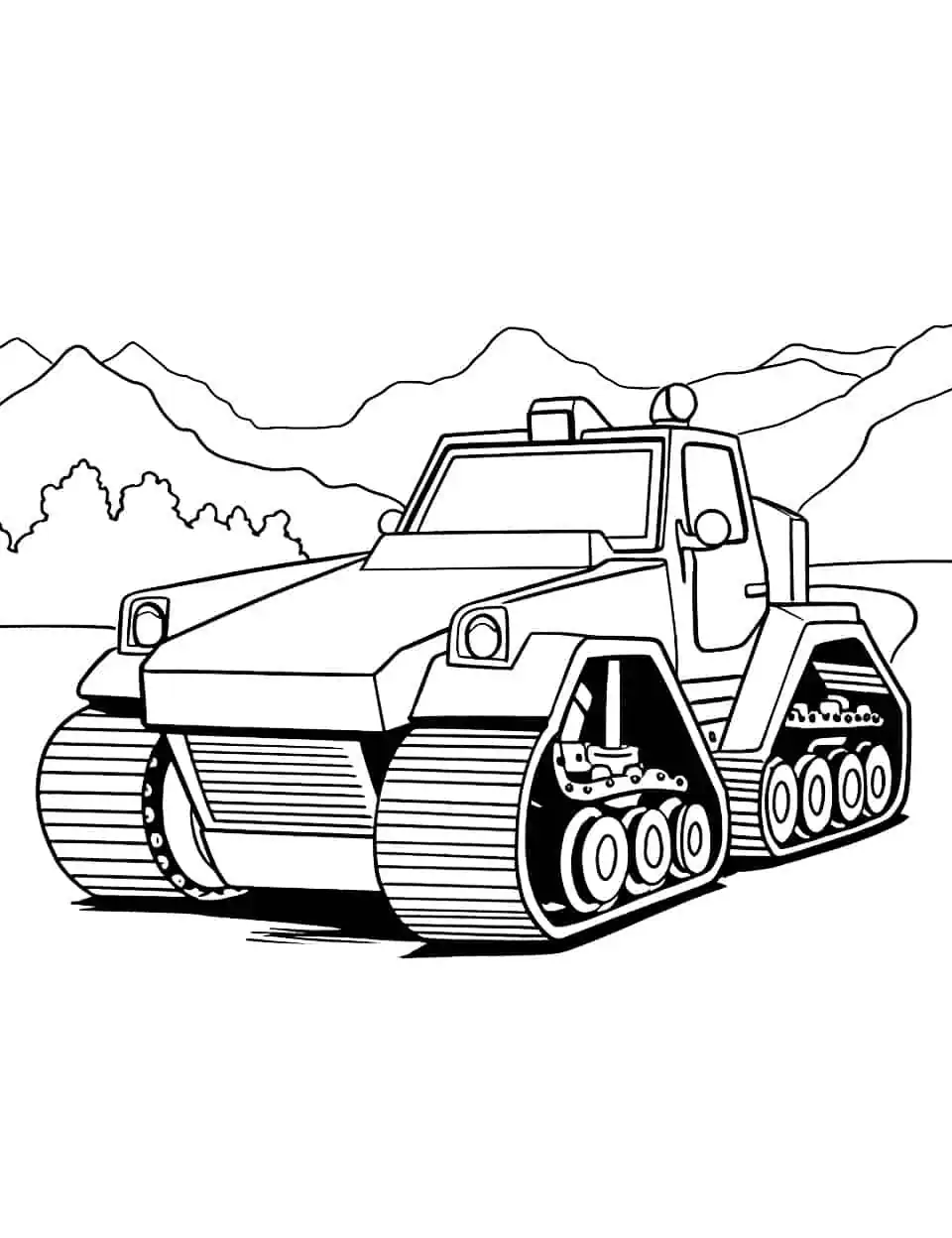
Four broad rubber tracks carry this working machine, and each one is ruled with dozens of little treads. Running a pencil back and forth in short strokes across those treads makes them look metallic. The cab, the square headlights and the beacon on the roof are the only other pieces, so it colors up quickly. Mountains and a clump of trees sit behind, easy to leave faint.
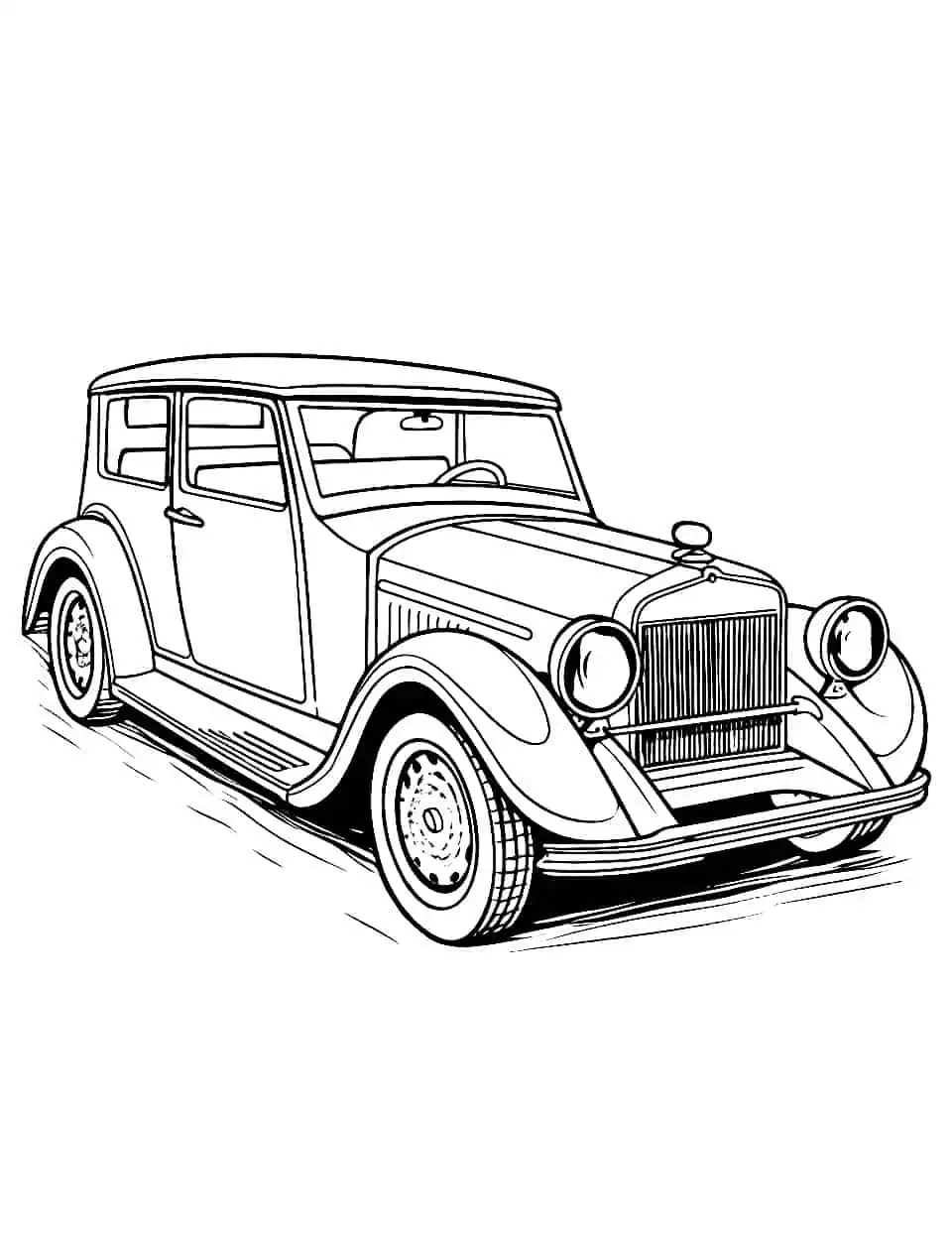
Upright and formal, this 1930s sedan has separate round lamps, a tall ribbed radiator and running boards along each side. Those lamps look right in yellow-orange outlined in brown, a nice small lesson in layering two colors. The body panels are wide and plain, so the page moves faster than the detail suggests. Pair it with the retro and vintage sheets here for a history-of-cars display.
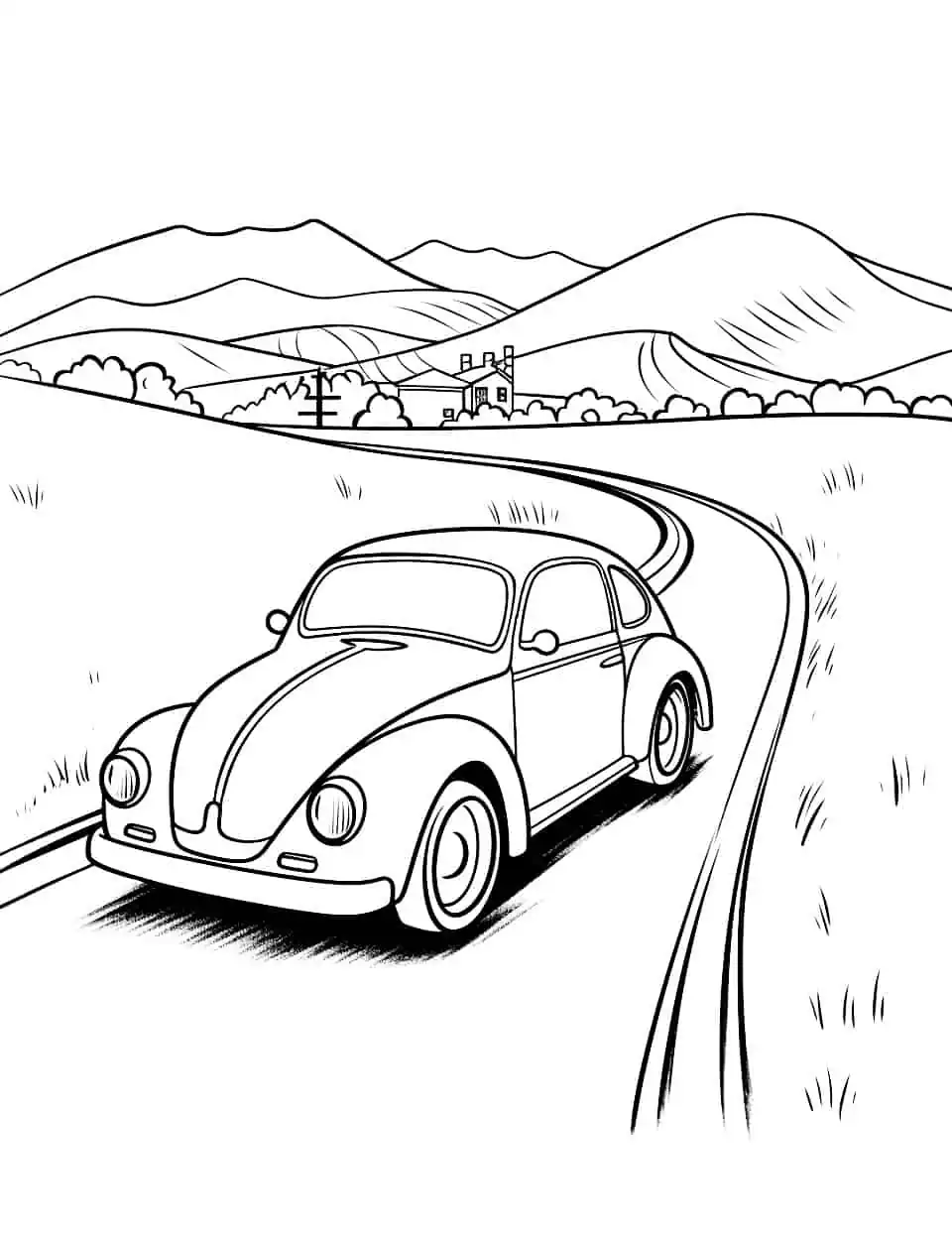
A Beetle putters along a road that curves away into low hills. Half the page is countryside, with bushes, grass tufts, a small farmhouse and a power pole out on the ridge. Wide bands of green and blue finish quickly, so a younger child still ends up with a full-looking picture. Any bold body color stands out against all that soft background.
By using our free coloring pages, you acknowledge and agree to our full disclaimer. All materials are for personal, non-commercial use only and all rights belong to their respective license holders.
How Do Car Coloring Pages Help Kids Build Fine Motor Skills?
Coloring a car sheet trains the same grip and hand control a child needs for writing. The CDC lists holding a crayon or pencil between the fingers and thumb, rather than in a fist, among the things most four year olds can do, and it defines a milestone as a skill at least 75% of children reach by that age (1). Copying a circle after someone demonstrates it sits a year earlier, on the checklist for three year olds, which is roughly when a wheel stops being a scribble.
Cars happen to be good practice shapes. A wheel is a circle, a window is a wedge, a truck bed is a long rectangle, and a child who colors those over and over is repeating the strokes that letters are built from. The simple sheets in this set do that work with wide, forgiving outlines; the detailed racers and grille-heavy classics ask for the controlled, small movements that come later.
Coloring also settles children down, and there is some measured support for that beyond parent instinct. In a randomized study with 120 participants in Taiwan, 20 minutes of coloring a mandala pattern left that group calmer than a control group that read instead (2). That research was run with older adults rather than children, so treat it as a hint about the activity rather than proof about your kid, but it lines up with what happens at most kitchen tables.
Which Car Coloring Page Should Your Child Start With?
Start with the simplest outline your child can finish in one sitting, then move up. Finishing matters more than difficulty at every age, and a page abandoned halfway teaches nothing except that coloring is annoying.
A rough guide to this set:
Toddlers and preschoolers: Simple Car, Easy Drive, Easy Peasy Lemon Squeezy and Fantastic Ford all use thick lines and open shapes.
Early elementary: Classic Mustang Muscles, Police Car Parade, Speedy Race, The Big Truck Adventure and Flatbed Truck in Town add wheels, windows and light bars without getting fussy.
Older kids and teens: JDM Street Race, JDM Masterpiece, Hot Rod Heaven and Racing Through the City reward a steady hand and a sharpened pencil.
Adults borrowing a sheet: The Detailed Racer, Detailed Luxury Car, Detailed Vintage Car and The Antique Automobile are the longest sits in the collection.
If your child is between stages, print one easy sheet and one hard sheet together. Most kids warm up on the simple one and then attempt the harder one with more patience than they would have had cold.
Activities to Do With Car Coloring Pages
The fun does not have to stop once the coloring is done. These car printables carry over into imaginative play and craft projects with almost nothing extra bought. Here are a few ideas that hold up.
Create A DIY Racetrack
Grab painter’s tape and map out a road system across the living room floor. Once the cars are colored and cut out, they can race along the tape. Shoe boxes become tunnels and garages, and a whole city grows out of a roll of tape and an afternoon.
Host A Car Show Art Gallery
Turn the fridge or a hallway wall into a car show. Have your children present their customized vehicles to the family and explain the color choices they made, which is more language practice than it sounds like. Blue ribbons for Best Paint Job and Fastest Looking Car cost nothing and get taken seriously.
Design 3D Paper Stand-Ups
Print on cardstock so the cars hold their shape. After coloring, cut each one out and tape a small triangular wedge of paper to the back so it stands on its own. They work on a shelf, on a windowsill, or as extra vehicles alongside action figures.
Make A Custom Car Puzzle
Color a page completely, then glue it onto thin cardboard from a cereal box. Cut the image into puzzle pieces, larger for younger children and smaller for older ones. The activity keeps going long after the coloring ends, and reassembling it works on the same problem-solving skills as a shop-bought puzzle.
Create Personalized Greeting Cards
Does someone in the family love cars? Shrink the print size so a sheet fits on the front of a half-folded piece of construction paper. Your child colors the car, writes the message inside, and a birthday or Father’s Day card is done without a trip to the store.
Storytelling And Character Creation
Ask your child to invent the driver of the car they just colored. Where are they going, and why the hurry? Writing a few sentences on the back of the page adds a literacy step to the art, and reluctant writers tend to produce more when the subject is their own drawing.
FAQs
What Paper Is Best for Printing Coloring Pages?
Standard printer paper is best for crayons and colored pencils, which sit on the surface and do not soak through. Switch to cardstock or a heavier weight paper for markers or watercolor pencils, since thin paper lets the ink bleed onto the next sheet and onto your table. Cardstock is also the right choice if the finished car is going to be cut out or stood up.
Do Car Coloring Pages Help With Motor Skills?
Yes. Holding a crayon and steering it around a wheel arch builds grip strength and hand-eye coordination, the same control a child later uses to form letters. The CDC treats holding a crayon between fingers and thumb as something most four year olds do, so a child who colors regularly is rehearsing a real developmental step. Bigger, simpler sheets do this work as well as detailed ones.
Can I Resize These Images Before Printing?
Yes, from your printer dialog. Scaling down to about half size gives you card-sized cars for greeting cards or paper stand-ups, while choosing Fit to Page fills the whole sheet for a wall display. Check the print preview first, because scaling sometimes crops a wheel or a spoiler off the edge.
What Are the Best Coloring Tools for Detailed Cars?
Sharpened colored pencils and fine-tip markers handle detailed cars best, because grille mesh, wire rims and roof light bars have spaces narrower than a crayon tip. Colored pencils have the added advantage of layering, so a child can shade a fender from light to dark. Keep crayons for the simple sheets, where their coverage is a benefit rather than a problem.
Are These Coloring Pages Suitable for Adults?
Definitely. Alongside the simple cars for toddlers, the detailed sports cars, luxury grilles and vintage automobiles have enough small sections to make a genuinely absorbing sit for adults and teenagers. The main study behind the calming claim was run with older adults, not children, so this is not a children-only activity dressed up.
How Can I Make the Coloring Pages Reusable?
Print on cardstock and laminate the sheet, then color it with dry-erase markers and wipe it clean. A clear plastic document sleeve does the same job if you have no laminator. This is a good trick for a favorite car that gets requested every week, and for restaurants or car journeys where you want one page instead of a stack.