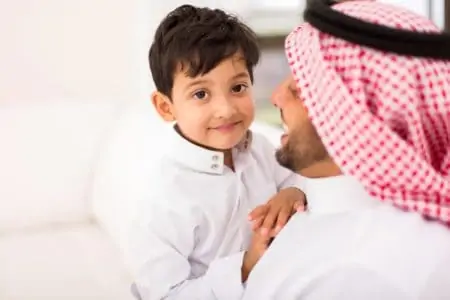
Arabic boy names showcase strength and personality and are a great way to celebrate Middle Eastern culture. Most Arab boy names have Islamic origins from the Quran, while others have Persian or Indian origins, each rich with meaning, depicting strong personal qualities.
Naming your baby boy is an exciting task, but one filled with responsibility as the name you choose will create a powerful first impression!
So to help you get started here is a carefully crafted list of the most powerful Arabic boy names that honor centuries of naming traditions.
100 Strong Arabic Names for Boys
These powerful and meaningful Arabic boy names could be perfect for your little boy.
Aayan
Aayan is an Arabic baby boy name that means “God’s gift.”
A baby is a gift from God, and if you wish to raise your swift and bright kid to be a religious one, then Aayan could be just suitable for him.
In the Indian languages, Aayan means “the one who is bright, and religiously inclined.” Other meanings include “coming or approaching” and “swift or speed.”
Abbas
A strong name with Arabic and Hebrew origin, Abbas means “the Lion.”
The common roots of Islam and Judaism are evident in Abbas. Other meanings of Abbas include “father, stern, and somber.” Abbas is no chirpy little trouble maker and could be a perfect name for parents who hope to encourage strong leadership in their boy’s life.
Banu Abbas is an Arab clan known as the Abbasid dynasty or Abbasids. From 750 to 1258 AD, as the ruling family of the Caliphate, they were the supreme heads of the Islamic world.
Abdul
In the Arabic language, Abdul means “servant.”
Now you may wonder, why would I name my child to be a servant? If you are a religious parent, then what better way to show your faithfulness than to dedicate your child to God.
Abdul is no man’s servant, but the Lord’s! Better yet, to name him Abdullah makes it all the more apparent, with it meaning “the servant of God.”
Adnan
Adnan is an Arabic name that means “one who settles for a long time in a place.”
We are talking about the eternal settlement, better known as paradise. Who wouldn’t wish for their child to ultimately attain a blissful life in paradise?
Ahmad
Ahmad is an Arabic name that means “the one who constantly thanks God.”
What better way to instill a life of gratitude in your son than naming him Ahmad! Ahmed and Ahmet are some spelling variations of this name. As a baby boy name, Ahmad has the same roots as Hamid, Mahmud, and Muhammad.
Did you know that Ahamad offers the highest number of spelling variations (transliterations) in the world? Prophet Muhammad is said to have been named Ahmad at birth by his mother.
Ahsan
A gorgeous choice for your baby boy, Ahsan means “the most beautiful one.” As a masculine name of Arabic origin, Ahsan has multiple meanings such as “excellence,” “perfection,” “the best of all,” and “superior.”
In its Sanskrit meaning, Ahsan means “gratitude.” A similar-sounding name to consider is Ihsan, which means “to do beautiful things.”
Ajmal
Ajmal is a masculine name from the land of Arabia, meaning “very handsome, most beautiful, delightful, and excellent.”
Alternate name spellings for your handsome young lad include Ejmal, Ajmel, and Agma.
Aladdin
Aladdin is a name of Arabic origin, meaning “excellence, nobility, faith, and religion.”
Aladdin brings to mind flying carpets and genies and, of course, Aladdin’s legendary love for his princess Jasmine! It’s hard to separate this name from Disney’s classic portrayal of Aladdin and his magic lamp.
Alaudin and Aladin are other spelling variations worth considering.
Ali
Ali has the meanings “exalted,” “noble,” and “supreme” in the Arabic language.
Although an Arab baby boy name, Ali is now popular for naming girls as well. Aly and Ally are some variations of this name used for baby girls.
Ali is often used as a surname as well. American professional boxer, Muhammad Ali, nicknamed “the greatest,” may be considered the most celebrated sports figure of the 20th-century. Ali ibn Abi Ṭalib was the son-in-law of Prophet Mohammed.
Amal
Amal is a unisex Arabic name meaning “aspiration,” “expectation,” or “hope.”
As a Biblical name, Amal belongs to the tribe of Asher and has the meaning “laborer” or “hard worker.”
Amal is gaining popularity for baby girls considering the fame of Amal Alamuddin, the international human rights lawyer. Maybe you know her better as Amal Clooney, the wife of Hollywood actor George Clooney.
Amir
Amir is an Arabic name meaning “the prince” or “the cultivated one.”
Every boy is a handsome prince in the eyes of his parents! In its Hebrew origin, Amir means “treetop,” while Amir means “rich” in Sanskrit.
The name gained popularity in the U.S. after American actor Omar Epps named his son Amir.
Arham
With Arabic meanings such as “kind,” “generous,” and “merciful,” Arham is quite a popular name in the Muslim community.
But Arham is also claimed by the Hindu community, with its Hindi meaning of “the most compassionate one.” Either way, there is no doubt that a boy named Arham may be a kind and lovable soul.
Arif
In its Arabic origin, Arif means “the one endowed with great knowledge.”
Wise, intelligent, kind, and good! Aren’t these all traits we wish for in our children? And these are the exact meanings attributed to the baby boy named Arif.
Spelling variations you can consider without changing the meaning of the name include Aarif, Aaref, and Aref.
Arsalan
Arsalan is a boy name with Persian and Urdu roots and has the meaning “fearless.”
The Turkish boy name Aslan meaning “the lion,” is the modern version of the Kurdish name Arsalan which translates to “king of the jungle.”
You could name your brave little boy Arsalan and call him Arsal for short. Arsal is an Urdu name meaning “the one who was sent.”
Arshad
The Muslim name Arshad is derived from the Arabic name Rashid meaning “rightly guided or the right path.”
Have you heard of the rags to riches story of Arshad Khan, the dreamy-eyed Pakistani chai wala (tea-maker) who became a celebrated actor, eventually owning a cafe? You could say he was “rightly guided” towards a shining destiny.
Aryan
Aryan is a name of Indian origin, and in Sanskrit, it means “high-born” and “honorable.”
History tells us about the Aryan supremacy of Nazi Germany and the Indus Valley Civilization of Aryans in India, who were considered noble and superior to the rest. The boy’s name Aryan is quite popular in Indian and Arab culture.
Aryan Khan is the son of Shah Rukh Khan, the reigning king of Bollywood cinema.
Asad
Asad or Assad in Arabic means “lion.”
As a baby boy’s name, Asad also means “lucky” and “happy.” Sounds perfect for a brave, cheerful kid who has Lady Luck on his side. If you wish for a more religious-sounding name, you could try Asadullah, meaning the “Lion of Allah.”
Ali ibn Abi Talib, the son-in-law of Prophet Mohammed, was known by the nickname Asad Allāh. The name Azad, on the other hand, stands for “freedom” and “liberation.”
Ashar
Ashar means “the one with wisdom” and has its roots in both Arabic and Indian culture.
The similar-sounding name Asher is derived from “osher,” a Hebrew word meaning “blessed” and “happy.”
Iqbal Ashhar is an Indian poet, while Justin Ashar is a Canadian artist who plays the harmonium.
Ashraf
Ashraf is a baby boy name derived from the Arabic word “Sharif.” It means “noble, most distinguished one or the most honorable one.”
The French transliteration of this name is Achraf. Ashraf is a very popular choice for naming boys in Egypt, Morocco, Israel, and Pakistan.
It is also used as a surname- such as Raja Pervaiz Ashraf, who was the Prime Minister of Pakistan from 2012 to 2013.
Asif
Asif has both Arabic and Hebrew roots with many meanings such as “fierce, strong, and stormy.”
If you are looking for a powerful masculine name, look no further than Asif. The Urdu meaning of Asif is “forgiveness.”
Asif is mentioned in the Quran multiple times, making it a favorite among ardent Muslims.
Asim
Asim is an inspiring Arabic baby boy name that means “guardian, rescuer, and defender.”
Asim is trendy among Muslims, as it is mentioned three times in the Quran. Asim also has an Egyptian origin with the meaning “protector.”
Asem is a charming spelling variant although it is regarded as a baby girl’s name, meaning “beautiful, magnificent, and elegant.”
Atif
Atif is a baby boy name of Arabic origin with the meanings “affectionate, kind, and compassionate.”
Atif is the ideal name for parents who hope to raise a strong leader who is merciful and kind. The name is popular among Muslims across the world.
Atif Aslam is a Pakistani singer, Atif Bashir is a German footballer, and Atif Sheikh is an English cricketer.
Ayman
Ayman is an Arabic name that means “the righteous one,” “blessed,” and “lucky.”
Ayman is mentioned in the Quran, making it quite popular among Muslims. Ayman ibn Ubayd was a companion of Prophet Muhammad.
Eymen is a unique alternative more commonly used in Turkey, while it’s usually spelled Aiman in Malaysia. Aiman is considered more of a girl’s name, which means “beauty of the moon.”
Aziz
In Arabic, Aziz takes on the meaning “strong” and “powerful.”
Aziz is a really powerful name to bestow upon a baby boy. Aziz implies a sense of strength, might, and power in its Hebrew origin.
As a Semitic word, Aziz describes the glory and power of kings and divine beings. But that’s not all! Aziz can also mean “dear,” “precious,” or “darling.”
Azmi
Short and trendy, Azmi is a unisex name of Arabic origin. It means “the one who fulfills his promise.”
“Determined, resolute, purposeful, and strong” are also meanings attributed to this name.
As a Muslim girl name, Azmi is often associated with someone who is “extremely wise.” Azmee, Azmy, and Ezmi are variations of this name.
Daniyal
Daniyal is an Arabic boy name that means “intellectual.”
You must have heard of the biblical story, Daniel in the lion’s den? The Islamic name Daniyal comes from the Hebrew name Daniel. “God is my judge” is the Hebrew meaning of Daniel, while Daniyal also has the meanings “sage” and “intellectual.”
Daniyal is a unique name compared to Daniel. You can call him Dany or even Dan, in short.
Dawoud
Dawoud or Daud is the Arabic variant of the biblical name David. While David means “beloved,” Dawoud has additional meanings of “happiness” and “riches.”
King David is a prominent figure in Judaism, Christianity, and Islam, so Dawoud is also interpreted as a “ruler or judge.”
Other spelling variations include Dawood, Dawud, and Davood.
Ehsan
Ehsan is an Arabic baby boy name that means “excellence” or “perfection.”
It is derived from the Arabic word “husn,” which means “beauty.” But Ehsan or Ihsan is more about doing beautiful things rather than looking beautiful.
Its female variant, Ehsa, is a popular choice for little girls.
Fahad
Fahad is a Persian name meaning “panther” or “leopard.”
Every parent wishes for their sons to be strong lads. Fahd and Fahed are spelling variants of the name, carrying a sense of strength and speed.
In Urdu, Fahad also has the meaning “counselor” or “guide.”
Faisal
Faisal is a Muslim boy name with multiple meanings, including “sword, judge, ruler, and resolute.”
Faisal is a decisive ruler whose sword divides sharply between right and wrong. Faisal is a good choice for boys with leadership qualities.
Faizal and Faysal are other spelling options you can consider.
Farhan
Farhan in Arabic means “laughter,” “happiness,” and “joyousness.”
It could be a great choice for your boy who is likely to brighten up any place with his cheerfulness and laughter- the one who everyone adores!
Many famous personalities have this name, such as Farhan Niazi, Farhan Beiherdin, or Farhan Nizami. Farhan is quite popular in South and West Asia. Dr. Farhan Nizami is the founder and director of the Oxford Centre for Islamic Studies, an organization dedicated to the advanced study of Islam.
Farouq
Farouq is an Arabic name that means “the one who has the ability to recognize between right and wrong.”
Farouq could be perfect for parents who wish to raise a strong and integrity-filled leader. This name is also popular in Urdu and Persian communities.
Farouq has many name variants that start with F, including Farouk, Farook, Farouqi, Farooq, and Faruk.
Fayez
Fayez is a unique Arabic boy name that means “the one who is always a victor.”
If you feel your little one is born to lead, Fayez can be the right name for him.
Fayez is one of the top trending baby names and is very popular in central and south Asia. You can’t go wrong with this name which beautifully describes the “winner” in your child.
Galib
The name Galib originates from Arabia and means “to overcome” or “to defeat.”
Mirza Galib is one of the great Urdu poets of the Mughal era that history has seen. His poems are the most quotable to date and depict almost all situations of life.
If you want to address the creative side of your child, Galib could be an ideal choice. It can be used as a first name, middle name, or surname as well.
Habib
Habib is a frequently used Arabic name that has the meaning “beloved” or “friend.”
Habib is popular among both Muslims and Jews, originating from the Arabic word “habba,” meaning “love,” and “admiration.”
In Hebrew, the name is pronounced Haviv. It can be used both as a first name or last name- for example, Aftab Habib, Brian Habib, Habib Dehgani, and Habib Girgis.
Hafeez
Hafeez is an Arabic name meaning “the guardian” or “the protector.”
This is a relatively modern name that aptly describes the personality traits of a bold leader. Hafeez showcases courage, vigor, and fearlessness and can be a great choice for your “little tiger.”
Mohammad Hafeez, the Pakistani international cricketer, is considered one of the best all-rounders in cricket.
Haider
The meaning of the Arabic name Haider is “the lion,” which could be perfect for parents who hope to raise a brave and virtuous young boy.
Haider is spelled in many different ways, such as Hyder, Heidar, Haidhar, and Haidr. Haider is also used as a German surname and mainly refers to the people who came from Haider. For example, the Haidar Village in Romania or Haidar Usmonov in West Tajikistan.
Karl Michael Haider was a German painter. Hyder Ali Khan was the father of Tipu Sultan, a ruler of the Kingdom of Mysore.
Hamid
Hamid in Arabic means “praiser of Allah.”
In Turkish, it is often pronounced as Hamed and means “praiseworthy.” It is an apt name if you hope to raise a boy which people genuinely admire. Hamid is used as a first name, middle name as well as a surname.
Some of the very famous personalities with this name are Hamed Rasouli, the Iranian footballer, and Hamid Arzulu, the Azerbaijani poet and doctor of philology.
Hamza
This Arabic name means “lion.” Hamza represents a persona that is brave, strong, and steadfast.
The name Hamza has Persian and Egyptian roots and has multiple pronunciations. It can be pronounced as Hamzah, Hamsah, Hamzeh, and Humza.
Hamza ibn Muttalib was one of prophet Muhammad’s uncles. He was highly regarded for his bravery and courage.
Haseeb
Haseeb means “respected” or “noble.” This is primarily an Arabic name but also has its roots in Turkish and Persian culture.
Haseeb has been mentioned in the Quran as Al-Hasib, with a mild variation to the spelling. He was the bringer of judgment and is one of the many names of God in Islam.
Haseeb is also a very popular name among Pakistanis, Bangladeshis, and Palestinians.
Hassan
Hassan in Arabic means “doer of good deeds” or ”benefactor.” It also means “good-looking” or “handsome.”
The name is a variant form of al-Hasan and comes from the same Arabic root as Hasan. Hasan was the grandson of Prophet Muhammad. Hassan is also very popular as a surname amongst Scots, Irish people, and Jews.
Hasana is a female variant meaning “beautiful and fair.”
Haydar
Haydar is one of the many names of “lions” in Arabic. The personality traits of bravery, fearlessness, and leadership are attributed to this name.
Ali ibn Abi Talib, the son-in-law and companion of Prophet Muhammad, was nicknamed Haydar. Shia Muslims consider him the first Imam and the rightful successor of the Prophet.
Haydar is also the name of a village in the Ankara Province of Turkey.
Hazem
The Arabic name Hazem means “firm,” “resolute,” and “determined” used for both boys and girls.
Bold, energetic, and strong-willed child. Hazem has multiple spellings, including Hazm or Hazim. This name can also be found in languages such as Hindi, Bangla, and Urdu.
Famous personalities with this name are Hazem Emam, the soccer player, and Hazem El Masri, the rugby player.
Hussein
Hussein or its variant Hussain comes from the Arabic name Husayn. These are derived from the Arabic word “hasuna,” meaning “beautiful” and “good.”
Hussein was the grandson of Prophet Muhammad, a highly recognized figure by both Shia and Sunni Muslims.
- F. Husain is a famous Indian painter, while Saddam Hussein needs no introduction.
Ibrahim
Ibrahim, in Hebrew, means “father of many” or “the father of nations.” It is the Muslim variation of the Christian name Abraham.
Ibrahim is known as the Father of the Arab people and was the one who rebuilt Kaba after the great flood destroyed the place. According to the Quran, his faith was tested by Allah on many occasions, including when he was commanded to sacrifice his son Ismail.
In the Bible, Abraham is asked to sacrifice his son, Isaac. In both interpretations, God is impressed with his dedication, and in the end, the child is not sacrificed. Thus Ibrahim is an apt name for a religious child dedicated to God.
Idris
Idris is an Arabic name that means “smart” and “studious.” It also has a Welsh origin, meaning “ardent” or “dedicated to the Lord.”
Idris has been mentioned in the Quran as a Prophet, and many legendary stories are included about him in Arabic folklore. Idris is described as being patient and trustworthy.
Girls can be named Idris too. Idris Elba is an English actor and musician.
Iman
In Arabic, Iman means “faith” or “believer.”
It is a unisex name historically given more to girls but is experiencing a crossover with modern parents. The feminine version of Iman is usually spelled as Imaan.
Iman is an appropriate name for a child raised to be a firm believer in humanity and a strong faith in the Almighty.
Imran
The Arabic boy name Imran means “prosperity” or “great pleasure.” In Urdu, it means “long-lived.”
In Urdu, it is the name of Hazrat Musa’s Father, an important prophet and messenger of God. Also pronounced as Emran or Omran, this can be a fitting name for your bundle of joy you wish for lifelong happiness and prosperity.
Imran Ahmed Khan is the prime minister of Pakistan and a former cricketer.
Iqbal
Iqbal in Arabic means “good fortune,” “success,” and “prosperity.”
In the Punjabi language, Iqbal means “the one who is strong.” Ikbal, Eqbal, and Eghbal are some spelling variants of this name.
As a Persian name, Eqbal means “luck.” Indian poet Allama Iqbal was well known as a philosopher and scholar.
Irfan
Irfan is an Arabic name that means “knowledge,” “awareness,” and “wisdom.”
Even though it originated in Arabia, the name is equally popular in Turkey and Persia. Irfan is a name with both strength and character.
In Urdu, it means “thankfulness” and is often pronounced as Erfan.
Ismail
This Arabic name means “heard by God.” In Urdu, it refers to Prophet Ishmael, the son of Prophet Abraham.
The story refers to Prophet Abraham’s child born to the Egyptian handmaiden, Hagar. His wife, Sarah, banishes Hagar and Ismail. But God rescues and promises to make him into a “great nation.” Ismail goes on to become a great Prophet and is the forefather of the Arab tribes.
Ismail is also a common name In Spain and Catalonia and is pronounced as “Ismael.”
Jamal
The Arabic baby boy name Jamal means “beautiful” or “handsome.” It speaks of inner beauty and beautiful deeds.
This name is also very popular in Africa, Central Asia, and South Asia. It is used by African Americans and certain sects in Russia. In Egypt, it is pronounced as Gamal, whereas in Eastern Africa, it is Jamel.
Many famous footballers are named Jamal, including Jamal Bhuyan, Jamal Anderson, and Jamal Adams.
Javed
Javed is an Arabic name that means “eternal,” “immortal,” or “everlasting.”
It also has its roots in Persian and Urdu languages. Also spelled as Jawid, or Jawed, this name is very popular in Islamic countries.
Javed wasn’t that famous until the early 20th century when it was chosen as a pseudonym by Huseyn Javid, a poet from Azerbaijan. Javed is also used as a middle name or surname.
Junaid
Junaid is an Arabic name that means “soldier, warrior, or fighter.” It originates from the Arabic word “jund,” which means “soldier.”
Junaid beautifully depicts the bold nature of a brave warrior. If your son is upfront, courageous, and likes to be in charge, you can’t go wrong with Junaid.
Junaid Jamshed is a Pakistani musician with three wives.
Kabir
Kabir in Arabic means “powerful, leader, or great.”
Kabir is a suitable name for a poetic and creative child. Kabir Das was an Indian mystic poet and saint who lived in the 15th century. He believed in the path of righteousness and divinity. His legacy continues through his writings “Kabir Panth,” also known as the Path of Kabir.
Kabir is mentioned many times in the Quran. Al-Kabir is one of Allah’s names in Islam.
Kamal
Kamal is an Arabic name that means ”perfection” and “excellence,” while in Persian, it means “beauty.” The “lotus flower” is also known as Kamal in the Sanskrit language.
Whichever meaning you prefer, Kamal can be a great choice for your child.
Kamal showcases the strength of character and the beauty of the mind. It is suitable for both boys and girls. Kamal Haasan is a famous Indian film actor.
Kamran
Kamran is an Arabic name that means “prosperous, successful, blessed.” In Persian, it translates to “fortunate.”
Kamran is a unique boy’s name that could encourage a life of virtue and perseverance within your boy. Kamran is also very common in countries such as Turkey and Azerbaijan.
Many famous personalities have this name, from Pakistani international cricketer Kamran Akmal to Kamran Shirazi, an International Master of chess.
Kareem
Kareem is an Arabic name that means “gracious, generous, noble.” The name has its mention in the Quran as well. Kareem is one of the 99 Names of God (Allah) in Islam.
Also spelled as Karim or Kerim, this is a very common name among famous footballers, athletes and actors.
Kareem Abdul-Jabbar was a famous American basketball player. Karim Masimov was the Prime Minister of Kazakhstan.
Kashif
Kashif in Arabic means “discoverer” or “revealer.”
What do you name a boy who is filled with curiosity? Kashif! His quest to learn, his search for knowledge – a name such as Kashif could set him apart from the general mass. The name itself suggests greatness or success – something all parents wish for their child to experience.
Also spelled as Kaashif, Kashef, or Kasif, the name is steeped in tradition yet very modern.
Khalid
This Arabic name means “eternal, everlasting, or immortal.” In English, it means “heaven.”
Khalid speaks of courage, bravery, and determination. Other variations include Khaled and Kalid.
Khalid ibn-al-Walid, a famous Muslim military leader, brought the defeat of the Byzantine Empire, consequently expelling them from Syria. Prophet Mohammed nicknamed him Sayfullah, which means “the Sword of Allah.”
Khalil
Khalil or Khaleel is an Arabic name that means “friend.”
Khalil aur Khalil-ulllah, which means “friend of Allah,” is believed to be a title given to Prophet Ibrahim as an honor.
In Hebrew, Khalil means “crown” or “wealth.” If you wish to encourage a gentle and wise soul in the life of your boy, Khalil could be a great choice. Khalil speaks of poise, camaraderie, love, and humanity.
Laraib
Laraib is an Arabic name that means “pure” and “truthful.”
Laraib is a popular choice for both boys and girls. The name has multiple meanings, including “faultless,” “intact,” and “not suspicious.” It is mentioned in the Quran with la-raib that literally translates to “no doubt.”
If you name your son Laraib, then you can call him Larbi for short. Larbi means ”for the lord.”
Majid
Majid means “glorious” and “noble” in Arabic. Majid is the “one who is honorable” and has the attributes of Allah.
Often the name is combined with other names such as Abdul Majid, which means “all glorious.”
It may also be spelled as Majed. Majid may be perfect if you value characteristics such as generosity and compassion. Al-Maajid is one of Allah’s 99 names.
Malik
In the Quran, Allah is Al-Malik, the one whose dominion is clear from imperfection. He is the Sovereign Lord. As a baby boy’s name, Malik means the “owner” or “the chief.”
Variations of this name include Melik, Malek, Melekh, and Malick. In Slovenian, Malík is used as a pet name for a small person.
If you are looking for a more holy name, then you can dedicate him to Allah by naming him Abdul Malik, which means “servant of the King.”
Mansour
Mansour in Arabic means “he who is victorious.” The name has its roots in the Arabic word “nasr,” which means “victory.”
Mansour may also be spelled Mounsor, Monsur, Mansoor, or Manser. A great name if you wish a life of success for your little boy.
As a surname, Mansour can be traced back centuries to the former Duchy of Normandy. Mansour Bahrani is a famous Iranian tennis player.
Marwan
Marwan is a powerful Arabic name that means “strong lion.”
In its Brazilian origin, the name Marwan comes from the word “marou,” a type of stone used to ignite a fire in ancient times.
Marwan is a suitable choice for a child with the ability to light up whatever he touches. You can experiment with spelling variants such as Merwan, Maruan, or Marouane.
Mohammed
Mohammed in Arabic means “praiseworthy” or “the one who is always praised.” In Urdu and Hindi, it means “appreciated.”
Mohammed is also spelled as Muhammad. Who hasn’t heard of Muhammad, the Arab, religious leader, prophet, and the founder of Islam? This great prophet has inspired millions with his teachings. It is a strong name that could cultivate a life of wisdom and greatness in your little boy.
Mohammad is one of the most common names in the world. It is believed that around 150 million boys have this name.
Najib
Najib is an Arabic name that characterizes “excellence.” It has multiple meanings, including “noble, highborn, and outstanding.” In Farsi, Najib means “pure.”
Do you hope to raise your child to be an achiever who will stand out from the rest? Then consider Najib as the name itself means “outstanding.” Najib is generally pronounced as Naa-jee-B. Najib is a popular name in Iran, Afghanistan, Pakistan, and India.
Najib Razak was the sixth prime minister of Malaysia from 2009 to 2018. However, he was sentenced to 12 years in prison for being guilty of multi-million dollar corruption. No one can say he didn’t stand out in the spotlight.
Nasir
Nasir is an Arabic name with numerous meanings in Islam and primarily means “defender” or the “one who gives victory.”
In Hebrew, Nasir is known to be “the one who voluntarily took a vow.” In English, it means “supporter” or “the protector.” The name is widely used historically as well as in the modern world.
Al-Nasir was a caliph who ruled from 1158-1225, while Nasir Jones was a famous American rapper. Nazir Kazmi is a famous Pakistani Urdu poet, and Nasir Gebelli is an Iranian-American video game player.
Omar
Omar means “flourishing” and “long-lived” in Arabic. In Hebrew, it means “gifted speaker” and “eloquent.”
Omar is popular among Jews, Christians, and Muslims. Omar is mentioned in the Bible as Esau’s son and Jacob’s nephew. Other cultures also claim this name, including Spain and some Nordic countries.
Omar is considered a variant of Germanic names “Ottomar” or “Othmar.”
Owais
The Arabic meaning of the name Owais is “the companion of the Prophet.” Owais is the one who is “fearless” and “experienced.”
Awais or Owais comes from the Arabic root word “aws,” meaning “little wolf.”
Aws is an Arab tribe of the city of Madinah. Oways, Ouays, and Uways are alternate spellings you can consider.
Qadir
Qadir means “powerful” and “capable” in Arabic.
In Islam, Qadir is also pronounced as Kadir, Kader, and Qader. It speaks of a deep connection with the Almighty and conveys strong spirituality.
Very famous personalities share this name, including Abdul Qadir, a world-famous cricketer from Pakistan.
Rahim
Rahim is an Arabic name that means “merciful, the one who is compassionate, and kind.”
Rahim has been used along with the name Rahman. These are known to be the two names of Allah. It originates from the word “ra,” which means “chief or leader,” and “him,” which means “merciful.”
Rahim is often used with other names, such as Abdur Rahim, which means “servant of the merciful.”
Rashid
Rashid in Arabic means “rightly-guided” or “judicious.” Attributes associated with the name include integrity and genuine faith, making this name an apt choice for those who hope for a wise, pious little boy guided on the right path.
The most famous of the Abbasid dynasty is Harun ur-Rashid. He was the fifth Abbasid Caliph, whose period was considered the beginning of the Islamic Golden Age.
Rashid is also spelled as Rasheed. Rashida is the female variant.
Rayan
Rayan is an Arabic name that means “plentiful, luxuriant or heaven’s flower.”
A popular boy name, Quranic experts, say this name can be used to name girls too. In Bengali, this name means “doorman of heaven” or “soft touch.”
Rayan may also be spelled as Rayyan or Rayhan and is considered to be a close variant of the English name Ryan.
Ridwan
Ridwan is a masculine name of Arabic origin, meaning “grace, contentment, or devoted to God.”
This pious name carries religious importance as it is derived from the Islamic Archangel Ridwan, who oversees Janna or paradise.
Ridhwan, Rezwan, or Rizwan are some spelling variants of this name.
Rohaan
Rohaan is a very meaningful name claimed by Muslims, Christians, and Hindus. It has the meanings “spiritual” and “compassionate.”
As an Arabic name, Rohaan means “ascending.” It is also said to be the name of a river in Paradise.
Rohaan is a popular name for Muslim girls as well. In Hinduism, Rohaan is said to be another name for Lord Vishnu.
Saleem
A baby boy name of Arabic origin, Saleem, means “the righteous,” “true” and “perfect.” In Hebrew, the root name of Saleem is Shalem which means “peaceful” and “complete.”
This name has variants, including Salem, Salman, Salim, Salam, Salaam, and Shalim.
In the African language, this name is used as Selam, and in the Turkish language as Selim.
Salman
Salman is a variation of Salima, a baby girl name of Arabic origin, meaning “to be safe.”
Salman has several other meanings, including “healthy” and “perfect.” Salman was the companion of Prophet Mohammad. Its triconsonant root S-L-M also forms the base for words such as Salaam and Islam.
Salman bin Abdulaziz Al Saud is the King of Saudi Arabia. He is the 25th son of King Abdulaziz, the Arab tribal leader who founded Saudi Arabia.
Sameer
Sameer is a Muslim name that means ”a pleasant companion” or “a good friend.” It is derived from the Sanskrit word “samir,” meaning “a gust of wind” or “a gentle breeze.”
Sameer is a popular name the Middle East, India, Central Asia, and Europe. Sameer is also used as another name for Lord Hanuman, making this a popular choice for Hindu boys.
Sameer Anjaan, an Indian lyricist, holds the Guinness World Record for writing the most songs.
Sana
Sana is an Arabic unisex name that means “radiance” or “brilliance.” As a boy’s name, Sana takes on the meaning of “praiseworthy” or “praise to Allah.”
Sana is a popular name for girls in India and Asian countries. Other variants include Sanah, Sanna, Sanako, Sanaah, Sane, and Saneh.
Famous personalities with this name include Japanese singer Sana Minatozaki and Indian actress Sana Khan.
Shafiq
Shafiq is an Arabic baby boy name that means “compassionate, kind, or merciful.” This rare but beautiful name originates from the Quranic SH-F-Q, meaning “compassion or twilight.”
Shafiq can alternatively be spelled as Shafeeq, Shafik, or Shefiq. Shafik Assad is an Israeli politician, while Shafik Chokin is a recognized Kazakh scientist.
It can also be used as a surname, as in the case of Asad Shafiq, the Pakistani international cricketer.
Shahbaz
Shahbaz is of Persian origin, meaning “royal falcon” or “king of falcons.” In Farsi, “shah” means “king,” and “baz” means “falcon.”
In Hebrew, Shahbaz stands for “the white falcon.” The falcon is a bird of prey known for its precision and speed.
In Urdu, Shahbaz has different meanings of “a handsome young man” and “a brave person.”
Shahzad
Shahzad is an Arabic boy name that means “the king’s son.”
Shahzad or Shehzad is derived from the Arabic words “shah,” meaning “king,” and “zad,” which means “son of.” In Persian and Arabic, the name is written as Shahzad.
However, in Turkish, Shahzad is also written as Şehzade, meaning “prince.” Shahzad is used both as a surname and a given name.
Shayan
Shayan is a name of Iranian-Persian origin. It means “clever, intelligent, beautiful and well-behaved.”
Who wouldn’t want their boy to grow into a gallant, chivalrous lad, as well as handsome and wise? As an Irish baby name, Shayan means “courteous.”
Some of the variants of this name include Shaayan, Shayaan, and Shaian. Iranian-American civil rights activist Shayan Modarres and Indian actor Shayan Munshi share the same first name.
Shoaib
The name Shoaib has an Arabic origin, and it means “to guide” or “the one who shows the right path to others.”
The name also finds religious significance as Shoaib was the name of an ancient Midianite Prophet in Islam.
A few variants of Shoaib include Shuaib and Shuʿayb. Cricket lovers may be familiar with Shoaib Akhtar, a famous Pakistani fast bowler.
Sohail
Sohail is an Arabic boy name meaning “sun” or “star.” It also means “the one who shines brightly.”
Sohail is also spelled as Suhail or Souhail. Interestingly, Sohail is associated with the southern constellation Vela, where Suhail is considered the second brightest star.
Sohail is often used as a surname. Sohail Khan is an Indian actor, while Sohail Khan, Aamer Sohail, Haris Sohail, and Omaima Sohail are cricketers.
Sufian
A pre-Islamic masculine name of Arabic origin, Sufian, means “fast-moving, light, and nimble.” In Persian, Sufian has the meaning “fast-walker” or “thunderstorm.”
Derived from the Arabic word “safa,” meaning “purity,” Sufian is also spelled as Sufyan.
Sufian was the name given to many Sahaba or companions of the prophet. The most renowned is Sufian bin Abi Umayyah (Abu Sufyan), a close companion to the Islamic Prophet Muhammed.
Suheil
Suheil is a male baby name derived from the Arabic word “sahula,” meaning “level” or “even.”
The name is spelled as Soheil in Perisian and Suheyl in Turkish. Soleil means “the sun” in French. Thus Suheil is associated with the sun while Sohail means star. Both may be bright choices for a baby boy.
Nicknamed The Tiger, Suheil Salman al-Hassan is a Brigadier General in the Syrian Army.
Taher
Taher is an Arabic name given for boys with the meaning “sacred” or “virtuous.” Its Parsi meaning is “purity” and “cleanliness.”
Spelled also as Tahyre or Tahir, it is an indirect Quranic word that also means “free from sin.” This name is an apt choice for parents who want their son to be honorable and pure at heart.
Perhaps a perfect name for your very own little angel in the flesh. Tahar is a French variant of this name.
Tariq
Tariq is an Arabic word meaning “night visitor, striker, or the brilliant star.”
In the hot climate of Arab countries, travel was planned after sundown, and visitors arrived at night, striking on the door. These night visitors or door strikers are referred to in Arabic as Tariq. Who else is out at night to visit you? The stars, of course! Tariq can also mean “the one who visits you in your dreams”- now that’s a beautiful meaning!
Tariq is popularly used after a military leader, Tariq ibn Ziyad. He captured the Gibraltar peninsula and has the mountain Jabal Tarik (Mount Tarik) named after him.
Usama
Usama is an Arabic baby boy name meaning “lion.”
Mostly spelled as Osama, Oussama, or Ausama, the name has a significant reference to the companions or followers of the Prophet Mohammud, such as Osama bin Zaid and Osama al-Hanafi.
Want your baby to be as fearless as a lion or grow into a pious follower of God? Consider naming him Usama. The name is most famously associated with Osama bin Laden whose name is traditionally spelled Usāmah ibn Lādin!
Waheed
Waheed is a masculine name of Arabic origin and means “the one, unique, or unequaled.”
Waheed, also spelled as Wahid, is a direct Quranic name, appearing nearly 60 times in the Holy Quran, and is considered very religious.
Al-Wahid ranks among the 99 revered names of Allah. If you are a God-fearing person and want your baby to be religiously oriented and unique from others, Waheed could be a perfect choice.
Waqas
Waqas in Arabic means “brave warrior” or “soldier.”
This Muslim name is rather an unusual one that’s sure to make your kid stand out from a crowd of Abduls and Salmans. Waqas may be used as a first name or last name. Parents who want their boy to be bold and daring may find this name an interesting choice.
In old Arabic, the name was spelled as Waqqas. Waqas Maqsood and Waqas Akhtar are both Pakistani cricketers.
Yahya
Yahya is an Arabic male name that means “God is gracious.”
Yahya is said to be a divine Islamic name. It is the Arabic variant of the English name John. In Hebrew, John is Yohanan and refers to John the Baptist (from the Bible). In the Quran, you can find mention of Yahya ibn Zakariya, meaning “son of Zakariya.”
The story goes that the name Yahya was chosen by God himself. Yahya or Yahiya, the Islamic prophet, was a messenger of Allah.
Yaseen
Yaseen is an Arabic name meaning “chief” and is used for naming both boys and girls.
Quite a popular name, Yaseen ranks among the top 1000 Muslim names. Yasin is also commonly spelled as Yasin, Yassin, or Yaseen.
In Islam, it is considered a spiritually relevant name, as it is an epithet of the prophet Muhammad, derived from the first two letters of the 36th chapter of the Holy Quran (Ya and Sin).
Yusuf
Yusuf is a masculine name of Hebrew origin, meaning “God increases.”
Yusuf is a Quranic name. The 12th chapter of the Quran is Surah Yusuf. Yusuf is the Arabic version of the Hebrew name Yosef, while the English equivalent of Yusuf is Joseph. He was sold into slavery by his jealous brothers, but God raised him above all others in power and influence.
Yusuf may also be spelled as Yusuff, Yusef, or Yousef. Yusuff Ali is the owner of the international LuLu Hypermarket chain.
Zaid
Zaid is an Arabian boy name that means “prosper” or “the one who makes progress.”
Zaid is derived from the word Ziyada, which in Arabic means “to increase.” Other spelling variations of Zaid include Zayd or Ziad.
The Quran mentions Zayd making this a coveted name among Muslim parents. Prophet Muhammad’s adopted son was named Zayd.
Zaki
Zaki is an Arab boy’s name that means “pure” or “without sin.”
Zaki is acquired from the Z-K-A root in the Quran. This short, sweet, two-syllable name is also said to have the meanings “smart” and “witty.” So it’s no wonder that it’s gaining popularity. You can also spell it as Zaky or Zakee and call him Zak for short!
Zaki can also be used as a surname. Zaki Nassif is a Lebanese composer, while Kim Khan Zaki is a Singaporean kickboxer.
Zayn
The Arabic name Zayn means “beauty” or “grace.”
This adorable name is used for both boys and girls. Derived from the Z-Y-N root, Zayn is considered a Quranic name.
Well-known personalities named Zayn include the British singer Zayn Malik, although he is probably more famous for his relationship with international model Gigi Hadid.