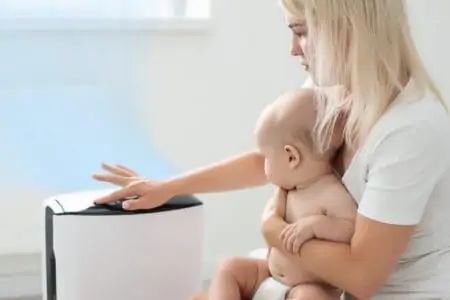
We all want our babies to breathe the cleanest air possible. But with some purifiers actually emitting harmful ozone, it’s hard to know which ones are truly safe for a nursery. We’ve done the heavy lifting to find the best options that actually work without putting your little one at risk.
Here is what we cover in this guide:
- Sizing: How to match the purifier to your room.
- Safety: What to avoid (like ozone generators).
- Performance: Getting the most clean air for your buck.
- Top Picks: Our favorite seven units for nurseries.
You’ll leave here knowing exactly which model fits your home and budget so everyone can sleep a little better.
- Air quality sensor & display
- Purification adjusted to air quality
- Built-in filter change indicator
- Freestanding or wall-mounted options
- Customize panels and filters
- Daily air cleaning schedule
- Rubber pads absorb sound & vibrations
- Low energy cost certified
- Color-coded air quality display
- Touch screen controls
- Variety of filters for customization
- CARB compliant
- Cleans up to 200 square feet
- Inexpensive for a true HEPA filtering
- Timer settings for energy saving
- Affordable
- Germ, general, & allergen settings
- Low running costs
- Doesn’t take up a lot of room
- Sits up far from children's reach
- Robust cleaning rate for its size
What to Look For
Picking a purifier isn’t just about grabbing the most expensive one. Here is what we look for to keep a baby’s room safe and clean.

Room Size
Specs will tell you the maximum square footage a machine can handle. You want to match this number to your baby’s room as closely as possible.
If you buy a unit rated for a tiny space and put it in a master bedroom, it won’t clean the air effectively. Conversely, putting a massive industrial unit in a small nursery is overkill; it will be louder, take up floor space, and waste electricity.
Here is a quick video on how to measure your space:
It’s simple math. Measure the length of two walls meeting in a corner, multiply those numbers, and you have your square footage.

HEPA Filter
HEPA stands for “high-efficiency particulate air.” To get the best results, you need a filter labeled “True HEPA.” This removes 99.97% of airborne particles 0.3 microns or larger (1). We are talking about dust, pollen, mold spores, and bacteria.
You might see filters labeled “HEPA-type” or “HEPA-style.” Skip them. These are marketing terms for inferior filters that aren’t guaranteed to capture the microscopic junk we want to get rid of.
Every air purifier on our list uses genuine True HEPA filtration.

Features
Marketing boxes are full of buzzwords, but here is what actually matters when looking at the specs.
- Clean Air Delivery Rate (CADR): This number tells you how fast the unit cleans the air. It is measured in CFM (cubic feet per minute). The higher the number, the faster it filters (2).
- Activated Charcoal Filters: These don’t catch dust; they catch smells. They are great for diaper pails, but they need to be replaced every few months to stay effective.
- Washable Pre-Filters: These sit in front of the main HEPA filter to catch big stuff like hair and lint. Being able to wash and reuse this layer saves you money and extends the life of the expensive HEPA filter.
- Child Locks: Buttons are irresistible to toddlers. A lock function ensures your settings stay put even if curious fingers get exploring.
- AHAM Verified: This mark means the Association of Home Appliance Manufacturers has independently tested the unit to confirm it actually does what the box says it does.
- UV-C Lights: Some brands claim UV light kills bacteria. However, this is rarely effective in portable home units because the air moves too fast past the light. Plus, some UV-C lights can accidentally generate ozone or contain mercury (3). We generally recommend avoiding them or keeping the feature turned off.
- Ionizers: Avoid these for nurseries. Ionizers create ozone as a byproduct, which is a lung irritant that can actually worsen asthma and respiratory issues for babies (4).

Energy Efficiency
Since you will likely run this machine for hours at a time (or 24/7), electricity usage matters. Look for the Energy Star label (5).
An Energy Star certified device meets strict efficiency guidelines, meaning you can keep the air clean without dreading your next utility bill. All units on our list meet this standard.
Noise Level
White noise can be great for babies, but a rattling fan is not. You want a unit that purrs rather than roars.
Ideally, look for a “Sleep Mode” or low setting that operates under 30 decibels. Anything louder than that might disturb light sleepers or potentially contribute to noise-related stress (6).

Budget
Don’t just look at the sticker price. You have to factor in the “cost of ownership,” which is fancy talk for how much the replacement filters cost.
A cheap machine might have expensive filters that need changing every three months, costing you more in the long run. Generally, a solid nursery purifier costs between $75 and $200 upfront, with filters costing $20 to $50 per replacement.
Product Reviews
We tested these units for noise, ease of use, and filtration speed to find the safest choices for your nursery.
Storebary Air Purifier with H13 True HEPA Filter
Best Features

The Storebary strikes a great balance between power and quiet operation. It features a three-stage filtration system that includes a True HEPA filter, making it highly effective against typical nursery pollutants.
Depending on your room size, this unit can cycle all the air through the filter up to five times an hour. We love the digital display in the center; it gives you a real-time numerical reading of your air quality. A reading of 12 or under means the air is healthy.
If you are worried about bright lights keeping the baby awake, you can turn the display off completely. It also features a child lock to protect your settings and an auto-mode that ramps the fan up or down based on current air quality sensors.
Pros
- Real-time feedback: The sensor displays air quality numbers clearly.
- Smart operation: Auto mode adjusts fan speed for you.
- Quiet sleeper: Sleep mode runs at a whisper-quiet 24.5 decibels.
- Maintenance alerts: Indicator tells you exactly when to swap filters.
Cons
- Average power: The CADR is decent but not the highest in its class.
Product Specs
| Room size | Up to 226 ft² |
| Clear air delivery rate | 150 CFM |
| Filter replacement | 2 filters per year = $24 |
| Power consumption | 144.5 kWh/year |
| Features | Child lock, timer, air quality indicator, sleep mode |
Our Ratings
RabbitAir Ultra Quiet HEPA Air Purifier
Best Versatile

If you are short on floor space, the RabbitAir MinusA2 is a lifesaver because it can be mounted directly on the wall. It’s also one of the few purifiers that tries to look good, offering “Artists Series” panels featuring everything from Van Gogh to Hello Kitty.
It uses a smart light sensor to automatically switch to sleep mode when the room gets dark, then wakes back up when the sun rises. The filtration is intense, boasting a five-stage system that you can actually customize.
Beyond the standard pre-filter and HEPA filter, you can choose a specialized filter based on your needs: Germ Defense, Pet Allergy, Odor Remover, or Toxin Absorber. Note that this unit does have an ionizer, but it can be turned completely off. We recommend keeping it off for the nursery to avoid any ozone generation (7).
Pros
- Versatile placement: Can stand on the floor or mount on the wall.
- Aesthetics: Customizable front panels look like art.
- Custom filtration: Choose specific filters for pets, toxins, or odors.
- Smart sensing: Light sensor automates sleep mode.
Cons
- Pricey: It is significantly more expensive than standard units.
Product Specs
| Room size | Up to 815ft² |
| Clear air delivery rate | 200 CFM |
| Filter cost per year | 1 filter per year = $95 |
| Power consumption | 390 kWh/year |
| Features | Customize panels and filters, mood lighting. |
Our Ratings
LEVOIT Core 400S Air Purifier
Best Smart

The Levoit Core 400S is a powerhouse for modern nurseries. It stands about 20 inches tall and is easy to move around thanks to built-in handles.
The “S” stands for smart; you can control this unit entirely from your phone using the VeSync app. This is great for checking air quality or adjusting fan speeds without opening the nursery door and risking waking the baby. It also works with Alexa and Google Assistant.
With a strong CADR of 260 CFM, it can cycle the air in a 400-square-foot room five times an hour. The auto-mode is responsive, and the dedicated sleep mode drops the noise to a barely-there 24 decibels while killing the display lights.
Pros
- Vibration dampening: Rubber pads keep it quiet on hard floors.
- Efficiency: Energy Star certified to keep bills low.
- Visual feedback: Color-coded ring shows air quality instantly.
- Remote access: Control everything via app or voice.
Cons
- Lag time: The sensor can sometimes be slow to react to new smells.
- Odor control: Better at particles than strong chemical smells.
Product Specs
| Room size | Up to 400 ft² |
| Clear air delivery rate | 260 CFM |
| Filter cost per year | 1 or 2 filters per year = $50 or $100 |
| Power consumption | 234 kWh/year |
| Features | Air quality monitor, child lock, ultra-quiet sleep mode. |
Our Ratings
LEVOIT Air Purifier for Home Allergies
Best Quiet
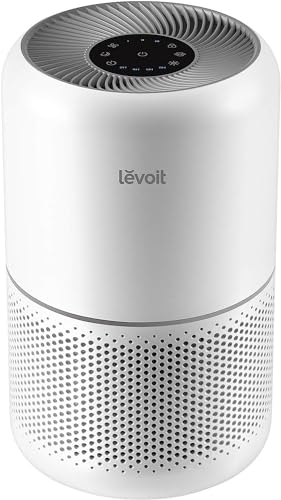
The Levoit Core 300 is one of the most popular air purifiers on the market for a reason: it’s simple, effective, and affordable. It uses a cylindrical 3-in-1 filter cartridge that pulls air from all sides.
The filtration includes a pre-filter (vacuum this every few weeks), a True HEPA filter, and an activated carbon layer for odors. It lacks the smart app features of the 400S, but the touch controls on top are easy to navigate.
You can set a timer for 2, 4, 6, or 8 hours, or just let it run. The sleep mode is exceptionally quiet at 24 decibels, quieter than a library. Plus, you can turn off the display lights so the room stays pitch black.
Pros
- Interface: Simple, intuitive touch screen.
- Flexibility: Compatible with different specialty filters (pet, toxin, etc).
- Compliance: Meets CARB standards for ozone safety.
Cons
- Learning curve: Icons can be a bit confusing at first glance.
- Basic: No air quality sensors or auto-mode.
Product Specs
| Room size | Up to 219 ft² |
| Clear air delivery rate | 140 CFM |
| Filter cost per year | 2 filters per year = $60 |
| Power consumption | 264 kWh/year |
| Features | Child lock, filter indicator, night mode. |
Our Ratings
Pure Enrichment PureZone Air Purifier
Best Energy-Efficient
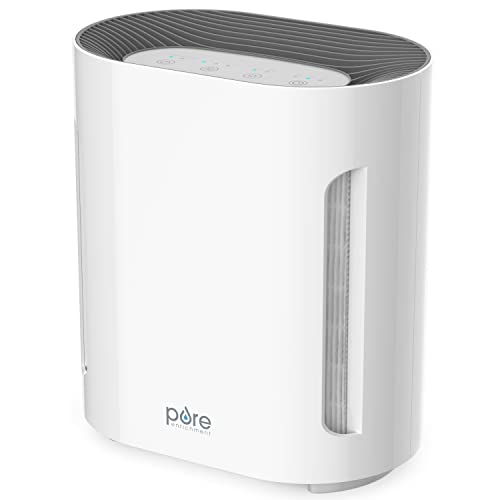
The PureZone is a compact unit perfect for small to mid-sized nurseries (up to 200 square feet). It’s small enough to sit on a dresser or shelf without dominating the room.
It uses a standard 3-stage process: activated carbon, True HEPA, and a UV-C light. As we mentioned in the buying guide, UV-C is generally not necessary for home use, but this unit allows you to easily switch that feature off if you prefer.
It handles odors surprisingly well for its size. The timer functions are handy for saving energy, allowing you to run it only during nap times or overnight.
Pros
- Compact: Fits easily in smaller rooms.
- Value: Great price point for True HEPA filtration.
- Energy saver: Timer settings help reduce electricity use.
Cons
- Maintenance: Filters need replacing roughly every six months.
- Power: Low CFM means it takes longer to clean a room.
Product Specs
| Room size | 190 ft² |
| Clear air delivery rate | 80 CFM |
| Filter cost per year | 2 filters per year = $30 |
| Power consumption | 87.6 kWh/year |
| Features | Sleep mode, timer, filter indicator. |
Our Ratings
Honeywell DH-HPA060 HEPA Air Purifier
Best Small

The Honeywell HPA060 is a tower unit designed specifically for small spaces, like a cozy nursery or a corner of your bedroom. It is rated for rooms around 75 square feet.
We have to be honest: this fan is audible. Even on the lowest setting, it produces a hum that might be distracting for some parents, though many babies actually enjoy the white noise.
It’s a basic, no-frills option. If you need something affordable to filter out allergens and dust in a small area, this gets the job done. However, if you have a larger room or need absolute silence, you might want to look at the Levoit options instead.
Pros
- Cost: Very affordable entry price.
- Settings: Specific modes for germs and allergens.
- Efficiency: Low impact on your electric bill.
Cons
- Noise: Noticeably louder than competitors.
- Upkeep: Frequent filter changes can add up if run 24/7.
Product Specs
| Room size | 75ft² |
| Clear air delivery rate | 60 CFM |
| Filter cost per year | 6 x filter one, 1 x filter two = $120 per year |
| Power consumption | 123 kWh/year |
| Features | Filter replacement light. |
Our Ratings
BLACK+DECKER Tabletop Air Purifier
Best Affordable

This Black+Decker model is tiny, just 12 inches tall and five pounds. It’s designed to sit on a tabletop or shelf, keeping it safely out of reach of crawling babies.
Despite the size, it works well in rooms up to 93 square feet. It offers four fan speeds, including a sleep mode that dims the lights. If you want a nightlight, you can leave the soft glow on; if not, you can go dark.
One quirk to note: the “replace filter” alert is an audible beep rather than just a light. While effective at getting your attention, it can be annoying if it goes off while the baby is sleeping.
Pros
- Footprint: Takes up almost no space.
- Safety: easy to place on high shelves away from kids.
- Performance: Good cleaning rate for a tabletop unit.
Cons
- Cost: High filter replacement costs relative to the unit price.
- Annoyance: The beeping filter alarm is aggressive.
Product Specs
| Room size | 93 ft² |
| Clear air delivery rate | 66 CFM |
| Filter cost per year | 4 filters per year = $120 |
| Power consumption | 82.1 kWh/year |
| Features | Child lock, touch control, sleep setting. |
Our Ratings
| Product | Best | Room size | Clear air delivery rate | Filter replacement | Power consumption | Features |
|---|---|---|---|---|---|---|
| Storebary Air Purifier with H13 True HEPA Filter | Best Features | < 226 ft² | 150 CFM | 2 filters per year = $24 | 144.5 kWh/year | Child lock, timer, air quality indicator, sleep mode |
| RabbitAir Ultra Quiet HEPA Air Purifier | Best Versatile | < 815ft² | 200 CFM | 1 filter per year = $95 | 390 kWh/year | Customize panels and filters, mood lighting. |
| LEVOIT Core 400S Air Purifier | Best Smart | < 400 ft² | 260 CFM | 1 or 2 filters per year = $50 or $100 | 234 kWh/year | Air quality monitor, child lock, ultra-quiet sleep mode. |
| LEVOIT Air Purifier for Home Allergies | Best Quiet | < 219 ft² | 140 CFM | 2 filters per year = $60 | 264 kWh/year | Child lock, filter indicator, night mode. |
| Pure Enrichment PureZone Air Purifier | Best Energy-Efficient | 190 ft² | 80 CFM | 2 filters per year = $30 | 87.6 kWh/year | Sleep mode, timer, filter indicator. |
| Honeywell DH-HPA060 HEPA Air Purifier | Best Small | 75ft² | 60 CFM | 6 x filter one, 1 x filter two = $120 per year | 123 kWh/year | Filter replacement light. |
| BLACK+DECKER Tabletop Air Purifier | Best Affordable | 93 ft² | 66 CFM | 4 filters per year = $120 | 82.1 kWh/year | Child lock, touch control, sleep setting. |
Tips for Using Air Purifiers in a Baby’s Nursery
To get the most out of your machine, placement and maintenance are key.
- Give it space: Air purifiers need to breathe. Place them at least a foot away from walls or furniture so they can pull air in freely. Putting it smack in the corner limits its efficiency.
- Keep it running: Air quality drops fast when the fan stops. It is best to leave the unit running on “auto” or “low” 24/7 rather than turning it on and off.
- Seal the room: It works best if you aren’t constantly letting new pollen in. Keep windows closed when the purifier is running.
- Vacuum the pre-filter: If your model has a permanent pre-filter (the mesh screen on the outside), vacuum it once a month. This keeps airflow high and extends the life of the expensive HEPA filter inside.
FAQs

Do air purifiers help babies sleep?
They can. While their primary job is cleaning the air, the “white noise” hum of the fan can help mask household sounds (like a barking dog or TV), helping the baby stay asleep longer. Additionally, reducing nasal congestion from allergens can help a baby breathe easier and sleep more comfortably.
Where should I place the air purifier in the nursery?
Place the purifier where it has the best airflow, usually a few feet away from walls or corners. However, ensure it is not blowing cold air directly onto the crib, as the draft can make the baby uncomfortable. Also, keep cords safely tucked away to prevent tripping or strangulation hazards.
Are ionizer air purifiers safe for babies?
No, we generally recommend avoiding ionizers for nurseries. Ionizers work by electrically charging particles, but a byproduct of this process is ozone. Ozone is a known lung irritant that can be harmful to developing lungs, potentially worsening asthma or causing respiratory irritation. Stick to mechanical filtration like True HEPA.