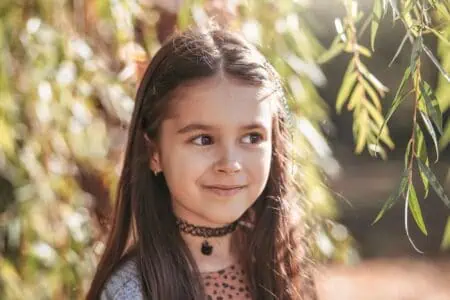
Many parents want their children to feel connected to nature and need a good place to start. Tree-inspired baby names are a great option since they represent resilience, growth, and strength. That’s why we’ve collected some of the best evergreen epithets from around the world.
Leaf behind the stresses of the modern world and prepare for a grounding outdoor adventure! As you dig through our list of tree baby names, you’ll find favorites like Aspen and Fern.
Whether you’re a sap for tradition or want to branch out into uncharted forests, read ahead for the perfect “poplar” pick!
100 Popular Tree Baby Names
Put down roots with these timeless tree names for babies.
Aase
Mountains and evergreens — Aase isn’t a lightweight regarding tree names for girls. But the alternative spelling, Åse, is more popular as a given name. Notably, it belongs to Agneta Åse Fältskog, one of the singers and songwriters for ABBA. Since many countries are “finicky” with special characters, Aase is preferable for written English.
- Origin: Norwegian, Danish
- Meaning: Tree-covered mountain, ridge
- Pronunciation: OH-seh, OH-suu
- Variations: Åse
- Namesakes: Hannah Caroline Aase, an American botanist and cytologist.
- Popularity: Aase is most popular in Denmark and Norway, where it last ranked 94th in 1957.
Acacia
Acacia is a Greek term used in the Bible and may have referred to the shittah tree in Hebrew. Acacia comes from the Greek element “ake,” meaning “thorn” or “point.” Because this tree grew so well in the wilderness and produced large boards, it was used to build the tabernacle. Acacia has some seriously spiritual roots!
- Origin: Greek
- Meaning: Thorny tree
- Pronunciation: uh-KAY-shuh
- Namesakes: Acacia Kersey, née Brinley, an American singer and lead vocalist for the band Watercolor.
- Popularity: In England and Wales, Acacia placed 973rd for the final time in 2011.
Acton
Acton sounds like it should be preceded by the title “Lord,” and in cases where it was a surname, it sometimes was. John Emerich Edward Dalberg-Acton was a baron and marquess commonly called Lord Acton. This refined moniker has Old English roots with “āc,” meaning “oak,” and “tūn,” meaning “enclosed garden,” and later, “settlement.”
- Origin: English
- Meaning: Oak tree settlement, oak town
- Pronunciation: AK-tn, AK-tun
- Namesakes: Acton Smee Ayrton, a British barrister and Liberal Party politician.
- Popularity: Acton is borne by just over 700 people worldwide.
Alba
Alba disappeared from U.S. charts after 1923 but remained a favorite in other countries. Although somewhat vintage in the west, there was a Spanish TV series called Alba. While it means “dawn” in Spanish and Italian, and in Latin, it means “white,” it’s also a species of tree. The white mulberry, or silkworm mulberry, is known as Morus alba.
- Origin: Latin, Italian, Spanish
- Meaning: White, dawn
- Pronunciation: AL-ba, AL-buh, AAL-buh
- Namesakes: Alba Bautista, a Spanish rhythmic gymnast. Alba Mujica, née Mugica, an Argentinian film and stage actress. Alba August, a Danish-Swedish actress and singer.
- Popularity: In 2021, Alba ranked 18th in Spain, 145th in England and Wales, and 8th in France.
Alder
Meant to distinguish between two people with the same name, Alder is a German variant of Alter, meaning “older.” It certainly adds an air of maturity. Alder is also the English term for a tree in the birch family. These trees consist of many types, including the black alder, gray alder, white alder, and Japanese alder.
- Origin: German, English
- Meaning: Older, Alder tree
- Pronunciation: AAL-dur, AL-dur
- Popularity: Alder is most popular in Israel, with about 5,017 bearers worldwide.
Almendra
There are about 1,506 bearers of Almendra worldwide, and it doesn’t have much of a following, even in Spanish-speaking territories. Almendra is ultimately of Latin origin and means “almond” in Spanish. The almond is a tree species native to Iran and surrounding countries. It also refers to the edible seed of the almond drupe.
- Origin: Spanish
- Meaning: Almond
- Pronunciation: al-MEN-dra
- Popularity: Almendra is most popular in Mexico but doesn’t make the top 1,000 names there. It ranked once in Chile at 100th in 2010.
Amaranth
Amaranth is a type of flower that gets its title from the Greek Amáranthos. This floral pick was the basis for streamer Kaitlyn Siragusa’s username, Amouranth. Her catchy play on the words “amour” and “amaranth” has brought attention to this rare epithet. If Amaranth looks too extravagant, simply make it a middle name instead, or try the nickname Amara.
- Origin: Greek
- Meaning: Unfading, everlasting
- Pronunciation: A-muh-ranth
- Variations: Amaranthus, Amaranthe
- Popularity: Amaranth has about 70 bearers globally and doesn’t make the U.S. top 1,000.
Anthea
Anthea or Antheia stems from the Greek “anthos” meaning “flower” or “blossom.” This was an epithet of the Greek goddess Hera, sister-wife of Zeus and queen of the Olympian gods. Anthea is perfect for a sweet girl teeming with life.
- Origin: Greek
- Meaning: Flower, blossom
- Pronunciation: AN-thee-uh
- Namesakes: Anthea Mary Fraser, a British mystery thriller novelist. Anthea Turner, an English TV presenter. Anthea Askey, an English actress and daughter of comedian and actor Arthur Askey.
- Variations: Antheia
- Popularity: Anthea is most prevalent in South Africa and England.
Arar
Paint the town yellow with Arar, a botanical choice that means wild daffodil. Although it takes on a more floral meaning, Arar or Araar is also a term for the Tetraclinis, a genus of evergreen conifers. If you’d like to pay homage to your ancestry or bring home a memory from vacation, Arar is a fun option.
- Origin: Arabic
- Meaning: Wild daffodil, Lent lily
- Pronunciation: ar-AAR
- Variations: Araar
- Namesakes: Mustafa Wahbi Tal, pen name Arar, a prominent Jordanian poet and writer.
- Popularity: Arar is most popular in India and Jordan, with about 685 bearers worldwide.
Arvid
Arvid comes from the Old Norse Arnviðr, consisting of the elements “ǫrn” meaning “eagle,” and “viðr” meaning “tree.” It may refer to a woodland where eagles nest. In the TV series Norsemen, Arvid is a Viking warrior who becomes the chieftain of Norheim village. Heroic-sounding Arvid is best for boys who will grow up to be tough.
- Origin: Old Norse
- Meaning: Eagle tree, eaglewood
- Pronunciation: AAR-vid
- Variations: Arved, Arnvid
- Namesakes: Arvid Carlsson, a Swedish neuropharmacologist and Nobel laureate. Salomon Arvid Lindman, a Swedish rear admiral and a former prime minister of Sweden.
- Popularity: Arvid is the most popular in Sweden, where it ranked 15th in 2022. In Norway, it last placed 93rd in 1963.
Ash
Ash derives from the Old English word “æsc.” It’s usually a diminutive of Ashley, meaning “ash tree clearing,” Ashton meaning “ash tree town,” or the Hebrew Asher meaning “happy.” In Norse myth, the ash was a tree of life called Yggdrasil, from which the first man came. Despite its simplicity, Ash is a classic on any list of tree baby names.
- Origin: English, Hebrew
- Meaning: Ash tree, happy
- Namesakes: Ash Atalla, an Egyptian-British TV producer. Ash Amin, a Ugandan-born British academic.
- Popularity: Ash is rising on U.S. charts but falls short of the top 1,000 names.
Aspen
Aspen is a whispery option from the Old English “æspe.” It refers to the aspen tree, a symbol of serenity known for its trembling leaves and slender white or gray trunk. It’s no wonder this epithet is taking off. Even celebrities like TV personality Erica Rose Sanders chose Aspen for her daughter. Call to mind tall, alpine forests with the lovely Aspen.
- Origin: English
- Meaning: Aspen tree, quaking tree
- Pronunciation: AZ-pen, AS-pn
- Variations: Aspin, Aspyn
- Namesakes: Aspen Ladd, an American mixed martial artist. Aspen Vincent, née Miller, an American Broadway actress and singer. Aspen Mays, an American artist.
- Popularity: There are about 1,981 people called Aspen worldwide, and in 2021, it peaked at 201st for girls on U.S. charts.
Baobab
Baobab will probably take a while to go mainstream. It refers to a water-storing tree native to Africa, Australia, and Madagascar, nicknamed The Tree of Life. Baobab is thought to stem from the Arabic “bu hibab,” meaning “fruit with several seeds.” Like these camels of the plant world, baby Baobab may be just as resourceful and long-lived.
- Origin: Arabic
- Meaning: Fruit with several seeds
- Pronunciation: BAY-oh-bab, BAHW-bab
- Popularity: Baobab is most popular in the Democratic Republic of Congo, with about 224 bearers worldwide.
Barbosa
Beyond being a popular Portuguese surname, Barbosa is primarily masculine but occasionally used for girls. It’s a topographic epithet denoting someone who lived on land with overgrown leafy foliage. Barbosa comes from the Portuguese word “barba,” meaning “a type of plant” or “leaf,” and the descriptor “oso/osa,” meaning “place rich in.” Bring home a baby Barbosa.
- Origin: Portuguese
- Meaning: Place abundant in plants/trees
- Pronunciation: BAAR-bohz, BAAR-bohz-uh
- Variations: Barbossa, Barboza
- Popularity: Barbosa is the most prevalent in Brazil and Portugal, with about 659 bearers worldwide.
Beech
Beech possibly comes from the Old English “bec,” referring to someone who lived near a beech tree or beech orchard. It might also stem from “baec,” meaning “small river” or “stream.” Just as flowing water is a source of life, the beech tree symbolizes protection and nurturing. That feeds into its nickname: Queen of Mother of the Woods.
- Origin: Old English
- Meaning: Beech tree
- Namesakes: Hannah Beech, an American journalist.
- Popularity: Beech is most prevalent in the U.S. but doesn’t crack the top 1,000 names.
Birch
Although Birch is historically male, it has become a sunny gender-neutral option for nature-loving parents. With just about 547 bearers globally, Birch is the right amount of special. It describes a small to medium-sized hardwood tree with thin leaves. According to folklore, the birch has “eyes” that help to guide travelers through the forest.
- Origin: English
- Meaning: Birch tree
- Pronunciation: BURCH
- Namesakes: Birch Evans Bayh Jr., an American Democratic Party politician and former U.S. senator. Birch Wilson, an American political activist and newspaper editor.
- Popularity: Birch is most prevalent in the U.S. but doesn’t make the top 1,000 names.
Björk
To westerners, Björk could appear quite masculine, but this uncommon tree-themed epithet is 100% feminine. It originates from Iceland and Sweden, with Faroese, Norwegian, and Danish variants. Give your sweetheart’s Scandinavian heritage the spotlight, whether you make Björk her first or second name. If her celebrity namesakes are any indication, she’ll also have the voice of an angel.
- Origin: Scandinavian
- Meaning: Birch (tree)
- Pronunciation: BYORFK, BYORK
- Variations: Bjørk, Björck, Biörck, Bjork
- Namesakes: Hera Björk Þórhallsdóttir, an Icelandic singer. Björk Guðmundsdóttir, an Icelandic singer-songwriter, record producer, and actress.
- Popularity: There are less than 200 people named Björk worldwide.
Bonsai
Bonsai comes from the East Asian art form of growing miniature shrubs or trees in a pot. The word is a combination of the Middle Chinese “bwon” meaning “bowl” and “tsoj” meaning “to plant.” Through adoption by the Japanese, the characters became “bon” meaning “tray” or “pot,” and “sai” meaning “to plant” or “to cultivate.” Bonsai breathes history and culture.
- Origin: Japanese
- Meaning: Planted in a container, to plant in a bowl
- Pronunciation: BON-seye, BON-zeye
- Popularity: About 65 people are called Bonsai globally.
Cedar
Cedar originates from the Latin “cedrus” and the Greek “kedros.” It’s the English term for a majestic cone-bearing tree native to the Himalayas and the Mediterranean. The cedar symbolizes strength, nobility, and eternal life. This is a perfect modern option to pair with another tree-related name that starts with C. Twins? How does Cedar and Cypress sound?
- Origin: English, Greek, Latin
- Meaning: Cedar (tree)
- Pronunciation: SEE-der, SEE-duh
- Variations: Cedre, Ceder, Seder
- Namesakes: Cedar Prest, an Australian stained glass artist. Cedar Sigo, a Native American writer. Cedar Walton Jr., an American jazz pianist.
- Popularity: Cedar has about 1,769 global bearers.
Celtis
Celtis sounds like you would find it in a book full of elves, kings, and magic. It’s a Latin word that refers to a species of medium-sized seasonal trees, commonly called nettle trees or hackberries. In the Latin Vulgate, “celtis” was misused in the sense of a “chisel,” whereas the correct word was “certē.” Certainly, one to consider.
- Origin: Latin
- Meaning: Hackberry tree
- Pronunciation: SEL-tiss
- Variations: Celtes
- Popularity: Celtis is extremely rare, with about five bearers worldwide.
Chinar
Chinar can be traced to both the Hindi “cinār” and the Urdu “činar” from the Persian root “čenâr,” the term for the oriental plane tree. In modern Turkish, the related “çınar” means “plane tree.” Globetrotting parents might know of the Char-Chinar, an island marked with a chinar tree at each of its four corners. Try the far-flung and fresh Chinar.
- Origin: Urdu, Indian, Persian
- Meaning: Beautiful tree, poplar
- Pronunciation: CHIH-nar
- Variations: Chenar
- Popularity: Chinar is most popular in Afghanistan, with about 4,897 bearers worldwide.
Citrus
Add the right amount of sourness to your sweetheart with the feisty Citrus. This Latin word refers to the citron fruit (historically cedrate) and the thuja conifer tree. Citrus plants have been well-documented throughout history. According to Rabbinic tradition, the citron was referred to in Leviticus as the “fruit of the beautiful (hadar) tree.”
- Origin: Latin
- Meaning: Citron fruit, thuja (tree)
- Pronunciation: SIT-russ, SIT-rss
- Popularity: Citrus doesn’t appear on U.S. charts as it is quite rare, with about 83 known bearers worldwide.
Clematis
Clematis comes from the Greek word “clēmatís” meaning “climbing plant,” from the root “klema” meaning “twig,” “tendril,” or “branch.” It describes a genus of 380 species of woody, flowering vines in the buttercup family. If you’re looking for floral tree-related options, why not give Clematis its moment in the sun? Maybe with a push, it could climb higher on the charts.
- Origin: English, Greek
- Meaning: Vine branch, climbing plant
- Pronunciation: KLEH-muh-tiss
- Popularity: Clematis is mostly used in the U.S., with about 33 international holders.
Colby
Colby feels modern despite its ancient origins. Colby could be for you if you ever wondered where charcoal comes from. This one gets into the chemistry of carbonizing bark. It comes from the Old Norse nickname Koli, meaning “coal” or “dark” and “býr” meaning “town.” Colby crept onto U.S. charts from about 2003 but fell to 650th in 2021.
- Origin: Old Norse
- Meaning: Coal town/settlement
- Pronunciation: KOHL-bee
- Variations: Colbie
- Namesakes: Colby Mitchell Chester, a U.S. Navy admiral. Colby Minifie, an American Broadway, TV, and film actress. Colby Corino, an American professional WWE wrestler.
- Popularity: Colby peaked in the U.S. at 99th in 2001.
Coriander
Coriander gets your nose tickling with just a mention. This herb was named for its strong fragrance. The Greek word for coriander, “koríannon” from “koris,” was related to bedbugs, as they were thought to have a similar scent. In DC Comics superhero fiction, risqué Starfire’s true Tamaranean moniker is inspired by the coriander spice. Koriand’r is an intentional personality-based pun.
- Origin: Greek
- Meaning: Bed bug, spice
- Pronunciation: KOR-ee-AN-duh, KOR-ee-AN-dur
- Popularity: About 58 people are called Coriander around the world.
Cypress
The English Cypress comes from the Greek word “kuparisso.” Cypress is popping with parents in celebrity circles — and for a good reason. These evergreen conifers withstand harsh conditions and challenging environments, qualities every parent wishes for their child. With its dark green foliage pointing heavenward, the cypress has symbolized mourning, death, and remembrance since classical antiquity.
- Origin: Greek, English
- Meaning: Cypress tree
- Pronunciation: SEYE-press, SEYE-priss
- Namesakes: Cypress Soleil Lee, the daughter of American rapper Solé. Cypress Huston, the daughter of British actor Jack Huston and American model Shannan Click.
- Popularity: Cypress is most popular in the U.S., where it falls just shy of the top 1,000 names.
Dahlia
Dahlia takes its title from the Swedish botanist Anders Dahl, whose name is a variation of the Scandinavian surname Dal, meaning “valley.” These fluffy flowers are eye-catching perennials indigenous to Mexico and Central America. Symbolizing beauty and grace, Dahlia is fairly popular in many cultures and continues to climb on U.S. charts. Add some variety to your garden with Dahlia.
- Origin: Swedish, English
- Meaning: Valley flower
- Pronunciation: DAH-lee-uh
- Namesakes: Dahlia Lithwick, a Canadian-American attorney and author. Dahlia Ravikovitch, an Israeli poet, translator, and peace activist.
- Popularity: Dahlia appeared on U.S. charts in 2006 and peaked at 309th in 2021.
Ebony
Ebony is the Anglicized form of the ancient Greek “ebenos,” referring to a tree species that produces black wood. It’s highly valued for ornamental purposes. This epithet is often associated with African American culture, but it has seen better days on U.S. popularity charts. Still going strong in England and Wales, Ebony ranked 536th in 2021.
- Origin: Greek, English
- Meaning: Blackwood
- Pronunciation: EH-buh-nee
- Variations: Eboni
- Namesakes: Ebony Thomas, an American writer and educator. Ebony Jo-Ann, an American actress, known for her role in the movie Grown Ups. Ebony Alleyne, an English R&B and soul singer.
- Popularity: Ebony placed 961st in 2005 before disappearing from U.S. charts.
Elan
Elan can be taken as an Anglicized form of the more well-known Hebrew Elon, meaning “oak tree” or “big tree.” But it’s also Native American, possibly Apache in origin. If you’d like your baby to grow as big and strong as an oak, plant that seed with Elan.
- Origin: Native American, Hebrew
- Meaning: Friendly, big tree, oak tree
- Pronunciation: EH-lan, EH-lahn
- Variations: Elon, Ilan
- Namesakes: Elan Atias, an American reggae singer-songwriter.
- Popularity: Elan doesn’t crack the U.S. top 1,000 names, but there are about 27,953 bearers globally.
Elder
Elder refers to the elder tree and stems from the Old English word “ealdra” meaning “older” — pretty fitting for a first child. Elder might also be a variation of the Portuguese Hélder, possibly meaning “hell’s door.” Christianity influenced pagan myths surrounding the elder tree. Burning its wood summoned the devil, but planting it near your house warded him off. Spooky!
- Origin: English
- Meaning: Elder tree, revered one, older
- Pronunciation: EL-dur, EL-duh
- Variations: Élder
- Namesakes: Elder Herrera, a Colombian road cyclist. Elder Olson, an American poet and literary critic. Elder Lafayette White, an American professional baseball player.
- Popularity: Elder was most popular in the U.S. in 1900 at 801st and ranked for the last time in 1910 at 998th.
Elmore
Elmore was initially a surname derived from Old English elements. It’s composed of either “elm,” meaning “elm (tree)” or “ellern,” meaning “alder (tree).” The second half might be “mor,” meaning “marsh” or “fen,” “fer,” meaning “river bank,” or “ofer,” meaning “ridge.” Elmore is a little tricky to pin down, but it certainly has a classic ring.
- Origin: Old English
- Meaning: Elm ridge, riverbank with elm trees
- Pronunciation: EL-mawr, EL-maw
- Namesakes: Elmore Hutchinson, a Jamaican-born American cricketer. Elmore Smith, an American professional basketball player. Elmore Leonard Jr., an American author and screenwriter.
- Popularity: In the U.S., Elmore ranked for a final time in 1949 at 915th.
Elon
Complete your list of traditional tree names for boys with Elon. Modern western interest likely comes from admiration for the indomitable entrepreneurial spirit of namesakes like Elon Musk. The Bible also cites several men called Elon, one of whom was a judge of Israel. Its biblical relevance might be why Elon remains popular in Israel, ranking 44th in 2020.
- Origin: Hebrew
- Meaning: Oak tree, big tree
- Pronunciation: EE-lon
- Variations: Alon, Elan, Ilan, Eilan, Eilon
- Namesakes: Elon Ganor, an Israeli entrepreneur and businessman. Elon Musk, a South African business tycoon and investor.
- Popularity: In the U.S., Elon ranked 940th in 2018 and 952nd in 2021.
Elowen
Elowen combines the Cornish “elvan,” meaning “elm,” and “wyn/wen,” meaning “blessed” or “white.” Because it wasn’t widely used outside of Cornwall, Elowen wasn’t officially registered as a given name in England until 1997. That might explain why it has been slow to gain traction. If you have any Cornish heritage, why not pay tribute with Elowen?
- Origin: Cornish
- Meaning: Elm tree
- Pronunciation: el-OO-en, EL-oh-win
- Variations: Elowyn, Elowynn
- Popularity: Elowen first made the charts in England and Wales in 2017 and was 734th in 2021.
Farina
Farina is popular in several Romance languages, like Italian and Spanish. It comes from the Latin “farina” meaning “wheat flour,” possibly used as a metonymic (referring to a concept with a related word). It usually described someone working as a miller or flour merchant. Wheat and other grains represent bounty and fertility, so Farina is well-suited for parents with a full house.
- Origin: Latin, Persian
- Meaning: Wheat flour, kind, merciful
- Pronunciation: FA-ree-nah, fuu-REE-nuh
- Variations: Fareenaa
- Namesakes: Farina Franco, stage name Farina, a Colombian rapper and singer-songwriter.
- Popularity: Farina is the most prevalent in Pakistan.
Fern
Of all the names that mean tree, Fern paints the greenest picture. These diverse and widely distributed leafy plants are synonymous with forests and woodlands across the globe. New Zealand alone has over 200 species. From the Anglo-Saxon word “fearn,” Fern has historically been feminine worldwide, with only occasional use for boys.
- Origin: Old English
- Meaning: A fern
- Pronunciation: FURN
- Namesakes: Fern Britton, an English author and TV presenter. Fern G. Z. Carr, a contemporary Canadian poet. Fern Emmett, an American film actress.
- Popularity: Fern is most popular in the U.S. but fell off the charts after ranking 819th in 1961.
Fir
Fir refers to an evergreen coniferous (cone-bearing) tree species in English. The occupational surname Fir derives from the German word “feuer,” meaning “fire.” This was a metonymic for someone who worked with fire, like a smith or fire lighter. Fir may also be an Arabic feminine epithet meaning “sharp weapon.”
- Origin: English, German
- Meaning: Fir tree, fire
- Pronunciation: FUR
- Popularity: Fir is most popular in India and the United Arab Emirates.
Flora
Flora derives from the Latin words “flos” and “florus,” and was the name of an ancient Roman goddess of flowers, spring, and fertility. In English, “flora” refers to plants, from weeds to trees and everything in-between. Flora is a break from the more outright tree names for baby that stays relevant to the theme.
- Origin: Latin
- Meaning: Flower
- Pronunciation: FLAW-rah, FLAH-ruh
- Variations: Flor, Florah, Fleur
- Namesakes: Flora Coquerel, a French model and pageant titleholder. Flora Twort, an English watercolor painter. Flora Brovina, a Kosovar-Albanian poet and women’s rights activist.
- Popularity: In 2021, Flora ranked 647th in the U.S. and 220th in England and Wales.
Florencia
Florencia is a Spanish form of the Latin Florentius — a moniker full of new life and possibilities. It has become somewhat antique in its homeland but remains a popular option in several other Spanish-speaking countries. This is one of the fancier-sounding options on our list of names meaning tree. For parents craving exotic flair, Florencia is just the right fit.
- Origin: Latin, Spanish
- Meaning: Blossoming, flourishing
- Pronunciation: FLAWR-en-see-ah
- Variations: Florentius, Florentia, Florence
- Namesakes: María Florencia Mutio, an Argentinian field hockey player and Olympic silver medalist. Florencia Lozano, an American actress.
- Popularity: Florencia was last seen in 1960 at 367th in Spain but ranked 11th in Chile in 2021.
Forrest
Forrest and Forest are deeply rooted in Anglo-Norman (English and French) origins as a given name and surname. This habitational moniker indicated someone living near or in a forest. Despite a decline in use in the later part of the 20th-century, Forrest has experienced a resurgence. In 2021, it ranked 556th in England and Wales and 414th in the U.S.
- Origin: Anglo-Norman
- Meaning: Of the woods, a large area covered by trees
- Pronunciation: FO-rest, FO-rist
- Variations: Forest
- Namesakes: Forrest Griffin, an American mixed martial artist and UFC Champion. Forrest Meredith Tucker, an American actor. Forrest Kline, an American musician and lead vocalist for the band Hellogoodbye.
- Popularity: Forrest disappeared from U.S. charts in 2003 but reappeared in 2013, ranking 834th, and has continued gaining momentum.
Geneva
Geneva is a derivative of the French Genève, pronounced “zhuh-NEHV,” and the name of Switzerland’s second-most populated city. It has been adopted by English-speaking cultures, possibly for its similarity to Genevieve. Geneva doesn’t only sound beautiful, it also means “juniper tree,” which symbolizes protection.
- Origin: French
- Meaning: Juniper tree, juniper berry
- Pronunciation: juh-NEE-vuh
- Variations: Genève
- Namesakes: Geneva Carr, an American TV and stage actress. Geneva Cruz, a multi-platinum Filipina singer. Geneva Mercer, an American artist.
- Popularity: Geneva is most popular in the U.S. and was last seen on U.S. charts in 1995 at 987th.
Ginkgo
Ginkgo is a Chinese flowering tree with fan-shaped leaves often used in medicine. It was originally derived from the Chinese “yājiǎo” meaning “duck feet,” referring to the leaves. The pronunciation and characters eventually changed to “yinxing,” meaning “silver apricot,” and passed into the Japanese language as “gin kyo.” Ginkgo is likely an English misspelling of the Japanese pronunciation.
- Origin: Chinese, Japanese, English
- Meaning: Silver apricot
- Pronunciation: GING-koh
- Variations: Gingko
- Popularity: Ginkgo is extremely rare, with about 19 recorded bearers worldwide.
Grimshaw
For fans of darker descriptors, Grimshaw is the ideal choice. It might stem from the Old Norse personal name Grímr, derived from “grimmr” meaning “grim” or “cruel.” This was connected to the Old Icelandic “gríma,” meaning “mask” or “helm.” More likely, though, it comes from the Old English “grīma,” meaning “specter” or “goblin,” and “sceaga,” meaning “copse” or “woods.”
- Origin: Anglo-Saxon
- Meaning: Grim’s woods, dark woods
- Pronunciation: GRIM-shaw
- Variations: Grimshawe
- Popularity: Grimshaw is mostly found in the U.S., with about 17 bearers worldwide.
Grover
Putting aside that funny blue monster from Sesame Street, Grover is quite a dignified option. It was originally an English surname derived from the Old English “graf,” meaning “grove of trees.” From lawyers to presidents, many high achievers carried this moniker. Get creative as you imagine the heights your young Grover will grow to reach.
- Origin: English
- Meaning: Dwells near the grove
- Pronunciation: GROHW-vur, GROH-vur
- Namesakes: Stephen Grover Cleveland, an American lawyer and the 22nd and 24th U.S. president. Grover Sellers, an American attorney-general of Texas.
- Popularity: Grover last ranked 949th in 1974 on U.S. charts.
Gwydion
Gwydion fab Dôn was a wizard and trickster from Welsh mythology and the Mabinogi, who made his nephew a wife from flowers. Gwydion pairs the Old Welsh “guid” meaning “trees” with “gen” meaning “born of.” In the video game Red Dead Redemption 2, Gwydion is the magician and conman Josiah Trelawny’s horse. A clever nod to the Welsh myth.
- Origin: Welsh
- Meaning: Born of trees
- Pronunciation: GWIH-dee-un, GWIH-dee-on
- Namesakes: Thomas deLong, known as Gwydion Pendderwen, an American musician and witch. Gwydion Brooke, an English principal bassoonist for the Royal Philharmonic Orchestra.
- Popularity: Gwydion is most popular in England and Wales, but there are only about 71 bearers globally.
Hadassah
Hadassah is a traditional Jewish tree-themed choice for parents expecting a little elegant queen. In the Bible, Hadassah, the cousin of Mordecai, was called by the Persian name Esther after becoming Queen of Persia. Jewish communities continue to use Hadassah, and it has gained mainstream interest. Let your fragrant myrtle blossom with a pretty pick like Hadassah.
- Origin: Hebrew
- Meaning: Myrtle
- Pronunciation: huu-DA-sah
- Variations: Hadasa
- Namesakes: Hadassah Epstein, a Jerusalem-born American dancer, choreographer, and instructor. Hadassa Rosensaft, a Polish survivor of the Holocaust. Hadassah Lieberman, the wife of former U.S. Senator Joe Lieberman.
- Popularity: Hadassah appeared on U.S. charts in 2007 at 998th and was 697th in 2021.
Hanako
Hanako is an adorable option composed of the Japanese characters for “hana,” meaning “flower,” and “ko,” meaning “child.” Despite being a primarily female epithet, Hanako has also been used for males. A fictional example is the ghost boy Hanako from the manga and anime Toilet-bound Hanako-kun. Call to mind any number of flowering trees with Hanako.
- Origin: Japanese
- Meaning: Flower child
- Pronunciation: HA-NA-KOH
- Namesakes: Hanako Muraoka, a Japanese translator known for translating Anne of Green Gables into Japanese. Hanako Footman, a British actress.
- Popularity: Hanako is the most popular in Japan, ranking in the top 1,000 names.
Hawthorn
Hawthorn is transferred from a surname and derives from the Old English “haga” meaning “hedge” and “thorn” meaning “thorn bush.” A hawthorn is a type of small tree with thorny branches, red berries, and aromatic flowers. This shrub is known for its endurance in harsh conditions. Nothing’s cooler than a tough kid called Hawthorn rocking a nickname like Thorn.
- Origin: English
- Meaning: Lives near a thorn hedge, where hawthorns grow
- Variations: Hawthorne
- Popularity: Hawthorn is quite rare, with less than 40 bearers worldwide.
Hayma
Hayma is more prevalent in Oman, the Philippines, and Central and South America than its birthplace of Myanmar (Burma). This exotic option is great for outdoorsy parents since it means “forest” or “deep forest.” Occasionally, Hayma is used for boys, as with Native American TV producer and executive Hayma Washington. Still, Hayma is a gorgeous tree-inspired pick for any baby girl.
- Origin: Burmese
- Meaning: Forest
- Pronunciation: HAY-muh
- Namesakes: Hayma Malini, the Singaporean wife of Indian actor and singer Yugendran.
- Variations: Haymar
- Popularity: Hayma is popular in the Philippines, India, and Oman, with about 502 bearers globally.
Hazel
Hazel is from the Old English “hæsel,” and has Germanic roots. It describes a genus of hazelnut-bearing shrubs or trees, and a greenish or reddish-brown pigment. It was once a surname for someone living near a hazel tree or grove or from a place called Haesel. Nowadays, Hazel is commonly used for girls but also fairly popular for boys.
- Origin: Old English
- Meaning: Hazel (tree or color)
- Pronunciation: HAY-zl
- Namesakes: Hazel Court, an English actress. Hazel Findlay, a British climber and mountaineer. Hazel Schmoll, an American botanist.
- Popularity: In 2021, Hazel ranked 28th in the U.S. and 147th in England and Wales. In 2022, it ranked 11th in New Zealand.
Hemlock
Most recognize Hemlock as the poison or wild hemlock, but only a few know of the eastern or Canadian hemlock. This coniferous plant is Pennsylvania’s state tree. Hemlock comes from the Old English word “hemlic” from the Proto-Germanic word “hamuljan” meaning “hooked,” referencing the shape of its leaves. Add Hemlock to your list of tree names for baby.
- Origin: English
- Meaning: Poisonous plant, hemlock plant
- Pronunciation: HEM-lok
- Popularity: Hemlock is most prevalent in the U.S., with about 15 bearers globally, but it doesn’t appear in the top 1,000 names.
Hideki
Hideki can be written with the kanji for “excellence” or “superior” and “timber trees.” In Japanese culture, trees hold significant symbolism and are often associated with resilience, flexibility, growth, and longevity. Hideki isn’t as common in the west, so it would make a unique and distinctive choice. You could even use a cute nickname like Hide (HEE-deh).
- Origin: Japanese
- Meaning: Bright tree, excellent tree
- Pronunciation: HEE-DEH-KEE
- Namesakes: Hideki Arai, a Japanese manga artist. Hideki Kadowaki, a Japanese professional mixed martial artist. Hideki Fujii, a Japanese photographer.
- Popularity: Hideki is quite popular worldwide and ranks in the top 1,000 names in Japan.
Holly
Get into the holiday spirit with this classic Christmas option. Holly springs from Old English “hole(g)n” or Middle English “holis.” This refers to a genus of flowering plants and trees, most of which produce bright red berries. In Celtic mythology and tradition, the holly tree represents peace and goodwill. Holly is simply a good-natured botanical pick.
- Origin: English
- Meaning: Holly tree
- Pronunciation: HOL-ee, HAH-lee
- Variations: Holli, Hollie, Holley, Hollee
- Namesakes: Holly Hunter, an award-winning American actress. Holly Jean Dorger, an American ballerina and principal dancer. Holly Earl, an English actress.
- Popularity: In 2021, Holly ranked 95th in England and Wales, 53rd in Scotland, and 465th in the U.S.
Itsuki
Itsuki comprises the characters “ki” meaning “tree,” and “i,” meaning “to live” or “to be.” This is interpreted as “living tree,” “tree of life,” or simply a “tree.” In Shintoism, Itsuki can mean “servant of God.” Other meanings include “fiber moon” and “one moon.” As a surname, it means “five trees,” like with Hiroshi Itsuki, a Japanese enka singer.
- Origin: Japanese
- Meaning: Tree
- Pronunciation: EE-TSOO-KEE
- Namesakes: Itsuki Hoshi, a Japanese character artist for Skies of Arcadia.
- Popularity: Itsuki is rare internationally but is most prevalent in Japan.
Ivo
Brought to England after the Norman conquest, Ivo was originally a diminutive of names starting with the Norman “iwa” meaning “yew.” These were names with the elements “iv” and “hild,” which respectively mean “yew” and “battle.” So Ivo can also be interpreted as an “archer in battle.” Similar to the modern day, Ivo was quite popular in medieval England.
- Origin: French, German
- Meaning: Yew, archer
- Pronunciation: EE-voh
- Namesakes: Ivo Andrić, a Yugoslav Nobel Prize-winning novelist and writer. Ivo Pogorelić, a Yugoslav-born Croatian pianist. Ivo Opstelten, a Dutch politician and jurist.
- Popularity: In 2021, Ivo ranked 729th in England and Wales, and in 2022 it ranked 437th in the Netherlands.
Jasmine
Jasmine originated with the Persian Yasmin or Yasamin and was brought into English via Old French. This elegant pick comes straight from the garden. A part of the olive family, Jasmine is a dainty flower with a characteristic strong aroma. Like Disney’s Princess Jasmine, you can spark a love of adventure and romance in your little flower bud.
- Origin: Persian
- Meaning: Gift from God
- Pronunciation: JAZ-min
- Variations: Jazmin, Yasmin, Yasamin, Yasmine, Jessamine
- Namesakes: Jasmine Sanders, a German-American model and fashion influencer. Jasmine Harman, an English TV and radio presenter.
- Popularity: Jasmine was most popular in the U.S. at 23rd in 1994 and ranked 170th in 2021.
Juniper
Juniper comes from the Latin “juniperus,” composed of the elements “juni” meaning “young” or “youngster,” and “perus” meaning “bearing” or “producing.” Juniper references several plant species, including an evergreen with fragrant foliage and berry-like cones. Choose from nicknames like June, Juni, Ginny, or Jinny. In every sense, lively Juniper is perfect for someone in the springtime of youth.
- Origin: Latin
- Meaning: Youthful bearer, vigorous
- Pronunciation: JOO-nih-puh, JOO-nih-pur
- Namesakes: Juniper Shuey, an American visual artist. Juniper Russo, an American author and educator.
- Popularity: Juniper showed up on U.S. charts in 2011 and peaked at 138th in 2021.
Juri
Juri in Japan is a girls-only option, pronounced “JOO-REE.” Different kanji combinations provide a range of meanings. In some cases, it combines “ju,” meaning “trees” or “longevity,” and “ri,” meaning “village,” “gemstone,” or “plum.” In Estonia and Germany, it’s masculine and spelled Jüri (YOO-ree.) Jüri is a diminutive of Jürgen, a cognate of George, meaning “farmer.” Pretty fitting either way.
- Origin: Japanese, Estonian
- Meaning: Pear tree, jasmine plant, farmer
- Pronunciation: JOO-REE
- Namesakes: Juri Ide, a Japanese Olympic triathlete. Jüri Tamm, an Estonian hammer thrower, Olympic bronze medalist, and politician. Juri Osada, a Japanese figure skater and coach.
- Popularity: Juri has over 40,000 global bearers.
Kaede
If you’re a long-time Inuyasha fan, then you’ll already be familiar with Kaede. For the uninitiated, Kaede was a priestess whose knowledge was integral to the main characters in the Inuyasha anime. This Japanese pick is an exotic alternative to the English equivalent, Maple. Autumn baby or not, Kaede is perfect for any sweet-as-syrup little girl.
- Origin: Japanese
- Meaning: Maple tree
- Pronunciation: ka-AY-day, ka-EH-deh
- Namesakes: Kaede Dobashi, a Japanese dancer, model, and actress. Kaede Aono, a Japanese actress. Kaede Hondo, a Japanese voice actress known for her role in K-On!.
- Popularity: Kaede is the most prevalent in Japan and is rare worldwide.
Kapok
Kapok is an interesting little number that refers to the silk-cotton tree. The Mayans considered the tree sacred and believed it connected the underworld, the earth, and the heavens above. As such, “kapok” was a Mayan word meaning “to rise up.” The kapok has an intense system of buttress roots and impressive height.
- Origin: Mayan
- Meaning: To rise up
- Pronunciation: KAY-pok, KAY-paak, KA-pok
- Popularity: About 209 people are called Kapok worldwide, and it is the most popular in South Africa.
Katsura
Katsura is a colloquial term for the Japanese Judas tree, native to Japan and China. Another way the kanji might be interpreted is as “arrowroot.” Katsura originated from a compound of a kanji read as “ka,” meaning “(good) smell,” or “fragrance” with “zu.” This “zu” was a contraction of the obsolete “izu” meaning “to go out.” Call your sweet-smelling baby Katsura.
- Origin: Japanese
- Meaning: Judas tree, fragrant tree (cinnamon or sandalwood)
- Pronunciation: KA-TSOO-RA, KA-TSOO-RUH
- Variations: Katsuura
- Namesakes: Katsura Hoshino, a Japanese manga artist. Katsura Sato, a Japanese biathlete.
- Popularity: Katsura is most prevalent in Japan but falls short of the top 1,000 names there.
Keziah
Beyond England, Keziah is popular in several African nations and Caribbean islands. In the Bible, Keziah was the second of Job’s three daughters born after his trial. This epithet was used for girls, as it likely referred to the fragrance of the cassia. In the case of Job’s daughter, it was probably an indication of her beauty.
- Origin: Hebrew
- Meaning: Cassia (tree)
- Pronunciation: KEH-zee-uh, kuh-ZEYE-uh
- Variations: Kezia
- Namesakes: Keziah, the daughter of the biblical figure Job. Keziah Goodwyn Hopkins Brevar, an American plantation mistress and biographer. Keziah Gore, a British rhythmic gymnast.
- Popularity: Keziah doesn’t make the U.S. charts but placed 918th in England and Wales in 2021.
Kiri
In Maori, Kiri means “skin of a tree,” which translates to “tree bark.” In Japanese, Kiri can refer to the paulownia tomentosa tree, which is the princess or empress tree. It may also mean “mist” or “fog.” Kiri is found in the Khmer language, where it is masculine and means “mountain.” Kiri is thoroughly connected to nature.
- Origin: Maori, Japanese
- Meaning: Tree bark, the empress tree
- Pronunciation: KIH-ree, KEE-REE
- Namesakes: Dame Kiri Te Kanawa, a New Zealand opera singer. Kiri Pritchard-McLean, a Welsh comedian and writer. Kiri Kim, a South Korean comedian.
- Popularity: Kiri ranked twice in England and Wales, once in 1996 at 916th and in 1997 at 820th.
Laurel
Laurel stems from the Latin “laurus.” The laurel shrub is synonymous with victory, as the ancient Greeks would weave wreath crowns for the winners of sporting competitions. Honor your little winner with a moniker fit for the best. Laurel will also remind you that, as parents, you deserve a pat on the back for all your efforts.
- Origin: Latin, English
- Meaning: Laurel tree
- Pronunciation: LAW-rl, LAW-rul
- Variations: Laurelle
- Namesakes: Laurel Arnell-Cullen, a British indie musician. Laurel Martyn, an Australian ballerina. William Laurel Harris, an American muralist.
- Popularity: In 2021, Laurel ranked 636th for girls in the U.S. but fell off the charts for boys after 1934 at 926th.
Lavender
Lavender doubles as a color and botanical name, likely derived from the Latin “lividus,” meaning “blueish.” Another possible origin is the Old French “lavandièrer,” meaning “launderer,” or “lavandière,” meaning “washerwoman.” Though lavender is a fragrant shrub, it’s often shaped into a tree with topiary art. See how your baby takes shape with an epithet like Lavender.
- Origin: Anglo-Saxon, Latin
- Meaning: Lavender flower, blueish
- Pronunciation: LA-vun-der, LA-vun-duh
- Popularity: Lavender is gaining popularity in the U.S. as it neared the top 1,000 names in 2020.
Leaf
Leaf is a surprisingly diverse option. As a variant of the Scandinavian Leif, it means “heir,” and is derived from the Old English “lēof,” meaning “dear” or “beloved.” In modern English, Leaf simply refers to the leaf of a plant. Leaves come in all shapes, sizes, and shades, so Leaf really is meant for everyone.
- Origin: Scandinavian, English
- Meaning: Heir, leaf of a plant, beloved
- Pronunciation: LEEF
- Variations: Leif, Lief, Leafe
- Namesakes: Dr. Leaf Huang, an American biophysicist and professor. Cyrus Leaf Daniell, a British fencer and Olympic silver medalist.
- Popularity: Leaf is the most prevalent in the U.S. but doesn’t appear on popularity charts.
Lennox
Lennox comes from a district in Scotland called Leamhnachd in Gaelic. Lennox was also a Lowland Scottish clan whose chieftains were the original earls of Lennox. It remains popular in nearby parts. In England and Wales, Lennox placed 308th in 2021, and in the Netherlands was 482nd in 2022.
- Origin: Scottish, Gaelic
- Meaning: Elm grove, place of elms
- Pronunciation: LEN-ukss, LEN-aakss
- Variations: Lenox, Lennix, Lenix
- Namesakes: Lennox Lewis, a boxing commentator and former boxer. Lennox Robinson, an Irish dramatist, theater producer, and director. Lennox Godfrey Bird, a prominent British architect.
- Popularity: Lennox showed up on U.S. charts in 2010, ranking 934th, and steadily rose to 254th in 2021.
Linden
Linden is a German surname from the Old High German “linta” meaning “linden tree.” It passed into Old English as the word “lind,” and referred to the lime tree. The linden is a tree known for its fragrant flowers and heart-shaped leaves. Though it is gender-neutral, Linden is primarily used for boys.
- Origin: English, German
- Meaning: Linden tree, lime tree
- Pronunciation: LIN-din, LIN-dn
- Variations: Lyndon
- Namesakes: Linden Dalecki, an American author. Truman Linden Chiles, an American actor, known for his role on CBS’s East Side/West Side.
- Popularity: After hitting U.S. charts in 1943 and 1944, Linden peaked at 929th in 1947 before disappearing from the runnings.
Linnea
Linnea is taken from the surname of the Swedish botanist Carolus Linnaeus. He gave this epithet to his favorite blossom, the twinflower. This delicate bell-shaped flower grows in pairs and is native to Northern Europe, often growing in wooded areas. Linnea might not have much sway in the west, but it’s still quite popular in Scandinavia.
- Origin: Swedish
- Meaning: Linden tree, lime tree
- Pronunciation: lin-AY-uh
- Variations: Linnaea, Linnaeus, Linnéa, Linnea
- Namesakes: Linnea Dale, a Norwegian singer. Linnea Sinclair, an American sci-fi, fantasy, and paranormal romance author. Linnea Ceder, a Finnish figure skater.
- Popularity: In 2021, Linnea placed 88th in Sweden and 12th in Finland. It hasn’t ranked on U.S. charts since 1955, where it was 987th.
Magnolia
Magnolia is a majestic-sounding floral pick, possibly due to its Latin root “magna,” meaning “great.” It’s the English word for the flower, named after the French botanist Pierre Magnol. This large bloom comes in several shades, but the most common is pink and white. Nicknames like Maggy and Nola will give the hyper-refined Magnolia a more down-to-earth vibe.
- Origin: French, Latin
- Meaning: Magnol’s flower
- Pronunciation: mag-NOH-lee-uh
- Variations: Magnole, Magnolya, Magnoly
- Namesakes: Maminydjama Maymuru, known as Magnolia Maymuru, an Aboriginal Australian actress and model.
- Popularity: Magnolia peaked on U.S. charts at 140th in 2021.
Mahogany
Mahogany is the English word for a tropical tree valued for its reddish-brown wood. The term derives from the Spanish “mahogani.” This is taken from the root “mogno” which comes from “maguana,” a Carib word for the mahogany tree. Mahogany is four syllables long, so it might work better as a middle name.
- Origin: English, Spanish
- Meaning: Deep redwood
- Pronunciation: muh-HO-gih-nee, muh-HO-guh-nee
- Variations: Mahoganie, Mahogony
- Namesakes: Mahogany Gordy, stage name Mahogany LOX, an American singer, DJ, and social media influencer.
- Popularity: About 1,468 people are called Mahogany around the world.
Maple
Maple comes from the Old English word “mapul” from “mapultreow,” meaning “maple tree.” We’re glad someone thought to shorten that one! Maple is unique, stopping short of being considered weird. Most maple trees are known for their autumn colors, but some Mediterranean and Southern Asian species are evergreen. Still, if you love the fall season, Maple might be for you.
- Origin: English
- Meaning: Maple (tree)
- Pronunciation: MAY-pull
- Namesakes: Maple Batalia, an Indian-Canadian actress known for Diary of a Wimpy Kid: Rodrick Rules.
- Popularity: Maple ranked once on U.S. charts in 1902 at 957th.
Matsu
Pine trees symbolize longevity, making Matsu a popular moniker in Japan. The pine makes up one of the trees in the sho-chiku-bai, a set of Japanese lucky charms. Together, sho-chiku-bai (pine, bamboo, plum) traditionally symbolize happiness. Is it any wonder that Matsu is ideal for your bundle of joy?
- Origin: Japanese
- Meaning: Pine (tree)
- Pronunciation: MA-TSOO
- Namesakes: Tomohiro Matsu, a Japanese light-novelist and anime scriptwriter.
- Popularity: Matsu is most popular in Japan, making the top 1,000 names there.
Meilin
Besides forests and plums, Meilin can have many other interpretations. For interesting results, pair the character for “mei” meaning “apricot,” “rose,” or “gemstone” with “lin” meaning “forest.” Another more unusual meaning is “beautiful female unicorn.” Movie buffs might also be familiar with Meilin Lee, the quirky female protagonist of Pixar’s Turning Red. There’s a lot to love with Meilin!
- Origin: Chinese
- Meaning: Plum jade, beautiful forest
- Pronunciation: MAY-lihn
- Variations: Mei-lin, Mei Lin, Meirin
- Namesakes: Meilin Shi, a Chinese tai chi practitioner. Alyssa Meilin Gray, a Chinese-American singer-songwriter. Mei Lin Ong, a Malaysian former backstroke and medley swimmer.
- Popularity: Meilin doesn’t appear on U.S. popularity charts but is fairly popular worldwide.
Moriko
Moriko is a rare name with no notable namesakes we know. In Japanese culture, many trees are considered sacred, and forests are tied to mystery and spirituality. Because Shinto practitioners believe in “kami” (gods) related to nature, many Shinto shrines are found in forests. Escape the bustle of the city and return to Mother Nature with Moriko.
- Origin: Japanese
- Meaning: Forest child
- Pronunciation: MAW-REE-KOH
- Popularity: Moriko is most popular in Japan, with about 5,061 bearers worldwide.
Myrtle
Myrtle comes from the Greek “myrtus” which describes a genus of small flowering trees. This plant bears star-like flowers with soft, white petals. Myrtle blew up in the Victorian era when floral names were all the rage and has since become an old classic. Help bring the delicate Myrtle back into fashion.
- Origin: Greek, English
- Meaning: Myrtle (tree)
- Pronunciation: MUR-tul, MUR-dl
- Variations: Myrtille
- Namesakes: Myrtle Allen, an Irish Michelin star-winning head chef and restaurant co-owner. Myrtle Elvyn, an American pianist and composer.
- Popularity: Myrtle last ranked on U.S. charts in 1965 at 947th.
Na-moo
Na-moo, also spelled Na-mu, is an indigenous Korean option. It’s written with one hanja as a single word, “Namoo,” meaning “tree,” “firewood,” or “wood.” This one might sound a bit funny for Westerners unfamiliar with K-dramas. Actor Na-moo Yoon and actress Na-moo Choi make it clear that this moniker has mainstream potential despite its rarity.
- Origin: South Korean
- Meaning: Firewood, tree
- Pronunciation: NA-MOO
- Variations: Na-mu, Namoo, Namu
- Namesakes: Na-moo Yoon, a South Korean actor known for the TV series Dr. Romantic.
- Popularity: Na-moo is most prevalent in Korea, with about 95 bearers worldwide.
Oakley
Oakley started as a place name that became a surname. It derives from the Old English “ac,” meaning “oak,” and “leah,” meaning “clearing” or “meadow.” In 2021, Oakley ranked 67th for boys and 720th for girls in England and Wales. In the same year, it was 403rd for boys and 193rd for girls in the U.S.
- Origin: English
- Meaning: Oak clearing, oak meadow
- Pronunciation: OH-klee
- Variations: Oakleigh, Oaklea, Oaklee, Oaklei
- Namesakes: Oakley Kelly, a record-setting U.S. Army Air Service pilot. Oakley Hall, an American novelist. Oakley Curtis, an American politician and 50th governor of Maine.
- Popularity: Oakley is rare internationally, with about 1,573 bearers, but is popular in England and Wales, and the U.S.
Olive
Olive is an adorable vintage pick from the Latin word “oliva” meaning “olive tree.” In the Bible, Noah released a dove to check the waters after the Great Flood. It returned with an olive branch, indicating that the waters had started to recede. Similar to doves, olives symbolize peace, fruitfulness, and companionship. Make the beautiful Olive a part of your garden.
- Origin: English, Latin
- Meaning: Olive tree
- Pronunciation: OL-iv
- Namesakes: Olive Marie Osmond, an American singer, actress, and TV host. Olive Dutton Green, an Australian artist. Olive Oatman, an American woman held captive and later adopted by Native Americans.
- Popularity: In 2021, Olive was 182nd in the U.S. and 74th in England and Wales.
Orchard
Orchard derives from the Old English word “ortgeard” or “orceard.” This was a compound of “wort” or “wyrt,” meaning “plant,” and “geard,” meaning “yard” or “enclosure.” It was later connected to the Latin “hortus,” meaning “garden.” Orchards are pieces of land planted with fruit trees, making this a sweet and sunny pick.
- Origin: English
- Meaning: Plant yard, garden yard
- Pronunciation: AW-chud, OR-churd
- Namesakes: Anthony Orchard, an Australian botanist.
- Popularity: Orchard is rare internationally, with about 620 bearers.
Oren
As a biblical figure, Oren, meaning “pine” or “ash tree,” was a son of Jerahmeel of the tribe of Judah. The pine tree is a cone-bearing evergreen, while the ash is a flowering tree genus. Oren is like a wish for your child to grow strong and have a long, fruitful life. Try out cute nicknames like Ren and Ori.
- Origin: Hebrew
- Meaning: Pine (tree), ash (tree)
- Pronunciation: OH-rin, OH-ren
- Variations: Orin
- Namesakes: Oren Harman, an Israeli writer and science historian. Oren Ambarchi, an Australian musician. Oren Moverman, an Israeli-American screenwriter, director, and award-winning producer.
- Popularity: Oren last ranked on U.S. charts at 990th in 1975 but made a comeback in England and Wales in 2021 at 854th.
Ornella
Ornella is an Italian epithet from the Latin word “ornus,” meaning “flowering ash tree.” The ash is a species of flowering trees in the olive or lilac family found in Asia, Europe, and the U.S. Its hardwood symbolizes solidness and immortality. As such, Ornella carries positive connotations of strength, resilience, and beauty.
- Origin: Italian, Latin
- Meaning: Flowering ash tree
- Pronunciation: OHR-nella, AW-nell-ah
- Variations: Ornela
- Namesakes: Ornella Vanoni, an Italian pop singer-songwriter and actress. Ornella Palla, a Uruguayan team handball player. Ornella Barra, an Italian-born Monegasque businesswoman.
- Popularity: Ornella is popular in France, last ranking 408th in 2013.
Palm
Palm is derived from the Old English word, possibly taken from Spanish or Latin, “palma” meaning “palm tree.” From antiquity, the palm branch has symbolized triumph. In the Bible, Jesus’ followers spread palm fronds and called out “Hosanna!” as he entered the city. Having a baby is a huge accomplishment, so why not celebrate by going with Palm?
- Origin: English
- Meaning: Palm (tree)
- Pronunciation: PAAM, PAALM
- Variations: Palma
- Popularity: Internationally, Palm is very rare, and it doesn’t appear on U.S. popularity charts.
Palmer
Palmer comes from the Latin and Spanish word “palma,” meaning “palm tree.” It was also a term for a pilgrim. Those who traveled to the Holy Land often returned with palm fronds to show evidence of their journey. Palmer has historically been primarily masculine but has taken a gender-neutral turn in modern times. Nowadays, Palmer is more popular with girls.
- Origin: Latin, English
- Meaning: Palm bearer, pilgrim
- Pronunciation: PAAM-er, PAAL-mer, PAAM-uh
- Variations: Pallmer
- Namesakes: Palmer Cox, a Canadian illustrator and author. Palmer Hayden, an American painter who depicted African-American life. Palmer Freeman Luckey, an American entrepreneur.
- Popularity: In 2021, Palmer peaked at 329th for girls and ranked 990th for boys in the U.S.
Peaches
Princess Peach would be proud of this pick. Peaches originates from the Middle English word “peche,” referring to the fruit of the peach tree. The singular alternative, Peach, is also sometimes seen as a variant of names like Peter or Patricia. Peaches and Peach are often used as nicknames, so would be perfect for your soft, fuzzy baby.
- Origin: English
- Meaning: Peaches, a peach
- Pronunciation: PEECH
- Variations: Peche, Peech, Peach
- Namesakes: Peaches Browning, born Frances Heenan, an American actress. Peaches Honeyblossom Geldof, an English TV personality and model.
- Popularity: Peaches has about 2,717 bearers globally and is most popular in the U.S.
Pine
Pine stems from the Middle English “pin(e),” which originates with the Old English “pīn” and Old French “pin.” Pine was a topographic surname for someone residing near a pine tree or pine forest. These conifers are associated with joy, hope, and peace in the west, making Pine a positively perfect addition to your happy family.
- Origin: English
- Meaning: Pine (tree), pine (forest)
- Pronunciation: PEYEN
- Variations: Pinel
- Namesakes: Tallulah Pine LeBon, the daughter of English singer Simon LeBon and model Yasmin Le Bon (née Parvaneh).
- Popularity: Pine is rare worldwide and doesn’t make U.S. charts.
Quince
Quince has roots in the Latin word “quinque,” meaning “five.” The flowering quince may be named for its flowers, which have five petals. But most notably, Quince refers to the quince tree and its bright yellow fruit. Although it’s unisex, this one is heavily preferred for boys.
- Origin: Latin
- Meaning: Applelike fruit, five
- Pronunciation: KWINSS
- Namesakes: Quince Duncan, a Costa Rican writer.
- Popularity: Quince has about 638 bearers worldwide.
Rosewood
Rosewood feels elegant and classy but is extremely rare. It refers to the rosewood tree, which produces rich brown timbers. The title comes from the sweet scent of the wood when cut. Rosewoods are valued for their beauty and durability, qualities appealing to most new parents. Nicknames for Rosewood include Woody for boys and Rosie for girls.
- Origin: English
- Meaning: Rosewood
- Pronunciation: ROHWZ-wuud
- Popularity: Rosewood is a rare given name and last name.
Rowan
Rowan is a fruit-bearing tree in the rose family. The moniker comes from the Anglicization of the Irish Ruadhán, meaning “little red-haired one,” taken from the Scottish “ruadh,” meaning “red.” But Rowan may go even further back to Old Norse “reynir,” ultimately from the Germanic “raud-inan” meaning “to redden.” This would have likely referred to the tree’s bright red berries.
- Origin: Irish, Scottish
- Meaning: Little red-haired one
- Pronunciation: ROHW-un
- Variations: Roan, Rowen, Rowyn, Ruadhán
- Namesakes: Rowan Gormley, a South African entrepreneur. Rowan Atkinson, an English actor and comedian, known for playing Mr. Bean. Rowan Anthony Williams, an English boxer.
- Popularity: In 2021, Rowan ranked 106th for boys and 241st for girls in the U.S., then 63rd for boys and 423rd for girls in England and Wales.
Saffron
Saffron is the English term for a spice harvested from the crocus flower or the flower itself. It came to the English language through Old French from the Arabic word “za’faran.” Ultimately, this stemmed from a Persian word meaning “gold leaves.” Calling your kid Saffron might be weird to some, but it’s surprisingly popular — especially with the Brits.
- Origin: English, Arabic
- Meaning: Yellow flower, gold leaves
- Pronunciation: SA-frun, SA-fron
- Variations: Zaffron
- Namesakes: Saffron Le Bon, an English musical artist and daughter of Simon and Yasmin Le Bon. Saffron Burrows, an English-American actress and model.
- Popularity: Saffron doesn’t appear on U.S. charts, but is popular in England and Wales, ranking 674th in 2021.
Sakura
Sakura is the Japanese word for the cherry blossom, a soft pink flower that bears on the tree of the same name. Such a delicate epithet is ideal for a sweet girl. In the anime Naruto, Sakura Haruno is a primary character with cherry blossom pink hair. A year after the release of the Naruto manga in 1999, Sakura experienced a popularity spike.
- Origin: Japanese
- Meaning: Cherry blossom
- Pronunciation: SA-koo-rah
- Namesakes: Sakura Oda, a Japanese pop singer and dancer. Sakura Nogawa, a Japanese voice actress and singer. Sakura Ishimoto, a Japanese professional shogi player.
- Popularity: Sakura is the most popular in Japan.
Sequoia
At three syllables and seven letters, Sequoia is somewhat complex. This Native American Cherokee pick experienced increased interest between 1990 and 2000. Sequoia describes one of three species of redwoods. These titans of the forest are massive conifers and the third longest-lived trees in the world. Although Sequoia appears similar to Sequoyah, possibly meaning “sparrow,” the two are unrelated.
- Origin: Native American
- Meaning: Redwood tree
- Pronunciation: sih-KOH-yuh, suh-KWOH-yuh
- Variations: Sequoiah, Sequoyah
- Namesakes: Sequoia Emmanuelle, a Los Angeles-based photographer and director. Sequoia Schmidt, a bestselling American author, adventurer, and speaker.
- Popularity: Sequoia is the most prevalent in the U.S. but doesn’t make the top 1,000 names.
Spruce
Spruce is a fun tree-related option commonly used as a middle name and surname. A spruce is a widespread evergreen conifer, often used for timber and Christmas trees. Spruce has a festive and refreshing air, conjuring images of tall trees, cool forests, and winter wonderlands. Spruce up your baby’s birthday with Spruce.
- Origin: English
- Meaning: Evergreen tree
- Pronunciation: SPROOS
- Namesakes: Stuart Spruce, an English professional rugby league football player.
- Popularity: Spruce has less than 90 bearers worldwide.
Sylvia
Sylvia comes from the Latin “silva,” meaning “forest” or “woods.” Although Sylvia is generally considered antique, it placed 581st in England and Wales in 2021. This elfin epithet could kick-start your baby’s woodland adventure as she connects with the mystery and wonder of the forest. Bring Sylvia into the modern age along with nicknames like Sylvie and Sylva.
- Origin: Latin
- Meaning: Of the wood, of the forest
- Pronunciation: SIL-vee-uh
- Variations: Silvia, Silwia, Silvija, Sylvie
- Namesakes: Sylvia Plath, an American poet and writer. Sylvia Day, a Japanese-American writer. Dame Silvia Cartwright, New Zealand’s 18th governor-general.
- Popularity: Sylvia peaked at 50th in the U.S. in 1937 and later ranked 467th in 2021.
Tamar
Tamar isn’t common in the west but is quite popular in Israel and Jewish communities. It’s the root of the more popular Tamara. In the Bible, three individuals were called Tamar. One was Judah’s daughter-in-law, another was King David’s daughter, and finally, Absalom’s daughter, likely named after her aunt. Tamar is backed by a whole host of biblical beauties.
- Origin: Hebrew
- Meaning: Palm tree
- Pronunciation: TAY-maar
- Variations: Tamara
- Namesakes: Tamar Braxton, an American singer and TV personality. Tamar Hoffs, an American filmmaker. Tamar Mardirossian, known as Tamar Kaprelian, an Armenian-American singer-songwriter.
- Popularity: Tamar ranked 1st in Israel in 2020 and last ranked in the Netherlands at 460th in 2013.
Tarhe
Tarhe is of Native American Wyandot origin. It’s associated with the “tree of peace,” a symbol of unity and diplomacy among Native American tribes in the Great Lakes area. Tarhe was most notably borne by a Wyandot leader who fought American expansion into Ohio Country. Parents looking for a sturdy option with a message of peace will appreciate Tarhe.
- Origin: Native American
- Meaning: The tree
- Pronunciation: TAAR-hay, taar-HAY
- Namesakes: Tarhe, nicknamed The Crane, a leader of the Wyandot people in Ohio Country.
- Popularity: Tarhe is most prevalent in Nigeria, with about 128 bearers worldwide.
Teak
Teak may stem from the Tamil word “tekku” or the Malayalam word “thekku.” It refers to a tropical hardwood tree that bears tiny white flowers in clusters at the ends of its branches. Teak wood is known for its resistance to water, rot, and pests. Give your little guy a strong start in life with a moniker like Teak.
- Origin: English, Tamil
- Meaning: Wood, teak tree
- Pronunciation: TEEK
- Popularity: Teak is rare, with about 1,031 holders worldwide.
Vesa
Vesa is feminine in Albania, meaning “dew,” and is masculine in Finland, where it means “young tree.” Both meanings have gentle connotations full of hope and renewal. Everyone starts as a sapling, so Vesa is a fitting option for a new life.
- Origin: Finnish, Albanian
- Meaning: Sapling, young tree, dew
- Pronunciation: VEH-sa
- Variations: Veso
- Namesakes: Vesa-Matti Loiri, a Finnish actor, musician, and comedian. Vesa Jokinen, the lead singer in the Finnish punk rock band Klamydia. Vesa Vasara, a Finnish football manager and former player.
- Popularity: Vesa is the most popular in Finland.
Willow
Willow has been floating around celebrity circles for some time but took off during the early 2000s in the U.S. It stems from the Old English word “welig,” which refers to a species of deciduous, long-leafed trees. They are commonly called weeping willows because raindrops run down the drooping leaves. Try out the graceful Willow for your darling baby.
- Origin: Old English
- Meaning: A willow tree
- Pronunciation: WIL-ohw
- Variations: Willa, Willo
- Namesakes: Willow Geer, an American actress. Willow Smith, an American singer, actress, and daughter of Will Smith. Willow Koerber, an American cross-country mountain biker.
- Popularity: In 2021, Willow ranked 10th in England and Wales, 14th in Australia, and 39th in the U.S.
Woody
Woody calls fun characters to mind, like Woody Woodpecker and the cowboy doll, Sheriff Woody, from Pixar’s Toy Story movies. While these are great fictional ties, Woody is also connected to more serious-sounding names. Often, it’s a diminutive of Woodrow, meaning “row of houses by the wood.” Woody is also a nickname for Elwood and Heywood.
- Origin: English
- Meaning: By the wood
- Pronunciation: WUUD-ee
- Variations: Woodie
- Namesakes: Woody T. Blackburn, an American professional golfer. Woody Deck, an American professional poker player. Heywood “Woody” Allen, an American filmmaker, actor, and comedian.
- Popularity: Woody fell off U.S. charts after 1965 but continued to rank in England and Wales, where it was 356th in 2021.
Yvette
Yvette is a female form of the French Yves, both meaning “yew tree.” Yews are long-lived trees that bear single-seed cones that resemble a red berry called an aril. These arils are probably the only safe part of the tree, as yews are poisonous to cats, dogs, and humans alike. Despite that dark detail, Yvette remains a classy option.
- Origin: French
- Meaning: Yew tree
- Pronunciation: EE-vet, ee-VET
- Variations: Ivette, Evette
- Namesakes: Yvette Mimieux, an American film and TV actress. Yvette Clarke, an American politician. Yvette Andréyor, a French silent film actress.
- Popularity: Yvette ranked for a final time in 2006 at 902nd in the U.S.