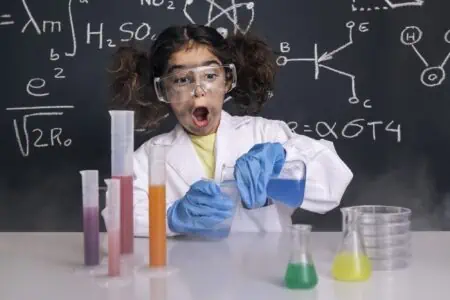
Raising a little Einstein? Traditional jokes might get an eye roll, but scientific head-scratchers are a different story. These 50 top-tier science riddles satisfy nerdy desires while sparking some genuine laughter.
We have curated brain teasers covering chemistry, biology, and physics to impress your whiz kid. Whether you need something strictly academic for the classroom or a fun challenge for a rainy day, you have found the right formula.
Put on your lab coat and test those theories. It isn’t rocket science (well, some of it is), but these riddles are an excellent way for adults and kids to engage their brains. We even included a few jokes to keep the mood light.
Science Riddles for High School

Teenagers can be a tough crowd, but these puzzles bridge the gap between textbook boredom and genuine curiosity. These riddles are perfect for advanced middle schoolers, high school students, or even college freshmen who think they know it all.
- I am found in the Earth’s mantle, silicate-rich and buoyant.
I am not quite a mineral, but I am super important.
I flow in slow motion, a geological dream.
What am I, beneath the Earth’s surface, it may seem?
Answer: Magma. - I make up three-fourths of the universe, but most of what I am is a mystery. What am I?
Answer: Dark energy. - I am black when you get me, red when you burn me, and gray when you are done with me. What am I?
Answer: Charcoal. - What can eat a lot of iron without getting sick?
Answer: Rust. - Number one is hydrogen, number 16 is sulfur, and number 36 is krypton. What list is this?
Answer: The periodic table. - I smell like rotten eggs, but I serve a purpose. I am used in the industrial realm, but my odor makes some nervous. What am I?
Answer: Sulfur. - I am the only metal that is liquid at room temperature. What am I?
Answer: Mercury. - I will burn your mouth and sting your eye, but you consume me often. What am I?
Answer: Salt (Sodium Chloride). - Your parents gave you 23 of these strands, making you who you are. What are they?
Answer: Chromosomes. - When combined, what four periodic elements make up something that terrifies criminals?
Answer: Carbon, oxygen, phosphorus, and sulfur (C + O + P + S).
Fun Science Puzzles

We want to spark curiosity, not give your kiddos a headache. These 10 fun science puzzles are slightly easier but still intriguing for young minds. They cover everything from states of matter to astronomy.
- When Kelly was 10, she hammered a nail into her favorite tree to mark her height. Five years later, she returned to the tree to see how much higher the nail was. If the tree grew by five inches each year, how much higher is the nail?
Answer: The nail is at the same height because trees grow from the top (apical meristem). - I am often associated with bad smells, but I am just a state of matter. What am I?
Answer: Gas. - I am a gas that helps plants make their food. What am I?
Answer: Carbon dioxide. - I am fluffy and high in the sky. I block the sun, making the world less bright. On rainy days, I fall to the ground. What am I?
Answer: A cloud. - You find me in the sky, often very bright. Sometimes I am round, other times a sliver of light. I am not the sun, but I shine at night. What am I?
Answer: The moon. - I can be good (like in yogurt), but I can be bad (like an infection). You find me wherever you go. What am I?
Answer: Bacteria. - Many have heard me, but nobody has seen me. I do not speak back unless spoken to. What am I?
Answer: An echo. - How do we know Saturn was married more than once?
Answer: She has a lot of rings! - I have a shell but I am not an egg. I can live for over 100 years. What am I?
Answer: A tortoise (or turtle). - If you put your eye to this, you can see far. It helps you spot planets, the moon, and stars. What is it?
Answer: A telescope.
Hard Science Riddles
If you want brain teasers that act as a mental gym, you have arrived at the right section. These puzzles require a bit more specific knowledge to crack.
Top Tip For Teachers
Whether you teach middle school or college, create a fun worksheet for your students using a mix of hard, easy, and funny scientific riddles. It works as a fantastic icebreaker or extra credit assignment!
- I am a phenomenon occurring near the speed of light. Inside me, time slows down. What am I?
Answer: Time dilation. - I am essential to life. With 23 pairs in you, I determine who you are. My structure is a double helix. What am I?
Answer: DNA (Deoxyribonucleic acid). - I am hard to create, but I cannot be destroyed. I can only change form. What am I?
Answer: Energy. - What did the scientist say when he found two atoms of helium?
Answer: HeHe. - What is the black hole’s equivalent of a one-way street?
Answer: The event horizon. - What do you do with a dead chemist?
Answer: Barium. - I am excellent to taste but horrible to smell. What am I?
Answer: A tongue. - I cannot be seen, and I am measured on the Beaufort scale. I keep kites in the air and ships sailing. What am I?
Answer: Wind. - I am a fundamental particle, small and neat. In the Standard Model, I take a front seat. With six “flavors” to my name, what am I?
Answer: A Quark. - What can go up and down without moving?
Answer: The temperature.
Physics Riddles With Answers

Physics fans, this is your time to shine. These 10 cosmic riddles force your brain to expend energy finding the fundamental answers. Can you spot the nerdy lingo?
- Which is heavier: a ton of feathers or a ton of rocks?
Answer: They both weigh the same (a ton). - I push back when you push me, but I never move on my own. I determine how hard it is to start and stop an object. What am I?
Answer: Inertia. - What is the loneliest of all physics concepts?
Answer: The singularity. - Why can’t you trust an atom?
Answer: They make up everything. - It keeps you on the ground and stops things from floating around. What is it?
Answer: Gravity. - Why did Carbon marry Hydrogen?
Answer: They bonded well from the moment they met. - What is a priest’s favorite thing about physics?
Answer: Mass. - I am a rock, bigger than Venus but smaller than Uranus. I am the only home you have ever known. What am I?
Answer: Earth. - I have no voice, but I can tell you a lot. I have no eyes, but I help you see. I have no side, but I have two poles. What am I?
Answer: A Magnet. - I am a particle and a wave, it’s true. In quantum realms, I might astound you. I travel at the fastest speed known. What am I?
Answer: Light (or a photon).
Biology Riddles
Biology riddles inject fun into learning about the living world. These are perfect for middle school kids yearning for life-science brain teasers. Check out these 10 riddles all about the study of life.
- What goes around and around wood but never into the wood?
Answer: The bark of a tree. - What are 10 things you can always count on?
Answer: Your fingers. - I am pronounced as one letter, written with three. I come in blue, brown, black, or gray. Reverse me, and I read the same way. What am I?
Answer: An eye. - What did one cell say to his sister cell when she stepped on his toe?
Answer: Mitosis. - I can rush and be still. I can be hot and be cold. I can be hard and be slippery. What am I?
Answer: Water. - I am a ball that can be rolled but never bounced or thrown. What am I?
Answer: An eyeball. - I am as hard as stone but found inside your mouth. What am I?
Answer: Teeth. - I am green and leafy, standing tall and true. In the sun, I photosynthesize. I produce oxygen, a breath of fresh air. What am I?
Answer: A plant or tree. - I crawl on the ground with no legs to show. My segmented body helps me move through the soil. What am I?
Answer: A worm. - Anyone can hold me, even without hands, but no one can do it for long. What am I?
Answer: Your breath.
Benefits of Science Riddles for Kids
You might wonder why you should introduce riddles to your kids beyond the entertainment value. Riddles and puzzles are actually powerful tools for child development.
Here are five of the main benefits of using science riddles:
- Critical thinking: Riddles force kids to analyze information and look at problems from new perspectives. They must apply existing knowledge to discover the answer, reinforcing what they learned in class.
- Motivation: Puzzles provide a “win” moment. The fun factor motivates children to keep working on a problem rather than giving up when things get tough.
- Vocabulary building: Riddles often use abstract language, metaphors, and specific scientific terms (like “silicate” or “photosynthesize”), naturally expanding a child’s lexicon.
- Creativity development: Science is technical, but riddles are creative. Combining the two prevents kids from thinking science is just dry facts; it encourages them to use their imagination alongside logic.
- Bonding experience: Solving puzzles is a shared activity. Whether parent-to-child or peer-to-peer, riddles are fantastic conversation starters that build social connections.
FAQs

At What Age Should I Introduce Science Riddles?
Simple science riddles can be introduced as early as age 5 or 6, focusing on basic concepts like weather or animals. More complex riddles involving the periodic table or physics are better suited for middle and high school students.
How Do Riddles Help in The Classroom?
Riddles act as excellent “hooks” to start a lesson, grabbing student attention immediately. They also serve as effective formative assessments to check if students understand a concept without the pressure of a formal quiz.
Where Can I Find More Science Riddles?
Beyond this list, you can find science riddles in educational magazines, science teacher forums, and library books dedicated to STEM activities. Encouraging students to write their own riddles is also a great resource!