Watching an RC plane soar through the sky is magical, but picking the right one for a child feels like navigating a minefield. You want something that flies well, yet you don’t want it to shatter into a million pieces on the first nose-dive.
We have spent countless hours at the airfield, crashing, repairing, and flying all sorts of models. We analyzed specs, tested durability, and checked spare part availability to find the best options on the market.
Here are the top seven RC planes for kids that balance durability, ease of use, and pure fun.
- Easy set up
- Safe flying technology
- Panic recovery for beginners
- Oversize flaps for shorter landings & take-offs
- Capable of aerobatics
- Factory-installed led lights
- Compact, easy to store
- Ready to fly out of the box
- Has three-part propeller
- Safe technology
- Spare parts are readily available
- Float set available for purchase
- No additional tools needed for setup
- One key plane return system
- Can be driven on the ground to taxi spot
- Super easy to fly with few controls
- Durable construction
- Extra batteries & spare in the box
- Exceptionally cool styling
- Faster than your average RC plane
- Optional SAFE technology
What to Look For
Selecting the right aircraft is about more than just looks. Here is what you need to look for before hitting the buy button.
Durability and Material
Most hobby-grade planes utilize EPP (Expanded Polypropylene) or EPO (Expanded Polyolefin) foam. These materials are lightweight and incredibly shock-absorbent. They bounce back from crashes that would destroy hard plastic or balsa wood models.
Pay close attention to the propeller placement. Planes with a “pusher prop” (mounted behind the wing) are generally more durable because the nose takes the impact during a crash, protecting the motor and propeller.
Number of Channels
Channels determine how many parts of the plane you can move. More channels equal more control, but also a steeper learning curve.
Here is the breakdown for beginners:
2 Channel Planes
This is the simplest setup. One channel controls the motor speed (throttle), and the other uses differential thrust (spinning one propeller faster than the other) or a simple rudder to turn left and right.
- Best for: Toddlers and young children who just want to see it fly.
3 Channel Planes
This adds an elevator to the mix. You control throttle, rudder (yaw), and elevator (pitch up/down). This is the sweet spot for learning flight dynamics without getting overwhelmed.
- Best for: Older kids and beginners learning the basics of flight.
4 Channel Planes
This adds ailerons, which control the roll of the plane. This allows for banking turns and aerobatic maneuvers like rolls and loops.
- Best for: Teens and confident learners ready for “real” piloting.
Speed and Flight Characteristics
Faster isn’t always better when you are learning. A slower plane gives the pilot more time to react to mistakes.
Look for “High Wing” trainers. These are planes where the wing is on top of the fuselage. They are naturally more stable and want to right themselves. “Low Wing” planes (like WWII fighters) are less stable and better suited for intermediate pilots.

Child’s Age and Maturity
Flying requires patience and fine motor skills. Manufacturer age ratings are often based on safety regulations for small parts, not skill level.
- Under 8: Stick to simple 2-channel gliders that fly slowly.
- Ages 8-12: A 3-channel trainer with gyro stabilization is ideal.
- Teens: They can likely handle 4-channel planes, provided they start with a beginner-friendly model.

Battery Life and Charging
Flight times are surprisingly short in the RC world. Expect 8 to 15 minutes of flight time per charge.
Most planes use LiPo (Lithium Polymer) batteries. They are powerful but require care. Always check if the box includes a charger. We highly recommend buying at least two or three extra batteries so the fun doesn’t end after just ten minutes.

Flying Space
Consider where you will be flying.
- Micro Flyers: Can be flown in backyards or large indoor gyms. They are sensitive to wind.
- Park Flyers: Need a baseball outfield or soccer field. They handle light breezes better.
- Club Size: Larger planes (1.1m wingspan and up) usually require a designated RC airfield.
RTF vs. BNF
You will see these acronyms often.
- RTF (Ready-to-Fly): The box contains the plane, the battery, and the transmitter (controller). You have everything you need.
- BNF (Bind-N-Fly): The box contains the plane and receiver, but you must provide your own transmitter and often your own battery.
For beginners, RTF is almost always the best choice.

Availability of Spare Parts
You will crash. It is part of the hobby.
Stick to reputable brands like HobbyZone, E-flite, or Top Race. They sell replacement propellers, wings, and landing gear. Off-brand planes might be cheaper, but once something breaks, the plane becomes a paperweight.
Gyro Stabilization (SAFE Technology)
Modern beginner planes often feature 6-axis gyro stabilization. Brands often call this “SAFE” (Sensor Assisted Flight Envelope) or “Beginner Mode.”
This technology limits how much the plane can bank or pitch, preventing it from flipping over. If you lose control, you simply let go of the sticks, and the plane automatically levels itself. This is a game-changer for new pilots.
Product Reviews
We combined our hands-on flight experience with deep market research to find the best aircraft for young pilots. Here are our top picks.
HobbyZone: AeroScout S 2 1.1m RC Airplane
Most Durable RC Plane
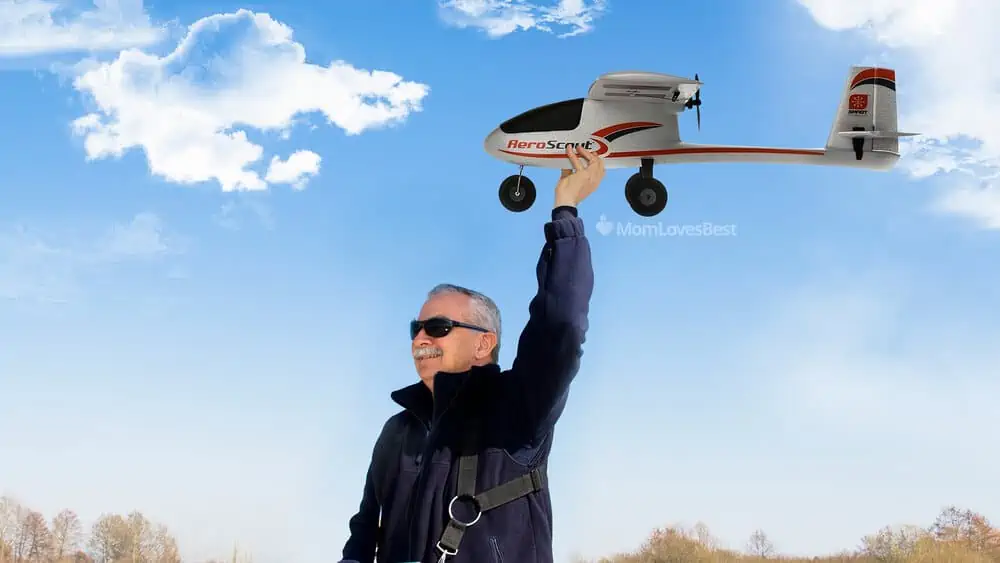
The HobbyZone AeroScout S 2 is widely considered the gold standard for student pilots. Its unique design places the propeller behind the wing in a “pusher” configuration. This means if you nose-dive into the ground (and you will), the expensive motor and propeller stay safe.
Assembly is tool-free and takes minutes. The oversized tires allow for take-offs from grass, dirt, or pavement, giving you flexibility on where you fly.
It features SAFE technology with three flight modes. Beginner mode limits your angles and self-levels the plane. Intermediate gives you more freedom, and Experienced mode lets you perform loops and rolls.
This is an RTF (Ready-to-Fly) package that includes the transmitter, battery, and USB-C charger. It is the complete package for anyone serious about learning to fly.
Pros
- Pusher prop design protects the motor during crashes.
- Includes Panic Recovery button to instantly level the plane.
- Large “tundra” tires handle rough grass easily.
Cons
- Requires a large open space like a park or field.
Product Specs
| Age | 14 years+ |
| Size | 39.1 x 11 inches |
| Channels | 6 |
| Power | 2200mAh 3S 11.1V Smart LiPo rechargeable battery |
Our Ratings
E-flite: UMX Turbo Timber BNF
Best RC Plane for Teens
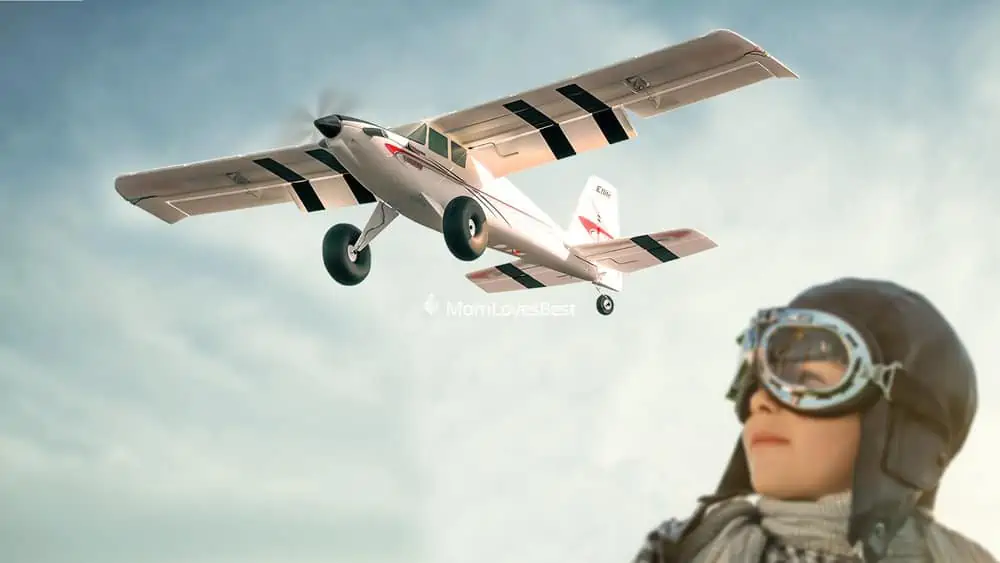
The UMX Turbo Timber is a “STOL” aircraft, which stands for Short Take-Off and Landing. It can take off in just a few feet, making it perfect for smaller parks or large backyards.
It comes fully assembled with functional LED navigation lights for dusk flying. The high-wing design offers great stability, while the oversized flaps allow it to fly incredibly slowly without stalling.
This model is a “Bind-N-Fly” (BNF) version. This means it does not come with a transmitter. It is perfect for teens who may already have a compatible Spektrum transmitter or are looking to invest in a high-quality radio they can use for future planes.
The 3S-compatible motor provides plenty of vertical power for aerobatics, keeping advanced pilots entertained long after they master the basics.
Pros
- STOL capabilities allow flight in smaller areas.
- Functional LED lights for realistic flying.
- Can fly very slowly, which is great for learning.
Cons
- Controller (Transmitter) is not included.
- The foam is thin and can tear on sharp objects.
Product Specs
| Age | 14 years+ |
| Size | 26 x 26 inches |
| Channels | Up to 6 |
| Power | 7.4V 200–280mAh LiPo rechargeable battery. |
Our Ratings
Top Race: 3 Channel RC Trainer Plane
Best 3 Channel RC Plane
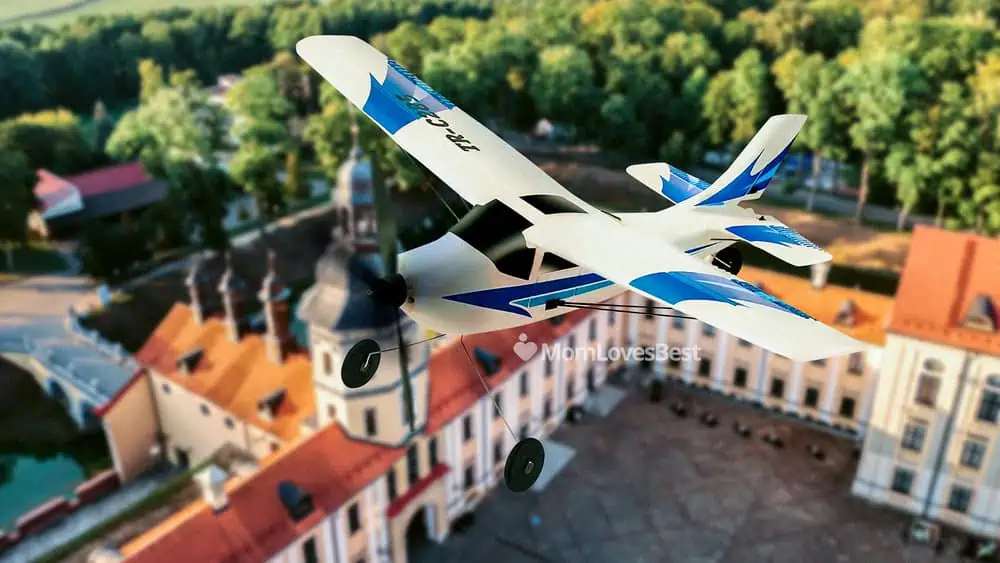
The Top Race Trainer is an excellent entry point for younger kids ready for a 3-channel experience. It controls the throttle, rudder, and elevator, teaching the fundamentals of flight without the complexity of ailerons.
It features a built-in 6-axis gyro system that works constantly to keep the plane stable against the wind. If the pilot gets confused, they just let go of the stick, and the plane flies straight.
One of our favorite features is the “Prop Saver” technology. Upon impact, the propeller pops off the shaft rather than snapping, saving you from constant repairs. You just clip it back on and keep flying.
It is made of durable EPP foam and comes as a complete RTF package, so you are ready to hit the skies immediately.
Pros
- Prop saver technology reduces broken parts.
- 3-mode speed control helps beginners learn gradually.
- Compact size makes it easy to transport.
Cons
- Lightweight body struggles in wind over 5 mph.
- Range is limited compared to hobby-grade brands.
Product Specs
| Age | 8 years+ |
| Size | 14 x 14 inches |
| Channels | 3 |
| Power | 3.7v 180mAh |
Our Ratings
HobbyZone: Sport Cub S 2 RC Airplane
Best RC Plane for Beginners

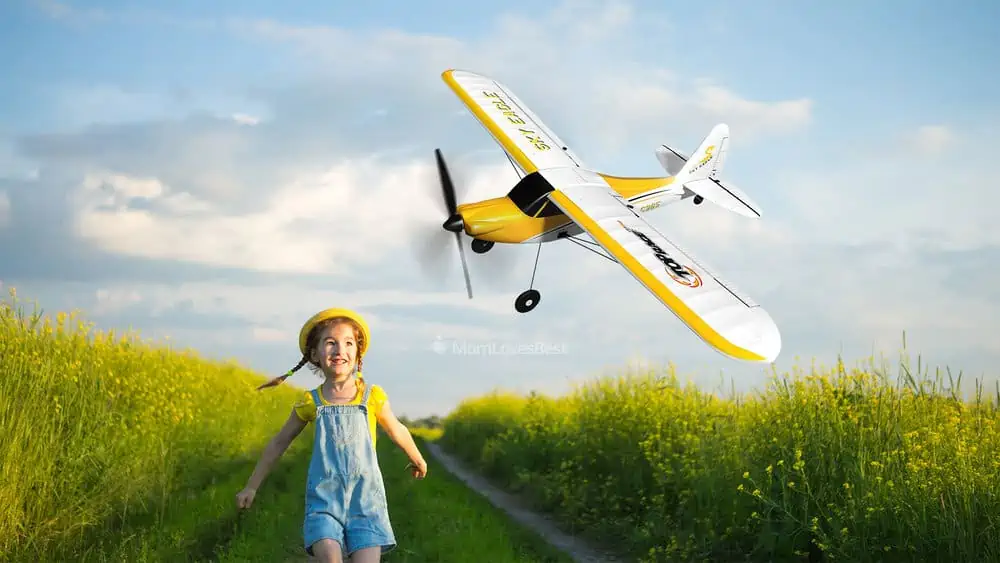
The Sport Cub S 2 is a micro-sized replica of the popular Super Cub bush plane. Because it is so small and lightweight (under 2 ounces), it poses very little risk of damage to property, making it a stress-free option for parents.
It features the full suite of SAFE technology, including Panic Recovery. If the pilot loses orientation, a push of the trigger instantly returns the aircraft to level flight.
It also provides telemetry data to compatible transmitters, letting you see the battery voltage so you know exactly when to land. While small, it is a fully hobby-grade 4-channel aircraft, offering full control over throttle, rudder, elevator, and ailerons.
This listing is for the BNF (Bind-N-Fly) Basic version, so you will need to purchase a Spektrum transmitter and batteries separately.
Pros
- Micro size allows for front-yard flying.
- Panic Recovery button prevents crashes.
- Very low mass means less damage upon impact.
Cons
- Requires separate purchase of transmitter and battery.
- Too light to fly in anything but dead calm wind.
Product Specs
| Age | 12 years+ |
| Size | 16.3 x 24.3 inches |
| Channels | 4 |
| Power | 3.7V 150–200mAh LiPo rechargeable battery |
Our Ratings
Top Race: 4 Channel TR-C385 Airplane
Best 4 Channel RC Plane
Styled to look like the legendary P-51 Mustang, the Top Race TR-C385 gives kids the thrill of flying a warbird without the usual difficulty.
Typically, warbirds are hard to fly, but this model uses a 6-axis gyro to make it as stable as a trainer. It offers three flight modes: Beginner, Intermediate, and Expert. In Expert mode, the gyro turns off, allowing for full manual control.
It features a unique “One Key Aerobatics” button. While flying, you press the button and pull the stick, and the plane performs a perfect roll or loop automatically. This makes your child look like a pro pilot on day one.
The package is Ready-to-Fly (RTF) and includes the battery and controller. The wheels are steerable, allowing you to taxi on the driveway before take-off.
Pros
- Looks like a classic WWII fighter plane.
- One-touch aerobatics button for easy stunts.
- Steerable tail wheel for realistic taxiing.
Cons
- Propeller shaft is prone to bending in hard crashes.
- Brushed motor will eventually wear out.
Product Specs
| Age | 14 years+ |
| Size | 21 x 16 x 5 inches |
| Channels | 4 |
| Power | 3.7v 360mAh rechargeable battery |
Our Ratings
Hawk’s Work 2 Channel RC Starter Airplane
Best Budget RC Plane

If you aren’t sure if your child will stick with the hobby, the Hawk’s Work 2-channel glider is the perfect low-risk investment. It is essentially a powered glider made of flexible EPP foam.
The controls are incredibly simple: throttle for altitude and left/right steering. There are no elevators or ailerons to worry about. The plane relies on differential thrust (spinning one motor faster than the other) to turn.
This simplicity makes it nearly indestructible. It is lightweight and flexible, meaning it usually bounces off obstacles rather than breaking.
The package includes extra propellers and a replacement battery, giving you plenty of value for the price. It is the ultimate “park flyer” for younger kids.
Pros
- Extremely affordable entry point.
- Flexible foam body is highly crash-resistant.
- Includes spare battery and props.
Cons
- Limited control (no elevator for pitch).
- Turns are wide and slow.
Product Specs
| Age | 6 years+ |
| Size | 12 x 14 inches |
| Channels | 2 |
| Power | 300 mAh Li-Po rechargeable batteries |
Our Ratings
E-flite: E-flite T-28 Trojan 1.1m BNF Basic Jet RC Airplane
Fastest RC Plane for Kids
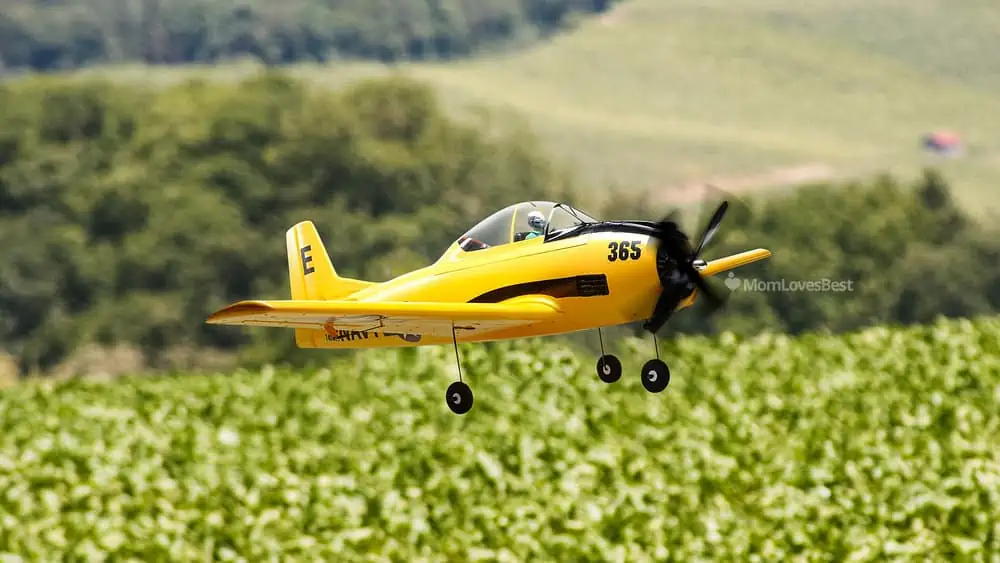
The E-flite T-28 Trojan is a step up for pilots who have mastered the basics. While it has “Jet” in the product title, this is actually a powerful propeller-driven warbird known for its speed and agility.
Unlike the high-wing trainers on this list, the T-28 is a “low-wing” aircraft. This makes it more aerodynamic and capable of higher speeds and precision aerobatics, but it also makes it less stable.
It comes equipped with SAFE Select technology, which can be turned on for easier flying or off for full performance. The plane is larger (1.1m wingspan), so you will need a proper flying field.
This is a BNF Basic model. You must provide your own 3S or 4S LiPo battery, charger, and Spektrum transmitter. It is the perfect second plane for a teen who is hooked on the hobby.
Pros
- High-performance brushless motor for serious speed.
- Retractable landing gear adds realism.
- Painted in high-visibility Navy trim.
Cons
- Not suitable for absolute beginners.
- Battery, charger, and remote sold separately.
Product Specs
| Age | 14 years+ |
| Size | 50 x 17.1 x 8.4 inches |
| Channels | 6 |
| Power | 300mAh 7.4V 30C Li-Po rechargeable battery |
Our Ratings
| Product | Best | Age | Size | Channels | Power |
|---|---|---|---|---|---|
| HobbyZone: AeroScout S 2 1.1m RC Airplane | Most Durable RC Plane | 14 years+ | 39.1 x 11″ | 6 | 2200mAh 3S 11.1V Smart LiPo battery |
| E-flite: UMX Turbo Timber BNF | Best RC Plane for Teens | 14 years+ | 26 x 26″ | 6 | 7.4V 200–280mAh LiPo battery |
| Top Race: 3 Channel RC Trainer Plane | Best 3 Channel RC Plane | 8 years+ | 14 x 14″ | 3 | 3.7v 180mAh |
| HobbyZone: Sport Cub S-2 RC Airplane | Best for Beginners | 12 years+ | 16.3 x 24.3″ | 4 | 3.7V 150–200mAh LiPo battery |
| Top Race TR-C385 | Best 4 Channel RC Plane | 14 years+ | 21 x 16 x 5″ | 4 | 3.7v 360mAh battery |
| Hawk’s Work 2 CHannel RC Starter Airplane | Best Budget RC Plane | 6 years+ | 12 x 14″ | 2 | 300 mAh Li-Po batteries |
| E-flite: T-28 Trojan BasicJet RC Airplane | Fastest RC Plane | 14 years+ | 50 x 17.1 x 8.4″ | 6 | 300mAh 7.4V 30C Li-Po battery |
FAQs

What Age Is Appropriate for RC Planes?
Most hobby-grade RC planes are suitable for children aged 8 and up. However, younger children (around 5 or 6) can enjoy simple 2-channel gliders with adult supervision. For complex 4-channel planes, the child usually needs the maturity and coordination of a 12 to 14-year-old.
Where Can I Fly My RC Plane?
Micro planes and small park flyers can be flown in large backyards or soccer fields. Larger planes (over 1 meter in wingspan) generally require a designated RC flying club or a very large, empty area away from people, cars, and buildings to ensure safety.
Do I Need a License to Fly an RC Plane?
In the United States, recreational flyers must pass a simple online safety test called TRUST (The Recreational UAS Safety Test). It is free and ensures you know the basic safety rules. Additionally, if your plane weighs more than 0.55 lbs (250g), you must register yourself with the FAA.
Earn Your Wings
Flying RC planes is a rewarding hobby that builds patience, coordination, and mechanical skills. Whether you choose a simple glider or a high-performance warbird, the thrill of seeing your aircraft lift off the ground never gets old.
Start with a durable trainer, buy a few extra batteries, and head to the local park. You will be performing loops and rolls before you know it.