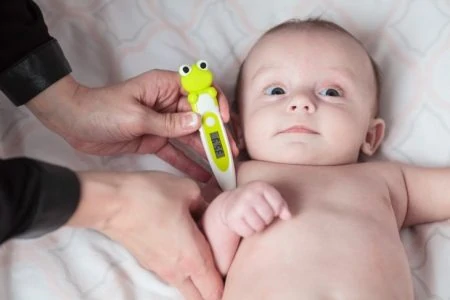
When your baby feels warm, you don’t want to second-guess your equipment. You need a reading that is fast, precise, and easy to interpret.
Navigating the sea of health gadgets can be overwhelming, especially when sleep-deprived and worried. We know the feeling; as parents, we have been there at 2 a.m., wondering if that number on the screen is accurate.
We analyzed the market to find the most reliable tools for your medicine cabinet. We listened to real parents, consulted safety standards, and compared features to bring you this list of dependable baby thermometers. With these options, you can confidently monitor your child’s health and make informed decisions when it matters most.
- Two-year warranty
- Immediate temperature reading
- Celsius or Fahrenheit reading
- Easy to use
- Forehead readings
- Accurate readings even at a distnce
- Highly accurate
- Can be used on sleeping baby
- Backlit screen for night use
- Designed for all ages
- Simple sleek design
- Reads instantly
- Multiple modes
- Stores up to 35 temperature readings
- Fever alarm feature
- Backed by FSA, HSA, and FDA
- One-minute auto shutdown
- Fever-detection system
- Accurate
- Works quickly
- Prevents accidental injury
Do You Need a Baby Thermometer?
Babies require a mountain of gear, so it is natural to wonder if a specific thermometer is necessary. While you might be tempted to use the standard one sitting in your bathroom drawer, investing in a baby-specific model is smarter and safer.
Here is why standard thermometers often fall short for infants:
- Oral issues: Regular sticks are hard to use because babies cannot hold them under their tongues securely. Using one under the arm is possible, but it is often considered the least accurate method (1).
- Ear canal size: Adult ear thermometers often have probes that are too large for a baby’s tiny ear canal, leading to poor readings.
- Safety hazards: Old-school glass mercury thermometers pose a serious risk. If they break, the mercury exposure can lead to neurological issues (2).
A thermometer designed for babies ensures you get a quick, safe, and accurate reading without the struggle.
Types of Baby Thermometers
Parents have several choices regarding how they want to measure temperature, and each type has pros and cons (3):
Digital Stick Thermometer
These are the standard, affordable sticks available at any pharmacy. They have a sensor on one end and a screen on the other. They are versatile, but they have limitations with squirmy infants.
Safety First
While reliable, they can be tricky for babies because:
- Oral difficulty: It is nearly impossible to keep a baby’s mouth closed around the probe long enough.
- Axillary accuracy: Under-the-arm readings are easier but generally less precise than other methods.
Glass Thermometer
This is the classic style many of us grew up with. You place it under the tongue, and the liquid inside rises to match the body temperature.
Modern versions use a non-toxic substitute instead of mercury, but the glass design remains fragile.
Hazard Warning
While they don’t require batteries, the risk of broken glass usually outweighs the benefits for active babies.
Ear Thermometer
Also called tympanic thermometers, these devices use infrared technology to measure heat inside the ear canal. They are popular because they are fast.
However, accuracy depends on a few specific conditions:
- Clear canals: Ear wax can block the sensor and skew results.
- Positioning: You must pull the ear correctly to straighten the canal for a direct line of sight to the eardrum.
- Age limits: These are generally recommended for babies older than six months, as newborn ear canals are too small for an accurate reading.
Temporal Artery Thermometer
Often referred to as “forehead thermometers,” these scan the temporal artery to measure infrared heat. They are non-invasive and very popular for sleeping babies.
Research supports their use, noting that modern temporal scanners are accurate enough for newborns and older children alike (5).
How to Choose a Baby Thermometer
Not all thermometers are created equal. Here are the features that matter most when shopping:

Accuracy
This is non-negotiable. If the device cannot give you a correct number, it is useless. Look for models that are clinically tested or widely used by medical professionals.

Consistency
You should get the same number if you take a temperature three times in a row. It is frustrating to get 98.6, 100.2, and 99.1 within the same minute. Good thermometers provide repeatable results.

Age Suitability
Some devices are better for older kids. If you have a newborn (under three months), a rectal thermometer is the gold standard for accuracy. For toddlers, forehead or ear models are easier to manage.

Units of Measurement
Ensure the device displays the unit you are most comfortable with. Most modern digital thermometers allow you to toggle between Fahrenheit and Celsius easily.
Speed
Babies are wiggly, especially when they feel sick. A device that reads in one second is vastly superior to one that takes 60 seconds. Speed reduces the chance of user error caused by a moving child.
Simplicity
When it is dark and you are worried, you do not want to fiddle with complex menus. Single-button operation is ideal. Memory recall is a nice bonus feature, but ease of use should come first.
Sound Options
A beep to confirm the reading is helpful, but the ability to mute that beep is even better. Silent modes allow you to check a sleeping baby without waking them up with a loud chirp.

Backlit Display
Fevers often spike at night. A large, backlit screen lets you read the temperature in the dark without turning on the overhead lights and disturbing your little one.
Product Reviews
We evaluated accuracy, speed, and ease of use to bring you these top-rated infant thermometers.
Amplim Medical Grade Digital Infrared Thermometer
Best Forehead Thermometer for Babies
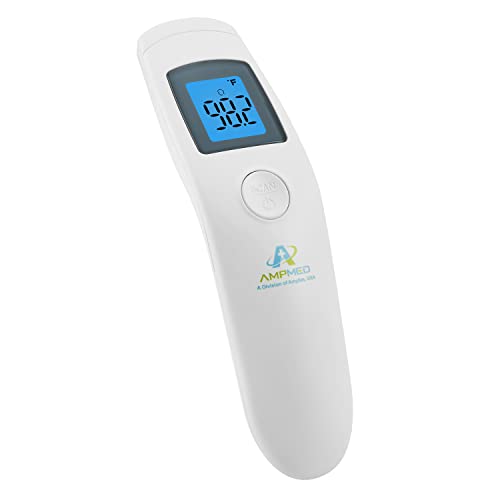
The Amplim Forehead Thermometer combines hospital-grade accuracy with a user-friendly design. It features a bright, backlit screen that makes nighttime checks easy. The memory function stores up to 32 past readings, allowing you to track fever trends over time without needing a pen and paper.
It is also an FSA/HSA eligible item, making it a smart buy for budget-conscious parents using health accounts.
We love that it is touch-free, which minimizes the spread of germs. You can get a reading in less than one second without waking your baby or dealing with disposable probe covers.
Pros
- FSA/HSA eligible product.
- Ultra-fast one-second reading.
- Hygenic non-contact design.
- Switch easily between Celsius and Fahrenheit.
Cons
- Display can seem dim in very bright rooms.
Our Ratings
iProven Infrared Lens Thermometer
Best Infrared Thermometer for Baby

The iProven NCT-978 is designed for distance and speed. It captures temperature from 0.4 to 2 inches away in roughly one second. The one-button operation is intuitive, so you won’t be fumbling with settings when your baby is fussy.
It includes intelligent fever indicators; the backlit display changes color and an alarm sounds if a high temperature is detected. The screen is centralized and large, making the numbers easy to read even for tired eyes. The device is also waterproof, making sanitization simple.
Pros
- Simple one-button operation.
- Large, color-coded backlit display.
- Built-in fever alarm.
- Waterproof housing is easy to wipe down.
Cons
- The beep cannot be silenced.
- Higher price point than basic models.
Our Ratings
Exergen Temporal Artery Thermometer
Best Temporal Artery Thermometer for Baby
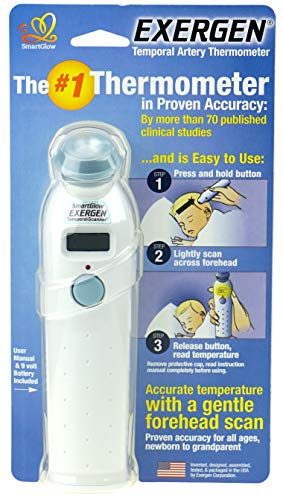
The Exergen Temporal Scanner is a favorite among medical professionals. Since little ones are prone to ear infections, having a non-intrusive way to check for fever is a relief. Ear thermometers can be painful on an infected ear, but a gentle forehead swipe is painless.
Clinical studies suggest this method is as accurate as rectal readings for infants but far less invasive. You simply swipe it across the forehead to capture the heat from the temporal artery.
It features a “soft glow” display for dark rooms and a programmable beeper, allowing you to silence the device to avoid waking a sleeping child. It runs on a standard 9-volt battery.
Pros
- High clinical accuracy.
- Non-invasive swipe method.
- Programmable sound (silent mode available).
- Works on sleeping babies comfortably.
Cons
- Lacks a color-coded fever indicator.
- Screen is smaller than some competitors.
- Pricey compared to standard sticks.
Our Ratings
Braun Digital Ear Thermometer
Best Ear Thermometer for Baby
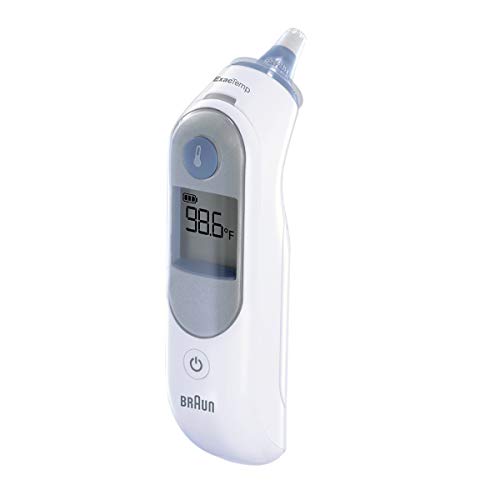
Ear thermometers are convenient, but positioning them correctly is the trick. The Braun ThermoScan 5 solves this with its ExacTemp system, which uses a light and beep to confirm the probe is in the right spot for an accurate reading.
A unique feature is the pre-warmed tip. Most thermometer tips are cool, which can slightly lower the temperature of the ear canal upon insertion; Braun warms the tip to ensure accuracy and comfort. It uses disposable lens filters, which keeps things sanitary and prevents earwax buildup on the sensor.
Pros
- Fast readings.
- Positioning system confirms accuracy.
- Pre-warmed tip for comfort and precision.
- Lens filters prevent cross-contamination.
Cons
- Ongoing cost for disposable filters.
- No backlit display on this specific model.
- No “fever alert” color indicator.
Our Ratings
iHealth No-Touch Digital Forehead Thermometer
Best Non-Contact Baby Thermometer

The iHealth PT3 is sleek, modern, and incredibly quiet. It measures temperature in one second without touching the skin, eliminating the risk of waking your child or spreading germs. It uses three sensors, infrared, distance, and environmental, to calculate a precise reading.
The standout feature is the vibration alert. Instead of a loud beep, the handle gently vibrates when the reading is complete. This makes it the ultimate stealth tool for checking temperatures at night. The LED display is crisp and easy to read in the dark.
Pros
- Vibration alert is silent and gentle.
- Tri-sensor technology for better accuracy.
- Modern, easy-to-read LED display.
- Hygienic no-touch operation.
Cons
- Requires 2 AAA batteries (included, but good to have spares).
Our Ratings
Goodbaby Touchless Thermometer
Best Thermometer for Whole Family
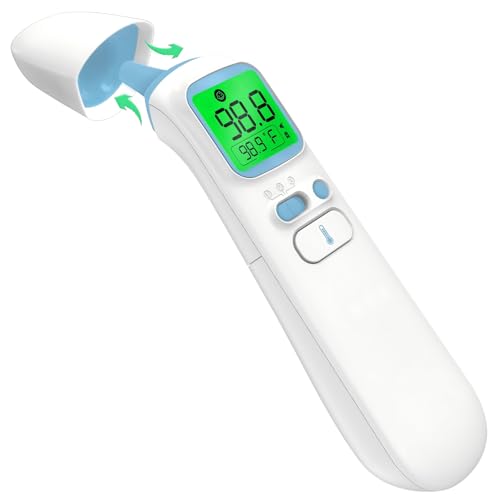
When illness hits the whole house, versatility is key. The Goodbaby thermometer is a hybrid device that switches between forehead (non-contact) and ear mode. You simply remove the magnetic cap to switch to the ear probe.
It takes readings in one second and features a large color-changing display that glows red if a fever is detected. This visual cue is great for tired parents.
We appreciate the flexibility; you can use the gentle forehead mode for the baby and the ear mode for older kids or adults. It stores up to 35 readings, allowing you to track the progression of an illness easily.
Pros
- Dual-mode: Measures both forehead and ear temperatures.
- High memory capacity (35 readings).
- Visual fever alarm (green/orange/red).
- Includes a mute function for silent use.
Cons
- Switching modes can sometimes lead to inconsistent readings if not done carefully.
Our Ratings
Amplim Hospital Medical Grade Infrared Digital Thermometer
Best Clinically Tested Thermometer

This model from Amplim focuses heavily on clinical reliability. It meets CE and FDA standards, giving you peace of mind regarding its accuracy. Like its sibling model, it is a non-contact forehead thermometer, ideal for fussy or sleeping infants.
The color-coded backlight system is straightforward: green for normal, yellow for elevated, and red for high fever. It also features an auto-off function to save battery life, shutting down after 60 seconds of inactivity.
It is another excellent FSA/HSA eligible option. While it only does forehead readings, it does them exceptionally well, with a focus on hygiene and speed.
Pros
- Meets strict FDA and CE standards.
- FSA/HSA eligible.
- Clear color-coded fever detection system.
- Auto-shutdown saves battery.
Cons
- Limited to forehead measurements only (no ear mode).
Our Ratings
Vicks Baby Rectal Thermometer
Best Rectal Baby Thermometer
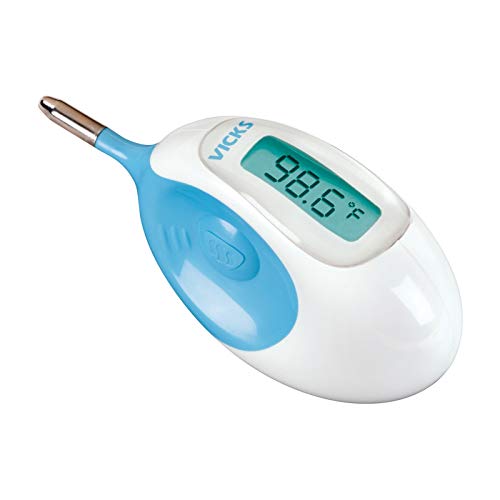
For newborns, most pediatricians still recommend a rectal temperature for the most accurate diagnosis. The Vicks Baby Rectal Thermometer is specifically engineered for this purpose. It features a very short, flexible probe with a guard that physically prevents you from inserting it too far.
This safety design eliminates the fear many new parents have about rectal thermometers. It takes about 10 seconds to get a reading, which is slower than infrared but faster than old-school digital sticks.
It is waterproof, easy to clean, and compact. If you need the definitive “gold standard” reading for a sick newborn, this is the tool to use.
Pros
- Highly accurate (gold standard for newborns).
- Safety guard prevents over-insertion.
- Flexible tip for baby’s comfort.
- Backlit display for night use.
Cons
- Rectal use only (limited versatility).
- Slower than infrared options (10 seconds).
- Does not beep when finished (visual check required).
Our Ratings
How to Use a Baby Thermometer
Remember
Using a thermometer correctly is just as important as buying a good one. Here are the best practices for each type:
- Rectal (Best for newborns): Lubricate the tip with petroleum jelly. Lay your baby on their back and lift their legs. Gently insert the tip only until the safety stop (or about 1/2 inch). Hold still until it beeps.
- Axillary (Underarm): Remove the baby’s shirt. Place the tip high in the armpit, ensuring it touches skin, not clothing. Hold the arm flat against the body to close the pocket. This method is safe but less accurate.
- Temporal (Forehead): Place the sensor in the center of the forehead. Press the button and either hold it steady or swipe across to the hairline (depending on your model’s instructions). Remove and read.
- Oral (Under tongue): Place the tip under the tongue towards the back (the “heat pocket”). Ensure the child keeps their mouth closed. This is usually only effective for kids over 4 years old.
- Ear (Tympanic): Pull the ear gently up and back to straighten the canal. Insert the probe snugly to seal the opening. Press the button and wait for the beep. Clean the lens or change the filter after every use.
Pro Tip: Do not take multiple readings back-to-back unless necessary. Slight variations are normal and will only stress you out. If you get a reading that doesn’t match how your baby is acting (e.g., high fever but baby is playing happily), wait 15 minutes and try again.
FAQs

Are No Touch Thermometers Accurate for Babies?
Yes, they are generally very accurate when used correctly. Studies show they are accurate about 97% of the time. However, external factors like sweat, heavy bangs/hair, or coming in from the cold can affect the reading. Always wipe the forehead dry before scanning.

Is an Ear or Forehead Thermometer More Accurate?
For newborns (under 3 months), a forehead reading is generally preferred over an ear reading because baby ear canals are too small for the probe. For older babies and toddlers, both are accurate. However, ear thermometers can be thrown off by earwax buildup or ear infections, while forehead thermometers are easier to misuse if you don’t hold them at the right distance.

How Do I Know If My Baby Has a Fever Without a Thermometer?
While a thermometer is the only way to be sure, you can look for signs. Feel their chest or back (hands and feet are unreliable). Look for flushed cheeks, sweating, or shivering. Behavioral changes are key: is your baby unusually cranky, lethargic, or refusing to eat? If your baby feels hot and is acting sick, assume it is a fever until you can measure it.

What Kind of Thermometer Do Pediatricians Use?
Most pediatricians use rectal thermometers for infants because they provide the core body temperature, which is the most accurate medical data point. As children get older (usually around 6 months to a year), many doctors’ offices switch to high-grade temporal (forehead) or ear scanners for speed and comfort.

What Is the Best Type of Thermometer for a Baby?
The “best” type depends on the baby’s age. For newborns up to 3 months, a rectal thermometer is the most reliable. For babies 3 months to 3 years, a temporal (forehead) thermometer offers the best balance of accuracy and ease of use. Ear thermometers are great for toddlers over 6 months who can sit still.

What Temperature Is Considered a Fever in Babies?
Generally, a rectal temperature of 100.4°F (38°C) or higher is considered a fever. For armpit measurements, anything above 99°F (37.2°C) may indicate a fever. Always consult your pediatrician if your baby is under 3 months old and has any fever, or if they are older and the fever persists or is accompanied by other worrying symptoms.
How Should I Clean My Baby’s Thermometer?
Hygiene is critical to stop the spread of germs. For most digital and rectal thermometers, clean the tip with cool, soapy water, rinse, and then wipe with rubbing alcohol. For ear and forehead thermometers, wipe the sensor lens gently with an alcohol swab or a cotton ball dipped in rubbing alcohol. Never submerge the battery section of a thermometer in water.
The Bottom Line
For most families, the Amplim Medical Grade Non-Contact Thermometer strikes the perfect balance. It is fast, hygienic, and easy to read in the dark, making those late-night fever checks much less stressful.
If you have a newborn, we also recommend keeping the Vicks Baby Rectal Thermometer on hand for when you need a medically precise confirmation.
A reliable thermometer gives you the data you need to decide whether to offer comfort measures or call the doctor. Stay calm, trust your gut, and use the right tool for the job.