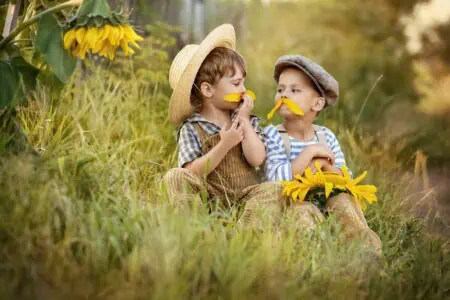
Looking for names that represent an escape from the hustle and bustle of modern city life? Cottagecore is an aesthetic inspired by a slow-paced, rural lifestyle in harmony with nature. Embrace simpler times with these nostalgic cottagecore names.
We’ve done our digging to find Mother Earth’s top picks and even a few vintage classics for your perusal. You can enjoy the freshness of verdant valleys and fairytale forests right in your own home.
So relax and use your spare time to bake a pie or knit a pair of booties for your baby. As for now, let’s read on.
100 Cute Cottagecore Baby Names
Return to the good old days with our collection of 100 comfy cottagecore names.
Adeline
Adeline was brought to England by the Normans and is a diminutive of the French Adèle, from the Germanic name Adalheidis, meaning “of noble birth.” These ultimately stem from the root “adal” meaning “noble.” Adeline will imbue your child with elegance, grace, and strength. Try out adorable nicknames like Ada and Addy whenever Adeline becomes a mouthful.
- Origin: French
- Meaning: Noble
- Pronunciation: A-duh-leen, A-duh-leyen
- Variations: Adaline, Adalene, Adeleine
- Namesakes: Adeline Pond Adams, an American writer and wife of sculptor Herbert Adams. Dame Adeline Genée, a Danish-British ballet dancer. Adeline Dutton Train Whitney, an American poet and author.
- Popularity: Adeline ranked 94th in the U.S. and 96th in Australia in 2021.
Adler
The surname Adler became a first during the 19th-century. It’s a strong Germanic nature name inspired by the eagle. Take the Austrian doctor and psychotherapist Alfred Adler. His ideas set him apart from other members of the Vienna Circle. Strive for greater heights and make bravery, strength, and independence part of your son’s identity with Adler.
- Origin: German
- Meaning: Eagle
- Pronunciation: AD-luh, AD-lur
- Namesakes: Adler Capelli, an Italian track cyclist.
- Popularity: Adler first appeared on U.S. charts in 2020 at 922nd and was 910th in 2021.
Adrina
Adrina might be a variant of Adriana, meaning “from Hadria,” though others have suggested that Adrina means “dark.” It’s based on Adria, also called Atria or Hatria, an ancient Italian town from which the Adriatic sea got its title. Adria probably comes from the Illyrian word “adur” meaning “water” or “sea.” Despite uncertain roots, Adrina is a perfectly pretty pick.
- Origin: Latin
- Meaning: From Hadria
- Pronunciation: uh-DREE-nuh, a-DREE-nuh
- Variations: Adriana
- Popularity: Adrina is most popular in the U.S. and has about 3,258 bearers globally.
Agnes
Agnes is a Latinization of the Greek “Hagne” from the root “hagnos,” meaning “chaste,” “pure,” or “holy.” It makes sense that several saints, including the virgin martyr St. Agnes of Rome, have used this traditional option. Agnes is great for parents who want to honor their faith or simply try out something that sounds old-fashioned.
- Origin: Greek
- Meaning: Chaste, pure, virginal
- Pronunciation: AG-niss
- Variations: Agnese, Ines, Annis, Hagne
- Namesakes: Agnes Dean Abbatt, an American landscape coastal and floral painter. Agnes Allen, an English children’s author. Agnes of Bohemia, a Bohemian princess and saint.
- Popularity: Agnes disappeared from the U.S. top 1,000 names after ranking 988th in 1972.
Alice
Alice is from the Old French Aalis, a diminutive of Adelais. This is a shortened version of the German Adalheidis, meaning “of noble birth” or “noble kind.” Lewis Caroll’s 1865 novel, Alice In Wonderland, likely popularized the epithet, which is now hugely popular worldwide. Take a leap of faith and fall down the rabbit hole with the lovely Alice.
- Origin: French, German
- Meaning: Noble
- Pronunciation: A-liss
- Variations: Alys, Aalis
- Namesakes: Alice Sebold, an American author known for The Lovely Bones. Alice Meynell, a British writer, poet, and suffragist. Princess Alice, a member of the British royal family.
- Popularity: In 2021, Alice placed 31st in England and Wales, 58th in Australia, and 64th in the U.S.
Amber
Amber is a warm, golden-orange fossilized tree resin used in jewelry-making. It comes from the Arabic “anbar,” referring to a substance found in the digestive system of sperm whales. Although Amber feels modern, it has existed for ages and is fairly popular worldwide. Who says cottagecore girl names can’t be trendy? Amber is a unique but down-to-earth pick.
- Origin: English, Arabic
- Meaning: Amber, amber-colored
- Pronunciation: AM-buh, AM-bur
- Variations: Ambre
- Namesakes: Amber Aguirre, an American ceramic sculptor. Amber Scott, an Australian ballerina and principal dancer. Amber Glenn, an American figure skater.
- Popularity: Amber spiked on U.S. charts between the ’70s and mid-2000s, dropping to 534th in 2021.
Ambrose
Ambrose is the Anglicized version of the Latin Ambrosius. It’s derived from the Greek Ambrosios, meaning “belonging to immortals” or “of the gods.” That meaning usually gets shortened to “immortal.” Ambrose may conjure laid-back pastoral scenes full of ambrosia and nectar, but it has a sophisticated flair. Endear everyone to your baby with the serious but gentle Ambrose.
- Origin: Latin, Greek
- Meaning: Immortal
- Pronunciation: AM-brohz
- Variations: Ambrosios, Ambrosius
- Namesakes: St. Ambrose of Milan, a theologian and bishop. Ambrose Bierce, an American author and poet. St. Ambrose of Camaldoli, an Italian monk and theologian.
- Popularity: In 2021, Ambrose placed 671st in the U.S.
Amelia
Amelia is an English variant of Amalia from the Germanic word “amal,” meaning “work.” Despite its practical, no-nonsense meaning, Amelia seems perfect for a princess. Amelia gets the job right if you’re into frilly cottagecore names that still fit the industrious rural lifestyle.
- Origin: English, German
- Meaning: Industrious, hard-working
- Pronunciation: uh-MEE-lee-uh
- Variations: Amalia
- Namesakes: Amelia Coats, an American landscape printmaker. Amelia Lily Oliver, an English singer. Amelia Perrier, an Irish novelist and travel writer.
- Popularity: In 2021, Amelia ranked 2nd in Australia and was most popular in the U.S. at 4th in the same year.
Amethyst
Amethyst is a lilac quartz that exudes refinement. In line with ideas of purification, the ancient Greeks believed amethyst prevented intoxication. Thus, Amethyst, from Amethystos, consists of the Greek elements “a,” meaning “not,” and “methystos,” meaning “intoxicated.” Carve this glittering gemstone from our list of cottage core names. Its gradual rise in use could make Amethyst as popular as Amber and Ruby.
- Origin: Greek
- Meaning: Not intoxicated, purple semi-precious quartz
- Pronunciation: A-muh-thist, A-muh-thust
- Variations: Amethystos
- Namesakes: Amethyst Kelly, stage name Iggy Azalea, an Australian rapper and model.
- Popularity: Amethyst is most prevalent in the U.S., with about 1,301 bearers worldwide.
Angus
Angus is vintage in the U.S., last ranked 989th in 1948. It stems from Scottish Gaelic and Irish Aonghas, composed of the Celtic elements “óen” meaning “one” and “guss” meaning “force/strength.” Its association with cows likely comes from a Scottish breed of beef cattle, the Aberdeen Angus. In the Animal Crossing universe, Angus is a cranky bull villager.
- Origin: Celtic, English
- Meaning: One choice, one strength
- Pronunciation: ANG-gus
- Variations: Aengus, Aonghas, Óengus
- Namesakes: Angus Clark, an American guitarist, singer, and producer. Angus Young, a Scottish-Australian musician and co-founder of AC/DC. Angus Jones, an American actor known for Two and a Half Men.
- Popularity: In 2021, Angus was 61st in Scotland and 329th in England and Wales.
Anne
Few people know that Anne is unisex. From the Hebrew Hannah, it’s feminine and means “favor” or “grace.” However, its Frisian origins deem it masculine. Anne has even appeared on French popularity charts for boys over the years. In the U.S., Anne is traditionally used for girls and was 588th in 2021. Simple Anne is perfect for everyone.
- Origin: French, Hebrew, Frisian
- Meaning: Favor, grace, eagle
- Pronunciation: AN
- Variations: Ann, Anna
- Namesakes: Anne Casimir Pyramus de Candolle, a Swiss botanist. Anne Hathaway, an American actress. Anne Rice, born Howard Allen O’Brien, an American gothic fiction author.
- Popularity: Anne ranked 135th for girls in the Netherlands in 2022 and last ranked for boys in 2008 at 488th.
Ansel
Ansel is a derivative of Anselm, which consists of Old German elements “ansi” meaning “god” and “helm” meaning “helmet” or “protection.” Ansel has long been associated with wisdom, strength, and resilience. As it gained momentum in the Middle Ages, it speaks to parents looking for chivalrous cottagecore boy names. Despite disappearing from U.S. charts, Ansel is timeless.
- Origin: German
- Meaning: God’s protection, divine helmet
- Pronunciation: AN-sul
- Variations: Ansell, Ancel, Anselm
- Namesakes: Ansel Adams, an American landscape photographer, and environmentalist. Ansel Hall, an American naturalist. Ansel Krut, a South African painter based in the UK.
- Popularity: Ansel ranked 962nd in the U.S. for the final time in 1923.
Asa
Although only three letters, Asa is wholesome and backed by loads of tradition and history. It finds roots in both the Hebrew and African cultures. In the Bible, Asa was a king of Judah who was highly devoted to God. In Nigeria, Asa is Yoruban, meaning “morning” or “new beginning,” symbolizing hope.
- Origin: Hebrew
- Meaning: Healer, physician
- Pronunciation: AY-suh
- Namesakes: Asa Gray, a 19th-century American botanist. Asa Keisar, an Israeli Jewish religious scholar, rabbi, and vegan advocate.
- Popularity: Asa has appeared on U.S. charts since 1900 and placed 496th in 2021.
Asher
Asher is a traditional trailblazer, making the U.S. top 100 in 2014. It comes from the Hebrew word “osher” meaning “happiness” or “blessed.” It also finds roots in occupational surnames like the Middle English Aschere and the German Äscher, both meaning “ash-maker.” Despite starting as a masculine moniker, nowadays, Asher has become a viable option for girls.
- Origin: Hebrew, English, German
- Meaning: Happy, blessed, ash maker
- Pronunciation: A-shuh, A-shur
- Variations: Ascher
- Namesakes: Asher Brown Durand, an American painter. Simon Asher Levin, an American ecologist. Asher Keddie, an Australian actress.
- Popularity: In 2021, Asher was most popular in the U.S. at 25th.
Aspen
Aspen is a zippy-sounding pick that takes root in the Old English “æspe.” Taken from the white-barked aspen tree known for its delicate, quaking leaves, Aspen is associated with the great outdoors. Paint a picture of pristine forests and alpine landscapes with this nature-loving pick. As a plus, Aspen is easy to say and spell, making it quite memorable.
- Origin: English
- Meaning: Aspen tree, quaking tree
- Pronunciation: AZ-pen, AS-pn
- Variations: Aspin, Aspyn
- Namesakes: Aspen Mays, an American artist. Aspen Ladd, an American professional mixed martial artist.
- Popularity: Aspen peaked at 201st on U.S. charts in 2021.
Aubrette
Aubrette seems slightly snobbish but balances that out with a whimsical feel. Like a fairy princess from a French fable, Aubrette perfectly suits the aesthetic of cottagecore baby names. It’s probably a version of the Old French Aubrey from the German Alberich. This consists of the Germanic elements “alb,” meaning “elf,” and “rih,” meaning “ruler” or “king.”
- Origin: French, German
- Meaning: Elf ruler
- Pronunciation: AW-bret
- Variations: Aubrey, Aubret
- Popularity: Aubrette is extremely rare worldwide, showing up in the U.S. and South Africa.
August
August is a short form of Augustus from the Latin term “augere,” meaning “to increase.” Despite being masculine worldwide, August began ranking on U.S. charts for girls in 2017, making it a modern, non-binary option. The connection to the eighth month also conjures a summery atmosphere. August is fit for royalty if you have a tiny caesar at home.
- Origin: Latin
- Meaning: Esteemed, magnificent, venerable
- Pronunciation: AW-gust, AH-gist
- Variations: Auguste
- Namesakes: August Jerndorff, a Danish portrait painter. August Weismann, a German evolutionary biologist. August Wilson, an American playwright.
- Popularity: Despite extreme highs and lows, August peaked on U.S. charts in 2021 at 121st.
Aurora
Aurora was the ancient Roman goddess of the dawn whose tears were said to turn into the morning dew. In the tale of Sleeping Beauty, Princess Aurora is cursed to sleep until she receives her true love’s kiss. Aurora is well and truly plucked out of a fairytale, so why not sprinkle some fairy dust over your sunlit girl?
- Origin: Latin
- Meaning: Dawn
- Namesakes: Aurora Aksnes, a Norwegian electropop, Nordic folk, and art pop singer-songwriter. Aurora Reyes Flores, a Mexican artist, muralist, and writer.
- Popularity: Aurora ranked 36th from 2020 to 2021 in the U.S.
Bea
However you choose to say it, Bea is simply adorable! It’s a diminutive of Beatrice from the Latin Beatrix and a derivative of Beáta. In the Animal Crossing video game, Bea is a dog villager. In the series’ New Horizons installation, Bea has a nature hobby. The player can find her reading up on bugs, flowers, fossils, and more.
- Origin: Latin, Italian, English
- Meaning: Blessed, happy
- Pronunciation: BEE-ah, BAY-ah, BEE
- Namesakes: Bea Booze, an American R&B, jazz singer, and blues guitarist. Bea Nettles, an American fine art photographer and author. Bea Palya, a Hungarian folk and world music singer-songwriter.
- Popularity: Bea spiked in the U.S. at 834th in 1904.
Bear
Animal epithets have gradually gained mainstream popularity in some English-speaking countries. Take Bear, a cuddly option from the Old English word “bera” probably meaning “brown.” Bear Grylls is the most well-known bearer (pun intended), though this is only a pet name. Bear could help your baby become one with Mother Nature if you have a taste for adventure.
- Origin: English, German
- Meaning: Bear
- Pronunciation: BAIR
- Variations: Bär, Björn, Bjørn
- Namesakes: Edward Grylls, known as Bear Grylls, a British adventurer and TV personality. Bear McCreary, an American musician and composer.
- Popularity: In 2021, Bear was 398th in England and Wales and peaked at 826th in the U.S.
Benedict
Benedict found its footing in the U.S. in the early 1900s before declining slowly. Still, this somewhat old-school option has an atmosphere of class and decorum. It stems from the Latin Benedictus, comprising the elements “bene,” meaning “good,” and “dicte,” meaning “speak.” Many saints and popes have used Benedict, including Pope Benedict XV and Pope Benedict XVI.
- Origin: English, Latin
- Meaning: Blessed
- Pronunciation: BEN-uh-dikt, BEN-eh-dikt
- Variations: Benedikt, Benedicto, Benedictus
- Namesakes: Benedict Cumberbatch, an award-winning English actor. Benedict Wells, a German-Swiss novelist.
- Popularity: Benedict peaked in the U.S. in 1914 at 447th and ranked 991st in 2021.
Benjamin
Benjamin is insanely popular worldwide — from Europe to Africa and Australia to the Americas. In the Bible, Benjamin was Jacob’s 12th son. His dying mother called him Ben-oni, meaning “son of my mourning,” but Jacob later renamed him Benjamin. This biblical moniker comes from the Hebrew roots “ben,” meaning “son,” and “yamin,” meaning “right hand” or “south.”
- Origin: Hebrew
- Meaning: Son of the right hand
- Pronunciation: BEN-juh-min
- Variations: Benyāmīn
- Namesakes: Benjamin Agosto, an American ice dancer. Benjamin Zephaniah, a British writer and dub poet. Edward Benjamin Britten, also called Baron Britten, an English composer and conductor.
- Popularity: From 2019 to 2021, Benjamin ranked 7th in the U.S.
Birch
Birch has a bright and cheerful vibe, perfect for boys and girls. This rare epithet comes from the thin-leaved hardwood tree of the Betulaceae family. According to folklore, the birch has “eyes”’ to help guide travelers through the mountains. The white trunks of the paper birch are easy to spot in a forest, so maybe there’s some truth to it.
- Origin: English
- Meaning: Birch tree
- Pronunciation: BURCH
- Namesakes: Birch Wilson, an American political activist, newspaper editor, and civic employee.
- Popularity: Birch is most prevalent in the U.S., with about 547 bearers worldwide.
Briar
A briar is any woody plant with a thorny stem, which leaves it fairly open to interpretation. Similarly, Briar is an androgynous option, though it’s still more popular for girls. If you feel Briar is too prickly, you can always make it a middle name. Allow your baby to feel like part of the countryside.
- Origin: English
- Meaning: Thorny bush, brambles
- Pronunciation: BREYE-uh, BREYE-er
- Namesakes: Briar Nolet, a Canadian dancer and actress. Briar Rose Christensen, daughter of American actress Rachel Bilson and Canadian actor Hayden Christensen.
- Popularity: In 2021, Briar was 713th for boys and 515th for girls in the U.S.
Brooke
Brooke comes from an English surname, referring to someone who lived near a small stream. It has been popular for several decades, so it shouldn’t go out of style. Despite being well known, Brooke remains fairly unique. Water is a source of life, and Brooke can help you feel connected to that source as you celebrate your child’s birth.
- Origin: English
- Meaning: Small stream
- Pronunciation: BRUUK
- Variations: Brook
- Namesakes: Brooke Castile, an American competitive pair skater. Brooke Sheldon, an American librarian. Brooke White, an American folk-pop singer and songwriter.
- Popularity: Brooke ranked 259th for girls in the U.S. in 2021 and last ranked 937th in 1980 for boys.
Caspian
Set sail for undiscovered places with Caspian. Author C.S. Lewis first used Caspian for a seafaring prince in his 1950 Chronicles of Narnia books. This regal epithet is the Anglicized form of the Greek Kaspioi. This was an ethnic group that once lived along the southwest shores of the Caspian Sea. It’s also been suggested that Caspian means “white.”
- Origin: Greek, English
- Meaning: From Caspian
- Pronunciation: KAS-pee-un
- Variations: Qazvin, Kaspian
- Namesakes: Caspian Tredwell-Owen, an American screenwriter. Jay Caspian Kang, an American writer, editor, and TV journalist.
- Popularity: Caspian appeared on U.S. charts in 2017 at 859th and rose to 709th in 2021.
Cedar
The English Cedar comes from the Latinized Greek word “kedros,” denoting a durable and unusually tall coniferous tree. As such, Cedar has a strong, stable, and steadfast connotation. With its modern feel, this versatile pick is great whether you have a boy or a girl. If your baby has siblings, you can plant a forest of little trees with other evergreen names.
- Origin: English, Greek
- Meaning: Cedar (tree)
- Pronunciation: SEE-der, SEE-duh
- Variations: Cedre, Ceder, Seder
- Namesakes: Cedar Sigo, a Suquamish-American writer. Cedar Prest, an Australian stained glass artist. Cedar Walton Jr., an American jazz pianist.
- Popularity: There are about 1,769 people called Cedar worldwide.
Charlotte
Charlotte is highly popular worldwide. It was in the top 10 on U.S. charts for eight years, placing third in 2021. With cute-as-can-be nicknames like Lottie and Charlie, Charlotte calls the beloved children’s book Charlotte’s Web to mind. Its roots in literature continue with novelist and poet Charlotte Brontë, best known for her Jane Eyre novel.
- Origin: French
- Meaning: Freeman, petite
- Pronunciation: SHAHR-lut, SHAHR-lt
- Variations: Sharlotte, Carlota, Carlotta
- Namesakes: Princess Charlotte of Wales, a member of the British royal family. Charlotte Rhead, an English ceramics artist. Charlotte Elliott, an English poet and hymnist.
- Popularity: Charlotte ranked first in New Zealand and third in Australia and the U.S. in 2021.
Clara
Clara is the feminine form of the Latin Clarus, a derivative of Claritas meaning “clarity” and “brightness.” This simple pick has a soft sound that is both sophisticated and charming. Clara is a friendly and hospitable hippo villager in the Animal Crossing games. It just goes to show that Clara is perfect for innocent types.
- Origin: Latin
- Meaning: Clear, bright
- Pronunciation: KLAH-ruh, KLAIR-uh
- Variations: Claire, Klara, Clare
- Namesakes: Clara Schumann, a German pianist, composer, and piano teacher. Clara Burnham, an American novelist. Clara Doty Bates, an American author.
- Popularity: Clara is most popular in the U.S., where it ranked 102nd in 2021.
Clement
Much like the idyllic pastoral life, Clement invokes an air of tranquility. It’s an Anglicization of the Late Latin Clemens or the derivative of Clementius. As Clement means “merciful” and “mild,” it’s unsurprising that many saints and popes carry this moniker. Clement is seeing a resurgence in popularity in many countries. Why not give it a chance too?
- Origin: English, Latin
- Meaning: Merciful, mild, gentle
- Pronunciation: KLEH-munt, KLEH-ment
- Variations: Clemente, Climent, Kliment, Klement
- Namesakes: Clement Clarke Moore, an American writer and scholar. Clement Cruttwell, an English mapmaker.
- Popularity: Clement last appeared on U.S. charts in 1969 at 991st.
Clover
Clover is typically considered feminine but can also be a surname or male name, depending on the culture. From the Old English word “clafre,” many people will think of the lucky four-leaf clover and the Irish countryside. You can almost see those rolling green hills dotted with sheep and gorse bushes at the mere mention of Clover.
- Origin: English
- Meaning: Meadow flower
- Pronunciation: KLOH-vr, KLOH-vuh
- Namesakes: Clover Blue Fortus, daughter of American guitarist Richard Fortus.
- Popularity: In 2021, Clover ranked 918th in England and Wales and 866th in the U.S.
Cobb
Cobb is quite unusual. It stems from the Old English “cob” meaning “lump” or “rounded hill.” Another possible root is the Old Norse cognate, Kobbi, denoting a large man. It’s hard not to think of corn with this one. And what loves corn? Pigs. In Animal Crossing, Cobb is a pig villager whose green color refers to Cobb salad.
- Origin: Old English, Old Norse
- Meaning: Lump, rounded hill
- Pronunciation: KOB
- Variations: Cobbe, Cob
- Namesakes: Cobb Rooney, a professional American (gridiron) football player.
- Popularity: Cobb has about 355 bearers worldwide and is most popular in the U.S.
Cornelius
Cornelius comes from the Latin “cornu,” meaning “horn.” It specifically referred to a bull’s horn, giving it a fierce and sturdy air. Cornelius also has literary roots. In Thumbelina, Cornelius was the faery prince that fell in love with the tiny title character. Besides royalty, the Harry Potter series has an elderly and stately character called Cornelius Fudge.
- Origin: Latin
- Meaning: Horn
- Pronunciation: kaw-NEE-lee-us, kawr-NEE-lee-us
- Variations: Cornelis, Kornelius
- Namesakes: Cornelius Cardew, an English composer. Cornelius Comegys, an American farmer and politician. Cornelius Hankins, an American landscape and portrait painter.
- Popularity: Cornelius appeared on U.S. charts for the last time in 2008, ranking 988th.
Dagan
Dagan, or Dagon, was an ancient Mesopotamian god of crop fertility. He was often depicted with the body of a fish and was credited with the invention of the plow. This one really takes you back to the farm. With its agricultural vibe and strong sound, Dagan is ideal for helpful little hands around the barn.
- Origin: Hebrew, Akkadian
- Meaning: Grain
- Pronunciation: DA-gan, da-GAHN
- Variations: Daganu, Dagon
- Namesakes: Dagan Yivzori, an Israeli basketball player. Dagán, a 7th-century Irish bishop who was based in Anglo-Saxon England.
- Popularity: Dagan doesn’t appear in the U.S. top 1,000 names, but there are about 4,827 bearers worldwide.
Dahlia
Dahlia is a floral option that paints a colorful picture. Named after the botanist Anders Dahl, these flowers are native to Mexico and Central America. If you like something unique that isn’t overly obscure, know that Dahlia is fairly popular around the globe. Its rise to the top of the U.S. charts has been swift. Hopefully, this growth trend will continue.
- Origin: Swedish, English
- Meaning: Valley flower
- Pronunciation: DAH-lee-uh
- Namesakes: Dahlia Ravikovitch, an Israeli poet, peace activist, and translator. Dahlia Lithwick, a Canadian-American writer and lawyer.
- Popularity: Dahlia appeared on U.S. charts in 2006 and peaked at 309th in 2021.
Daphne
Daphne is pretty but slightly dated. For some, it brings to mind the Scooby-Doo character, Daphne Blake, who first hit TV screens in 1969. But Daphne is even more ancient than that. In Greek mythology, Daphne was a water nymph pursued by the god Apollo. Her father turned her into a laurel tree to escape her infatuated suitor.
- Origin: Greek
- Meaning: Laurel
- Pronunciation: DAF-nee
- Variations: Daphnee, Dafne, Dafni, Daphney
- Namesakes: Daphne Reynolds, an English printmaker and painter. Dame Daphne du Maurier, an English novelist, biographer, and playwright. Daphne Njie Efundem, a Cameroonian singer.
- Popularity: In 2021, Daphne was 288th in the U.S., falling just shy of its best year in 1962 at 266th.
Dorian
The Dorians were an ancient Greek pre-Spartan tribe. Although the meaning is uncertain, Dorian has been posited to mean “gift” or “(descendent) of Doris/Doros.” Dorian hits the mark if you search high and low for an elegant, European-style moniker. Sealed in the annals of classic literature, it appears in Oscar Wilde’s novel, The Picture of Dorian Gray.
- Origin: Greek
- Meaning: Gift, of Doros
- Pronunciation: DOR-ee-un, DAW-ree-un
- Namesakes: Dorian FitzGerald, a Canadian artist. Dorian Haarhoff, a South African-Namibian writer and poet. Dorian Paskowitz, an American physician turned surfer.
- Popularity: Dorian placed 567th on U.S. charts in 2021 and, in 2022, ranked 371st in the Netherlands and 110th in Poland.
Edmund
Edmund just begs you to call your son “lad.” It’s a very British-sounding moniker perfectly suited for traditional cottagecore names. Edmund comes from the Old English elements “ēad” meaning “prosperity,” “wealth,” or “fortune,” and “mund” meaning “protector.” In the Chronicles of Narnia, after becoming loyal and courageous, the third Pevensie sibling was fittingly dubbed King Edmund the Just.
- Origin: Old English
- Meaning: Prosperous protector
- Pronunciation: ED-muhnd, ED-mnd
- Variations: Edmond, Edmont, Eadmund
- Namesakes: Edmund Lenihan, an Irish author and storyteller. Edmund Garrett, an American illustrator and author. Edmund Spenser, an English poet known for The Faerie Queene.
- Popularity: Edmund was last seen on U.S. charts in 1997 at 924th but continued ranking in England and Wales at 784th in 2021.
Elsa
Elsa is a German diminutive of Elisabeth from the Hebrew Elisheva, meaning “God is my oath,” or “my God is plenty.” It’s primarily used in Scandinavian countries, but after Disney’s Frozen, Elsa had a massive spike on U.S. charts. Don’t let the Nordic winter come and go without taking up this frosty pick for your snow princess.
- Origin: German
- Meaning: My God is an oath, God’s promise, my God is plenty
- Pronunciation: EL-suh, EL-zah
- Variations: Elza, Else
- Namesakes: Elsa Beata Bunge, née Wrede, a Finnish-Swedish botanist, writer, and noble. Elsa Einstein, the second wife and cousin of Albert Einstein.
- Popularity: Elsa blew up on U.S. charts in 2014 at 286th and ranked 954th in 2021.
Ember
If you’re bored with tradition, Ember should light a fire under you. It comes from the common English noun “ember,” from the Old English “æmerge.” This trendy choice exploded on U.S. charts, ranking 373rd in England and Wales for 2021. With Ember, you’ll look at your baby’s bright face and think of the still-warm glow of a fading campfire.
- Origin: Old English
- Meaning: Spark, ember
- Pronunciation: EM-bur, EM-buh
- Namesakes: Ember Oakley, an American lawyer and politician.
- Popularity: Ember first ranked in the U.S. in 2009 at 882nd and reached 163rd in 2021.
Ezra
Ezra is a biblical moniker of Hebrew origin, meaning “help,” and denotes a helper or an aide. With its welcoming feel, Ezra is a simple, easy-to-pronounce pick for the cottagecore aesthetic. So make a list of relaxing activities to do as a family. Ezra could be your little helper around the home.
- Origin: Hebrew
- Meaning: Help
- Pronunciation: EHZ-ruh
- Namesakes: Ezra Miller, an American actor. Ezra Pound, an American poet and critic. George Ezra Barnett, an English singer-songwriter and guitarist.
- Popularity: In 2021, Ezra placed 37th on the U.S. charts and 51st in England and Wales.
Fauna
Fauna is an ancient Roman goddess and is either the wife, sister, or daughter of Faunus, the god of the countryside. Her name is the feminine form of the Latin Faunus, which might stem from “fawe” or “fawono,” meaning “favorable.” Although some suggest, Fauna means “young deer,” possibly due to similar pronunciation, there is no etymological evidence to back this claim.
- Origin: Latin
- Meaning: Favorable, to befriend
- Pronunciation: FAW-nuh, FAH-nuh
- Namesakes: Fauna Hodel, an American author and motivational speaker.
- Popularity: Although Fauna is most popular in the U.S., it doesn’t make the charts.
Fawn
Fawn is from the English word, which denotes a young deer. This charming epithet is quite unique but has a history of use in the U.S. Fawn evokes images of delicate creatures roaming through woods and meadows — symbols of new beginnings, innocence, and peace. Bring your own baby Fawn home and watch her grow into a gentle soul.
- Origin: English
- Meaning: Young deer
- Pronunciation: FAWN, FAHN
- Variations: Fawne
- Namesakes: Fawn Brodie, an American biographer and historian. Fawn Oakes, daughter of Native American activist Richard Oakes. Fawn Johnson, an American journalist.
- Popularity: Fawn last ranked in the U.S. at 907th in 1983.
Flora
Flora is a classic pick from the Latin words “flos” and “florus.” In ancient Roman myth, Flora was a goddess of flowers, spring, and fertility. She was also the wife of the west wind Zephyr. Regardless of the time of year, Flora could be perfect for any budding baby.
- Origin: Latin
- Meaning: Flower
- Pronunciation: FLAW-rah, FLAH-ruh
- Variations: Flor, Florah, Fleur
- Namesakes: Flora Twort, an English painter specializing in watercolors and pastels. Flora Haines Loughead, an American writer, farmer, and miner. Florence Nwanzuruahu Nkiru Nwapa, a Nigerian author.
- Popularity: In 2021, Flora ranked 647th in the U.S. and 220th in England and Wales.
Florence
Florence is an androgynous French and English name. Originally a female version of the Roman Florentius, it derives from the Latin word “florens,” meaning “blossoming” or “flourishing.” Whether referencing Florence, Italy, in all its Renaissance glory, or Florence and the Machine, this picturesque option is quite elegant. Florence has an old-school vibe that promises refinement.
- Origin: Latin
- Meaning: Flourishing, prosperous, blossoming
- Pronunciation: FLAW-runtss, FLAWR-entss
- Variations: Florance, Florencia
- Namesakes: Florence Austin, an American violinist. Florence Welch, an English singer-songwriter for the indie rock band Florence and the Machine. Florence Brittingham, an American poet and writer.
- Popularity: Florence has been popular in the U.S. since the 1900s, ranking 713th in 2021.
Garnet
The (red) Garnet is one gemstone that has recently been given more spotlight with shows like Cartoon Network’s Steven Universe. It comes from the Middle English term “gernet,” meaning “dark red.” But the surname, Garnet, may stem from an Old French term for someone who made hinges or the Norman Gaurin, meaning “aware” or “cautious.”
- Origin: English
- Meaning: Dark red, hinge-maker
- Pronunciation: GAR-net, GAH-net
- Variations: Garnett
- Namesakes: Garnet Walch, an Australian writer and publisher. Garnet Jex, an American artist and historian.
- Popularity: Garnet ranked 956th for girls in 1944 and 953rd for boys in 1924 in the U.S.
Ginger
Ginger is a charming cottagecore name. It usually refers to the English word for the spice made from ginger root, which has a warm flavor. Ginger also refers to a reddish-brown color and is often a nickname for someone with a fiery temper or red hair. Keep it simple and sweet with cozy Ginger.
- Origin: English
- Meaning: Ginger (spice), reddish-brown color
- Pronunciation: JIN-juh, JIN-jer
- Variations: Ginjer, Ginnger
- Namesakes: Ginger Costa-Jackson, an Italian-American opera singer. Ginger Brooks Takahashi, an American artist. Ginger Riley Munduwalawala, an Aboriginal Australian artist.
- Popularity: Ginger last ranked in 1989 at 998th for girls in the U.S.
Hansel
Hansel is a German diminutive of Hans and means “little Hans.” As Hans is a nickname for Johannes, from John, Hansel also means “Jehovah has been gracious.” The most famous use of Hansel is in the fairytale Hansel and Gretel, where the children live a rural lifestyle and get lost in the forest. Break out the traditional lederhosen for folksy Hansel.
- Origin: German, Hebrew
- Meaning: Little Hans, Jehovah has been gracious
- Pronunciation: HAN-zel, HAN-sl
- Variations: Hänsel, Hansil, Hansell, Henschel
- Namesakes: Hansel Mieth, a German photojournalist.
- Popularity: Hansel placed 987th in 1917 on U.S. charts.
Harriette
Harriette is the French form of Harriet, a feminine version of Henry. This classy epithet means “little estate ruler.” Since an estate is usually located in the countryside, your girl is already connected to nature. Take this upscale option for a spin and try out nicknames like Hattie, Etta, or the tomboyish Harry or Harri.
- Origin: French
- Meaning: Little home ruler, little estate ruler
- Pronunciation: HA-ree-eht, HAIR-ee-eht
- Variations: Harriet, Hariette, Harriett
- Namesakes: Dame Harriette Chick, a British microbiologist who made a treatment for rickets. Harriette Campbell, a Scottish novelist.
- Popularity: Harriette last ranked in England and Wales in 2017 at 797th but last appeared on U.S. charts in 1952 at 976th.
Hazel
Hazel comes from the Old English “hæsel,” referring to the genus of large shrubs or small trees that produce hazelnuts. It’s also a greenish-brown color, commonly seen in the eyes. Gentle-sounding Hazel has been popular with girls but is also fairly popular with boys.
- Origin: Old English
- Meaning: Hazel (tree or color)
- Pronunciation: HAY-zl
- Namesakes: Hazel Findlay, a British climber and mountaineer. Hazel Hutchins, a Canadian children’s author. Hazel Schmoll, an American botanist.
- Popularity: In 2021, Hazel ranked 28th in the U.S. and 147th in English and Wales.
Holly
Holly is a five-letter botanical name that has a holiday aesthetic. It’s the English term for the holly tree and may derive from Old English “hole(g)n” or the Middle English “holis.” With Holly, those iconic, pretty red berries will perfectly reflect your daughter’s beauty.
- Origin: English
- Meaning: Holly tree
- Pronunciation: HOL-ee, HAH-lee
- Variations: Holley, Hollee, Holli, Hollie
- Namesakes: Holly Jean Dorger, an American ballerina and principal dancer. Holly Harris, an Australian figure skater and ice dancer.
- Popularity: In 2021, Holly placed 465th in the U.S.
Huckleberry
There are only about 52 recorded bearers of Huckleberry worldwide. This rare and unusual pick is famously the main character of Mark Twain’s Adventures of Huckleberry Finn. Once a nickname for something small and insignificant, Huckleberry is a North American form of “hurtleberry” or “whortleberry” — dialectal names for the “bilberry.”
- Origin: American English
- Meaning: Sweet berry
- Pronunciation: HUKL-beh-ree
- Namesakes: Huckleberry Edward Grylls, son of British adventurer and TV personality Bear Grylls.
- Popularity: Huckleberry is most prevalent in the U.S. but doesn’t make the top 1,000 names.
Iris
In Greek myth, Iris was the goddess of the rainbow and a messenger of the gods. Her moniker is a play on the Greek word “iris,” meaning “rainbow,” and “eiris,” meaning “messenger.” But rainbows aren’t the only marvel of nature connected to the word. The flowering plant species, the Iris, represents wisdom and hope.
- Origin: Greek
- Meaning: Rainbow
- Pronunciation: EYE-riss
- Variations: Irida
- Namesakes: Iris Birtwistle, an English lyric poet and gallery owner. Iris Davies, pen name Iris Gower, a British novelist from Wales. Iris Szeghy, a Slovak composer.
- Popularity: In 2021, Iris peaked at 107th in the U.S.
Ivy
Derived from the Old English “ifig,” Ivy is a short but impactful option. Though it’s officially called the Hedera, “ivy” is the common term for the evergreen climbing plant. If your baby girl is on the up and up in life, then Ivy might be the ideal botanical choice.
- Origin: Old English
- Meaning: Vine, climbing evergreen plant
- Pronunciation: EYE-vee
- Variations: Ivey
- Namesakes: Ivy May Bolton, an English Anglican nun and writer. Ivy Fife, a New Zealand portrait and landscape painter. Ivy Scott, an Australian stage actress and singer.
- Popularity: Ivy’s most popular year in the U.S. was 2021 when it ranked 49th.
Jane
Jane is a certified classic. It’s a popular pick for people, both real and fictional. The list is extensive, from 80s characters like Stranger Things’ Jane Hopper (Eleven) to superheroes like Marvel’s Jane Foster. Jane is a medieval English form of the Old French Jehanne, a cognate (having the same root) of Joan.
- Origin: English
- Meaning: Jehovah has been gracious
- Pronunciation: JAYN
- Variations: Jean, Jeane, Jayne, Jaine
- Namesakes: Jane Austen, an English novelist known for works such as Pride and Prejudice. Martha Jane Cannary, or Calamity Jane, an American frontierswoman, sharpshooter, and storyteller.
- Popularity: Jane ranked 265th on the U.S. charts in 2021 and 219th in the Netherlands in 2022.
Jasmine
Jasmine is a lovely aromatic option with exotic roots. From the Persian Yasmin, it was transferred from Old French to the English language. Going with a floral name might seem unoriginal, but who can resist the beauty and fragrance of this white bloom? Bring a bit of subtle elegance to your list of cottagecore girl names with Jasmine.
- Origin: Persian
- Meaning: Gift from God
- Pronunciation: JAZ-min
- Variations: Jazmin, Yasmin, Yasmine, Jessamine
- Namesakes: Jasmine van den Bogaerde, stage name Birdy, an English singer-songwriter. Jasmine Kaur Sandlas, an Indian-American Punjabi singer-songwriter, rapper, and TV personality.
- Popularity: Jasmine was most popular in the U.S. at 23rd in 1994 and ranked 170th in 2021.
Jeremiah
Jeremiah derives from the Hebrew Yirmiyahu and consists of the roots “rum” meaning “to exalt,” and “Yah,” which is the name of God. Another suggested meaning is “Jehovah loosens (from the womb).” The biblical Jeremiah was a prophet who foretold Jerusalem’s destruction. But you don’t have to see the future to know that Jeremiah is perfect for a country baby.
- Origin: Hebrew
- Meaning: Jehovah exalts, Yahweh exalts
- Pronunciation: JEH-rih-meye-uh
- Variations: Jeramiah, Jeremy
- Namesakes: Jeremiah Clemens, an American politician and novelist. Jeremiah Green, an American musician and founding member of the indie band Modest Mouse.
- Popularity: In 2021, Jeremiah ranked 85th in the U.S. and 321st in England and Wales.
Jude
Jude is a variant of Judas and Judah and a diminutive of Judith. It takes on a different meaning from Judith, stemming from the Hebrew Yehudit meaning “Jewish woman.” As Jude is already common for boys, your baby girl can really stand out with this option. And if you want old-fashioned, Jude takes you back centuries.
- Origin: Hebrew, English
- Meaning: Lauded, Jewish woman
- Pronunciation: JOOD
- Variations: Judas, Judah
- Namesakes: Jude Deveraux, an American historical romance author. David Jude Law, an English actor. Jude Frazier Acers, an American chess master and chess author.
- Popularity: Jude placed 40th in England and Wales and 150th on U.S. charts in 2021.
Juliet
Juliet is tied up in the romance and classical literature. From the Latin Julius, Juliet is an Anglicized form of Juliette, a French variant of Julia. It may also derive from Jupiter, meaning “sky father.” Almost everyone knows Shakespeare’s tragic romance Romeo and Juliet as the play has become synonymous with young love. Give your sweet girl an equally sweet epithet.
- Origin: English, French
- Meaning: Youthful, downy
- Pronunciation: joo-lee-EHT
- Variations: Juliette, Julliet
- Namesakes: Juliet Simms, an American musician, songwriter, and entrepreneur. Juliet Aubrey, a British actress. Juliet Huddy, an American journalist.
- Popularity: In 2021, Juliet was 295th in the U.S. and 640th in England and Wales.
Juniper
Juniper is an English term from the Latin “juniperus,” denoting several plant species, including an evergreen tree with aromatic wood and berry-like cones. These berry lookalikes are often used in traditional medicine and cooking. Juniper also makes for fun nicknames — June, Juni, Nipper, Juju, Ginny, or Jinny.
- Origin: Latin
- Meaning: Young, vigorous
- Pronunciation: JOO-nih-puh, JOO-nih-pur
- Namesakes: Juniper Russo, an American author and educator. Juniper Shuey, a Seattle-based visual artist.
- Popularity: Juniper appeared on U.S. charts in 2011 at 953rd and rose to 138th in 2021.
Lily
Lily is great for plant lovers who want to go the traditional route. Ultimately derived from the Latin “lilium,” Lily is an English term for the (usually) white flowering plant. The fragrant blossom symbolizes purity and innocence — qualities often associated with infancy.
- Origin: English
- Meaning: Lily (flower)
- Pronunciation: LIH-lee
- Variations: Lili, Lilli, Lillie, Lilly
- Namesakes: Lily Brown, an American poet. Lily Hoshino, a Japanese manga artist known for her cutesy art style. Lily Blatherwick, a British painter.
- Popularity: In 2021, Lily came 31st on the U.S. popularity charts, 11th in Scotland, and 7th in England and Wales.
Lyle
Lyle certainly has a grandpa vibe. In a good way! This classic-sounding Scottish moniker last ranked 936th in the U.S. in 2019, so it’s not that antiquated. It means “from the island” and comes from the Old French word “l’isle.” In the Animal Crossing: Wild World video game, an otter salesman is introduced with this balmy island pick.
- Origin: Scottish, French
- Meaning: Island, from the island
- Pronunciation: LEYEL
- Variations: Lisle
- Namesakes: Lyle Pearce Lovett, an American singer, songwriter, actor and record producer. Lyle Tuttle, an American tattoo artist and tattoo historian who has inked several celebrities.
- Popularity: Lyle fell off the charts for England and Wales, Scotland, and the U.S. from 2017, 2018, and 2019, respectively.
Magnolia
Magnolia is the English word for a large fragrant flower named after the French botanist Pierre Magnol. His surname comes from the Latin root “magna,” meaning “great.” Magnolia has an air of refinement that will follow your daughter into adulthood. Plus, if you need to go casual, you can always call her Maggy.
- Origin: French, Latin
- Meaning: Magnol’s flower
- Pronunciation: mag-NOH-lee-uh
- Variations: Magnole, Magnolya, Magnoly
- Namesakes: Maminydjama Maymuru, known as Magnolia Maymuru, an Aboriginal Australian actress and model.
- Popularity: After falling off U.S. charts at the start of the 1940s, Magnolia resurfaced in 2013 and ranked 140th in 2021.
Matilda
Matilda derives from the German Mahthilt, meaning “strength/might in battle.” It uses the elements “maht,” meaning “might” or “strength,” and “hilt” meaning “battle.” British author Roald Dahl used Matilda as the title for the main character in his 1988 children’s novel. Resilience and strength shine through in the personality of this hyper-intelligent psychic girl.
- Origin: German
- Meaning: Battle-strong, battle-mighty
- Pronunciation: muh-TIL-dah
- Variations: Mathilda, Matilde, Mathilde
- Namesakes: Mathilda Foy, a Swedish philanthropist and writer. Katherine Matilda Swinton, known as Tilda Swinton, a British actress. Empress Matilda, or Empress Maude, a claimant to the English throne during the Anarchy.
- Popularity: Matilda is extremely popular in England and Wales at 28th in 2021 and 26th in Finland in the same year.
Maude
Maude is a variant of Maud, which is the medieval English and French form of Matilda. For a famous namesake with royal roots, look no further than Empress Matilda, known as Empress Maude. Your little princess deserves a respectable epithet with a sophisticated feel, and Maude checks both boxes.
- Origin: German, English
- Meaning: Battle-strong, mighty in battle
- Pronunciation: MAWD
- Variations: Maud, Mawd
- Namesakes: Maude Andrews Ohl, an American journalist, poet, and novelist. Maude Gillette Phillips, an American author and animal welfare activist. Maude Nugent, an American singer and composer.
- Popularity: Maude last ranked in the U.S. at 994th in 1950, only falling off the charts in France after 2004.
May
May is like a breath of fresh air. It was used as a nickname for someone born in May and took on a life of its own. May derives from the Latin Maia, probably from “maior” meaning “greater,” and was a Roman and Greek goddess associated with growth. Save a spot in your garden for this sunny option.
- Origin: English, Latin
- Meaning: The month of May, greater
- Variations: Mae, Mey
- Namesakes: May Chow, a Canadian-born Chinese chef. May Hashimoto, stage name May J., a pop and R&B singer of Japanese and Iranian descent. May Musa Sayegh, or Mai Sayegh, a Palestinian poet, feminist, activist, and writer.
- Popularity: May fell off U.S. charts after 1982, when it ranked 964th.
Meadow
Meadow seems like a literal take on pastoral names. It comes from the Old English “mædwe,” a word denoting a grassy open field. Meadow hasn’t been on popularity charts for long, appearing in the U.S. top 1,000 around 2001. This gives it an air of freshness, though celebrity parents are already snatching it up, so make haste!
- Origin: English
- Meaning: Grassy field
- Pronunciation: MEH-dohw
- Variations: Meaddow
- Namesakes: Meadow Walker, an American model and daughter of American actor Paul Walker. Meadow Sisto, an American actress.
- Popularity: Meadow was most popular in the U.S. at 476th in 2020 and dropped to 499th in 2021.
Nell
Nell was likely a medieval nickname for names starting with “el,” like Helen and Eleanore. It might also come from a medieval phrase denoting affection, “mine El,” which gradually became “my Nel.” Nell just sounds so wholesome, especially with diminutives like Nelly. It’s no surprise that Nelly was chosen for a cute woodcock bird in Animal Crossing: New Horizons.
- Origin: Greek, English
- Meaning: Bright, shining light, torch
- Pronunciation: NEL
- Variations: Nelle, Nelly, Nellie
- Namesakes: Nell Carter, an American actress and singer. Nell Blaine, an American expressionist, watercolor, and landscape painter. Nell Freudenberger, an American writer.
- Popularity: Nell ranked for a final time in the U.S. in 1956 at 997th but ranked 296th in 2021 for England and Wales.
Olive
Olive is fantastically vintage despite still being in popular circulation. It’s one of those oldies that never dies. From the Latin “oliva” meaning “olive tree,” olives symbolize peace, friendship, wisdom, and fruitfulness. Olive has been gaining popularity in the U.S. since a dip in 2007, possibly because of rising interest in the cottagecore lifestyle.
- Origin: English, Latin
- Meaning: Olive tree
- Pronunciation: OL-iv
- Namesakes: Olive Dutton Green, an Australian artist. Olive Sanxay, an American poet and short story writer. Olive Dehn, an English children’s writer, anarchist, farmer, and poet.
- Popularity: In 2021, Olive was 182nd in the U.S. and 74th in England and Wales.
Oliver
Oliver may be a medieval English variant derived from the French word “olivier” or the Latin “olive,” both meaning “olive tree.” However, Oliver might have roots in the Old Norse Áleifr, meaning “ancestor’s descendent.” Though Charles Dickens’ Oliver Twist remains a popular fictional bearer, nowadays, the traditionally masculine Oliver is becoming unisex. Parents can be more liberal using Oliver.
- Origin: Latin, Old Norse
- Meaning: Olive tree, ancestor’s descendent
- Pronunciation: OL-iv-ur, OL-iv-uh
- Variations: Olivier
- Namesakes: Oliver Goldsmith, a renowned Anglo-Irish novelist, playwright, and poet. Oliver Hardy, an American comic actor and half of the Laurel and Hardy duo.
- Popularity: Oliver ranked 3rd in the U.S. from 2019 to 2021 and is highly popular worldwide.
Onyx
Onyx is a glossy black and white banded gemstone believed to offer protection and improve one’s confidence. It stems from an ancient Greek word meaning “claw” or “fingernail.” Go with the diminutives Nyx or Nixie if you’re leaning towards the modern Onyx for your son or daughter.
- Origin: Greek
- Meaning: Claw, fingernail
- Pronunciation: On-iks, AH-niks
- Variations: Onix
- Namesakes: Onyx Lorenzoni, a Brazilian politician, businessman, and veterinarian. Onyx Stauffer, son of Youtubers James and Myka Stauffer. Onyx Kelly, son of rapper Iggy Azalea.
- Popularity: Onyx appeared on U.S. charts in 2018 at 864th and ranked 406th in 2021.
Opal
Antique Opal experienced a resurgence in the west after over half a century missing from U.S. charts. The English word for this multicolored stone comes from the Sanskrit “upala” meaning “jewel.” In some rare instances, Opal has been used for boys, appearing in the U.S. top 1,000 for males between 1901 and 1911.
- Origin: Sanskrit
- Meaning: Precious stone, gemstone
- Pronunciation: OH-pl, OH-pul
- Namesakes: Sara Opal Search, an American composer. Opal Moore, an African-American poet, short story writer, and professor. Opal Palmer Adisa, a Jamaica-born award-winning poet and novelist.
- Popularity: Opal disappeared from U.S. charts in the 1960s but reappeared in 2017 at 848th. It rose to 547th in 2021.
Ottis
Ottis last ranked in the U.S. at 990th in 1951, making it a vintage choice. It stems from an English surname, ultimately from the medieval given name, Ode, a cognate of Otto. Both are composed of the Old High German element “ot” or “od,” meaning “wealth.” Old-timey Ottis also sounds like “oats,” a staple on many farms.
- Origin: German, English
- Meaning: Wealth, fortune
- Pronunciation: OH-tiss, OH-diss
- Variations: Otis
- Namesakes: Ottis Gibson, a Barbadian cricket coach and former cricketer. Ottis Steede, a Bermudian international football player.
- Popularity: Ottis is most prevalent in the U.S., with about 3,775 bearers worldwide.
Piper
Piper seems to pay tribute to the Pied Piper of Hamelin, but it’s so much more than a reference to a classic folktale. It comes from an English surname given to someone who played the flute or pipe. For lovers of the Animal Crossing video games, it might sound familiar. In the game, Piper is a lively and outgoing bird villager.
- Origin: English
- Meaning: Pipe/flute player
- Pronunciation: PEYE-pur, PEYE-puh
- Variations: Pyper
- Namesakes: Piper Gilles, an American-Canadian ice dancer. Piper Dellums, an American author and public speaker. Piper Perabo, an American actress known for Coyote Ugly and The Prestige.
- Popularity: Piper has ranked on U.S. charts since 1999 at 698th and was 96th in 2021.
Poppy
Poppy comes from the Old English “popæg” and refers to a bright red flower that blooms annually. This cheerful flower symbolizes hope and remembrance. With increasing value placed on the natural world and simple living, Poppy has become a popular choice. It ranked 17th in England and Wales for 2021.
- Origin: Latin, English
- Meaning: Red flower
- Pronunciation: POP-ee, PAH-pee
- Variations: Popi, Poppie
- Namesakes: Poppy Delevingne, an English model and socialite. Poppy Montgomery, an Australian actress known for the show Without a Trace. Poppy Ackroyd, a British composer, pianist, and violinist.
- Popularity: In the U.S., Poppy ranked for the first time at 747th in 2016, soaring to 401st in 2021.
Posie
Posie is a variant of Posy, an English term for a bunch of flowers but is also used as a diminutive of Josephine. Josephine is a feminine form of Joseph from the Hebrew Yosef, meaning “he will add.” Posie is simply too cute and worth considering, even if only as a nickname.
- Origin: French, Hebrew, English
- Meaning: He will add, a bouquet of flowers
- Pronunciation: POH-zee
- Variations: Posy, Poesy
- Namesakes: Posie Rayne LaBrant, daughter of vloggers Savannah and Cole LaBrant.
- Popularity: Posie has about 317 bearers globally and is most popular in the U.S. though it doesn’t make the top 1,000 names.
Rhodes
Rhodes is primarily masculine, with about 2,656 bearers globally. It comes from the Old English “rod,” meaning “cleared land” or “clearing in the woods.” Rhodes is also associated with the Greek island of Rhodes, named after the rose. If you’re a fan of the flower of love but want something more unique, go with Rhodes.
- Origin: English, Greek
- Meaning: Cleared land, rose
- Pronunciation: ROHD-s
- Variations: Rhoads, Rhoades, Roades, Rodes
- Namesakes: Sir Rhodes Boyson, an English educator, author, and politician. Rhodes Robert Hedlund, son of actress Emma Roberts.
- Popularity: Although Rhodes is most prevalent in the U.S., it doesn’t make the charts.
River
River feels like it was taken straight from the hippies and country folk playbook. It was originally a nickname for someone living near a river or who worked as a fisherman, but it was gradually adopted as a given name. River came into the English language through Old French but ultimately stems from the Latin “ripa,” meaning “riverbank.”
- Origin: English
- Meaning: Riverbank, flowing body of water
- Pronunciation: RIH-vr, RIH-vuh
- Variations: Ryver
- Namesakes: River Jude Phoenix, an American actor, musician, and activist. River Radamus, an American competitive alpine ski racer. River Alexander, an American actor.
- Popularity: River has risen on U.S. charts since 1994 and placed 110th in 2021.
Robin
Robin is usually associated with the bird, but it was originally a medieval English diminutive for Robert. It consists of the prefix “Ro-” from the Germanic element “hrod,” meaning “fame,” and the Old French diminutive suffix “-in.” The nursery rhyme Little Robin Redbreast gives Robin a quaint, nostalgic feel.
- Origin: German, French
- Meaning: Little fame
- Pronunciation: ROB-in, RAA-bin
- Variations: Robyn, Robbin
- Namesakes: Robin Williams, an American actor and comedian. Robin Laws, a Canadian writer and game designer. Robin Bengtsson, a Swedish singer.
- Popularity: In the U.S., Robin peaked for girls between the 1950s and ’60s, ranking 915th for girls and 896th for boys in 2021.
Romeo
Romeo has long been equated with passion and love because of its association with Shakespeare. This Italian and Romanian version of the Latin Romaeus, possibly the Greek Romaios, means “from Rome” or “Roman.” In medieval Italian, Romeo meant “a pilgrim to Rome.” Romeo evokes the romanticism of rural life and thoughts of confessing your love from a balcony.
- Origin: Italian, Latin
- Meaning: Pilgrim to Rome, from Rome
- Pronunciation: ROH-mee-oh, ROHW-mee-oh
- Variations: Romio, Romaeus
- Namesakes: Romeo Antoniazzi, an Italian violin maker. Romeo Alaeff, an American visual artist, photographer, and filmmaker. Romeo Tanghal, a Filipino comic book artist.
- Popularity: In 2021, Romeo came 349th in the U.S. and 234th in England and Wales. It ranked for a final time in Italy in 2020 at 144th.
Rose
Rose is a longtime classic stemming from the Latin word “rosa.” It refers to the flower of the woody perennial plant. The red rose symbolizes passion and romantic love, while the white symbolizes friendship, innocence, and purity. Rose may also have meant “famous type” in Old English, but it’s still a delicate option, perfect for a delicate girl.
- Origin: Latin
- Meaning: Rose flower
- Pronunciation: ROHWZ
- Variations: Rosa
- Namesakes: Rose Beranbaum, an American award-winning baker and cookbook author. Rose Valland, a French art historian, resistance member, and military captain. Rose Laurens, a French singer-songwriter.
- Popularity: In 2021, Rose was 6th in France, 42nd in Northern Ireland, and 116th in the U.S.
Rosemary
Rosemary is a fragrant evergreen herb used in many recipes. It stems from the Latin Rosmarinus, meaning “dew of the sea.” Sometimes, it’s just a combination of Rose and Mary, from the Hebrew Miryam, meaning “bitter sea.” Plants and herbs are a cottagecore staple, and Rosemary could make a great addition to your family.
- Origin: Latin, Hebrew, English
- Meaning: Dew of the sea, bitter sea, rosemary (herb)
- Pronunciation: ROHWZ-muh-ree, ROHWZ-MEH-ree, ROHWZ-MAIR-ee
- Variations: Rosemarie, Rosmarie, Rosamaria
- Namesakes: Rosemary Butler, an American singer and former bassist. Rosemary Bailey, a British travel memoir author. Rosemary Dunleavy, an American ballet dancer.
- Popularity: Rosemary boomed on U.S. charts between the 1910s and late ’60s, ranking 368th in 2021.
Rowan
Most people think of Mr. Bean when they hear Rowan. The Anglicized form of the Irish Ruadhán means “little red-haired one” and derives from the Scottish word “ruadh” meaning “red.” It’s a popular unisex option ranking 106th for boys and 241st for girls in the U.S. in 2021. For your Scottish countryside dream, Rowan fits right into place.
- Origin: Irish, Scottish
- Meaning: Little red-haired one
- Pronunciation: ROHW-un
- Variations: Roan, Rowen, Rowyn, Ruadhán
- Namesakes: Rowan Atkinson, an English actor and comedian known for his role as Mr. Bean. Rowan Williams, Baron Williams of Oystermouth, a Welsh Anglican bishop, theologian, and poet.
- Popularity: In 2021, Rowan placed 63rd for boys and 423rd for girls in England and Wales.
Ruby
Ruby is an earthy gemstone name that derives from the Latin “ruber” meaning “red.” It’s also a vintage classic that has seen much favor over the last century. Pair Ruby with other pretty cottagecore picks like Rose or May for an old-school indie rock band vibe.
- Origin: Latin
- Meaning: Red, red precious stone
- Pronunciation: ROO-bee
- Variations: Rubee, Rubi, Rubie
- Namesakes: Ruby Wright, an American country music singer-songwriter. Ruby Murray, a Northern Irish singer. Ruby Hunter, an Aboriginal Australian singer-songwriter and guitarist.
- Popularity: Ruby’s popularity in the U.S. began to pick up in 2001, from 232nd to ranking 62nd in 2021.
Ruth
Ruth is both a Limburgish diminutive of Rutger, a Dutch form of Roger, and a Hebrew name, meaning “friend.” In the Bible, Ruth was a Moabite woman who became the great-grandmother of King David, a direct ancestor of Jesus Christ. Ruth’s story is cherished for themes related to love, loyalty, and faithfulness. Although it’s already short, you can pick from cute nicknames like Rue or Ruthie.
- Origin: Hebrew, Limburgish
- Meaning: Friend, companion, famous spear
- Pronunciation: ROOTH, ROOT
- Variations: Ruthe
- Namesakes: Ruth Rendell, Baroness Rendell of Babergh, an English crime fiction author. Ruth Adler, an English human rights and child welfare advocate. Ruth Aspöck, an Austrian writer.
- Popularity: In 2021, Ruth came 189th in the U.S. and 567th in England and Wales.
Sadie
Sadie is a modern take on the cottagecore aesthetic. As a diminutive of Sarah, it has biblical origins and an atmosphere of historical significance. Want to be a trendsetter for nicknames still finding their feet as standalone names? Sadie is a great place to start.
- Origin: Hebrew
- Meaning: Princess, noblewoman
- Pronunciation: SAY-dee
- Variations: Sadi
- Namesakes: Sadie Alexander, the first African-American woman to earn a Ph.D. in the U.S. and a pioneering civil rights activist. Sadie Jones, an English novelist known for her award-winning book, The Outcast.
- Popularity: Sadie fell off U.S. charts between 1965 and 1974, placing 78th in 2021.
Sage
Sage stems from the Old English word “sæg,” meaning “wise,” but also finds roots in Latin from “salvia,” meaning “healing plant.” This soothing pick is perfect for herbalists and naturalists alike. Whether inviting wisdom or good health into your household, your child will surely be too cool for school with Sage.
- Origin: English, Latin
- Meaning: Wise one, from the sagebrush plant
- Pronunciation: SAY-j
- Variations: Saige, Saje, Sange, Sayge
- Namesakes: Sage Erickson, an American professional surfer. Sage Kotsenburg, an American snowboarder. Sage Sohier, an American photographer and educator.
- Popularity: In 2021, Sage ranked 427th for boys and 179th for girls in the U.S.
Sawyer
Sawyer is pretty badass-sounding; after all, it started as a surname. Conjure images of a hardcore life in the wild or saving little girls from wolves with a name that means “woodcutter.” Mark Twain might have brought this one into the spotlight with The Adventures of Tom Sawyer. Whatever the case, super-rare Sawyer could become a classic too.
- Origin: English
- Meaning: One who saws wood, a woodcutter
- Pronunciation: SAW-yur, SAW-yuh
- Variations: Sayer, Sawyere, Sawyers
- Namesakes: Sawyer Spielberg, an American actor, director, and son of film director Steven Spielberg. Sawyer Fredericks, an American blues singer-songwriter. Sawyer Sweeten, an American child actor.
- Popularity: Sawyer has about 1,547 global bearers and is most popular in the U.S., ranking 114th in 2021.
Shepherd
We admit Shepherd is unusual in the west as a given name and is much more prevalent in some African nations. This English occupational surname means “sheep herder” and stems from the Old English word “sceaphierde.” Try Shep out as a nickname, especially if you’re a fan of a certain smug Animal Crossing dog villager.
- Origin: English
- Meaning: Sheepherder
- Pronunciation: SHEH-perd, SHEH-purd
- Variations: Shephard, Sheppard, Shepard
- Namesakes: Shepherd Clark, an American competitive figure skater. Shepherd Mead, an American writer.
- Popularity: Shepherd first appeared on U.S. charts in 2016 at 848th and rose to 528th in 2021.
Shiloh
Shiloh gives Neil Diamond vibes, although his song was called Shilo (without the last h). In the Bible, before Judah was overthrown, God told King Zedekiah the rulership would pass to someone having legal rights. Since Shiloh means “He whose it is” or “He to whom it belongs,” the next ruler would be Shiloh. Other suggestions render it a “place of peace.”
- Origin: Hebrew
- Meaning: He to whom it belongs
- Pronunciation: SHEYE-loh
- Variations: Shilo, Shiloe
- Namesakes: Shiloh Walker, an American romance author. Shiloh Fernandez, an American actor. Shiloh Strong, an American actor, photographer, screenwriter, and film director.
- Popularity: In 2021, Shiloh ranked 410th for girls and 581st for boys in the U.S.
Silas
Silas is a diminutive of Silvanus from the Latin “silva,” meaning “wood” or “forest.” It could also be a Greek form of the Hebrew name Saul, which means “asked (of God).” Silas is a refined option that is reminiscent of a bygone era. There has been renewed interest since the early 2000s, and it continues to gain traction.
- Origin: Latin
- Meaning: Of the wood, of the forest
- Pronunciation: SEYE-lus
- Variations: Sylas
- Namesakes: Silas House, an American novelist and playwright. Silas Timberlake, son of American singer Justin Timberlake.
- Popularity: Silas peaked on U.S. charts in 2021 at 91st.
Simon
Simon may come from either the Greek adjective “simos,” meaning “flat-nosed” or “snub-nosed,” or “Siʹmon” from a Hebrew root meaning “to hear.” This one gets mocked for being overused, but it’s really just timeless. You can’t go wrong with a straightforward option like Simon. You’ll be grateful to have a teenager whose name obligates them to listen when you speak.
- Origin: Hebrew, Greek
- Meaning: (He who) hears, listen
- Pronunciation: SEYE-mun, SEYE-mn
- Variations: Simeon, Symeon
- Namesakes: Simon Fairweather, an Australian archer. Simon Armitage, an English poet, playwright, novelist, and musician. Simon Cowell, an English TV personality and entrepreneur.
- Popularity: Simon is most popular in France at 57th in 2021, whereas in the U.S., it placed 247th in the same year.
Sylvia
Sylvia is ideal for a fairy queen or a beautiful nymph. It’s apt, then, that it stems from the Latin “silva,” meaning “forest” or “woods.” Most will agree that Sylvia has an air of cultured sophistication, and its nature connection adds to its cottagecore credibility. Your baby girl will be in good company, sharing it with inspiring poets and suffragettes.
- Origin: Latin
- Meaning: Of the wood, of the forest
- Pronunciation: SIL-vee-uh
- Variations: Silvia, Silvija, Sylvie
- Namesakes: Sylvia Plath, an American poet and writer. Sylvia Earle, an American marine biologist, oceanographer, explorer, and author. Estelle Sylvia Pankhurst, an English suffragette and socialist.
- Popularity: Sylvia was 467th in the U.S. and 581st in England and Wales in 2021.
Thatcher
Thatcher comes from an occupational surname for someone who thatched roofs, from the Old English word “þæc.” Thatched roofs are considered an element of rural architecture, allowing Thatcher to weave into the cottagecore theme. Although the most famous bearer is probably Margaret Thatcher, as a given name, Thatcher is historically masculine. Only a couple of countries regard it as gender-neutral.
- Origin: English
- Meaning: Roof thatcher
- Pronunciation: THA-chuh, THA-chr
- Namesakes: Thatcher Demko, an American professional ice hockey player. Thatcher Szalay, a Hungarian American football (gridiron) player.
- Popularity: Thatcher first ranked in the U.S. at 991st in 2013 and was 813th in 2021.
Theodore
Theodore originates with the Greek Theodoros, from “theós,” meaning “god” and “dōron” meaning “gift.” Despite being fairly ancient, its length makes it sound slightly pompous and European upper-class. That works if the goal is for your little lord of the manor to seem refined. In 2021, it ranked 11th in England and Wales and 8th in New Zealand and Australia.
- Origin: English, Greek
- Meaning: Gift of God
- Pronunciation: THEE-OH-door, THEE-uh-daw
- Variations: Theodoros, Theodora, Theodor, Teodor
- Namesakes: Theodore Roosevelt Jr., the 26th U.S. president. Theodor Geisel, known as Dr. Seuss, an American children’s book author and illustrator. Theodore Pendergrass, an American soul and R&B singer-songwriter.
- Popularity: Theodore has ranked in the U.S. top 100 names since 2015 and was 10th in 2021.
Violet
Anybody who watched the Downton Abbey TV series or movie should be familiar with Violet. Maggie Smith added wit and poise to this wonderful floral pick with her portrayal of Violet Crawley. Violet is the term for a shade of purple and the five-petaled lavender or purple-blue flower. Try out sweet-sounding nicknames like Letta, Lottie, and Vi.
- Origin: English, Latin
- Meaning: Purple
- Pronunciation: VEYE-oh-let, VEYE-uh-lt
- Variations: Violette
- Namesakes: Violet Brunton, professionally known as Victor du Lac, a British visual artist. Marion Violet Aitken, a British suffragette. Violet Brown, a Jamaican supercentenarian.
- Popularity: Violet is most popular in the U.S., ranking 35th in 2021 and 45th in England and Wales the same year.
Willow
Willow originates with the Old English word “welig” and refers to a long-leafed shrub or tree. These plants are known for their resilience and toughness. In literature and art, the willow is associated with mourning and sorrow and relates to death, evil spirits, and ghosts in many cultures. Overall, Willow remains a graceful option from Mother Nature.
- Origin: Old English
- Meaning: Willow tree
- Pronunciation: WIL-ohw
- Variations: Willa, Willo
- Namesakes: Willow Smith, an American singer, actress, and daughter of Will Smith. Willow Dawson, a Canadian illustrator. Willow Koerber, an American cross-country mountain biker.
- Popularity: Willow has gained rapid momentum in the U.S. since 1998, placing 39th in 2021.
Winston
Winston is an English surname from the Old English given name Wynnstan, combining elements “wynn,” meaning “joy,” and “stan,” meaning “stone.” It seems like an odd pairing, but who doesn’t love a happy baby or want a resilient child? The vintage Winston hasn’t ever fallen off the charts completely, and its waning popularity is taking a turn for the better.
- Origin: Old English
- Meaning: Joyful stone
- Pronunciation: WIN-stn
- Variations: Wynston, Winstonn
- Namesakes: Sir Winston Churchill, a British prime minister (twice-appointed). Winston Groom, an American novelist best known as the author of Forrest Gump. Winston Jarrett, a Jamaican reggae singer.
- Popularity: In 2021, Winston was 411th in the U.S.
Winter
Winter is a frosty addition to your list of cottagecore baby names. Whether your child comes in the coldest month of the year or not, this could be the icing on top of the cake. Winter comes from the Old English “winter,” originating with Old High German “wintar,” from Old Norse “vetr” meaning “time of water.”
- Origin: Old English, Old Norse
- Meaning: Winter season, frosty, time of water
- Pronunciation: WIN-tur, WIN-tuh
- Variations: Wynter
- Namesakes: Winter Ave Zoli, an American actress and model. Winter Hall, a New Zealand silent (and later sound) film actor. Winter Lunde, a Canadian fashion model.
- Popularity: In 2021, Winter placed 324th in the U.S. and 266th in England and Wales.
Wren
Wren is rare worldwide and only recently made U.S. charts for girls — having yet to take off for boys. It has roots in the Old English word “wrenna.” In nature, the Wren is a tiny bird with a loud and beautiful song. They symbolize good fortune and joy in many cultures, something many parents associate with having a child.
- Origin: English
- Meaning: Small songbird
- Pronunciation: REN
- Variations: Wrenn
- Namesakes: Wren Blackberry, an American teacher and children’s fiction author. Wren Blair, a Canadian ice hockey coach and scout.
- Popularity: Wren placed 184th for girls and 688th for boys in England and Wales in 2021.