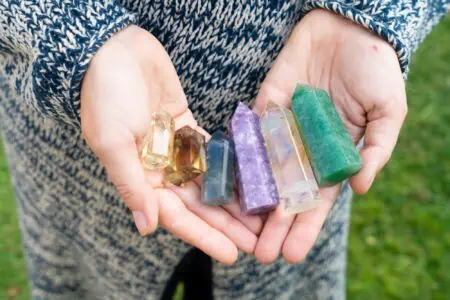
Jewels have captured the hearts, beliefs, and imaginations of civilizations for millennia – from Queen Cleopatra’s coveted emerald mines in Egypt, to China’s deep roots with the highly-prized jade (or “yu,” for “royal gem”), to the inhabitants of Hindu Kush (Afghanistan) who mined the brilliant blue lapis lazuli in 7,000 BC.
Drawing inspiration from a rich array of cultures, you’re sure to discover a variety of unique, classic, and popular names meaning jewel for your darling gem on the way.
So, let’s take a peek and find some names for that shortlist of yours!
100 Beautiful Names That Mean Crystal or Gemstone
These gemstone baby names will steal your heart in no time.
Agate
Agate, a combination of chalcedony and quartz, comes in various colors. It’s one of the most common stones found in ancient hardstone carvings and occurs naturally as nodules in volcanic rock. It typically has a waxy luster with white streaks. Ancient Greeks used agate stones in jewelry, and warriors used them as seal stones. In ancient Islamic beliefs, the stone was believed to increase longevity.
- Origin: Greek, Old French
- Meaning: Kind, one who lived at the gate
- Pronunciation: A-GAT (French), a-gha-teh (Basque)
- Popularity: Agate is a very rare name worldwide.
Akoya
Akoya is a Japanese term for natural or man-made pearls from the Akoya-gai mollusk. If you love the idea of pearls but want something a little more unique, Akoya could make a great first or middle name.
- Origin: Japanese
- Meaning: Pearl
- Pronunciation: ah-koy-yah
- Namesakes: Akoya Sogi, born Yasuyo Sogi, a Japanese voice actress.
- Popularity: Akoya is a very rare name worldwide, slightly more common in Kenya.
Alexandrite
Alexandrite is one of June’s alternative birthstones, the others being moonstone and pearl. Alexandrite is a very rare mineral variety of chrysoberyl, which changes color depending on the type of ambient lighting. It’s best known for displaying an emerald color by day and ruby red by night. Popular belief is that it was discovered in Russia’s Ural Mountains by a Finnish mineralogist and named in honor of Tsar Alexander II.
- Origin: Greek
- Meaning: Defender and protector of mankind
- Pronunciation: al-ig-ZAN-driet
- Variations: Alexander
Allira
Here’s a gorgeous pick for your shortlist, perfectly depicting how precious your newest daughter will be to you. Allira sounds exotic, trendy, and aesthetically appealing all at once. You can even spice it up a bit with some of its cool variations.
- Origin: Australian Aboriginal
- Meaning: Quartz crystal, gem quartz
- Pronunciation: Ah-leer-uh
- Variations: Allirah, Allihra, Allyra, Alliera, Alleira
- Namesakes: Allira Hudson-Gofers, an Australian handball player. Allira Toby, an Australian soccer player.
- Popularity: Allira is the most common in Australia and remains rare worldwide.
Amber
Amber is a fossilized tree resin known for its mesmerizing yellow-orange, translucent glow. The word originates from the Arabic “ambar,” for a “jewel,” while it’s also associated with the Sanskrit word for “sky.” Amber occurs naturally in many colors: white, pale lemon yellow, brownish-orange, and near black. Some lovely variations include Amberlee, Amerly, or Amberlynn.
- Origin: Arabic, French
- Meaning: Amber-color, yellowish-orange
- Pronunciation: AM-bur
- Variations: Ambre, Ambra, Aamber, Ambar
- Namesakes: Amber Evangeline Valletta, an American actress and model. Amber Josephine Liu, an American singer, rapper, and songwriter.
- Popularity: Amber has ranked in the top 1,000 girl names in the U.S. since 1900 and listed #542 in 2022.
Ambre
Ambre is the French version of Amber, so it’s no surprise that it’s very popular in France. If you love Amber’s charming allure but hope to find something more unique, the beautiful French Ambre may be right up your alley!
- Origin: French
- Meaning: Amber-colored, yellowish-orange
- Pronunciation: ahm-bah
- Variations: Amber, Ambra, Ámbar
- Namesakes: Ambre Hammond, an Australian classical pianist. Ambre Allinckx, a Swiss professional squash player, ranked #68 globally.
- Popularity: Ambre is one of the top girl names in France, ranked #4 in 2021.
Amethyst
Here’s a lovely pick among crystal and gemstone names for the precious girl born in February. The word derives from the ancient Greek “a-” meaning “not,” and “methystos,” meaning “intoxicated, drunk.” Greeks carved drinking vessels from the mineral to prevent them from becoming drunk. Amethyst is a variety of quartz, occurring in many gorgeous purple shades, from pale lilac to violet and deep purple. It’s associated with nobility, mental clarity, and healing.
- Origin: Greek
- Meaning: Protected from intoxication, dream-stone
- Pronunciation: am-uh-thist
- Popularity: Amethyst is a rare name worldwide, with some use in the United States.
Amora
Amora is the modern-day version of the Latin “amor” for “love.” It’s also the trademark name for a silicon carbide mineral known as moissanite. In Norse, it means “light eagle.” This unique girl’s name may perfectly celebrate your love and affection for the rare jewel entering your world.
- Origin: Spanish, English
- Meaning: Love
- Pronunciation: uh-moh-rah
- Variations: Amoura, Amore, Amor
- Namesakes: Amora Mautner, a Brazilian TV director, and former actress.
- Popularity: Amora entered the top 1,000 U.S. girl’s name list in 2017, last ranked #373 in 2022.
Aquamarine
Here’s a special one for unique name lovers, even better if you’re expecting a March baby. Aquamarine is a variety of the mineral beryl, derived from the Latin for “water” (aqua) and “marine” (of the sea). This gorgeous gemstone ranges from greenish blue to blue-green, perfectly depicting the ocean’s tranquil hues. Roman sailors would call it the “water of the sea” and believed it protected them from dangerous voyagers.
- Origin: English
- Meaning: Seawater
- Pronunciation: AH-kwa-mah-reen
Asteria
Asteria is inspired by the ancient Greek “aster,” meaning “star.” Asterism describes the star-shaped reflection of light depicted on shaped or polished gemstones. Stones with this feature are typically known as star stones or asterias, with the best example being the star sapphire. What better way to inspire your glowing girl to reach for her dreams than to name her after the stars above?
- Origin: Greek
- Meaning: Star, starry one, as radiant as a star
- Pronunciation: UH-st-eh-ree-ah
- Variations: Asterios
- Popularity: Asteria is pretty rare worldwide, with higher usage in parts of Africa, Indonesia, and the Philippines.
Beryl
Beryl is a gorgeous mineral that includes aquamarine and emerald gemstones. It comes from the Greek “beryllos,” meaning “color of the sea.” The first eyeglasses, constructed in 13th-century Italy, consisted of beryl. Predominantly used as a girl’s name, Beryl has also been used for boys, mainly in America. If you’re looking for a timeless, classic, Beryl is perfect for your blue or green-eyed baby!
- Origin: English, Latin, Sanskrit
- Meaning: The blue-green color of seawater
- Pronunciation: BEHR-uhl
- Variations: Beril
- Namesakes: Beryl Mercer, a Spanish American actress honored by Queen Alexandra of Denmark during World War I. Beryl Wallace, an American actress, dancer, and singer.
- Popularity: Beryl was most popular for U.S. girls in 1920 and 1912 for boys; last listed among the top 1,000 baby names in 1957.
Bijou
In French, Bijou refers to an intricate jewelry piece from the Breton word “bizou” for a “finger ring.” English speakers later adopted it when describing a delicately designed trinket or something small and exquisite. A bijou house or apartment would be described as small and fashionable. What better way to show love for your little one than with this stylish name?
- Origin: French
- Meaning: Jewel
- Pronunciation: bee-shuw
- Namesakes: Bijou Lilly Phillips Masterson, an American actress, singer and model. Bijou Thaangjam, an Indian actor, lyricist, chef, art director, and entrepreneur.
- Popularity: Bijou was most popular in the early to mid-2000s. It’s now quite rare, mostly heard among French-speakers.
Cameo
Cameo is one of the more unusual crystal-related names. It refers to an ancient jewelry carving technique first used in 3,100 B.C., in which precious stones (mostly agate, onyx, or sardonyx) were carved in relief, creating a 3D effect. This practice became popular again in the Victorian era, with jewelers carving intricate designs from coral, shell, and lava stone.
- Origin: English
- Meaning: A gem carved in relief, a carving or sculpture made into a cameo
- Pronunciation: KAM-ee-oh
- Namesakes: DJ Cameo, an English DJ and former host of the grim show Pirate Sessions.
Carmine
Carmine may not be a gemstone name, but it reminds us beautifully of gemstone-like qualities. It refers to a bright-red pigment from the aluminum complex in carminic acid extracted from the Cochineal insect. The word comes from the Latin “coccinus,” meaning “scarlet-colored,” or from “coccum,” meaning “berry-yielding scarlet dye.” It’s also believed to mean “poetry,” “spell,” or “sacred word,” from the Latin “carmen.”
- Origin: Latin, Aramaic, Italian
- Meaning: Red, crimson
- Pronunciation: KAR-mee-neh
- Variations: Carmen, Carmina, Cármine, Carminé, Carmo, Carmelo, Carmelino, Carmella, Carmela
- Namesakes: Carmine Dominick Giovinazzo, an American actor, known for his role as Detective Danny Messer in CSI: NY. Carmine Vingo, an American world-ranking heavy-weight boxer.
- Popularity: Carmine is common in America and Italy, last ranked #934 among the top 1,000 boy names in the U.S. in 2007.
Carnelian
Carnelian is a brownish-red mineral, a semi-precious stone, and a variety of chalcedony (a quartz group). It comes from the Latin “cornum,” referring to the Cornel Cherry, a small shrub or tree with red translucent berries closely resembling the stone. In the Bronze Era, chalcedony was used in tool-making, with evidence that people would shape Carnelian into intricately carved gems for jewelry. Carnelian could make a unique first or middle name for your energetic bundle.
- Origin: Latin
- Meaning: A semi-precious red stone
- Pronunciation: KAHR-nee-lee-ahn
- Variations: Cornelian
Celestine
Celestine is a mineral known for its delicate blue shade. Together with strontianite, it is one of the principal elements used in fireworks and metal alloys. It comes from the Latin “caelestis,” meaning “celestial,” and “caelum,” meaning “sky” or “heaven.” Between the 1200s and 1700s, it belonged to five popes and an order of Benedictine monks (Celestines).
- Origin: Latin
- Meaning: Of the sky, heavenly-minded
- Pronunciation: SEHL-uh-steen
- Variations: Célestine, Celestina, Celestino, Celandine, Celeste
- Namesakes: Pope Celestine I, the bishop of Rome from 10 Sep. 422, until his death on 1 Aug. 432. Célestine Galli-Marié, a French mezzo-soprano.
- Popularity: Celestine is heard predominantly in African countries and was last listed among the top 1,000 U.S. girl names in 1963.
Charoite
This gorgeously rare silicate mineral could be perfect if you love all things purple! Charoite has a pearly luster, ranging from translucent purple to violet and light brown. It was first called a Lilac Stone when discovered in the 1940s by the Chara River in Russia. It comes from the Russian word “chary,” meaning “magic” or “charms.” Charoite’s characteristic swirling patterns could perfectly depict your royal girl’s intricate personality.
- Origin: Russian, Latin
- Meaning: Magic
- Pronunciation: SHA-roo-ight
- Popularity: Charoite is extremely rare, only recorded once in Hong Kong as a first name.
Cinnabar
Cinnabar or cinnabarite is a bright scarlet to brick-red mineral typically found near volcanic activity and hot spring deposits. It’s the historical source for the scarlet pigment vermilion, associated with red mercury pigments. The word comes from the Greek “kinnabari,” while in Latin, it was called “minium,” meaning “red cinnamon.” A stunning, fiery-sounding name if you hope to inspire confidence in your young man.
- Origin: Greek, Latin
- Meaning: A bright-red mineral and chief ore of mercury, brilliant red
- Pronunciation: sin-NAH-bar
- Popularity: Cinnabar is very rarely heard as a first name worldwide.
Citrine
Citrine comes from the French “citron,” for “lemon,” referring to this beautiful gemstone’s pale yellow to honey orange hue. Citrine is one of the modern birthstones for November, alongside golden topaz (an unrelated gem). In the 18th-century, mineralogists discovered that amethyst and smoky quartz could be heat-treated to produce citrine’s rich, yellow hues. This gemstone remains one of the most affordable yellow gemstones today.
- Origin: English, Old French
- Meaning: Lemon
- Pronunciation: sit-REEN
- Namesakes: Walter Citrine, the 1st Baron Citrine, a leading English international trade unionist from the 20th-century.
Copper
Copper is a soft, malleable metal with high heat and electrical conductivity, typically displaying a pinkish-orange color. The Romans would mine for copper from Cyprus (or Kyprios in Greek), calling it the “metal of Cyprus.” This was shortened to “cyprium” and then “cuprum,” eventually leading to the Old English “coper,” more familiar to us today.
- Origin: Latin, Greek
- Meaning: Metal of Cyprus
- Pronunciation: KAWP-uhr
- Variations: Chopper, Copper, Coppier, Copper, Ciopper
Coral
Corals are marine invertebrates that form compact colonies and secrete calcium carbonate to develop hard skeletons. The name “coral ” is derived from the Greek word “korallion.” Red coral was a prized gemstone in China during the Manchu or Qing Dynasty (1644-1911), associated with long life, virtue, and high rank. Chinese emperors wore intricately carved coral beads for court jewelry, and penjing was a decorative miniature coral tree.
- Origin: English, Spanish
- Meaning: Sesile sea animals or reef-builders
- Pronunciation: KAWR-uhl
- Variations: Coralie, Coraline, Kaorlia
- Namesakes: Coral Bracho, a Mexican poet, translator, and literature doctor. Coral Buttsworth, an Australian professional tennis player, and Australian Championships winner.
- Popularity: Coral was most popular in English-speaking countries in the late 1800s and last listed in the U.S. top 1,000 girl names in 1992.
Crystal
Crystal is a solid material with molecules arranged into one of seven specific crystal patterns, forming a lattice. The word comes from the ancient Greek “krustallos,” meaning “ice” and “rock crystal,” or “kruos,” for “icy cold” and “frost.” It also offers lovely variations, such as Cristal in Spanish and Crystallia or Krystallia in Greek. It may not be as popular as it used to be among names that mean crystal, but you could initiate a fresh baby-naming trend!
- Origin: English
- Meaning: Transparent quartz gemstone
- Pronunciation: KRIS-tuhl
- Variations: Chrystal, Christal, Crystallia, Cristalle, Cristal, Kristal, Krystle, Krystal, Krystelle
- Namesakes: Crystal Reed, an American actress, playing Allison Argent in the Teen Wolf series. Crystal Taliefero, an American musician hired by the Billy Joel Band in 1989.
- Popularity: Crystal remained in the top 1,000 U.S. girl names between 1900 and 2021 and has since slipped off the charts.
Diamond
Diamonds, a pure form of carbon arranged in a rigid crystal structure, have been the most prized gemstones for centuries. The name comes from the Late Latin “diamas,” from “adamas,” meaning “unconquerable, unbreakable” in Greek. If your baby girl is born in April, she may be lucky enough to bear this name! Diamonds are usually colorless but can come in a rainbow of shades – from rare, fiery reds to deep blues, soft pinks, and warm, sunny yellows.
- Origin: Latin
- Meaning: Unbreakable
- Pronunciation: DIE-muhnd
- Variations: Diamantina, Diamanto, Diamanda, Dymond, Diamante
- Namesakes: Diamond White, an American singer and actress, who starred in the American X Factor. Diamond Zhang, or Zhang Bichen, known for winning The Voice of China contest in 2014.
- Popularity: Diamond was the most popular in 1999 in the U.S.
Dior
Dior is a type of intrusive igneous rock formed by the slow cooling of magma underground, typically found between continents in mountain-building belts (orogens). The name likely comes from the French “doré,” meaning “golden,” which is also used as a French surname. Diorite was historically used for sculptures by the Egyptians and Incas, and as cobblestones in England.
- Origin: French, English
- Meaning: Golden
- Pronunciation: dee-aw
- Namesakes: Christian Ernest Dior, a French fashion designer who founded one of the world’s top fashion houses, Christian Dior SE.
- Popularity: Dior entered the top 1,000 U.S. girl names in 2018 and the top boy names in 2020.
Ebony
Ebony may not be a strict gemstone name, but it certainly fits under the category of precious natural materials. It’s one of the most expensive woods worldwide. The wood comes from several species in the Diospyros genus, desired for its hard, heavy, dark timber. The word comes from the ancient Egyptian “hbny” via the ancient Greek “ébenos.”
- Origin: African American, Latin
- Meaning: Deep black wood
- Pronunciation: EHB-uh-nee
- Variations: Eboni, Ebonee
- Namesakes: Ebony Rainford-Brent, a former English cricketer, now a commentator and Director of Women’s Cricket at Surrey. Ebony M. Scott, an American lawyer and Associate Judge.
- Popularity: Ebony is less popular today – last ranked #85 in Australia in 2006, #536 in 2021 in England and Wales, and #961 in the U.S. in 2005.
Eirian
Eirian is a gorgeous classic, offering all the uniqueness for those desiring something extraordinary. It comes from the Welsh word “arian,” meaning “silver,” while it could also mean “bright” and “beautiful” in Welsh. A radiant title for the child destined to shine!
- Origin: Welsh
- Meaning: Silver
- Pronunciation: eye-ree-an
- Variations: Eiriane, Eiriann, Eirhian, Irian, Erian
- Namesakes: Eirian Llwyd, a Welsh artist and wife of former Plaid Cymru leader Ieuan Wyn Jones. Eirian Smith, an American acrobatic gymnast.
- Popularity: Eirian is a rare name worldwide, primarily recorded in Wales and England.
Electra
Here’s a stunning gemstone name for all those Greek mythology fans out there. Electra is derived from the Greek “elektron,” meaning “amber,” belonging to the main character in two Greek tragedies. In Greek myth, Electra was the daughter of Agamemnon and Clytemnestra and the sister of Orestes. She was also one of the Pleiades – the seven daughters of Atlas and Pleione.
- Origin: Greek
- Meaning: Shining, iridescent, amber-haired
- Pronunciation: ee-LEHK-truh
- Variations: Elektra, Ilektra, Ela, Elka, Elke, Elek, Elektrine, Elettra
- Namesakes: Electra Waggoner Biggs, a Texan heiress, socialite, artist, and owner of the Waggoner Ranch in Texas. Electra Collins Doren, an American suffragist and librarian.
Emerald
Emerald is a prized gemstone, classified among the “Big Four” – diamond, ruby, emerald, and sapphire. This mostly green beryl stone variety ranges from yellow-green to blue-green and is the traditional birthstone for May. Egyptians mined it as early as 330 B.C. and would bury the precious stone with monarchs for protection. Queen Cleopatra was especially known for cherishing this jewel. The Chipembel Emerlad, discovered in Zambia in 2021, is the largest emerald ever found to date (1).
- Origin: English, Greek
- Meaning: Green gemstone
- Pronunciation: EHM-uh-ruld
- Variations: Esmeralda, Esméralda, Esmé, Esme, Zümra
- Namesakes: Emerald Lilly Fennell, an English actress, writer and filmmaker.
- Popularity: Emerald is pretty popular, ranking its highest at #768 in 2022 in the U.S.
Emery
Emery refers to a dark, granular-like rock used to create abrasive or polishing material. Crushed emery, known as “black stone,” is used on emery boards or emery cloth, including asphalt and tarmac mixtures. This warm-sounding name was traditionally more popular for boys (ranked the highest in 1901) but has grown more popular for girls recently.
- Origin: English, French
- Meaning: Industrious, powerful
- Pronunciation: EHM-uh-ree
- Variations: Amery, Amory, Emerie, Emory
- Namesakes: Linda Emery Lee Cadwell, a retired American teacher and writer, widow of martial arts legend Bruce Lee, and mother to the late actor, Brandon Lee.
- Popularity: Emery is the most popular among girls, reaching its highest of #82 in 2022. It ranked #727 for American boys in 2022.
Esmeralda
Esmeralda is the Spanish and Portugese word for “emerald,” (pronounced: ehz-meh-RAL-da or izh-mi-RAL-duh). It was likely popularized among English-speakers, by the beloved gypsy girl character from Victor Hugo’s popular 1831 novel, The Hunchback of Notre Dame. Esmeralda constantly ranks among the top 100 girl names in Mexico. A stunning name for an adventurous girl, with the ocean in her eyes.
- Origin: Spanish, Portuguese, English
- Meaning: Emerald
- Pronunciation: ehz-muh-RAHL-duh, izh-mi-RAL-duh
- Variations: Emerald, Esmaralda, Esméralda
- Namesakes: Princess Marie-Esméralda of Belgium, Lady Moncada, a member of the Belgian royal family. Esmeralda Pimentel, a Mexican actress and model.
- Popularity: Esmeralda has ranked among the top 1,000 U.S. girl names since 1952 and last ranked #371 in 2022.
Farida
Farida is the feminine form of the masculine Farid, derived from the Arabic “farada”( فرد ), meaning “to be unique.” This stunning title is common among Muslim and Hindu communities. It’s spelled Feride in Turkish and Farideh in Persian, in the Iranian dialect.
- Origin: Arabic, Indian
- Meaning: Precious pearl, unique
- Pronunciation: fa-REED
- Variations: Feride, Farideh, Fárida, Faridà, Faridah, Fharida, Farieda
- Namesakes: Farida of Egypt, the Queen of Egypt as King Farouk’s first wife (1938 – 1978). Farida Azizi, an Afghan advocate for women’s rights.
- Popularity: Farida is a very common girl’s name, with the highest recordings in Algeria, India, Pakistan, Indonesia, and Bangladesh.
Firoza
Firoza is a beautiful Bengali word, depicting the deep shades of turquoise-colored gemstones. It’s ultimately derived from the classical Persian “firoza,” meaning “turquoise.” Firoza is also a town in Rahim Yar Khan, Pakistan.
- Origin: Bengali
- Meaning: Turquoise
- Pronunciation: fih-ROH-zah
- Variations: Firozah, Feiroza, Fieroza, Fairoza, Farooza, Feroza
- Namesakes: Firoza Begum, a Bangladeshi Nazrul Geeti singer, awarded the Independence Day Award in 1979. Firoza Begum, a Jewish Indian actress, starring in several Bollywood and Mollywood films
- Popularity: Firoza is a rare name worldwide but commonly heard in India and Bangladesh.
Flint
Another fancy term to describe flint is sedimentary cryptocrystalline – a variety of quartz found mostly as nodules in limestone or chalk. This nifty mineral, historically used as a tool, was essential for survival during the Stone Age and was used for making fire. If you’re up for a trendy-sounding name with a touch of uniqueness, Flint could be a keeper!
- Origin: English
- Meaning: A type of stone
- Namesakes: Flint Dille, and American screenwriter and game designer.
- Popularity: Flint was last ranked at #822 in 1960, in the United States.
Gabbro
Gabbro is a dark, coarse-grained igneous rock formed from magnesium-rich and iron-rich magma cooling beneath the Earth’s surface. This rock predominantly forms the Earth’s oceanic crust, especially along mid-ocean ridges. An interesting option for a boy who loves all the earth’s wonders!
- Origin: Italian
- Meaning: A type of igneous rock
- Pronunciation: gah-broh
- Popularity: Gabbro is only recorded as a name in Ghana.
Galena
Galena is the natural mineral form of lead sulfide, the most important ore of lead, and a vital source of silver. It likely comes from the Greek “galene” meaning “calm.” In ancient times, it was used in the cosmetic, kohl, applied by Egyptians to protect their eyes from the sun’s harsh glare in the desert and to keep flies away.
- Origin: Greek
- Meaning: Calm
- Pronunciation: guh-LEE-nah
- Variations: Galina, Galya
- Namesakes: Galina Vicheva Gencheva, known as Galena, a Bulgarian pop-folk singer.
- Popularity: Galena is a rare name primarily heard in Bulgaria and the United States.
Garnet
Garnet is January’s birthstone, typically depicted as a rich, deep red. This semi-precious stone occurs in almost any color, from the deep red of the pyrope garnet to the rich green of tsavorites. It comes from the 14th-century Middle English word “gernet,” meaning “dark red,” and the Latin “granatum,” meaning “seed,” due to its resemblance to a pomegranate seed. Garnets are associated with vitality, love, light, and keeping travelers safe.
- Origin: English
- Meaning: Dark red, seed
- Pronunciation: GAHR-nhut
- Variations: Garnette
- Namesakes: Garnett Genuis, a Canadian politician. Garnet Hathaway, an American professional hockey player.
- Popularity: Garnet is more widely used as a girl’s name, listed as the most popular in 1911 in the U.S.
Gemma
Gemma is an ideal pick among names meaning jewel. Originally used in Italian communities as a nickname for a “gem,” Gemma was later adopted as an English name. It also belonged to the wife of 13th-century poet Dante Alighieri.
- Origin: Latin, Italian
- Meaning: Jewel, gem
- Pronunciation: JEHM-ma, ZHEHM-muh
- Variations: Jemma, Gema, Gemmah, Ghemma
- Namesakes: Gemma Galgani, an Italian mystic and Catholic Church saint. Gemma Clare Collins, an English media personality and businesswoman.
- Popularity: Gemma was the most popular in the U.S. in 2021, at #191. It ranked another high of #197 in 2022.
Giada
Giada encompasses all the Italian charm of a crisp summer’s day, associated with the precious green stone jade. Jade was a prized ancient ornamental stone throughout Asia and Latin America. The Chinese empire has held jade in high regard for centuries, ranking it similarly to gold or diamonds in the West. It is usually associated with nobility and wealth.
- Origin: Italian
- Meaning: Jade
- Pronunciation: jah-dah
- Variations: Jada, Jade, Jaida, Jayda, Jayde
- Namesakes: Giada Colagrande, an Italian film director and actress, married to American actor, Willem Dafoe. Giada De Laurentiis, an Italian American television personality, chef, entrepreneur, and writer.
- Popularity: Giada was the most popular among U.S. girls in 2010 and slipped off the top 1,000 in 2013.
Goldie
This delightful vintage classic is re-entering the baby naming charts. Goldie offers several origins – from the Yiddish names Golde or Golda, a diminutive for the English Marigold, or a nickname for someone with blonde hair. It’s more common among girls but is occasionally used for boys. Goldie could make a stunning choice if you think your baby is destined to soak up the sun, no matter their hair color!
- Origin: English
- Meaning: Made of gold, gold
- Pronunciation: GOL-dee
- Variations: Golda, Goldeana, Goldee, Golden, Goldena, Goldene, Goldey, Goldi, Goldia, Goldina, Goldine, Goldy, Goldye
- Namesakes: Goldie Jeanne Hawn, an American actress, known for Bird on a Wire (1990) and The First Wives Club (1996).
- Popularity: Goldie was most popular among American girls in 1905, slipping off the top 1,000 list in 1958, only to rank again at #813 in 2022.
Goldstone
Goldstone, or aventurine glass, is a type of glass created in a low-oxygen environment. This results in a stunning, reddish, smooth, polished semi-precious stone used in beads, figurines, or other artifacts. The name for this artificial stone originates from the Anglo-Saxon, Goldstan, or Goldston, referring to those who lived near a yellow/golden stone. Its alternate name comes from the Italian “avventura,” meaning “adventure” or “chance.”
- Origin: English
- Meaning: Dweller at the gold rock
- Pronunciation: GHOLD-stohn
- Variations: Gouldstone, Goldstein, Goldzstone, Goldston, Gholdston
- Namesakes: James Goldstone, an American film and television director. Richard Goldstone, a South African former judge, and international war crimes prosecutor.
- Popularity: Goldstone is commonly recognized as a surname, with its highest usage in America, England, and South Africa.
Granite
Granite is a coarse-grained, intrusive, igneous rock common in the Earth’s continental crust. It comes from the Latin word “gratum,” referring to the stone’s grainy appearance. You’re more likely to come across it in various place names, such as Granite Harbour in Antarctica, Granite City in Illinois, and Granite Falls City in Washington.
- Origin: Latin
- Meaning: Grain
- Pronunciation: GRA-nit
- Variations: Granitë, Granit, Granites
Heliodor
Heliodor is a form of beryl, with one of the most brilliant golden yellow shades, discovered in Western Namibia in 1910. This gorgeous stone is highly prized among collectors due to its distinct shade and rarity. It comes from the Greek words “helios” and “doron,” meaning “gift from the sun.” Some sources mention Heliodor as the Polish or Catalan form for Heliodorus, pronounced “kheh-LYAW-dawr.”
- Origin: Greek, Polish
- Meaning: Gift of the sun
- Pronunciation: HEE-lee-oh-dore
- Variations: Heliodore, Héliodor, Eliodor, Heliodorous, Heliodoros, Heliodoro
- Popularity: Heliodor is a rare name, with the highest occurrence in Austria in 2014.
Helmi
Helmi has several uses and origins. In Finnish and Estonian, it’s considered a diminutive of Vilhelmiina or Vilhelmina – derived from William, meaning “will-helmet.” Helmi is also used in Arabic, Urdu, Hindi, and Bangla as a surname or first name for boys, meaning “gentle, calm, or patient.”
- Origin: Finnish, Swedish
- Meaning: Pearl, amber, bead
- Pronunciation: HEHL-mee
- Variations: Hélmi, Helmis, Chelmi, Helmie, Helmii, Hellmi, Hilmi
- Namesakes: Helmi Johannes, an Indonesian television newscaster. Helmi Purr, an Estonian prima ballerina, dance master, and coach.
- Popularity: Helmi is popular among Finnish girls. It’s also a common surname in Egypt, Indonesia, Saudi Arabia, and Iran.
Hira
Hira, also spelled Heera, comes from the Sanskrit word “hīrā” for “diamond.” It’s also the famous title for the Cave of Hira or Jabal al-Nour (“Mountain of the Light”), visited by the Prophet Muhammed, where it’s believed he received his first revelation of the Quran.
- Origin: Sanskrit
- Meaning: Diamond, jewel
- Pronunciation: HHIY-Raa
- Variations: Heera
- Namesakes: Hira Devi Waiba, an Indian folk singer, hailed as the pioneer of Nepali folk songs. Heera Rajagopal, an Indian actress, featured in several Tamil and Hindi films.
- Popularity: Hira is a popular name and common surname primarily used in India, Nepal, Bangladesh, and Pakistan.
Inbar
Inbar refers to the beautiful fossilized tree resin, amber, derived from the Arabic “anbar.” If you have Israeli heritage or desire something extraordinary, Inbar could work wonderfully for your little treasure.
- Origin: Hebrew
- Meaning: Amber
- Pronunciation: IN-bar
- Variations: Einbar, Yinbar, Ginbar, Inbare, Anbar
- Namesakes: Inbar Lavi, an Israeli actress known for playing Raviva on the 2012 MTV series Underemployed. Inbar Bakal, an Israeli singer-songwriter.
- Popularity: Inbar is a rare name worldwide, commonly heard among girls in Israel.
Indigo
Indigo is not a true gemstone name but represents a stunning hue found in many jewels. You’ll find various beautiful indigo shades among amethysts, charoites, iolites, and tanzanites, including indigo sapphire, indigo agate, lapis lazuli, and blue spinel. Indigo ultimately comes from the Greek word “indikon,” meaning “from India.” Many indigo gemstones are believed to offer healing powers.
- Origin: English, Greek
- Meaning: Blue-purple shade, from India
- Pronunciation: IN-dee-goh
- Variations: Indigo, Indiego
- Namesakes: Indigo De Souza, an American Brazilian singer-songwriter. Indigo Sparke, an Australian Indie rock musician.
- Popularity: Indigo is used more frequently as a girl’s name, hitting the top 1,000 girl names in the U.S. in 2021 and 2022.
Iris
Iris has remained a classic favorite, charming parents worldwide. It is listed through its association with iris quartz, which has other names such as rainbow quartz or anandalite. Iris quartz is uniquely characterized by internal rainbow reflections, which are colorless or faintly amethystine or citrine – a stunning analogy depicting the hidden beauty within your radiant girl.
- Origin: Greek
- Meaning: Rainbow
- Pronunciation: EYE-ris, EE-ris, EE-rees
- Variations: Iiris, Irida
- Namesakes: Iris Mittenaere, a French model, TV host, and beauty queen, crowned Miss Universe in 2016. Iris Apfel, an American actress, businesswoman, and fashion icon.
- Popularity: Iris has been in the top 1,000 girl names in the U.S. since 1900, hitting the top 200 names in 2016 and peaking at #86 in 2022.
Ivory
Ivory comes from the Egyptian “âb, âbu” for “elephant,” Anglo-Norman “ivurie,” and Latin “eboreus,” meaning “in or of ivory.” It refers to the hard, white, highly valuable material from animal tusks and teeth, mainly consisting of dentine (calcified tissue). Elephant tusks are the most important source, but other historical sources include mammoths, walruses, hippopotamuses, sperm whales, orcas, and warthogs. Most trade in natural ivory is illegal now, and ivory can be produced synthetically.
- Origin: English, German
- Meaning: Hard creamy white substance from animal tusks
- Pronunciation: IE-vuh-ree
- Variations: Aivory, Ivorry, Ivorey, Ivoray
- Namesakes: Ivory, or Lisa Mary Moretti, a retired American wrestler and coach. James Ivory, an American film director, producer, and screenwriter.
- Popularity: Ivory has been climbing the charts since 2013, reaching its highest of #518 in 2022 among the top 1,000 U.S. girl names.
Jacinth
Jacinth is a yellow-red to red-brown variety of zircon. In the Old Testament, it was one of the precious stones placed in the high priest’s hoshen (the breastplate), referred to as “leshem” in Hebrew, meaning “jacinth” in English.
- Origin: Greek, Hebrew
- Meaning: Blue larkspur, precious stone
- Pronunciation: JAY-sinth
- Variations: Jacintha, Jaycinthe, Hyacinth, Jacinthe, Jascinth, Jaycinth
- Namesakes: Jacintha Abisheganaden, a Singaporean actress and singer. Jacinthe Larivière, a Canadian pair skater.
- Popularity: Jacinth is a rare name, mostly recorded in Jamaica and the United States.
Jade
Jade refers to two types of ornamental gemstones, nephrite and jadeite. The more common nephrite stones are known for their splintery, oily luster, while the rarer jadeite stones, or imperial jade, occur in white, emerald green, apple green, red, brown, or blue. Jade comes from the Spanish term “piedra de ijada,” meaning “stone of the bowels,” describing its reputed role in healing ailments of the loins or kidneys. Parents believed a jade stone placed on a baby’s stomach could heal it from colic.
- Origin: English, French
- Meaning: Flank (side) of body, loin stone
- Pronunciation: JAYD, ZHAD
- Variations: Giada, Jada, Jaida, Jayda, Jayde, Jaden
- Namesakes: Jade Raymond, a Canadian video game producer, known for helping create the Assassin’s Creed and Watch Dogs franchises. Jade Buford, an American professional race driver.
- Popularity: Jade is more popular for girls, ranking among the top 1,000 U.S. girl names since 1975, last ranking #88 in 2022.
Jasper
Jasper is an aggregate mineral of quartz, chalcedony, and other mineral phases – typically an earthy red but can be yellow, brown, green, or a very rare blue. The name is derived from the Old French “jaspre,” meaning “spotted or speckled stone.” As a first name, Jasper comes from the Hebrew “gizbar,” meaning “treasurer.” Bloodstone, a type of jasper, is the traditional birthstone for March.
- Origin: Persian, Hebrew, Dutch
- Meaning: Bringer of treasure, treasurer
- Pronunciation: JAS-phur, YAHS-phur (Dutch)
- Variations: Jesper, Caspar, Kaspar, Kasper, Gasparo, Jespa
- Namesakes: Jasper Liu, a Taiwanese actor, model, and musician. Jasper Morris, a British Master of Wine and Burgundy expert.
- Popularity: Jasper was popular among American boys throughout the early 1900s, reaching its highest rank of #128 in 2021.
Jet
Jet is a type of lignite (brown coal) and gemstone originating from the decomposition of tree wood from the Araucariaceae family. It comes from the French word “jaiet” or modern French “jais,” for the same material, referring to the ancient town of Gagae. Interestingly, the adjective “jet-black” was inspired by this gemstone. In Dutch, Jet is a diminutive for other longer names, such as Henriëtte or Mariëtte, pronounced YEHT.
- Origin: Dutch
- Meaning: Black stone, home-ruler, drop of the sea
- Pronunciation: JEHT, YEHT
- Variations: Jett, Jeet, Jete, Jetta
- Namesakes: Terence “Jet” Harris, and English rock and roll musician, known for working with Cliff Richard. Jet Tila, an American celebrity chef, author, and restaurant developer.
- Popularity: Jet is less common worldwide, with the highest recordings in China, the Netherlands, and Hong Kong.
Jewel
Jewel is another term in English for a gemstone, precious stone, or semiprecious stone. It comes from the Old French “jouel,” meaning “toy” or “delight,” likely related to “jeu,” meaning “game.” Jewel could have begun as an affectionate nickname during the 19th-century or is related to the surname Jewel or Jewell.
- Origin: English, French
- Meaning: Precious stone
- Pronunciation: JOOL, JOO-uhl
- Variations: Juvela, Jewell, Jewele, Jhewel
- Namesakes: John Jewel, the Bishop of Salisbury from 1559 to 1571. Jewel Staite, a Canadian actress known for portraying Kaylee Frye in the series Firefly.
- Popularity: Jewel was most popular among American girls in 1904 and remained in the top 1,000 pretty consistently, only to slip off the charts in 2019.
Jumana
Jumana offers glorious Asian charm, with the “pearl” no doubt perfectly depicting your daughter’s radiant beauty. It can also mean “silver pearl” in Arabic.
- Origin: Arabic
- Meaning: Rarest pearl
- Pronunciation: joo-MA-nah
- Variations: Jumana, Jumanai, Jumanna, Jumanay
- Namesakes: Jumana Murad, a Syrian actress and producer. Jumana Ghunaimat, a Jordanian journalist and media figure.
- Popularity: Jamana is a pretty popular name, frequently heard in India, Bangladesh, Indonesia, and Israel.
Kohaku
Kohaku beautifully portrays the exotic allure of amber – a transparent, yellowish-orange hardened resin from ancient pine trees. Over many centuries, amber has been a treasured gem for creating jewelry and ornate carvings across many cultures. Kohaku could easily steal your heart if you’re looking for something truly one-of-a-kind!
- Origin: Japanese
- Meaning: Amber
- Pronunciation: KO-HA-KOO
- Variations: Chohaku, Kohakou,
- Namesakes: Hana Iwaki, known by her ring name Kohaku, a Japanese professional wrestler.
- Popularity: Kohaku is a rare name worldwide, mostly used in Japan.
Lapis
Lapis is the shortened term for lapis lazuli, a metamorphic rock and semi-precious stone prized for its rich, deep blue. Ancient artifacts of lapis lazuli found in Bhirrana date as far back as 7,570 B.C. It used to be one of the most important materials for Renaissance artists when it was ground into powder to make ultramarine. Lapis lazuli is also the birthstone for December babies.
- Origin: Latin, Persian
- Meaning: Stone of the sky, stone from heaven
- Pronunciation: LAH-pis
- Variations: Lápis
Larimar
Larimar is the trade name for a turquoise-blue variety of a silicate, pectolite mineral. The name comes from where it was first discovered in the early 1900s, at Filipinas Larimar Mine, Dominican Republic. The man who discovered it is believed to have combined his daughter’s name, Larissa, with the Spanish word for “sea” (mar) since they believed the stone came from the sea.
- Origin: Spanish
- Meaning: Stone of the sea, blue stone
- Pronunciation: LA-ree-mar
- Variations: Larrimar, Lariemar
- Popularity: Larimar is a very rare name, only recorded in the Dominican Republic and the Philippines.
Lazuli
Lazuli refers to the brilliant blue variety of the lazulite mineral, while it also refers to lapis lazuli, a beautiful deep-blue metamorphic rock. The word derives from the medieval Latin “lazulum,” which refers to the “sky” or “heaven.” If you want to raise a dreamer, what better crystal-inspired name than lazuli – especially if you expect him in December?
- Origin: Latin
- Meaning: Shining stone
- Pronunciation: LAH-zoo-lee
- Variations: Lázuli, Lazulie
Malachite
Malachite is a copper carbonate hydroxide mineral, typically occurring in various green shades. The name derives from the Greek “malachíti̱s, líthos,” meaning “mallow stone,” inspired by the stone’s resemblance to the leaves of the Mallow plant. Malachite also describes a particularly vivid, yellowish green in nature, such as the Malachite sunbird found from Ethiopia to South Africa.
- Origin: Latin, Greek
- Meaning: Mallow-green stone
- Pronunciation: MA-luh-kiet
- Variations: Mallachite, Malakite
Margot
Margo is the French version of Margaret (or Marguerite), from the Latin Margarita and Greek “margarites” meaning “pearl.” Its beautiful reference to the pearl could be perfect for your little jewel – known for representing wisdom, purity, and spiritual transformation.
- Origin: French
- Meaning: Pearl
- Pronunciation: MAHR-goh
- Variations: Marguerite, Marge, Margaretta, Margaux, Margery, Margret, Marjorie, Marjory
- Namesakes: Margot Elise Robbie, an Australian actress and producer, known for her roles in Suicide Squad and Barbie. Margo Cathleen Harshman, an American actress, starring in The Big Ban Theory.
- Popularity: Margo was the most popular in 1951 among American girls and remains relatively popular at #617 in 2022.
Marjani
Little information is available regarding this stunning name. In Sanskrit and Hindi, it refers to the female attendant of the goddess durga, representing “purification” and “cleansing.” Some sources suggest it means “one who is beautiful like precious coral” in Arabic. With such meaningful associations, it’s difficult for this one not to make the shortlist!
- Origin: Indian, Arabic
- Meaning: Coral
- Pronunciation: maar-jah-nEE
- Variations: Marijani, Marjanis, Mardjani
- Popularity: Marjani is a rare name, mostly occurring in Indonesia, Afghanistan, India, and the United States.
Mica
Mica describes a group of silicate minerals with highly beneficial properties, used in products such as paints, drywalls, fillers, roofing, vehicles, and electronics. The mineral word likely comes from the Latin “mica,” meaning “crumb,” inspired by “micare,” meaning “to glitter.” As a first name, Mica is a diminutive derived from the Hebrew Mikha’el, meaning “Who is like God?” Other sources suggest it means “brook.”
- Origin: Hebrew, Latin
- Meaning: To glitter
- Pronunciation: MHIE-kah
- Variations: Micah, Micael, Mikael, Mikkel, Maikel, Michel, Micha, Michaela, Michael
- Namesakes: Mica Burton, an American actress, cosplayer, and host. Mica Levi, an English singer, song-writer, and composer.
- Popularity: Mica is an uncommon name worldwide, mostly occurring in Romania and the United States.
Mina
Mina is a delightful short name with several origins. In Sanskrit, it means “fish,” referring to the daughter of the Hindu goddess, ushas. In English/Dutch, Mina is the diminutive for Wilhelmina and other names ending in “-mina.” For gemstone lovers, Mina means “azure” or “enamel.”
- Origin: Persian, Indian, Chinese, Japanese
- Meaning: Clear like crystals, sky blue
- Pronunciation: MEE-nah
- Variations: Mína, Miña, Miná, Minah, Maina, Minas
- Namesakes: Mina Myoi, a Japanese singer and dancer. Mina Anna Quaini, an Italian singer and actress.
- Popularity: Mina was the most popular in the U.S. in 1901. After slipping off the charts in 1944, it consistently ranked in the top 1,000 from 2004, hitting #611 in 2022.
Moonstone
Moonstone is a colorless, translucent mineral of the feldspar group, displaying a characteristic bluish milky light, similar to the moon’s light. This beautifully mysterious stone has captured people’s imaginations for millennia. Romans believed the stone was derived from solidified rays of the Moon and worshiped lunar deities inspired by it. This name offers loads of uniqueness, which could work as a special middle name.
- Origin: Latin
- Meaning: Stone name
- Pronunciation: MOON-stohn
Morganite
Morganite is an orange or pink variety of beryl, also known as pink beryl, rose beryl, or pink emerald. One of the largest morganite gems, “The Rose of Maine,” weighing 23 kg, was discovered in Buckfield, Maine, U.S.A., in 1989. The name Morganite originated from American financier and banker J.P. Morgan. In Welsh, Morgan means “sea-born” or “sea-circle.”
- Origin: Welsh
- Meaning: Gemstone name, sea-born
- Pronunciation: MOHR-gah-night
Neelam
Neelam is a Sanskrit and Marathi variation of Nilam, a unisex name meaning “dark, blue sapphire.” If your baby is due in September, even better, seeing sapphire is the modern and traditional birthstone for this month. Sapphires are believed to carry protective attributes and are one of the few gemstones to display natural asterism as a six-rayed star.
- Origin: Hindi
- Meaning: Blue sapphire
- Pronunciation: NIY-LAEM
- Variations: Neelum, Neela, Neelima, Nila, Nilima, Neelima, Nilima
- Namesakes: Neelam Verma, a Canadian TV host and advocate, crowned Miss Canada in 2002. Neelam Gill, a British fashion model.
- Popularity: Neelam is a common name for Indian girls, with the highest recordings in India, Pakistan, and England.
Ngọc
Ngọc is a Sino-Vietnamese name referring to the beautiful jade gemstone. Throughout history, this ornamental jewel has been associated with nobility, wealth, and good fortune and is considered a protector of generations. Chinese dynasties were the most fascinated with the gemstone, and according to legend, Chinese Emperor Qianlong dedicated over 800 songs to his jadeite treasure collection. As the Chinese saying goes: “You can put a price on gold, but jade is priceless.”
- Origin: Vietnamese
- Meaning: Jade
- Pronunciation: NGOWKP
- Variations: Ngoc
- Namesakes: Ngọc Bích Ngân, a Vietnamese Canadian singer-songwriter, writer, and artist. Ngọc Sơn, a Vietnamse singer.
Obsidian
Obsidian is a volcanic glass, or igneous rock, formed when larva cools quickly, with minimal crystal growth. It’s typically black and glassy or sometimes green and brown. The name comes from the Latin “obsidianus,” meaning “of Obsidius,” after the Roman who discovered it.
- Origin: Greek
- Meaning: Volcanic glass
- Pronunciation: ahb-SID-ee-yuhn
- Variations: Obsidiana, Obsidianna
Ocean
This nature-inspired name is inspired by ocean jasper, a rare form of jasper, classified as a silicon dioxide mineral, a type of quartz. The word ocean comes from the Greek Ōkeanós, referring to the elder of the titans in Greek mythology. Oceanus was believed to be the divine personification of a large river encircling the earth.
- Origin: Greek
- Meaning: Large body of water
- Pronunciation: OH-shun
- Variations: Oceane, Ocean, Océan, Ocèan
- Namesakes: Frank Ocean, an American singer, songwriter, and rapper.
- Popularity: Ocean is trending, recently entering the top 1,000 names for boys and girls in the U.S.
Onyx
Onyx is a parallel-banded mineral variety of chalcedony. Colors can vary for this gemstone, from black to just about any color, but it typically has black and white bands. The sardonyx variety can depict rich red parallel bands. Onyx could certainly make a unique pick among gemstone baby names!
- Origin: Greek
- Meaning: Claw, nail
- Pronunciation: AHN-iks
- Popularity: Onyx is a very rare name, but it has been recorded in the United States, the Phillippines, and DR Congo.
Opal
Opal is a delicate class of gemstones and a type of silica, classified as a mineraloid. It comes from the Sanskrit word “upala,” meaning “jewel,” or the Greek “opallios,” which means “to see a change in color” (2). Opals require special care and were believed to make the wearer invisible – a fascinating association for your elegant jewel, especially if they’re born in October!
- Origin: Sanskrit
- Meaning: Jewel, precious stone
- Pronunciation: OH-phul
- Variations: Opaline
- Namesakes: Opal Irene Whiteley, an American diarist and nature writer, who gained international fame in the early 1900s.
- Popularity: Opal was a consistent favorite in the early to mid-1900s in the U.S., and after exiting the top 1,000 girl names, it re-entered in 2017, ranking #525 in 2022.
Ophir
Ophir is the Hebrew masculine form of Ophira, which is typically heard among Israeli girls. The precise etymology of Ophir is unclear (3) but may have originated when referencing the rich, fruitful Ophir region in the New Testament. A perfect way to depict how valuable your precious new boy is to you!
- Origin: Hebrew
- Meaning: Gold, fruitful region
- Pronunciation: OH-fur
- Variations: Ofir, Ofira, Ophira
- Namesakes: Ophir Pines-Paz, an Israeli politician.
- Popularity: Ophir is a rare name worldwide and primarily used in Israel.
Oro
Oro started as a Pacific Islander name inspired by the war god of Tahiti. According to legend, he would create a rainbow to descend between the heavens and the earth as a warrior, where he would court the first daughter of man, Vairaumati.
- Origin: Spanish
- Meaning: Gold, god of war
- Pronunciation: OH-roh
- Variations: Orou, Ouro
- Namesakes: Jesús Javier Hernández Silva, a Mexican wrestler known as Oro. Juan Bustillo Oro, a Mexican film director and producer.
- Popularity: Oro is a very rare name, with the highest recordings in the Ivory Coast, Nigeria, and Italy.
Pearl
Pearl will never lose its vintage charm, derived from the French “perle,” after the ham- or mutton leg-shaped bivalve. Its scientific name, Margaritiferidae, comes from “margārīta,” the Old Persian word for “pearl” (associated with the name Margaret). Pearls symbolize purity and are the birthstone for June. Ancient Greeks believed pearls were Aphrodite’s hardened tears of joy, the goddess of love.
- Origin: Latin, Persian
- Meaning: Precious stone name
- Pronunciation: PUURL
- Variations: Pearll, Pearlie, Perlie, Pearle, Phearl, Pearel, Pearlh
- Namesakes: Pearl S. Buck, an American writer and novelist. Pearl Bailey, an American actress and the first African American to receive the Screen Actors Guild Life Achievement Award in 1976.
- Popularity: Pearl was the 24th most popular girl’s name in America in 1900, and although its popularity has decreased, it remains in the top 1,000 names.
Peridot
Peridot is a chrysolite, a variety of the mineral olivine. Peridot gems are one of the few gemstones occurring in one color – a yellowish-green transparent hue or olive-green. Its exact entomology is uncertain, but some believe it comes from the Anglo-Norman “pedoretés” via the Latin “paederos,” with “pais,” meaning “child,” and erôs meaning “love.” Other sources suggest it comes from the Arabic word “faridat,” meaning “gem.” Peridot is also the birthstone for August babies.
- Origin: Latin
- Meaning: Gem
- Pronunciation: PEH-ree-DOHT
Pyrite
Pyrite is also known as iron pyrite, an iron sulfide mineral. It’s also known as “fool’s gold” due to its close resemblance to gold – a metallic, shiny, and pale brass-yellow. It comes from the Greek phrase “pyritēs lithos,” meaning “stone or mineral which strikes fire.” This term likely comes from the many rocks, such as pyrite, that create a spark when struck against steel.
- Origin: Greek
- Meaning: Firestone
- Pronunciation: PYE-ryte
Quartz
Quartz is a hard, crystalline mineral composed of silica and is the second most abundant mineral in the earth’s crust. It comes from the Polish dialect term “kwardy,” associated with the Czech term “tvrdý” meaning “hard.” Ancient Greeks used to call quartz “krustallos,” meaning “icy cold.” This unique pick among crystal names could be perfect for a quirky middle name.
- Origin: Greek, German
- Meaning: Icy cold, cross-vein ore
- Pronunciation: KWORTZ
Ratna
Ratna is a popular Hindu name meaning “jewel” or “treasure.” It could be a perfect choice among gemstone names, capturing how deeply you value your little bundle of joy.
- Origin: Sanskrit
- Meaning: Jewel
- Pronunciation: RAHT-nah
- Variations: Rathna, Rathan, Rattna, Ratnna
- Namesakes: Ratna, Queen mother of Nepal from 1955 to 1972. Ratna Sari Dewi Sukarno, a Japanese Indonesian businesswoman, socialite, and television host.
- Popularity: Ratna is pretty common among girls, particularly from India, Indonesia, Bangladesh, and Nepal.
Rosegold
Rosegold is an alloy with varying ratios of gold, copper, and silver, resulting in a typical pinkish-gold hue. Also known as Pinkgold or Redgold, it was first used in the 19th-century by Carl Fabergé, the renowned Russian jeweler for the czars. Rose comes from the German name Hrodohaidis, meaning “famous type.” This delightfully unique name offers lovely nicknames, such as Goldie and Rosie.
- Origin: German, English
- Meaning: Pinkish-gold
- Pronunciation: RHOHZ-ghold
- Variations: Rosegale, Rasegole, Rosinha, Rozaliya, Rosalía, Rosie, Goldie
Ruby
Ruby could be a lovely pick if your rosey girl is a July baby. Ruby is a variety of the mineral corundum, ranging from pinkish-red, orange-red, purple-red, or blood-red. It comes from the Latin “ruber” or “rubinus” for “red” and is a prized gemstone known for its durability. Ruby is also one of the cardinal gems, together with amethyst, sapphire, emerald, and diamond – considered the most precious of the gems. In Sanskrit, ruby is called the “ratnaraj,” the “king of gems.”
- Origin: Latin
- Meaning: Red jewel
- Pronunciation: ROO-bee
- Variations: Rubi, Rubye, Rubina, Rubine, Rúby, Rubey, Rubiy
- Namesakes: Ruby Turner, a British Jamaican singer-songwriter and actress. Ruby Nash Garnett, an American singer for the rhythm and blues group Ruby & the Romantics.
- Popularity: Ruby has remained among the top 1,000 U.S. girl names since 1900, with its highest ranking in 1911 and ranking #62 in 2022.
Ruri
Ruri could be a beautiful alternative for December-born babies, with lapis lazuli categorized as the traditional birthstone. Depending on the kanji symbols used, Ruri can have other meanings, such as “current/flow” and “logic.”
- Origin: Japanese
- Meaning: Lapis Lazuli
- Pronunciation: roo-REE
- Variations: Ruiri, Rurai, Ruriko, Koruri
- Namesakes: Ruri Mizutani, a Japanese member of the music group Bon-Bon Blanco.
- Popularity: Ruri is rare worldwide and primarily used in Indonesia and Japan.
Sania
Sania is an Urdu Persian girl’s name, meaning “splendid,” “brilliant,” and “radiant” – a perfect representation of your prized possession. Naturally occurring pearls are scarce, making Sania an adorably unique pick among our top jewel names.
- Origin: Hindi
- Meaning: Pearl
- Pronunciation: sah-nee-yAAh,, saa-NEE
- Variations: Sanja, Sanya, Shania, Sanaia, Saniah
- Namesakes: Sania Saeed, a Pakistani actress and television host. Sani Mirza, a professional tennis player and former doubles world #1.
- Popularity: Sania is a rare name worldwide, more common among girls in Pakistan, India, Bangladesh, and Indonesia.
Saphira
Saphira is an English variant of the Greek Sapphira, from “sappheiros” for the sapphire gemstone. It comes from the Hebrew word “sappir” for the lapis lazuli gemstone. Sapphires symbolized wisdom, calm, and purity and were believed to have protective properties against evil and poisoning. In the Middle Ages, priests wore blue sapphires to represent heaven.
- Origin: English, Hebrew
- Meaning: Blue gemstone, lapis lazuli
- Pronunciation: sah-FIE-ruh
- Variations: Sapphira, Sappheire, Saffira, Safira, Saphia
- Namesakes: Saphira Indah, an Indonesian actress.
- Popularity: Saphira is a pretty rare name worldwide, mostly occurring in India and Brazil.
Sapphire
Sapphire is an adorable pick among crystal and gemstone names, perfectly portraying how you treasure your newest jewel in the family. Sapphires are one of the two varieties of corundum minerals, the other being ruby. They occur in a range of colors but typically blue. Pinkish-orange sapphires are called “padparadscha,” meaning “lotus flower” in Sri Lankan. Some believe sapphire comes from the Sanskrit word “sanipriya,” for “dear to Saturn.”
- Origin: Greek, Hebrew
- Meaning: Blue gemstone, lapis lazuli
- Pronunciation: SAHF-ai-uh
- Variations: Sapphira, Saffira, Safira, Sapphires, Sapphir, Saphire
- Popularity: Sapphire is slowly gaining popularity – ranking in the top 500 names in England and Wales in 2021 and entering the top 1,000 U.S. baby names in 2022.
Shale
Shale is a fine-grained sedimentary rock known for its unique ability to split into thin layers, known as fissility. Shale is known for forming interesting shapes, such as the high volume of heart-shaped rocks found along Fox Island, Alaska (4). Shale could be a keeper if you’re looking for a unique name full of nature’s wonders – even more perfect for doting parents.
- Origin: English
- Meaning: Laminated clayey rock
- Pronunciation: shayl
- Variations: Shalé, Shaleh, Shalle
Silica
Silica is the shortened form of silicate (silicon dioxide), a mineral typically occurring as quartz. Other silicate minerals include olivine, garnet, chalcedony, beryl, tourmaline, micas, and clays. Silica could be a fun and beautiful pick among rare crystal names for your little girl.
- Origin: English
- Meaning: Mineral name
- Pronunciation: SIH-lee-kah
Slate
Slate is a fine-grained, foliated, metamorphic rock consisting of clay or volcanic ash. This fascinating word name could suit parents seeking something different, or who want to inspire a love for nature in their adventurous boy’s life.
- Origin: English
- Meaning: A type of shale
- Pronunciation: SLAYT
- Variations: Slater, Slates, Slayte, Slaete, Slaste
- Popularity: Slate is a very rare name worldwide, with the highest recordings in the United States and Canada.
Tamako
Tamako has other meanings, depending on the kanji symbols used – a gorgeous name for your darling little jewel from above. It’s also used for many fictional characters in manga or anime series or films, such as in the 2013 film Tamako in Moratorium.
- Origin: Japanese
- Meaning: Jewel child
- Pronunciation: TAH-MA-KOH
- Variations: Taimako
- Namesakes: Tamako Kataoka, a Japanese Nihonga painter (with mineral pigments). Fujiwara no Tamako, a Japanese empress consort of Japan (1118 – 1124).
- Popularity: Tamako is rare worldwide, with the highest concentration in Japan.
Tangerine
Tangerine refers to a highly prized gemstone variety of quartz characterized by a slight orange tint. The English rock band Led Zeppelin also popularly sang a song named “Tangerine.” Some believe tangerine quartz is associated with healing from past traumas.
- Origin: English
- Meaning: Orange-colored citrus fruit
- Pronunciation: tan-juh-reen
Tanzanite
Tanzanite is a blue and violet variety of the mineral zoisite, only found in the Merelani Hills of northern Tanzania, south of Mount Kilimanjaro. Alongside blue topaz, turquoise, lapis lazuli, and blue zircon, tanzanite is the birthstone for December babies. Tanzanite could be a stunning moniker for your blue-eyed boy if you adore shades of intense blue and violet. The stone is believed to increase intuition and bring calmness to its wearer.
- Origin: Africa
- Meaning: Gemstone name
- Pronunciation: tan-zuh-nite
- Variations: Tanzanita
Topaz
Topaz is a silicate aluminum and fluorine mineral, ranging in many colors, but typically known for its golden yellow and blue shade. Some believe it comes from the Greek “topazion,” the ancient name for St John’s Island in the Red Sea. In antiquity, it was called the Land of the Topaz, famous for the yellow stone mined there – now believed to be chrysolite and olivine. Other sources suggest it comes from the Sanskrit word “tapas,” meaning “fire, heat.” Golden topaz is also the birthstone for November babies.
- Origin: English
- Meaning: Fire, heat
- Pronunciation: TOE-phaz
- Namesakes: Topaz Page-Green, a South African model and president of the non-profit corporation The Lunchbox Fund.
- Popularity: Topaz is rare worldwide, with the highest usage in Israel.
Tourmaline
Tourmaline is the modern birthstone for October-born babies. It refers to a crystalline silicate mineral group occurring in a rainbow of colors. Tourmaline comes from the Sinhalese (Sri Lankan) word “toramalli,” meaning “stone with mixed colors.” Some believe tourmaline can heal broken hearts and relieve stress. Black tourmaline is believed to bring confidence, while green encourages confidence.
- Origin: French, Indian
- Meaning: Colorful gem
- Pronunciation: tuor-muh-leen
- Namesakes: Tourmaline, previously Reina Gossett, an American transgender writer, filmmaker, and activist.
Ula
Ula is a charming addition to our list of jewel names – perhaps a keeper for your shortlist! Ula is a diminutive of Urszula, the Polish form of Ursula, derived from the Latin “ursa” for “little bear.” It also has Celtic roots, meaning “gem of the sea.”
- Origin: Scandinavian, Latin
- Meaning: Gem of the sea, little bear
- Pronunciation: OO-lah
- Variations: Ulla, Ursule, Ursula, Ursella, Orsola
- Namesakes: Ula Ložar, a Slovenian singer.
- Popularity: Ula was most popular among U.S. girls between 1901 and 1919 and is considered rare worldwide, with the highest usage in Poland.
Umina
Umina has several meanings depending on the kanji symbols, such as “sea” and “beauty.” Its reference to the prized yellow-green or blue-green stone adds to its charm. The word “emerald” comes from the Old French “esmeraude.” It was Queen Cleopatra’s favorite royal gem during her reign over Egypt, where, in ancient times, she held claim to the only emerald mines in the world. Emerald is also the birthstone for May babies.
- Origin: Japanese
- Meaning: Emerald
- Pronunciation: OO-mee-nah
- Variations: Umiña, Uminah
- Popularity: Umina is a rare name worldwide, mostly occurring in India, Indonesia, and Papua New Guinea.
Yaqoot
Yaqoot is a Muslim, Urdu, Hindi, and Bangla name for boys and girls. It can also refer to the ruby stone – one of the prized imperial gems of the world. Ruby is the birthstone for July and is rooted in the Sanskrit word “ratnaraj,” referring to the “king of the precious stones.”
- Origin: Arabic
- Meaning: Precious stone
- Pronunciation: YAHH-koot
- Variations: Yaqoote, Yaquoot, Yaqot
- Namesakes: Bader Yaqoot, a football player from the United Arab Emirates.
- Popularity: Yaqoot is a rare name worldwide, primarily used in Afghanistan and Pakistan.
Yari
Yari is a rare name worldwide, and little information is available on its etymology. Some sources suggest it’s a Spanish or Hebrew name meaning “small gold jewelry.” If you love a bit of mystery with a touch of gold, Yari sounds just perfect!
- Origin: Hebrew
- Meaning: Gold
- Pronunciation: yah-ree
- Variations: Yara, Yariv, Yuri, Yana
- Namesakes: Yari Montella, an Italian motorcycle racer.
Zahavi
Zahavi is a very rare first name for boys or an Israeli surname. It’s also considered a Middle Eastern name, meaning “golden” – a gorgeously unique pick among crystal and gemstone names for your radiant boy, destined to do great things!
- Origin: Hebrew
- Meaning: Gold
- Pronunciation: zeh-HAH-vee
- Variations: Zehavi, Zhavi, Zahafi, Zehava
- Namesakes: Eran Zahavi, an Israeli professional footballer. Dan Zahavi, a Danish philosopher.
Zariza
Zariza is an alternate version of the Hebrew Zahavi, also referring to “gold.” Little is known about this adorable moniker – perhaps a lovely choice for Z-name lovers, with a touch of exotic charm.
- Origin: Hebrew
- Meaning: Gold, brilliantly bright
- Pronunciation: ZAH-ree-zah
- Variations: Zarifa, Zarina
Zircon
Zircon belongs to the mineral group nesosilicates, known as a source of zirconium. The word comes from the Persian “zargun,” meaning “gold-hued.” Zircon can be colorless, yellow-golden, red, brown, blue, or green. Yellow, orange, and red zircon is known as hyacinth. Blue zircon is also the birthstone for December babies. During the Middle Ages, people believed the stone could lull someone into a deep sleep. It’s also been associated with warding off evil spirits and promoting wisdom.
- Origin: Greek
- Meaning: Gold-hued
- Pronunciation: ZUH-KON
Zümra
Zümra comes from the Turkish word “zümrüt” for “emerald.” It originated ultimately from the Greek term for emerald, “smaragdos.” If you’re looking for a special take on the more popular name, Emerald, consider trying this rare beauty. Your May-born darling girl could shine bright with this as a first or middle name.
- Origin: Turkish
- Meaning: Emerald
- Pronunciation: zuhm-RAH
- Variations: Zumra, Zümray, Zümerya
- Popularity: Zümra is rare worldwide and commonly heard in Turkey.
Crystal and Jewel Names FAQs

What Are the 9 Precious Stones Named After?
The 9 precious stones, or nine sacred gems of Hindu astrology, are typically called the Navaratna. These 9 gemstones are believed to hold unique astrological benefits and spiritual significance, derived from the Sanskrit word for “nine gems,” with “ratna” meaning “gem.” These stones include: ruby (manikya), yellow sapphire (pukhraj), blue sapphire (neelam), emerald (panna), diamond (heera), pearl (moti), precious red coral (moonga), hessonite garnet (gomedh), and chrysoberyl cat’s eye (lehsunia) (5).

What Is the Rarest Gem Called?
Painite is considered the rarest gem in the world, first discovered by British mineralogist Arthur C.D. Paine in the 1950s., who mistakenly thought it was a ruby. Since then, a little over 300 painite gems have been found worldwide, fetching the steep price of between US$50,000 and $60,000 per carat. Other very rare and highly prized gems include tanzanite, black opal, musgravite, alexandrite, benitoite, poudretteite, red beryl, serendibite, jeremejevite, and grandidierite.

What’s the Prettiest Gem?
Many will likely mention diamonds, rubies, emeralds, or sapphires as the prettiest gems. However, many consider less-known gems to be the prettiest. For example, red beryl, also known as scarlet emerald, is admired for its stunning strawberry, bright ruby, cherry, or orange shades. Black opal is considered beautiful for its play-of-color, displaying a dark or black body with vibrant flashes of iridescent colors that move when viewed from different angles. Ammonite is a rare fossil shell prized for its rainbow-colored iridescent reflections. Other very pretty gems include iris agate, aquamarine, haüyne, and the welo opal.